Improving Sparse Word Representations with Distributional Inference for
Semantic Composition
Thomas Kober, Julie Weeds, Jeremy Reffin and David Weir
TAG laboratory, Department of Informatics, University of Sussex Brighton, BN1 9RH, UK
{t.kober, j.e.weeds, j.p.reffin, d.j.weir}@sussex.ac.uk
Abstract
Distributional models are derived from co-occurrences in a corpus, where only a small proportion of all possible plausible co-occurrences will be observed. This results in a very sparse vector space, requiring a mechanism for inferring missing knowledge. Most methods face this challenge in ways that render the resulting word representa-tions uninterpretable, with the consequence that semantic composition becomes hard to model. In this paper we explore an alter-native which involves explicitly inferring un-observed co-occurrences using the tional neighbourhood. We show that distribu-tional inference improves sparse word repre-sentations on several word similarity bench-marks and demonstrate that our model is com-petitive with the state-of-the-art for adjective-noun, noun-noun and verb-object composi-tions while being fully interpretable.
1 Introduction
The aim of distributional semantics is to derive meaning representations based on observing co-occurrences of words in large text corpora. However not all plausible co-occurrences will be observed in any given corpus, resulting in word representa-tions that only capture a fragment of the meaning of a word. For example the verbs “walking” and “strolling” may occur in many different and pos-sibly disjoint contexts, although both verbs would be equally plausible in numerous cases. This sub-sequently results in incomplete representations for both lexemes. In addition, models based on counting
co-occurrences face the general problem of sparsity in a very high-dimensional vector space. The most common approaches to these challenges have in-volved the use of various techniques for dimension-ality reduction (Bullinaria and Levy, 2012; Lapesa and Evert, 2014) or the use of low-dimensional and dense neural word embeddings (Mikolov et al., 2013; Pennington et al., 2014). The common prob-lem in both of these approaches is that composition becomes a black-box process due to the lack of inter-pretability of the representations. Count-based mod-els are therefore a very attractive line of work with regards to a number of important long-term research challenges, most notably the development of an ade-quate model of distributional compositional seman-tics. In this paper we propose the use of distribu-tional inference (DI) to inject unobserved but plau-sible distributional semantic knowledge into the vec-tor space by leveraging the intrinsic structure of the distributional neighbourhood. This results in richer word representations and furthermore mitigates the sparsity effect common in high-dimensional vector spaces, while remaining fully interpretable.
Our contributions are as follows: we show that typed and untyped sparse word representations, enriched by distributional inference, lead to performance im-provements on several word similarity benchmarks, and that a higher-order dependency-typed vector space model, based on “Anchored Packed Depen-dency Trees (APTs)” (Weir et al., 2016), is com-petitive with the state-of-the-art for adjective-noun, noun-noun and verb-object compositions. Using our method, we are able to bridge the gap in perfor-mance between high dimensional interpretable
els and low dimensional non-interpretable models and offer evidence to support a possible explanation of why high-dimensional models usually perform worse, together with a simple, practical method for over-coming this problem. We furthermore demon-strate that intersective approaches to composition benefit more from distributional inference than com-position by unionand highlight the ability of com-position byintersection to disambiguate the mean-ing of a phrase in a local context.
The remainder of this paper is structured as follows: we discuss related work in section 2, followed by an introduction of the APTframework for semantic composition in section 3. We describe distributional inference in section 4 and present our experimental work, together with our results in section 5. We con-clude this paper and outline future work in section 6.
2 Related Work
Our method follows the distributional smoothing approach of Dagan et al. (1994) and Dagan et al. (1997). In these works the authors are con-cerned with smoothing the probability estimate for unseen words in bigrams. This is achieved by mea-suring which unobserved bigrams are more likely than others on the basis of the Kullback-Leibler di-vergence between bigram distributions. This has led to significantly improved performance on a lan-guage modelling for speech recognition task, as well as for word-sense disambiguation in machine trans-lation (Dagan et al., 1994; Dagan et al., 1997). More recently Pad´o et al. (2013) used a distribu-tional approach for smoothing derivadistribu-tionally related words, such as oldish – old, as a back-off strategy in case of data sparsity. However, none of these approaches have used distributional inference as a general technique for directly enriching sparse dis-tributional vector representations, or have explored its behaviour for semantic composition.
Compositional models of distributional semantics have become an increasingly popular topic in the re-search community. Starting from simple pointwise additive and multiplicative approaches to composi-tion, such as Mitchell and Lapata (2008; 2010), and Blacoe and Lapata (2012), to tensor based models, such as Baroni and Zamparelli (2010), Coecke et
al. (2010), Grefenstette et al. (2013) and Paperno et al. (2014), and neural network based approaches, such as Socher et al. (2012), Le and Zuidema (2015), Mou et al. (2015) and Tai et al. (2015). Zanzotto et al. (2015) provide a decompositional analysis of how similarity is affected by distributional compo-sition, and link compositional models to convolu-tion kernels. Most closely related to our approach of composition are the works of Thater et al. (2010), Thater et al. (2011) and Weeds et al. (2014), which aim to provide a general model of compositionality in a typed distributional vector space. In this paper we adopt the approach to distributional composition introduced by Weir et al. (2016), whose APT frame-work is based on a higher-order dependency-typed vector space, however they do not address the issue of sparsity in their work.
3 Background
Distributional vector space models can broadly be categorised into untyped proximity based models and typed models (Baroni and Lenci, 2010). Examples of the former include Deer-wester et al. (1990); Lund and Burgess (1996); Curran (2004); Sahlgren (2006); Bullinaria and Levy (2007) and Turney and Pantel (2010). These models count the number of times every word in a large corpus co-occurs with other words within a specified spatial context window, without leveraging the structural information of the text. Typed models on the other hand, take the grammatical relation between two words for a co-occurrence event into account. Early proponents of that approach are Grefenstette (1994) and Lin (1998). More recent work by Pad´o and Lapata (2007), Erk and Pad´o (2008) and Weir et al. (2016) uses dependency paths to build a structured vector space model. In both kinds of models, the raw counts are usually transformed by Positive Pointwise Mutual Informa-tion (PPMI) or a variant of it (Church and Hanks, 1990; Niwa and Nitta, 1994; Scheible et al., 2013; Levy and Goldberg, 2014).
order relations. Inverse relations are denoted with a horizontal bar above the dependency relation, such as amod for an inverse adjectival modifier. Higher order dependencies are separated by a colon as in the second order distributional feature
dobj:nsubj. The example below illustrates how raw text is processed to retrieve elementary representations in our APT model. As an example we consider a lowercased corpus consisting of the sentences:
we folded the clean clothes i like your clothes
we bought white shoes yesterday he folded the white sheets
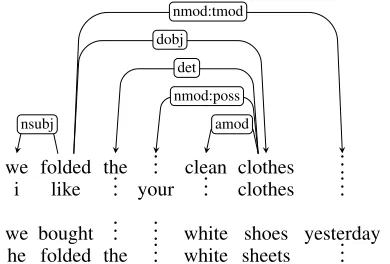
We dependency parse the raw sentences and, following Weir et al. (2016), align and aggregate the resulting parse trees according to their dependency type as shown in Figure 1. For example the lexeme clothes has the distributional features amod:dry anddobj:nsubj:weamong others. Over a large corpus, this results in a very high-dimensional and sparse vector space, which due to its typed nature is much sparser than for untyped models.
we folded the ... clean clothes ... i like ... your ... clothes ...
we bought ... ... white shoes yesterday he folded the ... white sheets ...
nsubj amod
det dobj
nmod:tmod
[image:3.612.89.284.383.515.2]nmod:poss
Figure 1: Aligned Packed Dependency Tree representation of the example sentences.
Composition with APTs
Composition is linguistically motivated by the prin-ciple of compositionality, which states that the meaning of a complex expression is fully deter-mined by its structure and the meanings of its con-stituents (Frege, 1884). Many simple approaches to semantic composition neglect the structure and lose information in the composition process. For exam-ple, the phrases house boat and boat house have the exact same representation when composition is done via a pointwise arithmetic operation. Despite
performing well in a number of studies, this com-mutativity is not desirable for a fine grained un-derstanding of the semantics of natural language. When performing composition with APTs, we adopt the method introduced by Weir et al. (2016) which views distributional composition as a process of con-textualisation. For composing the adjective white with the noun clothes via the dependency relation
amodwe need to consider how the adjective inter-acts with the noun in the vector space. The distri-butional features of white describe things that are white via their first order relations such as amod, and things that can be done to white things, such as boughtviaamod:dobjin the example above. Table 1 shows a number of features extracted from the aligned dependency trees in Figure 1 and high-lights that adjectives and nouns do not share many features if only first order dependencies would be considered. However through the inclusion of in-verse and higher order dependency paths we can ob-serve that the second order features of the adjective align with the first order features of the noun. For composition, the adjectivewhite needs to be offset by itsinverserelation toclothes1making it
distribu-tionally similar to a noun that has been modified by white. Offsetting can be seen as shifting the current viewpoint in the APTdata structure and is necessary for aligning the feature spaces for composition (Weir et al., 2016). We are then in a position to compose the offset representation ofwhitewith the vector for clothesby theunionor theintersectionof their fea-tures.
Table 2 shows the resulting feature spaces of the composed vectors. It is worth noting that any arith-metic operation can be used to combine the counts of the aligned features, however for this paper we use pointwise addition for both composition func-tions. One of the advantages of this approach to composition is that the inherent interpretability of count-based models naturally expands beyond the word level, allowing us to study the distributional se-mantics of phrases in the same space as words. Due to offsetting one of the constituents, the composition operation is not commutative and hence avoids iden-tical representations forhouse boatandboat house. However, the typed nature of our vector space
white clothes
Distributional Features Offset Features (byamod) Co-occurrence Count Distributional Features Co-occurrence Count
amod:shoes :shoes 1 amod:clean 1
amod:dobj:bought dobj:bought 1 dobj:like 1
[image:4.612.81.541.56.119.2]amod:dobj:folded dobj:folded 1 dobj:folded 1 amod:dobj:nsubj:we dobj:nsubj:we 1 dobj:nsubj:we 1
Table 1:Example feature spaces for the lexemeswhiteandclothesextracted from the dependency tree of Figure 1. Not all features are displayed for space reasons. Offsettingamod:shoesbyamodresults in an empty dependency path, leaving just the word co-occurrence:shoesas feature.
Composition byunion Composition byintersection
Distributional Features Co-occurrence Count Distributional Features Co-occurrence Count
:shoes 1
amod:clean 1
dobj:bought 1
dobj:folded 2 dobj:folded 2
dobj:like 1
[image:4.612.90.521.165.265.2]dobj:nsubj:we 2 dobj:nsubj:we 2
Table 2:Comparison of composition byunionand composition byintersection. Not all features are displayed for space reasons.
sults in extreme sparsity, for example while the un-typed VSM has 130k dimensions, our APT model can have more than 3m dimensions. We therefore need to enrich the elementary vector representations with the distributional information of their nearest neighbours to ease the sparsity effect and infer miss-ing information. Due to the syntactic nature of our composition operation it is not straightforward to apply common dimensionality reduction techniques such as SVD, as the type information needs to be preserved.
4 Distributional Inference
Following Dagan et al. (1994) and Dagan et al. (1997), we propose a simple unsupervised al-gorithm for enriching sparse vector representations with their nearest neighbours. We show that our distributional inference algorithm improves perfor-mance for untyped and typed models on several word similarity benchmarks, as well as being petitive with the state-of-the-art on semantic com-position. As shown in algorithm 1 below, we iter-ate over all word vectorswin a given distributional modelM, and add the vector representations of the nearest neighboursn, determined by cosine similar-ity, to the representation of the enriched word vector w0. The parameter α in line 4scales the
contribu-tion of the original word vector to the resulting en-riched representation. In this work we always chose α to be identical to the number of neighbours used
for distributional inference. For example, if we used 10neighbours for DI, we would setα = 10, which we found sufficient to prevent the neighbours from dominating the vector representation. In our exper-iments we kept the input distributional model fixed, however it is equally possible to update the given model in an online fashion, adding some amount of stochasticity to the enriched word vector repre-sentations. There is a number of possibilities for the neighbour retrieval functionneighbours()and we explore several options in this paper. The algo-rithm furthermore is agnostic to the input distribu-tional model, for example it is possible to use com-pletely different vector space models for querying neighbours and enrichment.
Algorithm 1Distributional Inference 1: procedureDIST INFERENCE(M) 2: initM0
3: for allwinM do
4: w0 ←w×α
5: for allninneighbours(M, w)do
6: w0 ←w0+n
7: addw0toM0
8: end for
9: end for
10: returnM0
Static TopnNeighbour Retrieval
The perhaps simplest way is to choose the top n most similar neighbours for each word in the vec-tor space and enrich the respective vecvec-tor represen-tations with them.
Density based Neighbour Retrieval
This approach has its roots in kernel density esti-mation (Parzen, 1962), however instead of defining a static global parzen window, we set the window size for every word individually, depending on the distance to its nearest neighbour, plus a threshold. For example if the cosine distance between the target vector and its top neighbour is0.5, we use a window size of0.5 +for that word. In our experiments we typically defineto be proportional to the distance of the nearest neighbour (e.g.= 0.5×0.1). WordNet based Neighbour Retrieval
Instead of leveraging the intrinsic structure of our distributional vector space, we retrieve neighbours by querying WordNet (Fellbaum, 1998), and treat synsets with agreeing PoS tags as the nearest neigh-bours of any target vector. This restricts the retrieved neighbours to synonyms only.
5 Experiments
Our model is based on a cleaned October 2013 Wikipedia dump, which excludes all pages with fewer than20 page views, resulting in a corpus of approximately 0.6 billion tokens (Wilson, 2015). The corpus is lowercased, tokenised, lemmatised, PoS tagged and dependency parsed with the Stan-ford NLP tools, using universal dependencies (Man-ning et al., 2014; de Marneffe et al., 2014). We then build our APTmodel with first, second and third or-der relations. We remove distributional features with a count of less than10, and vectors containing fewer than50non-zero entries. The raw counts are subse-quently transformed to PPMI weights. The untyped vector space model is built from the same lower-cased, tokenised and lemmatised Wikipedia corpus. We discard terms with a frequency of less than 50 and apply PPMI to the raw co-occurrence counts. Shifted PPMI
We explore a range of different values for shifting the PPMI scores as these have a significant impact
on the performance of the APT model. The effect of shifting PPMI scores for untyped vector space models has already been explored in Levy and Gold-berg (2014), and Levy et al. (2015), thus we only present results for the APT model. As shown in equation 1, PMI is defined as the log of the ratio of the joint probability of observing a word wand a contextctogether, and the product of the respec-tive marginals of observing them separately. In our APTmodel, a context cis defined as a dependency relation together with a word.
P M I(w, c) = log P(w, c)
P(w)P(c)
SP P M I(w, c) = max(P M I(w, c)−logk,0) (1)
As PMI is negatively unbounded, PPMI is used to ensure that all values are greater than or equal to 0. Shifted PPMI (SPPMI) subtracts a constant from any PMI score before applying the PPMI threshold. We experiment with values of1, 5,10,40 and100 for the shift parameterk.
5.1 Word Similarity Experiments
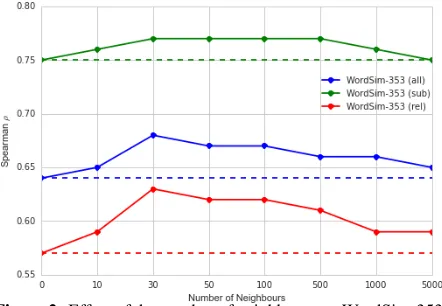
30. Performance slightly degrades with more neigh-bours. For the untyped VSM we use a symmetric window of5on either side of the target word.
Figure 2:Effect of the number of neighbours on WordSim-353.
Table 3 highlights the effect of the SPPMI shift parameter k, while keeping the number of neigh-bours fixed at 30 and using the static top n neigh-bour retrieval function. For the APTmodel, a value ofk = 40 performs best (except for SimLex-999, where smaller shifts give better results), with a per-formance drop-off for larger shifts. In our experi-ments we find that a shift ofk= 1results in top per-formance for the untyped vector space model. It ap-pears that shifting the PPMI scores in the APTmodel has the effect of cleaning the vectors from noisy PPMI artefacts, which reinforces the predominant sense, while other senses get suppressed. Sub-sequently, this results in a cleaner neighbourhood around the word vector, dominated by a single sense. This explains why distributional inference slightly degrades performance for smaller values ofk.
Table 4 shows that distributional inference suc-cessfully infers missing information for both model types, resulting in improved performance over mod-els without the use of DI on all datasets. The im-provements are typically larger for the APTmodel, suggesting that it is missing more distributional knowledge in its elementary representations than un-typed models. The density window and static topn neighbour retrieval functions perform very similar, however the static approach is more consistent and never underperforms the baseline for either model type on any dataset. The WordNet based neigh-bour retrieval function performs particularly well on SimLex-999. This can be explained by the fact that
antonyms, which frequently happen to be among the nearest neighbours in distributional vector spaces, are regarded as dissimilar in SimLex-999, whereas the WordNet neighbour retrieval function only re-turns synonyms. The results furthermore confirm the effect that untyped models perform better on datasets modellingrelatedness, whereas typed mod-els work better forsubstitutabilitytasks (Baroni and Lenci, 2011).
5.2 Composition Experiments
Our approach to semantic composition as described in section 3 requires the dimensions of our vector space models to be meaningful and interpretable. However, the problem of missing information is am-plified in compositional settings as many compati-ble dimensions between words are not observed in the source corpus. It is therefore crucial that dis-tributional inference is able to inject some of the missing information in order to improve the com-position process. For the experiments involving se-mantic composition, we enrich the elementary rep-resentations of the phrase constituents before com-position.
We first conduct a qualitative analysis for our APT model and observe the effect of distributional inference on the nearest neighbours of composed adjective-noun, noun-noun and verb-object com-pounds. In these experiments, we show how dis-tributional inference changes the neighbourhood in which composed phrases are embedded, and high-light the difference between composition by union and composition by intersection. For this exper-iment we use the static top n neighbour retrieval function with30neighbours andk= 40.
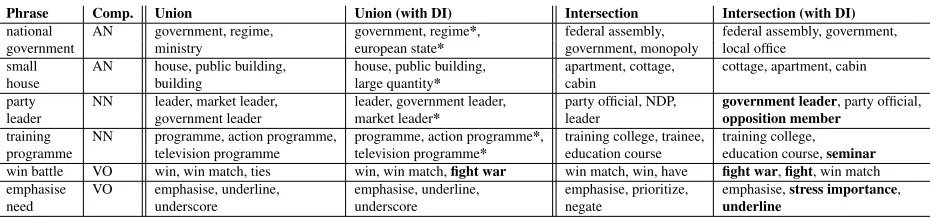
Table 5 shows a small number of example phrases together with their top 3 nearest neighbours, com-puted from the union of all words in the Wikipedia corpus and all phrase pairs in the Mitchell and La-pata (2010) dataset. As can be seen, nearest neigh-bours of phrases can be either single words or other composed phrases. Words or phrases marked with “*” in Table 5 mean that DI introduced, or failed to downrank, a spurious neighbour, while boldface means that performing distributional inference re-sulted in a neighbourhood more coherent with the query phrase than without DI.
APTs without DIMENwith DI without DISimLex-999with DI without DIWordSim-353 (rel)with DI without DIWordSim-353 (sub)with DI k= 1 0.54 0.52 0.31 0.30 0.34 0.27 0.62 0.60
k= 5 0.64 0.65 0.35 0.36 0.56 0.51 0.74 0.73
k= 10 0.63 0.66 0.35 0.36 0.56 0.55 0.75 0.74
[image:7.612.83.533.56.142.2]k= 40 0.63 0.68 0.30 0.32 0.55 0.61 0.75 0.76 k= 100 0.61 0.67 0.26 0.29 0.47 0.60 0.71 0.72
Table 3:Effect of the magnitude of the shift parameterkin SPPMI on the word similarity tasks. Boldface means best performance
per dateset.
APTs (k= 40) No Distributional Inference Density Window Static Topn WordNet
MEN 0.63 0.67 0.68 0.63
SimLex-999 0.30 0.32 0.32 0.38
WordSim-353 (rel) 0.55 0.62 0.61 0.56
WordSim-353 (sub) 0.75 0.78 0.76 0.77
Untyped VSM (k= 1) No Distributional Inference Density Window Static Topn WordNet
MEN* 0.71 0.71 0.71 0.71
SimLex-999 0.30 0.29 0.30 0.36
WordSim-353 (rel) 0.60 0.64 0.64 0.52
[image:7.612.91.527.180.300.2]WordSim-353 (sub) 0.70 0.73 0.72 0.67
Table 4: Neighbour retrieval function comparison. Boldface means best performance on a datasetperVSM type. *) With 3 significant figures, the density window approach (0.713) is slightly better than the baseline without DI (0.708), static topn(0.710) and WordNet (0.710).
downrank unrelated neighbours introduced by dis-tributional inference. For example large quantity is incorrectly introduced as a top ranked neighbour for the phrasesmall house, due to the proximity of small and large in the vector space. The phrases market leaderandtelevision programmeare two ex-amples of incoherent neighbours, which the compo-sition function was unable to downrank and where DI could not improve the neighbourhood. Compo-sition byintersectionon the other hand vastly ben-efits from distributional inference. Due to the in-creased sparsity induced by the composition pro-cess, a neighbourhood without DI produces numer-ous spurinumer-ous neighbours as in the case of the verb have as a neighbour for win battle. Distributional inference introduces qualitatively better neighbours for almost all phrases. For example, government leaderandopposition memberare introduced as top ranked neighbours for the phraseparty leader, and stress importance and underline are introduced as new top neighbours for the phraseemphasise need. These results show that composition byuniondoes not have the ability to disambiguate the meaning of a word in a given phrasal context, whereas composi-tion byintersectionhas that ability but requires
dis-tributional inference to unleash its full potential. For a quantitative analysis of distributional in-ference for semantic composition, we evaluate our model on the composition dataset of Mitchell and Lapata (2010), consisting of 108 adjective-noun, 108noun-noun, and108verb-object pairs. The task is to compare the model’s similarity estimates with the human judgements by computing Spearman’s ρ. For comparing the performance of the different neighbour retrieval functions, we choose the same parameter settings as in the word similarity experi-ments (k= 40and using30neighbours for DI).
Phrase Comp. Union Union (with DI) Intersection Intersection (with DI)
national AN government, regime, government, regime*, federal assembly, federal assembly, government, government ministry european state* government, monopoly local office
small AN house, public building, house, public building, apartment, cottage, cottage, apartment, cabin
house building large quantity* cabin
party NN leader, market leader, leader, government leader, party official, NDP, government leader, party official, leader government leader market leader* leader opposition member
training NN programme, action programme, programme, action programme*, training college, trainee, training college, programme television programme television programme* education course education course,seminar
win battle VO win, win match, ties win, win match,fight war win match, win, have fight war,fight, win match emphasise VO emphasise, underline, emphasise, underline, emphasise, prioritize, emphasise,stress importance,
[image:8.612.75.542.55.164.2]need underscore underscore negate underline
Table 5: Nearest neighbours AN, NN and VO pairs in the Mitchell and Lapata (2010) dataset, with and without distributional inference. Words and phrases marked with*denote spurious neighbours, boldfaced words and phrases mark improved neighbours.
inference, composition byuniondoes not appear to benefit from it.
Composition byUnionorIntersection
Both model types in this study support composition byunionas well as composition byintersection. In untyped models, composition by union and com-position by intersection can be achieved by point-wise addition and pointpoint-wise multiplication respec-tively. The major difference between composition in the APT model and the untyped model is that in the former, composition is not commutative due to offsetting the modifier in a dependency relation (see section 3). Blacoe and Lapata (2012) showed that an intersective composition function such as point-wise multiplication represents a competitive and ro-bust approach in comparison to more sophisticated composition methods. For the final set of experi-ments on the Mitchell and Lapata (2010) dataset, we present results the APT model and the untyped model, using composition by union and composi-tion byintersection, with and without distributional inference. We compare our models with the best performing untyped VSMs of Mitchell and Lap-ata (2010), and Blacoe and LapLap-ata (2012), the best performing APT model of Weir et al. (2016), as well as with the recently published state-of-the-art methods by Hashimoto et al. (2014), and Wieting et al. (2015), who are using neural network based approaches. For our models, we use the static top napproach as neighbour retrieval function and tune the remaining parameters, the SPPMI shiftk (1, 5, 10,40,100) and the number of neighbours (10,30, 50, 100, 500, 1000, 5000), for both model types, and the sliding window size for the untyped VSM (1,2,5), on the development portion of the Mitchell and Lapata (2010) dataset. We keep the vector
con-figuration (k and window size) fixed for all phrase types and only tune the number of neighbours used for DI individually. The best vector configuration for the APT model is achieved with k = 10 and for the untyped VSM withk= 1. For composition byintersectionbest performance on the dev set was achieved with1000neighbours for ANs,10for NNs and50for VOs with DI. For composition byunion, top performance was obtained with100neighbours for ANs, 30 neighbours for NNs and 50 for VOs. The best results for the untyped model on the dev set are achieved with a symmetric window size of1 and using5000neighbours for ANs,10for NNs and 1000for VOs with composition by pointwise multi-plication, and30neighbours for ANs,5000for NNs and5000for VOs for composition by pointwise ad-dition. The validated numbers of neighbours on the development set show that the problem of missing information appears to be more severe for seman-tic composition than for word similarity tasks. Even though a neighbour at rank1000or lower does not appear to have a close relationship to the target word, it still can contribute useful co-occurrence informa-tion not observed in the original vector.
APTs No Distributional Inferenceintersection union intersectionDensity Windowunion intersectionStatic Topunionn intersectionWordNetunion
Adjective-Noun 0.10 0.41 0.31 0.39 0.25 0.40 0.12 0.41
Noun-Noun 0.18 0.42 0.34 0.38 0.37 0.45 0.24 0.36
Verb-Object 0.17 0.36 0.36 0.36 0.34 0.35 0.25 0.36
Average 0.15 0.40 0.34 0.38 0.32 0.40 0.20 0.38
Table 6:Neighbour retrieval function. Underlined means best performance per phrase type, boldface means best average perfor-mance overall.
Model Adjective-Noun Noun-Noun Verb-Object Average
APT–union 0.45 (0.45) 0.45 (0.43) 0.38 (0.37) 0.43 (0.42)
APT–intersect 0.50 (0.38) 0.49 (0.44) 0.43 (0.36) 0.47 (0.39)
Untyped VSM –addition 0.46 (0.46) 0.40 (0.41) 0.38 (0.33) 0.41 (0.40)
Untyped VSM –multiplication 0.46 (0.42) 0.48 (0.45) 0.40 (0.39) 0.45 (0.42)
Mitchell and Lapata (2010) (untyped VSM &multiplication) 0.46 0.49 0.37 0.44
Blacoe and Lapata (2012) (untyped VSM &multiplication) 0.48 0.50 0.35 0.44
Hashimoto et al. (2014) (PAS-CLBLM &Addnl) 0.52 0.46 0.45 0.48 Wieting et al. (2015) (Paragram word embeddings &RNN) 0.51 0.40 0.50 0.47
[image:9.612.72.542.56.129.2]Weir et al. (2016) (APT&union) 0.45 0.42 0.42 0.43
Table 7:Results for the Mitchell and Lapata (2010) dataset. Results in brackets denote the performance of the respective models without the use of distributional inference. Underlined means best within group, boldfaced means best overall.
the APTmodel based on composition byunionand the untyped model based on composition by point-wise addition. The reason, as pointed out in the dis-cussion for Table 5, is that the composition function has no disambiguating effect and thus cannot elim-inate unrelated neighbours introduced by distribu-tional inference. An intersective composition func-tion on the other hand is able to perform the disam-biguation locally in any given phrasal context. This furthermore suggests that for the APTmodel it is not necessary to explicitly model different word senses in separate vectors, as composition by intersection is able to disambiguate any word in context individ-ually. Unlike the models of Hashimoto et al. (2014) and Wieting et al. (2015), the elementary word rep-resentations, as well as the representations for com-posed phrases and the composition process in our models are fully interpretable2.
6 Conclusion and Future Work
One of the major challenges in count-based mod-els is dealing with sparsity and missing information. To address this challenge, we contribute an unsu-pervised algorithm for enriching sparse word rep-resentations by exploiting the distributional neigh-bourhood. We have demonstrated its benefit to typed 2We release the APT vectors and our code athttps:// github.com/tttthomasssss/apt-toolkit.
and untyped vector space models on a range of tasks and have shown that with distributional inference our APTmodel is competitive with the state-of-the-art for adjective-noun, noun-noun and verb-object compositions while being fully interpretable. With our method, we are able to bridge the gap in perfor-mance between low-dimensional non-interpretable and high-dimensional interpretable representations. Lastly, we have investigated the different behaviour of composition byunionand composition by inter-section and have shown that an intersective com-position function, together with distributional in-ference, has the ability to locally disambiguate the meaning of a phrase.
In future work we aim to scale our approach to se-mantic composition with distributional inference to longer phrases and full sentences. We furthermore plan to investigate whether the number of neigh-bours required for improving elementary vector rep-resentations remains as high for other compositional tasks and longer phrases as in this study.
Acknowledgments
References
Eneko Agirre, Enrique Alfonseca, Keith Hall, Jana Kravalova, Marius Pasca, and Aitor Soroa. 2009. A study on similarity and relatedness using distributional and wordnet-based approaches. In Proceedings of
NAACL-HLT, pages 19–27, Boulder, Colorado, June.
Association for Computational Linguistics.
Marco Baroni and Alessandro Lenci. 2010. Distribu-tional memory: A general framework for corpus-based semantics. Computational Linguistics, 36(4):673– 721, December.
Marco Baroni and Alessandro Lenci. 2011. How we blessed distributional semantic evaluation. In
Pro-ceedings of GEMS Workshop, GEMS ’11, pages 1–10,
Stroudsburg, PA, USA. Association for Computational Linguistics.
Marco Baroni and Roberto Zamparelli. 2010. Nouns are vectors, adjectives are matrices: Representing adjective-noun constructions in semantic space. In
Proceedings of EMNLP, pages 1183–1193,
Cam-bridge, MA, October. Association for Computational Linguistics.
William Blacoe and Mirella Lapata. 2012. A com-parison of vector-based representations for semantic composition. InProceedings of EMNLP, pages 546– 556, Jeju Island, Korea, July. Association for Compu-tational Linguistics.
Elia Bruni, Nam Khanh Tran, and Marco Baroni. 2014. Multimodal distributional semantics. J. Artif. Int. Res., 49(1):1–47, January.
John A. Bullinaria and Joseph P. Levy. 2007. Extract-ing semantic representations from word co-occurrence statistics: A computational study. Behavior Research
Methods, pages 510–526.
John A. Bullinaria and Joseph P. Levy. 2012. Extract-ing semantic representations from word co-occurrence statistics: stop-lists, stemming, and svd. Behavior
Re-search Methods, 44(3):890–907.
Kenneth Ward Church and Patrick Hanks. 1990. Word association norms, mutual information, and lexicogra-phy. Computational Linguistics, 16(1):22–29, March. Bob Coecke, Mehrnoosh Sadrzadeh, and Stephen Clark. 2010. Mathematical foundations for a composi-tional distribucomposi-tional model of meaning. CoRR, abs/1003.4394.
James Curran. 2004. From Distributional to Semantic Similarity. Ph.D. thesis, University of Edinburgh. Ido Dagan, Fernando Pereira, and Lillian Lee. 1994.
Similarity-based estimation of word cooccurrence probabilities. InProceedings of ACL, pages 272–278, Las Cruces, New Mexico, USA, June. Association for Computational Linguistics.
Ido Dagan, Lillian Lee, and Fernando Pereira. 1997. Similarity-based methods for word sense disambigua-tion. InProceedings of ACL, pages 56–63, Madrid, Spain, July. Association for Computational Linguis-tics.
Marie-Catherine de Marneffe, Timothy Dozat, Natalia Silveira, Katri Haverinen, Filip Ginter, Joakim Nivre, and Christopher D. Manning. 2014. Universal stan-ford dependencies: A cross-linguistic typology. In
Proceedings of LREC, pages 4585–4592, Reykjavik,
Iceland, May. European Language Resources Associ-ation (ELRA). ACL Anthology Identifier: L14-1045. Scott Deerwester, Susan T. Dumais, George W. Furnas,
Thomas K. Landauer, and Richard Harshman. 1990. Indexing by latent semantic analysis. J. Amer. Soc. Inf. Sci., 41(6):391–407.
Katrin Erk and Sebastian Pad´o. 2008. A structured vector space model for word meaning in context. In
Proceedings of EMNLP, pages 897–906, Honolulu,
Hawaii, October. Association for Computational Lin-guistics.
Christiane Fellbaum, editor. 1998. WordNet: an elec-tronic lexical database. MIT Press.
Lev Finkelstein, Evgeniy Gabrilovich, Yossi Matias, Ehud Rivlin, Zach Solan, Gadi Wolfman, and Eytan Ruppin. 2001. Placing search in context: The concept revisited. InProceedings of WWW, WWW ’01, pages 406–414, New York, NY, USA. ACM.
Gottlob Frege. 1884. Die Grundlagen der Arithmetik: Eine logisch mathematische Untersuchung ¨uber den Begriff der Zahl. W. Koebner.
Edward Grefenstette, Georgiana Dinu, Yao-Zhong Zhang, Mehrnoosh Sadrzadeh, and Marco Baroni. 2013. Multi-step regression learning for composi-tional distribucomposi-tional semantics.Proceedings of IWCS. Gregory Grefenstette. 1994. Explorations in Automatic
Thesaurus Discovery. Kluwer Academic Publishers,
Norwell, MA, USA.
Kazuma Hashimoto, Pontus Stenetorp, Makoto Miwa, and Yoshimasa Tsuruoka. 2014. Jointly learning word representations and composition functions us-ing predicate-argument structures. InProceedings of
EMNLP, pages 1544–1555, Doha, Qatar, October.
As-sociation for Computational Linguistics.
Felix Hill, Roi Reichart, and Anna Korhonen. 2015. Simlex-999: Evaluating semantic models with (gen-uine) similarity estimation. Computational Linguis-tics, 41(4):665–695, December.
Phong Le and Willem Zuidema. 2015. The forest con-volutional network: Compositional distributional se-mantics with a neural chart and without binarization.
InProceedings of EMNLP, pages 1155–1164, Lisbon,
Portugal, September. Association for Computational Linguistics.
Omer Levy and Yoav Goldberg. 2014. Neural word em-bedding as implicit matrix factorization. In
Proceed-ings of NIPS, pages 2177–2185.
Omer Levy, Yoav Goldberg, and Ido Dagan. 2015. Im-proving distributional similarity with lessons learned from word embeddings. TACL, 3:211–225.
Dekang Lin. 1998. Automatic retrieval and clustering of similar words. InProceedings of ACL, pages 768– 774, Montreal, Quebec, Canada, August. Association for Computational Linguistics.
Kevin Lund and Curt Burgess. 1996. Producing high-dimensional semantic spaces from lexical co-occurrence. Behavior Research Methods, Instruments, & Computers, 28(2):203–208.
Christopher D. Manning, Mihai Surdeanu, John Bauer, Jenny Finkel, Steven J. Bethard, and David McClosky. 2014. The Stanford CoreNLP natural language pro-cessing toolkit. In Proceedings of ACL - System
Demonstrations, pages 55–60.
Tomas Mikolov, Ilya Sutskever, Kai Chen, Greg S Cor-rado, and Jeff Dean. 2013. Distributed representa-tions of words and phrases and their compositionality.
InProceedings of NIPS, pages 3111–3119.
Jeff Mitchell and Mirella Lapata. 2008. Vector-based models of semantic composition. InIn Proceedings of
ACL-08: HLT, pages 236–244.
Jeff Mitchell and Mirella Lapata. 2010. Composition in distributional models of semantics. Cognitive Science, 34(8):1388–1429.
Lili Mou, Hao Peng, Ge Li, Yan Xu, Lu Zhang, and Zhi Jin. 2015. Discriminative neural sentence modeling by tree-based convolution. InProceedings of EMNLP, pages 2315–2325, Lisbon, Portugal, September. Asso-ciation for Computational Linguistics.
Yoshiki Niwa and Yoshihiko Nitta. 1994. Co-occurrence vectors from corpora vs. distance vectors from dic-tionaries. In Proceedings of Coling, COLING ’94, pages 304–309, Stroudsburg, PA, USA. Association for Computational Linguistics.
Sebastian Pad´o and Mirella Lapata. 2007. Dependency-based construction of semantic space models. Compu-tational Linguistics, 33(2):161–199.
Sebastian Pad´o, Jan ˇSnajder, and Britta Zeller. 2013. Derivational smoothing for syntactic distributional se-mantics. In Proceedings of ACL, pages 731–735, Sofia, Bulgaria, August. Association for Computa-tional Linguistics.
Denis Paperno, Nghia The Pham, and Marco Baroni. 2014. A practical and linguistically-motivated ap-proach to compositional distributional semantics. In
Proceedings of ACL, pages 90–99, Baltimore,
Mary-land, June. Association for Computational Linguistics. Emanuel Parzen. 1962. On estimation of a probabil-ity densprobabil-ity function and mode. Ann. Math. Statist., 33(3):1065–1076, 09.
Jeffrey Pennington, Richard Socher, and Christopher Manning. 2014. Glove: Global vectors for word rep-resentation. InProceedings of EMNLP, pages 1532– 1543, Doha, Qatar, October. Association for Compu-tational Linguistics.
Magnus Sahlgren. 2006. The Word-space model. Ph.D. thesis, University of Stockholm (Sweden).
Silke Scheible, Sabine Schulte im Walde, and Sylvia Springorum. 2013. Uncovering distributional dif-ferences between synonyms and antonyms in a word space model. InProceedings of IJCNLP, pages 489– 497, Nagoya, Japan, October. Asian Federation of Nat-ural Language Processing.
Richard Socher, Brody Huval, Christopher D. Manning, and Andrew Y. Ng. 2012. Semantic compositionality through recursive matrix-vector spaces. In
Proceed-ings of EMNLP, pages 1201–1211, Jeju Island, Korea,
July. Association for Computational Linguistics. Kai Sheng Tai, Richard Socher, and Christopher D.
Manning. 2015. Improved semantic representa-tions from tree-structured long short-term memory networks. InProceedings of ACL, pages 1556–1566, Beijing, China, July. Association for Computational Linguistics.
Stefan Thater, Hagen F¨urstenau, and Manfred Pinkal. 2010. Contextualizing semantic representations using syntactically enriched vector models. InProceedings
of ACL, pages 948–957, Uppsala, Sweden, July.
Asso-ciation for Computational Linguistics.
Stefan Thater, Hagen F¨urstenau, and Manfred Pinkal. 2011. Word meaning in context: A simple and effec-tive vector model. InProceedings of IJCNLP, pages 1134–1143, Chiang Mai, Thailand, November. Asian Federation of Natural Language Processing.
Peter D. Turney and Patrick Pantel. 2010. From fre-quency to meaning: Vector space models of semantics.
J. Artif. Int. Res., 37(1):141–188, January.
Julie Weeds, David Weir, and Jeremy Reffin. 2014. Distributional composition using higher-order depen-dency vectors. In Proceedings of the 2nd Workshop on Continuous Vector Space Models and their Compo-sitionality, pages 11–20, Gothenburg, Sweden, April. Association for Computational Linguistics.
a theory of composition for distributional seman-tics. Computational Linguistics, in press (http: //arxiv.org/abs/1608.07115).
John Wieting, Mohit Bansal, Kevin Gimpel, and Karen Livescu. 2015. From paraphrase database to composi-tional paraphrase model and back.TACL, 3:345–358. Benjamin Wilson. 2015. The unknown perils of
mining wikipedia. https://blog.lateral.io/2015/06/the-unknown-perils-of-mining-wikipedia/, June.