Proceedings of the 2019 Conference on Empirical Methods in Natural Language Processing
718
Fine-Grained Evaluation for Entity Linking
Henry Rosales-M´endez, Aidan Hogan, Barbara Poblete
IMFD Chile & Department of Computer Science, University of Chile
{hrosales,ahogan,bpoblete}@dcc.uchile.cl
Abstract
The Entity Linking (EL) task identifies entity mentions in a text corpus and associates them with an unambiguous identifier in a Knowl-edge Base. While much work has been done on the topic, we first present the results of a survey that reveal a lack of consensus in the community regarding what forms of men-tions in a text and what forms of links the EL task should consider. We argue that no one definition of the Entity Linking task fits all, and rather propose a fine-grained cate-gorization of different types of entity men-tions and links. We then re-annotate three EL benchmark datasets – ACE2004, KORE50, and VoxEL – with respect to these categories. We propose a fuzzy recall metric to address the lack of consensus and conclude with fine-grained evaluation results comparing a selec-tion of online EL systems.
1 Introduction
Entity Linking (EL) is an Information Extraction task whose goal is to identify mentions of entities in a text and to link each mention to an unambigu-ous identifier in a Knowledge Base (KB) such as Wikipedia, BabelNet (Moro et al., 2014), DBpe-dia (Lehmann et al., 2015), Freebase (Bollacker et al., 2008), Wikidata (Vrandeˇci´c and Kr¨otzsch,
2014) or YAGO (Rebele et al., 2016) (among others). The results of this task offer a practi-cal bridge between unstructured text and struc-tured KBs, where EL has applications for semantic search, document classification, relation extrac-tion, and more besides (Wu et al.,2018).
While a broad number of EL techniques and systems have been proposed in recent years (Wu et al.,2018), a number of authors have noted that there is a lack of consensus on the fundamental question of what kinds of mentions in a text an EL system should link to which identifiers in the
KB (Ling et al.,2015;Waitelonis et al.,2016;Jha et al.,2017;Rosales-M´endez et al.,2018b).
A closely related task to EL is that of Named Entity Recognition (NER), which identifies men-tions of (named) entities in a task, but without link-ing the mention with a KB identifier. The types of entities that the NER task should target were defined at the Message Understanding Confer-ence 6 (MUC-6) (Grishman and Sundheim,1996), specifically entities corresponding to types such as Person, Organization, Place and other Numer-ical/Temporal expressions. While this provided a consensus for evaluating NER systems, some au-thors noted that such a categorization is coarse-grained and proposed finer-coarse-grained classification mechanisms (Fleischman and Hovy,2002).
In the context of EL, target Knowledge Bases will often contain entities from a wide variety of classes, including Movies, Products, Events, Laws, etc., not considered by the traditional NER definitions; a dataset such as Wikidata has around 50,000 entity classes, for example. As a result, class-based definitions of entities are restrictive. Hence some authors have proposed more general definitions for the EL task: asLing et al. (2015) note, while some authors follow traditional NER definitions, others propose a looser definition that any KB identifier (e.g., Wikipedia article URL) can be the target for a link; they further note that within these definitions there is a lack of guide-lines with respect to how EL datasets should be labeled and what sorts of mentions and links EL systems should (ideally) offer.
This ambiguity complicates research and ap-plications relating to EL, as highlighted previ-ously by various authors (Ling et al., 2015; Jha et al.,2017;Rosales-M´endez et al.,2018b). Fig-ure 1 shows the results of a selection of pop-ular online EL systems: Babelfy (Moro et al.,
FRED (Gangemi et al., 2017) and TagME ( Fer-ragina and Scaiella,2010). We see significant dif-ferences in the annotations provided, which we ar-gue are due not only to differing precision/recall of the systems, but also to differing policies on is-sues such as overlapping entities (should “Michael Jackson” be annotated within the documentary ti-tle), common/named entities (should “interview” be linked to the corresponding Wikipedia article
wiki:Interview), and more besides. With such varying perspectives on the EL task, it is not clear how we should define gold standards that offer a fair comparison of tools (Ling et al.,2015).
The standard approach to tackle this issue has been to make certain design choices explicit, such as to enforce a particular policy with respect to overlapping mentions, or common entities, etc., when labeling an EL dataset or performing evalua-tion. However, the appropriate policy may depend on the particular application, setting, etc. In this paper we pursue an alternative approach, which is to embrace different perspectives of the EL task, proposing a fine-grained categorization of differ-ent types of EL mdiffer-entions and links, and then re-annotating three existing datasets with respect to these categories, allowing us to compare the per-formance of EL tools within the different cate-gories. Specifically, our contributions are as fol-lows (indicating also the relevant section):
§2 We design and present the results of a ques-tionnaire addressed to authors of EL papers intended to understand the consensus (or lack thereof) regarding the goals of the EL task.
§3 We argue that no one definition of an en-tity mention/link fits all, and hence propose a fine-grained categorization scheme for the EL task covering details regarding base form, part of speech, overlap, and reference type.
§4 We relabel three existing EL datasets – ACE2004 (subset), KORE50 and VoxEL – per our novel categorization scheme, extend-ing the set of annotations as appropriate.
§5 We conduct a fine-grained evaluation of the performance of five EL systems with respect to individual categories of EL annotations.
§6 Addressing the lack of consensus, we pro-pose a fuzzy recall andF1measure based on a configurable membership function, present-ing results for the five EL systems.
In an [interview]td with [Martin Bashir]btf for the 2003 [documentary]td [Living with {Michael
Jackson}bd]btf, the King of [Pop]d recalled that
[Joe]t often sat with a white belt at hand as he and his four [siblings]tdrehearsed.
Figure 1: Output annotations made by four different systems – Babelfy (b), TagME (t), DBpedia Spotlight (d) and FRED (f) – on the same input text.
§7 We present conclusions about the perfor-mance of the EL systems surveyed for differ-ent types of differ-entity mdiffer-entions/links and high-light open challenges for the EL task.
2 Questionnaire: Lack of Consensus
To understand what consensus (or lack thereof) ex-ists within the EL community regarding the EL task, we designed a concise questionnaire with two sentences for which we proposed a variety of EL annotations, providing the text, the annotated text mentions, and proposed links to the respective Wikipedia articles. The two sentences – shown in Figure2 (with a summary of results that will be described presently) – were designed to exemplify the types of design choices that vary from author to author (Ling et al.,2015); specifically, we target the following questions:
1. Entity types: should types not typically con-sidered under MUC-6 definitions (other than as MISC) be linked (e.g., linking Living with Michael Jacksonto the corresponding Wikipedia article)?
2. Overlapping mentions: should mentions inside other mentions be annotated (e.g.,
Michael Jackson)?
3. Common entities: should common nouns be annotated (e.g.,documentary)?
4. Parts of speech: should only nouns be anno-tated or should other parts of speech also be linked (e.g.,reportsorwhite)?
In an [interview].19with [Martin Bashir]1for the [2003].28[documentary].28[Living with{Michael Jackson}.75
].97, the [{King}.08
of {Pop}.33
].94 [recalled].06 that [Joe]1 often [sat].08 with a [white].11 [belt].14 at [hand].14 as [{he}.56
and{his}.39{
four}.08 {
siblings}.14
].50[rehearsed].08.
[Russian].61 [daily].14 [Kommersant].97 [reports].06 that [Moscow].94will [supply].06the [Greeks].94 with [gas].36
at [{rock}0bottom{prices}.19].28as [Tsipras].92[prepares].03to [meet].06the [{Russian}.53{President}.12].97.
Figure 2: The sentences included in the questionnaire and the ratio of respondents who suggested to annotate the mentions. Multiple links were proposed for the mentions underlined (see Table1).
6. Link types: should mentions link to the explicitly named entity (e.g., linking
Moscow to wiki:Moscow), or should complex forms of reference such as meronymy (e.g., linking Moscow to
wiki:Government of Russia), hypernymy (e.g., linking daily to wiki:Newspaper
as the closest entity present in the KB, or linking Russian President to
wiki:Vladimir Putin), or metaphor (e.g., linkingKingtowiki:King) be considered?
For each sentence, respondents were asked to select the mentions and links that they consider an EL system shouldideallyprovide; specifically, they were presented an optional multiple choice question for each mention: the option to select one (or more, in underlined cases) suggested links, and the option to not annotate the mention. In order to address this survey to the EL research community, we extracted the emails of all papers referenced in the recent survey byWu et al.(2018) that are di-rectly related to EL. We sent the questionnaire to 321 researchers, of which 232 requests were de-livered successfully. We received a total of 36 re-sponses. Aggregated responses are available on-line1, where in Figure 2 we provide a summary of results, indicating in superscript the ratio of re-spondents who agreed to some link being provided for the given mention.
First we see that the only mentions that all 36 respondents agreed should be linked are Martin BashirandJoe, which are traditional MUC types, non-overlapping, named entities, with direct men-tions and links; on the other hand, there was also consensus that rock should not be linked. Oth-erwise, all other mentions showed some level of disagreement. Regarding our questions:
1. Entity types: perLiving with Michael
Jack-1https://users.dcc.uchile.cl/∼hrosales/
questionnaire
son(0.97), the vast majority of respondents do not restrict to non-MISCMUC types.
2. Overlapping mentions: perMichael Jackson
(0.75), most respondents also allow mentions contained in other mentions.
3. Common entities: most respondents do not consider common entities, with the highest response appearing fordocumentary(0.28).
4. Parts of speech: the consensus was mostly that EL should focus on nouns, with his
(0.39) andwhite(0.11) being the most popu-larly selected non-nouns.
5. Mention types: here there was a notable split, with he (0.56) and he and his four sib-lings(0.5)2 being selected for annotation by roughly half of the respondents.
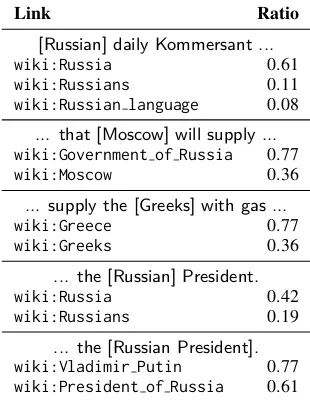
6. Link types: for this we introduce Table 1, where we see how respondents preferred dif-ferent types of reference (respondents could select multiple options); from this we con-clude that although respondents preferred to use a country directly to represent national-ity, they also preferred to resolve complex types of reference, such as the meronymic use of Moscow to refer to the government rather than the city, and the use of Putin’s title to refer to him rather than the title itself.
So who is correct? We argue that there is no “correct” answer here. Common entities may, for example, rather be considered the target of a sep-arate Word Sense Disambiguation task (Navigli,
2009), while pro-forms may be considered the tar-get of a separate Coreference/Anaphora Resolu-tion task (Sukthanker et al.,2018); these are mat-ters of convention. In more practical terms, the
2One respondent noted that it was not certain that this
Table 1: Links for mentions with multiple choices in Figure2and the ratio of respondents selecting that link
Link Ratio
[Russian] daily Kommersant ...
wiki:Russia 0.61
wiki:Russians 0.11
wiki:Russian language 0.08
... that [Moscow] will supply ... wiki:Government of Russia 0.77
wiki:Moscow 0.36
... supply the [Greeks] with gas ...
wiki:Greece 0.77
wiki:Greeks 0.36
... the [Russian] President.
wiki:Russia 0.42
wiki:Russians 0.19
... the [Russian President]. wiki:Vladimir Putin 0.77
wiki:President of Russia 0.61
importance of each individual EL annotation may vary from application to application; for exam-ple, for relation extraction, it may be important to identify all repeated mentions of an entity (as each such mention may lie within a distinct rela-tion), while for semantic search having repeated mentions may be less critical (a subset of mentions may suffice to know the document is relevant for a given entity). We propose that no one definition of the EL task fits all, and rather propose a catego-rization that covers different perspectives.
3 Categorization Scheme
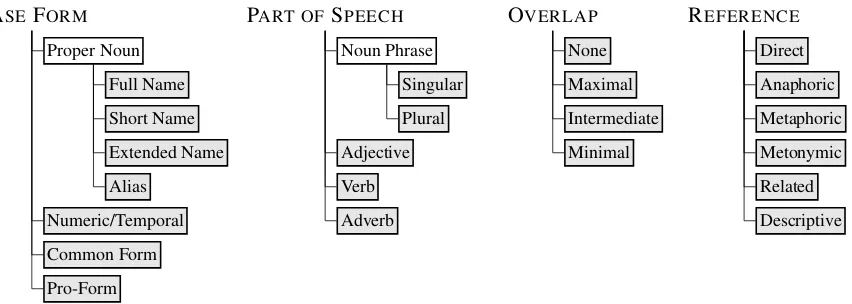
Inspired by the results of the questionnaire and related discussion by Ling et al. (2015), among other authors, in Figure 3 we propose a catego-rization scheme aiming to capture and organize these diverse perspectives on the EL task. This scheme makes explicit the types ofannotations– mention–link pairs – that can be considered when annotating EL datasets, or when developing, eval-uating and applying EL systems. The categoriza-tion scheme has four dimensions:Base Form,Part of Speech, Overlap and Reference. We propose that each EL annotation be labeled with precisely one leaf-node from each dimension. Our objec-tive with this categorization is not to imply that all types of annotationsshouldbe considered as part of the EL task, but rather to map out the types of annotations thatcouldbe considered for EL.
3.1 Base Form
TheBase Formconsiders the type of mention: is it a name, a common noun, a number, a date, etc.
We separate Proper Noun into more specific categories that deal with the difference between mentions and KB labels: Full Name, Short Name, Extended Name andAlias. The first three should be tagged when the mentions are equal (Michael Jackson), shorter (Jackson) or longer (Michael Joseph Jackson), respectively, than the primary label of their corresponding KB-entity (wiki:Michael Jackson). On the other hand, Aliasis used for mentions that vary from the pri-mary label of the KB (King of Pop).
Numeric/Temporal are mentions that refer to a number or a given temporal concept (e.g.,1,1900,
first, October, July 07, Tuesday, 2018/01/32, etc.). Such mentions were included in the MUC-6 definition and some such expressions have cor-responding Wikipedia articles. The next category isPro-form, which includes any pronoun (he,his, etc.) referring to a named entity elsewhere. The final category isCommon Form, which refers to a common word, such asdocumentary,sat, etc., or a noun-phrase referring to a named entity with a common head term, e.g.,he and his four siblings.
3.2 Part of Speech
Part of Speech denotes the grammatical function of a word in a sentence, where we include four high-level classes for which we have found in-stances that could be linked to the Wikipedia KB (without referring to their own syntactic form). As we have already discussed, the most common target for EL is Noun Phrases; we divide these into Singular and Pluralfor additional granular-ity. However, we also include Verbs (e.g., di-vorcing, metastasized), Adjectives (e.g., anaero-bic,French) andAdverbs (e.g.,polynomially, So-cratically) for linking to the Knowledge Base.
3.3 Overlap
BASE FORM
Proper Noun
Full Name
Short Name
Extended Name
Alias
Numeric/Temporal
Common Form
Pro-Form
PART OFSPEECH
Noun Phrase
Singular
Plural
Adjective
Verb
Adverb
OVERLAP
None
Maximal
Intermediate
Minimal
REFERENCE
Direct
Anaphoric
Metaphoric
Metonymic
Related
[image:5.595.94.520.61.213.2]Descriptive
Figure 3: EL categorization scheme with concrete alternatives (leaf-nodes) shaded for each dimension
3.4 Reference
The Reference dimension considers the relation between the mention and the linked entity. The topic of reference is a complex one that has been the subject of much attention over many decades (Strawson, 1950); here we propose a pragmatic but comprehensive set of options.
The Direct category considers a direct explicit mention of an entity based on a known KB la-bel/alias, such as M. Jackson or the King of Popforwiki:Michael Jackson ordivorcingfor
wiki:Divorce. Anaphoric denotes a reference to an antecedent (or postcedent) for pro-forms such as he or her that are coreferent with a named entity. Metaphoriccaptures figurative ref-erences to entities whose characteristics are re-ferred to, such as He is a pool [shark] linking towiki:Shark. Metonymicindicates reference by common association, such as usingMoscowto re-fer towiki:Government of Russiaor usingPeru
to refer towiki:Peru national football team. Related is used when only a near-synonym, hy-pernym or hyponym is available for a men-tion in the KB, such as the Russian [daily] be-ing linked to wiki:Newspaper.3 Finally, De-scriptive is used for (non-pro, non-proper) refer-ring noun-phrases, such as his father referring to wiki:Joe Jackson; unlike similar Anaphoric references, Descriptive references do not nec-essarily rely on an antecedent to be disam-biguated, as per the case ofHendix’s band refer-ring to wiki:The Jimi Hendrix Experience or
Fiji’s capital referring to wiki:Suva without re-quiring further context to disambiguate.
3Wikipedia will often redirect from a term to a related
arti-cle; for example,wiki:Daily newspapercurrently redirects towiki:Newspaper.
4 Fine-Grained Datasets
A wide variety of EL datasets have been pro-posed (e.g., ACE2004 (Ratinov et al., 2011), KORE50 (Hoffart et al.,2012), MEANTIME ( Mi-nard et al., 2016), DBpedia Spotlight (Mendes et al., 2011), VoxEL (Rosales-M´endez et al.,
2018a)) to support EL quality measurement. How-ever, often the guidelines followed in the annota-tion process are left implicit, such as the inclu-sion/exclusion of overlapping mentions, common entities, etc. Furthermore, different types of enti-ties are not distinguished.
dif-ferences, leading to further discussion and refine-ments in the categorization. Ambiguities and dis-agreements were iteratively resolved by the au-thors through discussion and modification of the categories. The resulting datasets reflect the con-sensus of the authors. The categorization scheme shown in Figure 3 is also a result of this pro-cess, where we iteratively extended and refined these categories as we encountered specific cases in these datasets; as a result, these categories suf-fice to cover all cases of possible mentions of Wikipedia entities in the datasets.
The labeling process was extremely time con-suming (taking place over six months) due to the large number of annotations generated, particu-larly for common-form mentions; for this reason, in the case of ACE2004, we only annotate 20 doc-uments (from a total of 57) wherein, for example, the number of annotations increases from 108 in the original data to 3,351 in our fine-grained ver-sion4. Per MUC-6, we also include emerging/not-in-lexicon entities and entity types in our annota-tions. Additionally, we label some mentions with multiple alternatives (per Table1).
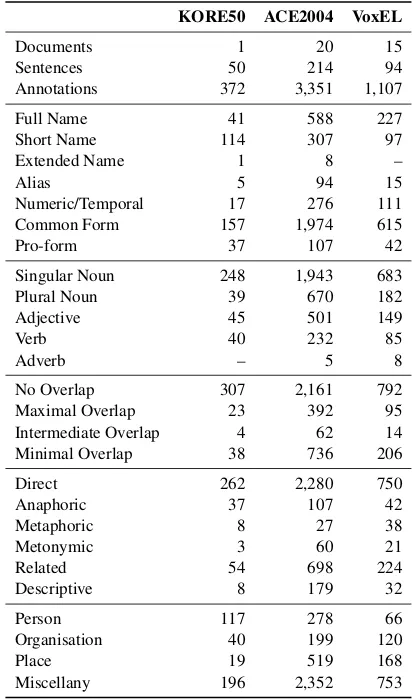
In Table 2 we summarize details of the recon-structed version of these three datasets, includ-ing the number of documents, sentences and an-notations. Except for the case of ACE2004, our re-annotated datasets maintain the same text col-lection as in the original version. For each cat-egory, we also show the number of annotations tagged with it. The most frequent annotations are those that belong toCommon Form, Singular Noun,Non-OverlappingandDirectcategories.
In the final iteration, we perform validation checking for erroneous links avoiding invalid, redirect and disambiguation pages; erroneous cat-egorizations, e.g., multiple tags in the same cate-gory; erroneous mentions, such as trailing spaces; etc. During this process, we also encountered and resolved numerous issues with the original datasets; of note, in ACE2004 we found various spelling errors of entity names, e.g.,Stewart Tal-botas a misspelling ofStrobe Talbott,Coral Is-landsas a misspelling ofKuril Islands, etc.
5 Fine-Grained Evaluation
Our fine-grained datasets allow us to understand the performance of EL systems in more detail
re-4https://github.com/henryrosalesmendez/
[image:6.595.312.518.84.434.2]categorized EMNLP datasets
Table 2: Content of relabeled datasets
KORE50 ACE2004 VoxEL
Documents 1 20 15
Sentences 50 214 94
Annotations 372 3,351 1,107
Full Name 41 588 227
Short Name 114 307 97
Extended Name 1 8 –
Alias 5 94 15
Numeric/Temporal 17 276 111
Common Form 157 1,974 615
Pro-form 37 107 42
Singular Noun 248 1,943 683
Plural Noun 39 670 182
Adjective 45 501 149
Verb 40 232 85
Adverb – 5 8
No Overlap 307 2,161 792
Maximal Overlap 23 392 95
Intermediate Overlap 4 62 14
Minimal Overlap 38 736 206
Direct 262 2,280 750
Anaphoric 37 107 42
Metaphoric 8 27 38
Metonymic 3 60 21
Related 54 698 224
Descriptive 8 179 32
Person 117 278 66
Organisation 40 199 120
Place 19 519 168
Miscellany 196 2,352 753
garding different types of EL annotations. In Ta-ble3, we present the Precision (P), Recall (R) and
F1 score (F1) for five popular EL systems with online APIs: Babelfy (B), TagME (T), DBpedia Spotlight (D), AIDA (A) and FREME (F). In the case of Babelfy, we consider both settings: strict, which excludes common entities (Bs); and re-laxed, which includes common entities (Br). Re-sults are shown for subsets of annotations corre-sponding to a particular category (A), where we also present the number of unique mentions for annotations of that category (|A|). Recall that our gold standard may have multiple annotations for a single mention in the gold standard, listing differ-ent possible links for an individual mdiffer-ention (see, e.g., Table1); on the other hand, evaluated systems predict a single link for each mention. We thus evaluate annotations on a mention-by-mention ba-sis.5 We consider a predicted mention to be atrue positiveif it is included inAand the predicted link
5While a mention can only appear in one P
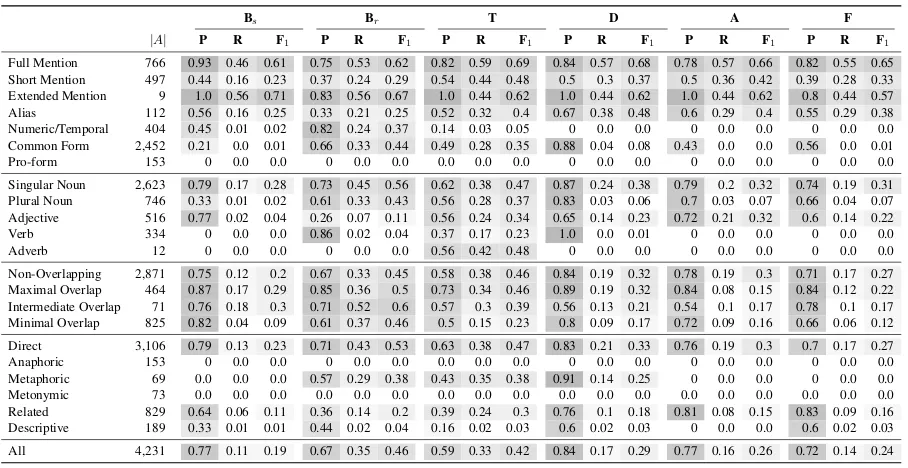
Table 3: Results for Babelfy (strict/relaxed), TagME, DBpedia Spotlight, AIDA and FREME on the unified dataset.
Bs Br T D A F
|A| P R F1 P R F1 P R F1 P R F1 P R F1 P R F1
Full Mention 766 0.93 0.46 0.61 0.75 0.53 0.62 0.82 0.59 0.69 0.84 0.57 0.68 0.78 0.57 0.66 0.82 0.55 0.65 Short Mention 497 0.44 0.16 0.23 0.37 0.24 0.29 0.54 0.44 0.48 0.5 0.3 0.37 0.5 0.36 0.42 0.39 0.28 0.33 Extended Mention 9 1.0 0.56 0.71 0.83 0.56 0.67 1.0 0.44 0.62 1.0 0.44 0.62 1.0 0.44 0.62 0.8 0.44 0.57 Alias 112 0.56 0.16 0.25 0.33 0.21 0.25 0.52 0.32 0.4 0.67 0.38 0.48 0.6 0.29 0.4 0.55 0.29 0.38 Numeric/Temporal 404 0.45 0.01 0.02 0.82 0.24 0.37 0.14 0.03 0.05 0 0.0 0.0 0 0.0 0.0 0 0.0 0.0 Common Form 2,452 0.21 0.0 0.01 0.66 0.33 0.44 0.49 0.28 0.35 0.88 0.04 0.08 0.43 0.0 0.0 0.56 0.0 0.01 Pro-form 153 0 0.0 0.0 0 0.0 0.0 0.0 0.0 0.0 0 0.0 0.0 0 0.0 0.0 0 0.0 0.0
Singular Noun 2,623 0.79 0.17 0.28 0.73 0.45 0.56 0.62 0.38 0.47 0.87 0.24 0.38 0.79 0.2 0.32 0.74 0.19 0.31 Plural Noun 746 0.33 0.01 0.02 0.61 0.33 0.43 0.56 0.28 0.37 0.83 0.03 0.06 0.7 0.03 0.07 0.66 0.04 0.07 Adjective 516 0.77 0.02 0.04 0.26 0.07 0.11 0.56 0.24 0.34 0.65 0.14 0.23 0.72 0.21 0.32 0.6 0.14 0.22 Verb 334 0 0.0 0.0 0.86 0.02 0.04 0.37 0.17 0.23 1.0 0.0 0.01 0 0.0 0.0 0 0.0 0.0 Adverb 12 0 0.0 0.0 0 0.0 0.0 0.56 0.42 0.48 0 0.0 0.0 0 0.0 0.0 0 0.0 0.0
Non-Overlapping 2,871 0.75 0.12 0.2 0.67 0.33 0.45 0.58 0.38 0.46 0.84 0.19 0.32 0.78 0.19 0.3 0.71 0.17 0.27 Maximal Overlap 464 0.87 0.17 0.29 0.85 0.36 0.5 0.73 0.34 0.46 0.89 0.19 0.32 0.84 0.08 0.15 0.84 0.12 0.22 Intermediate Overlap 71 0.76 0.18 0.3 0.71 0.52 0.6 0.57 0.3 0.39 0.56 0.13 0.21 0.54 0.1 0.17 0.78 0.1 0.17 Minimal Overlap 825 0.82 0.04 0.09 0.61 0.37 0.46 0.5 0.15 0.23 0.8 0.09 0.17 0.72 0.09 0.16 0.66 0.06 0.12
Direct 3,106 0.79 0.13 0.23 0.71 0.43 0.53 0.63 0.38 0.47 0.83 0.21 0.33 0.76 0.19 0.3 0.7 0.17 0.27 Anaphoric 153 0 0.0 0.0 0 0.0 0.0 0.0 0.0 0.0 0 0.0 0.0 0 0.0 0.0 0 0.0 0.0 Metaphoric 69 0.0 0.0 0.0 0.57 0.29 0.38 0.43 0.35 0.38 0.91 0.14 0.25 0 0.0 0.0 0 0.0 0.0 Metonymic 73 0.0 0.0 0.0 0.0 0.0 0.0 0.0 0.0 0.0 0.0 0.0 0.0 0.0 0.0 0.0 0.0 0.0 0.0 Related 829 0.64 0.06 0.11 0.36 0.14 0.2 0.39 0.24 0.3 0.76 0.1 0.18 0.81 0.08 0.15 0.83 0.09 0.16 Descriptive 189 0.33 0.01 0.01 0.44 0.02 0.04 0.16 0.02 0.03 0.6 0.02 0.03 0 0.0 0.0 0.6 0.02 0.03
All 4,231 0.77 0.11 0.19 0.67 0.35 0.46 0.59 0.33 0.42 0.84 0.17 0.29 0.77 0.16 0.26 0.72 0.14 0.24
corresponds to any of the possible links given by
Afor that mention. We consider a predicted men-tion to be a false positiveif the mention is given byA, but the predicted link is not given byAfor that mention; in other words, when restrictingA
by category, system annotations on mentions out-side ofAare ignored.6 Finally we consider a men-tion to be a false negative if it is given byA but either the mention is not predicted by the system or the system predicts a link not given by A for tht mention. We also show the overall result in the final row considering the full gold standard. The results consider a unified dataset that concatenates all three datasets. Better results (closer to 1) are shaded darker to aid with visual comparison.
Comparing the different types of annotations, on a high-level, we can see that recall, in particu-lar, varies widely across categories; unsurprisingly perhaps, systems, in general, exhibit higher recall for proper nouns (particularly full and extended names) with direct references. Looking at cate-gories with poor results, we see that none of the evaluated systems consider anaphoric references, perhaps considered as a task distinct from EL. In-terestingly, no system captures metonymic refer-ences, though as previously seen the results of our questionnaire (see Table 1) indicate that respon-dents prefer such types of links over their literal counterparts (e.g., linking Moscow in the given
6If a system predicts a link present in the gold standard for
the mention but with a different category than tested, it will thus be considered a false positive for the tested category.
context withwiki:Government of Russiarather thanwiki:Moscow). Comparing systems, Babelfy (relaxed) and TagME achieve much higher recall for common forms than the other systems: we attribute this to these systems making the design choice to additionally support common entities.
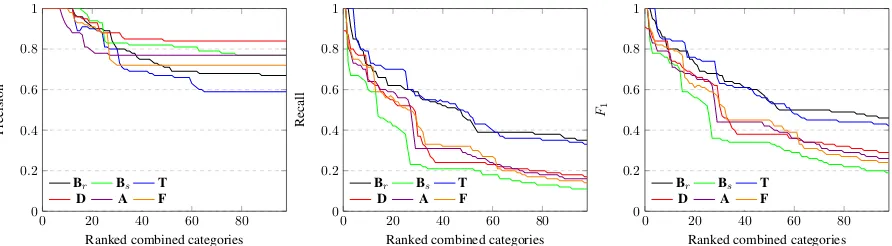
While the previous results consider dimensions independently, there are 7 ×5 ×4 ×6 = 840
0 20 40 60 80 0
0.2 0.4 0.6 0.8 1
Ranked combined categories
Precision
Br Bs T
D A F
0 20 40 60 80
0 0.2 0.4 0.6 0.8 1
Ranked combined categories
Recall
Br Bs T
D A F
0 20 40 60 80
0 0.2 0.4 0.6 0.8 1
Ranked combined categories
F1
Br Bs T
[image:8.595.79.525.63.186.2]D A F
Figure 4: Cumulative results for Babelfy (relaxed/strict), TagME, DBpedia Spotlight, AIDA and FREME for the unified dataset over ranked combinations of categories
6 Fuzzy Recall andF1 Measures
While the previous results provide insights into different design choices taken by different systems with respect to different types of EL annotations, still, per Table1, the results are perhapstoo fine-grained. For the purposes of comparing the per-formance of systems, we may rather prefer a mea-sure that aggregates performance across different categories. However, this presents a conceptual problem: for some applications or definitions of the EL task, certain categories may be considered more important than others. For instance, should we penalize a system equally for missing the an-notations gasand Tspirasin the second sentence of Figure2? In most EL settings, the former is ar-guably less important than the latter, but nonethe-less it may depend on the setting.
Reflecting the lack of consensus for the EL task, we rather propose a measure inspired by Fuzzy Set Theory (Zadeh, 1965): given a universe of ele-ments U and a particular element x ∈ U, rather than considering traditionalcrisp setsA with bi-nary membership (where x ∈ A or x 6∈ A), a fuzzy set A∗ is associated with a membership functionµA∗ :U →[0,1], which denotes the
de-gree to which an element x is a member of A∗
(given byµA∗(x)). Given that a crisp setAcan be
defined as a fuzzy set with membership function
µA : U → {0,1}, fuzzy sets are a generalization of crisp sets. Intuitively, we can then consider a gold standard with a fuzzy set of annotationsA∗, where (e.g.) annotations forming part of the core consensus of EL have a higher membership degree than those for which consensus does not exist; dif-ferent membership degrees can also be applied for evaluation in different application settings.
Formally, an annotation is a triplea= (o, o0, l), where o and o0 denotes the start and end offset
of a mention in a text (o < o0), and l denotes a link (a KB identifier or a not-in-lexicon string). For a given text, a gold standard G is a set of annotations, as is the result of a system S. The set of true positives is defined asT P = G∩S, false positives as F P = S −G, and false neg-atives as F N = G−S. In this case, however, while we still considerS to be a crisp set, we al-low a fuzzy version of the gold standardG∗ with
µG∗ :G → [0,1].7 In practice, for a given
anno-tation a ∈ G, we propose thatµG∗(a) is a
func-tion of the categorizafunc-tion fora; for example, with reference to Figure 2, we may consider that com-mon forms have a lower degree of membership than proper forms. We are left to define Precision, Recall andF1measures forSwith respect toG∗.
For a given system result S, gold standard G
and its fuzzy versionG∗, we propose that preci-sion be computed in the traditional way for the crisp version of the gold standard – P = |T P|S||
– with the intuition that false positives proposed by the system (type I error) be weighted equally: if the system proposes an annotation, it should be correct, independently of the type of annota-tion. On the other hand, a gold standard anno-tation not proposed by the system may be due to different design choices; we hence propose to use a fuzzy recall measure with respect to G∗, namelyR∗ =
P
a∈SµG∗(a)
P
a∈GµG∗(a), thus applying differ-ent costs for missing annotations (type II errors) depending on the annotation in question. We then define the fuzzy F1 measure in the natural way:
F1∗ = 2P·P+R·R∗∗. The following properties can be
verified forR∗ andF1∗:
• PROP1: the values for R∗ and F1∗ both
range between 0 and 1, inclusive.
7For annotationsa /∈G, we assumeµ
• PROP2: when µG∗ : G → {1} (i.e., when
memberships are binary),R∗ andF1∗ corre-spond toRandF1.
• PROP3: missing annotations with higher membership degree are penalized more inR∗
andF1∗than those with lower degree.
The definition of the membership functionµG∗
is then dependent on the setting. Here we define an instance ofµG∗ based on the questionnaire
re-sults shown in Figure2. Specifically, we consider annotations with Proper Forms, Noun Phrases, No OverlapandDirect Reference– which consis-tently score greater than0.9in Figure2– to have a membership degree of1; we consider these to be strictannotations. We assign all other annotations – which we callrelaxed annotations – a constant membership degree ofα, where higher values of
αplace more importance on achieving relaxed an-notations; whenα= 0, relaxed false negatives are not punished; whenα= 1, both strict and relaxed false negatives are weighted equally.
Finally, the gold standard may offer multiple al-ternative links for a mention while the evaluated systems predict one link per mention. We apply the same procedure outlined previously: checking for each mention that the predicted link matches one of the alternatives in the gold standard. In the case ofR∗, the membership score for a mention inG∗is given as the maximum membership score over all annotations/links for that mention inG∗; e.g., if a system predicts a link for a mention with weight α in G∗ but there exists another link for that mention with weight 1 inG∗, the system will scoremax{α1,α} =αfor that mention inR∗.
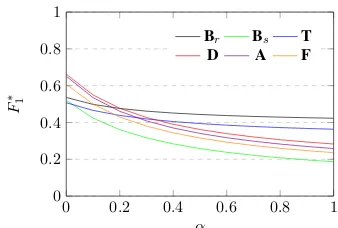
TheF1∗results are shown in Figure5, where we again can distinguish the systems that link com-mon entities – Babelfy (relaxed) and TagME – from those that do not; the former group of sys-tems performs worse for stricter definitions of EL annotations, but outperform other systems as the definition is relaxed.8 The raw data for these ex-periments can be found online.9
7 Conclusions
We have (i) presented the results of a question-naire that assesses consensus on the goals of the
8
We remark thatP is agnostic toαand would result in a straight line;R∗thus follows the same trend asF1∗.
9https://github.com/henryrosalesmendez/EL exp
0 0.2 0.4 0.6 0.8 1
0
0.2
0.4
0.6
0.8
1
α
F
∗ 1
Br Bs T
[image:9.595.330.499.62.176.2]D A F
Figure 5:α-based fuzzyF1scores
EL task, (ii) proposed a fine-grained categoriza-tion scheme for EL annotacategoriza-tions, (iii) comprehen-sively (re-)labeled three datasets accordingly to this scheme, (iv) presented results for five EL sys-tems with respect to annotations in different cate-gories, and (v) proposed fuzzy recall/F1measures to address the lack of consensus, presenting results for the five systems on a strict/relaxed spectrum.
Our main conclusions are as follows:
• Though there is consensus on some EL anno-tations, opinions differ for common entities, pro-forms, descriptive references, etc.
• The EL systems tested offer little or no sup-port for pro-forms, meronymic references, referencing noun phrases, etc., despite there being considerable support for such EL an-notations in the questionnaire.
• Our fine-grained evaluation distinguishes two groups of EL systems: one group target-ing common entities and named entities, the other group focused on named entities.
The results of our questionnaire and system evaluation suggest the need for future work on supporting complex forms of reference within EL systems; the datasets we provide can be used to evaluate such approaches. Another important di-rection is to either reach a consensus on the EL task (perhaps in a similar style to MUC-6 for NER), or define protocols for evaluation in the absence of such a consensus; our fuzzy recall/F1 metrics are concrete steps in this direction.
References
Kurt D. Bollacker, Colin Evans, Praveen Paritosh, Tim Sturge, and Jamie Taylor. 2008. Freebase: a col-laboratively created graph database for structuring human knowledge. In SIGMOD, pages 1247–1250.
Paolo Ferragina and Ugo Scaiella. 2010. TAGME: on-the-fly annotation of short text fragments (by wikipedia entities). In CIKM, pages 1625–1628.
Michael Fleischman and Eduard H. Hovy. 2002. Fine Grained Classification of Named Entities. In COLING.
Aldo Gangemi, Valentina Presutti, Diego Reforgiato Recupero, Andrea Giovanni Nuzzolese, Francesco Draicchio, and Misael Mongiov`ı. 2017. Semantic Web Machine Reading with FRED. Semantic Web, 8(6):873–893.
Ralph Grishman and Beth Sundheim. 1996. Message Understanding Conference- 6: A Brief History. In COLING, pages 466–471.
Johannes Hoffart, Stephan Seufert, Dat Ba Nguyen, Martin Theobald, and Gerhard Weikum. 2012. KORE: keyphrase overlap relatedness for entity dis-ambiguation. In CIKM, pages 545–554.
Kunal Jha, Michael R¨oder, and Axel-Cyrille Ngonga Ngomo. 2017. All that Glitters Is Not Gold - Rule-Based Curation of Reference Datasets for Named Entity Recognition and Entity Linking. In ESWC, pages 305–320.
Jens Lehmann, Robert Isele, Max Jakob, Anja Jentzsch, Dimitris Kontokostas, Pablo N. Mendes, Sebastian Hellmann, Mohamed Morsey, Patrick van Kleef, S¨oren Auer, and Christian Bizer. 2015. DBpedia - A large-scale, multilingual knowledge base extracted from Wikipedia. Semantic Web, 6(2):167–195.
Xiao Ling, Sameer Singh, and Daniel S. Weld. 2015. Design challenges for entity linking. TACL, 3:315– 328.
Pablo N. Mendes, Max Jakob, Andr´es Garc´ıa-Silva, and Christian Bizer. 2011. DBpedia Spotlight: shedding light on the web of documents. In I-SEMANTICS, pages 1–8.
Anne-Lyse Minard, Manuela Speranza, Ruben Urizar, Bego˜na Altuna, Marieke van Erp, Anneleen Schoen, and Chantal van Son. 2016. MEANTIME, the NewsReader Multilingual Event and Time Corpus. In LREC.
Andrea Moro, Alessandro Raganato, and Roberto Nav-igli. 2014. Entity Linking meets Word Sense Disam-biguation: a Unified Approach. TACL, 2:231–244.
Roberto Navigli. 2009. Word sense disambiguation: A survey. ACM Comput. Surv., 41(2):10:1–10:69.
Lev-Arie Ratinov, Dan Roth, Doug Downey, and Mike Anderson. 2011. Local and Global Algorithms for Disambiguation to Wikipedia. In ACL, pages 1375– 1384.
Thomas Rebele, Fabian M. Suchanek, Johannes Hof-fart, Joanna Biega, Erdal Kuzey, and Gerhard Weikum. 2016. YAGO: A Multilingual Knowledge Base from Wikipedia, Wordnet, and Geonames. In ISWC, pages 177–185.
Henry Rosales-M´endez, Aidan Hogan, and Barbara Poblete. 2018a. VoxEL: A Benchmark Dataset for Multilingual Entity Linking. In ISWC, pages 170– 186.
Henry Rosales-M´endez, Aidan Hogan, and Barbara Poblete. 2019. NIFify: Towards Better Quality Entity Linking Datasets. In WWW Companion Volume, pages 815–818.
Henry Rosales-M´endez, Barbara Poblete, and Aidan Hogan. 2018b. What should Entity Linking link? In AMW.
Peter F. Strawson. 1950. On referring. Mind, 59(235):320–344.
Rhea Sukthanker, Soujanya Poria, Erik Cambria, and Ramkumar Thirunavukarasu. 2018. Anaphora and coreference resolution: A review. CoRR, abs/1805.11824.
Denny Vrandeˇci´c and Markus Kr¨otzsch. 2014. Wiki-data: a free collaborative knowledgebase. Commun. ACM, 57(10):78–85.
J¨org Waitelonis, Henrik J¨urges, and Harald Sack. 2016. Don’t compare apples to oranges: Extend-ing GERBIL for a fine grained NEL evaluation. In SEMANTICS, pages 65–72.
Gong-Qing Wu, Ying He, and Xuegang Hu. 2018. En-tity linking: An issue to extract corresponding enEn-tity with knowledge base. IEEE Access, 6:6220–6231.