Proceedings of the 2019 Conference on Empirical Methods in Natural Language Processing
43
Knowledge Enhanced Contextual Word Representations
Matthew E. Peters1, Mark Neumann1, Robert L. Logan IV2, Roy Schwartz1,3, Vidur Joshi1, Sameer Singh2, and Noah A. Smith1,3
1Allen Institute for Artificial Intelligence, Seattle, WA, USA 2University of California, Irvine, CA, USA
3Paul G. Allen School of Computer Science & Engineering, University of Washington
{matthewp,markn,roys,noah}@allenai.org
{rlogan,sameer}@uci.edu
Abstract
Contextual word representations, typically trained on unstructured, unlabeled text, do not contain any explicit grounding to real world entities and are often unable to remember facts about those entities. We propose a general method to embed multiple knowledge bases (KBs) into large scale models, and thereby enhance their representations with structured, human-curated knowledge. For each KB, we first use an integrated entity linker to retrieve relevant entity embeddings, then update con-textual word representations via a form of word-to-entity attention. In contrast to pre-vious approaches, the entity linkers and self-supervised language modeling objective are jointly trained end-to-end in a multitask set-ting that combines a small amount of entity linking supervision with a large amount of raw text. After integrating WordNet and a subset of Wikipedia into BERT, the knowledge en-hanced BERT (KnowBert) demonstrates im-proved perplexity, ability to recall facts as measured in a probing task and downstream performance on relationship extraction, en-tity typing, and word sense disambiguation. KnowBert’s runtime is comparable to BERT’s and it scales to large KBs.
1 Introduction
Large pretrained models such as ELMo (Peters et al., 2018), GPT (Radford et al., 2018), and BERT (Devlin et al.,2019) have significantly im-proved the state of the art for a wide range of NLP tasks. These models are trained on large amounts of raw text using self-supervised objectives. How-ever, they do not contain any explicit grounding to real world entities and as a result have difficulty recovering factual knowledge (Logan et al.,2019). Knowledge bases (KBs) provide a rich source of high quality, human-curated knowledge that can be used to ground these models. In addition, they
often include complementary information to that found in raw text, and can encode factual knowl-edge that is difficult to learn from selectional pref-erences either due to infrequent mentions of com-monsense knowledge or long range dependencies. We present a general method to insert multiple KBs into a large pretrained model with a Knowl-edge Attention and Recontextualization (KAR) mechanism. The key idea is to explicitly model entity spans in the input text and use an entity linker to retrieve relevant entity embeddings from a KB to form knowledge enhanced entity-span representations. Then, the model recontextual-izes the entity-span representations with word-to-entity attention to allow long range interactions between contextual word representations and all entity spans in the context. The entire KAR is in-serted between two layers in the middle of a pre-trained model such as BERT.
In contrast to previous approaches that inte-grate external knowledge into task-specific mod-els with task supervision (e.g.,Yang and Mitchell,
2017;Chen et al.,2018), our approach learns the entity linkers with self-supervision on unlabeled data. This results in general purpose knowledge enhanced representations that can be applied to a wide range of downstream tasks.
Our approach has several other benefits. First, it leaves the top layers of the original model un-changed so we may retain the output loss layers and fine-tune on unlabeled corpora while training the KAR. This also allows us to simply swap out BERT for KnowBert in any downstream applica-tion. Second, by taking advantage of the exist-ing high capacity layers in the original model, the KAR is lightweight, adding minimal additional parameters and runtime. Finally, it is easy to in-corporate additional KBs by simply inserting them at other locations.
KB, subject to a small set of requirements (see Sec. 3.2). We experiment with integrating both WordNet (Miller, 1995) and Wikipedia, thus ex-plicitly adding word sense knowledge and facts about named entities (including those unseen at training time). However, the method could be ex-tended to commonsense KBs such as ConceptNet (Speer et al.,2017) or domain specific ones (e.g., UMLS; Bodenreider,2004).
We evaluate KnowBert with a mix of intrin-sic and extrinintrin-sic tasks. Despite being based on the smaller BERTBASE model, the
experi-ments demonstrate improved masked language model perplexity and ability to recall facts over BERTLARGE. The extrinsic evaluations
demon-strate improvements for challenging relationship extraction, entity typing and word sense disam-biguation datasets, and often outperform other contemporaneous attempts to incorporate external knowledge into BERT.
2 Related Work
Pretrained word representations Initial work learning word vectors focused on static word embeddings using multi-task learning objectives (Collobert and Weston,2008) or corpus level co-occurence statistics (Mikolov et al., 2013a; Pen-nington et al., 2014). Recently the field has shifted toward learning context-sensitive embed-dings (Dai and Le,2015;Peters et al.,2018; De-vlin et al.,2019). We build upon these by incorpo-rating structured knowledge into these models.
Entity embeddings Entity embedding methods produce continuous vector representations from external knowledge sources. Knowledge graph-based methods optimize the score of observed triples in a knowledge graph. These methods broadly fall into two categories: translational dis-tance models (Bordes et al., 2013; Wang et al.,
2014b;Lin et al.,2015;Xiao et al., 2016) which use a distance-based scoring function, and linear models (Nickel et al., 2011; Yang et al., 2014;
Trouillon et al.,2016;Dettmers et al.,2018) which use a similarity-based scoring function. We exper-iment with TuckER (Balazevic et al., 2019) em-beddings, a recent linear model which general-izes many of the aforecited models. Other meth-ods combine entity metadata with the graph (Xie et al.,2016), use entity contexts (Chen et al.,2014;
Ganea and Hofmann,2017), or a combination of contexts and the KB (Wang et al., 2014a;Gupta
et al.,2017). Our approach is agnostic to the de-tails of the entity embedding method and as a re-sult is able to use any of these methods.
Entity-aware language models Some previous work has focused on adding KBs to generative lan-guage models (LMs) (Ahn et al.,2017;Yang et al.,
2017;Logan et al.,2019) or building entity-centric LMs (Ji et al., 2017). However, these methods introduce latent variables that require full annota-tion for training, or marginalizaannota-tion. In contrast, we adopt a method that allows training with large amounts of unannotated text.
Task-specific KB architectures Other work has focused on integrating KBs into neural architec-tures for specific downstream tasks (Yang and Mitchell,2017;Sun et al.,2018;Chen et al.,2018;
Bauer et al., 2018; Mihaylov and Frank, 2018;
Wang and Jiang, 2019; Yang et al., 2019). Our approach instead uses KBs to learn more gener-ally transferable representations that can be used to improve a variety of downstream tasks.
3 KnowBert
KnowBert incorporates knowledge bases into BERT using the Knowledge Attention and Re-contextualization component (KAR). We start by describing the BERT and KB components. We then move to introducing KAR. Finally, we de-scribe the training procedure, including the multi-task training regime for jointly training KnowBert and an entity linker.
3.1 Pretrained BERT
We describe KnowBert as an extension to (and candidate replacement for) BERT, although the method is general and can be applied to any deep pretrained model including left-to-right and right-to-left LMs such as ELMo and GPT. Formally, BERT accepts as input a sequence of N Word-Piece tokens (Sennrich et al., 2016; Wu et al.,
2016), (x1, . . . , xN), and computes L layers of
D-dimensional contextual representations Hi ∈ RN×D by successively applying non-linear
func-tions Hi = Fi(Hi−1). The non-linear
(Vaswani et al.,2017):
Fi(Hi−1) =
TransformerBlock(Hi−1) =
MLP(MultiHeadAttn(Hi−1,Hi−1,Hi−1)).
The multi-headed self-attention usesHi−1 as the
query, key, and value to allow each vector to attend to every other vector.
BERT is trained to minimize an objective func-tion that combines both next-sentence predicfunc-tion (NSP) and masked LM log-likelihood (MLM):
LBERT=LNSP+LMLM.
Given two inputs xA and xB, the next-sentence
prediction task is binary classification to predict whether xB is the next sentence following xA.
The masked LM objective randomly replaces a percentage of input word pieces with a special [MASK] token and computes the negative log-likelihood of the missing token with a linear layer and softmax over all possible word pieces.
3.2 Knowledge Bases
The key contribution of this paper is a method to incorporate knowledge bases (KB) into a pre-trained BERT model. To encompass as wide a se-lection of prior knowledge as possible, we adopt a broad definition for a KB in the most general sense as fixed collection of K entity nodes, ek,
from which it is possible to compute entity embed-dings,ek ∈RE. This includes KBs with a typical
(subj, rel, obj)graph structure, KBs that contain only entity metadata without a graph, and those that combine both a graph and entity meta-data, as long as there is some method for embed-ding the entities in a low dimensional vector space. We also do not make any assumption that the en-tities are typed. As we show in Sec.4.1this flex-ibility is beneficial, where we compute entity em-beddings from WordNet using both the graph and synset definitions, but link directly to Wikipedia pages without a graph by using embeddings com-puted from the entity description.
We also assume that the KB is accompanied by an entity candidate selector that takes as input some text and returns a list of C potential entity links, each consisting of the start and end indices of the potential mention span andMm candidate
entities in the KG:
C={h(startm,endm),(em,1, . . . , em,Mm)i |
m∈1. . . C, ek∈1. . . K}.
In practice, these are often implemented us-ing precomputed dictionaries (e.g., CrossWikis;
Spitkovsky and Chang, 2012), KB specific rules (e.g., a WordNet lemmatizer), or other heuristics (e.g., string match; Mihaylov and Frank, 2018).
Ling et al.(2015) showed that incorporating can-didate priors into entity linkers can be a power-ful signal, so we optionally allow for the candi-date selector to return an associated prior proba-bility for each entity candidate. In some cases, it is beneficial to over-generate potential candidates and add a special NULL entity to each candidate list, thereby allowing the linker to discriminate be-tween actual links and false positive candidates. In this work, the entity candidate selectors are fixed but their output is passed to a learned context de-pendent entity linker to disambiguate the candi-date mentions.
Finally, by restricting the number of candidate entities to a fixed small number (we use 30), KnowBert’s runtime is independent of the size the KB, as it only considers a small subset of all pos-sible entities for any given text. As the candidate selection is rule-based and fixed, it is fast and in our implementation is performed asynchronously on CPU. The only overhead for scaling up the size of the KB is the memory footprint to store the en-tity embeddings.
3.3 KAR
The Knowledge Attention and Recontextualiza-tion component (KAR) is the heart of KnowBert. The KAR accepts as input the contextual rep-resentations at a particular layer, Hi, and
com-putes knowledge enhanced representationsH0i = KAR(Hi,C). This is fed into the next pretrained
layer, Hi+1 = TransformerBlock(H0i), and the
remainder of BERT is run as usual.
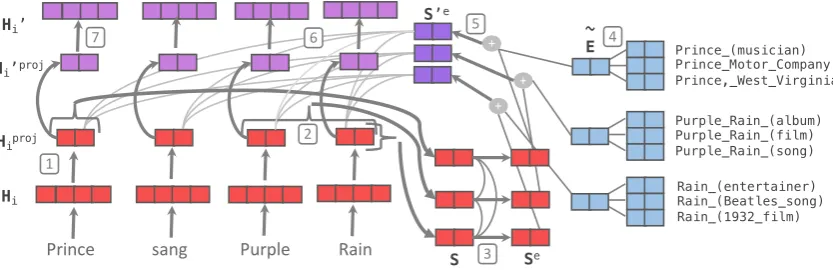
In this section, we describe the KAR’s key com-ponents: mention-span representations, retrieval of relevant entity embeddings using an entity linker, update of mention-span embeddings with retrieved information, and recontextualization of entity-span embeddings with word-to-entity-span attention. We describe the KAR for a single KB, but extension to multiple KBs at different layers is straightforward. See Fig.1for an overview.
pro-Prince sang Purple Rain
Prince_(musician) Prince_Motor_Company Prince,_West_Virginia
Purple_Rain_(album) Purple_Rain_(film) Purple_Rain_(song)
Rain_(entertainer) Rain_(Beatles_song) Rain_(1932_film)
+ + +
1
2
3
4 5
6 7
Hiproj
Hi
S Se
~ E S’e
Hi’proj
[image:4.595.94.511.66.201.2]Hi’
Figure 1: The Knowledge Attention and Recontextualization (KAR) component. BERT word piece representations (Hi) are first projected toHproji (1), then pooled over candidate mentions spans (2) to computeS, and contextual-ized intoSeusing mention-span self-attention (3). An integrated entity linker computes weighted average entity embeddingsE˜ (4), which are used to enhance the span representations with knowledge from the KB (5), comput-ingS0e. Finally, the BERT word piece representations are recontextualized with word-to-entity-span attention (6) and projected back to the BERT dimension (7) resulting inH0
i.
jected to the entity dimension (E, typically 200 or 300, see Sec.4.1) with a linear projection,
Hproji =HiWproj1 +b
proj
1 . (1)
Then, the KAR computesC mention-span repre-sentationssm ∈RE, one for each candidate
men-tion, by pooling over all word pieces in a mention-span using the self-attentive mention-span pooling from
Lee et al.(2017). The mention-spans are stacked into a matrixS∈RC×E.
Entity linker The entity linker is responsible for performing entity disambiguation for each poten-tial mention from among the available candidates. It first runs mention-span self-attention to compute
Se= TransformerBlock(S). (2)
The span self-attention is identical to the typical transformer layer, exception that the self-attention is between mention-span vectors instead of word piece vectors. This allows KnowBert to incorpo-rate global information into each linking decision so that it can take advantage of entity-entity co-occurrence and resolve which of several overlap-ping candidate mentions should be linked.1
Following Kolitsas et al.(2018), Se is used to score each of the candidate entities while incorpo-rating the candidate entity prior from the KB. Each candidate spanmhas an associated mention-span
1
We found a small transformer layer with four atten-tion heads and a 1024 feed-forward hidden dimension was sufficient, significantly smaller than each of the layers in BERT. Early experiments demonstrated the effectiveness of this layer with improved entity linking performance.
vector sem (computed via Eq. 2), Mm candidate
entities with embeddingsemk (from the KB), and
prior probabilitiespmk. We compute Mm scores
using the prior and dot product between the entity-span vectors and entity embeddings,
ψmk = MLP(pmk,sem·emk), (3)
with a two-layer MLP (100 hidden dimensions). If entity linking (EL) supervision is available, we can compute a loss with the gold entityemg.
The exact form of the loss depends on the KB, and we use both log-likelihood,
LEL=−X
m
log
exp(ψmg)
P
kexp(ψmk)
, (4)
and max-margin,
LEL= max(0, γ−ψmg) +
X
emk6=emg
max(0, γ+ψmk), (5)
formulations (see Sec.4.1for details).
Knowledge enhanced entity-span representa-tions KnowBert next injects the KB entity in-formation into the mention-span representations computed from BERT vectors (sem) to form entity-span representations. For a given entity-spanm, we first disregard all candidate entities with scoreψbelow a fixed threshold, and softmax normalize the re-maining scores:
˜ ψmk =
exp(ψmk)
P
ψmk≥δ
exp(ψmk)
, ψmk≥δ
Then the weighted entity embedding is
˜ em =
X
k
˜ ψmkemk.
If all entity linking scores are below the thresh-old δ, we substitute a special NULL embedding for˜em. Finally, the entity-span representations are
updated with the weighted entity embeddings
s0me =sem+ ˜em, (6)
which are packed into a matrixS0e∈RC×E.
Recontextualization After updating the entity-span representations with the weighted entity vec-tors, KnowBert uses them to recontextualize the word piece representations. This is accomplished using a modified transformer layer that substi-tutes the headed self-attention with a multi-headed attention between the projected word piece representations and knowledge enhanced entity-span vectors. As introduced by Vaswani et al.
(2017), the contextual embeddings Hi are used
for the query, key, and value in multi-headed self-attention. The word-to-entity-span attention in KnowBert substitutesHproji for the query, andS0e for both the key and value:
H0iproj= MLP(MultiHeadAttn(Hproji ,S0e,S0e)).
This allows each word piece to attend to all entity-spans in the context, so that it can propa-gate entity information over long contexts. Af-ter the multi-headed word-to-entity-span attention, we run a position-wise MLP analogous to the stan-dard transformer layer.2
Finally,H0proji is projected back to the BERT di-mension with a linear transformation and a resid-ual connection added:
H0i =H0proji W
proj
2 +b
proj
2 +Hi (7)
Alignment of BERT and entity vectors As KnowBert does not place any restrictions on the entity embeddings, it is essential to align them with the pretrained BERT contextual representa-tions. To encourage this alignment we initialize W2projas the matrix inverse ofWproj1 (Eq.1). The use of dot product similarity (Eq.3) and residual connection (Eq. 7) further aligns the entity-span representations with entity embeddings.
2As for the multi-headed entity-span self-attention, we
found a small transformer layer to be sufficient, with four attention heads and 1024 hidden units in the MLP.
Algorithm 1:KnowBert training method Input:Pretrained BERT andJ KBs Output: KnowBert
forj= 1. . . J do
Compute entity embeddings for KBj
ifEL supervision availablethen
Freeze all network parameters except those in (Eq.1–3)
Train to convergence using (Eq.4) or (Eq.5)
end
InitializeWproj2 as(Wproj1 )−1
Unfreeze all parameters except entity embeddings
Minimize
LKnowBert=LBERT+Pj
i=1LELi
end
3.4 Training Procedure
Our training regime incrementally pretrains in-creasingly larger portions of KnowBert before fine-tuning all trainable parameters in a multitask setting with any available EL supervision. It is similar in spirit to the “chain-thaw” approach in
Felbo et al.(2017), and is summarized in Alg.1. We assume access to a pretrained BERT model and one or more KBs with their entity candidate selectors. To add the first KB, we begin by pre-training entity embeddings (if not already pro-vided from another source), then freeze them in all subsequent training, including task-specific fine-tuning. If EL supervision is available, it is used to pretrain the KB specific EL parameters, while freezing the remainder of the network. Finally, the entire network is fine-tuned to convergence by minimizing
LKnowBert=LBERT+LEL.
We apply gradient updates to homogeneous batches randomly sampled from either the unla-beled corpus or EL supervision.
System PPL Wikidata # params. # params. # params. Fwd. / Bwd.
MRR masked LM KAR entity embed. time
BERTBASE 5.5 0.09 110 0 0 0.25
BERTLARGE 4.5 0.11 336 0 0 0.75
KnowBert-Wiki 4.3 0.26 110 2.4 141 0.27
KnowBert-WordNet 4.1 0.22 110 4.9 265 0.31
[image:6.595.78.518.64.169.2]KnowBert-W+W 3.5 0.31 110 7.3 406 0.33
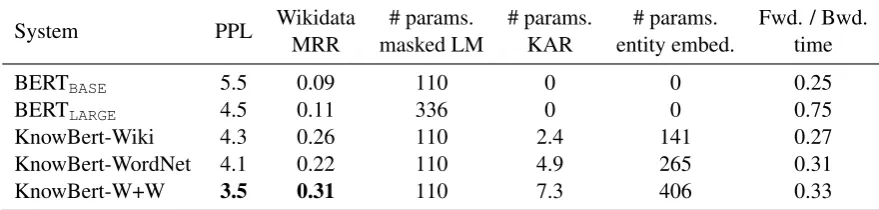
Table 1: Comparison of masked LM perplexity, Wikidata probing MRR, and number of parameters (in millions) in the masked LM (word piece embeddings, transformer layers, and output layers), KAR, and entity embeddings for BERT and KnowBert. The table also includes the total time to run one forward and backward pass (in seconds) on a TITAN Xp GPU (12 GB RAM) for a batch of 32 sentence pairs with total length 80 word pieces. Due to memory constraints, the BERTLARGEbatch is accumulated over two smaller batches.
minimize disruption of the network and decrease the likelihood that training will fail. See Sec.4.1
for details of where each KB was added.
The entity embeddings and selected candidates contain lexical information (especially in the case of WordNet), that will make the masked LM pre-dictions significantly easier. To prevent leaking into the masked word pieces, we adopt the BERT strategy and replace all entity candidates from the selectors with a special[MASK]entity if the can-didate mention span overlaps with a masked word piece.3 This prevents KnowBert from relying on the selected candidates to predict masked word pieces.
4 Experiments
4.1 Experimental Setup
We used the English uncased BERTBASE model
(Devlin et al., 2019) to train three versions of KnowBert: KnowBert-Wiki, KnowBert-WordNet, and KnowBert-W+W that includes both Wikipedia and WordNet.
KnowBert-Wiki The entity linker in KnowBert-Wiki borrows both the entity can-didate selectors and embeddings fromGanea and Hofmann (2017). The candidate selectors and priors are a combination of CrossWikis, a large, precomputed dictionary that combines statistics from Wikipedia and a web corpus (Spitkovsky and Chang,2012), and the YAGO dictionary (Hoffart et al., 2011). The entity embeddings use a skip-gram like objective (Mikolov et al., 2013b) to learn 300-dimensional embeddings of Wikipedia
3Following BERT, for 80% of masked word pieces all
candidates are replaced with[MASK], 10% are replaced with random candidates and 10% left unmasked.
page titles directly from Wikipedia descriptions without using any explicit graph structure between nodes. As such, nodes in the KB are Wikipedia page titles, e.g.,Prince (musician). Ganea and Hofmann (2017) provide pretrained embed-dings for a subset of approximately 470K entities. Early experiments with embeddings derived from Wikidata relations4did not improve results.
We used the AIDA-CoNLL dataset (Hoffart et al., 2011) for supervision, adopting the stan-dard splits. This dataset exhaustively annotates entity links for named entities of person, organi-zation and location types, as well as a miscella-neous type. It does not annotate links to common nouns or other Wikipedia pages. At both train and test time, we consider all selected candidate spans and the top 30 entities, to which we add the spe-cial NULL entity to allow KnowBert to discrim-inate between actual links and false positive links from the selector. As such, KnowBert models both entity mention detection and disambiguation in an end-to-end manner. Eq.5was used as the objec-tive.
KnowBert-WordNet Our WordNet KB com-bines synset metadata, lemma metadata and the re-lational graph. To construct the graph, we first ex-tracted all synsets, lemmas, and their relationships from WordNet 3.0 using thenltkinterface. After disregarding certain symmetric relationships (e.g., we kept thehypernymrelationship, but removed the inverse hyponymrelationship) we were left with 28 synset-synset and lemma-lemma relation-ships. From these, we constructed a graph where each node is either a synset or lemma, and
intro-4https://github.com/facebookresearch/
System F1
WN-first sense baseline 65.2
ELMo 69.2
BERTBASE 73.1
BERTLARGE 73.9
KnowBert-WordNet 74.9
[image:7.595.107.256.62.171.2]KnowBert-W+W 75.1
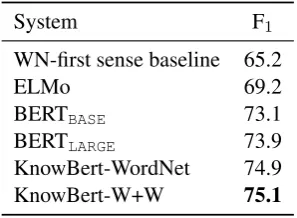
Table 2: Fine-grained WSD F1.
duced the special lemma in synset relation-ship to link synsets and lemmas. The candidate se-lector uses a rule-based lemmatizer without part-of-speech (POS) information.5
Our embeddings combine both the graph and synset glosses (definitions), as early experiments indicated improved perplexity when using both vs. just graph-based embeddings. We used TuckER (Balazevic et al.,2019) to compute 200-dimensional vectors for each synset and lemma using the relationship graph. Then, we extracted the gloss for each synset and used an off-the-shelf state-of-the-art sentence embedding method (Subramanian et al., 2018) to produce 2048-dimensional vectors. These are concatenated to the TuckER embeddings. To reduce the dimen-sionality for use in KnowBert, the frozen 2248-dimensional embeddings are projected to 200-dimensions with a learned linear transformation.
For supervision, we combined the SemCor word sense disambiguation (WSD) dataset (Miller et al.,1994) with all lemma example usages from WordNet6 and link directly to synsets. The loss function is Eq.4. At train time, we did not provide gold lemmas or POS tags, so KnowBert must learn to implicitly model coarse grained POS tags to dis-ambiguate each word. At test time when evaluat-ing we restricted candidate entities to just those matching the gold lemma and POS tag, consistent with the standard WSD evaluation.
Training details To control for the unlabeled corpus, we concatenated Wikipedia and the Books Corpus (Zhu et al., 2015) and followed the data preparation process in BERT with the exception of heavily biasing our dataset to shorter sequences of 128 word pieces for efficiency. Both
KnowBert-5
https://spacy.io/
6To provide a fair evaluation on the WiC dataset which
is partially based on the same source, we excluded all WiC train, development and test instances.
System AIDA-A AIDA-B
Daiber et al.(2013) 49.9 52.0
Hoffart et al.(2011) 68.8 71.9
Kolitsas et al.(2018) 86.6 82.6
KnowBert-Wiki 80.2 74.4
[image:7.595.312.519.63.155.2]KnowBert-W+W 82.1 73.7
Table 3: End-to-end entity linking strong match, micro averaged F1.
Wiki and KnowBert-WordNet insert the KB be-tween layers 10 and 11 of the 12-layer BERTBASE
model. KnowBert-W+W adds the Wikipedia KB between layers 10 and 11, with WordNet be-tween layers 11 and 12. Earlier experiments with KnowBert-WordNet in a lower layer had worse perplexity. We generally followed the fine-tuning procedure inDevlin et al.(2019); see supplemen-tal materials for details.
4.2 Intrinsic Evaluation
Perplexity Table 1 compares masked LM per-plexity for KnowBert with BERTBASE and
BERTLARGE. To rule out minor differences due to
our data preparation, the BERT models are fine-tuned on our training data before being evalu-ated. Overall, KnowBert improves the masked LM perplexity, with all KnowBert models outper-forming BERTLARGE, despite being derived from
BERTBASE.
Factual recall To test KnowBert’s ability to re-call facts from the KBs, we extracted 90K tu-ples from Wikidata (Vrandeˇci´c and Kr¨otzsch,
2014) for 17 different relationships such as companyFoundedBy. Each tuple was written into natural language such as “Adidas was founded by Adolf Dassler” and used to construct two test instances, one that masks out the subject and one that masks the object. Then, we evaluated whether a model could recover the masked entity by com-puting the mean reciprocal rank (MRR) of the masked word pieces. Table 1 displays a sum-mary of the results (see supplementary material for results across all relationship types). Overall, KnowBert-Wiki is significantly better at recalling facts than both BERTBASE and BERTLARGE, with
KnowBert-W+W better still.
Speed KnowBert is almost as fast as BERTBASE
System LM P R F1
Zhang et al.(2018) — 69.9 63.3 66.4 Alt et al.(2019) GPT 70.1 65.0 67.4 Shi and Lin(2019) BERTBASE 73.3 63.1 67.8 Zhang et al.(2019) BERTBASE 70.0 66.1 68.0 Soares et al.(2019) BERTLARGE — — 70.1 Soares et al.(2019) BERTLARGE† — — 71.5
[image:8.595.315.517.63.156.2]KnowBert-W+W BERTBASE 71.6 71.4 71.5
Table 4: Single model test set results on the TACRED relationship extraction dataset. †with MTB pretrain-ing.
of (frozen) parameters in the entity embed-dings (Table 1). KnowBert is much faster than BERTLARGE. By taking advantage of the already
high capacity model, the number of trainable parameters added by KnowBert is a fraction of the total parameters in BERT. The faster speed is partially due to the entity parameter efficiency in KnowBert as only as small fraction of parameters in the entity embeddings are used for any given input due to the sparse linker. Our candidate generators consider the top 30 candidates and produce approximately O(number tokens) can-didate spans. For a typical 25 token sentence, approximately 2M entity embedding parameters are actually used. In contrast, BERTLARGEuses the
majority of its 336M parameters for each input.
Integrated EL It is also possible to evaluate the performance of the integrated entity linkers in-side KnowBert using diagnostic probes without any further fine-tuning. As these were trained in a multitask setting primarily with raw text, we do nota prioriexpect high performance as they must balance specializing for the entity linking task and learning general purpose representations suitable for language modeling.
Table2displays fine-grained WSD F1using the
evaluation framework from Navigli et al. (2017) and the ALL dataset (combing SemEval 2007, 2013, 2015 and Senseval 2 and 3). By linking to nodes in our WordNet graph and restricting to gold lemmas at test time we can recast the WSD task under our general entity linking framework. The ELMo and BERT baselines use a nearest neighbor approach trained on the SemCor dataset, similar to the evaluation inMelamud et al.(2016), which has previously been shown to be competitive with task-specific architectures (Raganato et al.,2017). As can be seen, KnowBert provides competi-tive performance, and KnowBert-W+W is able to
System LM F1
Wang et al.(2016) — 88.0
Wang et al.(2019b) BERTBASE 89.0 Soares et al.(2019) BERTLARGE 89.2 Soares et al.(2019) BERTLARGE† 89.5
KnowBert-W+W BERTBASE 89.1
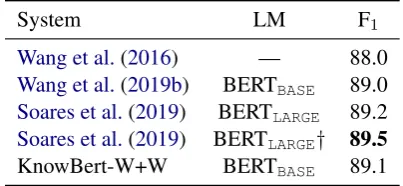
Table 5: Test set F1for SemEval 2010 Task 8
relation-ship extraction.†with MTB pretraining.
match the performance of KnowBert-WordNet de-spite incorporating both Wikipedia and WordNet.
Table 3 reports end-to-end entity linking per-formance for the AIDA-A and AIDA-B datasets. Here, KnowBert’s performance lags behind the current state-of-the-art model fromKolitsas et al.
(2018), but still provides strong performance com-pared to other established systems such as AIDA (Hoffart et al., 2011) and DBpedia Spotlight (Daiber et al., 2013). We believe this is due to the selective annotation in the AIDA data that only annotates named entities. The CrossWikis-based candidate selector used in KnowBert gen-erates candidate mentions for all entities includ-ing common nouns from which KnowBert may be learning to extract information, at the detriment of specializing to maximize linking performance for AIDA.
4.3 Downstream Tasks
This section evaluates KnowBert on downstream tasks to validate that the addition of knowledge improves performance on tasks expected to benefit from it. Given the overall superior performance of KnowBert-W+W on the intrinsic evaluations, we focus on it exclusively for evaluation in this sec-tion. The main results are included in this section; see the supplementary material for full details.
The baselines we compare against are BERTBASE, BERTLARGE, the pre-BERT state
of the art, and two contemporaneous papers that add similar types of knowledge to BERT. ERNIE (Zhang et al., 2019) uses TAGME (Ferragina and Scaiella, 2010) to link entities to Wikidata, retrieves the associated entity embeddings, and fuses them into BERTBASEby fine-tuning. Soares et al.(2019) learns relationship representations by fine-tuning BERTLARGE with large scale
[image:8.595.74.290.63.162.2]System Accuracy
ELMo† 57.7
BERTBASE† 65.4
BERTLARGE† 65.5
BERTLARGE†† 69.5
[image:9.595.109.253.62.156.2]KnowBert-W+W 70.9
Table 6: Test set results for the WiC dataset (v1.0).
†Pilehvar and Camacho-Collados(2019)
††Wang et al.(2019a)
Relation extraction Our first task is relation ex-traction using the TACRED (Zhang et al., 2017) and SemEval 2010 Task 8 (Hendrickx et al.,2009) datasets. Systems are given a sentence with marked a subject and object, and asked to pdict which of several different relations (or no re-lation) holds. FollowingSoares et al. (2019), our KnowBert model uses special entity tokens[E1], [/E1],[E2],[/E2]to mark the location of the subject and object in the input sentence, then con-catenates the contextual word representations for [E1] and[E2] to predict the relationship. For TACRED, we also encode the subject and object types with special tokens and concatenate them to the end of the sentence.
For TACRED (Table 4), KnowBert-W+W sig-nificantly outperforms the comparable BERTBASE
systems including ERNIE by 3.5%, improves over BERTLARGEby 1.4%, and is able to match the
per-formance of the relationship specific MTB pre-training in Soares et al. (2019). For SemEval 2010 Task 8 (Table5), KnowBert-W+W F1 falls
between the entity aware BERTBASE model from Wang et al. (2019b), and the BERTLARGE model
fromSoares et al.(2019).
Words in Context (WiC) WiC (Pilehvar and Camacho-Collados, 2019) is a challenging task that presents systems with two sentences both con-taining a word with the same lemma and asks them to determine if they are from the same sense or not. It is designed to test the quality of contextual word representations. We follow standard practice and concatenate both sentences with a [SEP] token and fine-tune the [CLS] embedding. As shown in Table 6, KnowBert-W+W sets a new state of the art for this task, improving over BERTLARGE
by 1.4% and reducing the relative gap to 80% hu-man perforhu-mance by 13.3%.
System P R F1
UFET 68.8 53.3 60.1
BERTBASE 76.4 71.0 73.6
ERNIE 78.4 72.9 75.6
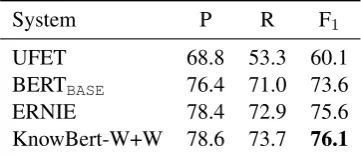
[image:9.595.326.507.63.141.2]KnowBert-W+W 78.6 73.7 76.1
Table 7: Test set results for entity typing using the nine general types from (Choi et al.,2018).
Entity typing We also evaluated KnowBert-W+W using the entity typing dataset from Choi et al.(2018). To directly compare to ERNIE, we adopted the evaluation protocol in Zhang et al.
(2019) which considers the nine general entity types.7 Our model marks the location of a target span with the special [E] and[/E] tokens and uses the representation of the[E]token to predict the type. As shown in Table7, KnowBert-W+W shows an improvement of 0.6% F1 over ERNIE
and 2.5% over BERTBASE.
5 Conclusion
We have presented an efficient and general method to insert prior knowledge into a deep neural model. Intrinsic evaluations demonstrate that the addition of WordNet and Wikipedia to BERT improves the quality of the masked LM and significantly im-proves its ability to recall facts. Downstream eval-uations demonstrate improvements for relation-ship extraction, entity typing and word sense dis-ambiguation datasets. Future work will involve in-corporating a diverse set of domain specific KBs for specialized NLP applications.
Acknowledgements
The authors acknowledge helpful feedback from anonymous reviewers and the AllenNLP team. This research was funded in part by the NSF under awards IIS-1817183 and CNS-1730158.
References
Sungjin Ahn, Heeyoul Choi, Tanel P¨arnamaa, and Yoshua Bengio. 2017. A neural knowledge lan-guage model. arXiv:1608.00318.
Christoph Alt, Marc H¨ubner, and Leonhard Hennig. 2019. Improving relation extraction by pre-trained language representations. InAKBC.
7Data obtained from https://github.com/
Ivana Balazevic, Carl Allen, and Timothy M. Hospedales. 2019. TuckER: Tensor factorization for knowledge graph completion. InEMNLP.
Lisa Bauer, Yicheng Wang, and Mohit Bansal. 2018. Commonsense for generative multi-hop question an-swering tasks. InEMNLP.
Olivier Bodenreider. 2004. The Unified Medical Lan-guage System (UMLS): integrating biomedical ter-minology. Nucleic Acids Research, 32 Database issue:D267–70.
Antoine Bordes, Nicolas Usunier, Alberto Garcia-Duran, Jason Weston, and Oksana Yakhnenko. 2013. Translating embeddings for modeling multi-relational data. InNeurIPS.
Qian Chen, Xiaodan Zhu, Zhen-Hua Ling, Diana Inkpen, and Si Wei. 2018. Neural natural language inference models enhanced with external knowl-edge. InACL.
Xinxiong Chen, Zhiyuan Liu, and Maosong Sun. 2014. A unified model for word sense representation and disambiguation. InEMNLP.
Eunsol Choi, Omer Levy, Yejin Choi, and Luke Zettle-moyer. 2018. Ultra-fine entity typing. InACL.
Ronan Collobert and Jason Weston. 2008. A unified architecture for natural language processing: Deep neural networks with multitask learning. InICML.
Andrew M. Dai and Quoc V. Le. 2015. Semi-supervised sequence learning. InNeurIPS.
Joachim Daiber, Max Jakob, Chris Hokamp, and Pablo N. Mendes. 2013. Improving efficiency and accuracy in multilingual entity extraction. In I-SEMANTICS.
Tim Dettmers, Pasquale Minervini, Pontus Stenetorp, and Sebastian Riedel. 2018. Convolutional 2d knowledge graph embeddings. InAAAI.
Jacob Devlin, Ming-Wei Chang, Kenton Lee, and Kristina Toutanova. 2019. BERT: Pre-training of deep bidirectional transformers for language under-standing. InNAACL-HLT.
Bjarke Felbo, Alan Mislove, Anders Søgaard, Iyad Rahwan, and Sune Lehmann. 2017. Using millions of emoji occurrences to learn any-domain represen-tations for detecting sentiment, emotion and sar-casm. InEMNLP.
Paolo Ferragina and Ugo Scaiella. 2010. TAGME: on-the-fly annotation of short text fragments (by wikipedia entities). InCIKM.
Octavian-Eugen Ganea and Thomas Hofmann. 2017. Deep joint entity disambiguation with local neural attention. InEMNLP.
Nitish Gupta, Sameer Singh, and Dan Roth. 2017. En-tity linking via joint encoding of types, descriptions, and context. InEMNLP.
Iris Hendrickx, Su Nam Kim, Zornitsa Kozareva, Preslav Nakov, Diarmuid ´O S´eaghdha, Sebastian Pad´o, Marco Pennacchiotti, Lorenza Romano, and Stan Szpakowicz. 2009. SemEval-2010 task 8: Multi-way classification of semantic relations be-tween pairs of nominals. InHLT-NAACL.
Johannes Hoffart, Mohamed Amir Yosef, Ilaria Bor-dino, Hagen F¨urstenau, Manfred Pinkal, Marc Span-iol, Bilyana Taneva, Stefan Thater, and Gerhard Weikum. 2011. Robust disambiguation of named entities in text. InEMNLP.
Yangfeng Ji, Chenhao Tan, Sebastian Martschat, Yejin Choi, and Noah A Smith. 2017. Dynamic entity rep-resentations in neural language models. InEMNLP.
Nikolaos Kolitsas, Octavian-Eugen Ganea, and Thomas Hofmann. 2018. End-to-end neural entity linking. InCoNLL.
Kenton Lee, Luheng He, Mike Lewis, and Luke S. Zettlemoyer. 2017. End-to-end neural coreference resolution. InEMNLP.
Yankai Lin, Zhiyuan Liu, Maosong Sun, Yang Liu, and Xuan Zhu. 2015. Learning entity and relation em-beddings for knowledge graph completion. InAAAI.
Xiao Ling, Sameer Singh, and Daniel S. Weld. 2015. Design challenges for entity linking. Transactions of the Association for Computational Linguistics, 3:315–328.
Robert L Logan, Nelson F. Liu, Matthew E. Peters, Matthew Ph Gardner, and Sameer Singh. 2019. Barack’s wife hillary: Using knowledge graphs for fact-aware language modeling. InACL.
Oren Melamud, Jacob Goldberger, and Ido Dagan. 2016. context2vec: Learning generic context em-bedding with bidirectional LSTM. InCoNLL.
Todor Mihaylov and Anette Frank. 2018. Knowledge-able reader: Enhancing cloze-style reading compre-hension with external commonsense knowledge. In ACL.
Tomas Mikolov, Kai Chen, Greg Corrado, and Jeffrey Dean. 2013a. Efficient estimation of word represen-tations in vector space. arXiv:1301.3781.
Tomas Mikolov, Ilya Sutskever, Kai Chen, Greg S Cor-rado, and Jeff Dean. 2013b. Distributed representa-tions of words and phrases and their compositional-ity. InNeurIPS.
George A. Miller, Martin Chodorow, Shari Landes, Claudia Leacock, and Robert G. Thomas. 1994. Us-ing a semantic concordance for sense identification. InHLT.
Roberto Navigli, Jos´e Camacho-Collados, and Alessandro Raganato. 2017. Word sense disam-biguation: A unified evaluation framework and empirical comparison. InEACL.
Maximilian Nickel, Volker Tresp, and Hans-Peter Kriegel. 2011. A three-way model for collective learning on multi-relational data. InICML.
Jeffrey Pennington, Richard Socher, and Christo-pher D. Manning. 2014. GloVe: Global vectors for word representation. InEMNLP.
Matthew E. Peters, Mark Neumann, Mohit Iyyer, Matt Gardner, Christopher Clark, Kenton Lee, and Luke Zettlemoyer. 2018. Deep contextualized word rep-resentations. InNAACL-HLT.
Mohammad Taher Pilehvar and Jos´e Camacho-Collados. 2019. WiC: the word-in-context dataset for evaluating context-sensitive meaning representa-tions. InNAACL-HLT.
Alec Radford, Karthik Narasimhan, Tim Salimans, and Ilya Sutskever. 2018. Improving language under-standing by generative pre-training.
Alessandro Raganato, Claudio Delli Bovi, and Roberto Navigli. 2017. Neural sequence learning models for word sense disambiguation. InEMNLP.
Rico Sennrich, Barry Haddow, and Alexandra Birch. 2016. Neural machine translation of rare words with subword units. InACL.
Peng Shi and Jimmy Lin. 2019. Simple BERT models for relation extraction and semantic role labeling.
Livio B. Soares, Nicholas FitzGerald, Jeffrey Ling, and Tom Kwiatkowski. 2019. Matching the blanks: Dis-tributional similarity for relation learning. InACL.
Robert Speer, Joshua Chin, and Catherine Havasi. 2017. ConceptNet 5.5: An open multilingual graph of general knowledge. InAAAI.
Valentin I. Spitkovsky and Angel X. Chang. 2012. A cross-lingual dictionary for English Wikipedia con-cepts. InLREC.
Sandeep Subramanian, Adam Trischler, Yoshua Ben-gio, and Christopher J Pal. 2018. Learning gen-eral purpose distributed sentence representations via large scale multi-task learning. InICLR.
Haitian Sun, Bhuwan Dhingra, Manzil Zaheer, Kathryn Mazaitis, Ruslan R. Salakhutdinov, and William W. Cohen. 2018. Open domain question answering us-ing early fusion of knowledge bases and text. In EMNLP.
Th´eo Trouillon, Johannes Welbl, Sebastian Riedel, ´Eric Gaussier, and Guillaume Bouchard. 2016. Complex embeddings for simple link prediction. InICML.
Ashish Vaswani, Noam Shazeer, Niki Parmar, Jakob Uszkoreit, Llion Jones, Aidan N. Gomez, Lukasz Kaiser, and Illia Polosukhin. 2017. Attention is all you need. InNeurIPS.
Denny Vrandeˇci´c and Markus Kr¨otzsch. 2014. Wiki-data: A free collaborative knowledgebase. Com-mun. ACM, 57(10):78–85.
Alex Wang, Yada Pruksachatkun, Nikita Nangia, Amanpreet Singh, Julian Michael, Felix Hill, Omer Levy, and Samuel R. Bowman. 2019a. SuperGLUE: A stickier benchmark for general-purpose language understanding systems. arXiv:1905.00537.
Chao Wang and Hui Jiang. 2019. Explicit utilization of general knowledge in machine reading comprehen-sion. InACL.
Haoyu Wang, Ming Tan, Mo Yu, Shiyu Chang, Dakuo Wang, Kun Xu, Xiaoxiao Guo, and Saloni Potdar. 2019b. Extracting multiple-relations in one-pass with pre-trained transformers. InACL.
Linlin Wang, Zhu Cao, Gerard de Melo, and Zhiyuan Liu. 2016. Relation classification via multi-level at-tention CNNs. InACL.
Zhen Wang, Jianwen Zhang, Jianlin Feng, and Zheng Chen. 2014a. Knowledge graph and text jointly em-bedding. InEMNLP.
Zhen Wang, Jianwen Zhang, Jianlin Feng, and Zheng Chen. 2014b. Knowledge graph embedding by translating on hyperplanes. InAAAI.
Yonghui Wu, Mike Schuster, Zhifeng Chen, Quoc V Le, Mohammad Norouzi, Wolfgang Macherey, Maxim Krikun, Yuan Cao, Qin Gao, Klaus Macherey, et al. 2016. Google’s neural machine translation system: Bridging the gap between human and machine translation. arXiv:1609.08144.
Han Xiao, Minlie Huang, and Xiaoyan Zhu. 2016. From one point to a manifold: knowledge graph em-bedding for precise link prediction. InAAAI.
Ruobing Xie, Zhiyuan Liu, J. J. Jia, Huanbo Luan, and Maosong Sun. 2016. Representation learning of knowledge graphs with entity descriptions. InAAAI.
An Yang, Quan Wang, Jing Liu, Kai Liu, Yajuan Lyu, Hua Wu, Qiaoqiao She, and Sujian Li. 2019. En-hancing pre-trained language representations with rich knowledge for machine reading comprehension. InACL.
Bishan Yang, Wen-tau Yih, Xiaodong He, Jianfeng Gao, and Li Deng. 2014. Embedding entities and relations for learning and inference in knowledge bases. arXiv:1412.6575.
Zichao Yang, Phil Blunsom, Chris Dyer, and Wang Ling. 2017. Reference-aware language models. In EMNLP.
Yuhao Zhang, Peng Qi, and Christopher D. Manning. 2018. Graph convolution over pruned dependency trees improves relation extraction. InEMNLP.
Yuhao Zhang, Victor Zhong, Danqi Chen, Gabor An-geli, and Christopher D. Manning. 2017. Position-aware attention and supervised data improve slot fill-ing. InEMNLP.
Zhengyan Zhang, Xu Han, Zhiyuan Liu, Xin Jiang, Maosong Sun, and Qun Liu. 2019. ERNIE: En-hanced language representation with informative en-tities. InACL.