Non-projective Dependency Parsing using Spanning Tree Algorithms
Ryan McDonald Fernando Pereira
Department of Computer and Information Science University of Pennsylvania
{ryantm,pereira}@cis.upenn.edu
Kiril Ribarov Jan Hajiˇc Institute of Formal and Applied Linguistics
Charles University
{ribarov,hajic}@ufal.ms.mff.cuni.cz
Abstract
We formalize weighted dependency pars-ing as searchpars-ing for maximum spannpars-ing trees (MSTs) in directed graphs. Using this representation, the parsing algorithm of Eisner (1996) is sufficient for search-ing over all projective trees inO(n3)time. More surprisingly, the representation is extended naturally to non-projective pars-ing uspars-ing Chu-Liu-Edmonds (Chu and Liu, 1965; Edmonds, 1967) MST al-gorithm, yielding an O(n2) parsing
al-gorithm. We evaluate these methods on the Prague Dependency Treebank us-ing online large-margin learnus-ing tech-niques (Crammer et al., 2003; McDonald et al., 2005) and show that MST parsing increases efficiency and accuracy for lan-guages with non-projective dependencies.
1 Introduction
Dependency parsing has seen a surge of inter-est lately for applications such as relation extrac-tion (Culotta and Sorensen, 2004), machine trans-lation (Ding and Palmer, 2005), synonym genera-tion (Shinyama et al., 2002), and lexical resource augmentation (Snow et al., 2004). The primary reasons for using dependency structures instead of more informative lexicalized phrase structures is that they are more efficient to learn and parse while still encoding much of the predicate-argument infor-mation needed in applications.
root John hit the ball with the bat
Figure 1: An example dependency tree.
Dependency representations, which link words to their arguments, have a long history (Hudson, 1984). Figure 1 shows a dependency tree for the sentence John hit the ball with the bat. We restrict ourselves to dependency tree analyses, in which each word de-pends on exactly one parent, either another word or a dummy root symbol as shown in the figure. The tree in Figure 1 is projective, meaning that if we put the words in their linear order, preceded by the root, the edges can be drawn above the words without cross-ings, or, equivalently, a word and its descendants form a contiguous substring of the sentence.
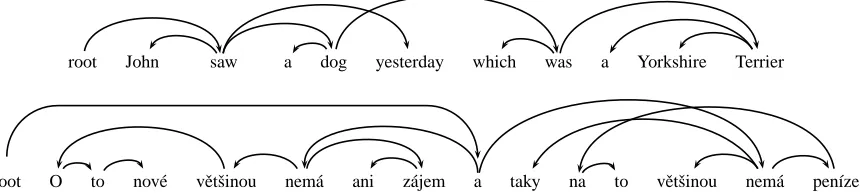
root John saw a dog yesterday which was a Yorkshire Terrier
root O to nov´e vˇetˇsinou nem´a ani z´ajem a taky na to vˇetˇsinou nem´a pen´ıze
[image:2.612.93.523.64.162.2]He is mostly not even interested in the new things and in most cases, he has no money for it either.
Figure 2: Non-projective dependency trees in English and Czech.
grammatical relations, allowing non-projective de-pendencies that we need to represent and parse ef-ficiently. A non-projective example from the Czech Prague Dependency Treebank (Hajiˇc et al., 2001) is also shown in Figure 2.
Most previous dependency parsing models have focused on projective trees, including the work of Eisner (1996), Collins et al. (1999), Yamada and Matsumoto (2003), Nivre and Scholz (2004), and McDonald et al. (2005). These systems have shown that accurate projective dependency parsers can be automatically learned from parsed data. However, non-projective analyses have recently attracted some interest, not only for languages with freer word order but also for English. In particular, Wang and Harper (2004) describe a broad coverage non-projective parser for English based on a hand-constructed con-straint dependency grammar rich in lexical and syn-tactic information. Nivre and Nilsson (2005) pre-sented a parsing model that allows for the introduc-tion of non-projective edges into dependency trees through learned edge transformations within their memory-based parser. They test this system on Czech and show improved accuracy relative to a pro-jective parser. Our approach differs from those ear-lier efforts in searching optimally and efficiently the full space of non-projective trees.
The main idea of our method is that dependency parsing can be formalized as the search for a maxi-mum spanning tree in a directed graph. This formal-ization generalizes standard projective parsing mod-els based on the Eisner algorithm (Eisner, 1996) to yield efficientO(n2)exact parsing methods for
non-projective languages like Czech. Using this span-ning tree representation, we extend the work of Mc-Donald et al. (2005) on online large-margin
discrim-inative training methods to non-projective depen-dencies.
The present work is related to that of Hirakawa (2001) who, like us, reduces the problem of depen-dency parsing to spanning tree search. However, his parsing method uses a branch and bound algorithm that is exponential in the worst case, even though it appears to perform reasonably in limited experi-ments. Furthermore, his work does not adequately address learning or measure parsing accuracy on held-out data.
Section 2 describes an edge-based factorization of dependency trees and uses it to equate depen-dency parsing to the problem of finding maximum spanning trees in directed graphs. Section 3 out-lines the online large-margin learning framework used to train our dependency parsers. Finally, in Section 4 we present parsing results for Czech. The trees in Figure 1 and Figure 2 are untyped, that is, edges are not partitioned into types representing additional syntactic information such as grammati-cal function. We study untyped dependency trees mainly, but edge types can be added with simple ex-tensions to the methods discussed here.
2 Dependency Parsing and Spanning Trees
2.1 Edge Based Factorization
In what follows,x=x1· · ·xnrepresents a generic input sentence, and y represents a generic
depen-dency tree for sentencex. Seeingyas the set of tree
edges, we write(i, j) ∈ yif there is a dependency
inyfrom wordxito wordxj.
be-tween a high dimensional feature representation of the edge and a weight vector,
s(i, j) =w·f(i, j)
Thus the score of a dependency treeyfor sentence xis,
s(x,y) =
X
(i,j)∈y
s(i, j) = X
(i,j)∈y
w·f(i, j)
Assuming an appropriate feature representation as well as a weight vector w, dependency parsing is the task of finding the dependency tree y with highest
score for a given sentencex.
For the rest of this section we assume that the weight vector w is known and thus we know the scores(i, j)of each possible edge. In Section 3 we present a method for learning the weight vector.
2.2 Maximum Spanning Trees
We represent the generic directed graphG= (V, E) by its vertex setV ={v1, . . . , vn}and setE ⊆[1 :
n]×[1 :n]of pairs(i, j)of directed edgesvi →vj. Each such edge has a score s(i, j). Since Gis di-rected,s(i, j) does not necessarily equals(j, i). A maximum spanning tree (MST) ofGis a treey⊆E
that maximizes the value P
(i,j)∈ys(i, j) such that
every vertex inV appears iny. The maximum
pro-jective spanning tree of G is constructed similarly except that it can only contain projective edges rel-ative to some total order on the vertices of G. The MST problem for directed graphs is also known as the maximum arborescence problem.
For each sentencexwe define the directed graph
Gx= (Vx, Ex)given by
Vx = {x0=root, x1, . . . , xn}
Ex = {(i, j) :i6=j,(i, j)∈[0 :n]×[1 :n]}
That is,Gx is a graph with the sentence words and
the dummy root symbol as vertices and a directed edge between every pair of distinct words and from the root symbol to every word. It is clear that de-pendency trees forxand spanning trees forGx
co-incide, since both kinds of trees are required to be rooted at the dummy root and reach all the words in the sentence. Hence, finding a (projective) depen-dency tree with highest score is equivalent to finding a maximum (projective) spanning tree inGx.
Chu-Liu-Edmonds(G, s) GraphG= (V, E)
Edge weight functions:E→R
1. LetM ={(x∗
, x) :x∈V, x∗
= arg maxx0s(x 0
, x)} 2. LetGM = (V, M)
3. IfGMhas no cycles, then it is an MST: returnGM 4. Otherwise, find a cycleCinGM
5. LetGC=contract(G, C, s) 6. Lety=Chu-Liu-Edmonds(GC, s) 7. Find a vertexx∈Cs. t.(x0
, x)∈y,(x00, x)∈C 8. returny∪C− {(x00, x)}
contract(G= (V, E), C, s)
1. LetGCbe the subgraph ofGexcluding nodes inC 2. Add a nodectoGCrepresenting cycleC
3. Forx∈V −C:∃x0∈C(x 0
, x)∈E
Add edge(c, x)toGCwith
s(c, x) = maxx0∈Cs(x 0
, x) 4. Forx∈V −C:∃x0∈C(x, x
0 )∈E
Add edge(x, c)toGCwith
s(x, c) = maxx0∈C[s(x, x0)−s(a(x0), x0) +s(C)] wherea(v)is the predecessor ofvinC
ands(C) =P
[image:3.612.317.545.60.291.2]v∈Cs(a(v), v) 5. returnGC
Figure 3: Chu-Liu-Edmonds algorithm for finding maximum spanning trees in directed graphs.
2.2.1 Non-projective Trees
To find the highest scoring non-projective tree we simply search the entire space of spanning trees with no restrictions. Well-known algorithms exist for the less general case of finding spanning trees in undi-rected graphs (Cormen et al., 1990).
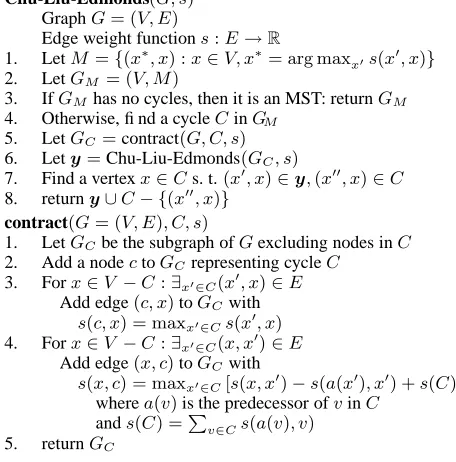
Efficient algorithms for the directed case are less well known, but they exist. We will use here the Chu-Liu-Edmonds algorithm (Chu and Liu, 1965; Edmonds, 1967), sketched in Figure 3 follow-ing Leonidas (2003). Informally, the algorithm has each vertex in the graph greedily select the incoming edge with highest weight. If a tree results, it must be the maximum spanning tree. If not, there must be a cycle. The procedure identifies a cycle and contracts it into a single vertex and recalculates edge weights going into and out of the cycle. It can be shown that a maximum spanning tree on the contracted graph is equivalent to a maximum spanning tree in the orig-inal graph (Leonidas, 2003). Hence the algorithm can recursively call itself on the new graph. Naively, this algorithm runs inO(n3)time since each recur-sive call takes O(n2) to find the highest incoming
Tarjan (1977) gives an efficient implementation of the algorithm withO(n2)time complexity for dense graphs, which is what we need here.
To find the highest scoring non-projective tree for a sentence, x, we simply construct the graph Gx
and run it through the Chu-Liu-Edmonds algorithm. The resulting spanning tree is the best non-projective dependency tree. We illustrate here the application of the Chu-Liu-Edmonds algorithm to dependency parsing on the simple examplex=John saw Mary,
with directed graph representationGx,
root
saw
J ohn M ary
10
9
9
30
30 20
3 0
11
The first step of the algorithm is to find, for each word, the highest scoring incoming edge
root
saw
J ohn 30 M ary
30 20
If the result were a tree, it would have to be the maximum spanning tree. However, in this case we have a cycle, so we will contract it into a single node and recalculate edge weights according to Figure 3.
root
saw
J ohn M ary
40 9
30
31
wjs
The new vertex wjs represents the contraction of vertices John and saw. The edge fromwjsto Mary is 30 since that is the highest scoring edge from any vertex inwjs. The edge from root intowjsis set to 40 since this represents the score of the best span-ning tree originating from root and including only the vertices in wjs. The same leads to the edge from Mary towjs. The fundamental property of the Chu-Liu-Edmonds algorithm is that an MST in this graph can be transformed into an MST in the orig-inal graph (Leonidas, 2003). Thus, we recursively call the algorithm on this graph. Note that we need to keep track of the real endpoints of the edges into and out ofwjsfor reconstruction later. Running the algorithm, we must find the best incoming edge to all words
root
saw
J ohn M ary
40
30
wjs
This is a tree and thus the MST of this graph. We now need to go up a level and reconstruct the graph. The edge fromwjsto Mary originally was from the word saw, so we include that edge. Furthermore, the edge from root towjsrepresented a tree from root to saw to John, so we include all those edges to get the final (and correct) MST,
root
saw
J ohn M ary
10
30 30
A possible concern with searching the entire space of spanning trees is that we have not used any syn-tactic constraints to guide the search. Many lan-guages that allow non-projectivity are still primarily projective. By searching all possible non-projective trees, we run the risk of finding extremely bad trees. We address this concern in Section 4.
2.2.2 Projective Trees
It is well known that projective dependency pars-ing uspars-ing edge based factorization can be handled with the Eisner algorithm (Eisner, 1996). This al-gorithm has a runtime of O(n3)and has been
em-ployed successfully in both generative and discrimi-native parsing models (Eisner, 1996; McDonald et al., 2005). Furthermore, it is trivial to show that the Eisner algorithm solves the maximum projective spanning tree problem.
The Eisner algorithm differs significantly from the Chu-Liu-Edmonds algorithm. First of all, it is a bottom-up dynamic programming algorithm as op-posed to a greedy recursive one. A bottom-up al-gorithm is necessary for the projective case since it must maintain the nested structural constraint, which is unnecessary for the non-projective case.
2.3 Dependency Trees as MSTs: Summary
the Eisner parsing algorithm and non-projective lan-guages with the Chu-Liu-Edmonds maximum span-ning tree algorithm. The only remaispan-ning problem is how to learn the weight vector w.
A major advantage of our approach over other dependency parsing models is its uniformity and simplicity. By viewing dependency structures as spanning trees, we have provided a general frame-work for parsing trees for both projective and non-projective languages. Furthermore, the resulting parsing algorithms are more efficient than lexi-calized phrase structure approaches to dependency parsing, allowing us to search the entire space with-out any pruning. In particular the non-projective parsing algorithm based on the Chu-Liu-Edmonds MST algorithm provides true non-projective pars-ing. This is in contrast to other non-projective meth-ods, such as that of Nivre and Nilsson (2005), who implement non-projectivity in a pseudo-projective parser with edge transformations. This formulation also dispels the notion that non-projective parsing is “harder” than projective parsing. In fact, it is eas-ier since non-projective parsing does not need to en-force the non-crossing constraint of projective trees. As a result, non-projective parsing complexity is just
O(n2), against the O(n3) complexity of the Eis-ner dynamic programming algorithm, which by con-struction enforces the non-crossing constraint.
3 Online Large Margin Learning
In this section, we review the work of McDonald et al. (2005) for online large-margin dependency pars-ing. As usual for supervised learning, we assume a training set T = {(xt,yt)}Tt=1, consisting of pairs
of a sentencextand its correct dependency treeyt. In what follows, dt(x) denotes the set of possible
dependency trees for sentencex.
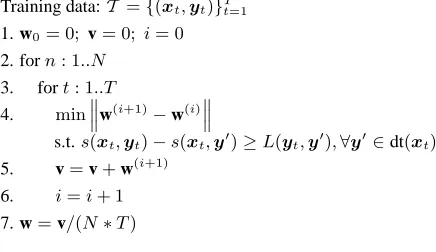
The basic idea is to extend the Margin Infused Relaxed Algorithm (MIRA) (Crammer and Singer, 2003; Crammer et al., 2003) to learning with struc-tured outputs, in the present case dependency trees. Figure 4 gives pseudo-code for the MIRA algorithm as presented by McDonald et al. (2005). An on-line learning algorithm considers a single training instance at each update to w. The auxiliary vector v accumulates the successive values of w, so that the final weight vector is the average of the weight
vec-Training data:T ={(xt,yt)}Tt=1
1. w0= 0; v= 0; i= 0
2. forn: 1..N
3. fort: 1..T
4. min‚‚
‚w
(i+1)−w(i)‚‚ ‚
s.t.s(xt,yt)−s(xt,y0)≥L(yt,y0),∀y0∈dt(xt) 5. v=v+w(i+1)
6. i=i+ 1
[image:5.612.313.531.57.183.2]7. w=v/(N∗T)
Figure 4: MIRA learning algorithm.
tors after each iteration. This averaging effect has been shown to help overfitting (Collins, 2002).
On each update, MIRA attempts to keep the new weight vector as close as possible to the old weight vector, subject to correctly classifying the instance under consideration with a margin given by the loss of the incorrect classifications. For dependency trees, the loss of a tree is defined to be the number of words with incorrect parents relative to the correct tree. This is closely related to the Hamming loss that is often used for sequences (Taskar et al., 2003).
For arbitrary inputs, there are typically exponen-tially many possible parses and thus exponenexponen-tially many margin constraints in line 4 of Figure 4.
3.1 Single-best MIRA
One solution for the exponential blow-up in number of trees is to relax the optimization by using only the single margin constraint for the tree with the highest score, s(x,y). The resulting online update (to be
inserted in Figure 4, line 4) would then be:
min w(i+1)−w(i)
s.t. s(xt,yt)−s(xt,y0)≥L(yt,y0)
wherey0 = arg maxy0s(xt,y0)
McDonald et al. (2005) used a similar update with
k constraints for the k highest-scoring trees, and showed that small values of k are sufficient to achieve the best accuracy for these methods. How-ever, here we stay with a single best tree becausek -best extensions to the Chu-Liu-Edmonds algorithm are too inefficient (Hou, 1996).
the correct tree and the highest scoring tree, which has been shown to lead to increased accuracy.
3.2 Factored MIRA
It is also possible to exploit the structure of the out-put space and factor the exponential number of mar-gin constraints into a polynomial number of local constraints (Taskar et al., 2003; Taskar et al., 2004). For the directed maximum spanning tree problem, we can factor the output by edges to obtain the fol-lowing constraints:
min
w(i+1)−w(i)
s.t.s(l, j)−s(k, j)≥1
∀(l, j)∈yt,(k, j)∈/yt
This states that the weight of the correct incoming edge to the word xj and the weight of all other in-coming edges must be separated by a margin of 1. It is easy to show that when all these constraints are satisfied, the correct spanning tree and all incor-rect spanning trees are separated by a score at least as large as the number of incorrect incoming edges. This is because the scores for all the correct arcs can-cel out, leaving only the scores for the errors causing the difference in overall score. Since each single er-ror results in a score increase of at least 1, the entire score difference must be at least the number of er-rors. For sequences, this form of factorization has been called local lattice preference (Crammer et al., 2004). Letnbe the number of nodes in graph Gx. Then the number of constraints is O(n2), since for each node we must maintainn−1constraints.
The factored constraints are in general more re-strictive than the original constraints, so they may rule out the optimal solution to the original prob-lem. McDonald et al. (2005) examines briefly fac-tored MIRA for projective English dependency pars-ing, but for that application,k-best MIRA performs as well or better, and is much faster to train.
4 Experiments
We performed experiments on the Czech Prague De-pendency Treebank (PDT) (Hajiˇc, 1998; Hajiˇc et al., 2001). We used the predefined training, develop-ment and testing split of this data set. Furthermore, we used the automatically generated POS tags that are provided with the data. Czech POS tags are very
complex, consisting of a series of slots that may or may not be filled with some value. These slots rep-resent lexical and grammatical properties such as standard POS, case, gender, and tense. The result is that Czech POS tags are rich in information, but quite sparse when viewed as a whole. To reduce sparseness, our features rely only on the reduced POS tag set from Collins et al. (1999). The num-ber of features extracted from the PDT training set was 13,450,672, using the feature set outlined by McDonald et al. (2005).
Czech has more flexible word order than English and as a result the PDT contains non-projective de-pendencies. On average, 23% of the sentences in the training, development and test sets have at least one non-projective dependency. However, less than 2%of total edges are actually non-projective. There-fore, handling non-projective edges correctly has a relatively small effect on overall accuracy. To show the effect more clearly, we created two Czech data sets. The first, Czech-A, consists of the entire PDT. The second, Czech-B, includes only the23%of sen-tences with at least one non-projective dependency. This second set will allow us to analyze the effec-tiveness of the algorithms on non-projective mate-rial. We compared the following systems:
1. COLL1999: The projective lexicalized phrase-structure parser of Collins et al. (1999).
2. N&N2005: The pseudo-projective parser of Nivre and Nilsson (2005).
3. McD2005: The projective parser of McDonald et al. (2005) that uses the Eisner algorithm for both training and testing. This system usesk-best MIRA withk=5.
4. Single-best MIRA: In this system we use the Chu-Liu-Edmonds algorithm to find the best dependency tree for Single-best MIRA training and testing.
5. Factored MIRA: Uses the quadratic set of constraints based on edge factorization as described in Section 3.2. We use the Chu-Liu-Edmonds algorithm to find the best tree for the test data.
4.1 Results
Results are shown in Table 1. There are two main metrics. The first and most widely recognized is Ac-curacy, which measures the number of words that correctly identified their parent in the tree. Complete measures the number of sentences in which the re-sulting tree was completely correct.
pars-Czech-A Czech-B
Accuracy Complete Accuracy Complete
COLL1999 82.8 - -
-N&N2005 80.0 31.8 -
-McD2005 83.3 31.3 74.8 0.0
Single-best MIRA 84.1 32.2 81.0 14.9
[image:7.612.161.454.52.130.2]Factored MIRA 84.4 32.3 81.5 14.3
Table 1: Dependency parsing results for Czech. Czech-B is the subset of Czech-A containing only sentences with at least one non-projective dependency.
ing. Even though less than 2%of all dependencies are non-projective, we still see an absolute improve-ment of up to 1.1% in overall accuracy over the projective model. Furthermore, when we focus on the subset of data that only contains sentences with at least one non-projective dependency, the effect is amplified. Another major improvement here is that the Chu-Liu-Edmonds non-projective MST al-gorithm has a parsing complexity ofO(n2), versus theO(n3)complexity of the projective Eisner
algo-rithm, which in practice leads to improvements in parsing time. The results also show that in terms of Accuracy, factored MIRA performs better than single-best MIRA. However, for the factored model, we do have O(n2) margin constraints, which re-sults in a significant increase in training time over single-best MIRA. Furthermore, we can also see that the MST parsers perform favorably compared to the more powerful lexicalized phrase-structure parsers, such as those presented by Collins et al. (1999) and Zeman (2004) that use expensiveO(n5)parsing al-gorithms. We should note that the results in Collins et al. (1999) are different then reported here due to different training and testing data sets.
One concern raised in Section 2.2.1 is that search-ing the entire space of non-projective trees could cause problems for languages that are primarily pro-jective. However, as we can see, this is not a prob-lem. This is because the model sets its weights with respect to the parsing algorithm and will disfavor features over unlikely non-projective edges.
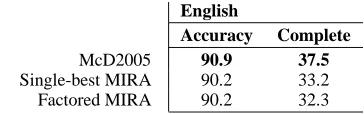
Since the space of projective trees is a subset of the space of non-projective trees, it is natural to won-der how the Chu-Liu-Edmonds parsing algorithm performs on projective data since it is asymptotically better than the Eisner algorithm. Table 2 shows the results for English projective dependency trees ex-tracted from the Penn Treebank (Marcus et al., 1993) using the rules of Yamada and Matsumoto (2003).
English
Accuracy Complete
McD2005 90.9 37.5
Single-best MIRA 90.2 33.2
Factored MIRA 90.2 32.3
Table 2: Dependency parsing results for English us-ing spannus-ing tree algorithms.
This shows that for projective data sets, training and testing with the Chu-Liu-Edmonds algorithm is worse than using the Eisner algorithm. This is not surprising since the Eisner algorithm uses the a pri-ori knowledge that all trees are projective.
5 Discussion
We presented a general framework for parsing de-pendency trees based on an equivalence to maxi-mum spanning trees in directed graphs. This frame-work provides natural and efficient mechanisms for parsing both projective and non-projective lan-guages through the use of the Eisner and Chu-Liu-Edmonds algorithms. To learn these structures we used online large-margin learning (McDonald et al., 2005) that empirically provides state-of-the-art per-formance for Czech.
A major advantage of our models is the abil-ity to naturally model non-projective parses. Non-projective parsing is commonly considered more difficult than projective parsing. However, under our framework, we show that the opposite is actually true that non-projective parsing has a lower asymp-totic complexity. Using this framework, we pre-sented results showing that the non-projective model outperforms the projective model on the Prague De-pendency Treebank, which contains a small number of non-projective edges.
[image:7.612.334.516.173.230.2]include features of larger substructures. Unfortu-nately, that would make the search for the best tree intractable (H¨offgen, 1993).
Acknowledgments
We thank Lillian Lee for bringing an important missed connection to our attention, and Koby Cram-mer for his help with learning algorithms. This work has been supported by NSF ITR grants 0205448 and 0428193.
References
Y.J. Chu and T.H. Liu. 1965. On the shortest arbores-cence of a directed graph. Science Sinica, 14:1396– 1400.
M. Collins, J. Hajiˇc, L. Ramshaw, and C. Tillmann. 1999. A statistical parser for Czech. In Proc. ACL.
M. Collins. 2002. Discriminative training methods for hidden Markov models: Theory and experiments with perceptron algorithms. In Proc. EMNLP.
T.H. Cormen, C.E. Leiserson, and R.L. Rivest. 1990.
In-troduction to Algorithms. MIT Press/McGraw-Hill.
K. Crammer and Y. Singer. 2003. Ultraconservative on-line algorithms for multiclass problems. JMLR.
K. Crammer, O. Dekel, S. Shalev-Shwartz, and Y. Singer. 2003. Online passive aggressive algorithms. In Proc.
NIPS.
K. Crammer, R. McDonald, and F. Pereira. 2004. New large margin algorithms for structured prediction. In
Learning with Structured Outputs Workshop (NIPS).
A. Culotta and J. Sorensen. 2004. Dependency tree ker-nels for relation extraction. In Proc. ACL.
Y. Ding and M. Palmer. 2005. Machine translation using probabilistic synchronous dependency insertion gram-mars. In Proc. ACL.
J. Edmonds. 1967. Optimum branchings. Journal of
Re-search of the National Bureau of Standards, 71B:233–
240.
J. Eisner. 1996. Three new probabilistic models for de-pendency parsing: An exploration. In Proc. COLING.
J. Hajiˇc, E. Hajicova, P. Pajas, J. Panevova, P. Sgall, and B. Vidova Hladka. 2001. The Prague Dependency Treebank 1.0 CDROM. Linguistics Data Consortium Cat. No. LDC2001T10.
J. Hajiˇc. 1998. Building a syntactically annotated cor-pus: The Prague dependency treebank. Issues of
Va-lency and Meaning, pages 106–132.
H. Hirakawa. 2001. Semantic dependency analysis method for Japanese based on optimum tree search al-gorithm. In Proc. of PACLING.
Klaus-U. H¨offgen. 1993. Learning and robust learning of product distributions. In Proceedings of COLT’93, pages 77–83.
W. Hou. 1996. Algorithm for finding the first k shortest arborescences of a digraph. Mathematica Applicata, 9(1):1–4.
R. Hudson. 1984. Word Grammar. Blackwell.
G. Leonidas. 2003. Arborescence optimization problems solvable by Edmonds’ algorithm. Theoretical
Com-puter Science, 301:427 – 437.
M. Marcus, B. Santorini, and M. Marcinkiewicz. 1993. Building a large annotated corpus of English: the Penn Treebank. Computational Linguistics, 19(2):313–330.
R. McDonald, K. Crammer, and F. Pereira. 2005. Online large-margin training of dependency parsers. In Proc.
ACL.
J. Nivre and J. Nilsson. 2005. Pseudo-projective depen-dency parsing. In Proc. ACL.
J. Nivre and M. Scholz. 2004. Deterministic dependency parsing of english text. In Proc. COLING.
Y. Shinyama, S. Sekine, K. Sudo, and R. Grishman. 2002. Automatic paraphrase acquisition from news ar-ticles. In Proc. HLT.
R. Snow, D. Jurafsky, and A. Y. Ng. 2004. Learning syntactic patterns for automatic hypernym discovery. In NIPS 2004.
R.E. Tarjan. 1977. Finding optimum branchings.
Net-works, 7:25–35.
B. Taskar, C. Guestrin, and D. Koller. 2003. Max-margin Markov networks. In Proc. NIPS.
B. Taskar, D. Klein, M. Collins, D. Koller, and C. Man-ning. 2004. Max-margin parsing. In Proc. EMNLP.
W. Wang and M. P. Harper. 2004. A statistical constraint dependency grammar (CDG) parser. In Workshop on
Incremental Parsing: Bringing Engineering and Cog-nition Together (ACL).
H. Yamada and Y. Matsumoto. 2003. Statistical depen-dency analysis with support vector machines. In Proc.
IWPT.
D. Zeman. 2004. Parsing with a Statistical Dependency