Composition of Conditional Random Fields for Transfer Learning
Charles Sutton and Andrew McCallum
Department of Computer Science
University of Massachusetts
Amherst, MA 01003
{
sutton,mccallum
}
@cs.umass.edu
Abstract
Many learning tasks have subtasks for which much training data exists. Therefore, we want to transfer learning from the old, general-purpose subtask to a more specific new task, for which there is often less data. While work in transfer learning often considers how the old task should affect learning on the new task, in this paper we show that it helps to take into account how the new task affects the old. Specifically, we perform joint decoding of separately-trained sequence models, preserv-ing uncertainty between the tasks and allowpreserv-ing information from the new task to affect predic-tions on the old task. On two standard text data sets, we show that joint decoding outperforms cascaded decoding.
1
Introduction
Many tasks in natural language processing are solved by chaining errorful subtasks. Within information extrac-tion, for example, part-of-speech tagging and shallow parsing are often performed before the main extraction task. Commonly these subtasks have their own standard sets of labeled training data: for example, many large data sets exist for learning to extract person names from newswire text; whereas the available training data for new applications, such as extracting appointment information from email, tends to be much smaller. Thus, we need to transfer regularities learned from a well-studied subtask, such as finding person names in newswire text, to a new, related task, such as finding names of speakers in email seminar announcements.
In previous NLP systems, transfer is often accom-plished by training a model for the subtask, and using its prediction as a feature for the new task. For example, re-cent CoNLL shared tasks (Tjong Kim Sang & De Meul-der, 2003; Carreras & Marquez, 2004), which are stan-dard data sets for such common NLP tasks as clause
iden-tification and named-entity recognition, include predic-tions from a part-of-phrase tagger and a shallow parser as features. But including only the single most likely sub-task prediction fails to exploit useful dependencies be-tween the tasks. First, if the subtask prediction is wrong, the model for the new task may not be able to recover. Of-ten, errors propagate upward through the chain of tasks, causing errors in the final output. This problem can be ameliorated by preserving uncertainty in the subtask pre-dictions, because even if the best subtask prediction is wrong, the distribution over predictions can still be some-what accurate.
Second, information from the main task can inform the subtask. This is especially important for learning trans-fer, because the new domain often has different charac-teristics than the old domain, which is often a standard benchmark data set. For example, named-entity recog-nizers are usually trained on newswire text, which is more structured and grammatical than email, so we expect an off-the-shelf named-entity recognizer to perform some-what worse on email. An email task, however, often has domain-specific features, such as PREVIOUS WORD IS
Speaker:), which were unavailable or uninformative to the subtask on the old training set, but are very informa-tive to the subtask in the new domain. While previous work in transfer learning has considered how the old task can help the new task, in this paper we show how the new task can help itself by improving predictions on the old.
at once. Viterbi decoding in this combined model im-plicitly considers all possible predictions for the subtask when making decisions in the main task.
We evaluate joint decoding for learning transfer on a standard email data set and a standard entity recognition task. On the email data set, we show a significant gain in performance, including new state-of-the-art results. Of particular interest for transfer learning, we also show that using joint decoding, we achieve equivalent results to cas-caded decoding with 25% less training data.
2
Linear-chain CRFs
Conditional random fields(CRFs) (Lafferty et al., 2001) are undirected graphical models that are conditionally trained. In this section, we describe CRFs for the linear-chain case. Linear-linear-chain CRFs can be roughly under-stood as conditionally-trained finite state machines. A linear-chain CRF defines a distribution over state se-quences s = {s1, s2, . . . , sT} given an input sequence x = {x1, x2, . . . , xT} by making a first-order Markov assumption on states. These Markov assumptions imply that the distribution over sequences factorizes in terms of pairwise functionsΦt(st−1, st,x)as:
p(s|x) = Q
tΦt(st−1, st,x)
Z(x) , (1)
The partition functionZ(x)is defined to ensure that the distribution is normalized:
Z(x) =X
s0 Y
t
Φt(s0t−1, s
0
t,x). (2)
Thepotential functionsΦt(st−1, st,x)can be interpreted as the cost of making a transition from statest−1to state stat timet, similar to a transition probability in an HMM. Computing the partition functionZ(x)requires sum-ming over all of the exponentially many possible state sequencess0. By exploiting Markov assumptions,
how-ever,Z(x)(as well as the node marginalsp(st|x)and the Viterbi labeling) can be calculated efficiently by variants of the standard dynamic programming algorithms used for HMMs.
We assume the potentials factorize according to a set of features{fk}, which are given and fixed, so that
Φ(st−1, st,x) = exp X
k
λkfk(st−1, st,x, t) !
. (3)
The model parameters are a set of real weightsΛ ={λk}, one for each feature.
Feature functions can be arbitrary. For example, one feature function could be a binary testfk(st−1, st,x, t) that has value 1 if and only ifst−1has the label SPEAK
-ERNAME,sthas the label OTHER, and the wordxt be-gins with a capital letter. The chief practical advantage
of conditional models, in fact, is that we can include ar-bitrary highly-dependent features without needing to es-timate their distribution, as would be required to learn a generative model.
Given fully-labeled training instances {(sj,xj)}Mj=1, CRF training is usually performed by maximizing the pe-nalized log likelihood
`(Λ) =X
j X
t X
k
λkfk(sj,t−1, sj,t,x, t)
−X
j
logZ(xj)− X
k
λ2k 2σ2 (4)
where the final term is a zero-mean Gaussian prior placed on parameters to avoid overfitting. Although this maxi-mization cannot be done in closed form, it can be op-timized numerically. Particularly effective are gradient-based methods that use approximate second-order infor-mation, such as conjugate gradient and limited-memory BFGS (Byrd et al., 1994). For more information on current training methods for CRFs, see Sha and Pereira (2003).
3
Dynamic CRFs
Dynamic conditional random fields (Sutton et al., 2004) extend linear-chain CRFs in the same way that dynamic Bayes nets (Dean & Kanazawa, 1989) extend HMMs. Rather than having a single monolithic state variable, DCRFs factorize the state at each time step by an undi-rected model.
Formally, DCRFs are the class of conditionally-trained undirected models that repeat structure and parameters over a sequence. If we denote byΦc(yc,t,xt)the repe-tition of cliquecat time stept, then a DCRF defines the probability of a label sequencesgiven the inputxas:
p(s|x) = Q
tΦc(yc,t,xt)
Z(x) , (5)
where as before, the clique templates are parameterized in terms of input features as
Φc(yc,t,xt) = exp (
X
k
λkfk(yc,t,xt) )
. (6)
Sutton et al. (2004) introduced the factorial CRF
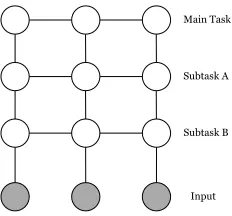
[image:3.612.368.484.55.163.2](FCRF), in which the factorized state structure is a grid (Figure 1). FCRFs were originally applied to jointly performing interdependent language processing tasks, in particular part-of-speech tagging and noun-phrase chunk-ing. The previous work on FCRFs used joint training, which requires a single training set that is jointly labeled for all tasks in the cascade. For many tasks such data is not readily available, for example, labeling syntac-tic parse trees for every new Web extraction task would be prohibitively expensive. In this paper, we train the subtasks separately, which allows us the freedom to use large, standard data sets for well-studied subtasks such as named-entity recognition.
4
Alternatives for Learning Transfer
In this section, we enumerate several classes of methods for learning transfer, based on the amount and type of interaction they allow between the tasks. The principal differences between methods are whether the individual tasks are performed separately in a cascade or jointly; whether a single prediction from the lower task is used, or several; and what kind of confidence information is shared between the subtasks.
The main types of transfer learning methods are:
1. Cascaded training and testing.This is the traditional approach in NLP, in which the single best prediction from the old task is used in the new task at training and test time. In this paper, we show that allowing richer interactions between the subtasks can benefit performance.
2. Joint training and testing. In this family of ap-proaches, a single model is trained to perform all the subtasks at once. For example, in Caruana’s work on multitask learning (Caruana, 1997), a neural net-work is trained to jointly perform multiple classifica-tion tasks, with hidden nodes that form a shared rep-resentation among the tasks. Jointly trained meth-ods allow potentially the richest interaction between tasks, but can be expensive in both computation time required for training and in human effort required to label the joint training data.
Exact inference in a jointly-trained model, such as forward-backward in an FCRF, implicitly con-siders all possible subtask predictions with confi-dence given by the model’s probability of the pre-diction. However, for computational efficiency, we can use inference methods such as particle filtering and sparse message-passing (Pal et al., 2005), which communicate only a limited number of predictions between sections of the model.
Main Task
Subtask A
Subtask B
Input
Figure 1: Graphical model for the jointly-decoded CRF. All of the pairwise cliques also have links to the observed input, although we omit these edges in the diagram for clarity.
3. Joint testing with cascaded training. Although a joint model over all the subtasks can have better per-formance, it is often much more expensive to train. One approach for reducing training time is cascaded training, which provides both computational effi-ciency and the ability to reuse large, standard train-ing sets for the subtasks. At test time, though, the separately-trained models are combined into a sgle model, so that joint decoding can propagate in-formation between the tasks.
Even with cascaded training, it is possible to pre-serve some uncertainty in the subtask’s predictions. Instead of using only a single subtask prediction for training the main task, the subtask can pass up-wards a lattice of likely predictions, each of which is weighted by the model’s confidence. This has the advantage of making the training procedure more similar to the joint testing procedure, in which all possible subtask predictions are considered.
In the next two sections, we describe and evaluate joint testing with cascaded training for transfer learning in linear-chain CRFs. At training time, only the best subtask prediction is used, without any confidence infor-mation. Even though this is perhaps the simplest joint-testing/cascaded-training method, we show that it still leads to a significant gain in accuracy.
5
Composition of CRFs
In this section we briefly describe how we combine individually-trained linear-chain CRFs using composi-tion. For a series ofN cascaded tasks, we train indi-vidual CRFs separately on each task, using the prediction of the previous CRF as a feature. We index the CRFs byi, so that the state of CRF iat timetis denoted si
t. Thus, the feature functions for CRF i are of the form fi
k(s i t−1, sit, s
i−1
t ,x, t)—that is, they depend not only on the observed inputxand the transition(si
wt=w
wtmatches[A-Z][a-z]+ wtmatches[A-Z][A-Z]+ wtmatches[A-Z] wtmatches[A-Z]+
wtmatches[A-Z]+[a-z]+[A-Z]+[a-z] wtappears in list of first names,
last names, honorifics, etc.
wtappears to be part of a time followed by a dash wtappears to be part of a time preceded by a dash wtappears to be part of a date
Tt=T
[image:4.612.87.286.52.186.2]qk(x, t+δ)for allkandδ∈[−4,4]
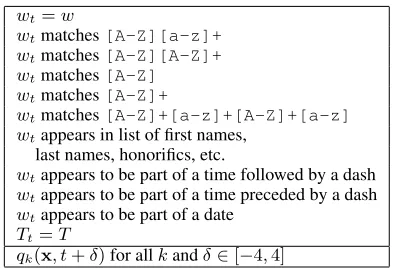
Table 1: Input featuresqk(x, t)for the seminars data. In the abovewtis the word at positiont,Ttis the POS tag at positiont,wranges over all words in the training data, andTranges over all Penn Treebank part-of-speech tags. The “appears to be” features are based on hand-designed regular expressions that can span several tokens.
also on the statesit−1of the previous transducer.
We also add all conjunctions of the input features and the previous transducer’s state, for example, a feature that is 1 if the current state is SPEAKERNAME, the previ-ous transducer predicted PERSONNAME, and the previ-ous word isHost:.
To perform joint decoding at test time, we form the composition of the individual CRFs, viewed as finite-state transducers. That is, we define a new linear-chain CRF whose state space is the cross product of the states of the individual CRFs, and whose transition costs are the sum of the transition costs of the individual CRFs.
Formally, let S1, S2, . . . SN be the state sets and
Λ1,Λ2, . . .ΛN the weights of the individual CRFs. Then the state set of the combined CRF isS=S1×S2×. . .× SN. We will denote weightkin an individual CRFiby λik and a single feature byfki(sit−1, sit, s
i−1
t ,x, t). Then fors∈S, the combined model is given by:
p(s|x) = Q
texp n
PN i=1
P kλ
i kf
i k(s
i t−1, sit, s
i−1
t ,x, t) o
Z(x) .
(7) The graphical model for the combined model is the fac-torial CRF in Figure 1.
6
Experiments
6.1 Email Seminar Announcements
We evaluate joint decoding on a collection of 485 e-mail messages announcing seminars at Carnegie Mellon Uni-versity, gathered by Freitag (1998). The messages are annotated with the seminar’s starting time, ending time, location, and speaker. This data set has been the sub-ject of much previous work using a wide variety of learn-ing methods. Despite all this work, however, the best
50 100 150 200 250
0.1
0.2
0.3
0.4
0.5
0.6
0.7
0.8
Number of training instances
F1
[image:4.612.318.526.53.239.2]Joint Cascaded
Figure 2: Learning curves for the seminars data set on the speaker field, averaged over 10-fold cross validation. Joint training performs equivalently to cascaded decoding with 25% more data.
reported systems have precision and recall on speaker names of only about 70%—too low to use in a practical system. This task is so challenging because the messages are written by many different people, who each have dif-ferent ways of presenting the announcement information. Because the task includes finding locations and per-son names, the output of a named-entity tagger is a use-ful feature. It is not a perfectly indicative feature, how-ever, because many other kinds of person names appear in seminar announcements—for example, names of faculty hosts, departmental secretaries, and sponsors of lecture series. For example, the tokenHost: indicates strongly both that what follows is a person name, but that person is not the seminars’ speaker.
Even so, named-entity predictions do improve per-formance on this task. We use the predictions from a CRF named-entity tagger that we trained on the standard CoNLL 2003 English data set. The CoNLL 2003 data set consists of newswire articles from Reuters labeled as either people, locations, organizations, or miscellaneous entities. It is much larger than the seminar announce-ments data set. While the named-entity data contains 203,621 tokens for training, the seminar announcements data set contains only slightly over 60,000 training to-kens.
System stime etime location speaker overall
WHISK (Soderland, 1999) 92.6 86.1 66.6 18.3 65.9
SRV (Freitag, 1998) 98.5 77.9 72.7 56.3 76.4
HMM (Frietag & McCallum, 1999) 98.5 62.1 78.6 76.6 78.9
RAPIER (Califf & Mooney, 1999) 95.9 94.6 73.4 53.1 79.3
SNOW-IE (Roth & Wen-tau Yih, 2001) 99.6 96.3 75.2 73.8 86.2
(LP)2 (Ciravegna, 2001) 99.0 95.5 75.0 77.6 86.8
CRF (no transfer) This paper 99.1 97.3 81.0 73.7 87.8
CRF (cascaded) This paper 99.2 96.0 84.3 74.2 88.4
[image:5.612.113.503.53.158.2]CRF (joint) This paper 99.1 96.0 85.3 76.3 89.2
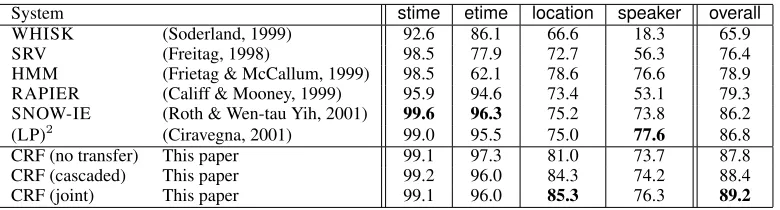
Table 2: Comparison of F1 performance on the seminars data. Joint decoding performs significantly better than cascaded decoding. The overall column is the mean of the other four. (This table was adapted from Peshkin and Pfeffer (2003).)
we use 10-fold cross validation with a 50/50 training/test split. We use a spherical Gaussian prior on parameters with varianceσ2= 0.5.
We evaluate whether joint decoding with cascaded training performs better than cascaded training and de-coding. Table 2 compares cascaded and joint decoding for CRFs with other previous results from the literature.1 The features we use are listed in Table 1. Although previ-ous work has used very different feature sets, we include a no-transfer CRF baseline to assess the impact of transfer from the CoNLL data set. All the CRF runs used exactly the same features.
On the most challenging fields,locationandspeaker, cascaded transfer is more accurate than no transfer at all, and joint decoding is more accurate than cascaded decod-ing. In particular, forspeaker, we see an error reduction of 8% by using joint decoding over cascaded. The differ-ence in F1 between cascaded and joint decoding is statis-tically significant forspeaker(pairedt-test;p= 0.017) but only marginally significant forlocation(p= 0.067). Our results are competitive with previous work; for ex-ample, onlocation, the CRF is more accurate than any of the existing systems.
Examining the trained models, we can observe both errors made by the general-purpose named entity tagger, and how they can be corrected by considering the sem-inars labels. In newswire text, long runs of capitalized words are rare, often indicating the name of an entity. In email announcements, runs of capitalized words are com-mon in formatted text blocks like:
Location: Baker Hall
Host: Michael Erdmann
In this type of situation, the named entity tagger often mistakesHost: for the name of an entity, especially be-cause the word precedingHostis also capitalized. On one of the cross-validated testing sets, of 80 occurrences of
1We omit one relevant paper (Peshkin & Pfeffer, 2003)
be-cause its evaluation method differs from all the other previous work.
wt=w
wtmatches[A-Z][a-z]+ wtmatches[A-Z][A-Z]+ wtmatches[A-Z] wtmatches[A-Z]+
wtmatches[A-Z]+[a-z]+[A-Z]+[a-z] wtis punctuation
wtappears in list of first names, last names, honorifics, etc. qk(x, t+δ)for allkandδ∈[−2,2]
[image:5.612.317.540.222.336.2]Conjunctionqk(x, t)andqk0(x, t)for all featuresk, k0 Conjunctionqk(x, t)andqk0(x, t+ 1)for all featuresk, k0
Table 3: Input featuresqk(x, t)for the ACE named-entity data. In the abovewt is the word at positiont, and w ranges over all words in the training data.
the wordHost:, the named-entity tagger labels 52 as some kind of entity. When joint decoding is used, however, only 20 occurrences are labeled as entities. Recall that the joint model uses exactly the same weights as the cas-caded model; the only difference is that the joint model takes into account information about the seminar labels when choosing named-entity labels. This is an example of how domain-specific information from the main task can improve performance on a more standard, general-purpose subtask.
Figure 2 shows the difference in performance between joint and cascaded decoding as a function of training set size. Cascaded decoding with the full training set of 242 emails performs equivalently to joint decoding on only 181 training instances, a 25% reduction in the training set.
In summary, even with a simple cascaded training method on a well-studied data set, joint decoding per-forms better for transfer than cascaded decoding.
6.2 Entity Recognition
Transfer Type
none cascaded joint
Person name 81.0 86.9 87.3
Person nominal 34.9 36.1 42.4
Organization name 53.9 62.6 61.1
Organization nominal 33.7 35.3 40.8
GPE name 78.5 84.0 84.0
[image:6.612.77.282.59.199.2]GPE nominal 51.2 54.1 59.2
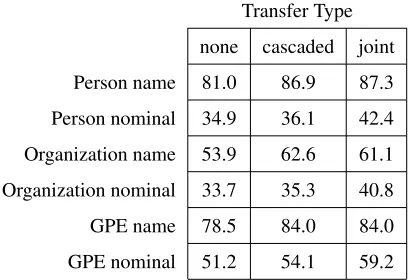
Table 4: Comparison of F1 performance between joint and cascaded training on the ACE entity recognition task. GPE means geopolitical entities, such as countries. Joint decoding helps most on the harder nominal (common noun) references. These results were obtained using a small subset of the training set.
set, containing 422 stories from newspaper, newswire, and broadcast news. Unlike the CoNLL entity recog-nition data set, in which only proper names of entities are annotated, the ACE data includes annotation both for named entities likeUnited States, and also nominal men-tions of entities likethe nation. Thus, although the input text has similar distribution in the CoNLL NER and ACE data set, the label distributions are very different.
Current state-of-the-art systems for the ACE task (Flo-rian et al., 2004) use the predictions of other named-entity recognizers as features, that is, they use cascaded trans-fer. In this experiment, we test whether the transfer be-tween these datasets can be further improved using joint decoding. We train a CRF entity recognizer on the ACE dataset, with the output of a named-entity entity recog-nizer trained on the CoNLL 2003 English data set. The CoNLL recognizer is the same CRF as was used in the previous experiment. In these results, we use a subset of 10% of the ACE training data. Table 3 lists the features we use. Table 4 compares the results on some represen-tative entity types. Again, cascaded decoding for transfer is better than no transfer at al, and joint decoding is better than cascaded decoding. Interestingly, joint decoding has most impact on the harder nominal references, showing marked improvement over the cascaded approach.
7
Related Work
Researchers have begun to accumulate experimental ev-idence that joint training and decoding yields better per-formance than the cascaded approach. As mentioned ear-lier, the original work on dynamic CRFs (Sutton et al., 2004) demonstrated improvement due to joint training in the domains of part-of-speech tagging and noun-phrase
chunking. Also, Carreras and Marquez (Carreras & M`arquez, 2004) have obtained increased performance in clause finding by training a cascade of perceptrons to minimize a single global error function. Finally, Miller et al. (Miller et al., 2000) have combined entity recognition, parsing, and relation extraction into a jointly-trained sin-gle statistical parsing model that achieves improved per-formance on all the subtasks.
Part of the contribution of the current work is to sug-gest that joint decoding can be effective even when joint training is not possible because jointly-labeled data is un-available. For example, Miller et al. report that they orig-inally attempted to annotate newswire articles for all of parsing, relations, and named entities, but they stopped because the annotation was simply too expensive. In-stead they hand-labeled relations only, assigning parse trees to the training set using a standard statistical parser, which is potentially less flexible than the cascaded train-ing, because the model for main task is trained explicitly to match the noisy subtask predictions, rather than being free to correct them.
In the speech community, it is common to com-pose separately trained weighted finite-state transducers (Mohri et al., 2002) for joint decoding. Our method ex-tends this work to conditional models. Ordinarily, higher-level transducers depend only on the output of the previ-ous transducer: a transducer for the lexicon, for exam-ple, consumes only phonemes, not the original speech signal. In text, however, such an approach is not sensi-ble, because there is simply not enough information in the named-entity labels, for example, to do extraction if the original words are discarded. In a conditional model, weights in higher-level transducers are free to depend on arbitrary features of the original input without any addi-tional complexity in the finite-state structure.
Finally, stacked sequential learning (Cohen & Car-valho, 2005) is another potential method for combining the results of the subtask transducers. In this general meta-learning method for sequential classification, first a base classifier predicts the label at each time step, and then a higher-level classifier makes the final prediction, including as features a window of predictions from the base classifier. For transfer learning, this would corre-spond to having an independent base model for each sub-task (e.g., independent CRFs for named-entity and sem-inars), and then having a higher-level CRF that includes as a feature the predictions from the base models.
8
Conclusion
pre-dictions of the old task, an effect that is only possible with joint decoding.
It is now common for researchers to publicly release trained models for standard tasks such as part-of-speech tagging, named-entity recognition, and parsing. This pa-per has implications for how such standard tools are pack-aged. Our results suggest that off-the-shelf NLP tools will need not only to provide a single-best prediction, but also to be engineered so that they can easily communicate distributions over predictions to models for higher-level tasks.
Acknowledgments
This work was supported in part by the Center for Intelligent In-formation Retrieval, in part by The Central Intelligence Agency, the National Security Agency and National Science Foundation under NSF grants #IIS-0326249 and #IIS-0427594, and in part by the Defense Advanced Research Projects Agency (DARPA), through the Department of the Interior, NBC, Acquisition Ser-vices Division, under contract number NBCHD030010. Any opinions, findings and conclusions or recommendations ex-pressed in this material are the author(s) and do not necessarily reflect those of the sponsor.
References
Byrd, R. H., Nocedal, J., & Schnabel, R. B. (1994). Repre-sentations of quasi-Newton matrices and their use in limited memory methods.Math. Program.,63, 129–156.
Califf, M. E., & Mooney, R. J. (1999). Relational learning of pattern-match rules for information extraction. Proceed-ings of the Sixteenth National Conference on Artificial Intel-ligence (AAAI-99)(pp. 328–334).
Carreras, X., & Marquez, L. (2004). Introduction to the CoNLL-2004 shared task: Semantic role labeling. Proceed-ings of CoNLL-2004.
Carreras, X., & M`arquez, L. (2004). Online learning via global feedback for phrase recognition. In S. Thrun, L. Saul and B. Sch¨olkopf (Eds.), Advances in neural information pro-cessing systems 16. Cambridge, MA: MIT Press.
Caruana, R. (1997). Multitask learning.Machine Learning,28, 41–75.
Ciravegna, F. (2001). Adaptive information extraction from text by rule induction and generalisation.Proceedings of 17th In-ternational Joint Conference on Artificial Intelligence (IJCAI 2001).
Cohen, W. W., & Carvalho, V. R. (2005). Stacked sequential learning.International Joint Conference on Artificial Intelli-gence(pp. 671–676).
Dean, T., & Kanazawa, K. (1989). A model for reasoning about persistence and causation.Computational Intelligence,5(3), 142–150.
Florian, R., Hassan, H., Ittycheriah, A., Jing, H., Kambhatla, N., Luo, X., Nicolov, N., Roukos, S., & Zhang, T. (2004). A statistical model for multilingual entity detection and track-ing.InHLT/NAACL 2004.
Freitag, D. (1998).Machine learning for information extraction in informal domains. Doctoral dissertation, Carnegie Mellon University.
Frietag, D., & McCallum, A. (1999). Information extraction with HMMs and shrinkage. AAAI Workshop on Machine Learning for Information Extraction.
Lafferty, J., McCallum, A., & Pereira, F. (2001). Conditional random fields: Probabilistic models for segmenting and la-beling sequence data.Proc. 18th International Conf. on Ma-chine Learning.
Miller, S., Fox, H., Ramshaw, L. A., & Weischedel, R. M. (2000). A novel use of statistical parsing to extract infor-mation from text.ANLP 2000(pp. 226–233).
Mohri, M., Pereira, F., & Riley, M. (2002). Weighted finite-state transducers in speech recognition. Computer Speech and Language,16, 69–88.
Pal, C., Sutton, C., & McCallum, A. (2005). Fast inference and learning with sparse belief propagation(Technical Re-port IR-433). Center for Intelligent Information Retrieval, University of Massachusetts.
Peshkin, L., & Pfeffer, A. (2003). Bayesian information extrac-tion network.Proceedings of the International Joint Confer-ence on Artificial IntelligConfer-ence (IJCAI).
Roth, D., & Wen-tau Yih (2001). Relational learning via propo-sitional algorithms: An information extraction case study. In-ternational Joint Conference on Artificial Intelligence (pp. 1257–1263).
Sha, F., & Pereira, F. (2003). Shallow parsing with conditional random fields.Proceedings of HLT-NAACL 2003.
Soderland, S. (1999). Learning information extraction rules for semi-structured and free text.Machine Learning, 233–272. Sutton, C., Rohanimanesh, K., & McCallum, A. (2004).
Dy-namic conditional random fields: Factorized probabilistic models for labeling and segmenting sequence data. Proceed-ings of the Twenty-First International Conference on Ma-chine Learning (ICML).