A Projection Extension Algorithm for Statistical Machine Translation
Christoph Tillmann
IBM T.J. Watson Research Center Yorktown Heights, NY 10598
Abstract
In this paper, we describe a phrase-based unigram model for statistical machine translation that uses a much simpler set of model parameters than similar phrase-based models. The units of translation are blocks – pairs of phrases. During decod-ing, we use a block unigram model and a word-based trigram language model. Dur-ing trainDur-ing, the blocks are learned from source interval projections using an un-derlying high-precision word alignment. The system performance is significantly increased by applying a novel block exten-sion algorithm using an additional high-recall word alignment. The blocks are fur-ther filtered using unigram-count selection criteria. The system has been successfully test on a Chinese-English and an Arabic-English translation task.
1 Introduction
Various papers use phrase-based translation systems (Och et al., 1999; Marcu and Wong, 2002; Ya-mada and Knight, 2002) that have shown to improve translation quality over single-word based transla-tion systems introduced in (Brown et al., 1993). In this paper, we present a similar system with a much simpler set of model parameters. Specifically, we compute the probability of a block sequence
[image:1.612.313.535.257.423.2]. A block is a pair consisting of a contiguous source and a contiguous target phrase. The block sequence
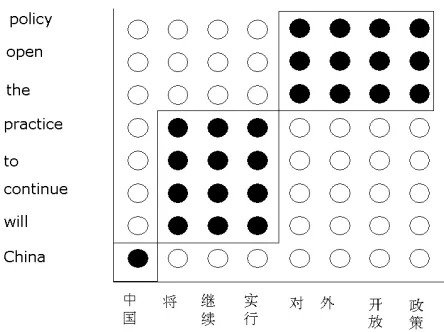
Figure 1: A block sequence that jointly generates
target and source phrases. The example is actual decoder output and the English translation is slightly incorrect.
probability
is decomposed into conditional probabilities using the chain rule:
(1)
"!
$#
We try to find the block sequence that maximizes
%
: %
'&(*)+,&-/.*01
%$
. The model pro-posed is a joint model as in (Marcu and Wong, 2002), since target and source phrases are generated jointly. The approach is illustrated in Figure 1. The source phrases are given on the2 -axis and the target
phrases are given on the3 -axis. During block
generated. The two types of parameters in Eq 1 are defined as:
4
Block unigram model576*89;:: We compute
un-igram probabilities for the blocks. The blocks are simpler than the alignment templates (Och et al., 1999) in that they do not have an internal structure.
4
Trigram language model: the probability
576*8<9>=8%9?A@: between adjacent blocks is
com-puted as the probability of the first target word in the target clump of 89 given the final two
words of the target clump of89?A@ .
The exponentB is set in informal experiments to be CEDGF
. No other parameters such as distortion proba-bilities are used.
To select blocks 8 from training data, we compute
unigram block co-occurrence counts HI6*8:. HI6*8J:
cannot be computed for all blocks in the training data: we would obtain hundreds of millions of blocks. The blocks are restricted by an underlying word alignment. In this paper, we present a block generation algorithm similar to the one in (Och et al., 1999) in full detail: source intervals are pro-jected into target intervals under a restriction derived from a high-precision word alignment. The projec-tion yields a set of high-precision block links. These block links are further extended using a high-recall word alignment. The block extension algorithm is shown to improve translation performance signifi-cantly. The system is tested on a Chinese-English (CE) and an Arabic-English (AE) translation task. The paper is structured as follows: in Section 2, we present the baseline block generation algorithm. The block extension approach is described in Sec-tion 2.1. SecSec-tion 3 describes a DP-based decoder using blocks. Experimental results are presented in Section 4.
2 Block Generation Algorithm
Starting point for the block generation algorithm is a word alignment obtained from an HMM Viterbi training (Vogel et al., 1996). The HMM Viterbi training is carried out twice with English as target language and Chinese as source language and vice versa. We obtain two alignment relations:
K
@ML NO6P Q>RTSO:=RVU$PXWZY\[
L NO6*8%_`QY:=8aUY,WZP"[
RbU/PcWdY is an alignment function from source to
target positions and8aUTYeWfP is an alignment
func-tion from target to source posifunc-tions 1. We compute the union and the intersection of the two alignment relations
K
@ and Kg]
:
h
L
K
@ji Kg]
k
L
K
@jl K ]
We call the intersection relation h
, because it rep-resents a high-precision alignment, and the union alignment
k
, because it is taken to be a lower pre-cision higher recall alignment (Och and Ney, 2000). The intersection h
is also a (partial) bijection be-tween the target and source positions: it covers the same number of target and source positions and there is a bijection between source and target po-sitions that are covered. For the CE experiments reported in Section 4 about m
F
% of the target and source positions are covered by word links inh
, for the AE experiments aboutn
F
% are covered. The ex-tension algorithm presented assumes that hpoqk
, which is valid in this case since h
and k
are de-rived from intersection and union. We introduce the following additional piece of notation:
rJst
6
h
:L NPb=u`Y and 6PvQY :xw
h
[ (2)
rJst
6
h
: is the set of all source positions that are
cov-ered by some word links inh
, where the source po-sitions are shown along theP -axis and the target
po-sitions are shown along theY -axis. To derive
high-precision block links from the high-high-precision word links, we use the following projection definitions:
y
S 6zP{QP\|:L N}~=u`wzP\{QP | and 6 Q}E:xw
h
[
Here, y
S 6: projects source intervals into target
in-tervals.y
_`6: projects target intervals into source
in-tervals and is defined accordingly. Starting from the high-precision word alignmenth
, we try to derive a high-precision block alignment: we project source intervals zP {QP |, whereP {QP w
rJst
6
h
:. We compute
the minimum target index Y
{ and maximum target
indexY for the word links5w
h
that fall into the
1
Source
Target
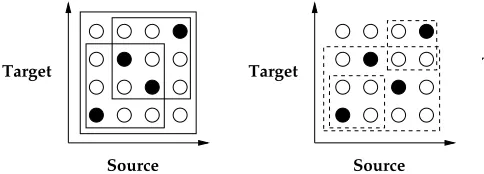
[image:3.612.71.313.71.158.2]Source Target
[image:3.612.314.539.71.224.2]Figure 2: The left picture shows three blocks that are learned from projecting three source intervals. The right picture shows three blocks that cannot be obtain from source interval projections .
Table 1: Block learning algorithm using the inter-section .
input: High-precision alignment
for each interval , where~J do
¡
¢,£¥¤ ¦§¨©«ª¬®¯J°±³²\´
¡
¢,µ·¶ ¦§¨©¸ª¹¬®¹¯J°±x²\´
Extend block linkº
\;«
¡
¡
’out--wards’ using the algorithm in Table 2 and
add extended block link set to
output: Sentence block link set
.
interval
\. This way, we obtain a mapping of
source intervals into target intervals:
\¼» ¢e£¤ ½§¨ © ª¹¬®¥¯J°±
¡
¢,µ·¶ ½§·¨ © ª¬®¯J°±
¡
(3)
The approach is illustrated in Figure 2, where in the left picture, for example, the source interval ¿¾<À¸
is projected into the target interval ¿¾<À¸ . The pair
\\;«
¡
¡
defines a block alignment linkº . We
use this notation to emphasize that the identity of the words is not used in the block learning algorithm. To denote the block consisting of the target and source words at the link positions, we writeÁ
ÃÂ ºE:
Á
ÄÂ º
Â
x
Â
¡
¡
Å
*Æ ®
ÇÇÇ<Æ
%«*È ½ ®
ÇÇÇ«<È
½
%
whereÆ
denote target words and
È
½ denote source
words.
Â
Ç denotes a function that maps intervals
Source
Target Target
Source Source
Target Target
[image:3.612.71.304.288.444.2]Source
Figure 3: One, two, three, or four word links in
lie on the frontier of a block. Additional word links may be inside the block.
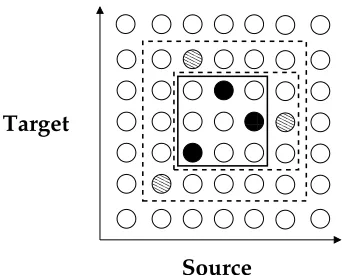
to the words at these intervals. The algorithm for generating the high-precision block alignment links is given in Table 1. The order in which the source intervals are generated does not change the final link set.
2.1 Block Extension Algorithm
Empirically, we find that expanding the high-precision block links significantly improves perfor-mance. The expansion is parameterised and de-scribed below. For a block linkº
;«
¡
¡
,
we compute its frontierÆÉ ºE by looking at all word
links that lie on one of the four boundary lines of a block. We make the following observation as shown in Figure 3: the number of links (filled dots in the picture) on the frontierÆɺ is less or equalÊ , since
in every column and row there is at most one link in
, which is a partial bijetion. To learn blocks from a
general word alignment that is not a bijection more thanÊ word links may lie on the frontier of a block,
but to compute all possible blocks, it is sufficient to look at all possible quadruples of word links. We extend the links on the frontier by links of the high-recall alignment Ë , where we use a parameterised
way of locally extending a given word link. We com-pute an extended link setÌ by extending each word
l 1 l 2 l 3 ÍÎÍ ÍÎÍ ÍÎÍ ÍÎÍ ÏÎÏ ÏÎÏ ÏÎÏ ÏÎÏ ÐÎÐ ÐÎÐ ÐÎÐ ÐÎÐ ÑÎÑ ÑÎÑ ÑÎÑ ÑÎÑ ÒÎÒÎÒ ÒÎÒÎÒ ÒÎÒÎÒ ÒÎÒÎÒ ÓÎÓÎÓ ÓÎÓÎÓ ÓÎÓÎÓ ÓÎÓÎÓ −1 −2 +1 +2 0 delta=1 delta=2 0 −1
[image:4.612.88.285.71.227.2]−2 +1 +2
Figure 4: Point extension scheme. Solid word links lie inÔ , striped word links lie inÕ .
Ö\Ö Ö\Ö Ö\Ö Ö\Ö ×\× ×\× ×\× ×\× Ø\Ø Ø\Ø Ø\Ø Ø\Ø Ù\Ù Ù\Ù Ù\Ù Ù\Ù Ú\Ú Ú\Ú Ú\Ú Ú\Ú Û\Û Û\Û Û\Û Û\Û Ü\Ü Ü\Ü Ü\Ü Ü\Ü Ý\Ý Ý\Ý Ý\Ý Ý\Ý Target Source
Figure 5: ’Outward’ extension of a high-precision block link.
extensions in its neighborhood that lie in Õ , where
the neighborhood is defined by a cell width parame-terÞ and a distance parameter ß . For instance, link à*á
in Figure 4 is reached with cell widthÞÃâäã and
distanceßâåã , the link àæ
is reached withÞçâåã and
ß âåè , the link à¹é
is reached with Þêâëè andß^âåì .
The word linkà
is added toí and it is itself extended
using the same scheme. Here, we never make use of a row or a column covered by Ô other than the
rows î and î`ï and the columns ð and ð/ï. Also, we
do not cross such a row or column using an exten-sion withß^ñêè : this way only a small fraction of the
word links inÕ is used for extending a single block
link. The extensions are carried out iteratively until no new alignment links fromÕ are added toí . The
block extension algorithm in Table 2 uses the exten-sion setí to generate all word link quadruples: the
extended blockò that is defined by a given
quadru-Table 2: Block link extension algorithm. The óXô;õ
and ó~öOð function compute the minimum and the
maximum of÷ integer values.
input: Block linkö,âùøúðïûð ü;û«úî`ïûîTüý
þÿ â
Compute extension setí from frontier øöý
for eachøð
á ûî á ý%û«øð æ ûî æ ý%û«øð é ûî é ý%û«øðûî¸ý Xí ï â á ð â á ð ï\â á î â á î
if (öêò âùøú
ïû ü;û«ú ï û üýý þÿ â þ! ò
output: Extended block link set
þ
.
ple is generated and a check is carried out whetherò
includes the seed block link ö . The following
defi-nition for block link inclusion is used:
ö ï ö ÿ â ú ï û ü"úð ï
ûð\ü and ú
ï û ü"úî ï ûîOü;û
where the block ö`ïaâ'øú
ïû ü;û«ú ï*û
üý is said to be
included in öùâ øúð ï ûð ü;û«úî ïûîTüý . ú
ï û
ü#Múî ïûîOü
holds iff
ï ñåî`ï and %$
î . The ’seed’ block link
ö is extended ’outwardly’: all extended blocksò
in-clude the high-precision block ö . The block link ö
itself may be included in other high-precision block links ö ï on its part, but ö&äò'ö ï holds. An
ex-tended block ò derived from the block ö never
vio-lates the projection restriction relative toÔ i.e., we
do not have to re-check the projection restriction for any generated block, which simplifies and fastens up the generation algorithm. The approach is illustrated in Figure 5, where a high-precision block withì
ele-ments on its frontier is extended by two blocks con-taining it.
The block link extension algorithm produces block links that contain new source and target intervals
úð ïûð\ü and úî ïûîOü that extend the interval mapping
[image:4.612.99.270.281.420.2]pairs:
()*+,.-+/0-1*23,4-23/.5&687"9:)*+,;-+:/.5=<>*23,.-23/@?
The set of high-precision blocks is contained in this set. We cannot use the entire set of blocks defined by all pairs in the above relation, the resulting set of blocks cannot be handled due to memory restric-tions, which motivates our extension algorithm. We also tried the following symmetric restriction and tested the resulting block set:
7A9)*+
,
-+/.5=<>*2-23/
and
7"BC)*2
,
-23/.5=<>*+
,
-+/
(4)
The modified restriction is implemented in the con-text of the extension scheme in Table 1 by insert-ing an if statement before the alignment link D is
extended: the alignment link is extended only if the restriction
7EBC)*2
,
-2F/.5G<H*+
,
-+:/
also holds.
Considering only block links for which the two way projection in Eq. 4 holds has the following inter-esting interpretation: assuming a bijectionI that is
complete i.e., all source and target positions are cov-ered, an efficient block segmentation algorithm ex-ists to compute a Viterbi block alignment as in Fig-ure 1 for a given training sentence pair. The com-plexity of the algorithm is quadratic in the length of the source sentence. This dynamic programming technique is not used in the current block selection but might be used in future work.
2.2 Unigram Block Selection
For selecting blocks from the candidate block links, we restrict ourselves to block links where target and source phrases are equal or less than J words long.
This way we obtain some tens of millions of blocks on our training data including blocks that occur only once. This baseline set is further filtered using the unigram count K
)4LM5
: KON denotes the set of blocks
L
for which K )4LM5QP
N . For our Chinese-English
experiments, we use theKOR restriction as our
base-line, and for the Arabic-English experiments theKOS
restriction. Blocks where the target and the source clump are of length T are kept regardless of their
count2. We compute the unigram probability U )4LM5
2
[image:5.612.359.514.71.260.2]To apply the restrictions exhaustively, we have imple-mented tree-based data structures to store up to VXW million blocks with phrases of up to length Y in less than Z gigabyte of RAM.
Figure 6: An example of[ recursively nested blocks L1\M-]L_^`-]Lba`-]L_c
.
as relative frequency over all selected blocks. An example of[ blocks obtained from the
Chinese-English training data is shown in Figure 6. ’$DATE’ is a placeholder for a date expression. Block
L
c
con-tains the blocks
L \
to
L a
. All [ blocks are selected
in training: the unigram decoder prefers
LMc
even if
L
\
,
L
^
, and
L
a
are much more frequent. The solid word links are word links in I , the striped word
links are word links ind . Using the links ind , we
can learn one-to-many block translations, e.g. the pair (e
\
,’Xinhua news agency’) is learned from the training data.
3 DP-based Decoder
We use a DP-based beam search procedure similar to the one presented in (Tillmann and Ney, 2003). We maximize over all block segmentations
LMf
\
for which the source phrases yield a segmentation of the input source sentence, generating the target sentence simultaneously. The decoder processes search states of the following form:
g h ikj
,;-j
-mlE-Ano-qp.,.-rpmst
j
and j
,
are the two predecessor words used for the trigram language model,
l
is the so-called cover-age vector to keep track of the already processed source position,
n
is the last processed source po-sition.
p
Table 3: Effect of the extension schemeu=v:wx on the
CE translation experiments.
Scheme # blocks # blocks BLEUr4n4
y{z4|X}=~! y%z4|M}G~
w
41.88 M 6.53 M 0.148 0.01
u
w
14.77 M 2.67 M 0.160 0.01
u w 24.47 M 4.50 M 0.180 0.01
u w 35.23 M 6.18 M 0.183 0.01
u
bw 37.92 M 6.65 M 0.183
0.01
u
bw 45.81 M 7.66 M 0.181
0.01
currently being matched. 0 is the length of the
ini-tial fragment of the source phrase that has been pro-cessed so far. is smaller or equal: . Note,
that the partial hypotheses are not distinguished ac-cording to the identity of the block itself. The de-coder processes the input sentence ’cardinality syn-chronously’: all partial hypotheses that are active at a given point cover the same number of input sen-tence words. The same beam-search pruning as de-scribed in (Tillmann and Ney, 2003) is used. The so-called observation pruning threshold is modified as follows: for each source interval that is being matched by a block source phrase at most the best
target phrases according to the joint unigram proba-bility are hypothesized. The list of blocks that cor-respond to a matched source interval is stored in a chart for each input sentence. This way the match-ing is carried out only once for all partial hypotheses that try to match the same input sentence interval. In the current experiments, decoding without block re-ordering yields the best translation results. The decoder translates about `
words per second.
4 Experimental Results
4.1 Chinese-English Experiments
The translation system is tested on a Chinese-to-English translation task. For testing, we use the DARPA/NIST MT 2001 dry-run testing data, which consists of ` sentences with
`
words
ar-ranged in`
documents 3. The training data is pro-vided by the LDC and labeled by NIST as the Large Data condition for the MT 2002 evaluation. The
3
[image:6.612.339.516.112.227.2]We removed the first _ documents that are contained in the training data.
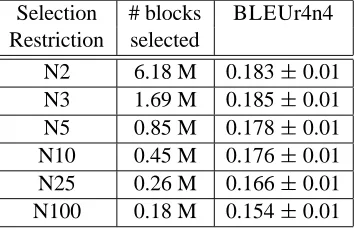
Table 4: Effect of the unigram threshold on the BLEU score. The maximum phrase length is
.
Selection # blocks BLEUr4n4
Restriction selected
N2 6.18 M 0.183 0.01
N3 1.69 M 0.185 0.01
N5 0.85 M 0.178 0.01
N10 0.45 M 0.176 0.01
N25 0.26 M 0.166 0.01
N100 0.18 M 0.154 0.01
Chinese sentences are segmented into words. The training data contains
C million Chinese and
million English words. The block selection algo-rithm described below runs less than one hour on a single
-Gigahertz linux machine.
Table 3 presents results for various block extension schemes. The first column describes the extension scheme used. The second column reports the total number of blocks in millions collected - including all the blocks that occurred only once. The third column reports the number of blocks that occurred at least twice. These blocks are used to compute the results in the fourth column: the BLEU score (Pa-pineni et al., 2002) with reference translation
us-ing -grams along with 95% confidence interval is
reported4. Line
and line
of this table show re-sults where only the source interval projection with-out any extension is carried with-out. For the #
w
ex-tension scheme, the high-recall union set itself is used for projection. The results are worse than for all other schemes, since a lot of smaller blocks are discarded due to the projection approach. Theu
w
scheme, where just theu word links are used is too
restrictive leaving out bigger blocks that are admis-sible according tou . For the Chinese-English test
data, there is only a minor difference between the different extension schemes, the best results are ob-tained for theu
w
and theu
w extension schemes.
Table 4 shows the effect of the unigram selection threshold, where theu8 w blocks are used. The
sec-ond column shows the number of blocks selected. The best results are obtained for they'
and they
4
sets. The number of blocks can be reduced dras-tically where the translation performance declines only gradually.
Table 5 shows the effect of the maximum phrase length on the BLEU score for theO block set.
In-cluding blocks with longer phrases actually helps to improve performance, although already a length of
obtains nearly identical results.
We carried out the following control experiments (using %4 M¡=¢£ as threshold): we obtained a block
set of¤C¥¦¨§ million blocks by generating blocks from
all quadruples of word links in ©
5. This set is a
proper superset of the blocks learned for the ©ªb«ª
experiment in Table 3. The resulting BLEU score is ¬¨¥§o® . Including additional smaller blocks even
hurts translation performance in this case. Also, for the extension scheme ©¯
«° , we carried out the
in-verse projection as described in Section 2.1 to obtain a block set ofC¥± million blocks and a BLEU score
of ¬¨¥§² . This number is smaller than the BLEU
score of¬¨¥§±¤ for the© ¯ «° restriction: for the
trans-lation direction Chinese-to-English, selecting blocks with longer English phrases seems to be important for good translation performance. It is interesting to note, that the unigram translation model is sym-metric: the translation direction can be switched to EnglishtoChinese without retraining the model -just a new Chinese language model is needed. Our experiments, though, show that there is an unbalance with respect to the projection direction that has a sig-nificant influence on the translation results. Finally, we carried out an experiment where we used the©ªb«ª
block set as a baseline. The extension algorithm was applied only to blocks of target and source length §
producing one-to-many translations, e.g. the blocks
1¯ and ° in Figure 6. The BLEU score improved
to¬¨¥§²² with a block set of ¤C¥§M¬ million blocks. It
seems to be important to carry out the block exten-sion also for larger blocks.
We also ran the N2 system on the June 2002 DARPA TIDES Large Data evaluation test set. Six re-search sites and four commercial off-the-shelf sys-tems were evaluated in Large Data track. A major-ity of the systems were phrase-based translation sys-tems. For comparison with other sites, we quote the
5
[image:7.612.315.539.332.406.2]We cannot compute the block set resulting from all word link quadruples in³ , which is much bigger, due to CPU and memory restrictions.
Table 5: Effect of the maximum phrase length on the BLEU score. Both target and source phrase are shorted than the maximum. The unigram threshold is{4 M¡G¢´ .
maximum # blocks BLEUr4n4
phrase length selected
8 6.18 M 0.183µ 0.01
7 5.60 M 0.182µ 0.01
6 4.97 M 0.182µ 0.01
5 4.25 M 0.179µ 0.01
4 3.40 M 0.178µ 0.01
3 2.34 M 0.167µ 0.01
2 1.07 M 0.150µ 0.01
1 0.16 M 0.118µ 0.01
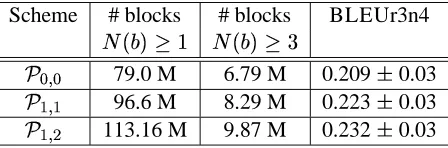
Table 6: Effect of the extension scheme©=¶
«· on the
AE translation experiments.
Scheme # blocks # blocks BLEUr3n4
{4 X¡=¢!§ %4 M¡G¢¤
© ªb«ª 79.0 M 6.79 M 0.209 µ 0.03
©
¯
«
¯ 96.6 M 8.29 M 0.223
µ 0.03
© ¯ «° 113.16 M 9.87 M 0.232 µ 0.03
NIST score (Doddington, 2002) on this test set: the N2 system scores 7.56 whereas the official top two systems scored 7.65 and 7.34 respectively.
4.2 Arabic-English Experiments
We also carried out experiments for the translation direction Arabic to English using training data from UN documents. For testing, we use a test set of§1®®
sentences with C¸]±² words arranged in §¦
docu-ments The training data contains §C¥¹¬ million
Ara-bic and ¦C¥± million English words. The
train-ing data is pre-processed ustrain-ing some morphologi-cal analysis. For the Arabic experiments, we have tested the¤ extension schemes ©ºªb«ª ,© ¯ «¯ , and © ¯ «°
as shown in Table 6. Here, the results for the differ-ent schemes differ significantly and the©»¯ «° scheme
produces the best results. For the AE experiments, only blocks up to a phrase length of² are computed
due to disk memory restrictions. The training data is split into several chunks of¤`¬¬¨¸¼¬¬¬ training
files for each of the chunks written onto disk mem-ory. The word-to-word alignment is trained using
½
iterations of the IBM Model ¾ training followed
by ½
iterations of the HMM Viterbi training. This training procedure takes about a day to execute on a single machine. Additionally, the overall block se-lection procedure takes about¿CÀ
½
hours to execute.
5 Previous Work
Block-based translation units are used in several pa-pers on statistical machine translation. (Och et al., 1999) describe the alignment template system for statistical MT: alignment templates correspond to blocks that do have an internal structure. Marcu and Wong (2002) use a joint probability model for blocks where the clumps are contiguous phrases as in this paper. Yamada and Knight (2002) presents a decoder for syntax-based MT that uses so-called phrasal translation units that correspond to blocks. Block unigram counts are used to filter the blocks. The phrasal model is included into a syntax-based model. Projection of phrases has also been used in (Yarowsky et al., 2001). A word link extension al-gorithm similar to the one presented in this paper is given in (Koehn et al., 2003).
6 Conclusion
In this paper, we describe a block-based unigram model for SMT. A novel block learning algorithm is presented that extends high-precision interval pro-jections by elements from a high-recall alignment. The extension method is shown to improve transla-tion performance significantly. For the Chinese-to-English task, we obtained a NIST score of Á3À
½Â
on the June 2002 DARPA TIDES Large Data evalua-tion test set.
Acknowledgements
This work was partially supported by DARPA and monitored by SPAWAR under contract No. N66001-99-2-8916. The paper has greatly profited from dis-cussion with Fei Xia and Kishore Papineni.
References
Peter F. Brown, Vincent J. Della Pietra, Stephen A. Della Pietra, and Robert L. Mercer. 1993. The Mathematics
of Statistical Machine Translation: Parameter Estima-tion. Computational Linguistics, 19(2):263–311.
George Doddington. 2002. Automatic evaluation of ma-chine translation quality using n-gram co-occurrence statistics. In Proc. of the Second International
Confer-ence of Human Language Technology Research, pages
138–145, March.
Philipp Koehn, Franz Josef Och, and Daniel Marcu. 2003. Statistical Phrase-Based Translation. In Proc.
of the HLT-NAACL 2003 conference, pages 127–133,
Edmonton, Alberta, Canada, May.
Daniel Marcu and William Wong. 2002. A Phrased-Based, Joint Probability Model for Statistical Machine Translation. In Proc. of the Conf. on Empirical
Meth-ods in Natural Language Processing (EMNLP 02),
pages 133–139, Philadelphia, PA, July.
Franz-Josef Och and Hermann Ney. 2000. Improved Sta-tistical Alignment Models. In Proc. of the 38th Annual
Meeting of the Association of Computational Linguis-tics (ACL 2000), pages 440–447, Hong-Kong, China,
October.
Franz-Josef Och, Christoph Tillmann, and Hermann Ney. 1999. Improved Alignment Models for Statistical Ma-chine Translation. In Proc. of the Joint Conf. on
Em-pirical Methods in Natural Language Processing and Very Large Corpora (EMNLP/VLC 99), pages 20–28,
College Park, MD, June.
Kishore Papineni, Salim Roukos, Todd Ward, and Wei-Jing Zhu. 2002. BLEU: a Method for Automatic Evaluation of machine translation. In Proc. of the
40th Annual Conf. of the Association for Computa-tional Linguistics (ACL 02), pages 311–318,
Philadel-phia, PA, July.
Christoph Tillmann and Hermann Ney. 2003. Word Re-ordering and a DP Beam Search Algorithm for Statis-tical Machine Translation. Computational Linguistics, 29(1):97–133.
Stefan Vogel, Hermann Ney, and Christoph Tillmann. 1996. HMM BasedWord Alignment in Statistical Ma-chine Translation. In Proc. of the 16th Int. Conf.
on Computational Linguistics (COLING 1996), pages
836–841, Copenhagen, Denmark, August.
Kenji Yamada and Kevin Knight. 2002. A Decoder for Syntax-based Statistical MT. In Proc. of the 40th
An-nual Conf. of the Association for Computational Lin-guistics (ACL 02), pages 303–310, Philadelphia, PA,
July.
David Yarowsky, Grace Ngai, and Richard Wicentowski. 2001. Inducing Multilingual Text Analysis tools via Robust Projection across Aligned Corpora. In Proc. of
the HLT 2001 conference, pages 161–168, San Diego,
![Figure 6: An example of[ recursively nested blocksL1\M-]L_^`-]Lba`-]L_c .](https://thumb-us.123doks.com/thumbv2/123dok_us/1380013.671891/5.612.359.514.71.260/figure-example-recursively-nested-blocksl-m-l-lba.webp)