Using the Web in Machine Learning for Other-Anaphora Resolution
Natalia N. Modjeska School of Informatics University of Edinburgh and Department of Computer Science
University of Toronto [email protected]
Katja Markert School of Computing University of Leeds and
School of Informatics University of Edinburgh [email protected]
Malvina Nissim School of Informatics University of Edinburgh [email protected]
Abstract
We present a machine learning frame-work for resolving other-anaphora. Be-sides morpho-syntactic, recency, and se-mantic features based on existing lexi-cal knowledge resources, our algorithm obtains additional semantic knowledge from the Web. We search the Web via lexico-syntactic patterns that are specific to other-anaphors. Incorporating this in-novative feature leads to an 11.4 percent-age point improvement in the classifier’s
F-measure (25% improvement relative to
results without this feature).
1 Introduction
Other-anaphors are referential NPs with the mod-ifiers “other” or “another” and non-structural an-tecedents:1
(1) An exhibition of American design and architec-ture opened in September in Moscow and will travel to eight other Soviet cities.
(2) [. . . ] the alumni director of a Big Ten university “I’d love to see sports cut back and so would a lot of my counterparts at other schools, [. . . ]”
(3) You either believe Seymour can do it again or you don’t. Beside the designer’s age, other
risk factors for Mr. Cray’s company include
the Cray-3’s [. . . ] chip technology.
1
All examples are from the Wall Street Journal; the correct antecedents are in italics and the anaphors are in bold font.
In (1), “eight other Soviet cities” refers to a set of So-viet cities excluding Moscow, and can be rephrased as “eight Soviet cities other than Moscow”. In (2), “other schools” refers to a set of schools excluding the mentioned Big Ten university. In (3), “other risk factors for Mr. Cray’s company” refers to a set of risk factors excluding the designer’s age.
In contrast, in list-contexts such as (4), the an-tecedent is available both anaphorically and
struc-turally, as the left conjunct of the anaphor.2
(4) Research shows AZT can relieve dementia and
other symptoms in children [. . . ]
We focus on cases such as (1–3).
Section 2 describes a corpus of other-anaphors. We present a machine learning approach to other-anaphora, using a Naive Bayes (NB) classifier (Sec-tion 3) with two different feature sets. In Sec(Sec-tion 4 we present the first feature set (F1) that includes standard morpho-syntactic, recency, and string com-parison features. However, there is evidence that, e.g., syntactic features play a smaller role in resolv-ing anaphors with full lexical heads than in pronom-inal anaphora (Strube, 2002; Modjeska, 2002). In-stead, a large and diverse amount of lexical or world knowledge is necessary to understand exam-ples such as (1–3), e.g., that Moscow is a (Soviet) city, that universities are informally called schools in American English and that age can be viewed as a risk factor. Therefore we add lexical knowledge, which is extracted from WordNet (Fellbaum, 1998) and from a Named Entity (NE) Recognition algo-rithm, to F1.
2
The algorithm’s performance with this feature set is encouraging. However, the semantic knowledge the algorithm relies on is not sufficient for many cases of other-anaphors (Section 4.2). Many expres-sions, word senses and lexical relations are miss-ing from WordNet. Whereas it includes Moscow as a hyponym of city, so that the relation between anaphor and antecedent in (1) can be retrieved, it does not include the sense of school as university, nor does it allow to infer that age is a risk factor.
There have been efforts to extract missing lexical relations from corpora in order to build new knowl-edge sources and enrich existing ones (Hearst, 1992; Berland and Charniak, 1999; Poesio et al., 2002).3 However, the size of the used corpora still leads to data sparseness (Berland and Charniak, 1999) and the extraction procedure can therefore require extensive smoothing. Moreover, some relations should probably not be encoded in fixed context-independent ontologies at all. Should, e.g., under-specified and point-of-view dependent hyponymy relations (Hearst, 1992) be included? Should age, for example, be classified as a hyponym of risk fac-tor independent of context?
Building on our previous work in (Markert et al., 2003), we instead claim that the Web can be used as a huge additional source of domain- and context-independent, rich and up-to-date knowledge, with-out having to build a fixed lexical knowledge base (Section 5). We describe the benefit of integrating Web frequency counts obtained for lexico-syntactic patterns specific to other-anaphora as an additional feature into our NB algorithm. This feature raises the algorithm’sF-measure from 45.5% to 56.9%.
2 Data Collection and Preparation
We collected 500 other-anaphors with NP an-tecedents from the Wall Street Journal corpus (Penn Treebank, release 2). This data sample excludes several types of expressions containing “other”: (a) list-contexts (Ex. 4) and other-than contexts (foot-note 2), in which the antecedents are available struc-turally and thus a relatively unsophisticated proce-dure would suffice to find them; (b) idiomatic and discourse connective “other”, e.g., “on the other
3
In parallel, efforts have been made to enrich WordNet by adding information in glosses (Harabagiu et al., 1999).
hand”, which are not anaphoric; and (c) reciprocal “each other” and “one another”, elliptic phrases e.g. “one X . . . the other(s)” and one-anaphora, e.g., “the other/another one”, which behave like pronouns and thus would require a different search method. Also excluded from the data set are samples of other-anaphors with non-NP antecedents (e.g., adjectival and nominal pre- and postmodifiers and clauses).
Each anaphor was extracted in a 5-sentence con-text. The correct antecedents were manually an-notated to create a training/test corpus. For each anaphor, we automatically extracted a set of po-tential NP antecedents as follows. First, we ex-tracted all base NPs, i.e., NPs that contain no further NPs within them. NPs containing a possessive NP modifier, e.g., “Spain’s economy”, were split into a possessor phrase, “Spain”, and a possessed entity, “economy”. We then filtered out null elements and lemmatised all antecedents and anaphors.
3 The Algorithm
We use a Naive Bayes classifier, specifically the im-plementation in the Weka ML library.4
The training data was generated following the procedure employed by Soon et al. (2001) for coreference resolution. Every pair of an anaphor and its closest preceding antecedent created a pos-itive training instance. To generate negative train-ing instances, we paired anaphors with each of the NPs that intervene between the anaphor and its an-tecedent. This procedure produced a set of 3,084 antecedent-anaphor pairs, of which 500 (16%) were positive training instances.
The classifier was trained and tested using 10-fold cross-validation. We follow the general practice of ML algorithms for coreference resolution and com-pute precision (P), recall (R), and F-measure (F) on
all possible anaphor-antecedent pairs.
As a first approximation of the difficulty of our task, we developed a simple rule-based baseline al-gorithm which takes into account the fact that the lemmatised head of an other-anaphor is sometimes the same as that of its antecedent, as in (5).
4
http://www.cs.waikato.ac.nz/ml/weka/.
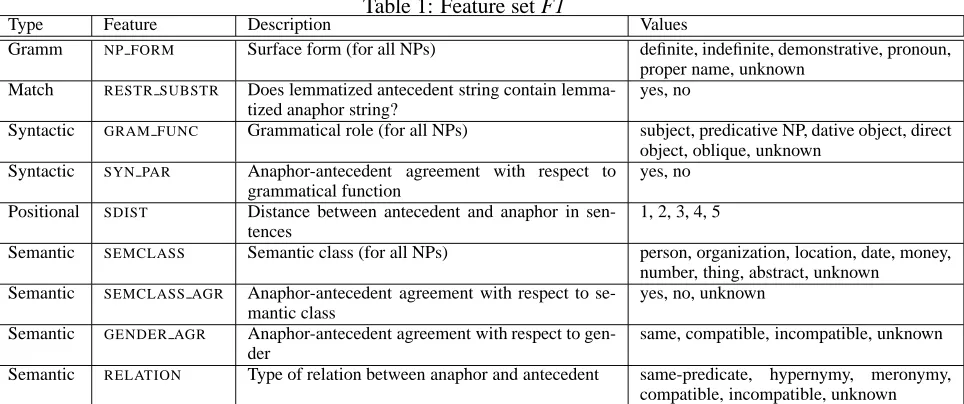
Table 1: Feature set F1
Type Feature Description Values
Gramm NP FORM Surface form (for all NPs) definite, indefinite, demonstrative, pronoun, proper name, unknown
Match RESTR SUBSTR Does lemmatized antecedent string contain lemma-tized anaphor string?
yes, no
Syntactic GRAM FUNC Grammatical role (for all NPs) subject, predicative NP, dative object, direct object, oblique, unknown
Syntactic SYN PAR Anaphor-antecedent agreement with respect to grammatical function
yes, no
Positional SDIST Distance between antecedent and anaphor in sen-tences
1, 2, 3, 4, 5
Semantic SEMCLASS Semantic class (for all NPs) person, organization, location, date, money, number, thing, abstract, unknown
Semantic SEMCLASS AGR Anaphor-antecedent agreement with respect to se-mantic class
yes, no, unknown
Semantic GENDER AGR Anaphor-antecedent agreement with respect to gen-der
same, compatible, incompatible, unknown
Semantic RELATION Type of relation between anaphor and antecedent same-predicate, hypernymy, meronymy, compatible, incompatible, unknown
(5) These three countries aren’t completely off the hook, though. They will remain on a lower-priority list that includes other countries [. . . ]
For each anaphor, the baseline string-compares its last (lemmatised) word with the last (lemmatised) word of each of its possible antecedents. If the words match, the corresponding antecedent is cho-sen as the correct one. If several antecedents pro-duce a match, the baseline chooses the most re-cent one among them. If string-comparison returns no antecedent, the baseline chooses the antecedent closest to the anaphor among all antecedents. The baseline assigns “yes” to exactly one antecedent per anaphor. Its P, R andF-measure are 27.8%.
4 Naive Bayes without the Web
First, we trained and tested the NB classifier with a set of 9 features motivated by our own work on other-anaphora (Modjeska, 2002) and previous ML research on coreference resolution (Aone and Ben-nett, 1995; McCarthy and Lehnert, 1995; Soon et al., 2001; Ng and Cardie, 2002; Strube et al., 2002).
4.1 Features
A set of 9 features, F1, was automatically acquired from the corpus and from additional external re-sources (see summary in Table 1).
Non-semantic features. NP FORMis based on the POS tags in the Wall Street Journal corpus and
heuristics. RESTR SUBSTR matches lemmatised strings and checks whether the antecedent string contains the anaphor string. This allows to resolve examples such as “one woman ringer . . . another woman”. The values forGRAM FUNCwere
approxi-mated from the parse trees and Penn Treebank anno-tation. The featureSYN PARcaptures syntactic par-allelism between anaphor and antecedent. The fea-ture SDIST measures the distance between anaphor and antecedent in terms of sentences.5
Semantic features. GENDER AGRcaptures agree-ment in gender between anaphor and antecedent, gender having been determined using gazetteers, kinship and occupational terms, titles, and Word-Net. Four values are possible: “same”, if both NPs have same gender; “compatible”, if antecedent and anaphor have compatible gender, e.g., “lawyer . . . other women”; “incompatible”, e.g., “Mr. Johnson . . . other women”; and “unknown”, if one of the NPs is undifferentiated, i.e., the gender value is “un-known”. SEMCLASS: Proper names were classified
using ANNIE, part of the GATE2 software package
(http://gate.ac.uk). Common nouns were
looked up in WordNet, considering only the most frequent sense of each noun (the first sense in Word-Net). In each case, the output was mapped onto one of the values in Table 1. TheSEMCLASS AGR
fea-5
ture compares the semantic class of the antecedent with that of the anaphor NP and returns “yes” if they belong to the same class; “no”, if they belong to different classes; and “unknown” if the seman-tic class of either the anaphor or antecedent has not been determined. The RELATION between other-anaphors and their antecedents can partially be de-termined by string comparison (“same-predicate”)6 or WordNet (“hypernymy” and “meronymy”). As other relations, e.g. “redescription” (Ex. (3), cannot be readily determined on the basis of the information in WordNet, the following values were used: “com-patible”, for NPs with compatible semantic classes, e.g., “woman . . . other leaders”; and “incompati-ble”, e.g., “woman . . . other economic indicators”. Compatibility can be defined along a variety of pa-rameters. The notion we used roughly corresponds to the root level of the WordNet hierarchy. Two nouns are compatible if they have the same SEM
-CLASS value, e.g., “person”. “Unknown” was used if the type of relation could not be determined.
4.2 Results
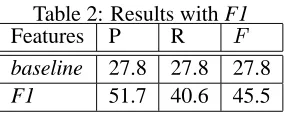
[image:4.612.115.258.423.480.2]Table 2 shows the results for the Naive Bayes clas-sifier using F1 in comparison to the baseline.
Table 2: Results with F1
Features P R F
baseline 27.8 27.8 27.8
F1 51.7 40.6 45.5
Our algorithm performs significantly better than the baseline.7 While these results are encouraging, there
were several classification errors.
Word sense ambiguity is one of the reasons for misclassifications. Antecedents were looked up in WordNet for their most frequent sense for a context-independent assignment of the values of semantic class and relations. However, in many cases either the anaphor or antecedent or both are used in a sense that is ranked as less frequent in Wordnet. This might even be a quite frequent sense for a specific corpus, e.g., the word “issue” in the sense of “shares, stocks” in the WSJ. Therefore there is a strong
inter-6
Same-predicate is not really a relation. We use it when the head noun of the anaphor and antecedent are the same.
7
We used a t-test with confidence level 0.05 for all signifi-cance tests.
action between word sense disambiguation and ref-erence resolution (see also (Preiss, 2002)).
Named Entity resolution is another weak link. Several correct NE antecedents were classified as “antecedent=no” (false negatives) because the NER
module assigned the wrong class to them.
The largest class of errors is however due to insuf-ficient semantic knowledge. Problem examples can roughly be classified into five partially overlapping groups: (a) examples that suffer from gaps in Word-Net, e.g., (2); (b) examples that require domain-, situation-specific, or general world knowledge, e.g., (3); (c) examples involving bridging phenomena (sometimes triggered by a metonymic or metaphoric antecedent or anaphor), e.g., (6); (d) redescriptions and paraphrases, often involving semantically vague anaphors and/or antecedents, e.g., (7) and (3); and (e) examples with ellipsis, e.g., (8).
(6) The Justice Department’s view is shared by
other lawyers [. . . ]
(7) While Mr. Dallara and Japanese officials say
the question of investors’ access to the U.S. and Japanese markets may get a
disproportion-ate share of the public’s attention, a number of
other important economic issues will be on
the table at next week’s talks.
(8) He sees flashy sports as the only way the last-place network can cut through the clutter of ca-ble and VCRs, grab millions of new viewers and tell them about other shows premiering a few weeks later.
In (6), the antecedent is an organization-for-people metonymy. In (7), the question of investors’ access to the U.S. and Japanese markets is characterized as an important economic issue. Also, the head “is-sues” is lexically uninformative to sufficiently con-strain the search space for the antecedent. In (8), the antecedent is not the flashy sports, but rather flashy sport shows, and thus an important piece of infor-mation is omitted. Alternatively, the antecedent is a
content-for-container metonymy.
5 Naive Bayes with the Web
With its approximately 3033M pages8 the Web is the largest corpus available to the NLP community. Building on our approach in (Markert et al., 2003), we suggest using the Web as a knowledge source for anaphora resolution. In this paper, we show how to integrate Web counts for lexico-syntactic patterns specific to other-anaphora into our ML approach.
5.1 Basic Idea
In the examples we consider, the relation between anaphor and antecedent is implicitly expressed, i.e., anaphor and antecedent do not stand in a structural relationship. However, they are linked by a strong semantic relation that is likely to be structurally
ex-plicitly expressed in other texts. We exploit this
in-sight by adopting the following procedure:
1. In other-anaphora, a hyponymy/similarity rela-tion between the lexical heads of anaphor and antecedent is exploited or stipulated by the con-text,9 e.g. that “schools“ is an alternative term for universities in Ex. (2) or that age is viewed as a risk factor in Ex. (3).
2. We select patterns that structurally explicitly express the same lexical relations. E.g., the list-context NP1 and other NP2 (as Ex. (4))
usually expresses hyponymy/similarity rela-tions between the hyponym NP1and its
hyper-nym NP2(Hearst, 1992).
3. If the implicit lexical relationship between anaphor and antecedent is strong, it is likely that anaphor and antecedent also frequently cooccur in the selected explicit patterns. We instantiate the explicit pattern for all anaphor-antecedent pairs. In (2) the pattern NP1
and other NP2 is instantiated with e.g.,
counterparts and other schools, sports and other schools and universities and other schools.10 These instantiations can be
8http://www.searchengineshowdown.com/ stats/sizeest.shtml, data from March 2003.
9
In the Web feature context, we will often use “anaphor/antecedent” instead of the more cumbersome “lexical heads of the anaphor/antecedent”.
10
These simplified instantiations serve as an example and are neither exhaustive nor the final instantiations we use; see Sec-tion 5.3.
searched in any corpus to determine their quencies. The rationale is that the most fre-quent of these instantiated patterns is a good clue for the correct antecedent.
4. As the patterns can be quite elaborate, most corpora will be too small to determine the cor-responding frequencies reliably. The instantia-tionuniversities and other schools, e.g., does not occur at all in the British National Cor-pus (BNC), a 100M words corCor-pus of British English.11 Therefore we use the largest corpus available, the Web. We submit all instantiated patterns as queries making use of the Google API technology. Here, universities and other schoolsyields over 700 hits, whereas
the other two instantiations yield under 10 hits each. High frequencies do not only occur for synonyms; the corresponding instantiation for the correct antecedent in Ex. (3)age and other risk factors yields over 400 hits on the Web and again none in the BNC.
5.2 Antecedent Preparation
In addition to the antecedent preparation described in Section 2, further processing is necessary. First, pronouns can be antecedents of other-anaphors but they were not used as Web query input as they are lexically empty. Second, all modification was elim-inated and only the rightmost noun of compounds was kept, to avoid data sparseness. Third, using pat-terns containing NEs such as “Will Quinlan” in (9) also leads to data sparseness (see also the use of NE recognition for featureSEMCLASS).
(9) [. . . ] Will Quinlan had not inherited a damaged retinoblastoma supressor gene and, therefore, faced no more risk than other children [. . . ]
We resolved NEs in two steps. In addition to GATE’s classification into ENAMEX and NU
-MEX categories, we used heuristics to automati-cally obtain more fine-grained distinctions for the categories LOCATION, ORGANIZATION, DATE and
MONEY, whenever possible. No further distinc-tions were made for the category PERSON. We
classifiedLOCATIONSintoCOUNTRY, (US)STATE,
CITY, RIVER, LAKE and OCEAN, using mainly
11
Table 3: Patterns and Instantiations for other-anaphora
ANTECEDENT PATTERN INSTANTIATIONS
common noun (O1):(N1fsgg OR N1fplg) and other N2fplg I c
1: “(university OR universities) and other schools”
proper name (O1):(N1
fsgg OR N 1
fplg) and other N 2
fplg I p 1
: “(person OR persons) and other children”
Ip
2: “(child OR children) and other persons”
(O2):N1 and other N2
fplg I
p 3
: “Will Quinlan and other children”
gazetteers.12 If an entity classified by GATE as
ORGANIZATION contained an indication of the
or-ganization type, we used this as a subclassifica-tion; therefore “Bank of America” is classified as
BANK. For DATE and MONEY entities we used
simple heuristics to classify them further into DAY,
MONTH,YEARas well asDOLLAR.
From now on we call A the list of possible
an-tecedents and ana the anaphor. For (2), this list
isA 2=
fcounterpart, sport, universityg(the pronoun
“I” has been discarded) and ana
2=school. For (9),
they are A 9=
frisk, gene, person [=Will Quinlan]g
andana
9=child.
5.3 Queries and Scoring Method
We use the list-context pattern:13
(O1)(N1
fsgg OR N1fplg) and other N2fplg
For common noun antecedents, we instantiate the pattern by substituting N1 with each possible
an-tecedent from set A, and N
2 with ana, as normally
N1 is a hyponym of N2 in (O1), and the antecedent
is a hyponym of the anaphor. An instantiated pat-tern for Ex. (2) is(university OR universities) and other schools(I
c 1
in Table 3).14
For NE antecedents we instantiate (O1) by substi-tuting N1 with the NE category of the antecedent,
and N2 with
ana. An instantiated pattern for
Example (9) is (person OR persons) and other children(I
p
1 in Table 3). In this instantiation, N 1
(“person”) is not a hyponym of N2(“child”), instead
N2 is a hyponym of N1. This is a consequence of
the substitution of the antecedent (“Will Quinlan”)
12
They were extracted from the Web. Small gazetteers, con-taining in all about 500 entries, are sufficient. This is the only external knowledge collected for the Web feature.
13
In all patterns in this paper, “OR” is the boolean operator, “N1” and “N2” are variables, all other words are constants.
14
Common noun instantiations are marked by a superscript “c” and proper name instantiations by a superscript “p”.
with its NE category (“person”); such an instanti-ation is not frequent, since it violates standard re-lations within (O1). Therefore, we also instantiate (O1) by substituting N1 with
ana, and N
2 with the
NE type of the antecedent (I p 2
in Table 3). Finally, for NE antecedents, we use an additional pattern:
(O2)N1 and other N 2fplg
which we instantiate by substituting N1 with the
original NE antecedent and N2 with ana(I
p 3 in
Ta-ble 3).
Patterns and instantiations are summarised in Ta-ble 3. We submit these instantiations as queries to the Google search engine.
For each antecedent ant inAwe obtain the raw
frequencies of all instantiations it occurs in (I c 1 for
common nouns, orI p 1, I p 2, I p
3 for proper names) from
the Web, yieldingfreq(I c 1
), orfreq(I p 1
),freq(I p 2 )
and freq(I p 3
). We compute the maximum M ant
over these frequencies for proper names. For com-mon nounsM
ant corresponds to
freq(I c 1
). The
in-stantiation yieldingM
antis then called Imax
ant.
Our scoring method takes into account the indi-vidual frequencies ofantandanaby adapting mu-tual information. We call the first part ofImax
ant
(e.g. “university OR universities”, or “child OR chil-dren”) X
ant, and the second part (e.g. “schools”
or “persons”) Y
ant. We compute the probability of Imax
ant, X
antand Y
ant, using Google to determine freq(X
ant
)andfreq(Y ant ). Pr(Imax ant )= M ant
number of GOOGLE pages
Pr(X ant )= freq(X ant )
number of GOOGLE pages
Pr(Y ant )= freq(Y ant )
We then compute the final scoreMI ant.
MI ant
=log
Pr(Imax ant
)
Pr(X ant
)Pr(Y ant
)
5.4 Integration into ML Framework and Results
For each anaphor, the antecedent in A with the
highest MI
ant gets feature value “webfirst”. 15 All
other antecedents (including pronouns) get the fea-ture value “webrest”. We chose this method instead of e.g., giving score intervals for two reasons. First, since score intervals are unique for each anaphor, it is not straightforward to incorporate them into a ML framework in a consistent manner. Second, this method introduces an element of competition be-tween several antecedents (see also (Connolly et al., 1997)), which the individual scores do not reflect.
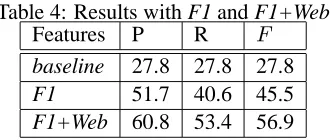
We trained and tested the NB classifier with the feature set F1, plus the Web feature. The last row in Table 4 shows the results. We obtained a 9.1 per-centage point improvement in precision (an 18% im-provement relative to the F1 feature set) and a 12.8 percentage point improvement in recall (32% im-provement relative to F1), which amounts to an 11.4 percentage point improvement inF-measure (25%
improvement relative to F1 feature set). In particu-lar, all the examples in this paper were resolved.
Our algorithm still misclassified several an-tecedents. Sometimes even the Web is not large enough to contain the instantiated pattern, espe-cially when this is situation or speaker specific. An-other problem is the high number of NE antecedents (39.6%) in our corpus. While our NER module is quite good, any errors in NE classification lead to incorrect instantiations and thus to incorrect classi-fications. In addition, the Web feature does not yet take into account pronouns (7.43% of all correct and potential antecedents in our corpus).
6 Related Work and Discussion
Modjeska (2002) presented two hand-crafted algo-rithms, SAL and LEX, which resolve the anaphoric references of other-NPs on the basis of grammati-cal salience and lexigrammati-cal information from WordNet, respectively. In our own previous work (Markert et
15
If several antecedents have the highestMIantthey all get
[image:7.612.345.510.80.150.2]value “webfirst”.
Table 4: Results with F1 and F1+Web
Features P R F
baseline 27.8 27.8 27.8
F1 51.7 40.6 45.5
F1+Web 60.8 53.4 56.9
al., 2003) we presented a preliminary symbolic ap-proach that uses Web counts and a recency-based tie-breaker for resolution of other-anaphora and bridging descriptions. (For another Web-based sym-bolic approach to bridging see (Bunescu, 2003).) The approach described in this paper is the first ma-chine learning approach to other-anaphora. It is not directly comparable to the symbolic approaches above for two reasons. First, the approaches dif-fer in the data and the evaluation metrics they used. Second, our algorithm does not yet constitute a full resolution procedure. As the classifier oper-ates on the whole set of antecedent-anaphor pairs, more than one potential antecedent for each anaphor can be classified as “antecedent=yes”. This can
be amended by e.g. incremental processing. Also, the classifier does not know that each other-NP is anaphoric and therefore has an antecedent. (This contrasts with e.g. definite NPs.) Thus, it can clas-sify all antecedents as “antecedent=no”. This can be
remedied by using a back-off procedure, or a compe-tition learning approach (Connolly et al., 1997). Fi-nally, the full resolution procedure will have to take into account other factors, e.g., syntactic constraints on antecedent realization.
between anaphor and antecedent to local dependen-cies. By looking up these patterns on the Web we obtain semantic information that is not and perhaps should not be encoded in an ontology (redescrip-tions, vague rela(redescrip-tions, etc.). Finally, these local de-pendencies also reduce the need for prior word sense disambiguation, as the anaphor and the antecedent constrain each other’s sense within the context of the pattern.
7 Conclusions
We presented a machine learning approach to other-anaphora, which uses a NB classifier and two sets of features. The first set consists of standard morpho-syntactic, recency, and semantic features based on WordNet. The second set also incorpo-rates semantic knowledge obtained from the Web via lexico-semantic patterns specific to other-anaphora. Adding this knowledge resulted in a dramatic im-provement of 11.4% points in the classifier’s F
-measure, yielding a finalF-measure of 56.9%.
To our knowledge, we are the first to integrate a Web feature into a ML framework for anaphora reso-lution. Adding this feature is inexpensive, solves the data sparseness problem, and allows to handle ex-amples with non-standard relations between anaphor and antecedent. The approach is easily applicable to other anaphoric phenomena by developing appropri-ate lexico-syntactic patterns (Markert et al., 2003).
Acknowledgments
Natalia N.Modjeska is supported by EPSRC grant GR/M75129; Katja Markert by an Emmy Noether Fellowship of the Deutsche Forschungsgemen-schaft. We thank three anonymous reviewers for helpful comments and suggestions.
References
C. Aone and S. W. Bennett. 1995. Evaluating automated and manual acquisition of anaphora resolution strate-gies. In Proc. of ACL’95, pages 122–129.
M. Berland and E. Charniak. 1999. Finding parts in very large corpora. In Proc. of ACL’99, pages 57–64.
G. Bierner. 2001. Alternative phrases and natural lan-guage information retrieval. In Proc. of ACL’01.
R. Bunescu. 2003. Associative anaphora resolution: A Web-based approach. In R. Dale, K. van Deemter, and
R. Mitkov, editors, Proc. of the EACL Workshop on the
Computational Treatment of Anaphora.
D. Connolly, J. D. Burger, and D. S. Day. 1997. A machine learning approach to anaphoric reference. In Daniel Jones and Harold Somers, editors, New
Meth-ods in Language Processing, pages 133–144. UCL
Press, London.
C. Fellbaum, editor. 1998. WordNet: An Electronic
Lex-ical Database. The MIT Press.
G. Grefenstette. 1999. The WWW as a resource for example-based MT tasks. In Proc. of ASLIB’99
Trans-lating and the Computer 21, London.
S. Harabagiu, G. Miller, and D. Moldovan. 1999. Word-net 2 - a morphologically and semantically enhanced resource. In Proc. of SIGLEX-99, pages 1–8.
M. Hearst. 1992. Automatic acquisition of hyponyms from large text corpora. In Proc. of COLING-92.
F. Keller, M. Lapata, and O. Ourioupina. 2002. Using the Web to overcome data sparseness. In Proc. of EMNLP
2002, pages 230–237.
K. Markert, M. Nissim, and N. N. Modjeska. 2003.
Using the Web for nominal anaphora resolution. In R. Dale, K. van Deemter, and R. Mitkov, editors, Proc.
of the EACL Workshop on the Computational Treat-ment of Anaphora, pages 39–46.
J. F. McCarthy and W. G. Lehnert. 1995. Using decision trees for coreference resolution. In Proc. of IJCAI-95, pages 1050–1055.
N. N. Modjeska. 2002. Lexical and grammatical role constraints in resolving other-anaphora. In Proc. of
DAARC 2002, pages 129–134.
V. Ng and C. Cardie. 2002. Improving machine learn-ing approaches to coreference resolution. In Proc. of
ACL’02, pages 104–111.
M. Poesio, T. Ishikawa, S. Schulte im Walde, and
R. Viera. 2002. Acquiring lexical knowledge for
anaphora resolution. In Proc. of LREC 2002, pages 1220–1224.
J. Preiss. 2002. Anaphora resolution with word sense disambiguation. In Proc. of SENSEVAL-2, pages 143– 146.
W. M. Soon, H. T. Ng, and D. C. Y. Lim. 2001. A ma-chine learning approach to coreference resolution of noun phrases. Computational Linguistics, 27(4):521– 544.
M. Strube, S. Rapp, and C. M¨uller. 2002. The influence of minimum edit distance on reference resolution. In
Proc. of EMNLP 2002, pages 312–319.