Abstract—This research looks into assessing the potential of using Bluetooth as a broadcasting medium for transmission of data files among Bluetooth-enabled devices. The effect of several parameters such as data file types and sizes, distance, barriers and interference from other wireless technologies on the system were tested. The software was written in Java in order to allow interoperability across multiple platforms. It was programmed to discover all Bluetooth-enabled devices within its range irrespective of the number of devices present and then broadcast multimedia content to these devices. This study shows that Bluetooth broadcasting would be appropriate for any file types not exceeding 500 KB in size. It was further noted that performance degrades in conditions where there is interference due to Wi-Fi and Bluetooth as well as obstruction due to barriers and in broad sunlight.
Index Terms—Bluetooth, mobile devices, wireless networks
1. INTRODUCTION
Mauritius is rapidly developing towards a knowledge-based society where exchange of information is mandatory for all activities. However, the cost of communication technologies is still expensive. Therefore, there is a need to find low cost and simple transmission technologies. The use of wireless communication technologies is an attractive opportunity, especially in view of the fact that in Mauritius, mobile devices including laptops, PDAs and sophisticated mobile phones are becoming widespread among the population and increasing every year. This medium was originally developed as a mean for cable replacement for communication between mobile phones and related accessories; and consequently increases their functionalities. But, nowadays another purpose of the latter is starting to gain momentum that includes broadcasting. Due to lack of information concerning the performance of this new born feature, the present and future broadcasting potential of Bluetooth is uncertain.
The aim of the study is to show that Bluetooth is a potential medium for broadcasting that can be used to send data files at low operating cost. It also investigates the ability of Bluetooth in performing this function efficiently and effectively. The paper is organised as follows: Section 2 describes a brief overview on Bluetooth, related work in discussed in section 3, section 4 presents the operation of the developed software, section 5 describes all the experimental scenarios that have been setup, section 6 shows the results obtained during the course of the experiments and section 7 concludes the paper.
S. Pudaruth is with the University of Mauritius, Reduit, Mauritius (Phone: 230-403-7754; e-mail: [email protected]).
H. K. Ramdolin was with the University of Mauritius. He is now at Accenture Mauritius, Ebene , Mauritius (e-mail: [email protected]). A. Bissoonee was with the University of Mauritius. He is now at Apollo Bramwell Hospital (e-mail: [email protected]).
2. BLUETOOTH OVERVIEW
Bluetooth is a short-range wireless technology for local area and personal area networking to interconnect low-power devices and portable computers [1]. Since its inception in early 1998 [2], it has been accepted and utilised worldwide; however since it is a fairly new technology it still has to be further improved to increase its functionalities. Bluetooth operates at 2.4 GHz in the ISM band. Some key attributes of Bluetooth are [3]:
Open Specification: Bluetooth technology is available for everyone and is royalty free.
Short Range Communication: Bluetooth embedded devices normally communicate over relatively short distances. It has three ranges of transmission distance; 0-1m, 0-10m and 0-100m using radio waves.
Low Power: Bluetooth uses low power radio which is more likely to suit portable and battery operated devices.
Robustness: It can face interference without affecting its operation from other devices, for e.g. cordless phones, microwaves ovens and WLANs that also makes use of the free ISM frequency band.
2.1 BLUETOOTH LIMITATIONS IN BROADCASTING
Bluetooth was originally intended as a cable replacement between battery-operated devices [4] and was not designed for broadcasting purposes as a Bluetooth emitter can only send data to seven devices simultaneously [5]. Moreover, Bluetooth has a relatively low transfer rate, 721Kbps in version 1.2 and 1Mbps in version 2.0 (without EDR); consequently broadcasting of data is restricted and this slow transfer rate is only apparent when very large files are being sent [6]. Finally, the discovery time by Bluetooth is long. According to [7], for Bluetooth version 1.x, the time required is about 20 seconds while for version 2.x it may take less than 10 seconds.
3. RELATED
WORK
Using Bluetooth as broadcasting medium is still an innovative field where very little studies have been performed. However, there are some researchers who have described and investigated Bluetooth broadcasting.
Several testing have been conducted in the past to evaluate the effect of the interference of Wi-Fi (IEEE 802.11) with Bluetooth devices. Early attempts to quantify the mutual interference effects have been based on simple geometric models of Bluetooth deployment rather than actual usage models.
An Assessment Of The Performance Of Bluetooth As
A Broadcasting Channel
In [7], the usefulness and practical issues related to Bluetooth broadcasting have been investigated and the experience from developing and exploring a broadcasting system (Baloo) has been described. However Baloo was not tested in real life situations.
In Ennis, the investigation focused on the problem of calculating the probability of an overlap, in both time and frequency, of a continuous sequence of Bluetooth packets and an IEEE 802.11b direct sequence 11-Mb/sec packet. Relative power levels between the Bluetooth and IEEE 802.11b packets were not considered. Zyren and others made several refinements on previous assumptions. These efforts, however, did not examine in detail the ramifications of the physical (PHY) layer such as hopping, spectral masks, and filter selectivity, nor did they discuss implementation. In addition, the geometries studied did not necessarily correspond to practical usage models [8].
Moreover, Punnoose et al. [9] performed some experiments to evaluate the effect of 802.11b signal on Bluetooth. They had found that Bluetooth to overlap in frequency and time with the 802.11b at most 1/3 of the time. Moreover, from the results obtained, it was deduced that Bluetooth performance starts to degrade rapidly when the interfering 802.11b signal is comparable to the desired signal [9].
4. SYSTEM’S OPERATION
A broadcasting system named BluPhox was developed that can broadcast any data file type such as text, image, audio and video. The software has been coded in Java thus enabling it to run on multiple platforms such as Windows and Linux. Libraries such as BluecoveJSR82 [10] and avetanaObex [11] were used to manage connectivity and to send files.
The broadcasting system requires Bluetooth capability to broadcast contents to devices in its range. The administrator will have to login as a security measure to use the system, he/she can choose any file and broadcast it to nearby Bluetooth devices. An interface is also provided to type a short quick message and broadcast it. The system first discovers devices in its range (10m), prompts the client if it wants to receive file from the broadcasting system and if the client accepts to receive the file, the file is then sent. This way of broadcasting content eliminates the problem of spamming.
Our system achieves broadcasting in a serial manner, i.e. sending contents to clients one after the other by (i) connecting to the first device and then send the content, (ii) closing the connection after the content has been received by the device, and (iii) move to the next device and repeat steps 1 and 2 until content has been broadcast to all devices. The above method transmits the same file to each of the devices one after the other and it uses unicasting as a means to achieve broadcasting. This method of broadcasting allows maximum usage of bandwidth since only one connection is made per transfer of the file to the device whereby all the necessary resources are allocated to the device in use and only after the file is sent or rejected that a new connection will be made.
While for the case of broadcasting to multiple devices simultaneously at a given point in time, the bandwidth will be shared among them making users to wait for more time to receive the file [12].
5. TESTING SCENARIOS
Despite the increasing usage of Bluetooth, the features that affect its performance are still unknown. Past studies have showed that efficiency of Bluetooth is affected by wi-fi and Bluetooth interference [6]. According to the wave theory [8], when two waves overlap, they either superimpose constructively or destructively; moreover, when a wave passes through a surface, its intensity decreases greatly. Therefore, several test scenarios were devised in order to evaluate the effectiveness of the Bluetooth device in performing its purpose in situations where there are barriers and interference from wireless devices. These tests were carried out in real case situations to ensure that the results obtained were reliable and could be used in assessing its areas of applications. Hence, these results can be used by organisations that are interested to implement systems that use Bluetooth as a communication medium and where the reliability of Bluetooth is important for the application to be useful.
5.1 PERFORMANCE ANALYSIS
During testing, the metric used to evaluate performance was throughput. This is defined as the amount of data that can be transmitted during a specific time interval. The simulation times and throughputs were based on the aggregate performance of all the Bluetooth mobile phones used during the testing. Therefore, each phone was tested in order to ensure that all models were able to handle large files well and they would not degrade the performance of the entire group.
Moreover, during on site testing it was noted that when it was performed in open air, under direct exposure to sunlight, the Bluetooth range varied from 4m to 7m depending on the model of the device being used. Due to this fact, the experiments were carried out indoor.
5.2 EFFECT OF MOBILE PHONE MODEL ON BLUETOOTH DISCOVERY
The testing was done by using 10 mobile phones of different models placed at 1 m intervals from a Bluetooth-enabled laptop running BluPhox. The order by which the discovered devices displayed was noted. The experiment was repeated and each time the position of the mobiles was interchanged.
5.3 EFFECT OF INTERFERENCE ON TRANSMISSION RATE AND THROUGHPUT
activated Bluetooth mobile and a laptop connected to a WLAN. The setup used is demonstrated by Figure 5.1.
Figure 5.1: Effect of Interference by an Activated Bluetooth Mobile
5.4 EFFECT OF BARRIER ON TRANSMISSION RATE AND THROUGHPUT
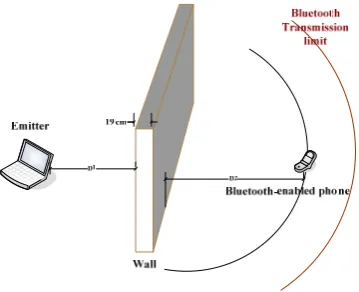
An informal survey was done initially and it was found that the common barriers that are present are: window panes, concrete walls, wooden and metal doors. The effect of these four barriers on the transmission time was determined.
[image:3.595.71.256.83.243.2]
Figure 5.2: Set-up for a concrete wall barrier
6. RESULTS
6.1 BROADCASTING SEQUENCE
During the preliminary testing, the internal functionalities of Bluetooth were assessed in order to understand its pathway of connection. From Table 6.1, it can be concluded that the BluPhox will broadcast data to Bluetooth devices discovered within its range, i.e. within 10 m, based on their Bluetooth addresses irrespective of their position, model and functionalities. The device with the lowest address will be the first to receive the data file while the one with the highest address will receive it last.
This implies that Bluetooth will discover and send files to any Bluetooth devices in the vicinity of the emitter based on the order of addresses without considering the brand and version of the mobile phones as well as there average distance from the emitter.
Table 6.1: Order of Broadcast
Device Model Bluetooth Address Order of Broadcast
Nokia 6600 000e6d15d531 1
Nokia 6630 00119fca421b 2
Nokia N70 0015a087d64e 3
Nokia 6085 00192d96fdfd 4
Nokia 6300 001d3bad9300 5
Nokia N70 001e3b54a8c2 6
Nokia 3500C 001f007fa8c1 7
Nokia 3220 001f5db82662 8
Nokia 6600 001f5db84230 9
Nokia 6670 00e0035e6d4a 10
[image:3.595.314.539.260.398.2]6.2 TRANSMISSION AND THROUGHPUT AGAINST DISTANCE FOR VARIOUS SIZES
Figure 6.1: Variation of Transmission Time against Size
[image:3.595.80.260.353.499.2]From Figure 6.1, it can be observed that for small data size the transmission time remains more or less constant at 7s, 14s and 42s for 11KB, 100KB, and 500KB respectively. However, as the size of the file increases, a drastic increase is noted in the transmission time. This indicates that for data size higher than 500KB, the relationship between transmission time and distance is non-linear. It becomes hectic for data larger than 2000KB. For small data size, the increase in transmission time above 7m is negligible as compared to data size above 500KB, this is why for small values the transmission time is more or less constant. However, if the range is expanded, those with small data size will also give similar results as those above 500KB. The same results were reported by Steele (2006) [6].
[image:3.595.304.536.597.734.2]From Figure 6.2, it can be deduced that throughput remains more or less constant for 11KB and 100 KB of data as the distance of the receiving device from the emitter is increased. For data size above 500KB, the throughput decrease with distance. Moreover, the decrease in throughput is linear between 0 to 7m and afterwards it becomes non-linear.
6.3 EFFECT OF INTERFERENCE ON TRANSMISSION TIME AND THROUGHPUT
The effects of interference from Wi-Fi, Bluetooth and combined Wi-Fi and Bluetooth on transmission time and throughput are compared with situations where there are no interference. From the figures, it is clearly noted that wi-fi and Bluetooth interferes with the broadcasting functions of the system.
Figures 6.3 and 6.4 show that interference has a negative effect on Bluetooth broadcasting functionality and there is an increase in transmission time and a decrease in the throughput. It can further be noted that Wi-Fi has the least effect for data size of 11 KB and the transmission rates and throughputs are constant. Moreover, the combined effect of Bluetooth and wi-fi had the greatest effect and the effect is non-linear [15].
[image:4.595.50.288.390.544.2]6.3.1 Effect of Interference on Transmission Time and Throughput for a Data Size of 11KB
[image:4.595.54.285.568.720.2]Figure 6.3: Effect of Interference on Transmission Time for a Data Size of 11KB
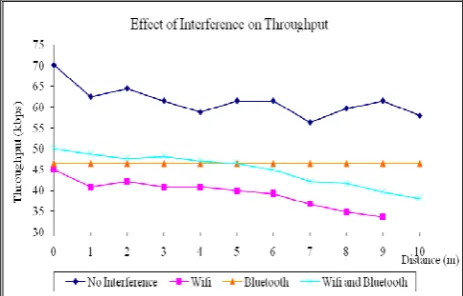
Figure 6.4: Effect of Interference on Throughput for a Data Size of 11KB
From the above figures, it can be observed that for small data size, wi-fi increases the transmission by 3.5 seconds and
affects overall transmission time linearly throughout as compared to the two other form of interferences. As expected, wi-fi together with Bluetooth decreases the throughput and their combined effect is the resultant of their summation on Bluetooth broadcasting. These sources of disturbances have a destructive impact on the wave frequency which in effect decreases the intensity [13] of the emission and thus increases the transmission time. Hence, for data sizes smaller than 50KB, the transmission of data to the devices/users is done within 20 seconds.
6.3.2 Effect of Interference on Transmission Time and Throughput for a Data Size of 100KB
Figure 6.5: Effect of Interference on Transmission Time for a Data Size of 100KB
As compared to Figure 6.5, Wi-Fi has the greatest impact on transmission for a data size of 100KB and broadcasting range of Bluetooth becomes 9m instead of 10m. The effect of Bluetooth interference is constant over the range of ten meters as shown by the constant horizontal line. Bluetooth interference increases the transmission time of data size of 100KB by 32%, while wi-fi interference by 57% and combined wi-fi and Bluetooth interference by 37%.
Moreover, for the combined effect of wi-fi and Bluetooth, it is more or less similar to Bluetooth interference from the range of 0m to 5m, beyond which there is a gradual increase in the interfering effect of the former. This result shows that for a Bluetooth emitter range of 10m sending files of size 100KB in an interfering environment, the transmission time will be less than an average time of 20 seconds to the users as long as the latter are within 5m radius from the emitter.
[image:4.595.310.542.591.739.2]Since the transmission time has been affected by the interferences, it is expected that the throughput will also be affected. This is shown in the graph above where wi-fi has the greatest impact on throughput. Moreover, Bluetooth decreases the throughput by 24% while wi-fi by 36% and the combination of the two negatively affect the throughput by 27%.
[image:5.595.306.546.151.320.2]6.3.3 Effect of Interference on Transmission Time and Throughput for a Data Size of 500KB
Figure 6.7: Effect of Interference on Transmission Time for a Data Size of 500KB
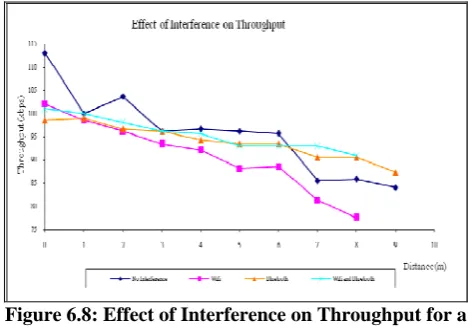
Compared to the previous figures, for data size of 500KB the effect on transmission can be regarded as negligible as they are close to the values where there are no interference. Moreover the graphs follow the same trend as the situation where there are no interferences. It can further be noted that wi-fi has the greatest impact on transmission for high data size.
[image:5.595.50.288.161.344.2]As previously stated, if transmission time is affected by interference and likewise throughput is affected. Figure 6.8 confirms this pattern.
Figure 6.8: Effect of Interference on Throughput for a Data Size of 500KB
6.3.4 Effect of Interference on Transmission Time and Throughput for a Data Size of 1003KB
As previously stated, wi-fi has the greatest effect on data transmission as the size of data increases. However it can further be noted that in cases where there is Bluetooth interference and combined WI-FI and Bluetooth interference, the transmission is less than in case where
there is no interference at all. Moreover, it is noted that the transmission time has decreased by 23% with Bluetooth interference, this might have been caused by an unstable operation of the Bluetooth emitter itself. Another reason can be for higher values greater than 1000KB, Bluetooth has a constructive interference over data broadcasting.
6.3.5 Effect of Interference on Transmission Time and Throughput for a Data Size of 2086KB
Figure 6.9: Effect of Interference on Transmission Time for a Data Size of 2086KB
Figure 6.11 shows that wi-fi has no effect on transmission time as it has a similar graph to the situation where is no interference. This fact has been confirmed by the graph of combined wi-fi and Bluetooth where it has been shown that only Bluetooth is causing the interference. Punnoose et al. (2001) [9] stated that wi-fi has similar frequency overlapping as Bluetooth one third of the time, however the result from the graph shows that during the testing period it can be deduced that this does not occur.
[image:5.595.51.288.501.665.2]As shown in figure 6.11, for higher data size transmission time decreases with Bluetooth interference confirming that for data size higher than 1000KB Bluetooth enhances its data transmission through a constructive interference. Similar results were obtained from the previous graphs of effects of interference on throughput and it is again confirmed by Figure 6.12 above.
[image:5.595.304.552.574.731.2]6.4 EFFECT OF BARRIER ON DATA TRANSMISSION AND THROUGHPUT
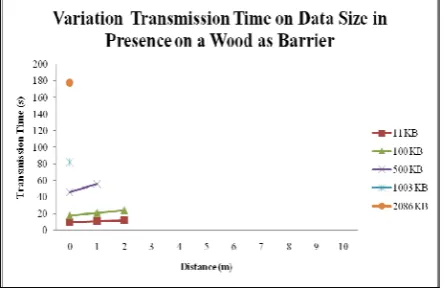
[image:6.595.59.282.333.477.2]In real environments, there will always be obstruction to the transmission of data like physical barriers and interference from other communication technologies. The effects of glass window (1-2 cm thick), wooden door (2-3 cm thick), concrete wall (11-12 cm thick) and metal barriers (1-2 mm thick) were investigated. The setup described in section 5.4 was used and the results obtained are explained. It is observed that barriers have a negative effect on transmission limit as well as data transmission time and throughput. Of the four barriers, window has the least effect on the broadcasting performance while wall and wood have similar results with similar transmission time and throughputs. As the wave passes through a solid barrier, some of the wave power is absorbed and therefore the Bluetooth range decreases drastically. This is caused by a decrease in the amplitude of the wave front when the later passes through a physical body. Figure 6.11 shows the variation in transmission against various data sizes when wood is used as a barrier. Similar experiments were conducted for glass, concrete and metal barriers.
Figure 6.11: Effect of Wood on Transmission Time
Moreover for the case of concrete wall, the transmission range was limited to a maximum radius of 2m, while for the case of the glass window, the range was up to 8m. This is explained the fact that the glass pane has a small thickness compared to the wall and hence the impact was more distinct compared to the former as increased in thickness causes a reduction of the energy possessed by the waves as they passed through the medium. Additionally, the difference in the densities of the different barriers also affect the transmission time [14] and range by the amount of wave it disperses [15].
7. CONCLUSIONS
The potential of using Bluetooth as a broadcasting medium for transmission of data has been described in this paper. The results from the different test scenarios indicate that the performance of Bluetooth is highly dependent on the Bluetooth devices being used. The effect of data types and size was assessed. However, it was observed that the data transmission was dependent only on data size. The type of data used had no effect on transmission time. Moreover, it was noted that for small data sizes, the effect on transmission time was negligible and it became more
significant as the data size increases. Distance from the Bluetooth server also affects the transmission time and throughput. As distance increases, transmission time increases while throughput decreases. Different types of barrier affected the transmission time and broadcast limit differently. Glass and wood had negligible effect on both parameters while thick concrete walls and metal barriers decrease the limit range to 3m for high data sizes. The effect of wi-fi, Bluetooth and combined wi-fi and Bluetooth increases the transmission time and decreases throughput as data size and distance increases. However, wi-fi alone had negligible effect during transmission of data sizes less than 100KB. Moreover, we noticed that the Bluetooth broadcasting range is restricted between 4m to 7m in sunlight depending on the model of the receiving device. This will be further investigated in our future work. We have found that although Bluetooth is becoming more and more popular and is being embedded in almost all electronic devices to enable seamless wireless communication, our research shows that the current Bluetooth technology (Bluetooth 2.0) is currently unsuitable to transfer large data files over a distance exceeding 3m in the presence of barriers.
REFERENCES
[1] K. Dogan, G. Gurel, A. K. Kamci and I. Korpeoglu, “A Performance Analysis of Bluetooth Broadcasting Scheme,” Springer Berlin / Heidelberg, Vol. 3992/2006, pp. 996-999, May 2006.
[2] T. J. Thompson, P. J. Kline and C. B. Kumar, Bluetooth Application Programming with the Java APIs Essentials Edition. Elselvier Inc., USA, 2008.
[3] Bluetooth SIG, Inc. (2004, Nov. 4). Specification of the Bluetooth System. [Online]. Available:
http://bluetooth.com/NR/rdonlyres/1F6469BA-6AE7-42B6-B5A1-65148B9DB238/840/Core_v210_EDR.zip
[4] B. Hopkins and R. Antony, Bluetooth for Java. Apress, USA, 2003. [5] H. Bohn, A. Bobek and F. Golatowski, “Bluetooth Device Manager Connecting a Large Number of Resource-Constraint Devices in a Service-Oriented Bluetooth Network,” Lecture Notes in Computer Science, vol. 3420/2005, pp. 430-437, Apr. 2005.
[6] R. Steele. (2006, Jun. 20). Introduction to Bluetooth. [Online]. Available:
http://cluster.crutchfield.com/S-B6fLsGBTCtH/app/learn/article/default.aspx?pp=T&page=All&aid=1 264&articlegroupid=114
[7] A. I. Wang and J. Ho, “Is Bluetooth Broadcasting Practical and Useful?,” International Symposium on Collaborative Technologies and Systems, pp. 356-363, May 2007.
[8] Kong, J. A., (2008, Aug. 08). Electromagnetic Wave Theory and Applications. [Online]. Available:
www.rle.mit.edu/media/pr146/pr146_ch17_Kong.pdf
[9] M. R. Doomun, “Video Transmission Performance Using Bluetooth Technology,” Innovative Algorithms and Techniques in Automation, Industrial Electronics and Telecommunications. Netherlands. 2007. [10] R. J. Punnoose, R. S. Tseng and D. D. Stancil, “Experimental Results
for Interference between Bluetooth and IEEE 802.11b DSSS Systems,” IEEE Vehicular Technology Conference. vol. 1, pp. 67- 71, 2001.
[11] BlueCove Team, (2008, Dec. 25). BlueCove test application. [Online]. Available: http://www.bluecove.org/bluecove-examples/bluecove-tester/
[12] SourceForge, Inc., (2006, Feb. 01). AvetanaOBEX OBEX implementation for J2ME. [Online]. Available:
http://sourceforge.net/projects/avetanaobex/
[13] R. Jong, (2009, July 17). Bluetooth Broadcasting. [Online]. Available: scripties.fwn.eldoc.ub.rug.nl/..../INF-MA-2009-R._de_Jong.PDF [14] J. Lai, C. Kuo and T. Hsu, “Physical Model Test on Wave
Transmission to Culvert Pipes Block with Constrictive Sections.” 2008 Taiwan-Polish Joint Seminar on Coastal Protection. pp. A15-A24. 2008.