A R o b u s t and Efficient T h r e e - L a y e r e d D i a l o g u e C o m p o n e n t
for a S p e e c h - t o - S p e e c h T r a n s l a t i o n System*
J a n A l e x a n d e r s s o n a n d E l i s a b e t h M a i e r a n d N o r b e r t R e i t h i n g e r D F K I G m b H , S t u h l s a t z e n h a u s w e g 3, D-66123 S a a r b r f i c k e n , G e r m a n y
{alexanders son, maier, reithinger}~dfki, uni- sb. de
Abstract
We present the dialogue component of the speech-to-speech translation system VERBMOBIL. In contrast to conventional dialogue systems it mediates the dia- logue while processing maximally 50% of the dialogue in depth. Special require- ments (robustness and efficiency) lead to a 3-layered hybrid architecture for the dialogue module, using statistics, an automaton and a planner. A dialogue memory is constructed incrementally.
1
I n t r o d u c t i o n
VERBMOBIL combines the two key technologies speech processing and machine translation. The long-term goal of this project is the development of a prototype for the translation of spoken di- alogues between two persons who want to find a date for a business meeting (for more detail on the objectives of VERBMOBIL see (Wahlster, 1993)). A special characteristic of VERBMOBIL is that both participants are assumed to have at least a pas- sive knowledge of English which is used as inter- mediate language. Translations are produced on demand so that only parts of the dialogue are pro- cessed. If VERBMOBIL is inactive, shallow process- ing by a keyword spotter takes place which allows the system to follow the dialogue at least partially. In this paper focus is on the description of the dialogue component, which processes the interac- tion of the two dialogue partners and builds a rep- resentation of the discourse. Dialogue processing in VERBMOBIL differs from systems,like SUNDIAL (Andry, 1992) in two important points: (1) VERB- MOBIL mediates the dialogue between two human dialogue participants; the system is not a partic- ipant of its own, i.e. it does not control the di- alogue as it happens in the flight scheduling sce- nario of SUNDIAL; (2) VERBMOBIL processes maxi- mally 50% of the dialogue contributions in depth,
*The research within VERBMOBIL presented here is
i.e. when the 'owner' of VERBMOBIL speaks Ger- man only. The rest of the dialogue can only be followed by a keyword spotter.
In the remainder of this paper first the require- ments of the VERBMOBIL setting with respect to functionality and design of the dialogue compo- nent section are introduced. Then a hybrid archi- tecture for the dialogue component and its embed- ding into the VERBMOBIL prototype are discussed. Finally, results from our implemented system are presented. We conclude with an outline of future extensions.
2
Tasks of t h e D i a l o g u e
C o m p o n e n tThe dialogue component within VERBMOBIL has four mQor tasks:
(1) to support speech recognition and linguis- tic analysis when processing the speech signal. Top-down predictions can be made to restrict the search space of other analysis components to get better results in shorter time (Young et al., 1989; Andry, 1992)). For instance, predictions about a speech act can be used to narrow down the set of words which are likely to occur in the following utterance - a fact exploited by the speech recog- nition component which uses adaptive language models (Jellinek, 1990). Top-down predictions are also used to limit the set of applicable grammar rules to a specific subgrammar. They are of par- ticular importance since the system has to work under real-time constraints.
English (and no automatic translation is neces- sary) VERBMOBIL is "passive", i.e. no syntactic or semantic analyses are performed. In such cases, the dialogue component tries to follow the dia- logue by using a keyword spotter. This device scans the input for a small set of predetermined words which are characteristic for certain stages of the dialogue. The dialogue component computes the most probable speech act type of the next ut- terance in order to selects its typical key words.
(4) to control clarification dialogues between
VERBMOBIL and its users. If processing breaks down VERBMOBIL h a s to initiate a clarification di- alogue in order to recover.
3 The Architecture
Planner
I
FSM
'1
Statistics
Dialogue Memory
Intel~~
Refer~mtlal
StnJcture
.•
Key-Word
Spotting
I
• -~ SemanUc ]
Evaluation
]
IH,.°.,. i
~ Generation
I
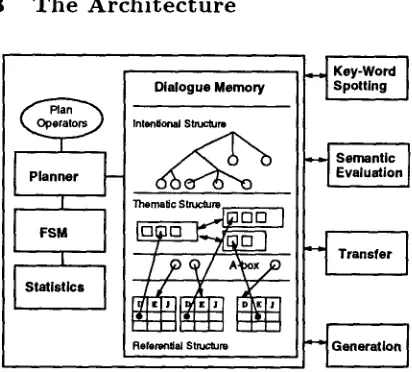
Figure 1: Architecture of the dialogue module
The abovementioned requirements cannot be met when using a single method of processing: if we use structural knowledge sources like plans or dialogue-grammars, top-down predictions are dif- ficult make, because usually one can infer many possible follow-up speech acts from such knowl- edge sources that are not scored (Nagata and Mo- rimoto, 1993). Also, a planning-only approach is inappropriate when the dialogue is processed only partially. Therefore we chose a hybrid 3-layered approach (see fig. 1) where the layers differ with respect to the type of knowledge they use and the task they are responsible for. The components are
A S t a t i s t i c M o d u l e The task of the statistic module is the prediction of the following speech act, using knowledge about speech act frequencies in our training corpus.
A F i n i t e S t a t e M a c h i n e ( F S M ) The
finite state machine describes the sequence of speech acts that are admissible in a standard appointment scheduling dialogue and checks the ongoing dialogue whether it follows these expectations (see fig. 2).
A P l a n n e r The hierarchical planner constructs a description of the dialogue's underlying dia- logue and thematic structures, making exten- sive use of contextual knowledge. This mod- ule is sensitive to inconsistencies and there- fore robustness and backup-strategies are the most important features of this component. While the statistical component completely re- lies on numerical information and is able to pro- vide scored predictions in a fast and efficient way, the planner handles time-intensive tasks exploit- ing various knowledge sources, in particular lin- guistic information. The FSM can be located in between these two components: it works like an efficient parser for the detection of inconsistent di- alogue states. The three modules interact in cases of repair, e.g. when the planner needs statistical information to resume an incongruent dialogue.
On the input side the dialogue component is in- terfaced with the output from the semantic con- struction/evaluation module, which is a Drts-like feature-value structure (Bos et al., 1994) contain- ing syntactic, semantic, and occasionally prag- matic information. The input also includes infor- mation from the generation component about the utterance produced in the target language and a word lattice from the keyword spotter.
The output of the dialogue module is de- livered to any module that needs information about the-dialogue pursued so far, as for example the transfer module and the semantic construc- tion/evaluation module. Additionally, the key- word spotter is provided with words expected in the next utterance.
4
Layered Dialogue Processing
4.1 K n o w l e d g e - B a s e d L a y e r s
4.1.1 T h e U n d e r l y i n g K n o w l e d g e S o u r c e - T h e D i a l o g u e M o d e l
Like previous approaches for modeling task- oriented dialogues we base our ideas on the as- sumption that a dialogue can be described by means of a limited but open set of speech acts (e.g. (Bilange, 1991), (Mast, 1993)). As point of departure we take speech acts as proposed by (Austin, 1962) and (Searle, 1969) and also a num- ber of so-called illocutionary acts as employed in a model of information-seeking dialogues (Sitter and Stein, 1992). We examined the VERBMOBIL cor- pus of appointment, scheduling dialogues for their occurrence and for the necessity to introduce new speech acts 1 .
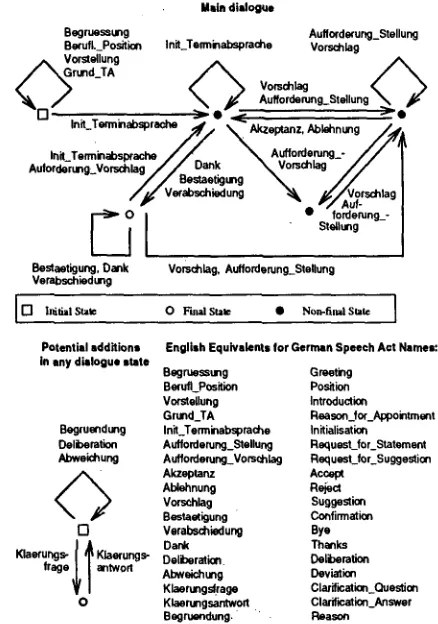
At present,, our model contains 17 speech acts (see (Maier, 1994) for more details on the char- acterization of the various speech acts; the di- alogue model describing admissible sequences of
[image:2.596.59.265.250.436.2]speech acts is given in fig. 2). Among the domain- dependent speech acts there are low-level (primi- tive) speech acts like BEC~RUESSUNG for initiating and VERABSCHIEDUNG for concluding a dialogue. Among the domain-independent speech acts we use acts as e.g. AKZEPTANZ and ABLEHNUNG. Additionally, we introduced two speech acts nec- essary for modeling our appointment scheduling dialogues: INIT_TERMINABSPRACHE and BESTAE- TIGUNG. While the first is used to describe utter- ances which state date s or places to be negotiated, the latter corresponds to contributions that con- tain a mutual agreement concerning a given topic.
Mnin dialogue
Begruessung Auflordecung_Stellung
BecufL_Position Init _Telminal~prache Vorsehlag ~Vorsldlung
rund .TA ~ Vomchlag
Aufforderung_Stellung ~
• ~ $
Inlt_Temamabsprache~ ~ Akzeplanz, Ablehnung/
Auforderung Vorschlag /, , ~ U at~k NV°mchlag / /
/ / uestaetigung \ / /
w forderung_-
~ 0 ! Stellung
Bestaetigung Dank Vomchlag. Aufforderung_Stellung Verabsehiedung
[ r'] lnilial State 0 Fu,al Sta. • Non-finalS== ]
Potential sdditions English Equivalents for German Speech Act Names: in any diMogue state
Begruessung Greeting Berufi_Position Position Vorstellung Introduction
Grund_TA Reason_for_Appointmmt Begruendung Init Terminabsprache Initialisation
Deliberation A ultord erung_Stellung Reque6t_for_Statement Abweichung AuffordeRing_Vorsehlag Request_for Suggestion
~ / ~ Akzeptanz Accept
Ablehnung Reject Vorschlag Suggestion Bestaetigung Confirmation
[] Verabschiedung Bye
Klaerur~gs- I ~ Klaerungs- Dar~ Thanks Deliberation Delibemli0n
lrage ~//antwoa Abweichung Deviation
Klaerungsfrage Clarification_Question 0 Klaerungsantwoa. Clarifcation_Answer
Begruendung. Reason
Figure 2: A dialogue model for the description of appointment scheduling dialogues
The dialogue consists Of three phases (Maier, 1994). First, an introductory phase, where the discourse participants greet I each other, introduce themselves and provide information e.g. about their professional status. After • this, the topic of the conversation is introduced, usually the fact t h a t one or more appointments have to be sched- uled. Then negotiation •begins where the discourse participants repeatedly offer possible time frames, make counter offers, refine the time frames, re- ject offers and request other • possibilities. Once an item is accepted ~nd mutual agreement exists either the dialogue can be terminated, or another
appointment is negotiated.
A dialogue model based on speech acts seems to be an appropriate approach also from the point of view of machine translation and of transfer in particular: While in written discourse sentences can be considered the basic units of transfer, this assumption is not valid for spoken dialogues. In m a n y cases only sentence fragments are uttered, which often are grammatically incomplete or even incorrect. Therefore different descriptive units have to be chosen. In the case Of VERBMOBIL these units are speech acts.
The speech acts which in our approach are em- bedded in a sequential model of interaction can be additionally classified using the taxonomy of dia- logue control functions as proposed in e.g. (Bunt, 1989). Speech acts like BEGRUESSUNG and VE- RABSCHIEDUNG, for example, can be classified as dialogue flmctions controlling interaction manage- ment. More fine-grained taxonomical distinctions like CONFIRM and CONFIRM/WEAK as proposed in (Bunt, 1994) are captured in our approach by pragmatic features like
suitability
andpossibility
specified in the DRS-description of an utterance, which serves as input for the dialogue component.
4.1.2 T i l e F i n i t e S t a t e M a c h i n e
The finite state machine provides an efficient and robust implementation of the dialogue model. It parses the speech acts encountered so far, tests their consistency with the dialogue model and saves the current state. When an inconsistency occurs fall back strategies (using for instance the statistical layer) are used to select the most prob- able state. The state machine is extended to al- low for phenomena t h a t might appear anywhere in a dialogue, e.g. h u m a n - h u m a n clarification di- alogues and deliberation. It can also handle re- cursively embedded clarification dialogues.
An important task of this layer is to signal to the planner when an inconsistency has occurred, i.e. when a speech act is not within the standard model so that it can activate repair techniques.
4.1.3 T h e D i a l o g u e P l a n n e r
[image:3.596.85.304.237.549.2]troductory phase (GREET-INTRODUCE-TOPIC), the negotiation phase (NEGOTIATE) and the closing phase (FINISH). These goals have to be fulfilled in the specified order. The keyword i t e r a t e speci- fies that negotiation phases can occur repeatedly.
begin-plan-operator GENERIC-OPERATOR
goal [SCHEDULE-MEETING] constraints nil
actions nil
subgoals (sequence [GREET-INTRODUCE-TOPIC] iterate [NEGOTIATE] [FINISH] )
end-plan-operator
begin-plan-operator OFFER-OPERATOR
goal [OFFER]
c o n s t r a i n t s n i l
a c t i o n s ( r e t r i e v e - t h e m e ) subgoals p r i m i t i v e e n d - p l a n - o p e r a t o r
In our hierarchy of plan operators the leaves, i.e. the most specific operators, correspond to the in- dividual speech acts of the model as given in fig. 2. Their application is mainly controlled by prag- matic and contextual constraints. Among these constraints are, for example, features related to the discourse participants (acquaintance, level of expertise) and features related to the dialogue his- tory (e.g. the occurrence of a certain speech act in the preceding context).
Additionally, our plan operators contain an ac- tions slot, where operations which are triggered after a successful fulfillment of the subgoals are specified. Actions, therefore, are employed to in- teract with other system components. In the sub- plan 0FFER-0PERATOR, for example, which is re- sponsible for planning a speech act of the type VORSCHLAG, the action ( r e t r i e v e - t h e m e ) filters the information relevant for the progress of the negotiation (e.g. information related to dates, like months, weeks, days) and updates the thematic structure of the dialogue history. During the plan- ning process tree-like structures are built which mirror the structure of the dialogue.
The dialogue memory consists of three layers of dialog structure: (1) an intentional structure representing dialogue phases and speech acts as occurring in the dialogue, (2) a thematic struc- ture representing the dates being negotiated, and (3) a referential structure keeping track oflexical realizations. The planner also augments the input sign by pragmatic information, i.e. by information concerning its speech act.
The plan-based and the other two layers - statistics and finite state machine - interact in a number of ways" in cases where gaps occur in the dialogue statistical rating can help to de- termine the speech acts which are most likely to miss. Also, when the finite state machine detect§ an error, the planner must activate plan operators which are specialized for recovering the dialogue
state in order not to fail. For this purpose spe- cialized repair-operators have been implemented which determine both the type of error occurred and the most likely and plausible way to continue the dialogue. It is an intrinsic feature of the dia- logue planner that it is able to process any input
- even dialogues which do not the least coincide
with our expectations of a valid dialogue - and that it proceeds properly if the parts processed by VERBMOBIL contain gaps.
4 . 2 T h e S t a t i s t i c a l L a y e r - S t a t i s t i c a l
M o d e l i n g a n d P r e d i c t i o n
Another level of processing is a n implementa- tion of an information-theoretic model. In speech recognition language models are commonly used to reduce the search space when determining a word that can match a given p a r t of the in° put. This approach is also used in the domain of discourse modeling to support the recognition process in speech-processing systems (Niedermair, 1992; Nagata and Morimoto, 1993). The units to be processed are not words, but the speech acts of a text or a dialogue. The basis oLprocessing is a training corpus annotated with the speech acts of the utterances. This corpus is used to gain sta- tistical information about the dialogue structure, namely unigram, bigram and trigram frequencies of speech acts. They can be used for e.g. the pre- diction of following speech acts to support the speech processing components (e.g. dialogue de- pendent language models), for the disambiguation of diflhrent readings of a sentence, or for guiding the dialogue planner. Since the statistical model always delivers a result and since it can adapt it- self to unknown structures, it is very robust. Also, if the statistic is updated during normal operation, it can adapt itself to the dialogue patterns of the VERBMOBIL user, leading to a higher prediction accuracy.
Considering a dialogue to be a source that has speech acts as output, we can predict the nth speech act s,~ using the maximal conditional prob- ability
s,, := max.. P(sls,,,1, s,,-2, s,_a, ...)
We approximate P with the standard smooth- ing technique known as deleted interpolation (Jellinek, 1990), using unigram, bigram and tri- gram relative frequencies, where f are relative fre- quencies and qi are weights whose sum is 1:
P ( s , , I s . - , , s,,..~) =
q,f(s..) + q~f(s..Is.._, ) + q.~f(s..ls,-,, s..-2)
Given tl/is formula and the required N-grams we can determine the k best predictions for the next speech acts.
2340 speech acts as training corpus, and 41 dia- logues with 2472 speech acts as test data. TS2 uses another 81 dialogues with 2995 speech acts as test data.
I P~ed" I TSI I TS2 I
1 40,65 % 44,24 % 2 60,19 % 66,47 % 3 73,92 % 81,46 %
Compared to the data from (Nagata and Mo- rimoto, 1993) who report prediction accuracies of 61.7 %, 77.5 % and 85.1% for one, two or three predictions respectively, our predictions are less reliable. The main reason is, that the dialogues in our corpus frequently do not follow conventional dialogue behavior, i.e. the dialogue structure dif- fers remarkably from dialogue to dialogue.
5
A n A n n o t a t e d E x a m p l e
To get an impression of the flmctionality of the dialogue module, we will show the processing of three sentences which are part of an example di- alogue which has a total length of 25 turns. This dialogue is part of a corpus of 200 dialogues which are all fully processed by our dialogue component. Prior to sentence DEO04 given below ~.L initialized the dialogue requesting a date for a trip s.
DEO04: #oh ja, gut, nach meinem Termin- kalender <Pause>, wie w"ars im Oktober?# (VORSCHLAG)
VMO05: just lookin at my diary, I would
suggest October. (VORSCHLAG) DEO06/I: <Pause> I propose from Tuesday
the fifth/-
DEO06/2: <Pause> no, Tuesday the fourth to Saturday the eighth <Pause>, those five days? (VORSCHLAG) ELO07: oh, that's too bad, I'm not free
right then. (ABLEHNUlVG) <Pause> I could fit it into my schedule <Smack> the week after, from Saturday to Thursday, the thirteenth. (VORSCHLAG)
If w e trace the processing with the finite state machine and the statistics component, allowing
two predictions, w e get the following results:
ELO03 : INIT_TERMINABSPRACHE
Prediction: (VORSCHLAG AUFFORDERUNG_VORSCHLAG) DEO04 : VORSCHLAG
Prediction: (KKZEPTANZ VORSCHLAG) DEO06/I : VORSCHLAG
Prediction: (AKZEPTANZ VORSCHLAG)
DEO06/2: VORSCHLAG
Prediction: (AKZEPTANZ VORSCHLAG) **Failed**
ELO07/I : ABLEHNUNG
Prediction: (VORSCHLAG AUFFORDERUNG_STELLUNG) ELO07/2 : VGRSCHLAG
2DE indicates the German speaker, VM the trans- lation provided by VERBMOBIL and EL the English speaker. # indicates pressing or release of the button that activates VERBMOBIL.
Prediction: (AKZEPTANZ ABLEHNUNG)
While the finite state machine accepts the se- quence of speech acts without failure the pre- dictions made by the statistical module are not correct for DE006/2. The four best predic- tions and their scores are AKZEPTANZ (28.09~,), V O R S C H L A G (26.93~,), A B L E H N U N G (21.67~,) and AUFFORDERUNG_STELLUNG (9.7~,). In comparison
with the fourth prediction, the first three pre- dictions have a very similar ranking, so that the failure can only be considered a near miss. The overall prediction rates for the whole dialogue are 56.52 %, 82,60%, and 95.65% for one, two, and three predictions, respectively.
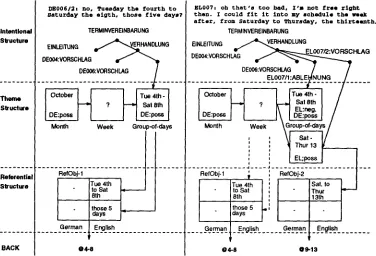
Since the dialogue can be processed properly by the finite state machine no repair is neces- sary. The only task of the planner therefore is the construction of the dialogue memory. It adds the incoming speech acts to the intentional struc- ture, keeps track of the dates being negotiated, stores the various linguistic realizations of objects (e.g. lexical variations, referring expressions) and builds and administrates the links to the instanti- ated representation of these objects in the knowl- edge representation language BACK (Hoppe et al., 1993). In fig. 3 we give two snapshots showing how the dialogue memory looks like after process- ing the turns DE006/2 and EL007.
6
C o n c l u s i o n a n d f u t u r e e x t e n s i o n s
Dialogue processing in VERBMOBIL poses prob- lems that differ from other systems like (Mast, 1993) and (Bilange, 1991). Not being in a control- ling position within a speech-processing system but tracking a mediated dialogue calls for an ar- chitecture where different approaches to dialogue processing cooperate. One important goal of our module is to provide top-down information for the other modules of VERBMOBIL, e.g. to reduce the search space of the word recognizer. This require- ment is solved partially by using a statistics-based speech act prediction component. Also, we repre- sent contextual information that is important for other VERBMOBIL components, as e.g. transfer and generation. This information is built up by the planner during dialogue processing.
Future extensions of the dialogue component, which has been sucessfidly tested with 200 dia- logues of our corpus concern the treatment of clar- ification dialogues. Robust processing will be an- other issue to be tackled: the possibility to process gaps in the dialogue will also be integrated.
R e f e r e n c e s
Andry, F. 1992. Static and dynamic predictions: a method to improve speech understanding in c o o p - e r a t i v e dialogues. In Proc. of the Int. Conference on Spoken Language Processing (ICSLP'9~), p a g e s
DE006/2t no, Tuesday the fourth to [ EL007= oh that's too bad, I'a no~ free right
Saturday the algth, those flve days? i then. I could fit it Into my schedule the wlak
I after, from Saturday to Thursday, the thir~aenth,
Intentional TERMINVEREINBARUNG I TERMINVEREINSARUNG Sbucture .,..-"4~VER HAN DLUN "- | EINLEITUNG J ' 4 ~ VERHANDLUNG
EINLEITUNG - / ~"~L% nn ~ I LAGS ~
DEOO4:VORSCHLAG r ~ [ DEOO4:VORSCH ELOO7/2:VORSCHLAG
DEOO6:VORSCHLAG / [ DEOO6:VORSCHLAG / /
. . . i . . . . . . . . .
Structure
Month Week Group-of-days Month Week \Group-of-days /
- _ : . : : - , , - . , [ . . . ~;,o-~j.; . . . T - r . . . ~ ; , ~ ; j : ; . . . , . . . . ! - - ~ ; , o ; j - ~ . . . l -
_~;.."~t','2~,- / I ITu~,., ] | | ] ]Tue 4t'h " I Sat. to | I
- " - / I " ItoSat ',~ " / I - ItoSat [ ', I " IThut
/
I~'h
/
~'" ',I
1'3'h
/
/ . I those5 _ | those5 I.,-: I - [ . |
J German | English German | English German | English . . . ~ . . . ~ . . . ~ . . .
BACK @4-8 @4-8 @9-13
Figure 3: A snapshot of the dialogue m e m o r y after processing the utterances D E 0 0 6 / 2 and EL007
Austin, 3. 1962. How to do things with words. Oxford: Clarendon Press.
Bilange, E. 1991. A task independent oral dialogue model. In Proceedings of EACL-91, pages 83-88, Berlin, Germany, April.
Bos, 3., Mastenbroek, E., McGlashan, S., Millies, S. and Pinkal, M. 1994. The VERBMOBIL Semantic Formalism. Technical report, Computerlinguistik, Universit/it des Saarlandes, Sam'brficken.
Bunt, H. C. 1989. Information Dialogues as Com- municative Action in Relation to Partner Model- ing and Information Processing. In M. M. Taylor, F. N~el, and D. B. Bouwhuis, editors, Tile Struc- ture of Muitimodal Dialogue, pages 47-73. Elsevier Sience Publishers, North-Holland.
Bunt, H. C. 1994. Context and Dialogue Control. Think, 3:19-31, May.
Hoppe, T., Kindermann, C., Quantz, J. a., Schmiedel, A., and Fischer, M. 1993. BACK V5 Tutorial & Manual. K I T - REPORT 100, TU Berlin, March. Hovy, E. H. 1988. Planning coherent multisentential
text. In Proceedings of the 26th A CL Conference, pages 179-186, Buffalo.
Jeilinek, F. 1990. Self-organized language modeling for speech recognition. In A. Waibel and K.-F. Lee, editors, Readings in Speech Recognition, pages 450- 506. Morgan Kaufmann.
LuperFoy, S. and Rich, E.A. 1992. A three tiered dis- course representation framework for computational discourse processing. Technical report, MITRE Corporation and MCC.
Maler, E. (ed.) 1994. Dialogmodellierung in VERB- MOBIL - Festlegung der Sprechhandlungen ffir den
Demonstrator. Technical Report Verbmobil-Memo 31, DFKI Saarbr/icken, July.
Mast, M. 1993. Ein Dialogmodui /iir ein Spracherkennungs- und Dialogsystem. Ph.D. the- sis, Universit/it Erlangen.
Moore, J. D. and PaISs, C. L. 1989. Planning text for advisory dialogues. In Proc. of A CL, Vancouver. Nagata, M. and Morimoto, T. 1993. An experimental
statistical dialogue model to predict the Speech Act Type of the next utterance. In Proc. of the Int. Symposium on Spoken Dialogue (ISSD-93), pages 83-86, Waseda University, Tokyo, Japan.
Niedermair, G. Th. 1992. Linguistic Modeling in the Context of Oral Dialogue. In Proceedings of IC- SLP'92, volume 1, pages 635-638, Banff', Canada. Ripplinger, B. and Caroli, F. 1994. Konzept-basierte
Ubersetzung in Verbmobil. Technical report, IAI Sam'br6cken, May.
SeaHe, J. R. 1969. Speech Acts. Cambridge/GB: University Press.
Sitter, S. and Stein, A. 1992. Modeling the iUocution- ary aspects of information-seeking dialogues. In. formation Processing and Management, 28(2):165 - 180.
Wahlster, W. 1993. Verbmobil -Translation of face- to-face dialogues. In Proceedings of the Fourth Ma- chine Translation Summit, Kobe, Japan, July. Young, S. R., Ward, W. H., and Hauptmann, A. G.
[image:6.596.91.467.71.327.2]