A General Feature Space for Automatic Verb Classification
Eric Joanis and Suzanne Stevenson
Department of Computer Science
University of Toronto
fjoanis,[email protected]
Abstract
We develop a general feature space for automatic classification of verbs into lexical semantic classes. Previous work was limited in scope by the need for manual selection of discriminating fea-tures, through a linguistic analysis of the target verb classes (Merlo and Steven-son, 2001). We instead analyze the classification structure at a higher level, using the possible defining characteris-tics of classes as the basis for our fea-ture space. The general feafea-ture space achieves reductions in error rates of 42— 69%, on a wider range of classes than investigated previously, with compara-ble performance to feature sets manu-ally selected for the particular classifi-cation tasks. Our results show that the approach is generally applicable, and avoids the need for resource-intensive linguistic analysis for each new task.
1 Introduction
Wide-coverage language processing systems re-quire large amounts of knowledge about individ-ual words, leading to a lexical acquisition bottle-neck. Because verbs play a central role in the syn-tactic and semantic interpretation of a sentence, much research has focused on automatically learn-ing properties of verbs from text corpora, such as their subcategorization (Brent, 1993; Briscoe and Carroll, 1997), argument roles (Riloff and Schmelzenbach, 1998; Gildea and Jurafsky, 2002), selectional preferences (Resnik, 1996), and lexi-cal semantic classification (Dorr and Jones, 1996;
Lapata and Brew, 1999; Schulte im Walde, 2000; Merlo and Stevenson, 2001). Our work aims to ex-tend the applicability of the latter, by developing a general feature space for automatic verb classifi-cation.
Specifically, Merlo and Stevenson (2001) showed that verbs could be automatically classi-fied into one of three lexical semantic classes on the basis of five simple statistical features. This work demonstrated the feasibility of verb classifi-cation from noisy, easily extractable corpus statis-tics. However, the approach was limited in scope by the need for manual determination of a discrim-inating set of features, through a linguistic anal-ysis of the target verb classes. Our work over-comes this limitation by developing a general fea-ture space that avoids the need for individual de-velopment of features for specific classes.
The central idea of our approach is as follows. We focus on lexical semantic classes as in Levin (1993) (hereafter Levin), which group together verbs sharing both a common semantics (such as manner of motion or change of state), and a set of syntactic alternations. An alternation refers to the alternative mappings of the semantic arguments of a verb to syntactic positions, as in:
la. I loaded the truck
b. I loaded hay onto the truck.
In Merlo and Stevenson (2001) (hereafter MS01), the differences between the specific semantic ar-guments and their possible alternations for the three target classes were analyzed to determine a small set of discriminating features. Here, we per-form the linguistic analysis at a higher level, by analyzing the range of possible alternations and distinctions among arguments that verbs can ex-hibit.
As an illustrative example, MS01 determined that an informative statistical feature is the propor-tion of animate subjects used with a verb, since an-imacy is correlated with agenthood, and their verb classes differed in whether they have an agentive subject. In our feature space, we generalize this idea to yield a set of features that estimate animacy for each possible syntactic argument slot (not just subject, but direct and indirect object, and object of prepositions). In this way, we capture the ob-servation that, across verb classes in general, se-mantic arguments in any slot (not just subject) may differ in their proportion of animate entities.
Since we analyze verb class distinctions at this more general level, we need only do the linguistic analysis once, rather than having to do the individ-ual analysis for every set of classes that we want to distinguish. It is worth emphasizing that we do not base our features directly on all the existing Levin classes (cf. Don and Jones 1996)—we instead an-alyze possible alternations for verbs independent of the actual classes. The result is a general classi-fication feature space that in principle is useful for any Levin-type verb classification task.1
The generality of our feature space enables ex-periments on a wider range of classes than has pre-viously been attempted with the approach in MS01 and subsequent extensions (Merlo et al., 2002). We demonstrate the applicability of the feature space to distinctions among 14 classes, including ten new classes in addition to the target classes on which the method was originally developed. To preview our results below, we achieve reduc-tions in error rate ranging from 42% to 69%, av-eraging more than 50% over all the tasks, demon-strating the potential of the approach for a wide range of classes. Furthermore, the performance compares favourably with sets of features hand-selected for the particular class distinctions, sup-porting our claim that the general feature space can replace the time-consuming expert linguistic analysis previously needed for each new classifi-cation task.
The remainder of the paper describes the
anal-!
And indeed, it may be useful for other approaches to predicate classification as well, as long as their distinc-tions have expression in syntactic behaviour (e.g., as in the FrameNet project, http://www.icsi.berkeley. edur framenet/).
ysis underlying the features in our general feature space, the classes chosen for demonstrating its ef-fectiveness, and our experimental procedures and results. We conclude with a discussion of related work, as well as limitations and planned exten-sions of our approach.
2 The Feature Space
Recall that lexical semantic classes as in Levin form a hierarchy of verb groupings with shared meaning and syntax. The constraints on map-ping semantic arguments to syntactic positions re-flect underlying semantic properties of the verbs (Pinker, 1989; Levin, 1993). Thus alternations, such as those in (1) above, in which the same ar-gument (hay or truck) is mapped to different po-sitions, are particularly useful in distinguishing verb classes. MS01 further note the importance of the differing semantic (thematic) roles assigned by verbs for distinguishing the classes.
The features in MS01, and those of our general feature space, were designed to tap into the dif-ferences between classes both in the alternations they allow, and in the thematic roles assigned. To this end, we generalized the features from MS01, and extended them by considering the full set of alternations from Levin, to capture similar distinc-tions across a wider range of verb class variability. Specifically, we drew on Part I of Levin, which elaborates the alternations she uses to characterize verb classes, in contrast to Part II, which enumer-ates the classes themselves.
The feature space is summarized in Table 1, and described in detail in the rest of this section. All frequency counts are normalized by the total num-ber of occurrences of the verb (or, in some cases, a relevant subset).
2.1 Features over Syntactic Slots
syntac-§ in Text Feature Category #Features
Syntactic slots 76
2.1 Slot overlap 40
"Empty" words 4
Passive 2
2.2 POS of the verb 6
Aux, modal, Adv 13
Derived forms 3
[image:3.595.110.309.85.217.2]2.3 Animacy of NPs 76
Table 1: Feature categories with number of fea-tures of each type.
tic frames for a verb.2 For prepositional phrases, we have a separate feature for each of 51 high frequency prepositions, as well as 19 groups of closely related prepositions (e.g., between, in be-tween, among, amongst, amid, and amidst form one group). We also count verb uses where any prepositional phrase occurs.
Using syntactic frame information alone misses critical properties of alternations, since two verbs may occur in the same frames but undergo differ-ent mappings of their argumdiffer-ents to the positions. Earlier work has used a measure of overlap over nouns in syntactic slots as a noisy indicator of par-ticipation in an alternation (Stevenson and Merlo, 1999; McCarthy, 2000). The idea is that since the same semantic argument may occur in two differ-ent slots in a pair of alternating frames, the degree to which those two slots contain the same entities is an indication of the verb's participation in the alternation.
In our feature space, we consider the overlap be-tween each pair of slots that corresponds to an al-ternation in Part I of Levin (i.e., §1-8). For each alternation in which a semantic argument occurs in one slot in one usage of the verb (such as sub-ject in The sky cleared), and in a different slot in the alternant usage (such as object of from in The clouds cleared from the sky), we add a feature with the measure of overlap in noun (lemma) usage be-tween those two slots (in this case, subject of verb and object of from, Levin §2.3.5). When
appropri-2Counts of separate slots are less informative than counts of entire syntactic frames, but also easier to extract, and there-fore less noisy.
ate, we considered prepositions as a group, e.g., when the alternation refers to a general locative or directional specification, rather than to a specific preposition.
Levin also includes a number of alternations in which semantically empty constituents (it and there) alternate with a contentful subject or ob-ject (e.g., A problem developed/There developed a problem, Levin §6.1). We added features to count it in the subject and direct object positions, and there in the subject position. Given our extrac-tion tools, the relevant semantically empty uses of these words are indistinguishable from their con-tentful usages. However, as with all our features, we assume that the features will be useful even given a certain level of noise, as found by MS01.
2.2 Tense, Voice, and Aspect Features
Verb meaning and alternations also interact in in-teresting ways with voice, tense, and aspect. For example, MS01 used counts of passive and VBN (past participle) usage as redundant indicators of the transitive alternation. Levin notes several alter-nations that depend on the passive use (§5), so we adopt this as a general feature. Some alternations in Levin indirectly depend on tense of the verb (e.g., the middle voice is usually in the present tense), so we include a set of features that encode the proportion of occurrence of the six POS tags that verbs can take in the Penn tagset: VB, VBP, VBZ, VBG, VBD, and VBN. We also further aug-ment the feature space to count verb uses which include each auxiliary or modal (or any modal), or an adverb, whose use also interacts with voice and aspect. In addition, there are alternations that involve derived forms of the verb (Levin §5.4, §7.1,2), hence we include a set of features that measure the frequency of a verb used as a noun or adjective.
2.3 The Animacy Feature
as animate proper NPs labelled as "person" by our chunker (Abney's (1991) SCOL). Other gen-eral feature differences across thematic roles are more challenging to detect automatically (e.g., vo-litionality or independent existence, from Dowty, 1991). We leave further generalization of the idea of distinctive features among thematic roles to fu-ture work.
3 Experimental Verb Classes
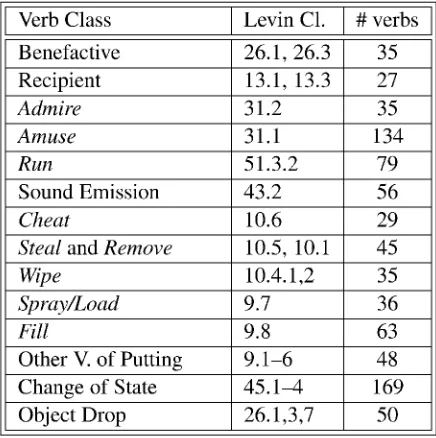
For the experimental investigation of our feature space, we selected a number of verb classes that would be non-trivial test cases for evaluating the method. Both for practical reasons and to make the results of general interest, the classes could neither be too small nor contain mostly infrequent verbs. Pairs or triples of verb classes were se-lected to form the test pairs/triples for each of a number of separate classification tasks. To illus-trate the range of applicability of the feature space, we picked some pairs/triples of classes that were closely related and some that were more dissim-ilar. Table 2 at the end of this section lists the classes, with their Levin class numbers; their prop-erties are summarized here with examples of each.
Benefactive versus Recipient verbs.
Mary baked... a cake for Joan/Joan a cake. Mary gave.., a cake to Joan/Joan a cake.
These dative alternation verbs differ in the prepo-sition and the semantic role of its object.
Admire versus Amuse verbs.
I admire Jane. Jane amuses me.
These psychological state verbs differ in that the Experiencer argument is the subject of Admire verbs, and the object of Amuse verbs.
Run versus Sound Emission verbs.
The kids ran in the room./*The room ran with kids. Birds sang in the trees./The trees sang with birds.
These intransitive activity verbs differ in the prepositional alternations they allow.
Cheat versus Steal and Remove verbs.
I cheated... Jane of her money/*the money from Jane. I stole... *Jane of her money/the money from Jane.
These semantically related classes differ in the prepositional alternants they allow.
Wipe versus Steal and Remove verbs.
Wipe... the dust/the dust from the table/the table. Steal... the money/the money from the bank/*the bank.
These classes generally allow the same syntactic frames, but differ in the possible semantic role as-signment. (Location can be the direct object of Wipe verbs but not of Steal and Remove verbs, as shown.)
Spray/Load versus Fill versus Other Verbs of Putting (several related Levin classes). / loaded.., hay on the wagon/the wagon with hay. I filled... *hay on the wagon/the wagon with hay. I put... hay on the wagon/*the wagon with hay.
These three classes also differ in prepositional altemants. Note, however, that the options for Spray/Load verbs overlap with both of the other two types of verbs.
Optionally Intransitive: Run versus Change of State versus "Object Drop".
These are the three classes of MS01, which we in-vestigate here for comparison to their results. All are optionally intransitive but assign different se-mantic roles to their arguments. (Note that the Ob-ject Drop verbs are a superset of the Benefactives above.)
The classification tasks we chose vary in dif-ficulty. For many tasks, knowing exactly what PP arguments each verb takes may be sufficient to perform the classification (cf. Don and Jones 1996). However, we do not have access to such perfect knowledge, since PP arguments and ad-juncts cannot be distinguished with high accuracy. Using our simple extraction tools, for example, the PP/or argument in I admired Jane for her honesty is not distinguished from the for adjunct in I
amused Jane for the money. Furthermore, PP ar-guments differ in frequency, so that a highly distin-guishing but rarely used alternant will likely not be useful. Differences in PP usage are thus noisy in-dicators that we expect to be useful but not defini-tive.
therefore expect this task to be one of the hardest we consider.
Verb Class Levin Cl. # verbs
B enefactive 26.1, 26.3 35
Recipient 13.1, 13.3 27
Admire 31.2 35
Amuse 31.1 134
Run 51.3.2 79
Sound Emission 43.2 56
Cheat 10.6 29
Steal and Remove 10.5, 10.1 45
Wipe 10.4.1,2 35
Spray/Load 9.7 36
Fill 9.8 63
Other V. of Putting 9.1-6 48
Change of State 45.1-4 169
[image:5.595.99.317.122.341.2]Object Drop 26.1,3,7 50
Table 2: Verb classes (see Section 3), their Levin class numbers, and the number of experimental verbs in each (see Section 4.2).
4 Materials and Method
4.1
CorpusWe use the British National Corpus (BNC) to es-timate all features (Burnard, 2000), a 100M word corpus tagged with the CLAWS POS tagset, which we map to the Penn tagset. It consists of text sam-ples of recent British English ranging over a wide spectrum of domains, including both fiction and non-fiction. Since it is a general corpus, we do not expect any strong domain-specific bias in verb usage.
4.2 Verb Selection
We selected our experimental verbs as follows. We started with a list of all the verbs in the given classes from Levin, removing any verb that did not occur at least 100 times in the BNC.3 Because we
assign a single classification to each verb, we also removed any verb: that was deemed excessively polysemous; that belonged to another class under consideration in this study; or for which the class
3Due to mistakes in our original counts, twelve verbs with frequency between 88 and 99 were retained, as well as one with frequency 44, singe, and one with frequency 19, idolize.
did not correspond to the main sense. (For exam-ple, the Recipient-verb sense of extend—in the us-age "extending a loan"—is far less common than the "stretching" sense.) In on-going work, we are exploring an iterative approach to token- and type-based classification that would address this current limitation of a single class per verb.
Table 2 above shows the number of verbs in each class at the end of this process. Of these verbs, 20 from each class were randomly selected to use as training data. (For two classes, the se-lection process was not completely random, since some of the verbs were ones used previously in MS01. We used those as training verbs since they did not qualify as unseen test verbs.) Our unseen test verbs then consist of all verbs remaining after the selection of training data, except those that had been used in the previous studies we build on.
4.3
Feature ExtractionWe use an existing tool to extract the verb group and syntactic slots on which our features are based. The partial (or chunking) parser of Abney (1991), called SCOL, allows us to extract subjects and direct objects with reasonable confidence, and to extract potential prepositional phrases associ-ated with the verb. SCOL does not identify in-direct objects, which we also require. We use TGrep2 (Rohde, 2002) to identify potential indi-rect objects by assuming that an object followed by a noun phrase which SCOL has left unattached is a double-object frame.4 From these extracted
slots, we calculate all the features described in Section 2, yielding a vector of 220 normalized counts for each verb, which forms the input to the machine learning system.
4.4
Machine Learning ApproachFor all our experiments, we use the decision-tree induction system C5.0, release 1.16 (www. . rulequest . com), the successor of C4.5 (Quin-lan, 1993), as our machine learning software. On our training sets, we use 10-fold cross-validation repeated 50 times to estimate classification accu-racy. For these, we report the average accuracy
Experiment
Base-line Acc
N Test Verbs
All features Levin-derived subsets Train
Acc SE
Test Acc (#)
Train Ace SE
Test Ace (#)
Benefactive/Recipient 50.0 22 74.1 0.6 72.7 (16) 79.5 0.6 86.4 (19)
Admire/Amuse 50.0 129 79.6 0.6 82.2 (106) 80.8 0.5 90.7 (117)
Run/Sound Emission 50.0 79 79.9 0.7 78.5 (62) 71.9 0.8 77.2 (61)
Cheat/Steal-Remove 50.0 33 88.9 0.4 72.7 (24) 83.0 0.5 72.7 (24)
Wipe/Steal-Remove 50.0 39 79.4 0.8 84.6 (33) 85.8 0.6 84.6 (33)
Spray/Fill/Putting 33.3 85 78.3 0.5 65.9 (56) 79.2 0.5 64.7 (55)
[image:6.595.57.487.85.272.2]Optionally Intrans. 33.3 204 68.3 0.7 72.1 (147) 68.7 0.5 77.0 (157) 6 Locative Classes 16.7 133 69.0 0.3 56.4 (75) 72.8 0.4 54.9 (73) 8 Locative Classes 12.5 212 69.3 0.4 59.9 (127) 64.7 0.3 59.0 (125) All 13 Classes 7.7 507 58.6 0.3 46.4 (235) 58.7 0.2 43.6 (221)
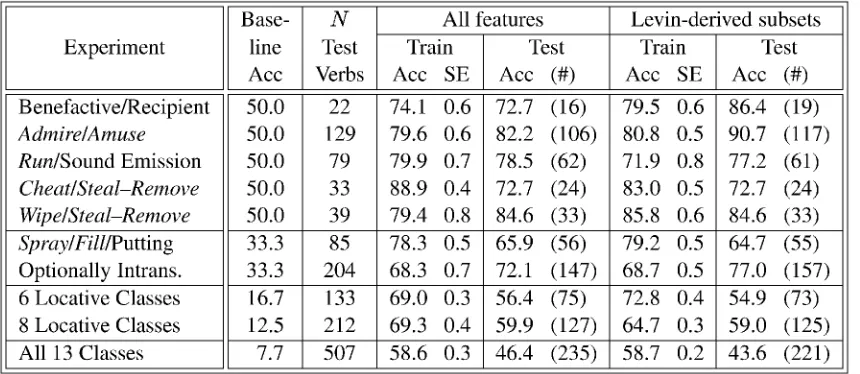
Table 3: Experimental Results. Acc is % accuracy; SE is % standard error; # is number of test items correctly classified.
(number of verbs correctly classified over the total number of verbs) and standard error calculated by C5.0. To measure performance on our unseen test data, we train a classifier on the training data, and then measure its accuracy on the test verbs. In all cases, we use the boosting option in C5.0.
5 Experimental Results
We performed ten classification tasks, shown in the first column of Table 3. The 2- and 3-way tasks, and their motivation, were described ear-lier in Section 3. We added three multiway tasks to explore how much we can expect our feature space to scale to multiple class distinctions: The 6-way task involves the Cheat, Steal-Remove, Wipe, Spray/Load, Fill, and "Other Verbs of Putting" classes, all of which undergo similar alternations of locative arguments. To these 6, the 8-way task adds the Run and Sound Emission verbs, which also undergo locative alternations. The 13-way task includes all our classes (except Benefactive, which is a subset of Object Drop).
Note that we do not create one classifier which is applied to different test data sets; rather, a sepa-rate classifier is defined for each task using only the training data for the verb classes under in-vestigation. In all cases, the training data is bal-anced, with 20 verbs in each class, so the baseline (chance) performance is 1/k for a task discrim-inating k classes. This baseline is shown in the
second column of Table 3, while the third column gives the number of test verbs for each task.
Our first set of experiments uses all our fea-tures (as listed in Table 1); the results are shown in columns 4 and 5 of Table 3. In all cases, test performance shows a substantial increase of 22-47 percentage points above the baseline, with a reduction in error rate ranging from 42-69%. In-deed, it is worth noting that what we predicted to be the most difficult task (the Wipe/Steal-Remove case) had the best overall performance, of 84.6% (line 5 of the table). In only two of our 2- and 3-way tasks did test performance decrease by more than 5% compared to training performance, in-dicating good generalizability of the classifiers. The 6- and 8-way tasks had very good perfor-mance, and even the 13-way task far exceeded the baseline, although in each case, test performance was substantially less than results on training data. For these complex multiway tasks, it seems, more training verbs would be desirable.
Ideally, we would also like to compare our re-sults to features developed by linguistic experts, such as those in MS01. On our new test verbs in the optionally intransitive task of MS01, our feature space outperformed their hand-crafted fea-tures, 72.1% (line 7 of the table) versus 64.2%.5
For the other tasks, however, no manually de-rived feature space exists. We instead compare the general feature space to subsets of our own fea-tures (called the Levin-derived subsets) which are hand-selected through an analysis of the classes in Levin.6 For each class, we have systematically
identified the subset of features indicated by the class description given in Levin. For each task, then, the Levin-derived subset is the union of these subsets for all the classes in the task. The results for these feature sets are given in columns 6 and 7 of Table 3. Comparing columns 5 and 7, we see that the general feature space performs as well as or better than the Levin-derived subset on most tasks. For only 3 of the 10 tasks does the subset of features outperform the full feature space by 5% or more.
These results taken together support the hypoth-esis that our general feature space can be used successfully for automatic verb classification, and can eliminate the need for time-consuming expert analysis for each new task.
6 Related Work
Don and Jones (1996) showed that perfect knowl-edge of the allowable syntactic frames for a verb enabled an accuracy of 98% in assigning verbs to Levin classes. We adopt the approach of MS01, which instead approximates such knowl-edge through statistical corpus analysis, allowing for easier extensibility to new classes. Further-more, rather than using a class-by-class analysis as in Dorr and Jones (1996), our features are de-termined through an analysis of the possible alter-nations for verbs independent of their class assign-ment, leading to a more general set of features.
Our study generalizes the slot overlap feature of MS01 as an indicator of membership in a verb class, on the assumption that slot overlap is cor-related with alternation behaviour. Indeed, Mc-Carthy (2000) confirmed this relation, showing
includes a broad range of indicators of syntactic behaviours. These indicators may help to discriminate classes even if they are not conceived of as core distinctions between the classes. 6This approach recognizes the important challenge faced by our method in having to automatically select the best fea-tures for a task from our large feature space. Admittedly, it does not address the possibility that a linguist may devise a feature for which we have no analogue.
that a slot overlap feature similar to ours could be a useful indicator for a given alternation. McCarthy achieved an increase in performance on her task by using an alternative similarity measure over the selectional preference of a verb for two slots that alternate, indicating that other formulations of slot similarity may be useful to pursue in future work.
Schulte im Walde (2000) and Schulte im Walde and Brew (2002) achieved promising results us-ing unsupervised clusterus-ing of verbs in English and German, respectively, according to syntactic frame statistics. Our feature space is more gen-eral because it uses a combination of types of fea-tures; we have features intended to indicate par-ticipation in alternations, and not just subcatego-rization. While our method used supervised learn-ing, Stevenson and Merlo (1999) found little dif-ference in performance between unsupervised and supervised approaches on the original MS01 task. However, since unsupervised methods are more sensitive to irrelevant features, additional care will be required to determine useful subsets of features from our (larger) general feature space.
Also using unsupervised learning, Oishi and Matsumoto (1997) clustered Japanese verbs auto-matically into hundreds of semantic classes, which they then combined into a network of 38 classes using linguistic knowledge and semi-automated processing. Their approach, like ours, used a com-bination of syntactic frame and aspectual features, but a limited set. Our work aims to extend this type of hand-picked feature space to achieve a general-ity that will limit the need for human expert input in the classification process.
7 Conclusion
not in the scope of Levin (such as those involving sentential arguments), through the same process of generalizing the existing features to new slots.
Still, our investigation has been limited to En-glish verb classes, and our feature space is lim-ited in being motivated by alternations in English. It thus lacks grammatical features (e.g., Case or other rich morphological properties) used in other languages to mark arguments or indicate the re-lation between them. Interestingly, Merlo et al. (2002) showed that some of the hand-crafted fea-tures of MS01 were useful in Italian for classify-ing the same verb classes in that language. We think a more general feature space such as ours will have even more potential for crosslinguis-tic applicability: We have devised a mapping of Levin's analysis of the variation in expression of arguments across classes in English to a general set of features. To the extent that Levin's anal-ysis is grounded in general principles concerning the linking of semantic arguments to their syntac-tic expression, our feature space is an initial step in capturing variation in the expression of arguments across languages.
Acknowledgements
We gratefully acknowledge the financial support of NSERC of Canada, Bell University Labs, and the University of Toronto.
References
Steven Abney. 1991. Parsing by chunks. In Robert Berwick, Steven Abney, and Carol Tenny, editors, Principle-Based Parsing. Kluwer Academic Pub-lishers.
Michael Brent. 1993. From grammar to lexicon: Unsu-pervised learning of lexical syntax. Computational Linguistics, 19(3):243-262.
Ted Briscoe and John Carroll. 1997. Automatic extrac-tion of subcategorizaextrac-tion from corpora. In Proceed-ings of the Fifth ACL Conference on Applied Natural Language Processing (ANLP-97), pages 356-363.
Lou Burnard, editor. 2000. British National Corpus User Reference Guide.
Bonnie J. Dorr and Doug Jones. 1996. Role of word sense disambiguation in lexical acquisition: Predict-ing semantics from syntactic cues. pages 322-327.
David R. Dowty. 1991. Thematic proto-roles and argu-ment selection. Language, 67(3):547-619.
Daniel Gildea and Daniel Jurafsky. 2002. Automatic labeling of semantic roles. Computational Linguis-tics, 28(3):245-288.
Maria Lapata and Chris Brew. 1999. Using subcatego-rization to resolve verb class ambiguity. In P. Fung and J. Zhou, editors, Joint SIGDAT Conference on Empirical Methods in NLP and Very Large Corpora (EMNLP/VLC-99), pages 266-274.
Beth Levin. 1993. English verb classes and alterna-tions: A preliminary investigation. Chicago UP.
Diana McCarthy. 2000. Using semantic preferences to identify verbal participation in role switching alter-nations. In Proceedings of the First Conference of the North American Ch. of the ACL (NAACL-2000).
Paola Merlo and Suzanne Stevenson. 2001. Automatic verb classification based on statistical distributions of argument structure. Computational Linguistics, 27(3):373-408.
Paola Merlo, Suzanne Stevenson, Vivian Tsang, and Gianluca Allaria. 2002. A multilingual paradigm for automatic verb classification. In Proceedings of the 40th Annual Meeting of the ACL, pages 207-214.
Akira Oishi and Yuji Matsumoto. 1997. Detecting the organization of semantic subclasses of japanese verbs. International Journal of Corpus Linguistics, 2(1):65-89.
Steven Pinker. 1989. Learnability and cognition: the acquisition of argument structure. MIT Press.
J. R. Quinlan. 1993. C4.5: Programs for Machine Learning. Morgan Kaufmann, CA.
Philip Resnik. 1996. Selectional constraints: an information-theoretic model and its computational realization. Cognition, 61(1-2):127-159.
Ellen Riloff and Mark Schmelzenbach. 1998. An em-pirical approach to conceptual case frame acquisi-tion. In Proceedings of the Sixth Workshop on Very Large Corpora (WVLC-98).
Douglas L. T. Rohde. 2002. TGrep2 user manual ver-sion 1.3. Available with the TGrep2 package at
http://tedlab.mit.edu/-dr/Tgrep2/.
Sabine Schulte im Walde. 2000. Clustering verbs se-mantically according to their alternation behaviour. In Proceedings of the 18th International Con-ference on Computational Linguistics
(COLING-2000), pages 747-753.
Sabine Schulte im Walde and Chris Brew. 2002. Induc-ing German semantic verb classes from purely syn-tactic subcategorisation information. In Proceed-ings of the 40th Annual Meeting of the ACL, pages 223-230.