Proceedings of the 2019 Conference on Empirical Methods in Natural Language Processing 4037
Auditing Deep Learning processes through
Kernel-based Explanatory Models
Danilo Croce and Daniele Rossini and Roberto Basili
Department of Enterprise Engineering University of Roma, Tor Vergata {croce,basili}@info.uniroma2.it
Abstract
While NLP systems become more pervasive, their accountability gains value as a focal point of effort. Epistemological opaqueness of non-linear learning methods, such as deep learn-ing models, can be a major drawback for their adoptions. In this paper, we discuss the ap-plication ofLayerwise Relevance Propagation over a linguistically motivated neural architec-ture, theKernel-based Deep Architecture, in order to trace back connections between lin-guistic properties of input instances and sys-tem decisions. Such connections then guide the construction of argumentations on the net-work’s inferences, i.e., explanations based on real examples that are semantically related to the input. We also propose here a method-ology to evaluate the transparency and co-herence of analogy-based explanations model-ing anauditstage for the system. Quantita-tive analysis on two semantic tasks, i.e., ques-tion classificaques-tion and semantic role labeling, shows that the explanatory capabilities (native in KDAs) are effective and they pave the way to more complex argumentation methods.
1 Introduction
AI systems are currently used in a wide variety of applications, with several levels of societal impact, and are expected to be soon deployed in safety-critical fields, e.g., autonomous driving. The def-inition of codes of conduct in the development of AI applications to ensure their ethical sustainabil-ity across dimensions, such as fairness, reliabilsustainabil-ity
and beneficialness (Kroll et al., 2016; Garfinkel
et al., 2017; Dignum, 2017) is becoming a cru-cial issue. Hence, a natural need for the ethical accountability of such systems is gaining impor-tance.
A central issue lies in designing systems whose
decisions are transparent (Ribeiro et al., 2016;
Doshi-Velez et al., 2017), i.e., they must be eas-ily interpretable by humans, as users must be able to suitably weight and trust the assistance of such systems.
Deep neural networks are clearly problematic in this regard: their high non-linearity, despite al-lowing for state-of-the-art performances in several challenging problems, amplifies the epistemologi-cal opaqueness of the decision-flow and limits its interpretability. The concept of transparency of a machine learning model spans multiple defini-tions, focusing on different aspects, from the sim-plicity of the model, e.g., the number of nodes in a decision tree, to the intuitiveness of its parameters
and computations (Chakraborty et al.,2017).
In this context, an important capability of an
AI system is the ability to provide post-hoc
ex-planations in terms of evidences supporting the produced decisions: although they usually do not formally elucidate how a model works, they of-ten have the property of being quite intuitive, con-veying useful information also to end-users
with-out any AI or machine learning expertise (Lipton,
2018). In semantic inference tasks (e.g., text
clas-sification), anexplanation modelgenerating
post-hoc explanations should hence be able to trace back connections between the output categories and the semantic and syntactic properties of the in-put texts. Such models should have three desired
properties: semantic transparency,
informative-ness w.r.t. the system decision and effectiveness
in enabling auditing processes against the system. In this work we focus on a specific post-hoc mechanism, which is to provide, along with the prediction, a comparison with one or more other
examples, namely landmarks, that share
task-relevant linguistic properties with the input. From an argument theory perspective, this corresponds to supporting decisions through an “argument by
ex-posed to such a kind of argument will endow a different level of trust into the machine decision according to the linguistic plausibility of the anal-ogy. He will implicitly gauge the evidence from the linguistic properties shared between the input sentence (or its parts) and the one(s) used for com-parison as well their importance with respect to the output decision. Let us consider, for exam-ple, the following prediction in a question
classi-fication (QC) task (Li and Roth,2006): “What is
the capital of Zimbabwe?” refers to aLocation. We would like the system to motivate its decision
with an argument such as: ...since it recalls me of
“What is the capital of California?” which also refers to a Location. Notice that explanation of a decision is quite different from sentence or document ranking in Information Retrieval so that semantic similarity plays only a minor role: clear and trustful analogies may exist with semantically different training examples that imply similar re-lationships between the input and the decision.
Recent work has been inspired by efforts in im-proving model’s interpretability in image
process-ing tasks, in particular by theLayerwise Relevance
Propagation(LRP) (Bach et al.,2015). In LRP the classification decision of a deep neural network is decomposed backward across the network layers and evidence about the contribution to the final de-cision brought by individual input fragments (i.e., pixels of the input image) is gathered.
In this paper, we propose to extend the LRP ap-plication to the linguistically motivated network architectures, known as Kernel-Based Deep
Ar-chitectures (KDAs) (Croce et al., 2017), which
frames semantic information captured by
linguis-tic Tree Kernel methods (Collins and Duffy,2001)
within the neural-based learning paradigm. The result is a mechanism that, for each system’s pre-diction such as in question classification, gener-ates an argument-by-analogy explanation based on real training examples, not necessarily similar to the input.
We also propose a novel approach to eval-uate numerically the interpretability of any explanation-enriched model applied in semantic inference tasks. By defining a specific audit
pro-cess, we derive a synthetic metric, i.e.
Audit-ing Accuracy, that takes into account the prop-erties of transparency, informativeness and effec-tiveness. The evaluation of the proposed method-ology shows the meaningful impact of LRP-based
explanation models: users faced with explanations are systematically oriented to accept (or reject) the
system decisions, so thatpost hocjudgments may
even improve the overall application accuracy.
In the rest of the paper, section 2 reports
re-lated works, while Section 3 describes the LRP
and its extension to KDAs. In Section 4, we
propose three explanation models and illustrate a novel evaluation methodology, commenting on the audit process and deriving quantitative notions
such as the Auditing Accuracy measure. Section
5presents and discusses the system effectiveness
against two semantic tasks, i.e., question classifi-cation and frame-based argument classificlassifi-cation in a semantic role labeling chain. Finally, in Section
6conclusions are derived.
2 Related Work
In recent years, research communities showed great interest in improving neural models’ inter-pretability, as testified by the effort of defining the concept of interpretability itself and the de-velopment of a variety of approaches to the
prob-lem. In (Chakraborty et al., 2017) and (Lipton,
2018), the authors examine the different notions of
interpretability found in literature and categorize techniques according to the transparency proper-ties they confer to decision models. Common
ap-proaches to improve the readability of a neural
model in image-related tasks are based on back-ward algorithms that reuse arc weights to
propa-gate the prediction down to the input (Erhan et al.,
2010; Zeiler and Fergus, 2013), thus leading to
the re-creation of meaningful patterns in the
in-put space. Typical examples are deconvolution heatmaps, used to approximate through Taylor
se-ries the partial derivatives at each layer (Simonyan
et al., 2013), or the so-called Layer-wise Rele-vance Propagation (LRP), that redistributes back positive and negative evidence across the layers (Bach et al.,2015).
Local explanation approaches focus on
high-lighting a handful of crucial features (Baehrens
et al., 2010) or deriving simpler, more readable models from a complex one, e.g., a binary decision
tree (Frosst and Hinton,2017), or by local
approx-imation with linear models (Ribeiro et al.,2016).
However, although they can explicitly show the representations learned in the specific hidden
neu-rons (Frosst and Hinton,2017), these approaches
the quality of the reasoning and of the account-ability as a side effect of the quality and the co-herence of the features selection: this can be very hard in tasks where boundaries between classes
are not well defined. Another strategy is
pair-ing the decision model with a generative model
to produce verbose explanations (Krening et al.,
2017). Sometimes explanations are associated to
vector representations as in (Ribeiro et al.,2016),
i.e., bag-of-words in case of text classification, that are clearly weak at capturing significant linguistic abstractions, such as the involved syntactic rela-tions. In this work, we systematically extend the
model presented in (Croce et al.,2018) which
al-lows to provide explanations that are easily inter-pretable even by non-expert users, as they are ex-pressed in natural language. Moreover, the inves-tigated approach is is computationally affordable, as it roughly corresponds to a forward pass across the network. In addition, we also provide a sys-tematic way to evaluate the provided explanations with a methodology able to support the audit of the targeted AI systems.
3 Layer-wise Relevance Propagation in Kernel-based Deep Architectures
In this section, we will review the Layer-wise
Rel-evance Propagation technique (LRP, as in (Bach
et al., 2015)), usually applied in image process-ing, and show how it can be naturally extended to Kernel-based Deep Architectures (KDA, as in (Croce et al.,2017)) in order to select real exam-ples useful to support the network decisions.
LRP is mainly a framework which allows to de-compose the prediction of a deep neural network computed over a sample, usually an image, down to relevance scores for the single input dimensions of the sample, such as sub-pixels of the image
it-self. More formally, letf :Rd → R+ be a
func-tion that quantifies, for example, the probability of
x ∈ Rd being in a certain class. The Layer-wise
Relevance Propagation assigns to each dimension,
or feature, xd a relevance score R(1)d such that
f(x) ≈P
dR
(1)
d . Features whose score isR
(1)
d >
0 or R(1)d < 0 correspond to evidence in favor
or against, respectively, the output classification. In other words, LRP allows to identify fragments of the input playing key roles in the decision, by propagating relevance backwards. Let us suppose
to know the relevance scoreRj(l+1) of a neuron j
at network layerl+ 1. This can be decomposed
into messages R(i←l,l+1)j sent from j to neurons i
in layerl according toRj(l+1) = P
i∈(l)R (l,l+1)
i←j .
Then ti directly follows that the relevance of a
neu-ron i at layer l, that is the quantity of
informa-tion travelling throughi, can be defined asR(il) =
P
j∈(l+1)R (l,l+1)
i←j . In this work, we adopted the
-rule defined in (Bach et al.,2015) to compute the
messages R(i←l,l+1)j = zij
zj+·sign(zj)R (l+1)
j , where
zij = xiwij and > 0is a small numerical
sta-bilizing term. The informative value is justified by
the fact that the weightszij are linked to the
acti-vation weightswij of the input neurons.
Given the capability of computing relevance scores for input dimensions, we now summa-rize the KDA to motivate how LRP can be ap-plied also to tasks other than image classifica-tion. In a nutshell, the KDA is a neural network trained in low-dimensional spaces which approxi-mate a generic Reproducing Kernel Hilbert Space
(RKHS) (Shawe-Taylor and Cristianini, 2004).
These low-dimensional approximations are de-rived as a reconstruction from a set of real
refer-ence training examples, calledlandmarks, which
can be used to compile the representation of any unseen test instance. As a consequence, the abil-ity of making connections between the KDA de-cisions and the landmarks corresponds to locating the candidate training examples that justify (in the LRP sense) decisions and trigger meaningful lin-guistic explanations.
More formally, given an input datasetD, a
ker-nelK(oi, oj)is a function overD2 operating
dot-products, i.e., similarity scores, in an projection
space, given by the mappingΦover the input
in-stances oi, which is implicit in the sense that the
kernel never explicitly accesses the representation
of projectionsΦ(oi). Here a RKHS corresponds
to the Gram Matrix G=XX>, whose element
Gi,j isK(oi, oj) = Φ(oi)·Φ(oj). The Nystr¨om
method (Williams and Seeger, 2001) can be
ap-plied to derive the approximating matrix G˜ =
(CU S−12)(CU S− 1
2)> ≈ G, where U,S are
ob-tained by applying the Singular Value
Decompo-sition to the matrixW ∈ Rl×l, a submatrix ofG
containing the kernel evaluations oflsampled
in-stances (namely, thelandmarks) andC ∈R|D|×l,
whose rowc~i corresponds to the similarity scores
betweenoi∈ Dand the landmarks. Hence, a
map-ping fromD to al-dimensional embedding, with
N
ys
tr
öm
P
roj
ec
ti
on
…
… …
K(x, l1)
K(x, l2)
K(x, ld)
hidden layers
classification layer landmarks
…
Nyström layer input
[image:4.595.75.286.68.180.2]layer x
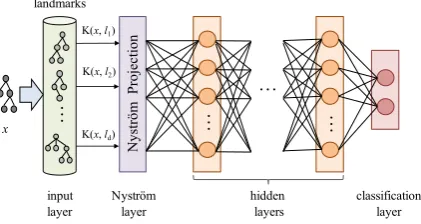
Figure 1: Kernel-based Deep Architecture.
function ~x˜ = ~c U S−12. Therefore, the method
producesl-dimensional vectors1.
In (Croce et al., 2017), the Nystr¨om
represen-tation ~x˜ has been used to map semantically
an-notated grammatical trees to the linear input of a Multi-Layer Perceptron (MLP). In fact, given
a dataset L, with o ∈ L denoting a generic
in-stance, the MLP architecture is defined with a spe-cific Nystr¨om input layer based on the Nystr¨om
embeddings. The resulting Kernel-based Deep
Architecture (KDA) includes an input layer, the
Nystr¨om layer, a sequence of hidden layers and
the final classification layer, which produces the
output. The input layer corresponds to the input
vector c~i, i.e., the row of the C matrix
associ-ated to an exampleoi. The input layer is mapped
to the Nystr¨om layer, through the Nystr¨om
pro-jection. Notice that the embedding provides also
the proper weights, defined byU S−12, so that the
mapping can be expressed through the Nystr¨om
matrixHN y=U S−
1
2. The resulting~x˜is the
in-put to one or morehiddenlayers. Clearly, the first
hidden layer receives in input~x˜=~cHN y. Finally,
theclassification layercomputes a linear classifi-cation function with a softmax operator, as shown
in Figure1. A KDA optimizes the standard
cross-entropy function withL2regularization.
It is worth recalling that the network is
trig-gered by an input vector~c expressing the kernel
evaluationsK(x, li)between the example and the
landmarks. When using linguistic kernels (such as
Semantic Tree Kernels, (Croce et al.,2011)), this
measure corresponds to the grammatical and
lexi-cal semantic similarity betweenxand the subset of
landmarks. The expected explanation is obtained from the network output by applying LRP to
re-1Note that, while any sampling policy for landmarks is admissible, in (Kumar et al., 2012) it is demonstrated that uniform sampling without replacement achieves results com-parable with alternative, more resource-consuming policies.
vert the propagation process, thus linking the out-put back to the inout-put. In a KDA that models lin-guistic instances, LRP implicitly traces back the syntactic, semantic and lexical relations between the example and the landmarks across the Nystr¨om layer: the side effect is to select those real exam-ples that mostly influenced the identification of the predicted structure in the sentence.
4 Generating explanations in Kernel-based Deep Architectures
Justifications for the KDA emissions can be
ob-tained by exploiting landmarks{`}as the evidence
in favour or against a class. The idea is to select
those{`}that the LRP highlights as the most
ac-tive elements in layer 0. Once such acac-tive
land-marks are detected, an Explanatory Model is a
function in charge to compile a linguistically flu-ent explanation by comparing the input case with such selection.
The semantic expressiveness of such analo-gies makes the resulting explanation clear and in-creases the user confidence on the system
reliabil-ity. When a sentencesis classified, LRP assigns
activation scores rs` to each individual landmark
`: letL(+) (orL(−)) denote the set of landmarks
with positive (or negative) activation scores. For-mally, each explanation is characterized by a triple
e = hs, C, τiwhere sis the input sentence, C is
a target label andτ is the modality of the
explana-tion: τ = +1 for positive (i.e., acceptance)
state-ments whileτ = −1correspond to rejections of
C. A landmark`ispositively activatedfor a given
sentencesif there are at mostk−1other active
landmarks`0 with activation value higher than the
one for`, i.e.,
|{`0 ∈ L(+):`06=`∧rs`0 ≥r`s>0}|< k
Similarly, a landmark is negatively activated
when:
|{`0 ∈ L(−) :`06=`∧rs`0 ≤r`s<0}|< k
where k is a fixed parameter used to make the
explanation depending on not more than k
land-marks, denoted as a set by Lk. Positively
(or negative) active landmarks in Lk are
as-signed an activation value a(`, s) = +1 (−1),
while a(`, s) = 0 for not active landmarks.
Given the explanation e = hs, C, τi, a
land-mark`, whose known class is C`, is called
δ(C`, C)·a(`, q)·τ is positive (or negative,
re-spectively), where δ(C0, C) = 2δkron(C0, C)−1
andδkronis the Kronecker delta.
We can thus partition such landmarks into
the set of positively consistent landmarks
Lc,k+⊆ Lc
k⊆ Lk and negatively consistent ones
Lc,k−⊆ Lc
k⊆ Lk, with Lc,k+∪ Lc,k−=Lck, that
aggregates all the consistent landmarks.
An explanatory model is then a function
M(e,Lc
k)which maps an explanationeand the set
Lc
kforeinto a sentencef in natural language. Of
course several definitions ofM(e,Lc
k) are
possi-ble, e.g.,
M(e,Lck) =
“sisCsince it recalls me of`”
∀`∈ Lc,k+ ifτ >0
“sis notCsince it does not
recall me of`which isC”
∀`∈ Lc,k− ifτ <0
“sisCbut I don’t know why”
ifLc≡ ∅
Here we introduce three explanatory models used during experimental evaluation:
• Singleton Model. The first model is the
simplest as it returns a single analogy with the consistent landmark with the
high-est positive score, if τ = 1, or lowest
negative score, when τ = −1. As an
example, the explanation of an accepted decision in a semantic argument
classifi-cation task, described by the triple e1 =
h’Putthis platein the center of the table’,
THEMEPLACING,1i, would be mapped by the
model into: I think “this plate” is THEME
of PLACINGin “RobotPUT this plate in the center of the table” since it recalls me of “the soap” in “Can youPUT the soap in the washing machine?”.
• Conjunctive Model. In a second model,
de-noted asConjunctive, the system makes
ref-erence to up to k1 ≤ kanalogies with
pos-itively (or negatively) active and consistent
landmarks. Given the above explanatione1,
and k1 = 2, it would return: I think “this
plate” isTHEMEof PLACINGin “RobotPUT this plate in the center of the table” since it recalls me of “the soap” in “Can you PUT “the soap” in the washing machine?” and
also of “my coat” in “HANG my coat in the closet in the bedroom”.
• Contrastive Model. The last proposed
model is more complex since it returns both a positive and a negative analogy by selecting, respectively, the most positively relevant and the most negatively relevant consistent
land-mark. Givene1, it would return: I think “this
plate” isTHEMEof PLACINGin “RobotPUT this plate in the center of the table” since it recalls me of “the soap” in “Can youPUTthe soap in the washing machine” and it is not theGOAL of PLACING since it does not re-call me of “on the counter” in “PUTthe plate on the counter”.
In case no active and consistent landmark can be found, the models return a phrase stating only the predicted class, with no explanation.
5 Experimental Evaluation
Evaluating the explanatory quality of an inductive model is still an open problem and universally rec-ognized gold standards are not available for com-parative analysis. In order to rely on a quantita-tive analysis, we assume that an explanation to be effective should assist a human user to ascertain whether the proposed classification is correct or not. Plausible and coherent explanations should thus be generated from correct system’s decisions, while bad decisions should correspond to ambigu-ous or plainly fallaciambigu-ous arguments.
Hence, the evaluation of an explanatory model should reflect the model’s adherence to three
de-sired properties: semantic transparency, i.e.,
ar-gument’s linguistic grounding should be clear and straightforward, requiring as less knowledge on the system’s functioning and on the specific task
as possible; informativeness with respect to the
system’s decision, i.e., the explanation’s generat-ing process should be highly dependent on how the
system processes input information;effectiveness
w.r.t an audit against the system, i.e., the
expla-nation should convey enough meaningful informa-tion so that a human can correctly decide whether to trust the system prediction or not.
within five possible labels: Very Goodif the anal-ogy is strongly convincing and linguistically clear;
Good if the explanation is still accepted but the
pertinence is slacker; Uncertain if the annotator
gains no meaningful information from the
expla-nation or no explaexpla-nation is provided at all;Badif
some connections can be detected between the in-put sentence and the one used as a comparison but they are so ambiguous that the explanation is
re-jected;Incoherentif the argument appears totally
inconsistent and meaningless. Given the nature of
the argument by analogy schema (Walton et al.,
2008), it follows that annotators assigning aVery
GoodorGoodlabel to an explanation are also
im-plicitly accepting the system decision as correct, whereas they are rejecting it as wrong in the other cases.
Given an explanation datasetE ={(e, c, xC)}
whereeis an explanation,c ∈ {1,−1}expresses
if the explanation was generated from a correct
(c = 1) or incorrect (c = −1) classification, and
xC is the numerical value corresponding to one of
the five labels categoriesCabove2, we can define
the setAcof accepted explanations generated from
correct predictions and the setRnc of rejected
ex-planations generated from not correct predictions as follows:
Ac={(e, c, l)∈E|c= 1∧xC >0}
Rnc ={(e, c, l)∈E|c=−1∧xC ≤0}
Accordingly, theAudit Accuracy (AuAcc)
AuAcc= |Ac|+|Rnc|
|E|
measures the ratio between correct
accep-tance/rejection decisions and the total number of decisions made by the human auditor.
Additionally, the Pearson Correlation between the system classification accuracy and the human judgment of an explanation can be interpreted as a concrete measure of the consistency of an explana-tory model: an ideal model should map correct classifications to convincing explanations and in-correct classification to implausible explanations. It will be thus exploited to compare alternative explanatory models. To test an explanation ap-proach as well as of the proposed evaluation met-rics, we will address two different semantic pro-cessing tasks, i.e., question classification (QC) and
2We assigned values x
C ∈ [1,−1]: xVery Good = 1,
xGood= 0.8,xUncertain= 0,xBad=−0.8,xIncoherent=−1
argument classification (AC) in semantic role la-beling.
Experimental Setup. The Nystr¨om projection
has been implemented in the KeLP framework3,
while the LRP-integrated KDA in Tensorflow, with 1 and 2 hidden layers, respectively, whose layer-size is equal to the number of randomly se-lected Nystr¨om landmarks (500 and 200, in QC and AC respectively). For both tasks, training have been executed in 500 epochs, using the Adam op-timizer and adopting early-stop and dropout strat-egy while selecting the best model according to performances over the development set. We con-ducted preliminary evaluations on small samples
of the dataset and set the parameterk= 5, which
defines the cardinality of the active landmarks
Lk4. The remaining hyper-parameters were tuned
via grid-search.
A group of human annotators was asked to rate each explanation with one out of the five labels described early in this section, basing their judg-ment only on the perceived level of trust w.r.t. the explanations. Each annotator was exposed to ex-planations derived from a perfectly balanced set of correct and incorrect classifications, so that anno-tators are not biased by the (possibly high) quality of the classifier when judging the explanations.
5.1 Question Classification
We replicated the experiments reported in (Croce
et al.,2017) with respect to the question
classifi-cation task, using the UIUC dataset (Li and Roth,
2006), including a training and test set of 5452
and 500 questions, respectively, organized in 6
coarse-grained classes (as ENTITY or HUMAN).
We generated Nystr¨om representation of the Com-positionally Smoothed Partial Tree Kernel
func-tion (Annesi et al.,2014) consistently with (Croce
et al.,2017). Using 500 landmarks, the KDA
accu-racy was93.6%, which is comparable with
state-of-the-art neural models, as discussed in (Croce
et al.,2017). The audit manual task was
indepen-dently performed by 3 annotators5: each annotator
3
http://www.kelp-ml.org, presented in (Filice et al., 2018).
4No particular differences have emerged in the generation of explanations when slightly different values ofkwhere con-sidered.
0% 25% 50% 75% 100%
Correct Incorrect Correct Incorrect Correct Incorrect Singleton Conjunctive Contrastive
Supporting the acceptance of a class
0% 25% 50% 75% 100%
Correct Incorrect Correct Incorrect Correct Incorrect Singleton Conjunctive Contrastive
Supporting the rejection of a class
Very Good Good Uncertain Bad Incoherent
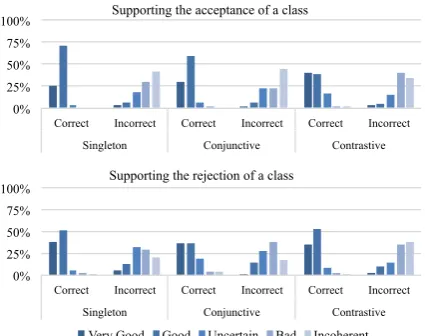
Figure 2: Results of the audit process in the QC task for the three explanatory models separating sys-tem acceptance (top) from rejection (bottom). Indi-vidual columns represent the percentage of quality la-bel across explanations. Left columns describe correct classifications, while right ones are derived from incor-rect classifications.
evaluated 300 explanations (100 for each model),
reaching an inter-annotation agreement if0.82on
these data.
Results in Figure 2 suggest that the annotators
were able to properly discriminate correct from incorrect decisions, just through the exposure to the explanations: in both acceptance or rejection cases, all models tend to assign positive labels (Very Good and Good) to explanations of correct decisions and negative ones (Uncertain, Bad and Incoherent) to explanations of incorrect decisions instead. Note that an explanation rejecting a class should be labeled as positive, if the landmark used for negativeanalogy is actually not recalling the
input sentence. The graphical intuition in
Fig-ure2 is confirmed by the metrics: the Singleton,
Conjunctive and Contrastive models reach an
Au-dit Accuracyof 89.3%, 84.7% and 86.3%,
respec-tively. The Pearson Correlation between
accep-tance and correctness is 78.9%, 69.4% and 72.8%, while if we measure the correlation between the explanation quality score and the decision cor-rectness, the Pearson coefficients become 76.1%, 71.2% and 77.2%: these are slightly lower
basi-cally for the lower reward assigned toxGoodw.r.t.
xVery Good. Small numerical differences among
models emerge: it seems that the Conjunctive and Contrastive models are not always able to retrieve meaningful additional information, while the
Sin-the last one is an expert in Sin-the field.
gleton model is simpler and more direct. An
ex-ample of output analogies is given byI think “How
many Admirals are there in the U.S. Navy?” refers to a NUMBER since it recalls me of both “How many words are there in the Spanish language?” and ”How many sides does an obelisk have?”, generated by the Conjunctive model. Here the se-mantic hint corresponds to the discriminative frag-ment“How many”. However meaningful connec-tions between the input and landmarks are also traced against poor overlaps in syntactic and
lexi-cal information as in: I think “Where is the Mall
of the America?” refers to aLOCATIONsince it recalls me of “What town was the setting for The Music Man?”.
Table1reports question-explanation pairs with
similarity estimates based on the adopted CSPTK kernel function. It is clear from the examples that similarity alone is not able to correlate with clas-sification decisions: questions in different classes (e.g. first two rows in the table) may have very high similarity scores. Second, landmarks cor-relate with decisions in interesting ways that do not depend on strict lexical and grammatical simi-larity. Conceptually more grounded associations
seem to emerge: e.g., explaining “What was
J.F.K.’s wife’s name”by the analogy with “What was Darth Vader’s son named?” is abstracted
across a conceptual relation (e.g.has name) and
the derived analogy is quite clear. Notice that ac-tive landmarks are independent from similar ques-tions, as landmarks triggered by similar questions are not similar to each other.
Interestingly, explanations of ambiguous in-stances are harmonic with human uncertainty. The
explanationI think “What is the sales tax in
Min-nesota?” refers to a NUMBERsince it recalls me of “What is the population of Mozambique?” and does not refer to a ENTITYsince it does not re-call me of “What is a fear of slime?”is convinc-ing, but incorrect. Here, the lack of context im-pacts on the disambiguation of two plausible inter-pretations that are (1) the definition of the notion
of “sales tax” (ENTITY), w.r.t (2) its current value
(NUMBER): the gold standard suggestsENTITYas the correct category.
5.2 Argument Classification
Semantic role labeling (SRL (Palmer et al.,2010))
[image:7.595.76.289.65.233.2]Class Questions(qi) k(q1, q2) Activated Landmarks(li) k(l1, l2)
LOC “What is the capital of Ethiopia?”
0.98
NUM “What is the population of Nigeria?”
ENTY“What was FDR ’s dog ’s name?”
0.97 “What is the name of David Letterman’s dog?” 0.49
HUM “What was J.F.K.’s wife ’s name?” “What was Darth Vader ’s son named?”
ENTY“What is the Ohio state bird?”
0.90 “What is the name of David Letterman ’s dog?” 0.61
ENTY“What is the pH scale?” “What is viscosity?”
ENTY“What was the first satellite to go into space?” “What was the first TV set to include a remote control?”
HUM “Who was the first American to walk in space? 0.83 “What ’s the name of the actress who starred in the 0.61
movie, Silence of the Lambs?”
NUM “What was the last year that the Chicago
0.73
“The film Jaws was made in what year?”
0.31
Cubs won the World Series?”
NUM “What is the average speed of the horses at “What is average salary of restaurant manager in
[image:8.595.73.531.60.211.2]the Kentucky Derby?” United States?”
Table 1: Examples of semantically similar questions in the same or different classes, with the corresponding landmarks activated during the classification.
0% 25% 50% 75% 100%
Correct Incorrect Correct Incorrect Correct Incorrect Singleton Conjunctive Contrastive
Supporting the acceptance of a class
0% 25% 50% 75% 100%
Correct Incorrect Correct Incorrect Correct Incorrect Singleton Conjunctive Contrastive
Supporting the rejection of a class
Very Good Good Weak Bad Incoherent
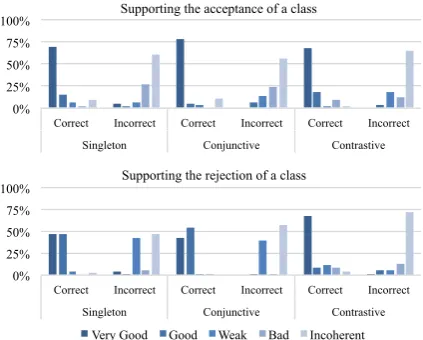
Figure 3: Results of the audit process in the SRL task for the three explanatory models: system acceptance (top), rejection (bottom).
classification into their specific roles ((Fillmore,
1985)). For example, given the sentence “Bring
the fruit onto the dining table”, the task would
be to recognize the verb “bring” as evoking the
BRINGING frame, with its roles, THEMEfor “the fruit” and GOAL for “onto the dining table”. Ar-gument classification corresponds to the subtask of assigning labels to the sentence fragments span-ning individual roles.
As proposed in (Moschitti et al., 2008), SRL
can be modeled as a multi-classification task over
each parse tree noden, where argument spans
re-flect sub-sentences covered by the tree rooted at
n. Consistently with (Croce et al., 2011), in our
experiments the KDA has been empowered with a Smoothed Partial Tree Kernel, operating over Grammatical Relation Centered Trees (GRCT) de-rived from dependency grammar. The reference benchmark, i.e., the HuRIC dataset related to an
Interactive Robotics task (Bastianelli et al.,2016),
includes about 650 annotated transcriptions of
spoken robotic commands, organized in18frames
and about60arguments. Individual arguments
ex-tracted amount to1,300examples. Experimental
setup was similar to that of Section5.1, but due
to the limited data size we applied 10-fold cross-validation, optimizing network hyper-parameters via grid-search for each fold. We generated the Nystr¨om representations of a SPTK function with
default parametersµ=λ= 0.4as in (Croce et al.,
2011). With these settings, the KDA accuracy was
96.1%. Due to the slightly higher complexity of
the task, w.r.t. QC, in the case the two independent auditors had at least graduate-level knowledge in
NLP. They were requested to judge about 700
generated explanations with an inter-annotation
agreement of0.89. For the Singleton, Conjunctive
and Contrastive model, respectively, theAudit
Ac-curacyis 91.6%, 93.4%, 88.4% while Pearson Co-efficients between acceptance/rejection and cor-rectness are 83.3% (80.1% for quality-corcor-rectness correlation), 86.9% (81.9%), 77.3% (78.7%): this suggests an higher annotator’s sensitivity to the explanations’ plausibility, as reflected also by the
charts in Figure3, probably due to the task itself
being more challenging for humans.
As in QC, the system can convey semantically transparent and useful information without relying
on lexical similarity alone; e.g., consider I think
“is hot” is DESIRED STATE of INSPECTING in “Robot CHECK whether the oven is hot?” since it recalls me of “is empty” in “SEEif the washing machine is empty”. In this task, the Contrastive model could also to produce explanations exem-plifying differences between separate roles in the
[image:8.595.76.288.266.436.2]GOALof BRINGINGin “Can you go to the kitchen find a glass and BRING it to me?” since it does not recall me of “to the bedroom” in “BRINGthe phone to the bedroom” and it’s theBENEFICIARY of BRINGING since it recalls me of “to me” in “can you please search the book and BRINGit to me”.
6 Conclusions
This paper proposes a quantitative evaluation of the automatic generation of epistemologically transparent and linguistically fluid explanations for neural inferences. The proposed approach ap-plies LRP to a Kernel-based Deep Architecture (KDA) that redistributes the prediction value to training entries (i.e., annotated landmarks). The resulting sentence exploits analogies with train-ing instances, accordtrain-ing to different explanatory strategies. Given that KDAs (based on Nystr¨om embeddings) can be flexibly adopted in neural learning for NLP, we show how the auditing mech-anism outlined in the paper is epistemologically very effective and emphasizes the neural embed-dings with a strong impact on explainability. First,
language semantics is promotedby designand
as-sociations generated between input instances and decisions are obtained without ever leaving the language level. Second, different and mathemat-ically solid models for different levels of lan-guage semantics can be obtained by modifying the adopted kernel formulations. In this way, a unique general auditing mechanism is able to sup-port fine tuning towards very different tasks, with-out changes in the learning architecture. Finally,
as Table1shows, explanations are strictly
depen-dent on the induced neural model and are not just triggered by text similarity metrics: they are epis-temologically principled evidences about the neu-ral learning stages, based on the observed exam-ples and the selected landmarks.
Empirical investigations carried out against the QC and AC tasks also confirm that the good ex-planatory models strongly correlate with consis-tent decisions and effectively contribute to in-crease the user confidence in the neural inference consistency. This make an auditing activity for
human users viable. On one side, it allows to
limit the impact of machine mistakes, in a natural and portable manner. Moreover, it can also serve as a novel comparative evaluation paradigm. The reachable auditing accuracy thus measures the
ex-planatory power of different models and can be
employed as a comparative benchmark. While
the methods proposed in this paper stem just from early explorations, the ways activated landmarks can be made useful to meaningful explanations stimulate further research, involving feature based
analysis such as suggested in (Ribeiro et al.,2016)
or the application of LRP to architectures more complex than a MLP. Argumentation theory, ap-plied to the active landmark semantics and the source input example as captured by the kernel, provides a very rich framework to design future and more complex justification mechanisms.
References
Paolo Annesi, Danilo Croce, and Roberto Basili. 2014.
Semantic compositionality in tree kernels. In Pro-ceedings of the 23rd ACM International Conference on Conference on Information and Knowledge Man-agement, CIKM 2014, Shanghai, China, November 3-7, 2014, pages 1029–1038.
Sebastian Bach, Alexander Binder, Gregoire Mon-tavon, Frederick Klauschen, Klaus-Robert M¨uller, and Wojciech Samek. 2015. On pixel-wise explana-tions for non-linear classifier decisions by layer-wise relevance propagation. PLOS ONE, 10(7).
David Baehrens, Timon Schroeter, Stefan Harmel-ing, Motoaki Kawanabe, Katja Hansen, and Klaus-Robert M¨uller. 2010. How to explain individ-ual classification decisions. J. Mach. Learn. Res., 11:1803–1831.
Emanuele Bastianelli, Danilo Croce, Andrea Vanzo, Roberto Basili, and Daniele Nardi. 2016. A discrim-inative approach to grounded spoken language un-derstanding in interactive robotics. InProceedings of IJCAI 2016, New York, NY, USA, pages 2747– 2753.
Supriyo Chakraborty, Richard Tomsett, Ramya Raghavendra, Daniel Harborne, and Moustafa Alzantot et al. 2017. In-terpretability of deep learning mod-els: A survey of results. 2017 Smart-World/SCALCOM/UIC/ATC/CBDCom/IOP/SCI, pages 1–6.
Michael Collins and Nigel Duffy. 2001. New rank-ing algorithms for parsrank-ing and taggrank-ing: Kernels over discrete structures, and the voted perceptron. In Pro-ceedings of ACL ’02, July 7-12, 2002, Philadelphia, PA, USA, pages 263–270.
Danilo Croce, Alessandro Moschitti, and Roberto Basili. 2011. Structured lexical similarity via convo-lution kernels on dependency trees. InProceedings of EMNLP ’11, pages 1034–1046.
Danilo Croce, Daniele Rossini, and Roberto Basili. 2018. Explaining non-linear classifier decisions within kernel-based deep architectures. In Proceed-ings of the Workshop: Analyzing and Interpreting Neural Networks for NLP, BlackboxNLP@EMNLP 2018, Brussels, Belgium, November 1, 2018, pages 16–24.
Virginia Dignum. 2017. Responsible autonomy. In Proceedings of the Twenty-Sixth International Joint Conference on Artificial Intelligence, IJCAI-17, pages 4698–4704.
Finale Doshi-Velez, Mason Kortz, Ryan Budish, Chris Bavitz, Sam Gershman, David O’Brien, Stuart Schieber, James Waldo, David Weinberger, and Alexandra Wood. 2017. Accountability of ai un-der the law: The role of explanation. CoRR, abs/1711.01134.
Dumitru Erhan, Aaron Courville, and Yoshua Ben-gio. 2010. Understanding representations learned in deep architectures. Technical Report 1355, Univer-sit´e de Montr´eal/DIRO.
Simone Filice, Giuseppe Castellucci, Giovanni Da San Martino, Alessandro Moschitti, Danilo Croce, and Roberto Basili. 2018. Kelp: a kernel-based learning platform. Journal of Machine Learning Research, 18(191):1–5.
Charles J. Fillmore. 1985. Frames and the semantics of understanding. Quaderni di Semantica, 6(2):222– 254.
Nicholas Frosst and Geoffrey Hinton. 2017. Distilling a neural network into a soft decision. CEUR Work-shop Proceedings, 2071.
Simson Garfinkel, Jeanna Matthews, Stuart S. Shapiro, and Jonathan M. Smith. 2017. Toward algorithmic transparency and accountability. Commun. ACM, 60(9):5–5.
S. Krening, B. Harrison, K. M. Feigh, C. L. Isbell, M. Riedl, and A. Thomaz. 2017. Learning from ex-planations using sentiment and advice in rl. IEEE Transactions on Cognitive and Developmental Sys-tems, 9(1):44–55.
Kroll, Huey, BAROCAS, W. Isaac Edward, and R. REIDENBERG. 2016. Accountable algorithms. University of Pennsylvania Law Review, 16.
Sanjiv Kumar, Mehryar Mohri, and Ameet Talwalkar. 2012. Sampling methods for the nystr¨om method. J. Mach. Learn. Res., 13:981–1006.
Xin Li and Dan Roth. 2006. Learning question clas-sifiers: the role of semantic information. Natural Language Engineering, 12(3):229–249.
Zachary C. Lipton. 2018. The mythos of model inter-pretability.Queue, 16(3):30:31–30:57.
Alessandro Moschitti, Daniele Pighin, and Robert Basili. 2008. Tree kernels for semantic role label-ing.Computational Linguistics, 34.
M.S. Palmer, D. Gildea, and N. Xue. 2010. Seman-tic Role Labeling. Online access: IEEE (Institute of Electrical and Electronics Engineers) IEEE Mor-gan & Claypool Synthesis eBooks Library. MorMor-gan & Claypool Publishers.
Marco T´ulio Ribeiro, Sameer Singh, and Carlos Guestrin. 2016. ”why should I trust you?”: Ex-plaining the predictions of any classifier. CoRR, abs/1602.04938.
John Shawe-Taylor and Nello Cristianini. 2004. Ker-nel Methods for Pattern Analysis. Cambridge Uni-versity Press, Cambridge, UK.
Karen Simonyan, Andrea Vedaldi, and Andrew Zisser-man. 2013. Deep inside convolutional networks: Vi-sualising image classification models and saliency maps.CoRR, abs/1312.6034.
Douglas Walton, Christopher Reed, and Fabrizio Macagno. 2008. Argumentation Schemes. Cam-bridge University Press.
Christopher K. I. Williams and Matthias Seeger. 2001. Using the nystr¨om method to speed up kernel ma-chines. In T. K. Leen, T. G. Dietterich, and V. Tresp, editors,Advances in Neural Information Processing Systems 13, pages 682–688. MIT Press.