Proceedings of the 2019 Conference on Empirical Methods in Natural Language Processing 1980
A Practical Dialogue-Act-Driven Conversation Model for Multi-Turn
Response Selection
Harshit Kumar IBM Research,
Delhi, India
Arvind Agarwal IBM Research,
Delhi, India
Sachindra Joshi IBM Research,
Delhi, India
Abstract
Dialogue Acts play an important role in con-versation modeling. Research has shown the utility of dialogue acts for the response se-lection task, however, the underlying assump-tion is that the dialogue acts are readily avail-able, which is impractical, as dialogue acts are rarely available for new conversations. This paper proposes an end-to-end multi-task model for conversation modeling, which is op-timized for two tasks, dialogue act prediction and response selection, with the latter being the task of interest. It proposes a novel way of combining the predicted dialogue acts of con-text and response with the concon-text (previous utterances) and response (follow-up utterance) in a crossway fashion, such that, it achieves at par performance for the response selection task compared to the model that uses actual dialogue acts. Through experiments on two well known datasets, we demonstrate that the multi-task model not only improves the accu-racy of the dialogue act prediction task but also improves the MRR for the response selection task. Also, the cross-stitching of dialogue acts of context and response with the context and response is better than using either one of them individually.
1 Introduction
Response selection remains at the core of con-versation modeling, with the objective of select-ing an appropriate response utterance from a set of candidate utterances, for a given conversation history consisting of previous utterances (context). Decades of research in this task includes tradi-tional methods such as (Kitano,1991;Ritter et al.,
2011) and recent deep learning based methods (Ji et al., 2014; Chaudhuri et al., 2018; Xu et al.,
2018;Chen et al.,2017;Song et al.,2018;Lowe et al.,2015;Zhao et al., 2018;Wen et al.,2016). Underlying these methods, a fundamental need is
to capture the semantics of the context and use it for selecting the appropriate response. While the context provides essential clues as to what could be a follow-up response, research (Kumar et al.,
2018) has further shown that any additional infor-mation available in the form of dialogue acts can also be helpful for response selection. Such in-formation when used along with the context im-proves the performance of the response selection task. However, the above method assumes that di-alogue acts are available at the time of response selection, which is rarely the case —as dialogue acts are usually not available for new conversa-tions in a live setting— thus making them imprac-tical for practitioners. In this paper, we propose a novel model that bridges this gap between theory and practice. In other words, our proposed model leverages the dialogue acts for response selection, as well as is practical.
In the literature, researchers (Kumar et al.,
i.e., it does not need the actual dialogue acts to se-lect an appropriate response, rather it predicts the dialogue acts and use them for response selection. Furthermore, our model is by design robust to the errors in dialogue act prediction; our novel way of combining dialogue acts of context and response, is able to compensate for the errors in dialogue act predictions, and performs on par with the model that uses actual dialogue acts.
The main contributions of this paper are as fol-lows:
• We model the task of response selection as a multi-task learning problem, with the ob-jective of performing two tasks in a single end-to-end model: first, learn to predict the dialogue acts of utterances (context and re-sponse), and second, use the previous utter-ances (context) and the predicted dialogue acts of both the context and the response to select a response from a given set of candi-date responses.
• While modeling the response selection con-ditioned on the dialogue acts of the context helps (Zhao et al.,2017), an important con-tribution is the additional utility of the dia-logue act of the response. Our simple yet novel way of combining the dialogue act rep-resentations of the context and response with the utterance representations of the context and response promotes cross similarities, and thereby bring in ensemble characteristics in the model. That is, the ensemble model out-performs all other non-ensemble models, and is robust to the errors made by any underlying components of the ensemble.
• We evaluate the proposed model on two dialogue datasets, DailyDialog(Li et al.,
2017) and Switchboard Dialogue Act Cor-pus (SwDA (Jurafsky,1997)), and show that having dialogue act prediction as an inte-gral part of the model improves the perfor-mance of the response selection consistently across both datasets. An important observa-tion is the significant performance boost ob-tained from the proposed Crossway model (ensemble-model); that is, it not only im-proves the MRR for the response selection task but also improves the accuracy of the di-alogue act prediction task.
2 Approach
This section details our approach, i.e. an end-to-end multi-task model for response selection (task1) using predicted dialogue acts (task2) of context and response. For response selection, there are two frameworks that are popular in the literature; one is generative and the other is discriminative. In the generative framework, sequence-to-sequence kind of model is used. It is trained togeneratean appropriate response given a context. On the other hand, a discriminative model is trained such that among a set ofKcandidate re-sponses, the correct response has the highest simi-larity with the context. Since discriminative model is superior than their generative counterpart(Liu et al.,2016), we use discriminative model as a base model.
Before proceeding, we first define the mathe-matical notation that we use throughout this work. Let D = (C1, C2, . . . CN) be a set of N con-versations, with (Y1, Y2, . . . YN) be their corre-sponding actual DAs. Each conversation Ci is a sequence ofRi utterances Ci = (u1i, ui2, . . . uiRi) withYi = (yi1, y2i, . . . yRi
i)being the correspond-ing actual DAs. For the notational simplicity, we shall ignore the conversation superscript iwhich should be clear from the context. For each ut-terance uj in each conversation, we have an
as-sociated DA label yj ∈ Y, where Y is the set
of all possible DAs. Each utterance uj is a
se-quence ofSj words stringed together, i.e., uj =
(wj1, wj2, . . . wjSj). In our problem setting, the firstRi−1utterances in a conversationCiform the
context, i.e. contexti = (ui1, ui2, . . . uiR
i−1); and, the last utterance,uiR
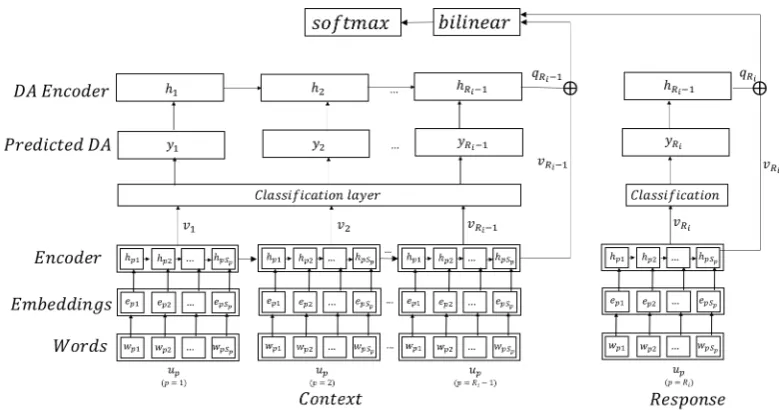
i is the true response. An il-lustration of the multi-task model for dialogue act prediction and response selection is illustrated in Figure1.
Our approach of joint modeling of dialogue act prediction task and response selection task, share a common encoder which encodes the conversa-tion context and response. These representaconversa-tions are then used to predict the dialogue acts and to find the right response from a set of candidate re-sponses. In the following subsections, we provide details of this shared encoder, dialogue act predic-tion modeling, and response selecpredic-tion modeling.
2.1 Shared Context-Response Encoder
con-Figure 1: Architecture diagram of the proposed multi-task Crossway model for response selection and dialogue prediction
sidered as a single very long chain of words. This is input to an RNN encoder to obtain a single uni-fied representation of the context (and response), and a representation of each utterance in the con-text (response). Given a conversation consisting ofRi utterances, with each utterance uj
consist-ing ofSj words, the sequence of operation used in
encoder is as follows:
ejk=fembed1 (wjk) ∀j∈1, . . . Ri,∀k∈1, . . . Sj
hjk=frnn1 (hjk−1, ejk) ∀j∈1, . . . Ri,∀k∈1, . . . Sj (1)
where, fembed1 represents the embedding layer, whereasfrnn1 is the encoder (RNN). The represen-tation of each utteranceuj, denoted byvj, can be
obtained by combining the representations of its constituent words. We take the representation of the last time-step of the encoder as the representa-tion of the entire utterance, i.e. vj = hjSj. This is because the final time-step contains the con-text of all the words preceding it, and serves as a good approximation to the representation of the entire utterance. Thus the shared encoder finally gives us the representations of each utterance, i.e.
v1, v2, . . . vRi−1, corresponding to the context
i
consisting of utterances u1, u2, . . . uRi−1, with
vRi−1 being the representation of the entire con-text. Since the encoder is shared between context and response, it is also used to get the representa-tionvRi corresponding to response utteranceuRi.
2.2 Dialogue Act Prediction Model
Dialogue act prediction (Task1) is a multi-class classification problem, where the goal is to assign a dialogue act to each utterance in a conversation. Following the recent advances in sequence predic-tion task (Kumar et al.,2017), the dialogue act pre-diction model is built on top of an RNN network, where each utterance’s representation is first ob-tained using an RNN Encoder (2.1), which is then input to a classification layer to predict the appro-priate dialogue act of that utterance. Given the rep-resentation of an utterance obtained using shared context-response encoder, the probability of pre-dicting the dialogue act of the utteranceuikcan be written as:
p(y|vk) =
exp(−WT yvk) P
y0∈Yexp(−WyT0vk)
(2)
where vk is the encoded representation of
utter-anceuk. Wy is the weight vector associated with
the classy. The network is optimized to maximize the probability of the gold-standard (actual) dia-logue act. For the diadia-logue acts associated with the utterances in the context, the loss function can be written as following:
Lc= X
Ci∈D
X
ui k∈Ci\uiRi
−logp(yki|vik) (3)
whereyikis the actual dialogue act of the utterance
ui
k. Lc is the loss (i.e., negative log likelihood)
[image:3.595.104.494.59.264.2]following:
Lr= X
Ci∈D
−logp(yRii|v
i
Ri) (4)
whereviRi is representation of the response utter-anceuiRiobtained from the encoder, andyRiiis the corresponding actual dialogue act.
2.3 Dialogue-Act Aware Response Selection
The goal of the second task is to select the true candidate response from a set of candidate re-sponses for a given context. This model consists of two modules, the first module is a Dialogue-Act Encoder which gives us two representations: a compositional representation for the sequence of dialogue acts associated with the context; and, a representation for the response dialogue act. The second module is a crossway response selection module which uses both dialogue act representa-tions to select the right response from a set of can-didate responses. This module combines the dia-logue act representation and utterance representa-tion of context utterances and response in a cross-stitched way using a Siamese network for the re-sponse selection task.
2.3.1 Dialogue-Act Encoder Module
In conversation modelling, dialogue acts are treated as an additional sequence of signals that can aid in the learning process. Dialog-Act en-coder (DA-enen-coder), which is based on the same principle as the RNN encoder, takes the sequence of dialogue acts and returns a representation of that sequence. The input to the DA-encoder are one hot encodings of the dialogue acts, which are then passed through an embedding layer (fembed2 ) to learn DA embeddings. These DA embeddings are sent to an RNN (frnn2 ) to learn a representation of the entire DA sequence. For a given sequence of DA of lengthK, the sequence of operations for the DA-encoder is as follows:
ek=fembed2 (yk) ∀k∈1,2, . . . K
hk=frnn2 (hk−1, ek) ∀k∈1,2, . . . K qK=hK
(5)
where, qK is the final representation of the
dia-logue act sequence.
2.3.2 Crossway Response Selection Module The Crossway Response Selection Module uses the shared context-response encoder to get the rep-resentations of the utterances in a context, i.e.
vRi−1, and the response, i.e.vRi; and DA encoder to get the representation of the DA sequence as-sociated with the context, i.eqRi−1 and response, i.e.qRi. A typical discriminative model, or in par-ticular Siamese model, consists of two encoders, one encoder encoding the context, while another encoding the response utterance. These two rep-resentations are passed to a final layer that com-putes the probability of candidate being a valid response given the context. In the previous re-sponse selection models that use dialogue acts, au-thors have only used the dialogue act representa-tions of the context and not of the response. We use all four representations in a Crossway fash-ion, i.e. vRi−1, vRi, qRi−1 andqRi. As we shall see in the experiments, using these four represen-tation adds robustness to the Crossway model. The two representations corresponding to context and its DA sequence, vRi−1 andqRi−1, are concate-nated together to obtain a compositional tation of the context. Similarly, the two represen-tations of the response and its associated dialogue act, vRi andqRi are concatenated together to ob-tain a compositional representation of the response utterance. The probability of the association of these representations can be computed using a bi-linear function as following:
dRi−1= [vRi−1, qRi−1]
dRi= [vRi, qRi]
p(s|dRi−1, dRi) =σ(d
T
Ri−1·A·dRi+b)
(6)
where, the biasband matrixAare learned model parameters. The model is trained by minimizing the cross-entropy of all labeled conversations in-cluding positive and negative examples. Let D−
be the variation of D where response utterance
uiR
iis replaced with some random utterance in or-der to create negative examples. Given the set of positive and negative conversation sets, the loss is computed as follows:
Ls=− X
Ci∈D
logp(si= 1|dRi−1, dRi)
− X
Ci∈D−
logp(si= 0|dRi−1, dRi)
(7)
3 Multi-task Crossway Model
Dialogue acts have been shown to be useful for re-sponse selection task (Kumar et al.,2018). These dialogue acts can either be given to us or can be predicted using an external model. When dia-logue acts are given to us, we denote this model as Siamese-ADA+Crossway. The assumption that the dialogue acts would be available at the test time is rather impractical, therefore an alternate way of leveraging dialogue acts is to predict them. We call this model as Siamese-PDA single-task (Siamese-PDA-ST+Crossway), since dialogue act prediction task is trained independent of the re-sponse selection task. In this work we hypothe-size that joint modeling of dialogue act prediction task and response selection task would be more beneficial than modeling them individually. Under this hypothesis, we propose a multi-task model, Siamese-PDA-MT+Crossway, that uses the same shared context-response encoder for both tasks. For the dialogue act prediction task of the con-text and the response, the representations obtained from the shared encoder are input to the classifi-cation layer (Section2.2). The loss is computed as the negative likelihood of predicting the cor-rect dialogue acts for each utterance in the con-text and the response. The dialogue act prediction loss associated with the context and response are given in Equations (3) and (4) respectively. The response selection task in the multi-task learning setting also uses the same representations as used by the dialogue act prediction task, i.e. those ob-tained from the shared encoder (Section2.3). The loss of the response selection task is given in Equa-tion (7). The final loss of the end-to-end multitask model is the combined loss of both the tasks, i.e.
L=Lc+Lr+Ls
4 Experiments
In this section, we provide details of the exper-iments, i.e. dataset and its preparation, baseline models, experimental setup, results and their anal-ysis including ablation study.
4.1 Datasets
While our model does not need the actual dialogue acts at test time, it does require them at the time of training. So in our problem setting, we require a dataset that is of reasonable size and has utterances annotated with the corresponding dialogue acts.
We considered several available datasets (Serban et al.,2015), such as DailyDialog (Li et al.,2017), SwDA (Switchboard Dialogue Act Corpus ( Juraf-sky,1997)), MRDA (Meeting Recorder Dialogue Act corpus (Janin et al., 2003)), Ubuntu(Lowe et al., 2015), OpenSubtitles(Tiedemann, 2009), etc. Out of these, Ubuntu, OpenSubtitles, MRDA were found to be unsuitable for our problem set-ting. The first two, i.e. Ubuntu and OpenSubti-tles, do not have dialogue act annotations, and the MRDA corpus is too small, it has only 51 conver-sations. Therefore, we evaluate the performance of our model on SwDA and DailyDialog datasets:
• SwDA: Switchboard Dialogue Act Cor-pus (Stolcke et al., 2000) is annotated on 1155 human to human telephonic conversa-tions. Each utterance in a conversation is labeled with one of the 42-class compact DAMSL taxonomy (Core and Allen, 1997;
Jurafsky, 1997). The dataset has train, val-idation, and test splits of 1003, 12, and 19 conversations, respectively.
• DailyDialog(Li et al., 2017) consists of ut-terances annotated with dialogue acts and is large enough for conversation modeling methods to work. Each utterance is anno-tated with one of the four dialogue acts. The dataset has train, validation, and test splits of 11118, 1000, and 1000 conversations, re-spectively.
Dataset Preparation To prepare the data for training and testing, we followed the procedure mentioned in (Kumar et al., 2018; Lowe et al.,
2017,2015). Examples in our training dataset con-sists of a context ofKutterances, followed by the
K+ 1utterance that acts as a true response (posi-tive examples). The training of response selection models require positive examples and an equal number of negative examples. In-order to prepare negative examples, each conversation is replicated by replacing the last utterance with a random ut-terance from the rest of the training data. On the other hand, examples in our test dataset consists of a context followed by a set of candidate responses of sizen. The first response is a true response fol-lowed byn−1utterances selected randomly from the rest of the test set. For the DailyDialog and SwDA dataset, the context length K is set to 3
DailyDialog SwDA
MRR R@1 R@3 Acc (%) MRR R@1 R@3 Acc (%)
Siamese (Lowe et al.,2017) 0.867 0.818 0.880 NA 0.615 0.463 0.687 NA
Siamese-PDA-ST + Crossway 0.900 0.870 0.899 82.9 0.669 0.568 0.685 71.4
Siamese-PDA-MT + Crossway 0.946 0.938 0.938 86.1 0.703 0.612 0.712 72.4
[image:6.595.76.520.61.129.2]Siamese-ADA + Crossway (upper bound) 0.956 0.944 0.955 100 0.719 0.630 0.738 100
Table 1: Results for DailyDialog and SwDA Datasets, PDA is for Predicted Dialogue Act, ADA is for Actual Dialogue Act, ST is Single-Task Learning, and MT is for Multi-Task Learning
this data preparation exercise, the total number of conversations in train, test, and validation for Dai-lyDialog are61030,2849, and2695, respectively. And, for the SwDA dataset, the total number num-ber of conversations in train, test, and validation split are178736,3483, and2245, respectively.
4.2 Hyper-parameter Tuning
The validation set is used for fine tuning hyper-parameters, and results are reported on the test set. The maximum batch size is 32; for each batch, the utterances are padded to the maximum length in that batch. We use 300-dimensional Glove em-beddings (Pennington et al.,2014) to initialize the word vectors – these word vectors are also up-dated during training. Both Context-Response en-coder and DA-Enen-coder are GRUs withrnn_size
of 300, after optimizing between 100 to 500 in step of100. Dropout of0.1 (optimized over0.0
to0.7in steps of0.1) was applied to embeddings obtained from the output of the encoder. Mod-els were trained to minimize cross entropy us-ing Adam optimizer with learnus-ing rate of0.0003
(optimized over 0.0001, 0.0003, 0.0005, 0.0007,
0.001). All models were trained for 200 epochs.
4.3 Evaluation Metrics
Since our problem formulation is retrieval based, we use standard IR metrics such as Mean Recipro-cal Rank (MRR) and ReRecipro-call@k as our evaluation metrics for the response selection task (Task-2). MRR is calculated as the mean of the reciprocal rank of the true candidate response among other candidate responses. Recall@kmeasures whether the true candidate response appears in a ranked list ofkresponses. While we report all of these met-rics, in order to make the analysis more explain-able, we will keep the MRR as our primary met-ric. We also report the accuracy of the dialogue act prediction task (Task-1).
4.4 Baseline Methods and Proposed Models
Following is the list of baseline model and pro-posed models that we use in our experiments:
• Siamese (Lowe et al., 2017): a siamese model that uses a dual encoder for conversa-tion modeling without any dialogue acts in-formation.
• Siamese-PDA-ST+Crossway: model that uses dialogue acts in single-task setting, (i.e. predicted externally) in a crossway fashion. PDA is for Predicted Dialogue Act and ST is for Single-Task.
• Siamese-ADA+Crossway: a hypothetical model that uses actual dialogue acts in a crossway fashion (upper bound). ADA is for Actual Dialogue Act
• Siamese-PDA-MT+Crossway: the pro-posed model uses predicted dialogue acts in a crossway fashion in a multi-task setting. MT is for Multi-Task.
• Siamese-PDA-MT+Context-DA (Zhao et al., 2017) : this model uses predicted dialogue acts of the context in a multi-task setting, we implemented this model for the discriminative response selection task.
4.5 Results and Discussion
In Tables1and2, we report results of our exper-imental study, providing evidences to support two hypotheses:
1. The joint modeling of dialogue act prediction task and response selection task (multi-task setting) performs better than modelling them independently (single-task setting).
DailyDialogue SwDA
Context-DA Response- Crossway Context-DA Response- Crossway
(Zhao et al.,2017) DA (Zhao et al.,2017) DA
Siamese-PDA-ST 0.912 0.900 0.900 0.639 0.649 0.669
Siamese-PDA-MT
(Zhao et al.,2017) 0.921 0.919 0.946 0.698 0.685 0.703 Siamese-ADA
[image:7.595.79.519.61.147.2](Kumar et al.,2018) 0.934 0.927 0.956 0.656 0.682 0.719
Table 2: Comparison of MRR when using dialogue acts of Context-only, Response-only and Crossway fashion
Multi-Task vs Single-Task Modelling: In Ta-ble 1, we report and compare the results of our proposed method with the baselines, for both datasets, i.e. DailyDialog and SwDA, and provide evidence for the first hypothesis outlined above. From these results, we draw several observations. First observation is that all models that use dia-logue acts outperform the model that does not use them. The second observation is that the multi-task model (Siamese-PDA-MT+Crossway), that does the joint modeling of both tasks (dialogue act prediction and response selection task), per-forms better than the single-task model (Siamese-PDA-ST+Crossway) that models them separately. Multi-task modelling not only improves the MRR in the response selection task for both datasets, but also achieves better dialogue act prediction accu-racy. Siamese-ADA+Crossway model which uses the actual dialogue acts, is an upper bound (there-fore an ideal model) on how good any model can perform if it were to use predicted dialogue acts. And as we can see, the MRR of multi-task model (Siamese-PDA-MT+Crossway) is close to the up-per bounds for both datasets as compared to the single-task model (Siamese-PDA-ST+Crossway). An interesting observation is that, for both Dai-lyDialog and SwDA dataset, though the multi-task model has less than ideal dialogue act pre-diction accuracy (less than 100%), it performs at par with the ideal model for the response selec-tion task. For the DailyDialog dataset, the multi-task model has the dialogue act prediction ac-curacy of 86.1%, much less than the ideal ac-curacy of 100%; in-spite of that, it performs at par with the ideal model that uses the actual dia-logue acts, i.e. Siamese-ADA+Crossway (MRR of
0.946with Siamese-PDA-MT+Crossway vs0.956
with Siamese-ADA+Crossway). Similarly, for the SwDA dataset, the MRR with multi-task model (Siamese-PDA-MT+Crossway) is0.703, which is very close to the MRR of0.719obtained with the ideal model (Siamese-ADA+Crossway).
Consis-tency of such results across both datasets suggests that the Crossway model is robust and is able to compensate for the errors in predictions by lever-aging the similarities across dialogue acts and con-text/response. In the follow up section, we analyze the effect of Crossway in much more detail.
Crossway vs Response-DA/Context-DA: Al-though the dialogue acts have been shown to be useful for the response selection task, exist-ing work has only used the dialogue acts of the context. Whereas, in our experiments, we have found that the model that uses the dialogue acts of both context and response outperforms the models that use the dialogue acts of either con-text or response. To further analyze the results, we perform an ablation study and show the sults of using the dialogue acts of context, re-sponse and of both. In Table 2, we report the MRR numbers of several models that use the dia-logue acts in different settings. More specifically, we show how the following models i.e., Siamese with actual dialogue act (Siamese-ADA), Siamese with predicted dialogue acts in single-task set-ting (Siamese-PDA-ST) and Siamese with pre-dicted dialogue act in multi-task setting (Siamese-PDA-MT) perform when they are given the dia-logue acts of only context (Context-DA), diadia-logue acts of only response (Response-DA), and dia-logue acts of both (Crossway). Results in Table2
way Crossway model works. Note that in the
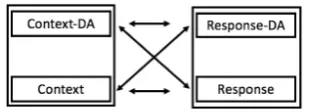
Figure 2: Four implicit similarities being used in Cross-way model
Crossway model, there are four similarities that play a role, i.e. context-response, ContextDA-ResponseDA, ContextDA-response and Context-responseDA, graphically depicted in Figure2. So, in the case of erroneous prediction of either of con-text DA or response DA, it shall only corrupt two of the four similarities, still leaving two other sim-ilarities that can provide strong clues to the under-lying model about the correct response belonging to the context.
5 Related Work
Researchers have shown that response selection is a promising approach to build a practical conver-sation system (Gandhe and Traum, 2010; Lowe et al.,2017;Wu et al.,2016). (Gandhe and Traum,
2010) have shown that response selection based approach for conversation modelling is a good ap-proximation of mimicking human dialogue. Re-sponse selection based conversation systems are more practical from the implementation perspec-tive because the responses are mined form previ-ous conversation logs and are therefore more nat-ural and semantically correct. (Ji et al., 2014) have used response selection based techniques for modelling short text conversation responses. They conclude that speech act, sentiment or entity asso-ciated with the utterances may enhance the accu-racy of the underlying model.
Recently, multi-turn response selection has be-come the focus of conversation modelling. In multi-turn response selection, current utterance in-cluding previouskutterances are used to select an appropriate response from a set of candidate re-sponses. (Lowe et al., 2017; Wu et al., 2016) have shown the efficacy of multi-turn response selection in conversation modeling. (Chaudhuri et al., 2018) have further enhanced these mod-els by incorporating additional domain knowl-edge in the form of domain specific keywords. (Song et al., 2018) have used an ensemble ap-proach (generation-based and selection-based) to
build conversational model. Although effective, none of these methods leverage Dialogue Acts for response selection.
The use of Dialogue Acts (DA) (Xu et al.,
2018), latent topics(Zhao et al.,2018;Wen et al.,
2017), sentiments, entity models can help in grounding or interpretation of the user utterances which can further aid in improvement of conversa-tion modelling. (Kumar et al.,2018) have shown the usefulness of dialogue act for conversation modeling. However, they assume that the dialogue acts are available at the conversation time which is impractical as dialogue acts are rarely available in a real conversation. Our work addresses this lim-itation and builds an end-to-end dialogue model, where we predict the dialogue acts and use them as an additional signal for response selection. (Xu et al., 2018; Zhao et al., 2017) use dialogue act for conversation modeling, however the focus of their work is on response generation. In addi-tion to the difference in the underlying task, (Xu et al., 2018) uses an in-house dataset with syn-thetic dialogue acts 1, whereas we have experi-mented on publicly available datasets. In (Zhao et al.,2017), while authors propose the model for the dialogue generation task, an important differ-ence is that their model uses the dialogue acts of the context whereas our model uses the dialogue acts of both context and response, combined in a cross-way fashion. We however do use this as a baseline, and show our model’s superior perfor-mance.
6 Conclusion
This paper presents an end-to-end multi-task model that eliminates the need of actual dialogue acts at the test time. Our end-to-end model com-bines the predicted dialogue acts of the context and the response with the context, and use the com-bined representation to select an appropriate re-sponse from a set of candidate rere-sponses. Our model has been validated on real-world dialogue datasets; we show that our novel way of combin-ing dialogue acts in a cross-way fashion not only compensates for the errors in the dialogue act pdiction model but it performs at par with the re-sponse selection model that uses actual dialogue acts.
1The dataset and the code is not publicly available to be
References
Debanjan Chaudhuri, Agustinus Kristiadi, Jens Lehmann, and Asja Fischer. 2018. Improving response selection in multi-turn dialogue systems.
arXiv preprint arXiv:1809.03194.
Hongshen Chen, Xiaorui Liu, Dawei Yin, and Jiliang Tang. 2017. A survey on dialogue systems: Recent advances and new frontiers. ACM SIGKDD Explo-rations Newsletter, 19(2):25–35.
Mark G Core and James Allen. 1997. Coding dialogs with the damsl annotation scheme. In AAAI Fall Symposium On Communicative Action In Humans And Machines.
Sudeep Gandhe and David Traum. 2010. I’ve said it before, and i’ll say it again: an empirical investiga-tion of the upper bound of the selecinvestiga-tion approach to dialogue. InProceedings of the 11th Annual Meet-ing of the Special Interest Group on Discourse and Dialogue, pages 245–248. Association for Compu-tational Linguistics.
Adam Janin, Don Baron, Jane Edwards, Dan Ellis, David Gelbart, Nelson Morgan, Barbara Peskin, Thilo Pfau, Elizabeth Shriberg, Andreas Stolcke, et al. 2003. The icsi meeting corpus. InICASSP.
Zongcheng Ji, Zhengdong Lu, and Hang Li. 2014. An information retrieval approach to short text conver-sation. arXiv preprint arXiv:1408.6988.
Dan Jurafsky. 1997. Switchboard swbd-damsl shallow-discourse-function annotation coders man-ual. www. dcs. shef. ac. uk/nlp/amities/files/bib/ics-tr-97-02. pdf.
Hirotani Kitano. 1991. Phi dm-dialog: an experimental speech-to-speech dialog translation system. Com-puter, 24(6):36–50.
Harshit Kumar, Arvind Agarwal, Riddhiman Dasgupta, Sachindra Joshi, and Arun Kumar. 2017. Dia-logue act sequence labeling using hierarchical en-coder with crf.arXiv preprint arXiv:1709.04250.
Harshit Kumar, Arvind Agarwal, and Sachindra Joshi. 2018. Dialogue-act-driven conversation model: An experimental study. InProceedings of the 27th In-ternational Conference on Computational Linguis-tics, pages 1246–1256.
Yanran Li, Hui Su, Xiaoyu Shen, Wenjie Li, Ziqiang Cao, and Shuzi Niu. 2017. Dailydialog: A manually labelled multi-turn dialogue dataset. arXiv preprint arXiv:1710.03957.
Chia-Wei Liu, Ryan Lowe, Iulian V Serban, Michael Noseworthy, Laurent Charlin, and Joelle Pineau. 2016. How not to evaluate your dialogue system: An empirical study of unsupervised evaluation met-rics for dialogue response generation. arXiv preprint arXiv:1603.08023.
Ryan Lowe, Nissan Pow, Iulian V Serban, and Joelle Pineau. 2015. The ubuntu dialogue corpus: A large dataset for research in unstructured multi-turn di-alogue systems. In 16th Annual Meeting of the Special Interest Group on Discourse and Dialogue, page 285.
Ryan Thomas Lowe, Nissan Pow, Iulian Vlad Serban, Laurent Charlin, Chia-Wei Liu, and Joelle Pineau. 2017. Training end-to-end dialogue systems with the ubuntu dialogue corpus. Dialogue & Discourse, 8(1):31–65.
Jeffrey Pennington, Richard Socher, and Christo-pher D. Manning. 2014. Glove: Global vectors for word representation. InEMNLP.
Alan Ritter, Colin Cherry, and William B Dolan. 2011. Data-driven response generation in social media. In
Proceedings of the conference on empirical methods in natural language processing, pages 583–593. As-sociation for Computational Linguistics.
Iulian Vlad Serban, Ryan Lowe, Peter Henderson, Lau-rent Charlin, and Joelle Pineau. 2015. A survey of available corpora for building data-driven dialogue systems. arXiv preprint arXiv:1512.05742.
Yiping Song, Rui Yan, Cheng-Te Li, Jian-Yun Nie, Ming Zhang, and Dongyan Zhao. 2018. An ensem-ble of retrieval-based and generation-based human-computer conversation systems.
Andreas Stolcke, Klaus Ries, Noah Coccaro, Eliza-beth Shriberg, Rebecca Bates, Daniel Jurafsky, Paul Taylor, Rachel Martin, Carol Van Ess-Dykema, and Marie Meteer. 2000. Dialogue act modeling for au-tomatic tagging and recognition of conversational speech. Computational linguistics, 26(3):339–373.
Jörg Tiedemann. 2009. News from opus-a collection of multilingual parallel corpora with tools and inter-faces. InRecent advances in natural language pro-cessing, volume 5, pages 237–248.
Tsung-Hsien Wen, Yishu Miao, Phil Blunsom, and Steve Young. 2017. Latent intention dialogue mod-els. InProceedings of the 34th International Confer-ence on Machine Learning-Volume 70, pages 3732– 3741. JMLR. org.
Tsung-Hsien Wen, David Vandyke, Nikola Mrksic, Milica Gasic, Lina M Rojas-Barahona, Pei-Hao Su, Stefan Ultes, and Steve Young. 2016. A network-based end-to-end trainable task-oriented dialogue system. arXiv preprint arXiv:1604.04562.
Yu Wu, Wei Wu, Chen Xing, Ming Zhou, and Zhoujun Li. 2016. Sequential matching network: A new architecture for multi-turn response selec-tion in retrieval-based chatbots. arXiv preprint arXiv:1612.01627.
Tiancheng Zhao, Kyusong Lee, and Maxine Eskenazi. 2018. Unsupervised discrete sentence representa-tion learning for interpretable neural dialog gener-ation.arXiv preprint arXiv:1804.08069.