Proceedings of the 2019 Conference on Empirical Methods in Natural Language Processing 2119
Executing Instructions in Situated Collaborative Interactions
Alane Suhr
Cornell University
Claudia Yan
IBM
Jacob Schluger∗
Cornell University
Stanley Yu∗
Columbia University
Hadi Khader∗∗
Intel
Marwa Mouallem∗∗
IBM
Iris Zhang
Yoav Artzi
Cornell University
Abstract
We study a collaborative scenario where a user not only instructs a system to complete tasks, but also acts alongside it. This allows the user to adapt to the system abilities by changing their language or deciding to simply accom-plish some tasks themselves, and requires the system to effectively recover from errors as the user strategically assigns it new goals. We build a game environment to study this sce-nario, and learn to map user instructions to system actions. We introduce a learning ap-proach focused on recovery from cascading er-rors between instructions, and modeling meth-ods to explicitly reason about instructions with multiple goals. We evaluate with a new evalu-ation protocol using recorded interactions and online games with human users, and observe how users adapt to the system abilities.
1 Introduction
Sequential instruction scenarios commonly as-sume only the system performs actions, and there-fore only its behavior influences the world state. This ignores the collaborative potential of such interactive scenarios and the challenges it intro-duces. When the user acts in the world as well, they can adapt to the system abilities not only by adopting simpler language, but also by deciding to accomplish tasks themselves. The system must then recover from errors as new instructions arrive and be robust to changes in the environment that are not a result of its own actions.
In this paper, we introduce CEREALBAR, a
collaborative game with natural language instruc-tion, and design modeling, learning, and evalua-tion methods for the problem of sequential
instruc-tion following in collaborative interacinstruc-tions. In CE
-REALBAR, two agents, a leader and a follower,
∗
,∗∗: Equal contribution. All work done at Cornell.
Follower’s view
Leader’s view
Leader Follower
. . . ¯
x3:turn left and head toward the yellow hearts, but don’t pick them up yet. I’ll get the next card first.
¯
x4:Okay, pick up yellow hearts and run past me toward the bush sticking out, on the opposite side is 3 green stars
[Set made. New score: 4]
[image:1.595.312.523.191.430.2]. . .
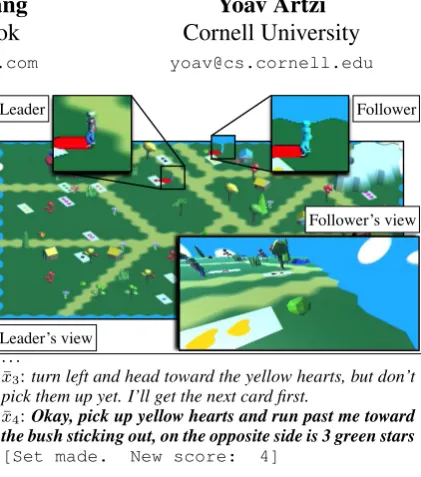
Figure 1: A snapshot from an interaction in CEREAL -BAR. The current instruction is in bold. The large im-age shows the entire environment. This overhead view is available only to the leader. The follower sees a first-person view only (bottom right). The zoom boxes (top) show the leader and follower.
move in a 3D environment and collect valid sets of cards to earn points. A valid set is a set of three cards with distinct color, shape, and count. The game is turn-based, and only one player can act in each turn. In addition to collecting cards, the leader sends natural language instructions to the follower. The follower’s role is to execute these
instructions. Figure 1shows a snapshot from the
inter-action key to success. We address the problem of mapping the leader instructions to follower ac-tions. In addition to the collaborative challenges, this requires grounding natural language to resolve spatial relations and references to objects, reason about dependencies on the interaction history, re-act to the changing environment as cards appear and disappear, and generate actions.
CEREALBAR requires reasoning about the changing environment (e.g., when selecting cards) and instructions with multiple goals (e.g., select-ing multiple cards). We build on the Visitation
Prediction Network model (VPN; Blukis et al.,
2018b), which casts planning as mapping instruc-tions to the probability of visiting posiinstruc-tions in the environment. Our new model generalizes the plan-ning space of VPN to reason about intermediate goals and obstacles, and includes recurrent action generation for trajectories with multiple goals.
We collect 1,202 human-to-human games for training and evaluation. While our model could be trained from these recorded games only, it would often fail when an instruction would start at the wrong position because of an error in following the previous one. We design a learning algorithm that dynamically augments the data with examples that require recovering from such errors, and train our model to distinguish such recovery reasoning from regular instruction execution.
Evaluation with recorded games poses addi-tional challenges. As agent errors lead to unex-pected states, later instructions become invalid. Because measuring task completion from such
states is meaningless, we proposecascaded
eval-uation, a new evaluation protocol that starts the agent at different points in the interaction and mea-sures how much of the remaining instructions it can complete. In contrast to executing complete sequences or single instructions, this method al-lows to evaluate all instructions while still mea-suring the effects of error propagation.
We evaluate using both static recorded games and live interaction with human players. Our hu-man evaluation shows users adapt to the system and use the agent effectively, scoring on average 6.2 points, compared to 12.7 for human players. Our data, code, and demo videos are available at
lil.nlp.cornell.edu/cerealbar/.
2 Setup and Technical Overview
We consider a setup where two agents, a leader and a follower, collaborate. Both execute actions
in a shared environment. The leader, additionally, instructs the follower using natural language. The leader goal is to maximize the task reward, and the follower goal is to execute leader instructions. We consider a turn-based version, where at each turn only one agent acts. We instantiate this scenario in CEREALBAR, a navigation card game (Figure1),
where a leader and follower move in an
environ-ment selecting cards to complete sets.1
CEREALBAR Overview The objective of CE
-REALBARis to earn points by selecting valid sets
of cards. A valid set has three cards with distinct color, shape, and count. When the only cards se-lected in the world form a valid set, the players receive a point, the selected cards disappear, three new cards are added randomly, and the number of remaining turns increases. The increase in turns decays for each set completed. An agent stepping on a card flips its selection status. The players form sets together. The follower has more steps per turn than the leader. This makes using the fol-lower critical for success. The folfol-lower only sees a first-person view of the environment, preventing them from planning themselves, and requiring in-structions to be sensible from the follower’s per-spective. The leader chooses the next target set, plans which of the two players should get which card, and instructs the follower. The follower can not respond to the leader, and should not plan themselves, or risk sabotaging the leader’s plan, wasting moves and lowering their potential score. Followers mark an instruction as finished before observing the next one. This provides alignment between instructions and follower actions. In con-trast to the original setup that we use for data
col-lection, in our model (Section4), we assume the
follower has full observability, leaving the chal-lenge of partial observability for future work.
Ap-pendixAprovides further game design details.
Problem Setup We distinguish between the
world state and the interaction state. LetSbe the
set of all world states, Γbe the set of all
interac-tion states, andX be the set of all natural language
instructions. A world state s ∈ S describes the
current environment. In CEREALBAR, the world
state describes the spatial environment, the loca-tion of cards, whether they are selected or not, and the location of the agents. An interaction state
γ ∈ Γ is a tuple hQ, α, ψ¯ i. The first-in-first-out
1The name C
queueQ¯ = [¯xq, . . . ,x¯q0]contains the instructions
¯
xi ∈ X available to execute. The current
instruc-tion is the left-most instrucinstruc-tion x¯q. The current
turn-taker α ∈ {Leader,Follower} indicates the
agent currently executing actions, andψ∈IN≥0is
the number of steps remaining in the current turn. At each time step, the current turn-taker agent takes an action. An action may be the leader is-suing an instruction, or either agent performing
an action in the environment. Let A = Aw ∪
{DONE} ∪ X be the set of all actions. The setAw
includes the actions available to the agents in the
environment. In CEREALBAR, this includes
mov-ing forward or backward, and turnmov-ing left or right.
Moving onto a card flips it selection status. DONE
indicates completing the current instruction for the follower or ending the turn for the leader. An
in-struction actiona= ¯x ∈ X can only be taken by
the leader and adds the instructionx¯to the queue
¯
Q. The effect of each action is determined by the
transition functionT :S ×Γ×A → S ×Γ, which
is formally defined in AppendixB. Only world
ac-tionsa∈ Awdecrease the remaining stepsψ.
The goal of the leader is to maximize the
to-tal reward of the interaction. An interactionI¯ =
h(s1, γ1, a1), . . . ,(s|I|¯, γ|I|¯, a|I|¯)i is a sequence
of state-action tuples, where T (si, γi, ai) =
(si+1, γi+1). The reward functionR:S ×A →R
assigns a numerical reward to a world state and
an action. The total reward of an interactionI¯is
P|I|¯
i=0R(si, ai). In CEREALBAR, the agents
re-ceive a reward of 1 when a valid set is selected.
Task Our goal is to learn a follower policy to
execute the leader instructions. At time t, given
the current world and interaction statesstandγt,
and the interaction so farI¯<t, the follower policy
π(st, γt,I¯<t)predicts the next actionat.
Model We decompose the follower policy π(st, γt,I¯<t) to predicting a set of distributions
over positions in the environment, including posi-tions to visit, intermediate goals (e.g., cards to se-lect), positions to avoid (e.g., cards not to touch), and positions that are not passable. These distri-bution are used in a second stage to generate a
se-quence of actions. Section4describes the model.
Learning We assume access to a set of N recorded interactions{I¯(i)}N
i=1, and create
exam-ples where each instruction is paired with a se-quence of state-action tuples. We maximize the action-level cross entropy objective, and use two
auxiliary objectives (Section5). We first train each
stage of the model separately, and then fine-tune
them jointly. During fine-turning, we continuously generate additional examples using model failures. These examples help the agent to learn how to re-cover from errors in prior instructions.
Evaluation We measure correct execution of in-structions and the overall game reward. We
as-sume access to a test set of M recorded
interac-tions{I¯(i)}M
i=1. We measure instruction-level and
interaction-level performance, and develop
cas-caded evaluation, an evaluation protocol that pro-vides a more graded measure than treating each in-teraction as a single example, while still
account-ing for error propagation (Section6). Finally, we
conduct online evaluation with human leaders.
3 Related Work
Goal-driven natural language interactions have been studied in various scenarios, including
dia-logue where only one side acts in the world (
An-derson et al.,1991;Williams et al.,2013;Vlachos and Clark,2014;de Vries et al.,2018;Kim et al.,
2019; Hu et al., 2019), coordination for agreed
selection of an object (He et al., 2017;Udagawa
and Aizawa,2019), and negotiation (Lewis et al.,
2017;He et al.,2018). We focus on collaborative interactions where both the user and the system perform sequences of actions in the same environ-ment. This allows the user to adapt to the language understanding ability of the system and balance between delegating goals to it and accomplishing them themselves. For example, a user may decide to complete a short but hard-to-describe task and delegate to the system a long but easy-to-describe one. In prior work, in contrast, recovery is limited to users paraphrasing their requests. The Cards
corpus (Djalali et al., 2011, 2012; Potts, 2012)
was used for linguistic analysis of collaborative bi-directional language interaction. The structure of collaborative interactions was also studied
us-ing Wizard-of-Oz studies (Lochbaum, 1998;
Sid-ner et al., 2000; Koulouri and Lauria, 2009). In contrast, we focus on building agents that follow
instructions. Ilinykh et al. (2019) present a
cor-pus for the related task of natural language co-ordination in navigation. Collaboration has also been studied for emergent communication (e.g.,
Andreas et al.,2017;Evtimova et al.,2017). Understanding sequences of natural language utterances has been addressed using semantic
parsing (e.g.,Miller et al.,1996;MacMahon et al.,
Iyyer et al.,2017;Suhr et al.,2018;Arkin et al.,
2017; Broad et al., 2017). Interactions were
also used for semantic parser induction (Artzi and
Zettlemoyer,2011;Thomason et al.,2015;Wang et al.,2016). These methods require hand-crafted symbolic meaning representation, while we use
low-level actions (Suhr and Artzi,2018). The
in-teractions in our environment interleave actions of both agents with leader utterances, an aspect not addressed by these methods. Executing single
instructions has been widely studied (e.g.,Tellex
et al., 2011; Duvallet et al., 2013; Misra et al.,
2017, 2018; Anderson et al., 2018;Blukis et al.,
2018a,b; Chen et al., 2019). The distinction we make between actions specified in the instruction and implicit recovery actions is similar to how
Artzi and Zettlemoyer(2013) use implicit actions for single instructions. Finally, our model is based
on the VPN model ofBlukis et al.(2018b). While
we assume full observability, their original work did not. This indicates that our model is likely to generalize well to partially observable scenarios.
4 Model
We use a two-stage model for the follower policy π(st, γt,I¯<t), where st is a world state, γt is an
interaction state, andI¯<tis the interaction history.
The instructionx¯that is the first in the queueQ¯t,
which is part of γt, is the currently executed
in-struction. In our model, we assume the follower observes the entire environment. First, we map ¯
xandstto distributions over locations in the
en-vironment, including what locations to visit and what are the goals. These distributions are consid-ered as an execution plan, and are used to generate a sequence of actions in the second stage. The dis-tribution can also be used to easily easily visualize the agent plan. The first stage is used when start-ing a new instruction, and the predicted distribu-tions are re-used for all acdistribu-tions for that instruction.
Figure2illustrates the architecture and the
distri-butions visualization. The two-stage approach was
introduced byBlukis et al.(2018b). We
general-ize its planning space and add a recurrent action generator for execution.
Input Representation The inputs to the first
stage are the instruction x¯ and the world state
st. We generate feature maps for both. We
use a learned embedding function φX and a
bi-directional recurrent neural network (RNN;
Elman, 1990) with a long short-term memory
cell (LSTM;Hochreiter and Schmidhuber,1997)
RNNX to mapx¯to a vector¯x. The world statest
is a 3D tensor that encodes the properties of each
position. The dimensions ofstareP ×W ×H,
whereP is the number of properties, andW and
Hare the environment width and height. Each of
theW×Hpositions is represented instas a binary
vector of length P. For example, a position with
a red hut will have 1’s for thered andhut
dimen-sions and 0’s for all other dimendimen-sions. We map
the world state to a tensor feature mapF0 by
em-beddingst and processing it using the text
repre-sentation¯x. We use a learned embedding function
φSto map each position vector to a dense
embed-ding of sizeNs by summing embeddings of each
of the position’s properties. The embeddings are
combined to a tensorSof dimensionNs×W×H
representing a featurized global view of the envi-ronment. We create a text-conditioned state
repre-sentation by creating a kernelKsand convolving
with it overS. We use a linear transformation to
create Ks = Ws¯x+bs, where Ws andbs are
learned weights. We reshapeKsto a1×1
convo-lution kernel withNs0 output channels, and
com-puteS0 =S∗Ks. We concatenateSandS0along
the channel dimension and rotate and center so the
follower position is at center pixel to generateF0.2
Stage 1: Plan Prediction We treat plan gen-eration as predicting distributions over positions
ρ in the environment. There are W × H
possible positions. We predict four
distribu-tions: (a) p(ρ|st,x¯), the probability of
vis-iting ρ while executing the instruction x¯; (b)
p(GOAL = 1|ρ, st,x¯), the binary probability
thatρ is a goal (i.e., GOAL = 1 when
contain-ing a card to select); (c)p(AVOID = 1|ρ, st,x¯),
the binary probability that the agent must not
pass in ρ (i.e., AVOID = 1 when it
con-tains a card that should not be touched); and (d) p(NOPASS = 1|ρ, st,x¯), the binary probability
the agent cannot pass in ρ (i.e., NOPASS = 1
when it contains another object).
We use LINGUNET(Misra et al.,2018) to
pre-dict the distributions. The inputs to LINGUNET
are the instruction embedding ¯x and featurized
world state F0, which is relative to the agent’s
frame of reference. The output are four
matri-ces, each of dimensionW ×H corresponding to
the environment. LINGUNETis formally defined
inMisra et al. (2018) and AppendixD. Roughly
2AppendixDdescribes the relationship between the
Stage 1: Plan prediction s ¯ x ⇤ LingUNet Conv2D Transpose Conv2d LeakyReLU InstanceNorm2D Fully connected + bias L2 norm KT 1 KT 2 KT 3 KT 4 F1 F2 F3 F4 RNN Goal
auxiliary G1
G2
G3
G4 H
4 H3 H2 H1 F0 Discriminator auxiliary
Okay, pick up yellow hearts and run past me toward the bush sticking out, on the opposite side is 3 green stars
¯
x<latexit sha1_base64="SyiLA+p38Q5nHeVQIMUe5kZ73KA=">AAAB73icbVDLSgNBEOyNrxhfUY9eBoPgKexGQfEU9OIxgnlAsoTeySQZMju7zsyKYclPePGgiFd/x5t/4yTZgyYWNBRV3XR3BbHg2rjut5NbWV1b38hvFra2d3b3ivsHDR0lirI6jUSkWgFqJrhkdcONYK1YMQwDwZrB6GbqNx+Z0jyS92YcMz/EgeR9TtFYqdUJUKVPk6tuseSW3RnIMvEyUoIMtW7xq9OLaBIyaahArdueGxs/RWU4FWxS6CSaxUhHOGBtSyWGTPvp7N4JObFKj/QjZUsaMlN/T6QYaj0OA9sZohnqRW8q/ue1E9O/9FMu48QwSeeL+okgJiLT50mPK0aNGFuCVHF7K6FDVEiNjahgQ/AWX14mjUrZOytX7s5L1essjjwcwTGcggcXUIVbqEEdKAh4hld4cx6cF+fd+Zi35pxs5hD+wPn8ASUukAk=</latexit> :
Plan distributions Trajectory distribution
Goal distribution Locations to avoid Impassable locations
S
Ks
S0
Stage 2: Action generation
LEFT T
RNN
hs1, 1i
hs2, 2i FORWARDT
RNN
T RNN
[image:5.595.75.527.64.262.2]hs3, 3i FORWARD
Figure 2: Illustration of the model architecture. Given the instructionx¯and the world states, we computeF0from
the embeddings of the instruction¯xand environmentS. We use LINGUNETto predict four distributions, which are visualized over the map (grayscaled to emphasize the distributions). We show three action generation steps. Each step receives the map cropped around the agent and the previous action, and outputs the next action.
speaking, LINGUNETreasons about the
environ-ment representation F0 at L levels. First, F0 is
used to generate feature maps of decreasing size Fj, j = 1. . . L using a series of convolutions.
We create convolution kernels from the
instruc-tion representainstruc-tion¯x, and apply them to the
fea-ture mapsFj to generate text-conditioned feature
mapsGj. Finally, feature maps of increasing size
Hj are generated using a series of L
deconvolu-tions. The last deconvolution generates a tensor
of size 4×W ×H with a channel for each of
the four distributions. We use a softmax over one
channel to compute p(ρ | st,x¯). Because the
other distributions are binary, we use a sigmoid on each value independently for the other
chan-nels. When computing p(GOAL = 1 | ρ, st,x¯)
andp(AVOID = 1 | ρ, st,x¯) we mask positions
without objects that can be changed (i.e., positions without cards) to assign them zero probability.
Stage 2: Action Generation We use the four distributions to generate a sequence of actions. We concatenate the distributions channel-wise to
a tensorP∈R4×W×H. We use a forward LSTM
RNN to predict a sequence of actions. At each
prediction stept, we rotate, transform, and cropP
to generate the egocentric tensorP0
t∈RN
0×C×C
, where the agent is always at the center and facing
in the same direction, such that P0t is relative to
the agent’s current frame of reference. The input
to the action generation RNN at timetis:
p0t = vec(NORM(RELU(CNN P
(P0t))))
pt = RELU(WP2[p 0
t;RELU(W P 1p
0
t+b P 1)] +b
P 2) ,
where CNNP is a convolutional layer, RELU
is a non-linearity, NORM is instance
normaliza-tion (Ulyanov et al., 2017), and WP
1, WP2, bP1,
bP
2 are learned weights. The action probability is:
ht = RNN
A
(ht−1,[φ A
(at−1);pt])
p(a) ∝ exp(WA[ht;pt] +b
A
) , (1)
where RNNA is an LSTM RNN,φA is a learned
action embedding function,a0 is a specialSTART
action, and WA andbA are learned. During
in-ference, we assign zero probabilities to actions a
whenTw(st, a)is invalid (AppendixB), for
exam-ple when an agent would move into an obstacle.
5 Learning
We assume access to a set of N recorded
inter-actions {I¯(i)}N
i=1. We generate instruction-level
examplesD = SN
i=1{I¯(i,j)}M
(i)
j=1 , where M(i) is
the number of examples fromI¯(i). EachI¯(i,j) =
h(s(i,j)1 , γ1(i,j), a(i,j)1 ), . . . ,(s(i,j)k , γk(i,j), a(i,j)k )iis a
subsequence of tuples in I¯(i), where a(i,j)
1 is the
first action the follower takes after observing the j-th instruction inI¯(i), anda(i,j)
k is theDONEaction
completing that instruction. We first estimate the
parameters for plan predictionθ1 and action
gen-erationθ2 separately (Section5.1), and then
fine-tune jointly with data augmentation (Section5.2).
5.1 Pretraining
Stage 1: Plan Prediction The input of Stage 1 is
the world states1and the instructionx¯at the head
of the queueQ¯.3 We generate labels for the four
output distributions usingI¯(i,j). The visitation
dis-tributionp(ρ|s1,x¯)label is proportional to
num-ber of states st ∈ I¯(i,j) where the follower is in
positionρ. The goal and avoidance distributions
model how the agent plans to manipulate parts of its environment to achieve the specified goals, but
avoid manipulating other parts. In CEREALBAR,
this translates to changing the status of cards, or
avoiding doing so. Forp(GOAL = 1 | ρ, s1,x¯),
we set the label to 1 for allρthat contain a card that
the follower changed its selection status in I¯(i,j),
and 0 for all other positions. Similarly, for the
avoidance distributionp(AVOID = 1 | ρ, s1,x¯),
the label is 1 for allρthat have cards that the
fol-lower does not change during the interactionI¯(i,j).
Finally, forp(NOPASS = 1| ρ, s1,x¯), the label
is 1 for all positions the agent cannot move onto, and zero otherwise. We define four cross-entropy
losses: visitationLV, goalLG, avoidanceLA, and
no passing LP. We also use an auxiliary
cross-entropy goal-prediction lossLG0 using a
probabil-ity p0
G(GOAL = 1 | ρ, s1,x¯) we predict from
the pre-LINGUNETrepresentationS0 by
classify-ing each position. The complete loss is a weighted
sum with coefficients:4
L1(θ1) =λVLV(θ1) +λGLG(θ1) +λALA(θ1) +λPLP(θ1) +λG0LG0(θ1) .
Stage 2: Action Generation We use the gold
distribution to create the inputP, and optimize
to-wards the annotated set of actions using teacher
forcing (Williams and Zipser,1989). We compute
the loss only over actions taken by the follower:
L2(θ2) =−Pnt=11αt=Followerp(at) ,
wherep(at)is computed by Equation1.
5.2 Fine-tuning with Example Aggregation
Simply combining the separately-trained networks together results in low performance. We perform additional fine-tuning with the two stages com-bined, and introduce a data augmentation method to learn to recover from error propagation. Error Propagation Executing a sequence of instructions is susceptible to error propagation, where an agent fails to correctly complete an in-struction, and because of it also fails on the follow-ing ones. While the collaborative, turn-switchfollow-ing setup allows the leader to adjust their plan fol-lowing a follower mistake, leaders often strategi-cally issue multiple instructions to use the
avail-4Additional details are in AppendixE.1.
able follower steps optimally. Given an agent fail-ure, subsequent instructions may not align with the state of the world resulting from the follower’s er-ror. In supervised learning, we do not have the opportunity to learn to recover from such errors, even when it is relatively simple. This usually re-quires exploration. However, conventional frame-works like reinforcement learning (RL) or imita-tion learning (IL) are poorly suitable. In a live interaction, when an agent makes a mistake (e.g., selecting the wrong card), the leader is likely to adjust their actions. Because of this, in a recorded interaction, which contains the leader actions fol-lowing a correct execution, it is not possible to re-liably compute an RL reward for states following erroneous executions. For similar reasons, we can-not compute an IL oracle.
We identify two classes of erroneous states in CEREALBAR: (a) not selecting the correct set of cards; and (b) finishing with the right card
selec-tion, but stopping at the wrong position.5 Case (a)
requires to modify the model, for example to know when to skip instructions that refer to a state that is no longer possible. We leave this case for fu-ture work. We address case (b) by augmenting the data with new examples that are aggregated during
learning. Our process is similar to DAGGER(Ross
et al., 2011). We alternate between: (a) collect-ing new traincollect-ing examples uscollect-ing a heuristic ora-cle, and (b) performing model updates. We gen-erate training examples that demonstrate recovery by starting in an incorrect initial position for an instruction, having arrived there by executing the previous instruction. We train our model to distin-guish between the reasoning required for generat-ing implicit actions to correct errors, and explicit actions directly mentioned in the instruction. Learning with Example Aggregation We al-ternate between aggregating a new set of
recov-ery examplesD0 and updating our parameters. At
each epoch, we first use the current policy to cre-ate new training examples. We run inference for
each exampleI¯(i,j)inD, the original training set,
using the current policy.6 We compare the states0
at the end of execution to the final state in I¯(i,j)
to generate an error-recovery exampleI¯0(i,j+1)for
the subsequent exampleI¯(i,j+1). We only
gener-ate such examples if the position or rotation of the
5
See AppendixE.2for further discussion of the two cases.
6We do not perform inference for the last instruction in an
agent are different, and there are no other
differ-ence between the states. Starting froms0, we
gen-erate the shortest-path sequence of actions that: (a)
changes the cards as specified inI¯(i,j+1), and (b)
executesDONEin the same position as inI¯(i,j+1).
We then createI¯0(i,j+1)usingI¯(i,j+1)and the new
sequence of state-action pairs, and add it toD0.7
Given the original set of examples D and the
aggregate examples D0 we update our model
pa-rameters. We randomly sample without
replace-ment at mostPN
i=1M(i)examples, the size ofD,
from D0. We use all the examples in D and the
sampled examples to do a single parameter update
epoch. We limit the number of examples fromD0
to maintain the effect of the original data.
Optimizing with Implicit Action Prediction The examples we generate during aggregation of-ten include sequences of state-action pairs that do not align with the instruction, for example when a mentioned spatial relation is incorrect from the new starting position. Such examples require rea-soning differently about the text and world state than with the original data. We identify such
ex-amples inD0by comparing their follower starting
position to the starting position in the original
cor-responding example inD. If the distance is over
two, we treat the examples as requiring implicit
actions (Artzi and Zettlemoyer,2013). All other
examples, including all original examples inDare
considered as not requiring implicit reasoning. We encourage the model to reason differently about these examples with a discriminator that classifies if the example requires implicit reasoning or not
using the internal activations of LINGUNET.
The discriminator classifies each of theLlayers
in LINGUNET for implicit reasoning. The goal
is to encourage implicit reasoning at all levels of reasoning in the first stage. The probability of
im-plicit reasoning for each LINGUNETlayerlis:
p(IMPLICT = 1|l, s1,x¯) =
(
σ(AVGPOOL(G1∗KIMP1 )) l= 1
σ(AVGPOOL(Hl∗KIMPl )) l >1
,
where KIMP
l are 1 × 1 learned kernels and
AVGPOOL does average pooling. We define a
cross-entropy loss LIMP that averages across the
Llayers. The complete fine-tuning loss is:
L(θ1, θ2) =L1(θ1) +L2(θ2) +λIMPLIMP(θ1) .
7AppendixE.2describes this process.
6 Cascaded Evaluation
Sequential instruction scenarios are commonly evaluated using recorded interactions by executing individual instructions or executing complete
in-teractions starting from their beginning (e.g.,Chen
and Mooney,2011;Long et al.,2016). Both have limitations. Instruction-level metrics ignore error propagation, and do not accurately reflect the sys-tem’s performance. In contrast, interaction-level metrics do consider error propagation and capture overall system performance well. However, they poorly utilize the test data, especially when perfor-mance is relatively low. When early failures lead to unexpected world states, later instructions be-come impossible to follow, and measuring perfor-mance on them is meaningless. For example, with our best-performing model, 82% of development instructions become impossible due cascading er-rors when executing complete interactions.
The two measures may also fail to distinguish models. For example, consider an interaction with three instructions. Two models, A and B, success-fully execute the third instruction in isolation, but fail on the two others. They also both fail when executing the entire interaction starting from the beginning. According to common measures, the models are equal. However, if model B can actu-ally recover from failing on the second instruction to successfully execute the third, it means it is bet-ter than model A. Both metrics fail to reflect this.
We proposecascaded evaluation, an evaluation
protocol for sequential instruction using static cor-pora. Our method utilizes all instructions during testing, while still accounting for the effect of er-ror propagation. Unlike instruction-level evalua-tion, cascaded evaluation executes the instructions in sequence. However, instead of starting of start-ing only from the start state of the first instruc-tion, we create separate examples for starting from the starting state of each instruction in the action and continuing until the end of the inter-action. For example, given a sequence of three
instructions h1,2,3i we will create three
exam-ples: h1,2,3i,h2,3i, andh3i. To evaluate
perfor-mance in CEREALBAR, we compute two statistics
using cascaded evaluation: the proportion of the remaining instructions followed successfully, and the proportion of potential points scored. We only consider the remaining instructions and points left to achieve in the example. For example, for the
before the second instruction to compute the
pro-portion of potential points scored. AppendixF
de-scribes cascaded evaluation formally.
7 Experimental Setup
Data We collect 1,202 human-human
interac-tions using Mechanical Turk, split into train (960 games), development (120), and test (122).
Ap-pendixCdetails data collection and statistics.
Recorded Interactions Metrics We evaluate instruction-level, interaction-level, and cascaded
(Section6) performance. We allow the follower
ten steps per turn, and interleave the actions taken by the leader during each turn in the recorded
interaction. Instruction execution often crosses
turns. At the instruction-level, we evaluate the mean card state accuracycomparing the state of the cards after inference with the correct card
state,environment state accuracycomparing both
cards and the agent’s final position, andaction
se-quence accuracycomparing the generated action sequence with the correct action sequence. For
complete interactions, we measure meanfull game
points. Finally, for cascaded evaluation, we mea-sure the mean proportion of instructions correctly executed and of possible points scored.
Human Evaluation We perform evaluation with human leaders, comparing our model and hu-man followers. Workers are told they will work with a human or an automated follower, but are not told which in each game. We evaluate both human (105 games) and automated agents at the same time (109 games). We evaluate the game scores, and also elicit free-form feedback.
Systems We evaluate three systems: (a) the
full model; (b) SEQ2SEQ+ATTN:8
sequence-to-sequence with attention; and (c) a static oracle that executes the gold sequence of actions in the recorded interaction. We report mean and standard deviation across three trials for development re-sults. We ablate model and learning components, and additionally evaluate the action generator with
access to gold plans.9 On the test set and for
hu-man evaluation, we use the model with the highest proportion of points scored. We provide
imple-mentation and learning details in AppendixG.
8 Results
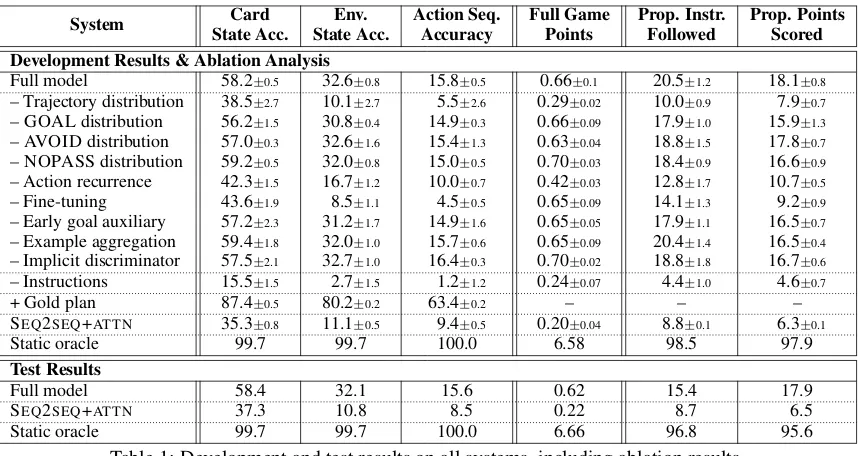
Table 1 shows development and test results,
in-cluding ablations. We consider the proportion of
8
This baseline is similar toMei et al.(2016).
9We do not measure interaction-level metrics with gold
plans as they are only available for the gold start positions.
points scored computed with cascaded evaluation as the main metric. Our complete approach
signif-icantly outperforms SEQ2SEQ+ATTN. Key to this
difference is the added structure within the model and the direct supervision on it. The results also
show the large remaining gap to the static oracle.10
Our results show how considering error prop-agation for all available instructions in cascaded evaluation guides different design choices. For example, example aggregation and the implicit discriminator lower performance according to instruction-level metrics, which do not consider error propagation. We see a similar trend for the implicit discriminator when looking at full game points, an interaction-level metric that does not ac-count for performance on over 80% of the data be-cause of error propagation. In contrast, the pro-portion of points scored computed using cascaded evaluation shows the benefit of both mechanisms. Our ablations demonstrate the benefit of each
model component. All four distributions help.
Without the trajectory distribution (– Trajectory distribution), performance drops almost to the
level of SEQ2SEQ+ATTN. This indicates the
ac-tion predictor is not robust enough to construct a path given only the three other disjoint distri-butions. While the predicted trajectory distribu-tion contains all informadistribu-tion necessary to reach the correct cards and goal location, the other three distributions further improve performance. This is likely because redundancy with the trajectory dis-tribution makes the model more robust to noisy predictions in the trajectory distribution. For ex-ample, the GOAL distribution guides the agent to move towards goal cards even if the predicted tra-jectory is discontinuous. The action generation re-currence is also critical (– Action rere-currence), al-lowing the agent to keep track of which locations it already passed when navigating complex paths that branch, loop, or overlap with themselves.
While we observe that each stage separately performs well after pretraining, combining them without fine-tuning (– Fine-tuning) leads to low performance because of the shift in the second stage input. Providing the gold distributions to the action generator illustrates this (+ Gold plan).
Removing early goal auxiliary loss LG0
(Sec-tion 5.1) leads to a slight drop in performance
on all metrics (– Early goal auxiliary). Learn-ing with aggregated recovery examples helps the
System Card Env. Action Seq. Full Game Prop. Instr. Prop. Points State Acc. State Acc. Accuracy Points Followed Scored Development Results & Ablation Analysis
Full model 58.2±0.5 32.6±0.8 15.8±0.5 0.66±0.1 20.5±1.2 18.1±0.8
– Trajectory distribution 38.5±2.7 10.1±2.7 5.5±2.6 0.29±0.02 10.0±0.9 7.9±0.7
– GOAL distribution 56.2±1.5 30.8±0.4 14.9±0.3 0.66±0.09 17.9±1.0 15.9±1.3
– AVOID distribution 57.0±0.3 32.6±1.6 15.4±1.3 0.63±0.04 18.8±1.5 17.8±0.7
– NOPASS distribution 59.2±0.5 32.0±0.8 15.0±0.5 0.70±0.03 18.4±0.9 16.6±0.9
– Action recurrence 42.3±1.5 16.7±1.2 10.0±0.7 0.42±0.03 12.8±1.7 10.7±0.5
– Fine-tuning 43.6±1.9 8.5±1.1 4.5±0.5 0.65±0.09 14.1±1.3 9.2±0.9
– Early goal auxiliary 57.2±2.3 31.2±1.7 14.9±1.6 0.65±0.05 17.9±1.1 16.5±0.7
– Example aggregation 59.4±1.8 32.0±1.0 15.7±0.6 0.65±0.09 20.4±1.4 16.5±0.4
– Implicit discriminator 57.5±2.1 32.7±1.0 16.4±0.3 0.70±0.02 18.8±1.8 16.7±0.6
– Instructions 15.5±1.5 2.7±1.5 1.2±1.2 0.24±0.07 4.4±1.0 4.6±0.7
+ Gold plan 87.4±0.5 80.2±0.2 63.4±0.2 – – –
SEQ2SEQ+ATTN 35.3±0.8 11.1±0.5 9.4±0.5 0.20±0.04 8.8±0.1 6.3±0.1
Static oracle 99.7 99.7 100.0 6.58 98.5 97.9
Test Results
Full model 58.4 32.1 15.6 0.62 15.4 17.9
SEQ2SEQ+ATTN 37.3 10.8 8.5 0.22 8.7 6.5
[image:9.595.85.514.60.288.2]Static oracle 99.7 99.7 100.0 6.66 96.8 95.6
Table 1: Development and test results on all systems, including ablation results.
model to learn to recover from errors in previ-ous instructions and increases the proportion of
points scored (– Example aggregation).
How-ever, without the implicit reasoning discriminator (– Implicit discriminator), the additional examples make learning too difficult, and do not help. Fi-nally, removing the language input (– Instructions) significantly decreases performance, showing that the data is relatively robust to observational biases and language is necessary for the task.
In the human evaluation, we observe a mean of 6.2 points (max of 14) with our follower model, compared to 12.7 (max of 20) with human
fol-lowers. While this shows there is much room
for improvement, it illustrates how human lead-ers adapt and use the agent effectively. One key strategy of adaptation is to use simplified language that fits the model better. This includes shorter in-structions, with 8.5 tokens on average with auto-mated followers compared to 12.3 with humans, and a smaller vocabulary, 578 word types with au-tomated followers and 1037 with humans. In gen-eral, human leaders commented that they are able to easily distinguish between automated and hu-man followers, and find working with the auto-mated agent frustrating.
9 Discussion
Our human evaluation highlights several direc-tions for future work. While human leaders adapt to the agent, scoring up to 14 points, there remains a significant gap to collaborations with human fol-lowers. Reported errors include getting stuck be-hind objects, selecting unmentioned cards, going
in the wrong direction, and ignoring instructions. At least one worker developed a strategy that took advantage of the agent’s full observability, writ-ing instructions with only simple card references. An important direction for future work is to
re-move our full observability assumption. Other
future directions include experimenting with us-ing the interaction history, expandus-ing the learnus-ing example aggregation to error cases beyond incor-rect start positions, and making agent reasoning
interpretable to reduce user frustration. CERE
-ALBARalso provides opportunities to study
prag-matic reasoning for language understanding (
An-dreas and Klein, 2016; Fried et al., 2018; Liang et al., 2019). While we currently focus on lan-guage understanding by limiting the communica-tion to be unidireccommunica-tional, bidireccommunica-tional communi-cation would allow for more natural and efficient
collaborations (Potts, 2012;Ilinykh et al., 2019).
CEREALBAR could be easily adapted to allow bidirectional communication, and provide a plat-form to study challenges in language generation.
Acknowledgments
This research was supported by the NSF under
Grant No. 1750499, an AI2 KSC Award, a
Workday Faculty Award, a Google Faculty Award, Unity, and an Amazon Cloud Credits Grant. This material is based on work supported by the Na-tional Science Foundation Graduate Research
Fel-lowship under Grant No. DGE-1650441. We
References
Anne H. Anderson, Miles Bader, Ellen Gurman Bard, Elizabeth Boyle, Gwyneth Doherty, Simon Garrod, Stephen Isard, Jacqueline Kowtko, Jan McAllister, Jim Miller, Catherine Sotillo, Henry S. Thompson, and Regina Weinert. 1991. The HCRC map task corpus.Language and Speech, 34.
Peter Anderson, Qi Wu, Damien Teney, Jake Bruce, Mark Johnson, Niko Sünderhauf, Ian D. Reid, Stephen Gould, and Anton van den Hengel. 2018. Vision-and-language navigation: Interpreting visually-grounded navigation instructions in real en-vironments. InIEEE Conference on Computer Vi-sion and Pattern Recognition, pages 3674–3683.
Jacob Andreas, Anca Dragan, and Dan Klein. 2017.
Translating neuralese. InProceedings of the Annual Meeting of the Association for Computational Lin-guistics, pages 232–242.
Jacob Andreas and Dan Klein. 2016. Reasoning about pragmatics with neural listeners and speakers. In Proceedings of the Conference on Empirical Meth-ods in Natural Language Processing, pages 1173– 1182.
Jacob Arkin, Matthew R. Walter, Adrian Boteanu, Michael E. Napoli, Harel Biggie, Hadas Kress-Gazit, and Thomas M. Howard. 2017. Contextual awareness: Understanding monologic natural lan-guage instructions for autonomous robots. InIEEE International Symposium on Robot and Human In-teractive Communication, pages 502–509.
Yoav Artzi, Dipanjan Das, and Slav Petrov. 2014.
Learning compact lexicons for CCG semantic pars-ing. InProceedings of the Conference on Empiri-cal Methods in Natural Language Processing, pages 1273–1283.
Yoav Artzi and Luke Zettlemoyer. 2011. Bootstrap-ping semantic parsers from conversations. In Pro-ceedings of the Conference on Empirical Methods in Natural Language Processing, pages 421–432.
Yoav Artzi and Luke Zettlemoyer. 2013. Weakly su-pervised learning of semantic parsers for mapping instructions to actions.Transactions of the Associa-tion of ComputaAssocia-tional Linguistics, 1:49–62.
Valts Blukis, Nataly Brukhim, Andrew Bennett, Ross A. Knepper, and Yoav Artzi. 2018a. Follow-ing high-level navigation instructions on a simulated quadcopter with imitation learning. InProceedings of the Robotics: Science and Systems Conference.
Valts Blukis, Dipendra Misra, Ross A. Knepper, and Yoav Artzi. 2018b. Mapping navigation instructions to continuous control actions with position visita-tion predicvisita-tion. In Proceedings of the Conference on Robot Learning.
Alexander Broad, Jacob Arkin, Nathan Ratliff, Thomas Howard, and Brenna Argall. 2017. Real-time natu-ral language corrections for assistive robotic manip-ulators. The International Journal of Robotics Re-search, 36(5-7):684–698.
David L. Chen and Raymond J. Mooney. 2011. Learn-ing to interpret natural language navigation instruc-tions from observainstruc-tions. InProceedings of the Na-tional Conference on Artificial Intelligence.
Howard Chen, Alane Suhr, Dipendra Misra, Noah Snavely, and Yoav Artzi. 2019. Touchdown: Natural language navigation and spatial reasoning in visual street environments. InIEEE Conference on Com-puter Vision and Pattern Recognition.
Alex Djalali, David Clausen, Sven Lauer, Karl Schultz, and Christopher Potts. 2011. Modeling expert ef-fects and common ground using questions under discussion. In AAAI Fall Symposium: Building Representations of Common Ground with Intelligent Agents.
Alex Djalali, Sven Lauer, and Christopher Potts. 2012. Corpus evidence for preference-driven interpreta-tion. InLogic, Language and Meaning, pages 150– 159.
Felix Duvallet, Thomas Kollar, and Anthony Stentz. 2013. Imitation learning for natural language direc-tion following through unknown environments. In IEEE International Conference on Robotics and Au-tomation, pages 1047–1053.
Jeffrey L. Elman. 1990. Finding structure in time. Cognitive Science, 14:179–211.
Katrina Evtimova, Andrew Drozdov, Douwe Kiela, and Kyunghyun Cho. 2017. Emergent communica-tion in a multi-modal, multi-step referential game. In Proceedings of the International Conference on Learning Representations.
Daniel Fried, Jacob Andreas, and Dan Klein. 2018.
Unified pragmatic models for generating and follow-ing instructions. InProceedings of the Conference of the North American Chapter of the Association for Computational Linguistics: Human Language Technologies, pages 1951–1963.
He He, Anusha Balakrishnan, Mihail Eric, and Percy Liang. 2017. Learning symmetric collaborative di-alogue agents with dynamic knowledge graph em-beddings. In Proceedings of the Annual Meeting of the Association for Computational Linguistics, pages 1766–1776.
He He, Derek Chen, Anusha Balakrishnan, and Percy Liang. 2018. Decoupling strategy and generation in negotiation dialogues. InProceedings of the Con-ference on Empirical Methods in Natural Language Processing, pages 2333–2343.
Hengyuan Hu, Denis Yarats, Qucheng Gong, Yuan-dong Tian, and Mike Lewis. 2019. Hierarchical de-cision making by generating and following natural language instructions. CoRR, abs/906.00744.
Nikolai Ilinykh, Sina Zarrieß, and David Schlangen. 2019. MeetUp! A corpus of joint activity dialogues in a visual environment. CoRR, abs/1907.05084.
Mohit Iyyer, Wen-tau Yih, and Ming-Wei Chang. 2017.
Search-based neural structured learning for sequen-tial question answering. InProceedings of the An-nual Meeting of the Association for Computational Linguistics, pages 1821–1831.
Jin-Hwa Kim, Nikita Kitaev, Xinlei Chen, Marcus Rohrbach, Yuandong Tian, Dhruv Batra, and Devi Parikh. 2019. CoDraw: Collaborative Drawing as a Testbed for Grounded Goal-driven Communication. CoRR, abs/1704.04517.
Theodora Koulouri and Stanislao Lauria. 2009. Ex-ploring miscommunication and collaborative be-haviour in human-robot interaction. InProceedings of the SIGDIAL Conference, pages 111–119.
Mike Lewis, Denis Yarats, Yann Dauphin, Devi Parikh, and Dhruv Batra. 2017. Deal or no deal? End-to-end learning of negotiation dialogues. In Proceedings of the Conference on Empirical Methods in Natural Language Processing, pages 2443–2453.
Claire Liang, Julia Proft, Erik Andersen, and Ross A. Knepper. 2019. Implicit communication of action-able information in human-AI teams. In Proceed-ings of the CHI Conference on Human Factors in Computing Systems, pages 95:1–95:13.
Karen E. Lochbaum. 1998. A collaborative planning model of intentional structure. Computational Lin-guistics, 24(4):525–572.
Reginald Long, Panupong Pasupat, and Percy Liang. 2016. Simpler context-dependent logical forms via model projections. In Proceedings of the Annual Meeting of the Association for Computational Lin-guistics, pages 1456–1465.
Matthew MacMahon, Brian Stankiewics, and Ben-jamin Kuipers. 2006. Walk the talk: Connecting language, knowledge, action in route instructions. In Proceedings of the National Conference on Ar-tificial Intelligence.
Hongyuan Mei, Mohit Bansal, and Matthew R. Wal-ter. 2016. Listen, attend, and walk: Neural mapping of navigational instructions to action sequences. In Proceedings of the AAAI Conference on Artificial In-telligence.
Scott Miller, David Stallard, Robert Bobrow, and Richard Schwartz. 1996. A fully statistical approach to natural language interfaces. In Proceedings of the Annual Meeting of the Association for Compu-tational Linguistics, pages 55–61.
Dipendra Misra, Andrew Bennett, Valts Blukis, Eyvind Niklasson, Max Shatkhin, and Yoav Artzi. 2018.
Mapping instructions to actions in 3D environments with visual goal prediction. InProceedings of the Conference on Empirical Methods in Natural Lan-guage Processing, pages 2667–2678.
Dipendra Misra, John Langford, and Yoav Artzi. 2017.
Mapping instructions and visual observations to ac-tions with reinforcement learning. InProceedings of the Conference on Empirical Methods in Natural Language Processing, pages 1004–1015.
Christopher Potts. 2012. Goal-driven answers in the Cards dialogue corpus. InProceedings of the West Coast Conference on Formal Linguistics, pages 1– 20.
Stéphane Ross, Geoffrey Gordon, and Drew Bagnell. 2011. A reduction of imitation learning and struc-tured prediction to no-regret online learning. In Pro-ceedings of the International Conference on Artifi-cial Intelligence and Statistics.
Candace L. Sidner, Carolyn Boettner, and Charles Rich. 2000. Lessons learned in building spoken language collaborative interface agents. In ANLP-NAACL Workshop: Conversational Systems.
Alane Suhr and Yoav Artzi. 2018. Situated mapping of sequential instructions to actions with single-step reward observation. InProceedings of the Annual Meeting of the Association for Computational Lin-guistics, pages 2072–2082.
Alane Suhr, Srinivasan Iyer, and Yoav Artzi. 2018.
Learning to map context-dependent sentences to ex-ecutable formal queries. InProceedings of the Con-ference of the North American Chapter of the Asso-ciation for Computational Linguistics: Human Lan-guage Technologies, pages 2238–2249.
Stephanie Tellex, Thomas Kollar, Steven Dickerson, Matthew R. Walter, Ashis Gopal Banerjee, Seth Teller, and Nicholas Roy. 2011. Understanding nat-ural language commands for robotic navigation and mobile manipulation. In Proceedings of the Na-tional Conference on Artificial Intelligence.
Jesse Thomason, Shiqi Zhang, Raymond Mooney, and Peter Stone. 2015. Learning to interpret natural lan-guage commands through human-robot dialog. In Proceedings of the International Joint Conference on Artificial Intelligence.
Takuma Udagawa and Akiko Aizawa. 2019. A nat-ural language corpus of common grounding under continuous and partially-observable context. In Pro-ceedings of the Conference on Artificial Intelligence.
Andreas Vlachos and Stephen Clark. 2014. A new cor-pus and imitation learning framework for context-dependent semantic parsing.Transactions of the As-sociation for Computational Linguistics, 2:547–560.
Harm de Vries, Kurt Shuster, Dhruv Batra, Devi Parikh, Jason Weston, and Douwe Kiela. 2018. Talk the Walk: Navigating New York City through grounded dialogue. arXiv preprint arXiv:1807.03367.
Sida I. Wang, Percy Liang, and Christopher D. Man-ning. 2016. Learning language games through in-teraction. In Proceedings of the Annual Meeting of the Association for Computational Linguistics, pages 2368–2378.
Jason Williams, Antoine Raux, Deepak Ramachan-dran, and Alan Black. 2013. The dialog state track-ing challenge. InProceedings of the SIGDIAL Con-ference, pages 404–413.