Proceedings of the 2019 Conference on Empirical Methods in Natural Language Processing and the 9th International Joint Conference on Natural Language Processing, pages 3579–3584,
3579
Multiple Text Style Transfer by using Word-level Conditional Generative
Adversarial Network with Two-Phase Training
Chih-Te Lai1, Yi-Te Hong1,2, Hong-You Chen1, Chi-Jen Lu1, Shou-De Lin2 1Academina Sinica, Taipei, Taiwan
2National Taiwan University, Taipei, Taiwan
1{cloudylai, ted0504, cbbjames, cjlu}@iis.sinica.edu.tw
Abstract
The objective of non-parallel text style trans-fer is to alter specific attributes (e.g. senti-ment, mood, tense, politeness, etc) of a given text while preserving unrelated content. Ad-versarial training is a popular method to en-sure the transferred sentences have the desired target styles. However, previous works of-ten suffer from conof-tent leaking problem. In this paper, we propose a new adversarial train-ing model with a word-level conditional ar-chitecture and a two-phase training procedure. By using a style-related condition architec-ture before generating a word, our model is able to maintain style-unrelated words while changing the others. By separating the train-ing procedure into reconstruction and transfer phases, our model is able to balance the re-construction and adversarial losses. We test our model on polarity sentiment transfer and multiple-attribute transfer tasks. The empirical results show that our model achieves compara-ble evaluation scores in both transfer accuracy and fluency but significantly outperforms other state-of-the-art models in content compatibil-ity on three real-world datasets.
1 Introduction
Text style transfer is a challenging problem in nat-ural language generation, whose objective is to al-ter specific attributes (e.g. sentiment, mood, tense, voice, politeness, etc (Hu et al.,2017;Shen et al., 2017; Sennrich et al., 2016; Logeswaran et al., 2018; Prabhumoye et al., 2018)) of a given text while preserving its remaining attributes and con-tents. This task has potential applications such as paraphrasing, summarizing articles, author ob-fuscation (Reddy and Knight,2016), poems/lyrics rewriting, and scenario-adaptive machine transla-tion (Michel and Neubig,2018).
One major challenge for text style transfer is that parallel data across different text attributes is
difficult to collect and label. Without parallel data, supervised deep-learning models are not applica-ble and the transfer rules among styles unclear. Unlike image style transfer, another main chal-lenge for text style transfer is the difficulty to iden-tify and disentangle neural feature representations for texts.
In previous models (Shen et al.,2017;Hu et al., 2017) the core idea for non-parallel text style transfer, is to training an auto-encoder with addi-tional adversarial loss (Goodfellow et al., 2014), (or a VAE with a classifier), for the discriminator, (or classifier), to guide the decoder generate sen-tences to have a specific target style.
Despite previous success in attribute-conditioned text generation, several research questions remain, regarding to previous models, including: 1) previous modeling limitations to transformations between only a few attributes. 2) the issue of trade-off among text fluency, content preservation, and the accurate transfer with the desired attributes and 3) the unstability of adversarial training.
2 Related Works
Text style transfer without parallel data is an ac-tive research topic.Mueller et al.(2017) designed a variational auto-encoder (VAE) framework;Hu et al.(2017) used VAE with controllable attributes; Shen et al.(2017) proposed to adversarially train a Cross-Aligned Auto-Encoder (CAAE) to align two different styles. To improve performances, several works including, (Fu et al., 2017; Yang et al., 2018;dos Santos et al., 2018;Logeswaran et al., 2018) were proposed. Fu et al. (2017) suggested a multi-head decoder to generate sen-tences with different styles;Yang et al.(2018) uti-lized language models as discriminators to stabi-lize training;dos Santos et al.(2018) used a classi-fier to aid style transfer;Logeswaran et al.(2018) also made use of a conditional discriminator for multiple style transfer.
On the other hand, a few works including, Li et al. (2018), Xu et al. (2018) adopt an erase-and-replace approach and design their methods to erase the style-related words first and then fill in words of different style attributes. Non-parallel text style transfer is also relevant to unsu-pervised machine translation. Prabhumoye et al. (2018), Subramanian et al. (2018), Logeswaran et al. (2018) and dos Santos et al. (2018) apply
back-translationtechnique from unsupervised ma-chine translation for style transfer task. Our work follows the framework of CAAE, and we propose several adjustments to improve the performance.
3 Methodology
3.1 Model Architecture
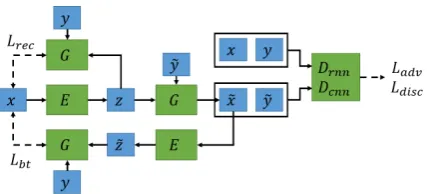
As shown in Figure 1, our model contains an encoder-decoder (E, G) and two discriminators
Dcnn, Drnn. We describe each model architecture
in details.
3.1.1 Encoder-Decoder
Following prior works (Hu et al., 2017; Shen et al.,2017;Yang et al.,2018;Logeswaran et al., 2018), we use a seq-to-seq de-noising encoder-decoder (E, G) with attention mechanism (Bah-danau et al., 2014). For each input sentence x
and attributey˜, the encoderE encodesx to a la-tent codez = E(x), and the decoderGdecodes transferred sentence x˜ = G(z,y)˜ , which can be further back-translated to reconstruct the original sentence. Based on this framework, we design
word-level conditionmodel for better results.
Word-level Condition The most unique com-ponent between our encoder-decoder and previous works is the condition architecture of attributes. Most of style transfer works (Hu et al.,2017;Shen et al., 2017; Logeswaran et al., 2018) treat at-tributesy as part of the initial vector fed into the RNN cell in the decoder, and we argue that the conditioning structure is important to the model performance. In our decoderG, we embedy to a vector and concatenate the vector with the output
htof GRU cell at each time stept. More formally, at each time stept, the hidden statehtand output probabilitiesotare generated as follows:
ht=GRU(ht−1, xt, ct|z)
ot=σ(Wp([y, ht]) +bp)
where GRU denotes a Gated Recurrent Unit (Chung et al., 2015) in decoder G, and ct is
the content vector from the attention mechanism;
Wp, bp denote the projection matrix and bias to map a hidden state to an output vocabulary dis-tribution;σis the softmax function.
3.1.2 Discriminator
Our discriminators take output probability dis-tributions o as inputs along with attribute la-bels y. Formally, for each discriminator D ∈ {Dcnn, Drnn}, the function ofDcan be expressed as:
D(o, y) =fdisc(ftrans(fcond(o, y))).
fcondis a multi-layer perceptron.ftransis either a
bi-directional GRU or a CNN to perform a global feature transform inDcnn, Drnnrespectively. Fi-nally,fdiscis a fully-connected layer with the
sig-moid function to output decisions. For simplicity, we substitutexforoas the input to discriminators in the following description.
3.2 Loss functions
We train our model with reconstruction loss
Lrec, back-translation lossLbt, discrimination loss Ldisc, and adversarial loss Ladv. Lrec and Lbt
force the decoderG to reconstruct the input sen-tencex.Lrec,Lbtare expressed as:
Lrec =−logp(x|z, y),Lbt=−logp(x|z, y)˜ . Ldisc andLadv force the decoder Gto output the
Figure 1: Overview of our model framework. Our model contains an encoder-decoder (E, G), and two discriminatorsDrnn andDcnn. We train our model
with reconstruction loss Lrec, back-translation loss
Lbt, adversarial loss Ladv, and discrimination loss
Ldisc. The dashed arrows describe where the losses
are computed.
The total lossLtotfor our encoder-decoder(E, G)
is a weighted sum ofLrec,Lbt, andLadv.
3.3 Training
We split our training procedure into two phases:
reconstruction andtransfer phase. We first train our encoder-decoder(E, G) with lossLrec in re-construction phase, and then in transfer phase, we use total loss Ltot and Ldisc to train our
encoder-decoder (E, G) and the discriminators
Dcnn, Drnn, respectively. Our experiments show this approach improves content preservation sig-nificantly. A diagram about this two-phase train-ing is provided in AppendixA.1.
4 Experiments Setup
4.1 Datasets
YelpSent Dataset The preprocessed Yelp dataset (Shen et al., 2017) consists of sentences with length limit of 15 words, labeled with either posi-tive or negaposi-tive sentiment as attributes.
AmaProd and AmaSent Dataset Amazon product dataset (He and McAuley, 2016): con-sists of product reviews associated with ratings of the products. We select 4 product types: (books/ movies/ electronics/ CDs), following the approach in (Kim et al.,2017) to select relevant sentences.1 YelpTense Dataset We use similar approach to label sentences with sentiment and past/present tense from Yelp Dataset Challenge2. If a sentence contains at least one verb in past tense, we label it as ‘past tense’; otherwise as ‘present tense’.
1
We refer to dataset labeled with both sentiment and prod-uct attributes asAmaProd Dataset, and dataset labeled only with sentiment attribute asAmaSent Dataset, respectively.
2https://ww.yelp.com/dataset/challenge
All the data statistics are presented in Table5in AppendixA.2.
4.2 Evaluation Metrics
We follow previous works and apply three auto-matic evaluation metrics and one human evalua-tion for three indicative aspects:attribute compat-ibility,content preservation, andfluency.
Attribute Compatibility To measure how well our model transfers sentence attributes, we pre-train a CNN classifier (Kim, 2014) for each attribute category (i.e. product types, sentiments, tenses) on our training data, and use the classifiers to measure the accuracy of transferred sentences associated with the desired attribute. We report the accuracy of each attribute category separately. Content Preservation Measuring content preservation is still an open research problem. Fol-lowing the previous works, we compute the BLEU score (Papineni et al.,2002) used in machine trans-lation. In our experiments, we use self BLEU to evaluate on transferred sentences as a measure-ment of content preservation.
Fluency To test fluency of the generated sen-tences, we train a bi-directional LSTM language model on our training data for each dataset. We regard the perplexity of generated sentences as a measure for fluency.
Human Evaluation We also evaluate the transferred sentences with human assessments. In the evaluation, 8 people are asked to rate sen-tences based on criteria associated with three dif: attribute compatibility, content preservation, and fluency. Each aspect is rated on a 5-point Likert scale. 20 sentences onYelpSentwith correspond-ing transferred sentences are randomly selected as testing examples. More details about our human evaluation are provided in AppendixA.3.
4.3 Comparison with State-Of-The-Arts
We compare with four different State-of-the-Art models: CAAE, DAR, MultiAttr, ContPrev. CAAE (Shen et al., 2017) consists of an auto-encoder with discriminator networks to guide text generation. DAR(Li et al., 2018) uses a delete-and-retrieve approach. 3 MultiAttr (Subrama-nian et al.,2018) performs multiple-attributes style transfer using back-translation (Lample et al.,
3We train DAR with the source code from
2018, 2017;Artetxe et al., 2017) and latent rep-resentation pooling. 4 ContPrev (Logeswaran et al.,2018) is an auto-encoder model with a con-ditional discriminator for multiple attributes trans-fer. Among these models, in our experiments, CAAE and DAR are compared only on polarity sentiment style transfer tasks. More details about our model and training settings are provided in AppendixA.4.
5 Experimental Results
5.1 Quantitative Result
Automatic Evaluation Results Table 1 and Ta-ble2 show the automatic evaluation results. Our model achieves higher BLEU scores and compa-rable transfer accuracy. We also notice that our model generates sentences with higher perplexity, while other models produce sentences with per-plexity lower than the real data.
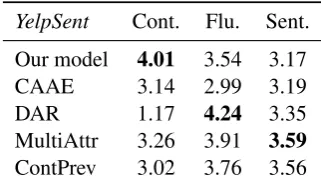
Human Evaluation Results Table 3 exhibits the human evaluation results onYelpSent. The re-sults show that our sentences are evaluated higher on content preservation, and share comparable scores with other models on attribute compatibil-ity.
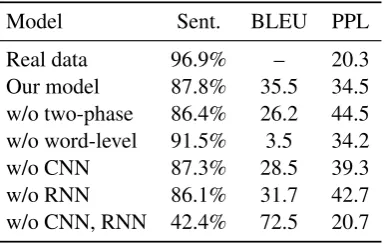
Ablation test We conduct ablation experiments on our model on YelpSentdataset. As the results shown at Table4, removing the word-level condi-tion architecture decreases transfer accuracy and BLEU scores. The two-phase training procedure can also ensure a much higher BLEU scores. Us-ing both CNN and RNN discriminator sightly im-proves the performance on all metrics.
Evaluation Curve We also plot the curves of transfer accuracy, BLEU score and perplexity, re-spectively, on the validation set, as the number of training epochs increases, across different models in Appendix A.5. According to the curves, our model achieves higher BLEU scores and relatively stable performance on all three metrics.
5.2 Qualitative Results
Our model exhibits a tendency to follow the orig-inal sentence surface structure. With the help of word-level conditional architecture, the de-coder learns to make word adjustments. Sam-ple sentences are shown in Tables 7 and 8 in Appendix A.6. For frequent occurring sentence structures across different attribute domains, our
4We re-implement this model with comparable results to
[image:4.595.328.502.100.313.2]the original publication.
Table 1: Polarity sentiment transfer on YelpSent &
AmaSent
YelpSent Sent. BLEU PPL
Real data 96.9% – 20.3
Our model 87.8% 35.5 34.5
CAAE 83.5% 11.5 19.0
DAR 96.3% 0.1 20.6
MultiAttr 86.0% 12.9 8.4
ContPrev 91.3% 14.7 10.5
AmaSent Sent. BLEU PPL
Real data 94.4% – 34.1
Our model 77.5% 24.5 57.4
CAAE 75.4% 5.3 23.7
DAR 83.4% 0.1 37.6
MultiAttr 76.6% 12.7 6.0
ContPrev 72.1% 12.7 17.0
Sent. represents the transfer accuracy measured by the pretrained sentiment-attribute classifier.BLEUandPPL
[image:4.595.310.522.395.552.2]stand for self BLEU and perplexity score, respectively.
Table 2: Multiple attribute transfer on YelpTense &
AmaProd
YelpTense Sent. Tense BLEU PPL
Real data 95.4% 99.9% – 24.5
Our model 79.9% 96.1% 32.2 40.0
MultiAttr 74.5% 91.4% 25.9 8.2
ContPrev 76.6% 94.9% 14.7 13.4
AmaProd Sent. Prod. BLEU PPL
Real data 94.4% 95.6% – 34.1
Our model 76.0% 87.4% 22.4 26.8
MultiAttr 79.9% 90.4% 15.3 7.7
ContPrev 75.8% 81.4% 11.2 17.7
Sent., Tense and Prod. represent the transfer accu-racy measured by the pretrained sentiment-, tense- and product-attribute classifiers, respectively.
Table 3: Human evaluation onYelpSent
YelpSent Cont. Flu. Sent.
Our model 4.01 3.54 3.17
CAAE 3.14 2.99 3.19
DAR 1.17 4.24 3.35
MultiAttr 3.26 3.91 3.59
ContPrev 3.02 3.76 3.56
[image:4.595.335.496.623.716.2]Table 4: Model ablation test onYelpSent
Model Sent. BLEU PPL
Real data 96.9% – 20.3
Our model 87.8% 35.5 34.5
w/o two-phase 86.4% 26.2 44.5
w/o word-level 91.5% 3.5 34.2
w/o CNN 87.3% 28.5 39.3
w/o RNN 86.1% 31.7 42.7
w/o CNN, RNN 42.4% 72.5 20.7
model shows good results. When the original sentence sometimes has a distinct sentence struc-ture and would require multiple editing in a larger scale, our model may not find a correct simi-lar sentence-level surface form adjustment in the target-attribute domain and the word-level local adjustments may sometimes not be coherent.
6 Conclusion
In this paper, we conduct non-parallel style trans-fer among multiple attributes. We propose a seq-to-seq model with word-level condition and two-phase training. The empirical results demonstrate that our model outperforms our competitors in the polarity sentiment transfer task on YelpSent. In multiple attribute transfer tasks, our model also achieves comparable results with the state-of-the-art MultiAttr onYelpTenseandAmaProd. We also analyze our model with ablation tests.
Although our model achieves better content preservation, the general quality of our transferred sentences can be further improved. Also, design-ing proper evaluation metrics is still an open prob-lem for text style transfer. We leave these two questions as the future works.
References
Mikel Artetxe, Gorka Labaka, Eneko Agirre, and Kyunghyun Cho. 2017. Unsupervised neural ma-chine translation. arXiv preprint arXiv:1710.11041.
Dzmitry Bahdanau, Kyunghyun Cho, and Yoshua Ben-gio. 2014. Neural machine translation by jointly learning to align and translate. arXiv preprint arXiv:1409.0473.
Junyoung Chung, Caglar Gulcehre, Kyunghyun Cho, and Yoshua Bengio. 2015. Gated feedback recur-rent neural networks. In International Conference on Machine Learning, pages 2067–2075.
Zhenxin Fu, Xiaoye Tan, Nanyun Peng, Dongyan Zhao, and Rui Yan. 2017. Style transfer in text: Exploration and evaluation. arXiv preprint arXiv:1711.06861.
Ian Goodfellow, Jean Pouget-Abadie, Mehdi Mirza, Bing Xu, David Warde-Farley, Sherjil Ozair, Aaron Courville, and Yoshua Bengio. 2014. Generative ad-versarial nets. In Advances in neural information processing systems, pages 2672–2680.
Ruining He and Julian McAuley. 2016. Ups and downs: Modeling the visual evolution of fashion trends with one-class collaborative filtering. In
proceedings of the 25th international conference on world wide web, pages 507–517. International World Wide Web Conferences Steering Committee.
Zhiting Hu, Zichao Yang, Xiaodan Liang, Ruslan Salakhutdinov, and Eric P Xing. 2017. Toward controlled generation of text. arXiv preprint arXiv:1703.00955.
Yoon Kim. 2014. Convolutional neural net-works for sentence classification. arXiv preprint arXiv:1408.5882.
Yoon Kim, Kelly Zhang, Alexander M Rush, Yann Le-Cun, et al. 2017. Adversarially regularized autoen-coders.arXiv preprint arXiv:1706.04223.
Diederik P Kingma and Jimmy Ba. 2014. Adam: A method for stochastic optimization. arXiv preprint arXiv:1412.6980.
Guillaume Lample, Alexis Conneau, Ludovic Denoyer, and Marc’Aurelio Ranzato. 2017. Unsupervised machine translation using monolingual corpora only.
arXiv preprint arXiv:1711.00043.
Guillaume Lample, Myle Ott, Alexis Conneau, Lu-dovic Denoyer, and Marc’Aurelio Ranzato. 2018. Phrase-based & neural unsupervised machine trans-lation.arXiv preprint arXiv:1804.07755.
Juncen Li, Robin Jia, He He, and Percy Liang. 2018. Delete, retrieve, generate: A simple approach to sentiment and style transfer. arXiv preprint arXiv:1804.06437.
Lajanugen Logeswaran, Honglak Lee, and Samy Ben-gio. 2018. Content preserving text generation with attribute controls. InAdvances in Neural Informa-tion Processing Systems, pages 5108–5118.
Paul Michel and Graham Neubig. 2018. Extreme adap-tation for personalized neural machine translation. In Proceedings of the 56th Annual Meeting of the Association for Computational Linguistics (Volume 2: Short Papers), volume 2, pages 312–318.
Kishore Papineni, Salim Roukos, Todd Ward, and Wei-Jing Zhu. 2002. Bleu: a method for automatic eval-uation of machine translation. In Proceedings of the 40th annual meeting on association for compu-tational linguistics, pages 311–318. Association for Computational Linguistics.
Shrimai Prabhumoye, Yulia Tsvetkov, Ruslan Salakhutdinov, and Alan W Black. 2018. Style transfer through back-translation. In Proceedings of the 56th Annual Meeting of the Association for Computational Linguistics (Volume 1: Long Papers), volume 1, pages 866–876.
Sravana Reddy and Kevin Knight. 2016. Obfuscating gender in social media writing. InProceedings of the First Workshop on NLP and Computational So-cial Science, pages 17–26.
Cicero Nogueira dos Santos, Igor Melnyk, and Inkit Padhi. 2018. Fighting offensive language on social media with unsupervised text style transfer. In Pro-ceedings of the 56th Annual Meeting of the Associa-tion for ComputaAssocia-tional Linguistics (Volume 2: Short Papers), volume 2, pages 189–194.
Rico Sennrich, Barry Haddow, and Alexandra Birch. 2016. Controlling politeness in neural machine translation via side constraints. In Proceedings of the 2016 Conference of the North American Chap-ter of the Association for Computational Linguistics: Human Language Technologies, pages 35–40.
Tianxiao Shen, Tao Lei, Regina Barzilay, and Tommi Jaakkola. 2017. Style transfer from non-parallel text by cross-alignment. InAdvances in Neural Informa-tion Processing Systems, pages 6830–6841.
Sandeep Subramanian, Guillaume Lample, Eric Michael Smith, Ludovic Denoyer, Marc’Aurelio Ranzato, and Y-Lan Boureau. 2018. Multiple-attribute text style transfer. arXiv preprint arXiv:1811.00552.
Jingjing Xu, Xu Sun, Qi Zeng, Xuancheng Ren, Xi-aodong Zhang, Houfeng Wang, and Wenjie Li. 2018. Unpaired sentiment-to-sentiment translation: A cycled reinforcement learning approach. arXiv preprint arXiv:1805.05181.