Two Improvements to Left-to-Right Decoding for Hierarchical
Phrase-based Machine Translation
Maryam Siahbani and Anoop Sarkar
School of Computing Science Simon Fraser University
Burnaby BC. Canada
msiahban,[email protected]
Abstract
Left-to-right (LR) decoding (Watanabe et al., 2006) is promising decoding algorithm for hierarchical phrase-based translation (Hiero) that visits input spans in arbitrary order producing the output translation in left to right order. This leads to far fewer language model calls, but while LR decod-ing is more efficient than CKY decoddecod-ing, it is unable to capture some hierarchical phrase alignments reachable using CKY decoding and suffers from lower transla-tion quality as a result. This paper in-troduces two improvements to LR decod-ing that make it comparable in translation quality to CKY-based Hiero.
1 Introduction
Hierarchical phrase-based translation (Hi-ero) (Chiang, 2007) uses a lexicalized syn-chronous context-free grammar (SCFG) extracted from word and phrase alignments of a bitext. De-coding for Hiero is typically done with CKY-style decoding with time complexity O(n3)for source input with n words. Computing the language model score for each hypothesis within CKY de-coding requires two histories, the left and the right edge of each span, due to the fact that the target side is built inside-out from sub-spans (Heafield et al., 2011; Heafield et al., 2013).
LR-decoding algorithms exist for phrase-based (Koehn, 2004; Galley and Manning, 2010) and syntax-based (Huang and Mi, 2010; Feng et al., 2012) models and also for hierarchical phrase-based models (Watanabe et al., 2006; Siahbani et al., 2013), which is our focus in this paper.
Watanabe et al. (2006) first proposed left-to-right (LR) decoding for Hiero (LR-Hiero hence-forth) which uses beam search and runs inO(n2b) in practice wherenis the length of source sentence andbis the size of beam (Huang and Mi, 2010). To simplify target generation, SCFG rules are
con-strained to be prefix-lexicalized on target side aka Griebach Normal Form (GNF). Throughout this paper we abuse the notation for simplicity and use the term GNF grammars for such SCFGs. This constraint drastically reduces the size of mar for LR-Hiero in comparison to Hiero gram-mar (Siahbani et al., 2013). However, the orig-inal LR-Hiero decoding algorithm does not per-form well in comparison to current state-of-the-art Hiero and phrase-based translation systems. Siah-bani et al. (2013) propose an augmented version of LR decoding to address some limitations in the original LR-Hiero algorithm in terms of transla-tion quality and time efficiency.
Although, LR-Hiero performs much faster than Hiero in decoding and obtains BLEU scores com-parable to phrase-based translation system on some language pairs, there is still a notable gap be-tween CKY-Hiero and LR-Hiero (Siahbani et al., 2013). We show in this paper using instructive ex-amples that CKY-Hiero can capture some complex phrasal re-orderings that are observed in language pairs such as Chinese-English that LR-Hiero can-not (c.f. Sec.3).
We introduce two improvements to LR decod-ing of GNF grammars: (1) We addqueue diversity to the cube pruning algorithm for LR-Hiero, and (2) We extend the LR-Hiero decoder to capture all the hierarchical phrasal alignments that are reach-able in CKY-Hiero (restricted to using GNF gram-mars). We evaluate our modifications on three language pairs and show that LR-Hiero can reach the translation scores comparable to CKY-Hiero in two language pairs, and reduce the gap between Hiero and LR-Hiero on the third one.
2 LR Decoding with Queue Diversity
LR-Hiero uses a constrained lexicalized SCFG which we call a GNF grammar: X → hγ,¯b βi where γ is a string of non-terminal and terminal symbols,¯bis a string of terminal symbols andβis a possibly empty sequence of non-terminals. This ensures that as each rule is used in a derivation,
Algorithm 1: LR-Hiero Decoding 1: Input sentence:f=f0f1. . . fn
2: F=FutureCost(f) (Precompute future cost1for spans) 3: S0={} (Create empty initial stack) 4: h0= (hsi,[[0, n]],∅,F[0,n]) (Initial hypothesis 4-tuple)
5: Addh0toS0 (Push initial hyp into first Stack) 6: fori= 1, . . . , ndo
7: cubeList={} (MRLis max rule length)
8: forp=max(i−MRL,0), . . . , i−1do
9: {G}= Grouped(Sp) (based on the first uncovered
span)
10: forg∈ {G}do 11: [u, v]=gspan
12: R = GetSpanRules([u, v]) 13: forRs∈Rdo
14: cube= [ghyps, Rs]
15: AddcubetocubeList
16: Si= Merge(cubeList,F) (Create stackSiand add
new hypotheses to it, see Figure 1) 17: returnarg max(Sn)
18: Merge(CubeList,F)
19: heapQ={}
20: foreach(H, R)incubeListdo
21: hypList= getBestHypotheses((H, R),F, d) (d
best hypotheses of each cube) 22: foreachh0inhypListdo
23: push(heapQ,(h0
c, h0,[H, R]) (Push new hyp
in queue)
24: hypList={}
25: while|heapQ|>0and|hypList|< Kdo 26: (h0
c, h0,[H, R])= pop(heapQ) (pop the best
hypothesis)
27: push(heapQ, GetNeighbours([H, R]) (Push neighbours to queue)
28: Addh0tohypList
29: returnhypList
the target string is generated from left to right. The rules are obtained from a word and phrase aligned bitext using the rule extraction algorithm in (Watanabe et al., 2006).
LR-Hiero decoding uses a top-down depth-first search, which strictly grows the hypotheses in tar-get surface ordering. Search on the source side follows an Earley-style search (Earley, 1970), the dot jumps around on the source side of the rules based on the order of nonterminals on the target side. This search is integrated with beam search or cube pruning to find thek-best translations.
Algorithm 1 shows the pseudocode for LR-Hiero decoding with cube pruning (Chiang, 2007) (CP). LR-Hiero with CP was introduced in (Siah-bani et al., 2013). In this pseudocode, we have in-troduced the notion ofqueue diversity (explained below). However to understand our change we need to understand the algorithm in more detail.
1The future cost is precomputed in a way similar to the phrase-based models (Koehn et al., 2007) using only the ter-minal rules of the grammar.
9.1 8.2
8.3 8.5 8.05
8.1 8.4
8.6
8.8 8.9
3.2 1.3 0.9
6.6
6.7
6.9
8.9
7.1 8.5 8.7
9.3
9.0
8.1 7.2
1.5 1.3 1.2
6.7
6.8
6.9
...
[image:2.595.324.506.63.164.2]Si
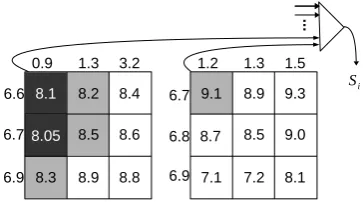
Figure 1: Cubes (grids) are fed to a priority queue (trian-gle) and generated hypotheses are iteratively popped from the queue and added to stackSi. Lower scores are better. Scores
of rules and hypotheses appear on the top and left side of the grids respectively. Shaded entries are hypotheses in the queue and black ones are popped from the queue and added toSi.
Each source side non-terminal is instantiated with the legal spans given the input source string, e.g. if there is a Hiero rulehaX1, a0X1iand ifaonly occurs at position3in the input then this rule can be applied to span[3, i]for alli,4< i≤nfor in-put of lengthnand source sideX1 is instantiated to span[4, i]. A worked out example of how the decoder works is shown in Figure 2. Each partial hypothesis h is a 4-tuple (ht, hs, hcov, hc): con-sisting of a translation prefixht, a (LIFO-ordered) listhsof uncovered spans, source words coverage sethcovand the hypothesis costhc. The initial hy-pothesis is a null string with just a sentence-initial markerhsiand the listhscontaining a span of the whole sentence,[0, n]. The hypotheses are stored in stacksS0, . . . , Sn, whereSp contains hypothe-ses coveringpsource words just like in stack de-coding for phrase-based SMT (Koehn et al., 2003). To fill stackSi we consider hypotheses in each stackSp2, which are first partitioned into a set of groups {G}, based on their first uncovered span (line 9). Each groupgis a 2-tuple(gspan, ghyps), whereghypsis a list of hypotheses which share the same first uncovered spangspan. Rules matching the spangspanare obtained from routine GetSpan-Rules. Eachghyps and possibleRscreate a cube which is added tocubeList.
The Merge routine gets the best hypotheses from all cubes (see Fig.1). Hypotheses (rows) and columns (rules) are sorted based on their scores.
GetBestHypotheses((H, R),F, d)uses current
hypothesisHand ruleRto produce new hypothe-ses. The first best hypothesis, h0 along with its
scoreh0
cand corresponding cube(H, R)is placed in a priority queue heapQ (triangle in Figure 1 and line 23 in Algorithm 1). Iteratively theKbest
rules hypotheses
hsi[0,15] G 1)hT aiguo shi X1/T hailand X1i hsiThailand [2,15] G 2)hyao X1/wants X1i
G 3)hliyong X1/to utilize X1i 4)hzhe bi qian X1/this money X1i
5)hX1zhuru geng duo X2/to inject more X2X1i 6)hliudong X1/circulating X1i
G 7)hzijin X1/capital X1i 8)h./.i
9)hxiang jingji/to the economyi
hsiThailand wants [3,15] hsiThailand wants to utilize [4,15] hsiThailand wants to utilize this money [7,15]
hsiThailand wants to utilize this money to inject more [12,15][7,9] hsiThailand wants to utilize this money to inject more circulating [13,15][7,9] hsiThailand wants to utilize this money to inject more circulating capital [14,15][7,9] hsiThailand wants to utilize this money to inject more circulating capital . [7,9]
[image:3.595.90.513.251.386.2]hsiThailand wants to utilize this money to inject more circulating capital . to the economyh/si
Figure 2: The process of translating the Chinese sentence in Figure 3(b) in LR-Hiero. Left side shows the rules used in the derivation (Gindicates glue rules as defined in (Watanabe et al., 2006)). The hypotheses column shows the translation prefix and the ordered list of yet-to-be-covered spans.
Tā b ch ng shu ,ǔ ō ō liánhé zhèngfǔ mùqián , bìngqiě y u nénglìǒ guànchè .
He added that the coalition government and capable of carrying out the economic reform plan jīngjì g igé jìhuàǎ
is now in stable .
X1
condition zhuàngkuàng wěndìng
0 1 2 3 4 5 6 7 8 9 10 11 12 13 14 15 16 17 18
(a)
Tàiguó shì yào lìyòng zhè bǐ qián xiàng jīngjì zhùrù gèng duō .
Thailand wants to this money to inject more circulating capital to the economy
liúdòng zījīn
utilize .
X1
X2
0 1 2 3 4 5 6 7 8 9 10 11 12 13 14 15
(b)
Figure 3: Two Chinese-English sentence pairs from devset data in experiments. (a) Correct rule cannot be matched to [6,18], our modifications match the rule to the first subspan [6,9] (b) LR-Hiero detects a wrong span forX2 [12,15], we modify the rule matching matchX2to all subspans [12,13], [12,14] and [12,15], corresponding to 3 hypotheses.
hypotheses in the queue are popped (line 26) and for each hypothesis its neighbours in the cube are added to the priority queue (line 27). Decoding finishes when stackSnhas been filled.
The language model (LM) score violates the hypotheses generation assumption of CP and can cause search errors. In Figure 1, the topmost and leftmost entry of the right cube has a score worse than many hypotheses in the left cube due to the LM score. This means the right cube has hypotheses that are ignored. This type of search error hurts LR-Hiero more than CKY-Hiero, due to the fact that hypotheses scores in LR-Hiero rely on a future cost, while CKY-Hiero uses the inside score for each hypothesis. To solve this issue for LR-Hiero we introduce the no-tion of queue diversity which is the parameter d
inGetBestHypotheses((H, R),F, d). This
pa-rameter guarantees that each cube will produce at leastdcandidate hypotheses for the priority queue.
d=1in standard cube pruning for LR-Hiero (Siah-bani et al., 2013). We apply the idea of
diver-sity at queue level, before generatingK best hy-pothesis, such that the GetBestHypotheses rou-tine generates dbest hypotheses from each cube and all these hypotheses are pushed to the prior-ity queue (line 22-23). We fill each stack differ-ently from CKY-Hiero and so queue diversity is different from lazy cube pruning (Pust and Knight, 2009) or cube growing (Huang and Chiang, 2007; Vilar and Ney, 2009; Xu and Koehn, 2012).
3 Capturing Missing Alignments
Figure 3(a) and Figure 3(b) show two examples of a common problem in LR-Hiero decoding. The decoder steps for Figure 3(b) are shown in Fig-ure 2. The problem occurs in Step 5 of FigFig-ure 2 where rule #5 is matched to span [7,15]. Dur-ing decodDur-ing LR-Hiero maintains a stack (last-in-first-out) of yet-to-be-covered spans and tries to translate the first uncovered span (span[7,15]
in Step 5). LR-Hiero should match rule #5 to span[7,15], thereforeX2is forced to match span
[12,15]which leads to the translation of span[7,9]
Corpus Train/Dev/Test Cs-En Europarl(v7) + CzEng(v0.9); News
commentary(nc) 2008&2009; nc 2011 7.95M/3000/3003
De-En Europarl(v7); WMT2006; WMT2006 1.5M/2000/2000
Zh-En HK + GALE phase-1; MTC part 1&3;
MTC part 4 2.3M/1928/919
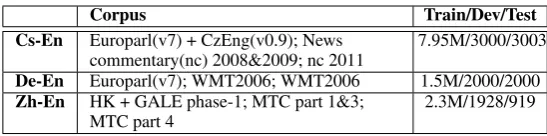
Table 1: Corpus statistics in number of sentences. Tuning and test sets for Chinese-English has 4 references.
Model Cs-En De-En Zh-En
Hiero 20.77 25.72 27.65
LR-Hiero (Watanabe et al., 2006) 20.72 25.10 25.99 LR-Hiero+CP (Siahbani et al., 2013) 20.15 24.83
-LR-Hiero+CP (QD=1) 20.68 25.14 24.44
LR-Hiero+CP (QD=15) - - 26.10
LR-Hiero+CP+(ab) 20.88 25.22 26.55
LR-Hiero+CP+(abc) 20.89 25.22 26.52
(a) BLEU scores for different baselines and modifications of this paper.
QD=15 for Zh-En in last three rows. (b) Average number of language model queries. Table 2: (a) BLEU (b) LM calls
causing the incorrect translation in Step 9. If we use the same set of rules for translation in Hi-ero (CKY-based decoder), the decoder is able to generate the correct translation for span[7,14](it works bottom-up and generate best translation for each source span). Then it combines translation of
[7,14]with translation of spans[0,7]and[14,15]
using glue rules (monotonic combination). In Figure 3(a) monotonic translations after span
[6,9] are out of reach of the LR-Hiero decoder which has to use the non-terminals to support the reordering within span [6,9]. In this exam-ple the first few phrases are translated monoton-ically, then for span[6,18]we have to apply rule hmuqianX1 wending,is now in stableX1ito ob-tain the correct translation. But this rule cannot be matched to span [6,18] and the decoder fails to generate the correct translation. While CKY-Hiero can apply this rule to span [6,9], generate correct translation for this span and monotonically combine it with translation of other spans ([0,6],
[9,18]).
In both these cases, CKY-Hiero has no diffi-culty in reaching the target sentencewith the same GNF rules. The fact that we have to process spans as they appear in the stack in LR-Hiero means that we cannot combine arbitrary adjacent spans to deal with such cases. So purely bottom-up de-coders such as CKY-Hiero can capture the align-ments in Figure 3 but LR-Hiero cannot.
We extend the LR-Hiero decoder to handle such cases by making the GNF grammar more expres-sive. Rules are partitioned to three types based on
the right boundary in the source and target side. The rhs after the⇒shows the new rules we create within the decoder using a new non-terminal Xr to match the right boundary.
(a) hγ¯a,¯bβi ⇒ hγ¯aXr,¯bβXri
(b) hγXn,¯bβXni ⇒ hγXnXr,¯bβXnXri (c) hγXn,¯bβXmi ⇒ hγXnXr,¯bβXmXri
(1)
whereγis a string of terminals and non-terminals,
¯
aand¯bare terminal sequences of source and tar-get respectively, β is a possibly empty sequence of non-terminals and Xn and Xm are different non-terminals distinct from Xr3. The extra non-terminalXr lets us add a new yet-to-be-covered span to the bottom of the stack at each rule appli-cation which lets us match any two adjacent spans just as in CKY-Hiero. This captures the missing alignments that could not be previously captured in the LR-Hiero decoder4.
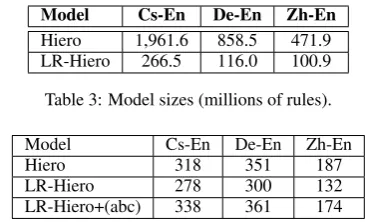
In Table 4 we translated devset sentences using forced decoding to show that our modifications to LR-Hiero in this section improves the alignment coverage when compared to CKY-Hiero.
4 Experiments
We evaluate our modifications to LR-Hiero de-coder on three language pairs (Table 1): German-English (De-En), Czech-German-English (Cs-En) and Chinese-English (Zh-En).
3In rule type (c)X
nwill be inβandXmwill be inγ.
4For the sake of simplicity, in rule type (b) we can merge XnandXras they are in the same order on both source and
[image:4.595.161.435.60.128.2]We use a 5-gram LM trained on the Gigaword corpus and use KenLM (Heafield, 2011). We tune weights by minimizing BLEU loss on the dev set through MERT (Och, 2003) and report BLEU scores on the test set. Pop limit for Hiero and LR-Hiero+CP is 500 and beam size LR-Hiero is 500. Other extraction and decoder settings such as max-imum phrase length, etc. were identical across set-tings. To make the results comparable we use the same feature set for all baselines, Hiero as well (including new features proposed by (Siahbani et al., 2013)).
We use 3 baselines: (i) our implementation of (Watanabe et al., 2006): LR-Hiero with beam search (LR-Hiero) and (ii) LR-Hiero with cube pruning (Siahbani et al., 2013): (LR-Hiero+CP); and (iii) Kriya, an open-source implementation of Hiero in Python, which performs comparably to other open-source Hiero systems (Sankaran et al., 2012).
Table 3 shows model sizes for LR-Hiero (GNF) and Hiero (SCFG). Typical Hiero rule extraction excludes phrase-pairs with unaligned words on boundaries (loose phrases). We use similar rule extraction as Hiero, except that exclude non-GNF rules and include loose phrase-pairs as terminal rules.
Table 2a shows the translation quality of dif-ferent systems in terms of BLEU score. Row 3 is from (Siahbani et al., 2013)5. As we
dis-cussed in Section 2, LR-Hiero+CP suffers from severe search errors on Zh-En (1.5 BLEU) but us-ing queue diversity (QD=15) we fill this gap. We use the same QD(=15) in next rows for Zh-en. For Cs-En and De-En we use regular cube prun-ing (QD=1), as it works as well as beam search (compare rows 4 and 2).
We measure the benefit of the new modified rules from Section 3: (ab): adding modifications for rules type (a) and (b); (abc): modification of all rules. We can see that for all language pairs (ab) constantly improves performance of LR-Hiero, significantly better than LR-Hiero+CP and LR-Hiero (p-value<0.05) on Cs-En and Zh-En, evaluated by MultEval (Clark et al., 2011). But modifying rule type (c) does not show any im-provement due to spurious ambiguity created by
5We report results on Cs-En and De-En in (Siahbani et al., 2013). Row 4 is the same translation system as row 3 (LR-Hiero+CP). We achieve better results than our previous work (Siahbani et al., 2013) (row 4 vs. row 3) due to bug corrections and adding loose phrases as terminal rules.
Model Cs-En De-En Zh-En
[image:5.595.322.505.60.171.2]Hiero 1,961.6 858.5 471.9 LR-Hiero 266.5 116.0 100.9 Table 3: Model sizes (millions of rules).
Model Cs-En De-En Zh-En
Hiero 318 351 187
LR-Hiero 278 300 132
[image:5.595.326.505.126.170.2]LR-Hiero+(abc) 338 361 174
Table 4: No. of sentence covered in forced decoding of a sam-ple of sentences from the devset. We improve the coverage by 31% for Chinese-English and more than 20% for the other two language pairs.
type (c) rules.
Figure 2b shows the results in terms of average number of language model queries on a sample set of 50 sentences from test sets. All of the base-lines use the same wrapper to KenLM (Heafield, 2011) to query the language model, and we have instrumented the wrapper to count the statistics. In (Siahbani et al., 2013) we discuss that LR-Hiero with beam search (Watanabe et al., 2006) does not perform at the same level of state-of-the-art Hi-ero (more LM calls and less translation quality). As we can see in this figure, adding new mod-ified rules slightly increases the number of lan-guage model queries on Cs-En and De-En so that LR-Hiero+CP still works 2 to 3 times faster than Hiero. On Zh-En, LR-Hiero+CP applies queue diversity (QD=15) which reduces search errors and improves translation quality but increases the number of hypothesis generation as well. LR-Hiero+CP with our modifications works substan-tially faster than LR-Hiero while obtain signifi-cantly better translation quality on Zh-En.
Comparing Table 2a with Figure 2b we can see that overall our modifications to LR-Hiero decoder significantly improves the BLEU scores compared to previous LR decoders for Hiero. We obtain comparable results to CKY-Hiero for Cs-En and De-En and remarkably improve results on Zh-En, while at the same time making 2 to 3 times less LM calls on Cs-En and De-En compared to CKY-Hiero.
Acknowledgments
References
David Chiang. 2007. Hierarchical phrase-based
trans-lation. Computational Linguistics, 33.
Jonathan H. Clark, Chris Dyer, Alon Lavie, and Noah A. Smith. 2011. Better hypothesis testing for statistical machine translation: controlling for
opti-mizer instability. InProceedings of the 49th Annual
Meeting of the Association for Computational Lin-guistics: Human Language Technologies: short pa-pers - Volume 2, HLT ’11, pages 176–181, Strouds-burg, PA, USA. Association for Computational Lin-guistics.
Jay Earley. 1970. An efficient context-free parsing
al-gorithm. Commun. ACM, 13(2):94–102, February.
Yang Feng, Yang Liu, Qun Liu, and Trevor Cohn. 2012. Left-to-right tree-to-string decoding with
pre-diction. InProceedings of the 2012 Joint
Confer-ence on Empirical Methods in Natural Language Processing and Computational Natural Language Learning, EMNLP-CoNLL ’12, pages 1191–1200, Stroudsburg, PA, USA. Association for Computa-tional Linguistics.
Michel Galley and Christopher D. Manning. 2010. Accurate non-hierarchical phrase-based translation. In Human Language Technologies: The 2010 An-nual Conference of the North American Chapter of the Association for Computational Linguistics, pages 966–974, Los Angeles, California, June. As-sociation for Computational Linguistics.
Kenneth Heafield, Hieu Hoang, Philipp Koehn, Tet-suo Kiso, and Marcello Federico. 2011. Left lan-guage model state for syntactic machine translation. In Proceedings of the International Workshop on Spoken Language Translation, pages 183–190, San Francisco, California, USA, 12.
Kenneth Heafield, Philipp Koehn, and Alon Lavie. 2013. Grouping language model boundary words to speed K-Best extraction from hypergraphs. In
Proceedings of the 2013 Conference of the North American Chapter of the Association for Computa-tional Linguistics: Human Language Technologies, Atlanta, Georgia, USA, 6.
Kenneth Heafield. 2011. KenLM: Faster and smaller
language model queries. In In Proc. of the Sixth
Workshop on Statistical Machine Translation.
Liang Huang and David Chiang. 2007. Forest rescor-ing: Faster decoding with integrated language
mod-els. InIn ACL 07.
Liang Huang and Haitao Mi. 2010. Efficient incre-mental decoding for tree-to-string translation. In
Proceedings of the 2010 Conference on Empirical Methods in Natural Language Processing, pages 273–283, Cambridge, MA, October. Association for Computational Linguistics.
Philipp Koehn, Franz Josef Och, and Daniel Marcu.
2003. Statistical phrase-based translation. InProc.
of NAACL.
Philipp Koehn, Hieu Hoang, Alexandra Birch, Chris Callison-Burch, Marcello Federico, Nicola Bertoldi, Brooke Cowan, Wade Shen, Christine Moran, Richard Zens, Chris Dyer, Ondˇrej Bojar, Alexandra Constantin, and Evan Herbst. 2007. Moses: open source toolkit for statistical machine translation. In
Proceedings of the 45th Annual Meeting of the ACL on Interactive Poster and Demonstration Sessions, ACL ’07, pages 177–180, Stroudsburg, PA, USA. Association for Computational Linguistics.
Philipp Koehn. 2004. Pharaoh: A beam search de-coder for phrase-based statistical machine
transla-tion models. InAMTA, pages 115–124.
Franz Josef Och. 2003. Minimum error rate training in
statistical machine translation. InProceedings of the
41st Annual Meeting on Association for Computa-tional Linguistics - Volume 1, ACL ’03, pages 160– 167, Stroudsburg, PA, USA. Association for Com-putational Linguistics.
Michael Pust and Kevin Knight. 2009. Faster mt
decoding through pervasive laziness. In
Proceed-ings of Human Language Technologies: The 2009 Annual Conference of the North American Chap-ter of the Association for Computational Linguistics, Companion Volume: Short Papers, pages 141–144, Boulder, Colorado, June. Association for Computa-tional Linguistics.
Baskaran Sankaran, Majid Razmara, and Anoop Sarkar. 2012. Kriya - an end-to-end
hierarchi-cal phrase-based mt system. The Prague Bulletin
of Mathematical Linguistics (PBML), 97(97):83–98, apr.
Maryam Siahbani, Baskaran Sankaran, and Anoop Sarkar. 2013. Efficient left-to-right hierarchical phrase-based translation with improved reordering. InProceedings of the 2013 Conference on Empirical Methods in Natural Language Processing, Seattle, USA, October. Association for Computational Lin-guistics.
David Vilar and Hermann Ney. 2009. On lm
heuris-tics for the cube growing algorithm. InAnnual
Con-ference of the European Association for Machine Translation, pages 242–249, Barcelona, Spain, may. Taro Watanabe, Hajime Tsukada, and Hideki Isozaki. 2006. Left-to-right target generation for hierarchical
phrase-based translation. InProc. of ACL.
Wenduan Xu and Philipp Koehn. 2012. Extending
hi-ero decoding in moses with cube growing. Prague