Modeling Biological Processes for Reading Comprehension
Jonathan Berant∗, Vivek Srikumar∗, Pei-Chun Chen, Brad Huang and Christopher D. Manning
Stanford University, Stanford
Abby Vander Linden and Brittany Harding
University of Washington, Seattle
Peter Clark
Allen Institute for Artificial Intelligence, Seattle
Abstract
Machine reading calls for programs that read and understand text, but most current work only attempts to extract facts from redundant web-scale corpora. In this pa-per, we focus on a new reading compre-hension task that requires complex reason-ing over a sreason-ingle document. The input is a paragraph describing a biological pro-cess, and the goal is to answer questions that require an understanding of the re-lations between entities and events in the process. To answer the questions, we first predict a rich structure representing the process in the paragraph. Then, we map the question to a formal query, which is executed against the predicted structure. We demonstrate that answering questions via predicted structures substantially im-proves accuracy over baselines that use shallower representations.
1 Introduction
The goal of machine reading is to develop pro-grams that read text to learn about the world and make decisions based on accumulated knowl-edge. Work in this field has focused mostly on macro-reading, i.e., processing large text collec-tions and extracting knowledge bases of facts (Et-zioni et al., 2006; Carlson et al., 2010; Fader et al., 2011). Such methods rely on redundancy, and are thus suitable for answering common factoid ques-tions which have ample evidence in text (Fader et al., 2013). However, reading a single document (micro-reading) to answer comprehension ques-tions that require deep reasoning is currently be-yond the scope of state-of-the-art systems.
In this paper, we introduce a task where given a paragraph describing a process, the goal is to
∗
Both authors equally contributed to the paper.
answer reading comprehension questions that test understanding of the underlying structure. In par-ticular, we consider processes in biology text-books such as this excerpt and the question that follows:
“. . .Water is split, providing a source of elec-trons and protons (hydrogen ions, H+) and
giv-ing off O2 as a by-product. Light absorbedby
chlorophyll drives atransfer of the electrons and hydrogen ionsfrom water to an acceptor called NADP+. . . ”
Q What can the splitting of water lead to?
a Light absorption
b Transfer of ions
This excerpt describes a process in which a com-plex set of events and entities are related to one another. A system trying to answer this ques-tion must extract a rich structure spanning multi-ple sentences and reason thatwater splitting com-bined with light absorption leads to transfer of ions. Note that shallow methods, which rely on lexical overlap or text proximity, will fail. Indeed, both answers are covered by the paragraph and the wrong answer is closer in the text to the question.
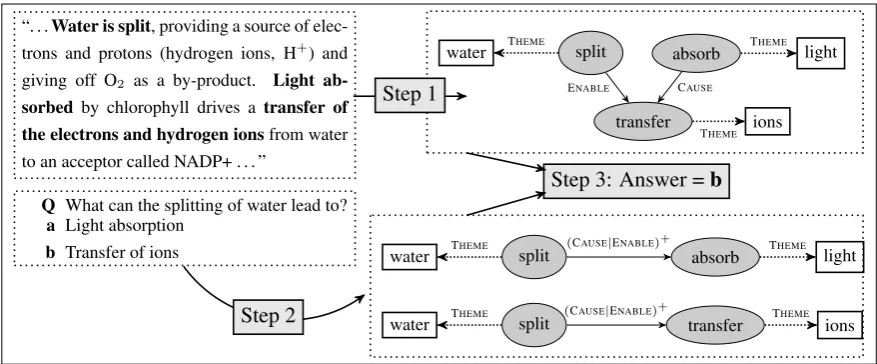
We propose a novel method that tackles this challenging problem (see Figure 1). First, we train a supervised structure predictor that learns to ex-tract entities, events and their relations describing the biological process. This is a difficult prob-lem because events have complex interactions that span multiple sentences. Then, treating this struc-ture as a small knowledge-base, we map ques-tions to formal queries that are executed against the structure to provide the answer.
“. . .Water is split, providing a source of elec-trons and protons (hydrogen ions, H+) and
giving off O2 as a by-product. Light ab-sorbedby chlorophyll drives a transfer of the electrons and hydrogen ionsfrom water to an acceptor called NADP+ . . . ”
Q What can the splitting of water lead to?
a Light absorption
b Transfer of ions
water THEME split absorb THEME light
transfer ions
THEME
ENABLE CAUSE
water THEME split (C absorb light
AUSE|ENABLE)+ THEME
water T split transfer ions
HEME (CAUSE|ENABLE)+ THEME
Step 1
Step 2
[image:2.595.79.518.61.243.2]Step 3: Answer =b
Figure 1: An overview of our reading comprehension system. First, we predict a structure from the input paragraph (the top right portion shows a partial structure skipping some arguments for brevity). Circles denote events, squares denote argu-ments, solid arrows represent event-event relations, and dashed arrows represent event-argument relations. Second, we map the question paired with each answer into a query that will be answered using the structure. The bottom right shows the query representation. Last, the two queries are executed against the structure, and a final answer is returned.
domain, processes are abundant in domains such as chemistry, economics, manufacturing, and even everyday events like shopping or cooking, and our model can be applied to these domains as well.
The contributions of this paper are:
1. We propose a reading comprehension task which requires deep reasoning over struc-tures that represent complex relations be-tween multiple events and entities.
2. We present PROCESSBANK, a new dataset consisting of descriptions of biological pro-cesses, fully-annotated with rich process structures, and accompanied by multiple-choice questions.
3. We present a novel method for answer-ing questions, by predictanswer-ing process struc-tures and mapping questions to queries. We demonstrate that by predicting structures we can improve reading comprehension accu-racy over baselines that do not exploit the un-derlying structure.
The data and code for this paper are avail-able at http://www-nlp.stanford.edu/
software/bioprocess.
2 Task Definition and Setup
This section describes the reading comprehension task we address and the accompanying dataset. We will use the example in Figure 1 as our run-ning example throughout the paper.
Our goal is to tackle a complex reading com-prehension setting that centers on understanding
the underlying meaning of a process description. We target a multiple-choice setting in which each input consists of a paragraph of text describing a biological process, a question, and two possible answers. The goal is to identify the correct answer using the text (Figure 1, left). We used the 148 paragraphs from the textbookBiology(Campbell and Reece, 2005) that were manually identified by Scaria et al. (2013). We extended this set to 200 paragraphs by including additional paragraphs that describe biological processes. Each paragraph in the collection represents a single biological pro-cess and describes a set of events, their partici-pants and their interactions.
Because we target understanding of paragraph meaning, we use the following desiderata for building the corpus of questions and answers:
1. The questions should focus on the events and entities participating in the process described in the paragraph, and answering the questions should require reasoning about the relations between those events and entities.
2. Both answers should have similar lexical overlap with the paragraph. Moreover, names of entities and events in the question and an-swers should appear as in the paragraph and not using synonyms. This is to ensure that the task revolves around reading comprehension rather than lexical variability.1
A biologist created the question-answer part of
1Lexical variability is an important problem in NLP, but
the corpus comprising of 585 questions spread over the 200 paragraphs. A second annotator val-idated 326 randomly chosen questions and agreed on the correct answer with the first annotator in 98.1% of cases. We provide the annotation guide-lines in the supplementary material.
Figure 1 (left) shows an excerpt of a paragraph describing a process and an example of a ques-tion based on it. In general, quesques-tions test an un-derstanding of the interactions between multiple events (such as causality, inhibition, temporal or-dering), or between events and entities (i.e., roles of entities in events), and require complex reason-ing about chains of event-event and event-entity relations.
3 The Structure of Processes
A natural first step for answering reading compre-hension questions is to identify a structured rep-resentation of the text. In this section, we define this structure. We broadly follow the definition of Scaria et al. (2013), but modify important aspects, highlighted at the end of this section.
A paragraph describing a process is a sequence of tokens that describes events, entities and their relations (see Figure 1, top right). A process is a directed graph(T,A,Ett,Eta), where the nodes
T are labeled event triggers, the nodes Aare ar-guments, Ett are labeled edges describing
event-event relations, and Eta are labeled edges from
triggers to arguments denoting semantic roles (see Figure 1 top right for a partial structure of the run-ning example). The goal of process extraction is to generate the process graph given the input para-graph.
Triggers and arguments A trigger is a token span denoting the occurrence of an event. In Fig-ure 1, split, absorbedandtransferare event trig-gers. In rare cases, a trigger denotes the non-occurrence of an event. For example, in “sym-patric speciation can occur when gene flow is blocked”,sympatric speciationoccurs ifgene flow
doesnothappen. Thus, nodes inT are labeled as either a T-YESor T-NOto distinguish triggers of events that occur from triggers of events that do not occur. Arguments are token spans denoting entities that participate in the process (such as wa-ter,lightandionsin Figure 1).
Semantic roles The edges Eta from triggers
to arguments are labeled by the semantic roles
AGENT, THEME, SOURCE, DESTINATION, LO
-CATION, RESULT, and OTHERfor all other roles. Our running example shows three THEME seman-tic roles for the three triggers. For brevity, the fig-ure does not show the RESULTof the eventsplit, namely, bothsource of electrons and protons (hy-drogen ions, H+)andO2.
Event-event relations The directed edges Ett
between triggers are labeled by one of eight pos-sible event-event relations. These relations are central to answering reading comprehension ques-tions, which test understanding of the depen-dencies and causal relations between the process events. We first define three relations that express a dependency between two event triggersuandv.
1. CAUSEdenotes thatu starts beforev, and if uhappens thenvhappens (Figure 1).
2. ENABLE denotes that u creates conditions
necessary for the occurrence of v. This means thatu starts before v andv can only happen ifuhappens (Figure 1).2
3. PREVENTdenotes thatustarts before v and ifuhappens, thenvdoes not happen.
In processes, events sometimes depend on more than one other event. For example, in Figure 1 (right top)transfer of ionsdepends on bothwater splittingas well as light absorption. Conversely, in Figure 2, theshiftingevent results in either one of two events but not both. To express both con-junctions and discon-junctions of related events we add the relations CAUSE-OR, ENABLE-OR and PREVENT-OR, which express disjunctions, while
the default CAUSE, ENABLE, and PREVENT ex-press conjunction (Compare the CAUSE-OR rela-tions in Figure 2 with the relarela-tions in Figure 1).
We define the SUPER relation to denote that event u is part of event v. (In Figure 2, slip-page is a sub-event ofreplication.) Last, we use the event coreference relation SAMEto denote two event mentions referring to the same event.
Notice that the assignments of relation labels in-teract across different pairs of events. As an ex-ample, if event u causes event v, then v can not causeu. Our inference algorithm uses such struc-tural constraints when predicting process structure (Section 4).
2In this work, we do not distinguish causation from
Figure 2: Partial example of a process, as annotated in our dataset.
Avg Min Max
# of triggers 7.0 2 18 # of arguments 11.3 1 36 # of relation 7.9 1 37
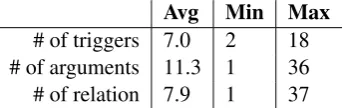
Table 1: Statistics of triggers, arguments and rela-tions over the 200 annotated paragraphs.
Three biologists annotated the same 200 para-graphs described in Section 2 using the brat anno-tation tool (Stenetorp et al., 2012). For each para-graph, one annotator annotated the process, and a second validated its correctness. Importantly, the questions and answers were authored sepa-rately by a different annotator, thus ensuring that the questions and answers are independent from the annotated structures. Table 1 gives statistics over the dataset. The annotation guidelines are in-cluded in the supplementary material.
Relation to Scaria et al. (2013) Scaria et al. (2013) also defined processes as graphs where nodes are events and edges describe event-event relations. Our definition differs in a few important aspects.
First, the set of event-event relations in that work included temporal relations in addition to causal ones. In this work, we posit that because events in a process are inter-related, causal depen-dencies are sufficient to capture the relevant tem-poral ordering between them. Figure 1 illustrates this phenomenon, where the temporal ordering be-tween the events ofwater splitting and light ab-sorptionis unspecified. It does not matter whether one happens before, during, or after the other. Fur-thermore, the incoming causal links totransfer im-ply that the event should happen aftersplittingand
absorption.
A second difference is that Scaria et al. (2013) do not include disjunctions and conjunctions of events in their formulation. Last, Scaria et al.
(2013) predict only relations given input triggers, while we predict a full process structure.
4 Predicting Process Structures
We now describe the first step of our algorithm. Given an input paragraph we predict events, their arguments and event-event relations (Figure 1, top). We decompose this into three sub-problems: 1. Labeling trigger candidates using a
multi-class multi-classifier (Section 4.1).
2. For each trigger, identifying an over-complete set of possible arguments, using a classifier tuned for high recall (Section 4.2). 3. Jointly assigning argument labels and
rela-tion labels for all trigger pairs (Secrela-tion 4.3). The event-event relations CAUSE, ENABLE, CAUSE-OR and ENABLE-OR, form a semantic cluster: If (u, v) is labeled by one of these, then the occurrence ofvdepends on the occurrence of u. Since our dataset is small, we share statistics by collapsing all four labels to a single ENABLE la-bel. Similarly, we collapse the PREVENT and
PREVENT-ORlabels, overall reducing the number of relations to four.
For brevity, in what follows we only provide a flavor of the features we extract, and refer the reader to the supplementary material for details.
4.1 Predicting Event Triggers
The first step is to identify the events in the pro-cess. We model the trigger detector as a multi-class multi-classifier that labels all content words in the paragraph as one of T-YES, T-NO or NOT -TRIGGER (Recall that a word can trigger an event
[image:4.595.96.268.208.262.2]the lemma and POS tag of the word and adja-cent words, dependency path to the root, POS tag of children and parent in the dependency tree, and clustering features from WordNet (Fellbaum, 1998), Nomlex (Macleod et al., 1998), Levin verb classes (Levin, 1993), and a list of biological pro-cesses compiled from Wikipedia.
4.2 Filtering Argument Candidates
Labeling trigger-argument edges is similar to se-mantic role labeling. Following the standard ap-proach (Punyakanok et al., 2008), for each trigger we collect all constituents in the same sentence to build an over-complete set of plausible candidate arguments. This set is pruned with a binary classi-fier that is tuned for high recall (akin to the argu-ment identifier in SRL systems). On the develop-ment set we filter more than half of the argudevelop-ment candidates, while achieving more than 99% recall. This classifier is trained using argument identifica-tion features from Punyakanok et al. (2008).
At the end of this step, each trigger has a set of candidate arguments which will be labeled during joint inference. In further discussion, the argument candidates for triggertare denoted byAt.
4.3 Predicting Arguments and Relations
Given the output of the trigger classifier, our goal is to jointly predict argument and event-event relations. We model this as an integer linear program (ILP) instance described below. We first describe the inference setup assuming a model that scores inference decisions and defer description of learning to Section 4.4. The ILP has two types of decision variables: arguments and relations.
Argument variables These variables capture the decision that a candidate argumenta, belong-ing to the setAt of argument candidates, takes a
labelA(from Section 3). We denote the Boolean variables by yt,a,A, which are assigned a score
bt,a,Aby the model. We include an additional label
NULL-ARG, indicating that the candidate is not an
argument for the trigger.
Event-event relation variables These variables capture the decision that a pair of triggers t1 and
t2are connected by a directed edge (t1,t2) labeled
by the relation R. We denote these variables by zt1,t2,R, which are associated with a scorect1,t2,R. Again, we introduce a labelNULL-REL to indicate triggers that are not connected by an edge.
Name Description
Unique labels Every argument candidate and trigger pair has ex-actly one label.
Argument overlap Two arguments of the same trigger cannot overlap. Relation symmetry The SAME relation is symmetric. All other retions are anti-symmetric, i.e., for any relation la-bel other than SAME, at most one of(ti, tj)or (tj, ti)can take that label and the other is assigned the labelNULL-REL.
Max arguments per trigger
Every trigger can have no more than two arguments with the same label.
Max triggers per ar-gument
The same span of text can not be an argument for more than two triggers.
Connectivity The triggers must form a connected graph, framed as flow constraints as in Magnanti and Wolsey (1995) and Martins et al. (2009).
Shared arguments If the same span of text is an argument of two trig-gers, then the triggers must be connected by a rela-tion that is notNULL-REL. This ensures that trig-gers that share arguments are related.
[image:5.595.308.530.62.240.2]Unique parent For any trigger, at most one outgoing edge can be labeled SUPER.
Table 2:Constraints for joint inference.
Formulation Given the two sets of variables, the objective of inference is to find a global as-signment that maximizes the score. That is, the objective can be stated as follows:
max
y,z X
t,a∈At,A
bt,a,A·yt,a,A+
X
t1,t2,R
ct1,t2,R·zt1,t2,R
Here,yandz refer to all the argument and rela-tion variables respectively.
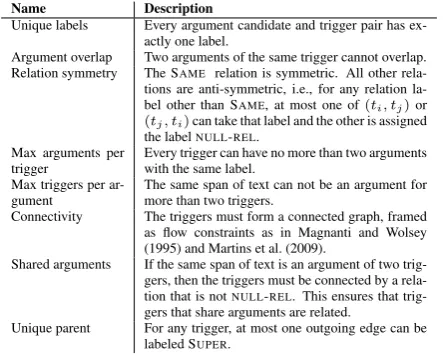
Clearly, all possible assignments to the infer-ence variables are not feasible and there are both structural as well as prior knowledge constraints over the output space. Table 2 states the con-straints we include, which are expressed as linear inequalities over output variables using standard techniques (e.g., (Roth and Yih, 2004)).
4.4 Learning in the Joint Model
We train both the trigger classifier and the argu-ment identifier using L2-regularized logistic
re-gression. For the joint model, we use a linear model for the scoring functions, and train jointly using the structured averaged perceptron algo-rithm (Collins, 2002).
5 Question Answering via Structures
This section describes our question answering sys-tem that, given a process structure, a question and two answers, chooses the correct answer (steps 2 and 3 in Figure 1).
Our strategy is to treat the process structure as a small knowledge-base. We map each answer along with the question into astructured querythat we compare against the structure. The query can prove either the correctness or incorrectness of the answer being considered. That is, either we get a valid match for an answer (proving that the cor-responding answer is correct), or we get a refu-tation in the form of a contradicted causal chain (thus proving that the other answer is correct). This is similar to theorem proving approaches sug-gested in the past for factoid question answering (Moldovan et al., 2003).
The rest of this section is divided into three parts: Section 5.1 defines the queries we use, Sec-tion 5.2 describes a rule-based algorithm for con-verting a question and an answer into a query and finally, 5.3 describes the overall algorithm.
5.1 Queries over Processes
We model a query as a directed graph path with regular expressions over edge labels. The bot-tom right portion of Figure 1 shows examples of queries for our running example. In general, given a question and one of the answer candidates, one end of the path is populated by a trigger/argument found in the question and the other is populated with a trigger/ argument from the answer.
We define a query to consist of three parts: 1. A regular expression over relation labels,
de-scribing permissible paths,
2. A source trigger/argument node, and 3. A target trigger/argument node.
For example, the bottom query in Figure 1 looks for paths labeled with CAUSE or ENABLE edges from the eventsplitto the eventtransfer.
Note that the representation of questions as di-rected paths is a modeling choice and did not influ-ence the authoring of the questions. Indeed, while most questions do fit this model, there are rare cases that require a more complex query structure.
5.2 Query Generation
Mapping a question and an answer into a query involves identifying the components of the query listed above. We do this in two phases: (1) In the
alignment phase, we align triggers and arguments in the question and answer to the process structure to give us candidate source and target nodes. (2) In the query construction phase, we identify the regular expression and the direction of the query using the question, the answer and the alignment.
We identify three broad categories of QA pairs (see Table 3) that can be identified using simple lexical rules: (a)Dependency questionsask which event or argument depends on another event or ar-gument, (b)Temporal questionsask about tempo-ral ordering of events, and (c)True-false questions
ask whether some fact is true. Below, we describe the two phases of query generation primarily in the context of dependency questions with a brief dis-cussion about temporal and true-false questions at the end of the section.
Alignment Phase We align triggers in the struc-ture to the question and the answer by matching lemmas or nominalizations. In case of multiple matches, we use the context to disambiguate and resolve ties using the highest matching candidate in the syntactic dependency tree.
We align arguments in the question and the an-swer in a similar manner. Since arguments are typically several words long, we prefer maximal spans. Additionally, if a question (or an answer) contains an aligned trigger, we prefer to align words to its arguments.
Query Construction Phase We construct a query using the aligned question and answer trig-gers/arguments. We will explain query construc-tion using our running example (reproduced as the dependency question in Table 3).
Type Example # (%)
Dependency Q: What can the splitting of water lead to? 407 (69.57%)
a: Light absorption
b: Transfer of ions
Temporal Q: What is the correct order of events? 57 (9.74%)
a: PDGF binds to tyrosine kinases, then cells divide, then wound healing
b: Cells divide, then PDGF binds to tyrosine kinases, then wound healing
True-False Q: Cdk associates with MPF to become cyclin 121 (20.68%)
a: True
[image:7.595.96.504.62.172.2]b: False
Table 3:Examples and statistics for each of the three coarse types of questions.
Is main verb trigger?
Condition Regular Exp. Wh-word subjective? AGENT
Wh-word object? THEME
Condition Regular Exp. default (ENABLE|SUPER)+
DIRECT (ENABLE|SUPER)
PREVENT (ENABLE|SUPER)∗PREVENT(ENABLE|SUPER)∗
Yes No
Figure 3: Rules for determining the regular expressions for queries concerning two triggers. In each table, thecondition
column decides the regular expression to be chosen. In the left table, we make the choice based on the path from the root to theWh-word in the question. In the right table, if the worddirectlymodifies the main trigger, theDIRECTregular expression is chosen. If the main verb in the question is in the synset ofprevent,inhibit,stoporprohibit, we select thePREVENTregular expression. Otherwise, the default one is chosen. We omit the relation label SAME from the expressions, but allow going through any number of edges labeled by SAMEwhen matching expressions to the structure.
that we expand using WordNet.
The final step in constructing the query is to identify the regular expression for the path con-necting the source and the target. Due to paucity of data, we do not map a question and an answer to arbitrary regular expressions. Instead, we con-struct a small set of regular expressions, and build a rule-based system that selects one. We used the training set to construct the regular expressions and we found that they answer most questions (see Section 6.4). We determine the regular expression based on whether the main verb in the sentence is a trigger and whether the source and target of the path are triggers or arguments. Figure 3 shows the possible regular expressions and the procedure for choosing one when both the source and target are triggers. If either of them are argument nodes, we append the appropriate semantic role to the regu-lar expression, based on whether the argument is the source or the target of the path (or both).
True-false questions are treated similarly, ex-cept that both source and target are chosen from the question. For temporal questions, we seek to identify the ordering of events in the answers. We use the keywordsfirst,then, orsimultaneously to identify the implied order in the answer. We use the regular expression SUPER+for questions ask-ing about simultaneous events and ENABLE+ for those asking about sequential events.
5.3 Answering Questions
We match the query of an answer to the process structure to identify the answer. In case of a match, the corresponding answer is chosen. The matching path can be thought of as aprooffor the answer.
If neither query matches the graph (or both do), we check if either answer contradicts the struc-ture. To do so, we find an undirected path from the source to the target. In the event of a match, if the matching path traverses any ENABLE edge in
the incorrect direction, we treat this as arefutation
for the corresponding answer and select the other one. In our running example, in addition to the valid path for the second query, for the first query we see that there is an undirected path fromsplit
to absorb through transfer that matches the first query. This tells us that light absorption cannot be the answer because it is not along a causal path fromsplit.
[image:7.595.105.492.199.266.2]6 Empirical Evaluation
In this section we aim to empirically evaluate whether we can improve reading comprehension accuracy by predicting process structures. We first provide details of the experimental setup.
6.1 Experimental setup
We used 150 processes (435 questions) for train-ing and 50 processes (150 questions) as the test set. For development, we randomly split the train-ing set 10 times (80%/20%), and tuned hyper-parameters by maximizing average accuracy on question answering. We preprocessed the para-graphs with the Stanford CoreNLP pipeline ver-sion 3.4 (Manning et al., 2014) and Illinois SRL (Punyakanok et al., 2008; Clarke et al., 2012). We used the Gurobi optimization package3 for infer-ence.
We compare our system PROREADto baselines that do not have access to the process structure:
1. BOW: For each answer, we compute the proportion of content word lemmas covered by the paragraph and choose the one with higher coverage. For true-false questions, we compute the coverage of the question state-ment, and answer “True” if it is higher than a threshold tuned on the development set. 2. TEXTPROX: For dependency questions, we
align content word lemmas in both the ques-tion and answer against the text and select the answer whose aligned tokens are closer to the aligned tokens of the question. For tempo-ral questions, we return the answer for which the order of events is identical to their order in the paragraph. For true-false questions, we return “True” if the number of bigrams from the question covered in the text is higher than a threshold tuned on the development set. 3. SYNTPROX: For dependency questions, we
use proximity as in TEXTPROX, except that
distance is measured using dependency tree edges. To support multiple sentences we con-nect roots of adjacent sentences with bidi-rectional edges. For temporal questions this baseline is identical to TEXTPROX. For true-false questions, we compute the number of dependency tree edges in the question state-ment covered by edges in the paragraph (an edge has a source lemma, relation, and target lemma), and answer “True” if the coverage is
3http://www.gurobi.com/
Method Depen. Temp. True-false
All
PROREAD 68.1 80.0 55.6 66.7
SYNTPROX 61.9 70.0 48.1 60.0
TEXTPROX 58.4 70.0 33.3 54.7
BOW 47.8 40.0 44.4 46.7
[image:8.595.311.528.61.135.2]GOLD 77.9 80.0 70.4 76.7
Table 4:Reading comprehension test set accuracy. TheAll
column shows overall accuracy across all questions. The first three columns show accuracy for each coarse type.
higher than a threshold tuned on the training set.
To separate the contribution of process struc-tures from the performance of our structure pre-dictor, we also run our QA system given manually annotated gold standard structures (GOLD).4
6.2 Reading Comprehension Task
We evaluate our system using accuracy, i.e., the proportion of questions answered correctly. Ta-ble 4 presents test set results, where we break down questions by their coarse-type.
PROREADimproves accuracy compared to the best baseline by 6.7 absolute points (last column). Most of the gain is due to improvement on de-pendency questions, which are the most common question type. The performance of BOWindicates that lexical coverage alone does not distinguish the correct answer from the wrong answer. In fact, guessing the answer with higher lexical overlap results in performance that is slightly lower than random. Text proximity and syntactic proximity provide a stronger cue, but exploiting predicted process structures substantially outperforms these baselines.
Examining results using gold information high-lights the importance of process structures inde-pendently of the structure predictor. Results of GOLDdemonstrate that given gold structures we can obtain a dramatic improvement of almost 17 points compared to the baselines, using our sim-ple deterministic QA system.
Results on true-false questions are low for PROREADand all the baselines. True-false ques-tions are harder for two main reasons. First, in dependency and temporal questions, we create a query for both answers, and can find a proof or a refutation for either one of them. In true-false
4We also ran an experiment where gold triggers are
Precision Recall F1
Triggers 75.4 73.9 74.6
Arguments 43.4 34.4 38.3
[image:9.595.315.523.61.143.2]Relations 27.0 22.5 24.6
Table 5:Structured prediction test set results.
questions we must determine given a single state-ment whether it holds. Second, an analysis of true-false questions reveals that they focus less on re-lations between events and entities in the process, and require modeling lexical variability.5
6.3 Structure Prediction Task
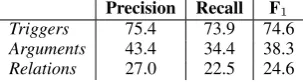
Our evaluation demonstrates that gold structures improve accuracy substantially more than pre-dicted structures. To examine this, we now di-rectly evaluate the structure predictor by com-paring micro-average precision, recall and F1
be-tween predicted and gold structures (Table 5). While performance for trigger identification is reasonable, performance on argument and relation prediction is low. This explains the higher perfor-mance obtained in reading comprehension given gold structures. Note that errors in trigger predic-tion propagate to argument and relapredic-tion predicpredic-tion – a relation cannot be predicted correctly if either one of the related triggers is not previously identi-fied. One reason for low performance is the small size of the dataset. Thus, training process predic-tors with less supervision is an important direction for future work. Furthermore, the task of process prediction is inherently difficult, because often re-lations are expressed only indirectly in text. For example, in Figure 1 the relation between water splitting andtransfer of ions is only recoverable by understanding that water provides the ions that need to be transferred.
Nevertheless, we find that questions can often be answered correctly even if the structure con-tains some errors. For example, the gold structure for the sentence “Some . . . radioisotopes have long half-lives, allowing. . .”, contains the trigger
long half-lives, while we predicthaveas a trigger andlong half-lives as an argument. This is good enough to answer questions related to this part of the structure correctly, and overall, to improve per-formance using predicted structures.
5The low performance of TEXTPROXand SYNTPROXon
true-false questions can also be attributed to the fact that we tuned a threshold parameter on the training set, and this did not generalize well to the test set.
Reason GOLD PROREAD
Alignment 35% 15%
Missing from annotation 25% 10%
Entity coreference 20% 10%
Missing regular expression 10%
Lexical variability 5% 10%
Error in predicted structure 55%
[image:9.595.105.257.63.104.2]Other 5%
Table 6: Error analysis results. An explanation of the vari-ous categories are in the body of the paper.
6.4 Error Analysis
This section presents the results of an analysis of 20 sampled errors of GOLD(gold structures), and 20 errors of PROREAD(predicted structures). We
have categorized the primary reason for error in Table 6.
As expected, the main problem when using pre-dicted structures, is structure errors which account for more than half of the errors.
Errors in GOLD are distributed across various categories, which we briefly describe. Alignment
errors occur due to multiple words aligning to mul-tiple triggers and arguments. For example, in the question “What is the result of gases being pro-duced in the lysosome?”, the answer “engulfed pathogens are poisoned”is incorrectly aligned to the triggerengulfedrather than topoisoned.
Another reason for errors are cases where ques-tions are asked about parts of the paragraph that aremissing from annotation. This is possible since questions were authored independently of struc-ture annotation. Two other causes for errors are
entity coreference errors, where a referent for an entity is missing from the structure, and lexical variability, where the author of questions uses names for triggers or arguments that are missing from the paragraph, and so alignment fails.
Last, in 10% of the cases in GOLD we found that the answer could not be retrieved using the set of regular expressions that are currently used by our QA system.
7 Discussion
This work touches on several strands of work in NLP including information extraction, semantic role labeling, semantic parsing and reading com-prehension.
McCal-lum, 2011) focused on biomedical data to extract events and their arguments. Event-event relations have been mostly studied from the perspective of temporal ordering; e.g., (Chambers and Jurafsky, 2008; Yoshikawa et al., 2009; Do et al., 2012; Mc-Closky and Manning, 2012). The process struc-ture predicted in this work differs from these lines of work in two important ways: First, we predict events, argumentsandtheir interactions from mul-tiple sentences, while most earlier work focused on one or two of these components. Second, we model processes, and thus target causal relations between events, rather than temporal order only.
Our semantic role annotation is similar to ex-isting SRL schemes such as PropBank (Palmer et al., 2005), FrameNet (Ruppenhofer et al., 2006) and BioProp (Chou et al., 2006). However, in con-trast to PropBank and FrameNet, we do not allow all verbs to trigger events and instead let the an-notators decide on biologically important triggers, which are not restricted to verbs (unlike BioProp, where 30 pre-specified verbs were selected for an-notation). Like PropBank and BioProp, the argu-ment labels are not trigger specific.
Mapping questions to queries is effectively a se-mantic parsing task. In recent years, several lines of work addressed semantic parsing using vari-ous formalisms and levels of supervision (Zettle-moyer and Collins, 2005; Wong and Mooney, 2006; Clarke et al., 2010; Berant et al., 2013). In particular, Krishnamurthy and Kollar (2013) learned to map natural language utterances to ref-erents in an image by constructing a KB from the image and then mapping the utterance to a query over the KB. This is analogous to our process of constructing a process structure and performing QA by querying that structure. In our work, we parse questions into graph-based queries, suitable for modeling processes, using a rule-based heuris-tic. Training a statistical semantic parser that will replace the QA system is an interesting direction for future research.
Multiple choice reading comprehension tests are a natural choice for evaluating machine read-ing. Hirschman et al. (1999) presented a bag-of-words approach to retrieving sentences for read-ing comprehension. Richardson et al. (2013) re-cently released the MCTest reading comprehen-sion dataset that examines understanding of fic-tional stories. Their work shares our goal of ad-vancing micro-reading, but they do not focus on
process understanding.
Developing programs that perform deep reason-ing over complex descriptions of processes is an important step on the road to fulfilling the higher goals of machine reading. In this paper, we present an end-to-end system for reading comprehen-sion of paragraphs which describe biological pro-cesses. This is, to the best of our knowledge, the first system to both predict a rich structured rep-resentation that includes entities, events and their relations, and utilize this structure for answering reading comprehension questions. We also created a new dataset, PROCESSBANK, which contains
200 paragraphs that are both fully-annotated with process structure, as well as accompanied by ques-tions. We empirically demonstrated that model-ing biological processes can substantially improve reading comprehension accuracy in this domain.
Acknowledgments
The authors would like to thank Luke Amuchastegui for authoring the multiple-choice questions, and also the anonymous reviewers for their constructive feedback. We thank the Allen Institute for Artificial Intelligence for assistance in funding this work.
References
Jonathan Berant, Andrew Chou, Roy Frostig, and Percy Liang. 2013. Semantic parsing on Freebase from question-answer pairs. InProceedings of EMNLP.
Neil Campbell and Jane Reece. 2005. Biology. Ben-jamin Cummings.
Andrew Carlson, Justin Betteridge, Bryan Kisiel, Burr Settles, Estevam R. Hruschka Jr., and Tom M. Mitchell. 2010. Toward an architecture for never-ending language learning. InProceedings of AAAI.
Nathanael Chambers and Daniel Jurafsky. 2008. Jointly combining implicit constraints improves temporal ordering. InProceedings of EMNLP.
Wen-Chi Chou, Richard Tzong-Han Tsai, Ying-Shan Su, Wei Ku, Ting-Yi Sung, and Wen-Lian Hsu. 2006. A semi-automatic method for annotating a biomedical proposition bank. InProceedings of the Workshop on Frontiers in Linguistically Annotated Corpora 2006, July.
James Clarke, Dan Goldwasser, Ming-Wei Chang, and Dan Roth. 2010. Driving semantic parsing from the world’s response. InProceedings of CoNLL.
Learned to Stop Worrying and Love NLP Pipelines).
InProceedings of LREC.
Michael Collins. 2002. Discriminative training meth-ods for hidden markov models: Theory and exper-iments with perceptron algorithms. InProceedings of ACL.
Quang Do, Wei Lu, and Dan Roth. 2012. Joint infer-ence for event timeline construction. InProceedings
of EMNLP-CoNLL.
George R. Doddington, Alexis Mitchell, Mark A. Przy-bocki, Lance A. Ramshaw, Stephanie Strassel, and Ralph M. Weischedel. 2004. The Automatic Con-tent Extraction (ACE) Program-Tasks, Data, and Evaluation. InProceedings of LREC.
Oren Etzioni, Michele Banko, and Michael J. Cafarella. 2006. Machine reading. InProceedings of AAAI.
Anthony Fader, Stephen Soderland, and Oren Etzioni. 2011. Identifying relations for open information ex-traction. InProceedings of EMNLP.
Anthony Fader, Luke Zettlemoyer, and Oren Etzioni. 2013. Paraphrase-Driven Learning for Open Ques-tion Answering. InProceedings of ACL.
Christiane Fellbaum, editor. 1998. WordNet: An elec-tronic lexical database. MIT Press.
Lynette Hirschman, Marc Light, Eric Breck, and John D. Burger. 1999. Deep read: A reading com-prehension system. InProceedings of ACL.
Jin-Dong Kim, Tomoko Ohta, Sampo Pyysalo, Yoshi-nobu Kano, and Junichi Tsujii. 2009. Overview of BioNLP 09 shared task on event extraction. In
Pro-ceedings of BioNLP.
Jin-Dong Kim, Sampo Pyysalo, Tomoko Ohta, Robert Bossy, and Junichi Tsujii. 2011. Overview of BioNLP shared task 2011. In Proceedings of
BioNLP.
Jayant Krishnamurthy and Thomas Kollar. 2013. Jointly learning to parse and perceive: Connect-ing natural language to the physical world. TACL, 1:193–206.
Nate Kushman, Yoav Artzi, Luke Zettlemoyer, and Regina Barzilay. 2014. Learning to automatically solve algebra word problems. In Proceedings of ACL.
Beth Levin. 1993. English verb classes and alter-nations: A preliminary investigation. University of Chicago Press.
Catherine Macleod, Ralph Grishman, Adam Meyers, Leslie Barrett, and Ruth Reeves. 1998. Nomlex: A lexicon of nominalizations. InProceedings of
EU-RALEX.
Thomas L. Magnanti and Laurence A. Wolsey. 1995. Optimal trees. Handbooks in operations research
and management science, 7:503–615.
Christopher D. Manning, Mihai Surdeanu, John Bauer, Jenny Finkel, Steven J. Bethard, and David Mc-Closky. 2014. The Stanford CoreNLP natural lan-guage processing toolkit. In Proceedings of ACL:
System Demonstrations.
Andr´e L. Martins, Noah A. Smith, and Eric P. Xing. 2009. Concise integer linear programming formu-lations for dependency parsing. InProceedings of
ACL/IJCNLP.
David McClosky and Christopher D. Manning. 2012. Learning constraints for consistent timeline extrac-tion. InProceedings of EMNLP-CoNLL.
Dan Moldovan, Christine Clark, Sanda Harabagiu, and Steve Maiorano. 2003. Cogex: A logic prover for question answering. InProceedings of NAACL-HLT.
Martha Palmer, Paul Kingsbury, and Daniel Gildea. 2005. The proposition bank: An annotated cor-pus of semantic roles. Computational Linguistics, 31(1):71–106.
Vasin Punyakanok, Dan Roth, and Wen-tau Yih. 2008. The importance of syntactic parsing and inference in semantic role labeling. Computational Linguistics, 34(2).
Matthew Richardson, Christopher JC Burges, and Erin Renshaw. 2013. MCTest: A challenge dataset for the open-domain machine comprehension of text. In
Proceedings of EMNLP.
Sebastian Riedel and Andrew McCallum. 2011. Fast and robust joint models for biomedical event extrac-tion. InProceedings of EMNLP.
Dan Roth and Wen-tau Yih. 2004. A linear program-ming formulation for global inference in natural lan-guage tasks. InProceedings of CoNLL.
Josef Ruppenhofer, Michael Ellsworth, Miriam RL Petruck, Christopher R. Johnson, and Jan Schef-fczyk. 2006. FrameNet II: Extended theory and practice. Berkeley FrameNet Release, 1.
Aju Thalappillil Scaria, Jonathan Berant, Mengqiu Wang, Peter Clark, Justin Lewis, Brittany Harding, and Christopher D. Manning. 2013. Learning bi-ological processes with global constraints. In
Pro-ceedings of EMNLP.
Pontus Stenetorp, Sampo Pyysalo, Goran Topi´c, Tomoko Ohta, Sophia Ananiadou, and Jun’ichi Tsu-jii. 2012. Brat: a web-based tool for NLP-assisted text annotation. InProceedings of the demonstra-tions at EACL.
Katsumasa Yoshikawa, Sebastian Riedel, Masayuki Asahara, and Yuji Matsumoto. 2009. Jointly identi-fying temporal relations with Markov logic. In
Pro-ceedings of ACL/IJCNLP.