Abstract—IEEE802.16 is the standard defining the Worldwide Interoperability for Microwave Access (WiMAX) for Metropolitan Area Network (MAN). WiMAX has recently being considered by Internet Service Providers (ISPs) as an attractive alternative to leasing lines from current ISPs or the deployment of new fiber networks. This is mainly the case since WiMAX is more flexible and much cheaper than other possible solutions. Our focus in this paper is on mobile WiMAX i.e. IEEE802.16e designed to provide broadband wireless access for mobile users. In this paper we have designed various scenarios using the Qualnet simulation package to evaluate the performance of WiMAX in delivering traffic under different operational conditions for a point to multi point configuration. The results showed how different factors such as load and mobility might affect the performance of WiMAX in a single cell environment. End to end delay, delay jitter and throughput were considered as the performance measures in this study.
Index Terms— Performance Evaluation, WiMAX, Wireless Access Networks.
I. INTRODUCTION
With advent of access technologies (WiFi, WiMAX, Sensors), demand for open access networks is increasing due to pressure from regulatory, competition, and user interest groups, which are changing the playing fields by empowering customers to choose which devices to use on a carrier network and which applications to run on them. WiMAX as broadband wireless solution, IEEE802.16 [1], [2] is gaining ground as an attractive solution to the wired backhaul and last mile deployments problems ISPs are usually faced with. WiMAX coverage can reach up to a thirty mile radius with theoretical data rates between 1.5 Mbps and 75 Mbps per channel. Fixed WiMAX, based on the IEEE 802.16 [1] Air Interface Standard, is a cost effective fixed wireless alternative to cable and DSL services. IEEE 802.16e amendment [2] to the 802.16 standard adds mobility to the original standard and thus makes WiMAX an attractive solution to provide high bit rate mobile wireless services over a broader range of coverage.
WiMAX Forum [3] believes that Mobile WiMAX (IEEE 802.16e-2005) services will complement existing and future broadband technologies such as WiFi. As a result, researchers, service providers and telecom equipment providers have increased their efforts to integrate WiMAX
Manuscript received March 14, 2009. This work was supported in part by the UAE University internal research affairs unit under grant number: 06 -03 -9 -11 /07.
Khaled A. Shuaib is with the College of IT, UAE University, P.O. Box 17551, Al-Ain, UAE. (Telephone: +971-3-715551, Fax: +971-3-762018, e-mail: [email protected])
into existing infrastructure. This is in addition to the need for converged data networks fueled by service providers’ wireless and wire line convergence to packet based network technologies.
Mobile WiMAX is built around an IP core network which makes it easy to deploy and integrate with existing networks. The IP core for WiMAX is based on advanced technologies and protocols that provide the needed Quality of Service (QoS) and security features. This makes WiMAX ideal to support Voice over IP (VOIP) which is becoming very popular especially in enterprise networks. The deployment of WiMAX usually does not eliminate the need for WiFi which is deployed mostly in door and it is expected that WiMAX will soon be integrated into portable devices just like WiFi. WiMAX is designed to operate within a frequency band of 2-66 GHz. If line of sight (LOS) operation is desired, then frequencies greater than 10 GHz will be utilized. However, for communications that require non-line of sight (NLOS), frequency bands below the 10 GHz are utilized with those below 6 GHz being more suited for mobile applications i.e. IEEE802.16e. Regardless of the frequency band used, Time Division Duplexing (TDD) and Frequency Division Duplexing (FDD) are both supported [4].
The initial implementation of WiMAX, IEEE802.16 was intended for the 10-66 GHz licensed band. Later modifications of the standards, IEEE802.16a and d made it possible to deploy WiMAX in the licensed and unlicensed frequency bands in the range of 2-11 GHz. To enable mobility the IEEE 802.16 working group came up with the IEEE802.16e standards to support mobility. With the introduction of mobility, issues such as roaming, and power consumption had to be dealt with [4]. IEEE802.16e operates in the NLOS mode between 2-11 GHz. The Mobile WiMAX Air Interface adopts Orthogonal Frequency Division Multiple Access (OFDMA) [5] for improved multi-path performance in NLOS environments. Scalable OFDMA [6] was later introduced in the IEEE 802.16e to support scalable channel bandwidths from 1.5 to 20 MHz with guaranteed bandwidth of up to 15 Mbps. According to the WiMAX Forum [3], “WiMAX is a standards-based technology enabling the delivery of last mile wireless broadband access as an alternative to wired broadband like cable and DSL. WiMAX provides fixed, nomadic, portable, and soon, mobile wireless broadband connectivity without the need for a direct line-of-sight with a base station.
Recently several performance studies were done on IEEE802.16e. For example, the authors in [7] conducted simulation and modeling of IEEE802.16e specifically on MAC layer scheduling for VOIP traffic. In turn, the authors in
A Performance Evaluation Study of WiMAX
Using Qualnet
[8] discussed a proposed seamless handoff mechanism for WiMAX mobile users. In [9] the authors conducted a performance evaluation study of a WiMAX system (802.16 2004) when using directional antennas to improve its general performance. On another front, the authors in [10] discussed the performance of a small WiMAX network and developed an optimization and monitoring system to reduce the capital and operation expenses of such a network.
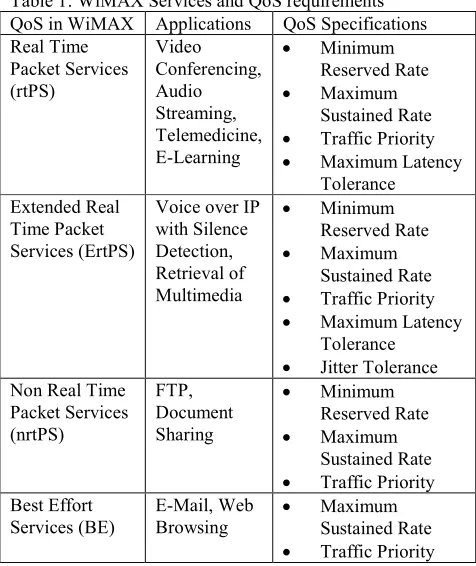
[image:2.612.65.303.285.568.2]As mentioned earlier, one of the main features of IEEE802.16e is that it can operate exclusively in the unlicensed band which makes it attractive and cost effective to be deployed in campus based networks such as universities, military bases and airports. The WiMAX forum developed requirement guidelines for the several applications that can be run over WiMAX [11], [12]. These applications vary from being real-time with stringent QoS requirements such as delay and jitter, to non-real time applications with more relaxed requirements. Table 1 (Taken from [11]), shows the various WiMAX service types and their QoS requirements.
Table 1: WiMAX Services and QoS requirements QoS in WiMAX Applications QoS Specifications Real Time
Packet Services (rtPS)
Video Conferencing, Audio Streaming, Telemedicine, E-Learning
• Minimum Reserved Rate
• Maximum Sustained Rate
• Traffic Priority
• Maximum Latency Tolerance Extended Real
Time Packet Services (ErtPS)
Voice over IP with Silence Detection, Retrieval of Multimedia
• Minimum Reserved Rate
• Maximum Sustained Rate
• Traffic Priority
• Maximum Latency Tolerance
• Jitter Tolerance Non Real Time
Packet Services (nrtPS)
FTP, Document Sharing
• Minimum Reserved Rate
• Maximum Sustained Rate
• Traffic Priority Best Effort
Services (BE)
E-Mail, Web Browsing
• Maximum Sustained Rate
• Traffic Priority The rest of the paper is organized as follows: Section two briefly introduces the simulation tool and environment used. Simulation scenarios and the obtained results are presented in section three and the paper is concluded in section four along with intended future work.
II. SIMULATION TOOL
For our performance study of WiMAX, we have used the MAC802.16 model of QualNet 4.0, which has implemented features defined in both IEEE 802.16 and IEEE 802.16e [1], [2]. WiMAX is implemented as part of the Advanced Wireless 6 QualNet 4.0 Model Library [13]. Mesh networking was not available in the used version of Qualnet; therefore the point to multi point mode was the only mode
used in this performance study. For all simulation scenarios a single circular WiMAX cell was used with omni-directional antenna model at the alleviation of 15 meters above the ground with a transmission power of 25 dbm. The simulation time was for one hour.
III. SIMULATION SCENARIOS AND RESULTS
In an effort to evaluate the performance of WiMAX, we have developed several simulation scenarios using Qualnet. These scenarios were designed to target WiMAX performance under specific conditions such as load, traffic type, mobility and coverage. The packet delay jitter for all scenarios, where CBR traffic was used, was measured as: (Packet Reception Time of packet i – Packet Reception Time of packet (i-1) ). The average delay jitter for N transmitted packets was calculated by the Qulanet software as: [abs (jitter (1)) + abs (jitter (2)) + ... + abs (jitter (N-2))] /(N-2).
The various scenarios discussed in the subsections below covered various aspects of the performance of WiMAX by looking at the effect of load, number of WiMAX subscriber stations and mobility of these stations within the WiMAX cell.
Scenario 1:
In this scenario, a single 550 meter radius WiMAX cell was used with a single base station connected via a 100 Mbps Fast Ethernet link to a traffic generator as shown in Fig. 1. A single stationary subscriber station (SS) was placed within the cell at varying distances with an increment of 50 meters. Once the SS is 500 meter away, the increment in distance was reduced to 10 meter only to look at the performance at a more granular level when approaching the edge of the cell. The traffic generated to the SS was a constant bit rate (CBR) traffic with packet size of 1024 bytes and an inter packet departure interval of 16 ms, i.e. the bit rate was 512 Kbps. The buffer at the base station was chosen as 50,000 bytes FIFO buffer. The throughput, packet delay and delay jitter results for this experiment showed no significant difference when varying the distance except when reaching the edge of the cell where a sharp drop in throughput coupled with a sharp increase in jitter was noticed.
Scenario 2:
100 Mbps Ethernet link Traffic Generator
Omni directional WiMAX BS
[image:3.612.353.510.49.189.2]SS unit placed X meters from the BS
x
Fig. 1: The basic WiMAX single cell configuration used in the simulation study
0.0218 0.0219 0.0219 0.0220 0.0220 0.0221 0.0221 0.0222 0.0222 0.0223
0 10 20 30 40 50 60
se
c
Speed (ms-1)
Moving Outward
[image:3.612.77.301.50.203.2]Moving Inward Average End-to-End Delay
Fig. 2: Average end to end delay for Scenario 2
0.00796 0.00797 0.00798 0.00799 0.008 0.00801 0.00802 0.00803
0 10 20 30 40 50 60
s
e
c
Speed (ms-1)
Moving Outward
[image:3.612.69.302.241.534.2]Moving Inward Average End-to-End Delay Jitter
Fig. 3: Average delay jitter for Scenario 2
Scenario 3:
In this scenario, the number of stationary SSs was varied from 4 to 64 as 4, 8, 16, 32, 48 and 64. These stations were placed within the single WiMAX cell in a circular orientation around the BS with equal distances of 50 meters away as shown in Fig. 4. CBR traffic, as described in scenario 1, was generated from the CBR traffic generator to all SSs through the BS. Fig. 5 shows the average end to end delay measured as the number of SSs was increased adding to the load exerted on the BS. As expected , and as shown in Fig. 5 and Fig. 6, the greater the load represented in the number of SSs connected to the BS the greater the end-to-end delay and jitter experienced.
SS2
SS1
SS50
Base Station 50 m
WiMAX Cell
Fig. 4: Placement of SSs around the base station in a WiMAX cell for scenario 3
In this scenario it was noticed that once the number of SSs reached 49, packets were dropped due to excessive delay and buffer overflow at the BS. Fig. 7 shows that for the case of 49 and 64 SSs, the number of dropped packet climbed exponentially as the number of subscriber stations (shown as nodes in Figs. 5, 6 and 7) increased from 49 to 64. It is also worth mentioning that the maximum total received throughput in this scenario was measured as 24.6 Mbps when 48 SSs where used without any packet loss.
0 0.2 0.4 0.6 0.8 1 1.2 1.4
4 nodes 8 nodes 16 nodes 32 nodes 48 nodes 64 nodes
average end-to-end delay
s
e
[image:3.612.313.552.332.472.2]c
Fig. 5: Average end to end delay versus number of stationary SSs within the WiMAX cell, Scenario 3.
0 0.1 0.2 0.3 0.4 0.5 0.6
4 nodes 8 nodes 16 nodes 32 nodes 48 nodes 64 nodes
average delay Jitter
sec
[image:3.612.316.556.509.642.2]0 1000 2000 3000 4000 5000 6000 7000 8000 9000
4 nodes 8 nodes 16 nodes 32 nodes 48 nodes 49 nodes 64 nodes
Number of dropped packets
P
a
ck
e
[image:4.612.72.302.50.180.2]ts
Fig. 7: Number of dropped packets versus number of stationary SSs within the WiMAX cell, Scenario 3.
Scenario 4:
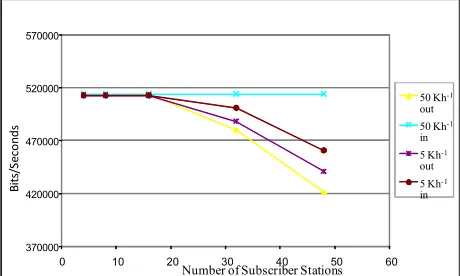
[image:4.612.313.543.93.246.2] [image:4.612.313.542.284.446.2]To look at the effect of mobility while having a number of SSs within the same cell, we repeated scenario 3 here, but with mobility added to the SSs. The placed SSs were programmed to move all inward or outward within the cell with respect to the BS at different specified speeds. Results for the average end to end delay, delay jitter and throughput at a chosen SS were measured as shown in Fig. 8, Fig. 9 and Fig. 10. The number of SSs was limited to 49 since excessive data loss was noticed when the number exceeded that. As seen from Fig. 8, the throughput started to drop once the number of SSs approached 20 with about 18% for the case of a SS station moving outward at the speed of 50 Kh-1. However, no throughput degradation was noticed in the case where the SS was moving inward at the same speed of 50 Kh-1. While, the end to end delay results showed a consistent behavior at the same speed with increasing number of SSs, Fig. 9, the results when varying the speed and direction showed inconsistency as the number of SSs increased. This inconsistency was also noticed when looking at the delay jitter results as shown in Fig. 10.
370000 420000 470000 520000 570000
0 10 20 30 40 50 60
Number of Subscriber Stations
50 Kh-1
out
50 Kh-1
in
5 Kh-1
out
5 Kh-1
in
B
it
s/
S
e
co
n
d
s
Fig. 8: Average throughput in bits per seconds per SS versus number of mobile SSs within the WiMAX cell, Scenario 4.
Scenario 5:
In this scenario a number of SSs was varied as 4,8,16,32 and 48 and placed to move around within the WiMAX cell according to the Random Waypoint model. Each SS chooses a random point in the terrain to move to with speed X. When the SS reaches its destination, it pauses for zero seconds and then chooses a new random point and moves towards it and so on. The following speeds were chosen {5,25,50} Kh-1. For all the obtained results no significant performance differences were noticed when the speed was varied. For example, when
there are 16 SSs and the speed was varied from as 5,25 and 50 Kh-1, there were no noticable differences between the corresponding throughputs, jitter and delay.
0 0.5 1 1.5 2 2.5 3 3.5 4
0 10 20 30 40 50 60
Number of SSs
50 Kh-1 out 50 Kh-1in 5 Kh-1out 5 Kh-1in
Sec
Fig. 9: Average end to end delay in seconds versus number of mobile SSs at different speeds within the WiMAX cell,
Scenario 4.
0.007 0.0075 0.008 0.0085 0.009 0.0095 0.01
0 10 20 30 40 50 60
sec
Number of SSs
[image:4.612.70.300.460.598.2]50 Kh-1out 50 Kh-1 in 5 Kh-1 out 5 Kh-1 in
Fig. 10: Average delay jitter in seconds versus number of mobile at different speeds SSs within the WiMAX cell,
Scenario 4.
Scenario 6:
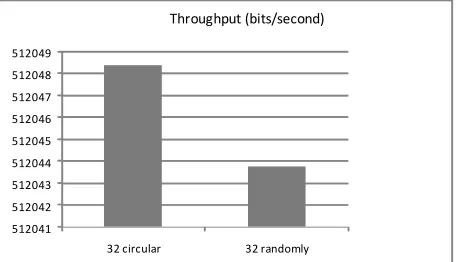
In this scenario the end to end delay, average delay jitter and throughput was compared when having 32 SSs preplaced within the WiMAX cell in a circular orientation as was described in scenario 3 versus when these SSs are placed randomly with the cell. The obtained results as shown in Fig. 11 and Fig. 12 showed minimal performance degradation for the randomly placed SSs.
IV. CONCLUSIONS
more than 48 SSs where simultaneously receiving traffic within the same cell. For our future work, we intend to look at simulating a multi-cell environment and look at the effect of handover and mobile SS to SS communication while focusing on the use of mobile WiMax for road to vehicle and vehicle to vehicle communications.
0 0.005 0.01 0.015 0.02 0.025
Jitter Delay
32 circular
32 randomly
sec
Fig. 11: Average end to end delay and jitter in seconds for 32 SSs when placed randomly or circularly within a WiMAX
cell.
512041 512042 512043 512044 512045 512046 512047 512048 512049
32 circular 32 randomly
[image:5.612.72.301.304.435.2]Throughput (bits/second)
Fig. 12: Average throughput in bits per seconds for 32 SSs when placed randomly or circularly within a WiMAX cell.
References
[1] IEEE802.16e: IEEE Standard for Local and metropolitan area networks Part 16: Air Interface for Fixed and Mobile Broadband Wireless Access Systems, 2005.
[2] IEEE802.16: IEEE Standard for Local and metropolitan area networks Part 16: Air Interface for Fixed Broadband Wireless Access Systems, 2004.
[3] WiMax Forum, http://www.wimaxforum.org
[4] K.R. Santhi and G. Senthil Kumararn, “Migration to 4G: Mobile IP based Solutions”, Proceedings of the Advanced International Conference on Telecommunications and International Conference on Internet and Web Applications and Services, February, 19-25 2006, Guadeloupe, French Caribbean.
[5] Richard Van Nee and Ramjee Prasad, “OFDM for Wireless Multimedia Communications,” Artech House, 2000.
[6] Bernard Fong, et. Al., “On the Scalability of Fixed Broadband Wireless Access Network Deployment,” IEEE Communications, Vol. 42, No, 9, 2004.
[7] D.T. Chen, N. Natarajan, and Y. Sun “On the Simulation, Modeling, and Performance Analysis of an 802.16E Mobile Broadband Wireless Access System”, Proceeding of CCN, October 24 – 26, 2005, Marina del Rey, USA.
[8] Kyung-ah Kim, Chong-kwon Kim and Tongsok Kim "A Seamless Handover Mechanism for IEEE 802.16e Broadband Wireless Access Networks" 2005. 5, LNCS 3515, pp. 527-534.
[9] Zaggoulos, G. Nix A. and Doufexi, A. “ WiMAX System Performance in Highly Mobile Scenarios with Directional Antennas”, Proceedings of IEEE PIMRC 2007, Athens, Greece, Sept. 3-7, 2007.
[10] Qi Zhang and Dam, H. “WiMAX network performance monitoring & optimization”, Proceeding of IEEE NOMS, 2008, Bahia, Salvador, April 7-11, 2008.
[11] “Can WiMAX Address Your Applications?”, Westech communication corporation on Behalf of the WiMAX Forum, October 24,2005. [12] The WiMAX Forum, “Mobile WiMAX – Part I: A Technical Overview