Y. Matsumoto and K. Sakamoto are with Konan University, 8-9-1 Okamoto, Higashinada, Kobe 658-8501, Japan (e-mail: [email protected]).
S. Nomura is with Nagaoka University of Technology, 1603-1 Kamitomioka, Nagaoka 940-2188, Japan
T. Hirotomi, K. Shiwaku and M. Hirakawa are with Shimane University, 1060 Nishikawatsu-cho, Matsue, Shimane 690-8504, Japan
Abstract— The authors have researched a support system of the reminiscence and life review activity. In this life review therapy, it is important to review the sessions after the activity for an effective therapy. Moreover a record of the activities is made the best use for making progress of technique on progressing the sessions and bringing up young or new therapists on training. In this paper, we describe the replay system of an activity on the life review therapy using mixed reality technology, which can reproduce a situation during the executions of the reminiscence therapy at a difference place later.
Index Terms— mixed reality, group work, support system, experienceable education system, life review therapy
I. INTRODUCTION
The authors have researched multimedia system and support system for nursing studies on and practices of reminiscence therapy and life review therapy. Since Butler first presented the concept of the life review in 1963, many kinds and types of study in this field have appeared and developed. However these studies only involve methods of its application as nursing intervention in order to understand patients and to apply theories to nursing care. In hospice care and in many nursing homes, the process of thinking back on one's life and communicating about one's life to another person is called life review[1].
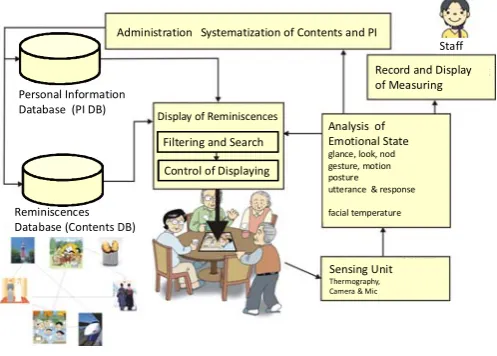
The authors have researched a support system of the reminiscence and life review activity. Fig. 1 shows an outline of our support system. This system consists of three main functions; multimedia systems, an analyzing system and a recording system. We have set three goals of this research. One of the goals is to construct an automatic generating system of reports about life review activities. A therapist must keep a record of sessions for inspection of methods and ways of valuation on reminiscence and life review therapy, but it is trouble for the therapist to record. To overcome this problem, we have developed the support system which can automatically write down a session report about the activity. The other target is a conversion to electronics (electronic form) of presenting reminiscences. The life review activity is generally assisted by aids such as videos, pictures, objects, archives and life story books. The authors tackled an
adaptive presenting system using multimedia systems, sensing units and an analysis algorithm of emotional states in presenting reminiscences. The aim which is described in this paper is to build an automatic review system of an activity of the reminiscence therapy. Because it is important to review the sessions after the activity for an effective therapy on this activity of therapy. In addition, the record of the sessions of life review activities is made the best use in order to make progress of technique on progressing the sessions and to bring up young or new therapists on training. In this paper, we describe the replay system of an activity on the life review therapy using mixed reality technology, which can reproduce a situation during the executions of the reminiscence therapy at a difference place later.
Personal Information Database (PI DB)
Reminiscences Database (Contents DB)
Administration Systematization of Contents and PI
Display of Reminiscences
Filtering and Search
Control of Displaying
Sensing Unit Thermography,
Camera & Mic
Record and Display
of Measuring Staff
Analysis of
Emotional State
[image:1.595.306.555.373.551.2]glance, look, nod gesture, motion posture utterance & response facial temperature
Fig. 1 Support system of life review activity
II. LIFE REVIEW ACTIVITY
The life review activity has been defined as the vocal or silent recall of events in a person's life, either alone, or with another person or group of people. This life review therapy consists of three phases. The life review activity is generally assisted by aids such as videos, pictures, objects, archives and life story books. The first phase is to prepare these aids and to plan activities of the therapy. The second phase is the main part of an activity on a group work. In this phase, the activity of thinking back on one's life and communicating about one's life to another person is performed and a therapist writes down a record of this activity simultaneously with the progress of an activity of the therapy. The last phase is an evaluation. This phase is to examine the process and outcomes of life review therapy using the record of an
Activity Replay System of Life Review Therapy
Using Mixed Reality Technology
activity.
The frame of the analysis in the reminiscence therapy is the following element; nonverbal behavior, verbal behavior, an element related to function of the reminiscence, an element related to kind of memory and interpersonal relatedness in the group and so on. There is sense in continuing and making good use of progresses and results of the reminiscence in a group on the actual spot in hospice care. On the reminiscence therapy and life review therapy, it is one of the important things to analyze the sessions after the activity for an effective therapy. Moreover, it is necessary for therapists to make the best use of analyzing results and records about the sessions of life review activities in order to make progress of their technique on progressing the sessions. In addition, it is useful also to show trainees the site and the situation of a reminiscence activity for bringing up young or new therapists on training. So the authors have developed the replay system which can reconstruct sessions of the reminiscence activity.
III. OBJECT RECOGNITION
The authors suppose that the assist aids are only pictures for the simplicity. It is necessary to recognize each picture using two-dimensional (2D) codes or Radio Frequency Identification (RFID) tag.
QR Code is a kind of 2D symbology developed by Denso Wave in 1994. QR Code (2D Code) contains information in both the vertical and horizontal directions, whereas a bar code contains data in one direction only. QR Code is capable of 360 degrees, high speed reading. QR Code accomplishes this task through position detection patterns located at the three corners of the symbol as shown in Fig. 2. This ability allows the use of 2D in a wide range of applications. QR codes onto labels are widely used in the fields of distribution and logistics. Moreover, QR Code is available for camera phones which enable new services based on QR-code (2D-barcode) input. The QR Code can store much information, but its symbol is large.
Fig. 2 QR Code
[image:2.595.311.548.220.317.2]RFID tag, which is a silicon chip with IDs, frequency function within small size, is attached to some goods such as transportation tickets, luggage management and so on. RFID technologies deliver wireless communication with small tags. Fig. 3 shows the RFID board for reading tags and RFID tags. The RFID board is a USB-based controller for radio frequency identification applications. This RFID has a read range of approximately 3 inches for the three types of RFID tags which are disc tag, credit card sized tag and keyfob tag. The tags are read only devices with unique ID's.
[image:2.595.345.508.352.484.2]To merge real and virtual worlds in the scene of a video window on the computer, the authors use the software library which is called ARToolKit. In the mixed reality environment of ARToolKit, a spatial measuring technology uses special designed 2D codes in order to calculate positions of virtual 3D objects. In order to recognize each picture, we utilize 2D codes. A printing company has developed a new technology which makes a publication embedded with invisible codes, which is made by infrared reflective pigment, or small 2D codes, which is made by conventional offset printing using an infrared printing ink. Using this infrared printing technique, our developing activity replay system recognizes a kind of pictures on the table.
Fig. 3 RFID reader and cards within tag
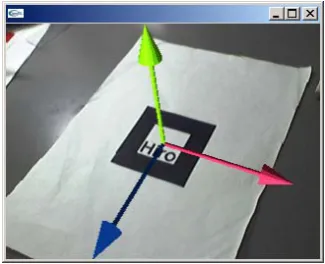
Fig. 4 Overlapped 3D image by ARToolKit
IV. ARTOOLKIT
A. Outline
On a reconstruction of the life review activity, the authors make use of a mixed reality technology in order to reproduce the situation of a life review session. This mixed reality technology can merge real and virtual worlds to produce new environments and visualisations where physical and digital objects co-exist and interact in real time. To merge real and virtual worlds in the scene of a video window on the computer, we use the software library which is called ARToolKit. ARToolKit involves a video capture, a 3D graphics generator, a spatial measuring and an overlay imaging for the creation of augmented reality applications[2]. To do this, it uses video tracking capabilities in order to calculate the real camera position and orientation relative to physical markers in real time. When you point a camera toward the marker, you will see a computer generated 3D object overlaying the marker as shown in Fig. 4. Thus the images captured by the cameras are transported to a PC which makes composite images of real and virtual world
[image:2.595.79.227.531.632.2]together in real-time. Then a mixed reality world can be seen. To overlap a 3D object on the 2D marker, ARToolKit calculates three coordinate axes from a captured camera scene. The video tracking libraries calculate the real camera position and orientation relative to physical markers in real time. Suppose that two 2D markers are laid on the table. One is the marker which is the datum point of a spatial measurement. The rest is the picture for an aid to recollect of reminiscence. The tracking library calculates each three coordinate axes on the two markers. Since our system program can detect a difference between two coordinate axes, that is a relative position between two coordinate systems, we can know the position of its picture even if the picture doesn't exist on the table in case that we can know the position of the 2D marker as a datum point. This is similar even for three markers or more. Because each marker only has to be comparable with the marker as the datum point.
B. Internal Function for 3D positioning
ARToolKit has an internal function for computing camera position in function of detected marker with a history function. This function is named arGetTransMat. The function arGetTransMat calculates the transformation between a detected marker and the real camera, i.e. the position and orientation of the camera relative to the tracking mark. Since this routine operates on previous values, the result is more stable. The arGetTransMat function is defined in the include file of the C programming as follows;
double arGetTransMat (ARMarkerInfo * marker_info, double center[2],
double width, double conv[3][4] )
Parameters:
marker_info the structure containing the parameters for
the marker for which the camera position and orientation is to be found relative to. This structure is found using arDetectMarker.
center the physical center of the marker.
arGetTransMat assumes that the marker is in x-y plane, and z axis is pointing downwards from marker plane. So vertex positions can be represented in 2D coordinates by ignoring the z axis information. The marker vertices are specified in order of clockwise.
width the size of the marker (in mm).
conv the transformation matrix from the marker
coordinates to camera coordinate frame, that is the relative position of real camera to the real marker
Returns: always 0.
Setting three parameters marker_info, center and width, the arGetTransMat function returns the parameter conv. On developing our activity replay system, the most important parameter of this function is this conv parameter. The conv parameter is a transformation matrix from the marker
coordinates to camera coordinate. The conv is a 3 by 4 matrix as follows;
⎥
⎥
⎥
⎦
⎤
⎢
⎢
⎢
⎣
⎡
=
⎥
⎥
⎥
⎦
⎤
⎢
⎢
⎢
⎣
⎡
z y xt
r
r
r
t
r
r
r
t
r
r
r
conv
conv
conv
conv
conv
conv
conv
conv
conv
conv
conv
conv
33 32 31 23 22 21 13 12 11]
3
][
2
[
]
2
][
2
[
]
1
][
2
[
]
0
][
2
[
]
3
][
1
[
]
2
][
1
[
]
1
][
1
[
]
0
][
1
[
]
3
][
0
[
]
2
][
0
[
]
1
][
0
[
]
0
][
0
[
[image:3.595.325.527.352.463.2]Assume that the transposed matrix [Xc Yc Zc 1]T means the camera coordinate and [Xm Ym Zm 1]T means the marker coordinate. The relation of above equation is modified into following equation.
⎥
⎥
⎥
⎥
⎦
⎤
⎢
⎢
⎢
⎢
⎣
⎡
⎥
⎥
⎥
⎥
⎦
⎤
⎢
⎢
⎢
⎢
⎣
⎡
=
⎥
⎥
⎥
⎥
⎦
⎤
⎢
⎢
⎢
⎢
⎣
⎡
1
1
0
0
0
1
33 32 31 23 22 21 13 12 11 m m m z y x c c cZ
Y
X
t
r
r
r
t
r
r
r
t
r
r
r
Z
Y
X
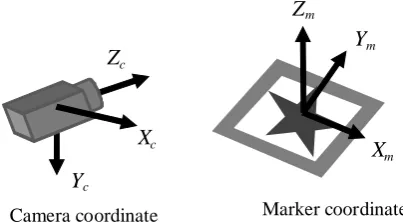
.Fig. 5 shows the relation between camera coordinate system and marker coordinate system.
Yc Xc
Z Ym
Xm Zm
Camera coordinate Marker coordinate
[image:3.595.308.547.660.774.2]c
Fig. 5 Camera and marker coordinate system
C. Geometric Analysis
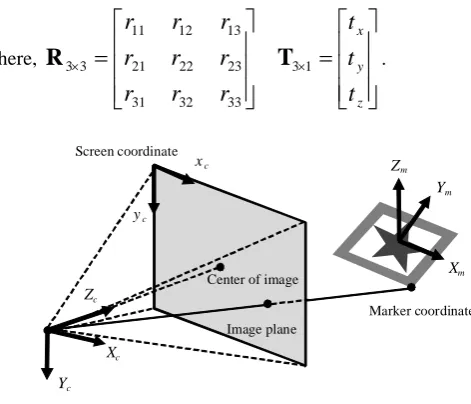
Fig. 6 shows camera coordinate system, screen coordinate system and marker coordinate system. In Fig. 6, let (Xc, Yc,
Zc) be three space coordinate of a camera and parameter z shows the depth. The xc-yc coordinate system shows the image plane of a camera. Moreover, let (Xm, Ym, Zm) be three space coordinate of a marker and parameter z shows the height. Assume that the transposed matrix [Xc Yc Zc 1]T means the camera coordinate and [Xm Ym Zm 1]T means the marker coordinate. Then the coordinate transformation between three space coordinate of a camera and three space coordinate of a marker is given as follows;
⎥
⎥
⎥
⎥
⎦
⎤
⎢
⎢
⎢
⎢
⎣
⎡
=
⎥
⎥
⎥
⎥
⎦
⎤
⎢
⎢
⎢
⎢
⎣
⎡
=
⎥
⎥
⎥
⎥
⎦
⎤
⎢
⎢
⎢
⎢
⎣
⎡
1
0
0
0
1
1
33 32 31 23 22 21 13 12 11 z y x cm m m m cm c c ct
r
r
r
t
r
r
r
t
r
r
r
Z
Y
X
Z
Y
X
T
T
(1).here,
⎥
⎥
⎥
⎦
⎤
⎢
⎢
⎢
⎣
⎡
=
⎥
⎥
⎥
⎦
⎤
⎢
⎢
⎢
⎣
⎡
=
× × z y xt
t
t
r
r
r
r
r
r
r
r
r
1 3 33 32 31 23 22 21 13 12 11 3 3T
R
. Yc Xc Zc Ym Xm Zm xc yc Screen coordinate Camera coordinate Marker coordinate Center of image [image:4.595.48.284.49.251.2]Image plane
Fig. 6 Definition of corrdinate systems
Moreover the transposed matrix [xc yc 1]T means the image plane of a camera, then the perspective transformation from the camera coordinate to the imaging plane is given as follows;
⎥
⎥
⎥
⎥
⎦
⎤
⎢
⎢
⎢
⎢
⎣
⎡
=
⎥
⎥
⎥
⎥
⎦
⎤
⎢
⎢
⎢
⎢
⎣
⎡
=
⎥
⎥
⎥
⎥
⎦
⎤
⎢
⎢
⎢
⎢
⎣
⎡
1
0
0
0
0
1
0
0
0
0
0
1
1
23 22 13 12 11P
P
P
P
P
Z
Y
X
h
hy
hx
c c c c cP
P
(2)here, h is the scalar value. Matrix P is determined by a camera calibration. Actual values (xc, yc) are calculated by the equation (2) as follows;
c c c c c c c c c
Z
Z
P
Y
P
y
Z
Z
P
Y
P
X
P
x
23 22 13 12 11+
=
+
+
=
(3). Yc Xc Zc(I) Set marker on origin of camera coordinate
Marker
Image plane
3 3×
R T3×1 (II) After rotate by , slide by
(III) Project on plane by P
m1 m2 m3 m4 M1 M2 M3 M4
Fig. 7 Calculation process of 3D Geometry
The coordinate transformation matrix Tcm consists of a rotation matrix R3x3 and a translation vector T3x1. In order to
generate a perspective image, you need compute the rotation matrix R3x3 and the translation vector T3x1. Fig. 7 shows a
transformation process of generating an image of the marker on the camera plane in perspective. As shown in Fig. 7,
firstly the square marker is located at the origin of three space coordinate of a camera. Next slide the position of a marker by translation vector T3x1 after rotate the marker at the origin
by rotation matrix R3x3. Then project an image of the marker
on the camera plane by matrix P. The R3x3 and T3x1 are
computed automatically by ARToolKit. Since all we have to do is to utilize return values of the arGetTransMat function in order to calculate the relations of spatial position among markers, allow me to leave out the explanation. For further information, see reference [2].
V. POSITION RECOGNITION
Fig. 8 shows a transformation process between three space coordinates of markers on the same plane. Equation (1) shows the coordinate transformation between three space coordinate of a camera and three space coordinate of a marker. As shown in Fig. 8, the marker A and maker B are shotted by the same camera. Assume that [XAm YAm ZAm 1]T means the coordinate of marker A and [XBm YBm ZBm 1]T means the coordinate of marker B. From equation (1), the coordinate transformation matrixes TAcm and TBcm are given
as follows;
⎥
⎥
⎥
⎥
⎦
⎤
⎢
⎢
⎢
⎢
⎣
⎡
=
⎥
⎥
⎥
⎥
⎦
⎤
⎢
⎢
⎢
⎢
⎣
⎡
=
⎥
⎥
⎥
⎥
⎦
⎤
⎢
⎢
⎢
⎢
⎣
⎡
1
0
0
0
1
1
33 32 31 23 22 21 13 12 11 Az A A A Ay A A A Ax A A A Acm Am Am Am Acm c c ct
r
r
r
t
r
r
r
t
r
r
r
Z
Y
X
Z
Y
X
T
T
⎥
⎥
⎥
⎥
⎦
⎤
⎢
⎢
⎢
⎢
⎣
⎡
=
⎥
⎥
⎥
⎥
⎦
⎤
⎢
⎢
⎢
⎢
⎣
⎡
=
⎥
⎥
⎥
⎥
⎦
⎤
⎢
⎢
⎢
⎢
⎣
⎡
1
0
0
0
1
1
33 32 31 23 22 21 13 12 11 Bz B B B By B B B Bx B B B Bcm Bm Bm Bm Bcm c c ct
r
r
r
t
r
r
r
t
r
r
r
Z
Y
X
Z
Y
X
T
T
(4). Yc Xc Zc Marker A Acm T YAm XAm ZAm Marker B Bcm T 1 − Acm T 1 − Bcm T Bcm Acm TT −1
Acm
Bcm T
T −1
ZBm YBm
[image:4.595.47.301.321.655.2]XBm
Fig. 8 Calculation process of relations between markers
The coordinate transformation matrix Tcm shows the relation between three space coordinate of a camera and three space coordinate of a marker. When the coordinate transformation matrixes TAcm and TBcm are determined, the
[image:4.595.297.553.337.657.2]⎥
⎥
⎥
⎥
⎦
⎤
⎢
⎢
⎢
⎢
⎣
⎡
=
⎥
⎥
⎥
⎥
⎦
⎤
⎢
⎢
⎢
⎢
⎣
⎡
⎥
⎥
⎥
⎥
⎦
⎤
⎢
⎢
⎢
⎢
⎣
⎡
=
⎥
⎥
⎥
⎥
⎦
⎤
⎢
⎢
⎢
⎢
⎣
⎡
− −
1
1
1
1
1 1
Am Am Am
Acm Bcm Bm
Bm Bm
Bm Bm Bm
Bcm Acm Am
Am Am
Z
Y
X
Z
Y
X
Z
Y
X
Z
Y
X
T
T
T
T
(5).
VI. ACTIVITY REPLAY SYSTEM
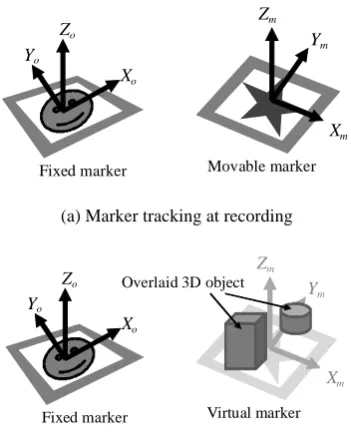
The authors have been developing a replay system of sessions on the reminiscence activity using functions of ARToolKit. On a session of the activity in the life review therapy, a therapist executes an activity using pictures on the round table. Fig. 9 shows the brief illustration of the life review therapy. As shown in Fig. 9(a), there are two markers or more on the table. One is a fixed marker for datums. Others are movable markers for the object recognition. These markers are attached on the pictures (In Fig. 9(a), the markers are drawn only for the simplification).
Yo
Xm
Zo Y
m
Xo
Zm
Fixed marker Movable marker
(a) Marker tracking at recording
Yo
Xm
Zo Y
m
Xo
Zm
Fixed marker Virtual marker Overlaid 3D object
[image:5.595.46.179.50.200.2](b) Marker tracking at reconstructing scene Fig. 9 Marker tracking at recording and reconstruction
[image:5.595.338.519.192.331.2]At the session of the activity in the life review therapy, a therapist and participants move and rotate a picture on the table. As the result, it is important for object recognition to track the maker which is attached on a picture as shown in Fig. 9(a). At the same time, a camera shots a marker as a datum point and a picture. The system program calculates and records the position and motion of a picture on the table. As shown in Fig. 9(b), the positions and the attitudes of virtual markers are calculated using equation (5). Therefore a 3D graphics generator can overlay CG (Computer Graphics) objects on the virtual markers. Then you will see a computer generated 3D object overlaying the invisible marker which is
the same position of an actual marker at recording. At the reconstructing part, a virtual object, i.e., a picture used at the session, is overlapped on the scene which is captured by a camera. Using this reconstruction system, therapists can review their executed sessions of reminiscence activities for improving their capability. At the different time or place, trainees can acquire a technique of session progressing on life review therapy using the situation actually executed. Fig. 10 shows the scenes generated by the activity replay system using ARToolKit during a session of the therapy and at a playback of the activity.
(a) Recording of executed session
[image:5.595.337.516.366.509.2](b) Reconstructed scene of reminiscence therapy Fig. 10 Recording and reconstruction of situations at group work
in life review therapy
VII. OTHER USEFUL USAGES
A. Marionette play system
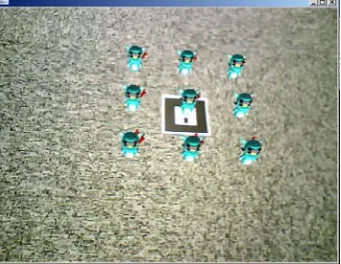
[image:5.595.80.256.373.596.2]puppetry is the manipulation and performance of digitally animated 3D figures and objects in a virtual environment that are rendered in real-time by computers. The motions of characters are learned so that you move markers toward the direction where you want to move the characters. After learning the motion, the motions of 3D characters are playbacked at the performance. Since the scene of a stage is generated in the mixed reality environment, observers can view the stage anywhere as shown in Fig. 11.
(a) View at the front and above
[image:6.595.336.518.49.345.2](b) Another view from different and lower position Fig. 11 Playback scene of marionette play system
B. 3D mouse system
The coordinate transformation matrix Tcm gives us the relation between three space coordinate of a camera and three space coordinate of a marker. Using two markers, we can use a camera as the 3D pointing device. To measure a 3D position using a single-lens camera, it is necessary to detect two markers. The position of a camera is calculated using equation (4). Because the relation between the camera position and the marker position (i.e., the origins of camera and marker coordinate system) is given from equation (1), we can know the spatial position of a camera if the camera measuring device is calibrated in order to fix the position by the units of measure in the real world. We can also measure the special position of a camera utilizing two markers without the calibration. Figure 12 shows an interaction system by 3D pointing using a USB camera. Since this system tracks the movement and spatial position, an operator can move the position of a painted circle by the direction of shooting and change the size by distance between the display and camera as shown in Fig. 12.
(a) near position
[image:6.595.84.255.176.308.2](b) far position
Fig. 12 Interaction system using 3D pointing
VIII. CONCLUSIONS
We describe the replay system of an activity on the life review therapy using mixed reality technology, which can reproduce a situation during the executions of the reminiscence therapy at a difference place later. It is important to review the sessions after the activity for an effective therapy on this activity of therapy. In addition, the record of the sessions of life review activities is made the best use in order to make progress of technique on progressing the sessions and to bring up young or new therapists on training. Using this reconstruction system, therapists can review their executed sessions of reminiscence activities for improving their capability. At the different time or place, trainees can acquire a technique of session progressing on life review therapy using the situation actually executed.
ACKNOWLEDGMENT
This research is partially supported by “Grant-in-Aid for Young Scientists(B)” #20700112 and “Scientific Research (C) (General)” #20500481 from Ministry of Education, Culture, Sports, Science and Technology Japan(MEXT) and also by MEXT ORC (2004-2008).
REFERENCES
[1] R.N.Butler, “The life review : An interpretation of reminiscence in the aged”, Psychiatry, Vol. 26, pp.65-76 (1963)