Lightly-Supervised Word Sense Translation Error Detection for an
Interactive Conversational Spoken Language Translation System
Dennis N. Mehay, Sankaranarayanan Ananthakrishnan and Sanjika Hewavitharana Speech, Language and Multimedia Processing Unit
Raytheon BBN Technologies Cambridge, MA, 02138, USA
{dmehay,sanantha,shewavit}@bbn.com
Abstract
Lexical ambiguity can lead to concept transfer failure in conversational spo-ken language translation (CSLT) systems. This paper presents a novel, classification-based approach to accurately detecting word sense translation errors (WSTEs) of ambiguous source words. The approach requires minimal human annotation effort, and can be easily scaled to new language pairs and domains, with only a word-aligned parallel corpus and a small set of manual translation judgments. We show that this approach is highly precise in de-tecting WSTEs, even in highly skewed data, making it practical for use in an in-teractive CSLT system.
1 Introduction
Lexical ambiguity arises when a single word form can refer to different concepts. Selecting a con-textually incorrect translation of such a word — here referred to as a word sense translation error (WSTE) — can lead to a critical failure in a con-versational spoken language translation (CSLT) system, where accuracy of concept transfer is paramount. Interactive CSLT systems are espe-cially prone to mis-translating less frequent word senses, when they use phrase-based statistical ma-chine translation (SMT), due to its limited use of source context (source phrases) when constructing translation hypotheses. Figure 1 illustrates a typi-cal WSTE in a phrase-based English-to-Iraqi Ara-bic CSLT system, where the English word board
Disclaimer: This paper is based upon work supported by the DARPA BOLT program. The views expressed here are those of the authors and do not reflect the official policy or position of the Department of Defense or the U.S. Govern-ment.
Distribution Statement A (Approved for Public Release, Distribution Unlimited)
Figure 1: Example WSTE in English-to-Iraqi SMT.
is mis-translated as mjls (“council”), completely distorting the intended message.
Interactive CSLT systems can mitigate this problem by automatically detecting WSTEs in SMT hypotheses, and engaging the operator in a clarification dialogue (e.g. requesting an unam-biguous rephrasing). We propose a novel, two-level classification approach to accurately detect WSTEs. In the first level, a bank of word-specific classifiers predicts, given a rich set of contextual and syntactic features, a distribution over possi-ble target translations for each ambiguous source word in our inventory. A single, second-level clas-sifier then compares the predicted target words to those chosen by the decoder and determines the likelihood that an error was made.
A significant novelty of our approach is that the first-level classifiers are fully unsupervised with respect to manual annotation and can easily be expanded to accommodate new ambiguous words and additional parallel data. The other innovative aspect of our solution is the use of a small set of manual translation judgments to train the second-level classifier. This classifier uses high-second-level fea-tures derived from the output of the first-level clas-sifiers to produce a binary WSTE prediction, and can be re-used unchanged even when the first level of classifiers is expanded.
Our goal departs from the large body of work devoted to lightly-supervised word sense disam-biguation (WSD) using monolingual and bilingual corpora (Yarowsky, 1995; Schutze, 1998; Diab and Resnik, 2002; Ng et al., 2003; Li and Li, 2002; Purandare and Pedersen, 2004), which seeks to
bel and group unlabeled sense instances. Instead, our approach detects mis-translations of a known set of ambiguous words.
The proposed method also deviates from ex-isting work on global lexical selection models (Mauser et al., 2009) and on integration of WSD features within SMT systems with the goal of im-proving offline translation performance (Chan et al., 2007). Rather, we detect translation errors due to ambiguous source words with the goal of pro-viding feedback to and soliciting clarification from the system operator in real time. Our approach is partly inspired by Carpuat and Wu’s (2007b; 2007a) unsupervised sense disambiguation mod-els for offline SMT. More recently, Carpuat et al. (2013) identify unseen target senses in new do-mains, but their approach requires the full test cor-pus upfront, which is unavailable in spontaneous CSLT. Our approach can, in principle, identify novel senses when unfamiliar source contexts are encountered, but this is not our current focus.
2 Baseline SMT System
In this paper, we focus on WSTE detection in the context of phrase-based English-to-Iraqi Ara-bic SMT, an integral component of our interac-tive, two-way CSLT system that mediates con-versation between monolingual speakers of En-glish and Iraqi Arabic. The parallel training cor-pus of approximately 773K sentence pairs (7.3M English words) was derived from the DARPA TransTac English-Iraqi two-way spoken dialogue collection and spans a variety of domains includ-ing force protection, medical diagnosis and aid, etc. Phrase pairs were extracted from bidirectional IBM Model 4 word alignment after applying a merging heuristic similar to that of Koehn et al. (2003). A 4-gram target LM was trained on Iraqi Arabic transcriptions. Our phrase-based decoder, similar to Moses (Koehn et al., 2007), performs beam search stack decoding based on a standard log-linear model, whose parameters were tuned with MERT (Och, 2003) on a held-out develop-ment set (3,534 sentence pairs, 45K words). The BLEU and METEOR scores of this system on a separate test set (3,138 sentence pairs, 38K words) were 16.1 and 42.5, respectively.
3 WSTE Detection
[image:2.595.308.490.65.138.2]The core of the WSTE detector is a novel, two-level classification pipeline. Our approach avoids
Figure 2: An English–Iraqi training pair.
the need for expensive, sense-labeled training data based on the observation that knowing the sense of an ambiguous source word is distinct from know-ing whether a sense translation error has occurred. Instead, the target (Iraqi Arabic) words typically associated with a given sense of an ambiguous source (English) word serve as implicit sense la-bels, as the following describes.
3.1 A First Level of Unsupervised Classifiers
The main intuition behind our approach is that strong disagreement between the expanded con-text of an ambiguous source word and the corre-sponding SMT hypothesis indicates an increased likelihood that a WSTE has occurred. To identify such disagreement, we train a bank of maximum-entropy classifiers (Berger et al., 1996), one for each ambiguous word. The classifiers are trained on the same word-aligned parallel data used for training the baseline SMT system, as follows.
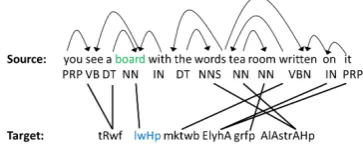
For each instance of an ambiguous source word in the training set, and for each target word it is aligned to, we emit a training instance associating that target word and the wider source context of the ambiguous word. Figure 2 illustrates a typical training instance for the ambiguous English word board, which emits a tuple of contextual features and the aligned Iraqi Arabic word lwHp (“plac-ard”) as a target label. We use the following con-textual features similar to those of Carpuat and Wu (2005), which are in turn based on the clas-sic WSD features of Yarowsky (1995).
Neighboring Words/Lemmas/POSs. The to-kens,t, to the left and right of the current ambigu-ous token, as well as all trigrams of tokens that span the current token. Separate features for word, lemma and parts of speech tokens,t.
Figure 3: An unsupervised first-level classifier.
Bag-of-words/lemmas. Distance decayed bag-of-words-style features for each word and lemma in a seven-word window around the current token.
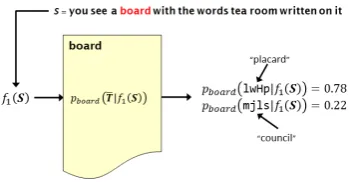
Figure 3 schematically illustrates how this classi-fier operates on a sample test sentence. The ex-ample assumes that the ambiguous English word board is only ever associated with the Iraqi Arabic words lwHp (“placard”) and mjls (“council”) in the training word alignment. We emphasize that even though the first-level maximum entropy clas-sifiers are intrinsically supervised, their training data is derived via unsupervised word alignment.
3.2 A Second-Level Meta-Classifier
The first-level classifiers do not directly predict the presence of a WSTE, but induce a distribu-tion over possible target words that could be gen-erated by the ambiguous source word in that con-text. In order to make a binary decision, this distri-bution must be contrasted with the corresponding target phrase hypothesized by the SMT decoder. One straightforward approach, which we use as a baseline, is to threshold the posterior probabil-ity of the word in the SMT target phrase which is ranked highest in the classifier-predicted distribu-tion. However, this approach is not ideal because each classifier has a different target label set and is trained on a different number of instances.
To address this issue, we introduce a second meta-classifier, which is trained on a small number of hand-annotated translation judgments of SMT hypotheses of source sentences containing am-biguous words. The bilingual annotator was sim-ply asked to label the phrasal translation of source phrases containing ambiguous words as correct or incorrect. We obtained translation judgments for 511 instances from the baseline SMT development and test sets, encompassing 147 pre-defined am-biguous words obtained heuristically from Word-Net, public domain homograph lists, etc.
[image:3.595.79.254.60.151.2]The second-level classifier is trained on a small
Figure 4: The two-level WSTE architecture.
set of meta-features drawn from the predictions of the first-level classifiers and from simple statistics of the training corpus. For an ambiguous word
wain source sentence S, with contextual features
f1(S), and aligned to target wordst ∈T (the set of words in the target phrase) in the SMT hypoth-esis, we extract the following features:
1. The first-level classifier’s maximum likelihood of any decoded target word:
max
t∈T pwa(t|f1(S))
2. The entropy of the predicted distribution:X
t
pwa(t|f1(S))·ln(pwa(t|f1(S)))
3. The number of training instances forwa
4. The inverse of the number of distinct target labels forwa.
5. The product of meta-features (1) and (4)
3.3 Scalability and Portability
Scalability was an important consideration in de-signing the proposed WSTE approach. For in-stance, we may wish to augment the inventory with new ambiguous words if the vocabulary grows due to addition of new parallel data or due to a change in the domain. The primary advan-tage of the two-level approach is that new ambigu-ous words can be accommodated by augmenting the unsupervised first-level classifier set with addi-tional word-specific classifiers, which can be done by simply extending the pre-defined list of am-biguous words. Further, the current classification stack requires only≈1.5GB of RAM and performs per-word WSTE inference in only a few millisec-onds on a commodity, quad-core laptop, which is critical for real-time, interactive CSLT.
The minimal annotation requirements also al-low a high level of portability to new language pairs. Moreover, as our results indicate (below), a good quality WSTE detector can be bootstrapped for a new language pair without any annotation ef-fort by simply leveraging the first-level classifiers.
4 Experimental Results
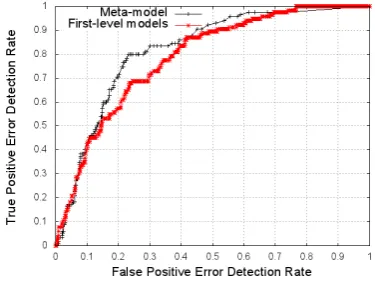
The 511 WSTE-annotated instances used for train-ing the second-level classifier doubled as an eval-uation set using the leave-one-out cross-validation method. Of these, 115 were labeled as errors by the bilingual judge, while the remaining 396 were translated correctly by the baseline SMT system. The error prediction score from the second-level classifier was thresholded to obtain the receiver operating characteristic (ROC) curve shown in the top (black) curve of Figure 5. We obtain a 43% error detection rate with only 10% false alarms and 71% detection with 20% false alarms, in spite of the highly skewed label distribution. In abso-lute terms, true positives outnumber false alarms at both the 10% (49 to 39) and 20% (81 to 79) false alarm rates. This is important for deployment, as we do not want to disrupt the flow of conversation with more false alarms than true positives.
For comparison, the bottom (red) ROC curve shows the performance of a baseline WSTE pre-dictor comprised of just meta-feature (1), obtain-able directly from the first-level classifiers. This performs slightly worse than the two-level model at 10% false alarms (40% detection, 46 true pos-itives, 39 false alarms), and considerably worse at 20% false alarms (57% detection, 66 true
pos-Figure 5: WST error detection ROC curve.
itives, 78 false alarms). Nevertheless, this result indicates the possibility of bootstrapping a good quality baseline WSTE detector in a new language or domain without any annotation effort.
5 Conclusion
We proposed a novel, lightly-supervised, two-level classification architecture that identifies pos-sible mis-translations of pre-defined ambiguous source words. The WSTE detector pre-empts communication failure in an interactive CSLT sys-tem by serving as a trigger for initiating feed-back and clarification. The first level of our de-tector comprises of a bank of word-specific classi-fiers trained on automatic word alignment over the SMT parallel training corpus. Their predicted dis-tributions over target words feed into the second-level meta-classifier, which is trained on a small set of manual translation judgments. On a 511-instance test set, the two-level approach exhibits WSTE detection rates of 43% and 71% at 10% and 20% false alarm rates, respectively, in spite of a nearly 1:4 skew against actual WSTE instances.
[image:4.595.311.499.66.207.2]References
Adam L. Berger, Vincent J. Della Pietra, and Stephen A. Della Pietra. 1996. A Maximum Entropy Ap-proach to Natural Language Processing. Computa-tional Linguistics, 22(1):39–71.
Leo Breiman. 2001. Random Forests. Technical re-port, Statistics Department, University of California, Berkeley, Berkeley, CA, USA, January.
Marine Carpuat and Dekai Wu. 2005. Word sense dis-ambiguation vs. statistical machine translation. In Proceedings of the 43rd Annual Meeting on Associa-tion for ComputaAssocia-tional Linguistics, pages 387–394.
Marine Carpuat and Dekai Wu. 2007a. How phrase sense disambiguation outperforms word sense dis-ambiguation for statistical machine translation. In Proceedings of the 11th International Conference on Theoretical and Methodological Issues in Machine Translation (TMI 2007), Skovde, Sweden, Septem-ber.
Marine Carpuat and Dekai Wu. 2007b. Improving sta-tistical machine translation using word sense disam-biguation. In Proceedings of the 2007 Joint Con-ference on Empirical Methods in Natural Language Processing and Computational Natural Language Learning (EMNLP-CoNLL), pages 61–72, Prague, Czech Republic, June.
Marine Carpuat, Hal Daum´e III, Katharine Henry, Ann Irvine, Jagadeesh Jagarlamudi, and Rachel Rudinger. 2013. Sensespotting: Never let your par-allel data tie you to an old domain. In Proceed-ings of the 51st Annual Meeting of the Association for Computational Linguistics (Volume 1: Long Pa-pers), pages 1435–1445, Sofia, Bulgaria, August. Association for Computational Linguistics.
Yee Seng Chan, Hwee Tou Ng, and David Chiang. 2007. Word sense disambiguation improves statisti-cal machine translation. In Proceedings of the 45th Annual Meeting of the Association of Computational Linguistics, pages 33–40, Prague, Czech Republic, June.
Mona Diab and Philip Resnik. 2002. An unsupervised method for word sense tagging using parallel cor-pora. In Proceedings of the 40th Annual Meeting on Association for Computational Linguistics, pages 255–262, July.
Mark Hall, Eibe Frank, Geoffrey Holmes, Bernhard Pfahringer, Peter Reutemann, and Ian H. Witten. 2009. The WEKA Data Mining Software: An Up-date. SIGKDD Explorations, 11(1).
Philipp Koehn, Franz Josef Och, and Daniel Marcu. 2003. Statistical phrase-based translation. In NAACL ’03: Proceedings of the 2003 Conference of the North American Chapter of the Association for Computational Linguistics on Human Language Technology, pages 48–54, Morristown, NJ, USA. Association for Computational Linguistics.
Philipp Koehn, Hieu Hoang, Alexandra Birch, Chris Callison-Burch, Marcello Federico, Nicola Bertoldi, Brooke Cowan, Wade Shen, Christine Moran, Richard Zens, Chris Dyer, Ondˇrej Bojar, Alexandra Constantin, and Evan Herbst. 2007. Moses: Open source toolkit for statistical machine translation. In Proceedings of the 45th Annual Meeting of the ACL on Interactive Poster and Demonstration Sessions, ACL ’07, pages 177–180, Stroudsburg, PA, USA. Association for Computational Linguistics.
Hang Li and Cong Li. 2002. Word translation dis-ambiguation using bilingual bootstrapping. In Pro-ceedings of the 40th Annual Meeting on Association for Computational Linguistics, pages 343–351, July.
Arne Mauser, Saˇsa Hasan, and Hermann Ney. 2009. Extending statistical machine translation with dis-criminative and trigger-based lexicon models. In Proceedings of the 2009 Conference on Empirical Methods in Natural Language Processing, pages 210–218, Singapore, August. Association for Com-putational Linguistics.
Hwee Tou Ng, Bin Wang, and Yee Seng Chan. 2003. Exploiting parallel texts for word sense disambigua-tion: An empirical study. In Proceedings of 41st Annual Meeting on Association for Computational Linguistics, pages 455–462, July.
Franz Josef Och. 2003. Minimum error rate train-ing in statistical machine translation. In ACL ’03: Proceedings of the 41st Annual Meeting on Asso-ciation for Computational Linguistics, pages 160– 167, Morristown, NJ, USA. Association for Compu-tational Linguistics.
Amruta Purandare and Ted Pedersen. 2004. Word sense discrimination by clustering contexts in vector and similarity spaces. In Proceedings of the Confer-ence on Computational Natural Language Learning, pages 41–48.
Hinrich Schutze. 1998. Automatic word sense dis-crimination. Journal of Computational Linguistics, 24:97–123.