335
Learning to Attend On Essential Terms: An Enhanced Retriever-Reader
Model for Open-domain Question Answering
Jianmo Ni1∗, Chenguang Zhu2, Weizhu Chen3, Julian McAuley1
1University of California, San Diego 2Microsoft Speech and Dialogue Research Group
3 Microsoft Dynamics 365 AI
{jin018,jmcauley}@ucsd.edu, {chezhu,wzchen}@microsoft.com
Abstract
Open-domain question answering remains a challenging task as it requires models that are capable of understanding questions and an-swers, collecting useful information, and rea-soning over evidence. Previous work typi-cally formulates this task as a reading com-prehension or entailment problem given evi-dence retrieved from search engines. How-ever, existing techniques struggle to retrieve indirectly related evidence when no directly related evidence is provided, especially for complex questions where it is hard to parse precisely what the question asks. In this pa-per we propose a retriever-reader model that learns to attend on essential terms during the question answering process. We build (1) an essential term selector which first identifies the most important words in a question, then refor-mulates the query and searches for related ev-idence; and (2) an enhanced reader that distin-guishes between essential terms and distract-ing words to predict the answer. We evaluate our model on multiple open-domain multiple-choice QA datasets, notably performing at the level of the state-of-the-art on the AI2 Reason-ing Challenge (ARC) dataset.
1 Introduction
Open-domain question answering (QA) has been extensively studied in recent years. Many exist-ing works have followed the ‘search-and-answer’ strategy and achieved strong performance (Chen et al.,2017;Kwon et al.,2018;Wang et al.,2018b) spanning multiple QA datasets such as TriviaQA (Joshi et al., 2017), SQuAD (Rajpurkar et al.,
2016), MS-Macro (Nguyen et al., 2016), ARC (Clark et al.,2018) among others.
However, open-domain QA tasks become inher-ently more difficult when (1) dealing with ques-tions with little available evidence; (2) solving
∗
Most of the work was done during internship at Mi-crosoft, Redmond.
questions where the answer type is free-form text (e.g. multiple-choice) rather than a span among existing passages (i.e., ‘answer span’); or when (3) the need arises to understand long and com-plex questions and reason over multiple passages, rather than simple text matching. As a result, it is essential to incorporate commonsense knowledge or to improve retrieval capability to better capture partially related evidence (Chen et al.,2017).
As shown in Table 1, the TriviaQA, SQuAD, and MS-Macro datasets all provide passages within which the correct answer is guaranteed to exist. However, this assumption ignores the diffi-culty of retrieving question-related evidence from a large volume of open-domain resources, espe-cially when considering complex questions which require reasoning or commonsense knowledge. On the other hand, ARC does not provide passages known to contain the correct answer. Instead, the task of identifying relevant passages is left to the solver. However, questions in ARC have multi-ple answer choices that provide indirect informa-tion that can help solve the quesinforma-tion. As such an effective model needs to account for relations among passages, questions, and answer choices. Real-world datasets such as Amazon-QA (a cor-pus of user queries from Amazon) (McAuley and Yang,2016) also exhibit the same challenge, i.e., the need to surface related evidence from which to extract or summarize an answer.
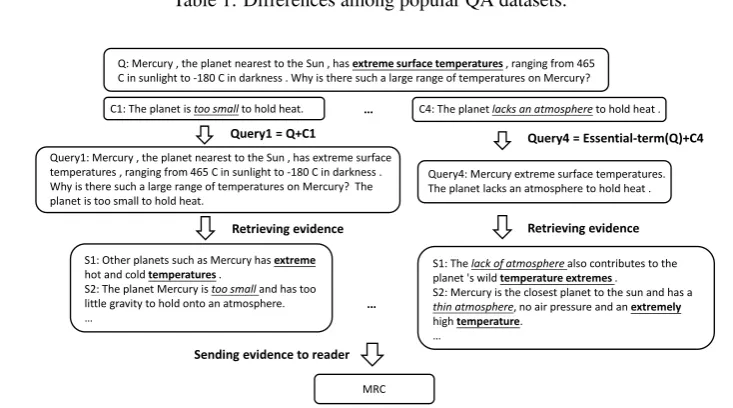
Figure1shows an example of a question in the ARC dataset and demonstrates the difficulties in retrieval and reading comprehension. As shown for Choice 1 (C1), a simple concatenation of the
1
Dataset # of questions Open-domain
Multiple choice
Passage retrieval
No ranking supervision1
ARC (Clark et al.,2018) ≈7K 3 3 3 3
Amazon-QA (McAuley and Yang,2016) ≈1.48M 3 3
SQuAD (Rajpurkar et al.,2016) ≈100K 3
TriviaQA (Joshi et al.,2017) ≈650K 3
[image:2.595.112.479.164.368.2]MS-Macro (Nguyen et al.,2016) ≈1M 3
Table 1: Differences among popular QA datasets.
Query1: Mercury , the planet nearest to the Sun , has extreme surface temperatures , ranging from 465 C in sunlight to -180 C in darkness . Why is there such a large range of temperatures on Mercury? The planet is too small to hold heat.
Q: Mercury , the planet nearest to the Sun , has extreme surface temperatures, ranging from 465 C in sunlight to -180 C in darkness . Why is there such a large range of temperatures on Mercury?
C1: The planet is too smallto hold heat. C4: The planet lacks an atmosphereto hold heat .
Query1 = Q+C1
S1: The lack of atmosphere also contributes to the planet 's wild temperature extremes .
S2: Mercury is the closest planet to the sun and has a
thin atmosphere, no air pressure and an extremely
high temperature. …
S1: Other planets such as Mercury has extreme
hot and cold temperatures.
S2: The planet Mercury is too small and has too little gravity to hold onto an atmosphere. …
MRC
…
… Retrieving evidence
Sending evidence to reader
Query4: Mercury extreme surface temperatures. The planet lacks an atmosphere to hold heat .
Retrieving evidence Query4 = Essential-term(Q)+C4
Figure 1: Example of the retrieve-and-read process to solve open-domain questions. Words related with the ques-tion are inbold; and words related with C1 and C4 are initalics.
question and the answer choice is not a reliable query and is of little help when trying to find sup-porting evidence to answer the question (e.g. we might retrieve sentences similar to the question or the answer choice, but would struggle to find ev-idence explaining why the answer choice is cor-rect). On the other hand, a reformulated query consisting of essential terms in the question and Choice 4 can help retrieve evidence explaining why Choice 4 is a correct answer. To achieve this, the model needs to (1) ensure that the retrieved evidence supports the fact mentioned in both the question and the answer choices and (2) capture this information and predict the correct answer.
To address these difficulties, we propose an essential-term-aware Retriever-Reader (ET-RR) model that learns to attend on essential terms dur-ing retrieval and readdur-ing. Specifically, we develop a two-stage method with an essential term selector followed by an attention-enhanced reader.
Essential term selector. ET-Net is a recurrent neural network that seeks to understand the ques-tion and select essential terms, i.e., key words, from the question. We frame this problem as a classification task for each word in the question.
These essential terms are then concatenated with each answer choice and fed into a retrieval engine to obtain related evidence.
Attention-Enhanced Reader. Our neural reader takes the triples (question, answer choice, retrieved passage) as input. The reader consists of a sequence of language understanding layers: an input layer, attention layer, sequence model-ing layer, fusion layer, and an output layer. The attention and fusion layers help the model to ob-tain a refined representation of one text sequence based on the understanding of another, e.g. a pas-sage representation based on an understanding of the question. We further add a choice-interaction module to handle the semantic relations and differ-ences between answer choices. Experiments show that this can further improve the model’s accuracy. We evaluate our model on the ARC Chal-lenge dataset, where our model achieves an ac-curacy of 36.61% on the test set, and outper-formed all leaderboard solutions at the time of writing (Sep. 2018). To compare with other benchmark datasets, we adapt RACE (Lai et al.,
super-vision in the form of relevant passages. We also consider a large-scale real-world open-domain dataset, Amazon-QA, to evaluate our model’s scalability and to compare against standard bench-marks designed for the open-domain setting. Ex-periments on these three datasets show that ET-RR outperforms baseline models by a large mar-gin. We conduct multiple ablation studies to show the effectiveness of each component of our model. Finally, we perform in-depth error analysis to ex-plore the model’s limitations.
2 Related Work
There has recently been growing interest in build-ing better retrievers for open-domain QA. Wang et al. (2018b) proposed a Reinforced Ranker-Reader model that ranks retrieved evidence and assigns different weights to evidence prior to pro-cessing by the reader. Min et al. (2018) demon-strated that for several popular MRC datasets (e.g. SQuAD, TriviaQA) most questions can be answered using only a few sentences rather than the entire document. Motivated by this observa-tion, they built a sentence selector to gather this potential evidence for use by the reader model.
Nishida et al.(2018) developed a multi-task learn-ing (MTL) method for a retriever and reader in or-der to obtain a strong retriever that consior-ders cer-tain passages including the answer text as posi-tive samples during training. The proposed MTL framework is still limited to scenarios where it is feasible to discover whether the passages con-tain the answer span. Although these works have achieved progress on open-domain QA by improv-ing the rankimprov-ing or selection of given evidence, few have focused on the scenario where the model needs to start by searching for the evidence itself.
Scientific Question Answering (SQA) is a rep-resentative open-domain task that requires capa-bility in both retrieval and reading comprehen-sion. In this paper, we study question answering on the AI2 Reasoning Challenge (ARC) scientific QA dataset (Clark et al.,2018). This dataset con-tains multiple-choice scientific questions from 3rd to 9th grade standardized tests and a large cor-pus of relevant information gathered from search engines. The dataset is partitioned into “Chal-lenge” and “Easy” sets. The challenge set consists of questions that cannot be answered correctly by either of the solvers based on Pointwise Mutual Information (PMI) or Information Retrieval (IR).
Existing models tend to achieve only slightly bet-ter and sometimes even worse performance than random guessing, which shows that existing mod-els are not well suited to this kind of QA task.
Jansen et al.(2017) first developed a rule-based focus word extractor to identify essential terms in the question and answer candidates. The extracted terms are used to aggregate a list of potential an-swer justifications for each anan-swer candidate. Ex-periments shown that focus words are beneficial for SQA on a subset of the ARC dataset.Khashabi et al.(2017) also worked on the problem of find-ing essential terms in a question for solvfind-ing SQA problems. They published a dataset containing over 2,200 science questions annotated with es-sential terms and train multiple classifiers on it. Similarly, we leverage this dataset to build an es-sential term selector using a neural network-based algorithm. More recently, Boratko et al. (2018) developed a labeling interface to obtain high qual-ity labels for the ARC dataset. One finding is that human annotators tend to retrieve better evidence after they reformulate the search queries which are originally constructed by a simple concatenation of question and answer choice. By feeding the evidence obtained by human-reformulated queries into a pre-trained MRC model (i.e., DrQA (Chen et al., 2017)) they achieved an accuracy increase of 42% on a subset of 47 questions. This shows the potential for a “human-like” retriever to boost performance on this task.
para-graph ranking, F1 and Exact Matching for span-based MRC). Different from these works, we train the query reformulator using an annotated dataset as supervision and then apply the output to a sep-arate reader model. We leave the exploration of training our model end-to-end using reinforcement learning as future work.
3 Approach
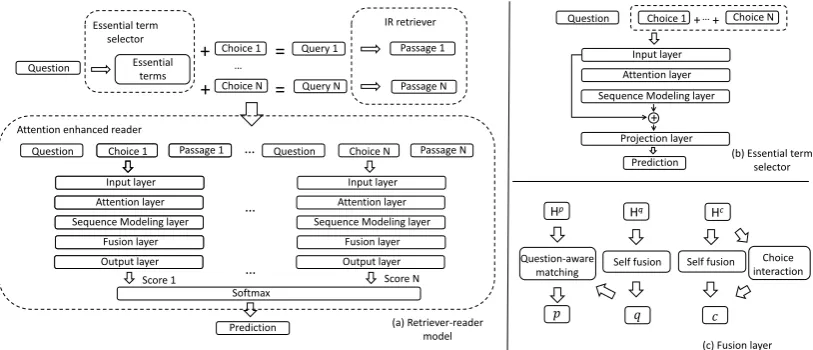
In this section, we introduce the essential-term-aware retriever-reader model (ET-RR). As shown in Figure 2, we build a term selector to discover which terms are essential in a question. The se-lected terms are then used to formulate a more effi-cient query enabling the retriever to obtain related evidence. The retrieved evidence is then fed to the reader to predict the final answer.
For a question with q words Q = {wtQ}qt=1
along with itsN answer choicesC = {Cn}Nn=1 whereCn={wCt }ct=1, the essential-term selector chooses a subset of essential termsE⊂Q, which are then concatenated with eachCnto formulate a query. The query for each answer choice,E+Cn, is sent to the retriever (e.g. Elastic Search2), and the topK retrieved sentences based on the scores returned by the retriever are then concatenated into the evidence passagePn={wPt }Kt=1.
Next, given these text sequences Q, C, and
P={Pn}Nn=1, the reader will determine a match-ing score for each triple{Q,Cn,Pn}. The answer choiceCn∗with the highest score is selected.
We first introduce the reader model in Sec-tion3.1and then the essential term selector in Sec-tion3.2.
3.1 Reader Model
3.1.1 Input Layer
To simplify notation, we ignore the subscript n
denoting the answer choice until the final output layer. In the input layer, all text inputs—the ques-tion, answer choices, and passages, i.e., retrieved evidence—are converted into embedded represen-tations. Similar toWang(2018), we consider the following components for each word:
Word Embedding. Pre-trained GloVe word em-bedding with dimensionalitydw = 300.
Part-of-Speech Embedding and Named-Entity Embedding. The part-of-speech tags and named entities for each word are mapped to embeddings with dimension 16.
2https://www.elastic.co/products/elasticsearch
Relation Embedding. A relation between each word inPand any word inQorCis mapped to an embedding with dimension 10. In the case that multiple relations exist, we select one uniformly at random. The relation is obtained by querying ConceptNet (Speer et al.,2017).
Feature Embeddings. Three handcrafted features are used to enhance the word representations: (1) Word Match; if a word or its lemma ofPexists in
Q orC, then this feature is 1 (0 otherwise). (2) Word Frequency; a logarithmic term frequency is calculated for each word. (3) Essential Term; for the i-th word in Q, this feature, denoted as wei,
is 1 if the word is an essential term (0 otherwise). Letwe= [we1, we2, . . . , weq]denote the essential
term vector.
For Q,C,P, all of these components are con-catenated to obtain the final word representations
WQ ∈ Rq×dQ,WC ∈ Rc×dC,WP ∈ Rp×dP,
where dQ, dC, dP are the final word dimensions ofQ,C,andP.
3.1.2 Attention Layer
As shown in Figure2, after obtaining word-level embeddings, attention is added to enhance word representations. Given two word embedding se-quencesWU,WV, word-level attention is calcu-lated as:
M0U V =WUU·(WVV)>
MU V = softmax(M
0
U V)
WVU =MU V ·(WVV),
(1)
where U ∈ RdU×dw and V ∈
RdV×dw are two
matrices that convert word embedding sequences to dimensiondw, andM
0
U V contains dot products between each word in WU and WV, and soft-max is applied on M0U V row-wise. Three types of attention are calculated using Equation (1): (1) question-aware passage representationWQP ∈
Rp×dw; (2) question-aware choice representation WCQ∈Rc×dw; and (3) passage-aware choice
rep-resentationWCP ∈Rc×dw.
3.1.3 Sequence Modeling Layer
To model the contextual dependency of each text sequence, we use BiLSTMs to process the word representations obtained from the input layer and attention layer:
Hq =BiLSTM[WQ]
Hc=BiLSTM[WC;WPC;W Q C]
Hp =BiLSTM[WP;WQP],
Question Essential terms
Choice 1
Choice N …
Query 1
Query N
Passage 1 IR retriever
Attention enhanced reader
…
…
Prediction Essential term
selector
Choice 1 Passage 1 + +
=
= Passage N
Softmax
Hc
Self fusion Question-aware
matching Self fusion
Hp Hq
Choice interaction
𝑝𝑝 𝑞𝑞 𝑐𝑐
Question Choice 1 Choice N
Sequence Modeling layer
Prediction Input layer Attention layer
(a) Retriever-reader
model (c) Fusion layer (b) Essential term
selector …
Projection layer
+ +
+
Sequence Modeling layer Fusion layer
Score 1 Input layer Attention layer
Output layer Question Choice 1 Passage 1
Sequence Modeling layer Fusion layer
Input layer Attention layer
Output layer
Question Choice N Passage N
Sequence Modeling layer Fusion layer
Score N Input layer Attention layer
[image:5.595.95.502.63.238.2]Output layer …
Figure 2: Model structure for our essential-term-aware retriever-reader model.
where Hq ∈ Rq×l,Hc ∈
Rc×l, and Hp ∈ Rp×l are the hidden states of the BiLSTMs, ‘;’ is
feature-wise concatenation, andlis the size of the hidden states.
3.1.4 Fusion Layer
We further convert each question and answer choice into a single vector:q∈Rlandc∈
Rl:
αq= softmax([Hq;we]·w>sq), q=Hq
>
αq
αc= softmax(Hc·w>sc), c=Hc
> αc,
(3) where the essential-term feature we from Sec-tion 3.1.1is concatenated with Hq, andwsq and
wscare learned parameters.
Finally, a bilinear sequence matching is calcu-lated betweenHpandqto obtain a question-aware passage representation, which is used as the final passage representation:
αp = softmax(Hp·q); p=Hp>αp. (4)
3.1.5 Choice Interaction
When a QA task provides multiple choices for se-lection, the relationship between the choices can provide useful information to answer the question. Therefore, we integrate a choice interaction layer to handle the semantic correlation between multi-ple answer choices. Given the hidden stateHcnof
choicecnandHciof other choicesci,∀i6=n, we calculate the differences between the hidden states and apply max-pooling over the differences:
cinter = Maxpool(Hcn−
1
N −1 X
i6=n
Hci), (5)
where N is the total number of answer choices. Here,cinter characterizes the differences between
an answer choice cn and other answer choices. The final representation of an answer choice is up-dated by concatenating the self-attentive answer choice vector and inter-choice representation as
cfinal = [c;c inter].
3.1.6 Output Layer
For each tuple{q,pn,cn}Nn=1, two scores are cal-culated by matching (1) the passage and answer choice and (2) question and answer choice. We use a bilinear form for both matchings. Finally, a softmax function is applied overNanswer choices to determine the best answer choice:
spcn =pnWpccnfinal; sqcn =qWqccfinaln
s= softmax(spc) + softmax(sqc), (6)
where spcn, sqcn are the scores for answer choice 1 ≤ n ≤ N;spc,sqc are score vectors for allN
choices; and s contains the final scores for each answer choice. During training, we use a cross-entropy loss.
3.2 Essential Term Selector
Essential terms are key words in a question that are crucial in helping a retriever obtain related ev-idence. Given a questionQandNanswer choices
C1, . . . ,CN, the goal is to predict a binary vari-ableyifor each wordQiin the questionQ, where
yi = 1ifQi is an essential term and 0 otherwise. To address this problem, we build a neural model, ET-Net, which has the same design as the reader model for the input layer, attention layer, and se-quence modeling layer to obtain the hidden state
Hqfor questionQ.
Question If an object is attracted to a magnet, the object is most likely made of (A) wood (B) plastic (C) cardboard (D) metal
# annotators 5
[image:6.595.339.509.59.146.2]Annotation If,0; an,0; object,3; is,0; attracted,5; to,0; a,0; magnet,,5; the,0; object,1; is,0; most,0; likely,0; made,2; of,0
Table 2: Example of essential term data.
Model Precision Recall F1 MaxPMI 0.88 0.65 0.75 SumPMI 0.88 0.65 0.75 PropSurf 0.68 0.64 0.66 PropLem 0.76 0.64 0.69 ET Classifier 0.91 0.71 0.80 ET-Net 0.74 0.90 0.81
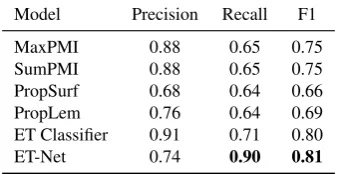
Table 3: Performance of different selectors.
ET-Net. QandCfirst go through an input layer to convert to the embedded word representation, and then word-level attention is calculated to ob-tain a choice-aware question representation WQC
as in Equation (1). We concatenate the word repre-sentation and word-level attention reprerepre-sentation of the question and feed it into the sequence mod-eling layer:
Hq =BiLSTM[WQ;WCQ]. (7)
As shown in Figure2, the hidden states obtained from the attention layer are then concatenated with the embedded representations of Q and fed into a projection layer to obtain the prediction vector
y∈Rqfor all words in the question:
y= [Hq;WfQ]·ws, (8)
where ws contains the learned parameters, and
WQf is the concatenation of the POS embedding, NER embedding, relation embedding, and feature embedding from Section3.1.1.
After obtaining the prediction for each word, we use a binary cross-entropy loss to train the model. During evaluation, we take words withyi greater than 0.5 as essential terms.
4 Experiments
In this section, we first discuss the performance of the essential term selector, ET-Net, on a public dataset. We then discuss the performance of the whole retriever-reader pipeline, ET-RR, on mul-tiple open-domain datasets.For both the ET-Net and ET-RR models, we use 96-dimensional hid-den states and 1-layer BiLSTMs in the sequence modeling layer. A dropout rate of 0.4 is applied for the embedding layer and the BiLSTMs’ out-put layer. We use adamax (Kingma and Ba,2014) with a learning rate of 0.02 and batch size of 32. The model is trained for 100 epochs. Our code is released at https://github.com/ nijianmo/arc-etrr-code.
4.1 Performance on Essential Term Selection
We use the public dataset from Khashabi et al.
(2017) which contains 2,223 annotated questions, each accompanied by four answer choices. Ta-ble2 gives an example of an annotated question. As shown, the dataset is annotated for binary clas-sification. For each word in the question, the data measures whether the word is an “essential” term according to 5 annotators. We then split the dataset into training, development, and test sets us-ing an 8:1:1 ratio and select the model that per-forms best on the development set.
Table3shows the performance of our essential term selector and baseline models fromKhashabi et al.(2017). The second best model (ET Classi-fier) is an SVM-based model fromKhashabi et al.
(2017) requiring over 100 handcrafted features. As shown, our ET-Net achieves a comparable re-sult with ET Classifier in terms of the F1 Score.
Table4shows example predictions made by ET-Net. As shown, ET-Net is capable of selecting most ground-truth essential terms. It rejects cer-tain words such as “organisms” which have a high TF-IDF in the corpus but are not relevant to an-swering a particular question. This shows its abil-ity to discover essential terms according to the context of the question.
4.2 Performance on Open-domain Multiple-choice QA
We train and evaluate our proposed pipeline method ET-RR on four open-domain multiple-choice QA datasets. All datasets are associated with a sentence-level corpus. Detailed statistics are shown in Table5.
• ARC (Clark et al., 2018): We consider the ‘Challenge’ set in the ARC dataset and use the provided corpus during retrieval.
Example questions
Whichunitof measurementcan be used to describe the
lengthof adesk?
One way animal usually respond to a sudden drop in
temperatureis by
Organisms require energy to survive. Which of the follow-ingprocesses provides energyto the body ?
Table 4: Examples of essential term prediction (in ques-tions) by ET-Net. True positives are marked bold and underlined while false positives are only underlined.
Dataset Train Dev Test Corpus ARC 1,119 299 1,172 1.46M RACE-Open 9,531 473 528 0.52M MCScript-Open 1,036 156 319 24.2K Amazon-Patio 36,587 4,531 4,515 2.55M Amazon-Auto 49,643 6,205 6,206 7.32M Amazon-Cell 40,842 5,105 5,106 1.86M
Table 5: Statistics on ARC, RACE-Open, MCScript-Open and Amazon-QA. Corpus size is the number of sentences.
Dataset Example questions
ARC The best way to separate salt from water is with the use of
Which geologic process most likely caused the formation of the Mount St. Helens Volcano?
RACE-Open According to the article, what does the band Four Square hope to do in the future? According to the article we know it is to prevent the forests from slowly disappearing.
Amazon-QA For anyone with small ears, do these fit comfortably or do they feel like they are always going to fall out, not in correctly, etc.
Does it remove easily and does it leave any sticky residue behind? thanks in advance.
Table 6: Example of predictions on ARC, RACE-Open and Amazon-QA. Predicted terms are underlined.
with a specific passage. To enable passage retrieval, we concatenate all passages into a corpus with sentence deduplication.3
• MCScript-Open: The MCScript (Ostermann et al., 2018) dataset is also adapted to the open-domain setting. Again we concatenate all passages to build the corpus.4
• Amazon-QA: The Amazon-QA dataset (McAuley and Yang, 2016) is an open-domain QA dataset covering over one million questions across multiple product categories. Each question is associated with a free-form answer. We adapt it into a 2-way multiple-choice setting by randomly sampling an answer from other questions as an answer distractor. We split all product reviews at the sentence-level to build the corpus. We consider three categories from the complete dataset in our experiments.
In the experiments, ET-RR uses ET-Net to choose essential terms in the question. Ta-ble 6 shows example predictions on these target datasets. Then it generates a query for each of the N answer choices by concatenating essential
3As short questions might not contain any words which
can relate the question to any specific passage or sentence, we only keep questions with more than 15 words.
4We keep questions with more than 10 words rather than
15 words to ensure that there is sufficient data.
terms and the answer choice. For each query, ET-RR obtains the topKsentences returned by the re-triever and considers these sentences as a passage for the reader. We setK = 10for all experiments. We compare ET-RR with existing retrieve-and-read methods on both datasets. As shown in Ta-ble7, on the ARC dataset, ET-RR outperforms all previous models without using pre-trained mod-els and achieves a relative 8.1% improvement over the second best BiLSTM Max-out method ( Mi-haylov et al.,2018). Recently, finetuning on pre-trained models has shown great improvement over a wide range of NLP tasks. Sun et al.(2019) pro-posed a ‘Reading Strategies’ method to finetune the pre-trained model OpenAI GPT, a language model trained on the BookCorpus dataset ( Rad-ford, 2018). They trained Reading Strategies on the RACE dataset to obtain more auxiliary knowl-edge and then finetune that model on the ARC cor-pus. Table8demonstrates the performance com-parison of ET-RR and Reading Strategies on ARC. As shown, though Reading Strategies trained on both ARC and RACE dataset outperforms ET-RR, ET-RR outperforms Reading Strategies using only the ARC dataset at training time.
Model ARC RACE-Open MCScript-Open Test Test Test IR solver 20.26 30.70 60.46 Random 25.02 25.01 50.02 BiDAF 26.54 26.89 50.81 BiLSTM Max-out 33.87 / / ET-RR (Concat) 35.33 36.87 66.46 ET-RR 36.61 38.61 67.71
Table 7: Accuracy on multiple-choice selection on ARC, RACE-Open and MCScript-Open.
Training Corpus model ARC
[image:8.595.337.522.79.141.2]ARC Reading Strategies 35.0 ET-RR 36.6 ARC+RACE Reading Strategies 40.7
Table 8: Comparisons of ET-RR and Reading Strategies on ARC.
Model Amazon Amazon Aamzon -Patio -Auto -Cell IR solver 72.80 73.60 70.50 Moqa 84.80 86.30 88.60 ET-RR (Concat) 96.19 95.21 93.26 ET-RR 96.61 95.96 93.81
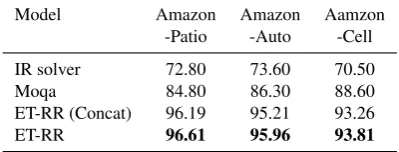
Table 9: Accuracy on multiple-choice selection on three product categoris of Amazon-QA.
Pre-trained model RACE
3 Reading Strategies 63.8
3 OpenAI GPT 59.0 ET-RR (reader) 52.3
Bi-attn (MRU) 50.4 Hier. Co-Matching 50.4
Table 10: Experimental results for reader on RACE.
the Amazon-QA dataset. As shown in Table 9, ET-RR increases the accuracy by 10.33% on aver-age compared to the state-of-the-art model Moqa (McAuley and Yang,2016). We also compare ET-RR with ET-ET-RR (Concat), which is a variant of our proposed model that concatenates the question and choice as a query for each choice. Among all datasets, ET-RR outperforms ET-RR (concat) consistently which shows the effectiveness of our essential-term-aware retriever.
4.3 Ablation study
We investigate how each component contributes to model performance.
Performance of reader. Our reader alone can be applied on MRC tasks using the given pas-sages. Here, we evaluate our reader on the orig-inal RACE dataset to compare with other MRC models as shown in Table 10. As shown, the re-cently proposed Reading Strategies and OpenAI GPT models, that finetune generative pre-trained models achieve the highest scores. Among non-pre-trained models, our reader outperforms other
Model Test ET-RR 36.61
[image:8.595.81.281.207.283.2]– inter-choice 36.36 – passage-choice 35.41 – question-choice 34.47 – passage-question 34.05
Table 11: Ablation test on attention components of ET-RR on ARC. ‘–’ denotes the ablated feature.
baselines: Bi-attn (MRU) (Tay et al., 2018) and Hierarchical Co-Matching (Wang et al.,2018a) by a relative improvement of 3.8%.
Attention components. Table11demonstrates how the attention components contribute to the performance of ET-RR. As shown, ET-RR with all attention components performs the best on the ARC test set. The performance of ET-RR without passage-question attention drops the most signifi-cantly out of all the components. It is worth not-ing that the choice interaction layer gives a further 0.24% boost on test accuracy.
Essential term selection. To understand the contribution of our essential-term selector, we compare ET-RR with two variants: (1) ET-RR (Concat) and (2) ET-RR (TF-IDF). For ET-RR (TF-IDF), we calculate the TF-IDF scores and take words with the top 30% of TF-IDF scores in the question to concatenate with each answer choice as a query.5
Table 12 shows an ablation study comparing different query formulation methods and amounts of retrieved evidenceK. As shown, with the es-sential term selector ET-Net, the model consis-tently outperforms other baselines, given different numbers of retrievalsK. Performance for all mod-els is best whenK= 10. Furthermore, only using TF-IDF to select essential terms in a question is not effective. WhenK = 10, the ET-RR (TF-IDF)
5According to the annotated dataset, around 30% of the
[image:8.595.358.473.209.289.2] [image:8.595.97.266.325.403.2]Model ET-RR ET-RR ET-RR (Concat) (TF-IDF)
TopK Dev Test Dev Test Dev Test 5 39.26 33.36 39.93 34.73 39.93 35.59 10 38.93 35.33 39.43 35.24 43.96 36.61
20 41.28 34.56 38.59 33.88 42.28 35.67
Table 12: Comparison of query formulation methods and amounts of retrieved evidence (i.e., topK) on the ARC dataset, in terms of percentage accuracy.
method performs even worse than ET-RR (Con-cat). This illustrates the challenges in understand-ing what is essential in a question.
Though RR consistently outperforms ET-RR (TF-IDF), the improvement is relatively mod-est on the Tmod-est set (around 1.4%). A similar out-come has been reported in Jansen et al. (2017);
Khashabi et al. (2017) where essential term ex-traction methods have shown around 2%-4% gain compared with TF-IDF models and struggle to ob-tain further improvement on SQA tasks. This con-sensus might show the discrepancy of essential terms between human and machine (i.e., the es-sential terms obtained using a human annotated dataset might not be helpful in a machine infer-ence model). Another reason might be the current retrieval method does not effectively use these es-sential terms and the performance highly depends on the dataset. Note that the ET-RR outperforms ET-RR (TF-IDF) by around 4% on the Dev set. Therefore, how to develop well-formed single or even multi-hop queries using these terms are worth studying in the future.
4.4 Error Analysis
Table13shows two major types of error, where the correct answer choice is inboldand the predicted answer choice is initalics.
Retrieved supporting evidence but failed to rea-son over it. For the first question, there exists ev-idence that can justify the answer candidate (C). However, the model chooses (D) which has more words overlapping with its evidence. This shows that the model still lacks the reasoning capability to solve complex questions.
Failed to retrieve supporting evidence. For the second question, the retrieved evidence of both the correct answer (D) and the prediction (B) is not helpful to solve the question. Queries such as ‘what determines the year of a planet’ are needed to acquire the knowledge for solving this question.
The elements carbon, hydrogen, and oxygen are parts of many different compounds. Which explains why these three elements can make so many different compounds? (A) They can be solids, liquids, or gases.
(B) They come in different sizes and shapes.
(C) They combine in different numbers and ratios.
* There are many different types of compounds because atoms of elements combine in many different ways (and in different whole number ratios) to form different com-pounds.
(D) They can be a proton, a neutron, or an electron.
* Atoms of different elements have a different number of protons, neutrons, and electrons.
Which planet in the solar system has the longest year? (A) The planet closest to the Sun.
(B) The planet with the longest day.
* The planet with the longest day is Venus; a day on Venus takes 243 Earth days.
(C) The planet with the most moons.
(D) The planet farthest from the Sun.
* The last planet discovered in our solar system is farthest away from the sun.
Table 13: Examples where ET-RR fails on ARC. The retrieved evidence for each answer candidate is marked by *.
This poses further challenges to design a retriever that can rewrite such queries.
5 Conclusion
We present a new retriever-reader model (ET-RR) for open-domain QA. Our pipeline has the follow-ing contributions: (1) we built an essential term se-lector (ET-Net) which helps the model understand which words are essential in a question leading to more effective search queries when retrieving related evidence; (2) we developed an attention-enhanced reader with attention and fusion among passages, questions, and candidate answers. Ex-perimental results show that ET-RR outperforms existing QA models on open-domain multiple-choice datasets as ARC Challenge, RACE-Open, MCScript-Open and Amazon-QA. We also per-form in-depth error analysis to show the limita-tions of current work. For future work, we plan to explore the directions of (1) constructing multi-hop query and (2) developing end-to-end retriever-reader model via reinforcement learning.
Acknowledgments
References
Michael Boratko, Harshit Padigela, Divyendra Mikki-lineni, Pritish Yuvraj, Rajarshi Das, Andrew Mc-Callum, Maria Chang, Achille Fokoue, Pavan Ka-panipathi, Nicholas Mattei, Ryan Musa, Kartik Ta-lamadupula, and Michael Witbrock. 2018. A sys-tematic classification of knowledge, reasoning, and context within the arc dataset. In1st Workshop on Machine Reading for Question Answering.
Christian Buck, Jannis Bulian, Massimiliano Cia-ramita, Andrea Gesmundo, Neil Houlsby, Wojciech Gajewski, and Wei Wang. 2018. Ask the right ques-tions: Active question reformulation with reinforce-ment learning. InICLR.
Danqi Chen, Adam Fisch, Jason Weston, and Antoine Bordes. 2017. Reading wikipedia to answer open-domain questions. InACL.
Peter Clark, Isaac Cowhey, Oren Etzioni, Tushar Khot, Ashish Sabharwal, Carissa Schoenick, and Oyvind Tafjord. 2018. Think you have solved question answering? try arc, the ai2 reasoning challenge.
CoRR, abs/1803.05457.
Rajarshi Das, Shehzaad Dhuliawala, Manzil Zaheer, and Andrew McCallum. 2019. Multi-step retriever-reader interaction for scalable open-domain question answering. InICLR.
Peter Jansen, Rebecca Sharp, Mihai Surdeanu, and Pe-ter Clark. 2017. Framing qa as building and ranking intersentence answer justifications. Computational Linguistics, 43:407–449.
Mandar Joshi, Eunsol Choi, Daniel S. Weld, and Luke S. Zettlemoyer. 2017. Triviaqa: A large scale distantly supervised challenge dataset for reading comprehension. InACL.
Daniel Khashabi, Tushar Khot, Ashish Sabharwal, and Dan Roth. 2017. Learning what is essential in ques-tions. InCoNLL.
Diederik P. Kingma and Jimmy Ba. 2014. Adam: A method for stochastic optimization. CoRR, abs/1412.6980.
Heeyoung Kwon, Harsh Trivedi, Peter Jansen, Mi-hai Surdeanu, and Niranjan Balasubramanian. 2018. Controlling information aggregation for complex question answering. InECIR.
Guokun Lai, Qizhe Xie, Hanxiao Liu, Yiming Yang, and Eduard H. Hovy. 2017. Race: Large-scale read-ing comprehension dataset from examinations. In
EMNLP.
Victor Lavrenko and W. Bruce Croft. 2001. Relevance-based language models. SIGIR Forum, 51:260–267.
Julian McAuley and Alex Yang. 2016. Addressing complex and subjective product-related queries with customer reviews. InWWW.
Todor Mihaylov, Peter Clark, Tushar Khot, and Ashish Sabharwal. 2018. Can a suit of armor conduct elec-tricity? a new dataset for open book question an-swering. InEMNLP.
Sewon Min, Victor Zhong, Richard Socher, and Caim-ing Xiong. 2018. Efficient and robust question an-swering from minimal context over documents. In
ACL.
Tri Nguyen, Mir Rosenberg, Xia Song, Jianfeng Gao, Saurabh Tiwary, Rangan Majumder, and Li Deng. 2016. Ms marco: A human generated machine read-ing comprehension dataset. CoRR, abs/1611.09268.
Kyosuke Nishida, Itsumi Saito, Atsushi Otsuka, Hisako Asano, and Junji Tomita. 2018. Retrieve-and-read: Multi-task learning of information retrieval and reading comprehension. InCIKM.
Rodrigo Nogueira and Kyunghyun Cho. 2017. Task-oriented query reformulation with reinforcement learning. InEMNLP.
Simon Ostermann, Michael Roth, Ashutosh Modi, Ste-fan Thater, and Manfred Pinkal. 2018. Semeval-2018 task 11: Machine comprehension using com-monsense knowledge. InSemEval@NAACL-HLT.
Alec Radford. 2018. Improving language understand-ing by generative pre-trainunderstand-ing. InTechnical report.
Pranav Rajpurkar, Jian Zhang, Konstantin Lopyrev, and Percy Liang. 2016. Squad: 100, 000+ questions for machine comprehension of text. InEMNLP.
Robert Speer, Joshua Chin, and Catherine Havasi. 2017. Conceptnet 5.5: An open multilingual graph of general knowledge. InAAAI.
Kai Sun, Dian Yu, Dong Yu, and Claire Cardie. 2019. Improving machine reading comprehension with general reading strategies. InNAACL.
Yi Tay, Luu Anh Tuan, and Siu Cheung Hui. 2018. Multi-range reasoning for machine comprehension.
CoRR, abs/1803.09074.
Liang Wang. 2018. Yuanfudao at semeval-2018 task 11: Three-way attention and relational knowledge for commonsense machine comprehension. In
SemEval@NAACL-HLT.
Shuohang Wang, Mo Yu, Shiyu Chang, and Jing Jiang. 2018a. A co-matching model for multi-choice read-ing comprehension. InACL.