1648
Something’s Brewing!
Early Prediction of Controversy-causing Posts from Discussion Features
Jack Hessel
Cornell University
Lillian Lee
Cornell University [email protected]
Abstract
Controversial posts are those that split the preferences of a community, receiving both significant positive and significant negative feedback. Our inclusion of the word “com-munity” here is deliberate: what is controver-sial to some audiences may not be so to oth-ers. Using data from several different commu-nities onreddit.com, we predict the ulti-mate controversiality of posts, leveraging fea-tures drawn from both the textual content and the tree structure of the early comments that initiate the discussion. We find that even when only a handful of comments are available, e.g., the first 5 comments made within 15 minutes of the original post, discussion features often add predictive capacity to strong content-and-rate only baselines. Additional experiments on domain transfer suggest that conversation-structure features often generalize to other communities better than conversation-content features do.
1 Introduction
Controversial content — that which attracts both positive and negative feedback — is not necessar-ily a bad thing; for instance, bringing up a point that warrants spirited debate can improve com-munity health.1 But regardless of the nature of the controversy, detecting potentially controversial content can be useful for both community mem-bers and community moderators. Ordinary users, and in particular new users, might appreciate being warned that they need to add more nuance or qual-ification to their earlier posts.2 Moderators could be alerted that the discussion ensuing from some
1Coser(1956);Jehn(1995);De Dreu and Weingart(2003)
discuss how disagreement interacts with group makeup,
group-task type, and outcome. Chen and Berger (2013)
demonstrate a non-linear relationship between controversy and amount of subsequent discussion.
2We set aside the issue of
trollswhose intent is solely to divide a community.
content might need monitoring. Alternately, they could draw community attention to issues possi-bly needing resolution: indeed, some sites already provide explicit sorting by controversy.
We consider the controversiality of a piece of content in the context of the community in which it is shared, because what is controversial to some audiences may not be so to others (Chen and Berger, 2013; Jang et al., 2017; Basile et al.,
2017). For example, we identify “break up” as a controversial concept in therelationships sub-reddit (a subsub-reddit is a subcommunity hosted on the Reddit discussion site), but the same topic is associated with a lack of controversy in the AskWomensubreddit (where questions are posed for women to answer). Similarly, topics that are controversial in one community may simply not be discussed in another: our analysis identifies “crossfit”, a type of workout, as one of the most controversial concepts in the subredditFitness.
However, while controversial topics may be community-specific, community moderators still may not be able to determine a priori which posts will attract controversy. Many factors cannot be known ahead of time, e.g., a fixed set of topics may not be dynamic enough to handle a sudden current event, or the specific set of users that happen to be online at a given time may react in unpredictable ways. Indeed, experiments have shown that, to a certain extent, the influence of early opinions on subsequent opinion dynamics can override the in-fluence of an item’s actual content (Salganik et al.,
2006;Wu and Huberman, 2008;Muchnik et al.,
2013;Weninger et al.,2015).
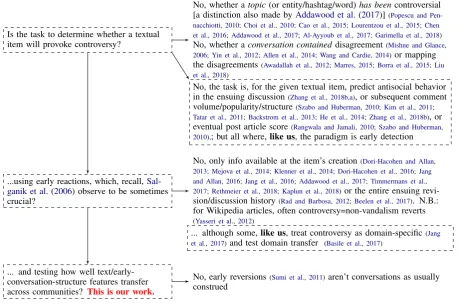
discus-Is the task to determine whether a textual item will provoke controversy?
No, whether atopic(or entity/hashtag/word)has beencontroversial [a distinction also made byAddawood et al.(2017)](Popescu and Pen-nacchiotti,2010;Choi et al.,2010;Cao et al.,2015;Lourentzou et al.,2015;Chen et al.,2016;Addawood et al.,2017;Al-Ayyoub et al.,2017;Garimella et al.,2018)
No, whether aconversation containeddisagreement(Mishne and Glance,
2006;Yin et al.,2012;Allen et al.,2014;Wang and Cardie,2014)or mapping
the disagreements(Awadallah et al.,2012;Marres,2015;Borra et al.,2015;Liu et al.,2018)
No, the task is, for the given textual item, predict antisocial behavior in the ensuing discussion(Zhang et al.,2018b,a), or subsequent comment volume/popularity/structure(Szabo and Huberman,2010;Kim et al.,2011;
Tatar et al.,2011;Backstrom et al.,2013;He et al.,2014;Zhang et al.,2018b), or
eventual post article score(Rangwala and Jamali,2010;Szabo and Huberman,
2010),; but all where,like us, the paradigm is early detection
No, only info available at the item’s creation(Dori-Hacohen and Allan,
2013;Mejova et al.,2014;Klenner et al.,2014;Dori-Hacohen et al.,2016;Jang and Allan,2016;Jang et al.,2016;Addawood et al.,2017;Timmermans et al.,
2017;Rethmeier et al.,2018;Kaplun et al.,2018)or the entire ensuing revi-sion/discussion history(Rad and Barbosa,2012;Beelen et al.,2017). N.B.:
for Wikipedia articles, often controversy=non-vandalism reverts
(Yasseri et al.,2012)
... although some,like us, treat controversy as domain-specific(Jang et al.,2017)and test domain transfer (Basile et al.,2017)
...using early reactions, which, recall, Sal-ganik et al.(2006) observe to be sometimes crucial?
... and testing how well text/early-conversation-structure features transfer
across communities? This is our work.
[image:2.595.69.530.65.370.2]No, early reversions(Sumi et al.,2011)aren’t conversations as usually construed
Figure 1: How our research relates to prior work.
sion trees across six subreddits, we find that incor-porating structural and textual features of budding comment trees improves predictive performance relatively quickly; for example, in one of the com-munities we consider, adding features taken from just the first 15 minutes of discussion significantly increases prediction performance, even though the average thread only contains 4 comments by that time (∼4% of all eventual comments).
Additionally, we study feature transferability across domains (in our case, communities), train-ing on one subreddit and testtrain-ing on another. While text features of comments carry the great-est predictive capacity in-domain, we find that discussion-tree and -rate features are less brittle, transferring better between communities.
Our results not only suggest the potential use-fulness of granting controversy-prediction algo-rithms a small observation window to gauge com-munity feedback, but also demonstrate the utility of our expressive feature set for early discussions.
2 Datasets
Given our interest in community-specific con-troversiality, we draw data from reddit.com, which hosts several thousand discussion
subcom-munities (subreddits) covering a variety of inter-ests. Our dataset, which attempts to cover all pub-lic posts and comments from Reddit’s inception in 2007 until Feb. 2014, is derived from a combina-tion of Jason Baumgartner’s posts and comments sets and our own scraping efforts to fill in dataset gaps. The result is a mostly-complete set of posts alongside associated comment trees.3 We focus on six text-based4 subreddits ranging over a va-riety of styles and topics: two Q&A subreddits: AskMen(AM) andAskWomen(AW); a special-interest community, Fitness (FT); and three ad-vice communities:LifeProTips(LT), personalfi-nance(PF), andrelationships(RL). Each com-prises tens of thousands of posts and hundreds of thousands to millions of comments.
In Reddit (similarly to other sites allowing ex-plicit negative feedback, such as YouTube, imgur, 9gag, etc.), users can give postsupvotes,
increas-3 Data hosted at pushshift.io, an open data
ini-tiative. Scraping was performed using Reddit’s API or
github.com/pushshift/api. Roughly 10% of
com-ments and 20% of posts are deleted by users and/or moder-ators; also, authorship information is not available for many posts due to deletion of accounts.
/r/LifeProTips (LT)
63 comments, 72% upvoted
LPT: Check the Facebook app to find the owner of a lost smartphone or simply call her 'mum'? Also
slightly less intrusive IMO.
62 comments, 72% upvoted
LPT: get your pets to take their medicine with butter.
This is much better! I have been trying ice cream but my dog is
too smart.
115 comments, 93% upvoted
LPT: For a cleaner home with little effort, never leave a room empty-handed. There is almost always something you can put back in
its place on your way.
Woah.
237 comments, 71% upvoted
**tl;dr** quit whining cuz r/fitness didn't respond they way you wanted... Unfortunately, I doubt this kind of post is going to change anything...
66 comments, 63% upvoted
Interesting New Study: Red Meat Linked With Increased Mortality Risk. Thought this study
is worth a discussion... Man, it seems like everything these
days will lower your life span.
394 comments, 90% upvoted
What type of snack should I have preworkout to avoid lethargy at the gym? I don't wanna be
sluggish at the gym... Apples slices with peanut butter.
61 comments, 57% upvoted
Tipping as legal discrimination: Black servers get tipped 3.25% less... [LINK]...
Tipping should be abandoned anyway, it's ridiculous....
125 comments, 62% upvoted
Am I crazy for wanting this car/payment? Short of it .. car is $45,000... Needing a car for work and purchasing $45k car are two entirely different things.
110 comments, 97% upvoted
Accumulating wealth via homeownership vs accumulating wealth as a renter. One of the often cited benefits of homeownership ...
Use this handy calculator from the NY Times. If you're dilligent...
[image:3.595.72.503.71.212.2]/r/Fitness (FT) /r/personalfinance (PF)
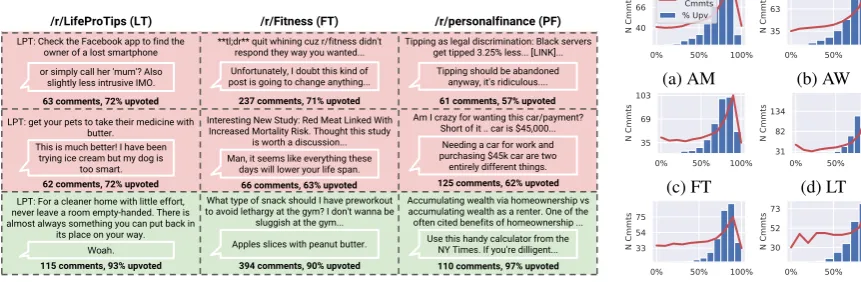
Figure 2: Examples of two controversial and one non-controversial post from three communities. Also shown are the text of the first reply, the num-ber of comments the post received, and its percent-upvoted.
0% 50% 100% 40 66 93 N Cmmts Median Cmmts % Upv (a) AM
0% 50% 100% 35
63 91
N Cmmts
(b) AW
0% 50% 100% 35
69 103
N Cmmts
(c) FT
0% 50% 100% 31
82 134
N Cmmts
(d) LT
0% 50% 100% 33
54 75
N Cmmts
(e) PF
0% 50% 100% 30
52 73
N Cmmts
(f) RL
Figure 3: For each community, a his-togram of percent-upvoted and the median number of comments per bin.
ing a post’s score, or downvotes, decreasing it.5 While the semantics of up/down votes may vary based on community (and, indeed, each user may have their own views on what content should be upvoted and what downvoted), in aggregate, posts that split community reaction fundamentally dif-fer from those that produce agreement. Thus, in principle, posts that have unambiguously received both many upvotes and many downvotes should be deemed the most controversial.
Percent Upvoted on Reddit. We quantify the rel-ative proportion of upvotes and downvotes on a post using percent-upvoted, a measure provided by Reddit that gives an estimate of the percent of all votes on a post that are upvotes. In practice, exact values of percent-upvoted are not directly available; the site adds “vote fuzzing” to fight vote manipulation.6 To begin with, we first dis-card posts with fewer than 30 comments.7 Then, we query for the noisy percent-upvoted from each post ten times using the Reddit API, and take a mean to produce a final estimate.
Post Outcomes. To better understand the inter-play between upvotes and downvotes, we first ex-plore the outcomes for posts both in terms of percent-upvoted and the number of comments;
do-5Vote timestamps are not publicly available. 6
Prior to Dec. 2016, vote information was fuzzed accord-ing to a different algorithm; however, vote statistics for all posts were recomputed according to a new algorithm that, according to a reddit moderator, can “actually be trusted;”
https://goo.gl/yHWeJp 7
The intent is to only consider posts receiving enough community attention for us to reliably compare upvote counts with downvotes. We use number of comments as a proxy for aggregate attention because Reddit does not surface the true number of votes.
ing so on a per-community basis has the potential to surface any subreddit-specific effects. In addi-tion, we compute the median number of comments for posts falling into each bin of the histogram. The resulting plots are given in Figure3.
In general, posts receive mostly positive feed-back in aggregate, though the mean percent-upvoted varies between communities (Table 1). There is also a positive correlation between a post’s percent-upvoted and the number of com-ments it receives. This relationship is unsurpris-ing, given that Reddit displays higher rated posts to more users.
A null hypothesis, which we compare to empir-ically in our prediction experiments, is that popu-larity and percent-upvoted simply carry the same information. However, we have reason to doubt this null hypothesis, as quite a few posts receive significant attention despite having a low percent-upvoted (Figure2).
Assigning Controversy Labels To Posts. We as-sign binary controversy labels (i.e., relatively con-troversial vs. relatively non-concon-troversial) to posts according to the following process: first, we dis-card posts where the observed variability across 10 API queries for percent-upvoted exceeds 5%; in these cases, we assume that there are too few total votes for a stable estimate. Next, we dis-card posts where neither the observed upvote ra-tio nor the observed score8 vary at all; in these cases, we cannot be sure that the upvote ratio is insensitive to the vote fuzzing function.9
Fi-8
A score is the (noised) upvotes minus the downvotes.
9We validate our filtration process in a later section by
# posts # cmnts µupcont µupnoncont
AM 3.3K 474K 66% 90%
AW 3.0K 417K 67% 91%
FT 3.9K 625K 66% 91%
LT 1.6K 208K 68% 91%
PF 1.0K 95K 72% 92%
RL 2.2K 221K 68% 93%
Table 1: Dataset statistics: number of posts, number of comments, mean percent-upvoted for the controversial and non-controversial classes.
nally, we sort each community’s surviving posts by upvote percentage, and discard the small num-ber of posts with percent-upvoted below 50%.10 The top quartile of posts according to this rank-ing (i.e., posts with mostly only upvotes) are la-beled “non-controversial.” The bottom quartile of posts, where the number of downvotes can-not exceed but may approach the number of up-votes, are labeled as “controversial.” For each community, this process yields a balanced, labeled set of controversial/non-controversial posts. Ta-ble1 contains the number of posts/comments for each community after the above filtration process, and the percent-upvoted for the controversial/non-controversial sets.
2.1 Quantitative Validation of Labels
Reddit provides a sort-by-controversy function, and we wanted to ensure that our controversy la-beling method aligned with this ranking.11 We contacted Reddit itself, but they were unable to provide details. Hence, we scraped the 1K most controversial posts according to Reddit (1K is the max that Reddit provides) for each community over the past year (as of October 2018). Next, we sampled posts thatdid notappear on Reddit’s con-troversial list in the year prior to October 2018 to create a 1:k ratio sample of Reddit-controversial posts and non-Reddit-controversial posts for k ∈ {1,2,3}, k = 3 being the most difficult setting. Then, we applied the filtering/labeling method de-scribed above, and measured how well our process matched Reddit’s ranking scheme, i.e., the “con-troversy” label applied by our method matched the “controversy” label assigned by Reddit.
Our labeling method achieves high precision in
10Reddit provides less information for posts with more
up-votes than downup-votes.
11This validation step rules out the possibility that
percent-upvoted is uncorrelated with Reddit’s official definition of controversy.
identifying controversial/non-controversial posts. While a large proportion of posts are discarded, the labels assigned to surviving posts match those assigned by Reddit with the following F-measures atk= 3(the results fork= 1,2are higher):12
AM AW FT LT PF RL
F-measure 97 96 88 90 94 96
In all cases, the precision for the non-controversial label is perfect, i.e., our filtration method never labeled a Reddit-controversial post as non-controversial. The precision of the controversy la-bel was also high, but imperfect; errors could be a result of, e.g., Reddit’s controversy ranking being limited to 1K posts, or using internal data, etc.
2.2 Qualitative Validation of Labels
Figure2gives examples of controversial and non-controversial posts from three of the communities we consider, alongside the text of the first com-ment made in response to those posts.
Topical differences. A priori, we expect that the topical content of posts may be related to how controversial they become (see prior work in Fig. 1). We ran LDA (Blei et al., 2003) with 10 topics on posts from each community independently, and compared the differences in mean topic frequency between controversial and non-controversial posts. We observe community-specific patterns, e.g., in relationships, posts about family (top words in topic: “family parents mom dad”) are less controversial than those as-sociated with romantic relationships (top words: “relationship, love, time, life”); inAskWomen, a gender topic (“women men woman male”) tends to be associated with more controversy than an advice-seeking topic (“im dont feel ive”)
Wording differences. We utilize Monroe et al.’s (2008) algorithm for comparing language usage in two bodies of text; the method places a Dirich-let prior over n-grams (n=1,2,3) and estimates Z-scores on the difference in rate-usage between controversial and non-controversial posts.
This analysis reveals many community-specific patterns, e.g., phrases associated with controversy include “crossfit” inFitness, “cheated on my” in relationships, etc. What’s controversial in one community may be non-controversial in another, e.g., “my parents” is associated with controversy
12There were communities that we did not consider
(a) Discussions on controversial posts
(b) Discussions on non-controversial posts
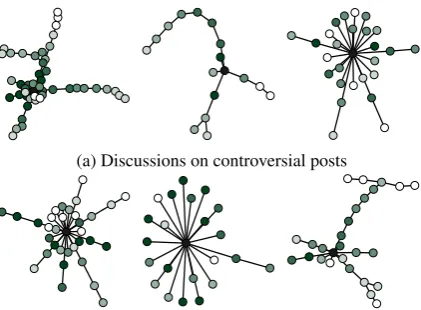
Figure 4: Early conversation trees from AskMen; nodes are comments and edges indicate reply structure. The original post is the black node, and as node colors lighten, comment timing increases from zero minutes to sixty minutes.
inpersonalfinance(e.g., “live with my parents”) but strongly associated with lack of controversy in relationships (e.g., “my parents got divorced”). We also observe that some communities share commonalities in phrasing, e.g., “do you think” is associated with controversy in bothAskMenand AskWomen, whereas “what are some” is associ-ated with a lack of controversy in both.
3 Early Discussion Threads
We now analyze comments posted in early discussion threads for controversial vs. non-controversial posts. In this section, we focus on comments posted within one hour of the original submission, although we consider a wider range of times in later experiments.
Comment Text. We mirrored the n-gram analy-sis conducted in the previous section, but, rather than the text of the original post, focused on the text of comments. Many patterns persist, but the conversational framing changes, e.g., “I cheated” in thepostsofrelationshipsis mirrored by “you cheated” in thecomments. Community differences again appear: e.g., “birth control” indicated con-troversy when it appears in the comments for re-lationships, but not forAskWomen.
Comment Tree Structure. While prior work in early prediction mostly focuses on measuring rate of early responses, we postulate that more expres-sive, structural features of conversation trees may also carry predictive capacity.
Figure 4 gives samples of conversation trees
that developed on Reddit posts within one hour of the original post being made. There is sig-nificant diversity among tree size and shape. To quantify these differences, we introduce two sets of features: C-RATE features, which encode the rate of commenting/number of comments;13 and C-TREE features, which encode structural aspects of discussion trees.14 We then examine whether or not tree features correlate with controversy after controlling for popularity.
Using binary logistic regression, after con-trolling for C-RATE, C-TREE features extracted from comments made within one hour of the original post improve model fit in all cases ex-cept for personalfinance (p < .05, LL-Ratio test). We repeated the experiment, but also con-trolled foreventualpopularity15 in addition to C-RATE, and observed the same result. This pro-vides evidence thatstructuralfeatures of conver-sation trees are predictive, thoughwhichtree fea-ture is most important according to these exper-iments is community-specific. For example, for the models without eventual popularity informa-tion, the C-TREE feature with largest coefficient inAskWomen andAskMen was the max-depth ratio, but it was the Wiener index inFitness.
4 Early Prediction of Controversy
We shift our focus to the task of predicting con-troversy on Reddit. In general, tools that predict controversy are most useful if they only require in-formation available at the time of submission or as soon as possible thereafter. We note that while the causal relationship between vote totals and com-ment threads is not entirely clear (e.g., perhaps the comment threads cause more up/down votes on the post), predicting the ultimateoutcome of posts is still useful for community moderators.
Experimental protocols. All classifiers are
bi-13Specifically: total number of comments, the logged time
between OP and the first reply, and the average logged parent-child reply time over pairs of comments.
14
Specifically: max depth/total comment ratio, proportion of comments that were top-level (i.e., made in direct reply to the original post), average node depth, average branching factor, proportion of top-level comments replied to, Gini co-efficient of replies to top-level comments (to measure how “clustered” the total discussion is), and Wiener Index of vi-rality (which measures the average pairwise path-length be-tween all nodes in the conversation tree (Wiener,1947;Goel et al.,2015)).
15We added in the logged number of eventual comments,
[image:5.595.75.286.59.214.2]nary (i.e., controversial vs. non-controversial) and, because the classes are in 50/50 balance, we com-pare algorithms according to their accuracy. Ex-periments are conducted as 15-fold cross valida-tion with random 60/20/20 train/dev/test splits, where the splits are drawn to preserve the 50/50 label distribution. For non-neural, feature-based classifiers, we use linear models.16 For BiLSTM models,17we use Tensorflow (Abadi et al.,2015). Whenever a feature is ill-defined (e.g., if it is a comment text feature, but there are no comments at time t) the column mean of the training set for each cross-validation split is substituted. Sim-ilarly, if a comment’s body is deleted, it is ig-nored by text processing algorithms. We perform both Wilcoxon signed-rank tests (Demˇsar, 2006) and two-sided corrected resampled t-tests (Nadeau and Bengio, 2000) to estimate statistical signifi-cance, taking the maximum of the two resulting p-values to err on the conservative side and reduce the chance of Type I error.
4.1 Comparing Text Models
The goal of this section is to compare text-only models for classifying controversial vs. non-controversial posts. Algorithms are given access to the full post titles and bodies, unless stated oth-erwise.
HAND. We consider a number of hand-designed features related to the textual content of posts in-spired byTan et al.(2016).18
TFIDF. We encode posts according to tfidf fea-ture vectors. Words are included in the vocabulary if they appear more than 5 times in the correspond-ing cross-validation split.
16
We cross-validate regularization strength 10ˆ(-100,-5,-4,-3,-2,-1,0,1), model type (SVM vs. Logistic L1 vs. Logistic L2 vs. Logistic L1/L2), and whether or not to apply feature standardization for each feature set and cross-validation split
separately. These are trained usinglightning (http:
//contrib.scikit-learn.org/lightning/).
17
We optimize using Adam (Kingma and Ba,2014) with
LR=.001 for 20 epochs, apply dropout withp = .2, select
the model checkpoint that performs best over the validation set, and cross-validate the model’s dimension (128 vs. 256) and the number of layers (1 vs. 2) separately for each cross-validation split.
18
Specifically: for the title and text body separately, length, type-token ratio, rate of first-person pronouns, rate of second-person pronouns, rate of question-marks, rate of capitaliza-tion, and Vader sentiment (Hutto and Gilbert,2014). Com-bining the post title and post body: number of links, number of Reddit links, number of imgur links, number of sentences, Flesch-Kincaid readability score, rate of italics, rate of bold-face, presence of a list, and the rate of word use from 25 Empath wordlists (Fast et al.,2016), which include various categories, such as politeness, swearing, sadness, etc.
W2V. We consider a mean, 300D word2vec (Mikolov et al.,2013) embedding representation, computed from a GoogleNews corpus.
ARORA. A slight modification of W2V, proposed byArora et al.(2017), serves as a “tough to beat” baseline for sentence representations.
LSTM. We train a Bi-LSTM (Graves and Schmid-huber, 2005) over the first 128 tokens of ti-tles + post text, followed by a mean pooling layer, and then a logistic regression layer. The LSTM’s embedding layer is initialized with the same word2vec embeddings used in W2V. Mark-down formatting artifacts are discarded.
BERT-LSTM. Recently, features extracted from fixed, pretrained, neural language models have re-sulted in high performance on a range of lan-guage tasks. Following the recommendations of
§5.4 of Devlin et al. (2019), we consider repre-senting posts by extracting BERT-Large embed-dings computed for the first 128 tokens of titles + post text; we average the final 4 layers of the 24-layer, pretrained Transformer-decoder network (Vaswani et al.,2017). These token-specific vec-tors are then passed to a Bi-LSTM, a mean pooling layer, and a logistic classification layer. We keep markdown formatting artifacts because BERT’s token vocabulary are WordPiece subtokens (Wu et al., 2016), which are able to incorporate arbi-trary punctuation without modification.
BERT-MP. Instead of training a Bi-LSTM over BERT features, we mean pool over the first 128 tokens, apply L2 normalization to the resulting representations, reduce to 100 dimensions using PCA,19and train a linear classifier on top.
BERT-MP-512. The same as BERT-MP, ex-cept the algorithm is given access to 512 tokens (the maximum allowed by BERT-Large) instead of 128.
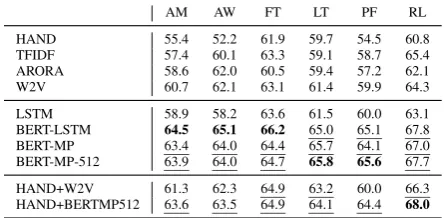
Results: Table 2 gives the performance of each text classifier for each community. In general, the best performing models are based on the BERT features, though HAND+W2V performs well, too. However, no performance gain is achieved when adding hand designed features to BERT. This may be because BERT’s subtokenization scheme incor-porates punctuation, link urls, etc., which are sim-ilar to the features captured by HAND. Adding an LSTM over BERT features is comparable to mean pooling over the sequence; similarly, considering 128 tokens vs. 512 tokens results in comparable
AM AW FT LT PF RL
HAND 55.4 52.2 61.9 59.7 54.5 60.8
TFIDF 57.4 60.1 63.3 59.1 58.7 65.4
ARORA 58.6 62.0 60.5 59.4 57.2 62.1
W2V 60.7 62.1 63.1 61.4 59.9 64.3
LSTM 58.9 58.2 63.6 61.5 60.0 63.1
BERT-LSTM 64.5 65.1 66.2 65.0 65.1 67.8 BERT-MP 63.4 64.0 64.4 65.7 64.1 67.0 BERT-MP-512 63.9 64.0 64.7 65.8 65.6 67.7
[image:7.595.70.293.64.173.2]HAND+W2V 61.3 62.3 64.9 63.2 60.0 66.3 HAND+BERTMP512 63.6 63.5 64.9 64.1 64.4 68.0
Table 2: Average accuracy for each post-time, text-only predictor for each dataset, averaged over 15 cross-validation splits; standard errors are ±.6, on average (and never exceed±1.03). Bold is best in column; un-derlined are statistically indistinguishable from best in column (p < .01)
AM AW FT LT PF RL
TEXT 63.9 64.0 64.7 65.8 65.6 67.7 +TIME 68.1 65.4 65.5 66.2 66.5 69.3 +AUTHOR 68.2 65.3 65.7 66.0 66.4 69.3
Table 3: Post-time only results: the effect of incorpo-rating timing and author identity features.
performance. Based on the results of this experi-ment, we adopt BERT-MP-512 to represent text in experiments for the rest of this work.
4.2 Post-time Metadata
Many non-content factors can influence commu-nity reception of posts, e.g., Hessel et al. (2017) find thatwhena post is made on Reddit can signif-icantly influence its eventual popularity.
TIME. These features encode when a post was created. These include indicator variables for year, month, day-of-week, and hour-of-day.
AUTHOR. We add an indicator variable for each user that appears at least 3 times in the training set, encoding the hypothesis that some users may sim-ply have a greater propensity to post controversial content.
The results of incorporating the metadata fea-tures on top of TEXT are given in Table3. While incorporating TIME features on top of TEXT re-sults in consistent improvements across all com-munities, incorporating author features on top of TIME+TEXT does not. We adopt our highest per-forming models, TEXT+TIME, as a strong post-time baseline.
4.3 Early Discussion Features
Basic statistics of early comments. We aug-ment the post-time features with early-discussion
feature sets by giving our algorithms access to comments from increasing observation periods. Specifically, we train linear classifiers by combin-ing our best post-time feature set (TEXT+TIME) with features derived from comment trees avail-able aftertminutes, and sweeptfromt = 15 to
t= 180minutes in 15 minute intervals.
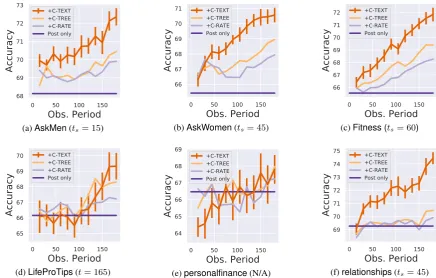
Figure6plots the median number of comments available per thread at different tvalues for each community. The amount of data available for the early-prediction algorithms to consider varies sig-nificantly, e.g., whileAskMenthreads have a me-dian 10 comments available at 45 minutes, Life-ProTipsposts do not reach that threshold even af-ter 3 hours, and we thus expect that it will be a harder setting for early prediction. We see, too, that even our maximal 3 hour window is still early in a post’s lifecycle, i.e., posts tend to receive sig-nificant attention afterwards: only 15% (LT) to 32% (AW) of all eventual comments are available per thread at this time, on average. Figure7gives the distribution of the number of comments avail-able for controversial/non-controversial posts on AskWomenatt= 60minutes. As with the other communities we consider, the distribution of num-ber of available posts is not overly-skewed, i.e., most posts in our set (we filtered out posts with less than 30 comments) get at least some early comments.
We explore a number of feature sets based on early comment trees (comment feature sets are prefixed with “C-”):
C-RATE and C-TREE. We described these in§3. C-TEXT. For each comment available at a given observation period, we extract the BERT-MP-512 embedding. Then, for each conversation thread, we take a simple mean over all comment represen-tations. While we tried several more expressive means of encoding the text of posts in comment trees, this simple method proved surprisingly ef-fective.20
Sweeping over time. Figure 5 gives the perfor-mance of the post-time baseline combined with comment features while sweeping t from 15 to 180 minutes. For five of the six communi-ties we consider, the performance of the com-ment feature classifier significantly (p < .05)
ex-20
0 50 100 150
Obs. Period
6869 70 71 72 73
Accuracy
+C-TEXT +C-TREE +C-RATE Post only
(a)AskMen(ts= 15)
0 50 100 150
Obs. Period
6667 68 69 70 71
Accuracy
+C-TEXT +C-TREE +C-RATE Post only
(b)AskWomen(ts= 45)
0 50 100 150
Obs. Period
6667 68 69 70 71 72
Accuracy
+C-TEXT +C-TREE +C-RATE Post only
(c)Fitness (ts= 60)
0 50 100 150
Obs. Period
6566 67 68 69 70
Accuracy
+C-TEXT +C-TREE +C-RATE Post only
(d)LifeProTips(t= 165)
0 50 100 150
Obs. Period
6465 66 67 68 69
Accuracy
+C-TEXT +C-TREE +C-RATE Post only
(e)personalfinance(N/A)
0 50 100 150
Obs. Period
6970 71 72 73 74 75
Accuracy
+C-TEXT +C-TREE +C-RATE Post only
[image:8.595.77.514.60.338.2](f)relationships(ts= 45)
Figure 5: Classifier accuracy for increasing periods of observation; the “+” in the legend indicates that a feature set is combined with the feature sets below. ts, the time the full feature set first achieves statistical significance over the post-time only baseline, is given for each community (if significance is achieved).
0 60 120 180 Obs Period (mins) 0
10 20 30
Med. Comments / Thread
AM AW RL FT PF LT
Figure 6: Observation pe-riod versus median num-ber of comments avail-able.
0 20 40
N Comments
Non-cont Cont
Figure 7: Histogram of the number of comments available per thread at t = 60 minutes in
AskWomen.
ceeds the performance of the post-time baseline in less than three hours of observation, e.g., in the case ofAskMenandAskWomen, significance is achieved within 15 and 45 minutes, respectively.
In general, C-RATE improves only slightly over post only, even though rate features have proven useful in predicting popularity in prior work (He et al., 2014). While adding C-TREE also im-proves performance, comment textual content is the biggest source of predictive gain. These re-sults demonstrate i) that incorporating a variety of early conversation features, e.g., structural fea-tures of trees, can improve performance of
contro-versy prediction over strong post-time baselines, and ii) the text content of comments contains sig-nificant complementary information to post text.
Controversy prediction 6= popularity predic-tion. We return to a null hypothesis introduced in§2: that the controversy prediction models we consider here are merely learning the same pat-terns that a popularity prediction algorithm would learn. We train popularity prediction algorithms, and then attempt to use them at test-time to predict controversy; under the null hypothesis, we would expect little to no performance degradation when training on these alternate labels.
We 1) train binary popularity predictors using post text/time + comment rate/tree/text features available at t = 180,21 and use them to predict controversy at test-time; and 2) consider an oracle that predicts the true popularity label at test-time; this oracle isquitestrong, as prior work suggests that perfectly predicting popularity is impossible (Salganik et al.,2006).
21We predict whether or not a post eventually receives an
AM AW FT LT PF RL
Pop Pred 53.9 55.2 60.1 54.2 52.9 52.8
Pop Oracle 65.8 67.0 70.3 68.1 64.0 63.3
In all cases, the best popularity predictor does not achieve performance comparable to even the post-only baseline. For 3 of 6 communities, even the popularity oracle does not beat post time base-line, and in all cases, the mean performance of the controversy predictor exceeds the oracle by
t = 180. Thus, in our setting, controversy pre-dictors and popularity prepre-dictors learn disjoint pat-terns.
4.3.1 Domain Transfer
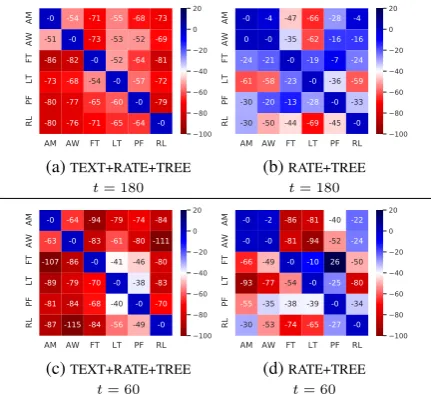
We conduct experiments where we train models on one subreddit and test them on another. For these experiments, we discard all posting time fea-tures, and compare C-(TEXT+TREE+RATE) to C-(TREE+RATE); the goal is to empirically ex-amine the hypothesis in§1: that controversial text is community-specific.
To measure performance differences in the do-main transfer setting, we compute the percent-age accuracy drop relative to a constant predic-tion baseline when switching the training subred-dit from the matching subredsubred-dit to a different one. For example, at t = 60, we observe that raw ac-curacy drops from65.6 → 55.8when training on AskWomen and testing on AskMen when con-sidering text, rate, and tree features together; given that the constant prediction baseline achieves 50% accuracy, we compute the percent drop in accuracy as:(55.8−50)/(65.6−50)−1 =−63%.
The results of this experiment (Figure 8) sug-gest that while text features are quite strong in-domain, they are brittle and community specific. Conversely, while rate and structural comment tree features do not carry as much in-domain predictive capacity on their own, they generally transfer bet-ter between communities, e.g., for RATE+TREE, there is very little performance drop-off when training/testing on AskMen/AskWomen (this holds for all timing cutoffs we considered). Sim-ilarly, in the case of training onFitnessand test-ing onPersonalFinance, we sometimes observe a performanceincrease when switching domains (e.g., att= 60); we suspect that this could be an effect of dataset size, as our Fitnessdataset has the most posts of any subreddit we consider, and PersonalFinancehas the least.
AM AW FT LT PF RL
AM
AW
FT
LT
PF
RL
-0 -54 -71 -55 -68 -73
-51 -0 -73 -53 -52 -69 -86 -82 -0 -52 -64 -81 -73 -68 -54 -0 -57 -72 -80 -77 -65 -60 -0 -79 -80 -76 -71 -65 -64 -0
100 80 60 40 20 0 20
(a)TEXT+RATE+TREE
t= 180
AM AW FT LT PF RL
AM
AW
FT
LT
PF
RL
-0 -4 -47 -66 -28 -4 0 -0 -35 -62 -16 -16 -24 -21 -0 -19 -7 -24 -61 -58 -23 -0 -36 -59
-30 -20 -13 -28 -0 -33 -30 -50 -44 -69 -45 -0
100 80 60 40 20 0 20
(b)RATE+TREE
t= 180
AM AW FT LT PF RL
AM
AW
FT
LT
PF
RL
-0 -64 -94 -79 -74 -84 -63 -0 -83 -61 -80 -111 -107 -86 -0 -41 -46 -80 -89 -79 -70 -0 -38 -83 -81 -84 -68 -40 -0 -70 -87 -115 -84 -56 -49 -0
100 80 60 40 20 0 20
(c)TEXT+RATE+TREE
t= 60
AM AW FT LT PF RL
AM
AW
FT
LT
PF
RL
-0 -2 -86 -81 -40 -22 -0 -0 -81 -94 -52 -24 -66 -49 -0 -10 26 -50
-93 -77 -54 -0 -25 -80 -55 -35 -38 -39 -0 -34 -30 -53 -74 -65 -27 -0
100 80 60 40 20 0 20
(d)RATE+TREE
[image:9.595.308.524.60.257.2]t= 60
Figure 8: Average cross-validated performance degra-dation for transfer learning setting at t = 180 and t = 60; the y-axis is the training subreddit and the x-axis is testing. For a fixed test subreddit, each column gives the percent accuracy drop when switching from the matching training set to a domain transfer setting. In general, while incorporating comment text features results in higher accuracy overall, comment rate + tree features transfer between communities with less per-formance degradation.
5 Conclusion
We demonstrated that early discussion features are predictive of eventual controversiality in several reddit communities. This finding was dependent upon considering an expressive feature set of early discussions; to our knowledge, this type of feature set (consisting of text, trees, etc.) hadn’t been thor-oughly explored in prior early prediction work.
One promising avenue for future work is to examine higher-quality textual representations for conversation trees. While our mean-pooling method did produce high performance, the result-ing classifiers do not transfer between domains effectively. Developing a more expressive algo-rithm (e.g., one that incorporates reply-structure relationships) could boost predictive performance, and enable textual features to be less brittle.
Acknowledgments
References
Mart´ın Abadi, Ashish Agarwal, Paul Barham, Eugene Brevdo, Zhifeng Chen, Craig Citro, Greg S. Cor-rado, Andy Davis, Jeffrey Dean, Matthieu Devin, Sanjay Ghemawat, Ian Goodfellow, Andrew Harp, Geoffrey Irving, Michael Isard, Yangqing Jia, Rafal Jozefowicz, Lukasz Kaiser, Manjunath Kudlur, Josh Levenberg, Dandelion Man´e, Rajat Monga, Sherry Moore, Derek Murray, Chris Olah, Mike Schus-ter, Jonathon Shlens, Benoit Steiner, Ilya Sutskever, Kunal Talwar, Paul Tucker, Vincent Vanhoucke, Vijay Vasudevan, Fernanda Vi´egas, Oriol Vinyals, Pete Warden, Martin Wattenberg, Martin Wicke, Yuan Yu, and Xiaoqiang Zheng. 2015. TensorFlow: Large-scale machine learning on heterogeneous sys-tems. Software available from tensorflow.org.
Aseel Addawood, Rezvaneh Rezapour, Omid Abdar, and Jana Diesner. 2017. Telling apart tweets as-sociated with controversial versus non-controversial topics. InSecond Workshop on NLP and Computa-tional Social Science.
Mahmoud Al-Ayyoub, Abdullateef Rababah, Yaser Jararweh, Mohammed N. Al-Kabi, and Brij B. Gupta. 2017. Studying the controversy in online crowds interactions. Applied Soft Computing.
Kelsey Allen, Giuseppe Carenini, and Raymond Ng. 2014. Detecting disagreement in conversations using pseudo-monologic rhetorical structure. In
EMNLP.
Sanjeev Arora, Yingyu Liang, and Tengyu Ma. 2017. A simple but tough-to-beat baseline for sentence em-beddings. InICLR.
Rawia Awadallah, Maya Ramanath, and Gerhard Weikum. 2012. Harmony and dissonance: organiz-ing the people’s voices on political controversies. In
Proceedings of WSDM, page 523, Seattle, Washing-ton, USA. ACM Press.
Lars Backstrom, Jon Kleinberg, Lillian Lee, and Cristian Danescu-Niculescu-Mizil. 2013. Characterizing and curating conversation threads: expansion, focus, volume, re-entry. In WSDM. ACM. Project homepage at
http://www.cs.cornell.edu/home/
llee/papers/convcuration.home.html.
Angelo Basile, Tommaso Caselli, and Malvina Nissim. 2017. Predicting controversial news using Facebook reactions. In The Italian Conference on Computa-tional Linguistics.
Kaspar Beelen, Evangelos Kanoulas, and Bob van de Velde. 2017. Detecting Controversies in Online News Media. InProceedings of SIGIR, pages 1069– 1072, New York, NY, USA. ACM.
David M. Blei, Andrew Y. Ng, and Michael I. Jordan. 2003. Latent Dirichlet allocation. JMLR.
Erik Borra, Esther Weltevrede, Paolo Ciuccarelli, Andreas Kaltenbrunner, David Laniado, Giovanni Magni, Michele Mauri, Richard Rogers, and Tom-maso Venturini. 2015. Societal Controversies in Wikipedia Articles. InProceedings of CHI, pages 193–196, New York, NY, USA. ACM.
Nan Cao, Lu Lu, Yu-Ru Lin, Fei Wang, and Zhen Wen. 2015. Socialhelix: Visual analysis of sentiment di-vergence in social media. Journal of Visualization.
Wei-Fan Chen, Fang-Yu Lin, and Lun-Wei Ku. 2016. Wordforce: Visualizing controversial words in de-bates. InProceedings of COLING: System Demon-strations, pages 273–277, Osaka, Japan. The COL-ING 2016 Organizing Committee.
Zoey Chen and Jonah Berger. 2013. When, why, and how controversy causes conversation. Journal of Consumer Research, 40(3).
Yoonjung Choi, Yuchul Jung, and Sung-Hyon Myaeng. 2010. Identifying controversial issues and their sub-topics in news articles. InPacific-Asia Workshop on Intelligence and Security Informatics. Springer.
Lewis Coser. 1956. The Functions of Social Conflict. The Free Press, New York.
Carsten K. W. De Dreu and Laurie R. Weingart. 2003. Task versus relationship conflict, team performance, and team member satisfaction: A meta-analysis.
Janez Demˇsar. 2006. Statistical comparisons of classi-fiers over multiple data sets.JMLR.
Jacob Devlin, Ming-Wei Chang, Kenton Lee, and Kristina Toutanova. 2019. BERT: Pre-training of deep bidirectional transformers for language under-standing. InNAACL.
Shiri Dori-Hacohen and James Allan. 2013. Detecting controversy on the web. InCIKM. ACM.
Shiri Dori-Hacohen, David Jensen, and James Allan. 2016. Controversy detection in Wikipedia using collective classification. In Proceedings of SIGIR, pages 797–800, New York, NY, USA. ACM.
Ethan Fast, Binbin Chen, and Michael S. Bernstein. 2016. Empath: Understanding topic signals in large-scale text. InCHI.
Kiran Garimella, Gianmarco De Francisci Morales, Aristides Gionis, and Michael Mathioudakis. 2018. Quantifying controversy on social media. ACM Transactions on Social Computing.
Sharad Goel, Ashton Anderson, Jake Hofman, and Duncan J. Watts. 2015. The structural virality of on-line diffusion. Management Science.
Xiangnan He, Ming Gao, Min-Yen Kan, Yiqun Liu, and Kazunari Sugiyama. 2014. Predicting the popu-larity of Web 2.0 items based on user comments. In
SIGIR.
Jack Hessel, Lillian Lee, and David Mimno. 2017. Cats and captions vs. creators and the clock: Comparing multimodal content to context in pre-dicting relative popularity. In WWW. Project homepage athttp://www.cs.cornell.edu/
˜jhessel/cats/cats.html.
C.J. Hutto and Eric Gilbert. 2014. VADER: A parsi-monious rule-based model for sentiment analysis of social media text. InIWCSM.
Myungha Jang and James Allan. 2016. Improving au-tomated controversy detection on the web. InSIGIR.
Myungha Jang, Shiri Dori-Hacohen, and James Allan. 2017. Modeling controversy within populations. In
SIGIR.
Myungha Jang, John Foley, Shiri Dori-Hacohen, and James Allan. 2016. Probabilistic approaches to con-troversy detection. InCIKM.
Karen A. Jehn. 1995. A multimethod examination of the benefits and detriments of intragroup conflict.
Administrative Science Quarterly, 40(2):256–282.
Kateryna Kaplun, Christopher Leberknight, and Anna Feldman. 2018. Controversy and sentiment: An ex-ploratory study. InProceedings of the 10th Hellenic Conference on Artificial Intelligence (SETN), pages 37:1–37:7, New York, NY, USA. ACM.
Su-Do Kim, Sung-Hwan Kim, and Hwan-Gue Cho. 2011. Predicting the virtual temperature of web-blog articles as a measurement tool for online pop-ularity. In11th International Conference on Com-puter and Information Technology.
Diederik P. Kingma and Jimmy Ba. 2014. Adam: A method for stochastic optimization. arXiv preprint arXiv:1412.6980.
Manfred Klenner, Michael Amsler, and Nora Hollen-stein. 2014. Verb polarity frames: A new resource and its application in target-specific polarity classi-fication. InKONVENS.
Weichen Liu, Sijia Xiao, Jacob T. Browne, Ming Yang, and Steven P. Dow. 2018. ConsensUs: Supporting multi-criteria group decisions by visualizing points of disagreement.ACM Transactions on Social Com-puting, 1(1):1–26.
Ismini Lourentzou, Graham Dyer, Abhishek Sharma, and ChengXiang Zhai. 2015. Hotspots of news ar-ticles: Joint mining of news text & social media to discover controversial points in news. In2015 IEEE International Conference on Big Data, pages 2948– 2950. IEEE.
Noortje Marres. 2015. Why map issues? On contro-versy analysis as a digital method. Science, Tech-nology, & Human Values, 40(5):655–686.
Yelena Mejova, Amy X. Zhang, Nicholas Diakopoulos, and Carlos Castillo. 2014. Controversy and senti-ment in online news. InComputation and Journal-ism Symposium.
Tomas Mikolov, Ilya Sutskever, Kai Chen, Greg S. Cor-rado, and Jeff Dean. 2013. Distributed representa-tions of words and phrases and their compositional-ity. InNeurIPS.
Gilad Mishne and Natalie Glance. 2006. Leave a reply: An analysis of weblog comments. InThird Annual Workshop on the Weblogging Ecosystem. Edinburgh, Scotland.
Burt L. Monroe, Michael P. Colaresi, and Kevin M. Quinn. 2008. Fightin’ words: Lexical feature se-lection and evaluation for identifying the content of political conflict. Political Analysis.
Lev Muchnik, Sinan Aral, and Sean J. Taylor. 2013. Social influence bias: A randomized experiment.
Science, pages 647–651.
Claude Nadeau and Yoshua Bengio. 2000. Inference for the generalization error. InNeurIPS.
Ana-Maria Popescu and Marco Pennacchiotti. 2010. Detecting controversial events from Twitter. In
CIKM.
Hoda Sepehri Rad and Denilson Barbosa. 2012. Identi-fying controversial articles in Wikipedia: A compar-ative study. InProceedings of the Eighth Annual In-ternational Symposium on Wikis and Open Collab-oration (WikiSym), pages 7:1–7:10, New York, NY, USA. ACM.
Huzefa Rangwala and Salman Jamali. 2010. Defining a coparticipation network using comments on Digg.
IEEE Intelligent Systems.
Nils Rethmeier, Marc H¨ubner, and Leonhard Hennig. 2018. Learning comment controversy prediction in web discussions using incidentally supervised multi-task CNNs. In Proceedings of the 9th Workshop on Computational Approaches to Subjectivity, Sen-timent and Social Media Analysis, pages 316–321.
Matthew J. Salganik, Peter Sheridan Dodds, and Dun-can J. Watts. 2006. Experimental study of inequality and unpredictability in an artificial cultural market.
Science, 311:854–6.
R´obert Sumi, Taha Yasseri, Andr´as Rung, Andrs Kor-nai, and J´anos Kert´esz. 2011. Characterization and prediction of Wikipedia edit wars. InProceedings of Web Science. Poster.
Chenhao Tan, Vlad Niculae, Cristian Danescu-Niculescu-Mizil, and Lillian Lee. 2016. Win-ning arguments: Interaction dynamics and per-suasion strategies in good-faith online discus-sions. In WWW, pages 613–624. Paper home-page at https://chenhaot.com/papers/
changemyview.html.
Alexandru Tatar, J´er´emie Leguay, Panayotis Anto-niadis, Arnaud Limbourg, Marcelo Dias de Amorim, and Serge Fdida. 2011. Predicting the popularity of online articles based on user comments. In Interna-tional Conference on Web Intelligence, Mining and Semantics.
Bram Timmermans, Lora Aroyo, Thomas A. Kuhn, Kaspar Beelen, Evangelos Kanoulas, Bob van de Velde, and Gerben van Eerten. 2017. ControCu-rator: Understanding controversy using collective intelligence. In Proceedings of Collective Intelli-gence.
Ashish Vaswani, Noam Shazeer, Niki Parmar, Jakob Uszkoreit, Llion Jones, Aidan N Gomez, Łukasz Kaiser, and Illia Polosukhin. 2017. Attention is all you need. InNeurIPS.
Lu Wang and Claire Cardie. 2014. A piece of my mind: A sentiment analysis approach for online dispute de-tection. InProceedings of the 52nd Annual Meet-ing of the Association for Computational LMeet-inguis- Linguis-tics (Volume 2: Short Papers), pages 693–699, Bal-timore, Maryland. Association for Computational Linguistics.
Tim Weninger, Thomas James Johnston, and Maria Glenski. 2015. Random voting effects in social-digital spaces: A case study of Reddit post submis-sions. InConference on Hypertext and Social Me-dia, pages 293–297, New York, NY, USA. ACM.
Harry Wiener. 1947. Structural determination of paraf-fin boiling points. Journal of the American Chemi-cal Society.
Fang Wu and Bernardo A. Huberman. 2008.How pub-lic opinion forms. InProceedings of the 4th Inter-national Workshop on Internet and Network Eco-nomics (WINE), pages 334–341, Berlin, Heidelberg. Springer-Verlag.
Yonghui Wu, Mike Schuster, Zhifeng Chen, Quoc V. Le, Mohammad Norouzi, Wolfgang Macherey, Maxim Krikun, Yuan Cao, Qin Gao, Klaus Macherey, Jeff Klingner, Apurva Shah, Melvin Johnson, Xiaobing Liu, Lukasz Kaiser, Stephan Gouws, Yoshikiyo Kato, Taku Kudo, Hideto Kazawa, Keith Stevens, George Kurian, Nishant Patil, Wei Wang, Cliff Young, Jason Smith, Jason Riesa, Alex Rudnick, Oriol Vinyals, Greg Corrado, Macduff Hughes, and Jeffrey Dean. 2016. Google’s neural machine translation system: Bridging the gap between human and machine translation. arXiv preprint arXiv:1609.08144. Version 2.
Taha Yasseri, Robert Sumi, Andrs Rung, Andrs Kornai, and Jnos Kertsz. 2012. Dynamics of Conflicts in Wikipedia.PLoS ONE, 7(6):e38869.
Jie Yin, Paul Thomas, Nalin Narang, and Cecile Paris. 2012. Unifying local and global agreement and dis-agreement classification in online debates. In Pro-ceedings of the 3rd Workshop in Computational Ap-proaches to Subjectivity and Sentiment Analysis. As-sociation for Computational Linguistics.
Justine Zhang, Jonathan P. Chang, Cristian Danescu-Niculescu-Mizil, Lucas Dixon, Yiqing Hua, Nithum Thain, and Dario Taraborelli. 2018a. Conversations gone awry: Detecting early signs of conversational failure. In ACL. Project homepage at http: //www.cs.cornell.edu/˜cristian/
Conversations_gone_awry.html.
Justine Zhang, Cristian Danescu-Niculescu-Mizil, Christina Sauper, and Sean J. Taylor. 2018b. Characterizing online public discussions through patterns of participant interactions. InProceedings of CSCW. Project homepage at http://www. cs.cornell.edu/˜cristian/Patterns_