1019
Relation Extraction with Temporal Reasoning Based on Memory
Augmented Distant Supervision
Jianhao Yan1, Lin He1, Ruqin Huang2, Jian Li3∗, and Ying Liu1 1Institute for Network Sciences and Cyberspace, Tsinghua University 2Department of Computer Science and Technology, Tsinghua University 3Institute for Interdisciplinary Information Sciences, Tsinghua University
{yjh16, he-l14, hrq16}@mails.tsinghua.edu.cn [email protected], [email protected]
Abstract
Distant supervision (DS) is an important paradigm for automatically extracting rela-tions. It utilizes existing knowledge base to collect examples for the relation we intend to extract, and then uses these examples to au-tomatically generate the training data. How-ever, the examples collected can be very noisy, and pose significant challenge for obtaining high quality labels. Previous work has made remarkable progress in predicting the rela-tion from distant supervision, but typically ig-nores the temporal relations among those su-pervising instances. This paper formulates the problem of relation extraction with tem-poral reasoning and proposes a solution to predict whether two given entities participate in a relation at a given time spot. For this purpose, we construct a dataset called WIKI-TIME1 which additionally includes the valid period of a certain relation of two entities in the knowledge base. We propose a novel neu-ral model to incorporate both the temponeu-ral in-formation encoding and sequential reasoning. The experimental results show that, compared with the best of existing models, our model achieves better performance in both WIKI-TIME dataset and the well-studied NYT-10 dataset.
1 Introduction
As an important technique to automatically com-plete the knowledge base and reduce labeling ef-forts, distant supervision (DS) for relation ex-traction has drawn much attention. In DS, we align the entity pair (head, tail) from a triple
hhead, rel, tailiextracted from a huge knowledge base (e.g., Freebase, Wikidata) with sentences from free texts (e.g., Wikipedia, New York Times)
∗
Jian Li is the corresponding author.
1https://github.com/ElliottYan/DS_
Temporal
to obtain the training examples, and the label of such an example is the corresponding relationrel. Therefore, DS can automatically create a set of training data for each entity pair.
However, the noisy training data problem (Riedel et al., 2010) significantly affects the per-formance of DS. Therefore, most of the recent approaches (Riedel et al.,2010;Hoffmann et al.,
2011;Zeng et al., 2015;Lin et al., 2016) follow a common assumption called the at-least-once as-sumption, which treats all aligned sentences of each entity pair as one training sample. We re-fer to a sentence as an instance and all sentences aligned to one entity pair as a mention set in the following, respectively.
The models in previous work (Zeng et al.,2015;
Lin et al.,2016;Luo et al.,2017) generally include two parts, encodingandfusion. The former en-codes each instance into a low-dimensional repre-sentation. The latter combines representation of each instance. Then, their combination is used to predict the relation.
Although the approaches mentioned above seem promising, they have the following limita-tions:
1. They all use a separate but identical encod-ing module among instances and introduce no difference temporally.
2. They only adopt single step of fusion and in-troduce no sentence-level reasoning.
instances express different relations. For exam-ple, suppose we want to predict the relation be-tween Angelina Jolie and Brad Pitt (using Wiki-data). The knowledge base contains a factual rela-tion ofspousebetween them with the valid period from August 2014 to September 2016. However, the extracted mention set contains instances about their marriage in 2014, as well as their divorce in 2016. Because existing models do not encode temporal information, the relation they extract is likely to be the one with highest confidence. In this example, their models may predict the rela-tion of marriage since the instances may suggest a higher confidence for the relation of marriage. But the correct prediction should be divorce. As shown in the above example, we can see it is necessary to include temporal information in DS.
On the other hand, in fusion module, most ex-isting work focused on denoising using methods such as attention or reinforcement learning. We want to argue that a sentence-level reasoning can also be useful since there are instances which are not direct positive examples for the given relation, but can provide supporting evidence. We call them remote instances. Consider the Jolie-Pitt exam-ple again. Suppose we are to predict their rela-tion after their divorce. The instances about their marriage also indirectly help to infer their divorce since marriage is the premise of divorce. Hence, we need an algorithm that can incorporate tempo-ral information and perform reasoning over remote instances.
In this paper, we address both limitations and extend the task to predict the relation of a par-ticular entity pair at any specific time spot. The problem can be formulated as a sequence labeling problem (See § 2). We propose a novel relation extraction architecture that can address both afore-mentioned limitations. Our model follows the popular encoding-fusion architecture, but makes two crucial modifications. Firstly, we introduce temporal encoding to model the temporal infor-mation among the instances in the encoding. Sec-ondly, we use the Memory Network (Sukhbaatar et al.,2015;Miller et al.,2016) to iteratively rea-son over temporally augmented encodings in the fusion part.
Moreover, we evaluate our model on the widely studied NYT-10 dataset (Riedel et al., 2010) and a new WIKI-TIME dataset. The construction of WIKI-TIME is similar to that of the NYT-10
dataset except for two important differences. One is that we only consider triples hhead, rel, taili
with the valid period (T1, T2). For example, the triple hJ olie, married, P itti has a valid pe-riod of(2014.08,2016.09). The other is that we extract contextual temporal information for each aligned instance. We use Wikidata (Vrandeˇci´c and Kr¨otzsch,2014) as knowledge base and Wikipedia as free corpus. Both automatic and manual eval-uation are applied in the experiments. The perimental results show that, compared with ex-isting models, our model can achieve compara-ble/better performance in both WIKI-TIME and standard NYT-10 datasets.
Our main contributions can be summarized as follows:
• We introduce a new task aiming to solve the problem of relation extraction with temporal information.
• We propose a novel relation extraction archi-tecture, which encodes both the temporal and semantic information and includes remote in-stances for temporal reasoning.
• We construct a new WIKI-TIME dataset by aligning Wikidata to Wikipedia, which is spe-cially designed for the task of relation extrac-tion with temporal informaextrac-tion.
• The experiment results show that, com-pared with the best of existing models, our model achieves comparable/better perfor-mance both in WIKI-TIME dataset and stan-dart NYT-10 dataset.
2 Formulation
2.1 Traditional Distant Supervision (DS)
The traditional distant supervision (DS) task can be defined as:
Given two entities hhead, taili and their cor-responding mention set S = {s1, s2,· · ·, sT},
where si denotes the ith instance, the task aims
to predict the probability for specific relationr of
hhead, taili:
P(r|S={s1, s2,· · ·, sT}). (1)
The task can be seen as a label multi-instance classification problem.
2.2 Distant Supervision with Temporal Reasoning
en-tities at any specific time spot. Because modeling over any specific time spot is non-trivial, we relax the goal to predict the relation between two given entities at any mentioned time spots. Note that we can infer the relations at other time spots using prediction at mentioned ones. Formally, the rela-tionrtatt∈(t1, t2]can be infered byrt1.
There-fore, we can model the problem as a sequence la-beling problem with noisy inputs.
Given two entities, we collect the chronologi-cally sorted list of its mention instances and the time spot associated with each instance . We denote the list by S = {(s1, t1),· · ·,(sT, tT)},
where(si, ti)is theith instance and the associated
time spot. Our goal is to predict the probability of relationrat time spotti:
P(rti|S ={(s1, t1),· · · ,(sT, tT)}, ti). (2)
3 Methodology
3.1 Overview of TempMEM
Note that RNN-like models are not suitable for this sequence labeling problem, because the input se-quence contains noisy sentences and lacks direct dependency between time steps. We propose a neural model called TempMEM which models the sequence labeling problem by creating query se-quence based on each mentioned time spot.
TempMEM also follows the encoding-fusion framework (Zeng et al.,2015;Lin et al.,2016;Luo et al.,2017). However, we make two crucial mod-ifications to the original framework. First, for the encoding part, we use time-aware encoding mod-ules for instances instead of identical ones. Sec-ond, we use the memory network to iteratively rea-son over instances, which makes use of remote in-stances.
In the following sections, we introduce how to encode the temporal and semantic information and include remote instances for temporal reasoning.
3.2 Encoding
3.2.1 Sentence Encoding
For sentence encoding, here we apply the Con-volutional Neural Network (CNN) and the Piece-wise Convolutional Neural Network (PCNN) (Zeng et al., 2015). Note that, since TempMEM has no preferance over specific sentence encoding, other encoding modules like word memory (Feng et al.,2017) or self-attention can also be used here. The inputs of convolution layers are word em-beddings concatenated with position features. For
a detailed description of the inputs, we refer the readers to (Zeng et al.,2015).
First, the convolution layer extracts local fea-tures with sliding window wˆ over the input rep-resentation. Formally, the convolution operates on the concatenation of the input representations Xk:k+ ˆw of instance jwith the shared parameters
Wc∈RD∗wˆandbc∈R1:
oc,k=Wc·Xk:k+ ˆw+bc, (3)
whereoc,kis thekth output of channelc.
Then, we use the piece-wise max-pooling layer. It divides the outputs of filters into three parts
{oc,0:h,oc,h:t,oc,t:N} and performs max-pooling
over each part:
oc= [ max
0≤k<h(oc,k),hmax≤k<t(oc,k),t≤maxk<N(oc,k)],
(4) wherehandtdenote the indices of the head and tail entities, respectively. The concatenation of the output of all channelscis considered as the con-volutional representation of instancej:
Oj = [o1,o2,· · · ,oC], (5)
whereCdenotes the number of filters.
3.2.2 Temporal Encoding
In order to introduce temporal priorities among in-stances, it is necessary to inject temporal informa-tion into the encoding part. We want the temporal encoding to have the following characteristics:
• The temporal encodings should comply with the chronological order of instances.
• The difference between two time spots de-termines the similarity between two temporal encodings.
Since directly encoding the time spot value leads to huge difference among mention sets of the dataset, we propose an approximate approach with PE encoding (Vaswani et al., 2017) based on the rank (i.e. position of an instance in a mention set with chronological order):
P E(j)=
(
sin(j/10000d/dm) if d%2 = 0
cos(j/10000(d−1)/dm)if d%2 = 1 , (6) wherej is the rank of instances, dis the dimen-sion, anddmis the dimension of temporal
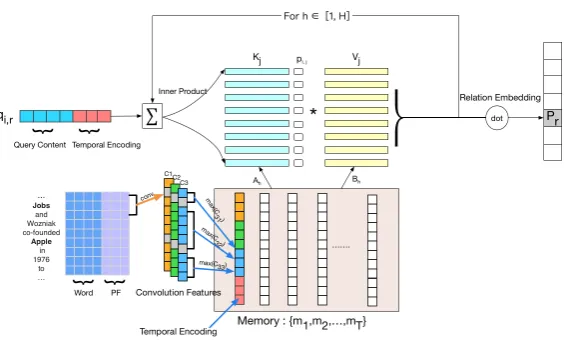
Figure 1: Overall TempMEM architecture
two PE encodings (by dot product) is determined by their rank difference.
Then, we concatenate the corresponding tempo-ral encoding with the convolutional features of in-stance j to form the final representation of each instance with a learnable scale factorλ:
mj = [Oj;λ·P E(j)]. (7)
3.3 Fusion
In the fusion part, we use the Memory Network to perform temporal reasoning among different in-stances. Each encoded instance is considered to be a memory slot. Then, we construct a time specific query and iteratively compute the weighted atten-tion over all instances. We detail the process in the following sections.
3.3.1 Query Construction
We construct each query with the guidance of the following intuition.
• Relation extraction within instances is equal to the query “what is the relation between headandtailat time spotti?”.
So, we construct our queries based on four key variables,(relation, head, tail, ti).
Specifically, we combine the embeddings (pre-trained by TransE (Bordes et al., 2013)) of head and tail and project the combination through an affine matrixΦq∈RDe∗Dr, whereDeandDr
de-note the dimension of relation and entity embed-ding, respectively. After the projection, we add the randomly initialized relation embedding. The formal definition of a query is given below:
qr=Rr+ (Ehead+Etail)∗Φq, (8)
whereRr∈RDr is the embedding of specific
re-lation r andE∗ ∈ RDe is the entity embedding.
Finally, we also concatenate the query with the same temporal encoding defined in§3.2.2to ob-tain theith query:
qr,i = [qr;λ·P E(i)]. (9)
3.3.2 Iterative Reasoning
In this part, we introduce how to use the queries to perform temporal reasoning. Two operations are involved, memory addressing and reading.
One of our key motivations is to consider the remote instances. So, instead of using single step attention computation as in previous work (Lin et al.,2016;Luo et al.,2017;Ji et al.,2017), we perform an overallHsteps of memory addressing and reading to obtain the final prediction. Within each step (also called hop), we update the query value by adding the output of the previous step, which provides a gradual shift in attention. Next, we introduce the whole process in detail.
Memory Addressing In addressing, we com-pute the similarity between the query vector qi,r
and each candidate memory slot keyKj. Note that
the encoding outputmj is not in the same
contin-uous space as the query vector. So, we adopt linear projections to both memory keys:
Kj =ATh ·mj, (10)
whereAh∈RDm∗Dr. Then, we compute the
sim-ilarity score and importance probability using the bilinear form,
si,j =qTi,r·Wa·Kj, (11)
pi,j =
exp(si,j)
PM ˆ
j=1exp(si,ˆj)
whereWa ∈ RDr∗Dm is the model parameter to
be learned andi, j are the indices of queries and memory slots.
As for the addressing step, it worths noting that the query and memory slots are both concatenated with temporal encodings. If we define the embed-ding layerAas the identity matrix, each similarity score of a query-memory pair can be divided into two parts,
si,j =qiT ·oj+λ2·P E(i)T ·P E(j). (13)
Each query can automatically attend to in-stances with either close encoding representations or close temporal encodings. This tradeoff also accords with our intuition, since the confidence of a relational factual statement decreases when the time span increases.
Memory reading The value of each memory slot, which is also projected by an affine matrix B ∈RDm∗Dr, is read by computing the weighted sum over all memory slots with the importance probability derived in the addressing step:
ˆ
qi =
X
j
pi,jVj, (14)
whereVj =BhT ·mj.
Iterative computation Here, we combine the above two operations as a single step for reason-ing. We use h ∈ [1, H] to denote a particular step, whereHis the total step number. To achieve a step-by-step reasoning, we update the next step queryqh+1with the summation of the current step outputqˆhand the current queryqh:
qh+1=qh+qˆh. (15)
During training, we add dropout with probability
pb at the final query step. By combining the
pre-vious hop query and the output in this way, Temp-MEM can gain information from the last read out-put and shift addressing attention to remote in-stances.
3.3.3 Output
In the output module, we define the conditional probability P(r|S, θ) through a softmax layer as follows:
P(r|S, θ) = exp(R T r ·qrH)
PNr
ˆ
r=1exp(RTrˆ ·qHr )
, (16)
where Nr is the total amount of pdefined
lations. Also, since we construct and predict re-lations using the same relation embedding in the
query construction part, we remove the original query from the last hop queryqH to keep the pre-diction unbiased.
3.4 Optimization
Here we introduce the learning and optimiza-tion details of TempMEM. We use query-level CrossEntropy loss as our objective function:
J(θ) = Ns
X
s=1
T
X
i=1
yt·logp(ˆyt|Ss, θ, ti), (17)
whereNsis the number of sets andT is the length
of query sequence.
We use stochastic gradient descent (SGD) to minimize our objective function. For the explo-ration of optimization, we add small white noise to the gradients (Neelakantan et al., 2015). We also anneal the learning ratelby0 < ρ <1(i.e.,
l←ρ·l) for everyτ epochs.
4 Experiment
4.1 Dataset
We evaluate our model on two datasets, the widely used NYT-10 dataset which is developed by (Riedel et al., 2010) and the WIKI-TIME dataset we created.
4.1.1 NYT-10
This dataset is generated by aligning Freebase en-tities to New York Times corpus (NYT) of years from 2005 to 2007. There are 53 pdefined re-lations including a particular relation NA which indicates no relation betweenhead andtail. The training data contains 522,611 sentences, 281,270 entity pairs, and 18,252 of them are relational facts. The testing data contains 172,448 sentences, 96,678 entity pairs, and 1,950 of them are rela-tional facts.
4.1.2 WIKI-TIME
Similar to NYT-10, the WIKI-TIME dataset is also generated by aligning knowledge base entities to free corpus, except that we choose Wikidata and Wikipedia instead of Freebase and NYT news.
the contextual time expressions with the valid pe-riod of each relation to achieve labeling. For ex-ample, sentence like:
“On September 19, 2016, Jolie filed for divorce from Pitt, citing irreconcilable differences.” is labeled with no relation (NA).
The dataset contains 57 relations. The training set contains 97,616 sentences and 20,085 entity pairs. The test set contains 39,990 sentences and 8,641 entity pairs.2
4.2 Experiment Details
Hyper-Parameter Settings For WIKI-TIME ex-periments, we construct query over each appeared time spot in the mention set. On the other hand, for NYT-10 experiments, we adopt a single query without temporal encoding to compare results with other baseline methods since the dataset only contains one label for each mention set.
Among all experiments, we use 230 convolu-tion kernels with windows size 3. The dropout probability pd is set to 0.5. We try various max
hops values H (from 1 to 5) to test how reason-ing works in our model. We train the models with 20 epochs and 50 epochs for NYT-10 dataset and WIKI-TIME dataset and report the best perfor-mance.
As for optimization step, we adopt SGD with gradient plus Gaussian noise with standard devi-ation of 0.01, which helps to better generalize. Also, we apply gradient decay of rate (ρ = 0.5) over everyτ = 10epochs. The learning rates for NYT-10 and WIKI-TIME experiments are set to 0.001 and 0.01, respectively.
4.2.1 Input Vectors
With regard to inputs, we use 50-d Glove ( Pen-nington et al., 2014) word embeddings pretri-aned on Wikipedia and Gigaword and 5-d pos-tion embedding. The temporal encodings are ei-ther initialized with random 50-d vectors, which are learned during training, or set directly with PE. For entity embeddings, we use the TransE (Bordes et al.,2013) entity vectors pretrained on Wikidata released by the OpenKE platform.
4.2.2 Evaluation Metric
The performance of comparative experiment is reported by precision-recall (PR) curve. Specifi-cally, we sort the prediction scores of the model in
2The details of construction of WIKI-TIME can be found inAppendix A.
Symbol Remarks
CNN ONE (Zeng et al.,2015). CNN ATT (Lin et al.,2016). CNN AVE (Lin et al.,2016).
TempMEM Our model without temporal encoding.
TempMEM+R Our model with random
[image:6.595.308.524.64.196.2]intialized temporal encoding. TempMEM+P Our model with PE encoding.
Table 1: Notations.
descending order (without NA relation) and com-pute the precision with threshold for each recall value. Also, we report theP@N values which in-dicate the precision over N predictions with the highest confidence scores.
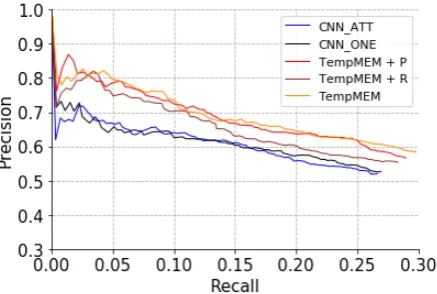
Figure 2: Precison-Recall curve of bag-level experiment on WIKI-TIME. Best viewed in color.
4.3 Performance of iterative reasoning
To test the effect of iterative reasoning over in-stances, we implement the neural models pro-posed in previous work (Zeng et al., 2015; Lin et al.,2016), from the source code released by au-thors. Since the previous models perform predic-tion in bag-level, the label is given by the latest relation appeared in KB. As for our models, we fix the number of hopsH = 2and set the encod-ing to CNN.3The notations of the experiments are shown in Table1.
As shown in Figure2and Table2, we have the following observations: (1) All TempMEM mod-els achieve better performance compared with the previous neural models (CNN ONE, CNN ATT).
[image:6.595.313.532.321.468.2]Method P@N 100 P@N 200 P@N 300
CNN ATT 67.33 67.66 66.45
CNN ONE 70.3 68.66 65.78
TempMEM 81.18 82.09 78.41
TempMEM+R 79.21 78.61 75.42
[image:7.595.74.288.63.149.2]TempMEM+P 81.19 79.1 77.41
Table 2: Comparison with previous models. P@N 100/200/300 refers to the precision for the highest 100, 200 and 300 predictions in WIKI-TIME.
Method Bag-level F1 Query-level F1
CNN ATT 39.66
-CNN ONE 40.15
-TempMEM 47.88 54.75
TempMEM+R 46.76 47.83
[image:7.595.81.283.210.297.2]TempMEM+P 54.86 60.01
Table 3: Manual evaluation of Bag-level and Query-level F1 scores in WIKI-TIME.
Recall that the hop number is set to 2. This can be seen as an ablation experiment. The results sug-gest that the remote instances can generally help relation extraction task. (2) TempMEM + P clearly outperforms TempMEM + R, which proves that the properly chosen temporal encodings help the performance.
Note that, in the columns “P@N 200” and “P@N 300” of Table 2, we find that the pure TempMEM outperforms TempMEM + P and TempMEM + R. Based on the results in Table3, their drop of performance comes from the noisy labeling problem of distant supervision.
Also, TempMEM can catch relation changes through the timeline of two entities. We refer the readers to the case study inAppendix B.
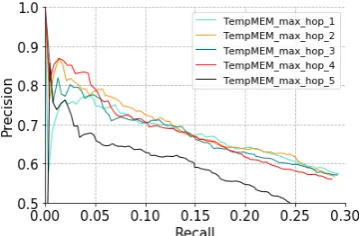
Figure 3: Number-of-hops experiment on WIKI-TIME. Best viewed in color.
4.4 Manual Evaluation on WIKI-TIME
Since the WIKI-TIME is distantly collected, we want to obtain a more precise view of how the models perform. So, we apply the manual evalu-ation to verify our experimental results. We ran-domly pick 200 mention sets in the test set of WIKI-TIME and ask two annotators to label the relation for each instance. The annotation rule is to label the instance with the relation that can be inferred from the instance itself or previous in-stances. As shown in Table 3, the manual eval-uated F1 scores are basically consistent with the PR curves in Figure 2, which indirectly proves the WIKI-TIME’s quality. Also, we find that the TempMEM + P achieves the best performance and shows obvious advantages in both query-level and bag-level F1 scores over the naive TempMEM (i.e., with no temporal encodings). This proves the effectiveness of our temporal encodings.
4.5 Effect of the Number of Hops
[image:7.595.91.271.606.724.2]In this section, we discuss the effect of different number of hops in TempMEM. We change the hop value from 1 to 5 and evaluate the precision and recall of our models in query-level. The hyper-parameters are fixed. The temporal encoding is set to PE and each model is trained for 30 epochs. The results of the hop number experiment are depicted in Figure3. From the results, we can ob-serve that models show better performance with hop number 2 and 4. Most of the improvement of the model with hop number 4 resides in the recall range [0, 0.05], but the performance remains in the similar trend with other models in the recall range [0.05, 0.2]. In addition, we notice that the perfor-mance of the models fluctuates with the increase in the number of hops and the model with even hop number generally perform better than its pre-decessor, e.g. models with hop number 4 and 5. We believe that the reason might lie in the distri-bution of the hop distance between origin instance and useful remote instance.
4.6 Performance on NYT-10 Dataset
In this section, we report our results on the well-studied NYT-10 dataset. By evaluating our model in the NYT-10 dataset, our objective is to prove the power of reasoning among remote instances.
(a) Results with CNN encod-ing.
[image:8.595.76.285.68.136.2](b) Results with PCNN en-coding.
Figure 4: Precison-Recall curve on NYT-10. Best viewed in color.
temporal encoding for each instance. Also, we do not use the entity embedding for the NYT-10 ex-periments.
The results are shown in Figure 4. For both CNN and PCNN models, We can see that our mod-els exceed the performance of all other modmod-els (CNN ATT, CNN ONE, CNN AVE, PCNN ATT, PCNN ONE, PCNN AVE) in the range of low re-call values. In the high rere-call range, our models also have results about the same as the best model among others. This suggests that even without the temporal encoding, reasoning over remote in-stances is indeed useful in relation extraction task.
5 Related Work
5.1 Distant Supervision
Distant supervision for relation extraction is an important, automatic method of completing knowledge base.
(Riedel et al.,2010) made the at-least-once as-sumption that led the distant supervision for rela-tion extracrela-tion to multi-instance learning. ( Hoff-mann et al.,2011) and (Surdeanu et al.,2012) tried to model the task with a instance, multi-label setting using the classical graph model.
Recently, some work focused on applying deep neural network to the DS task. (Zeng et al.,2014) was the first trial to apply deep learning in rela-tion extracrela-tion by solving a classificarela-tion problem with fully supervised approach. (Zeng et al.,2015) moved a step further and introduced the multi-instance learning paradigm by using only the most important instance to predict relation. (Lin et al.,
2016;Liu et al.,2017;Ji et al.,2017) improved the previous work by adding attention mechanism to instances and automatically reducing the weights of noisy instances. There are other approaches that tried to reduce the impact of noise in DS by using active learning (Sterckx et al.,2014) and reinforce-ment learning (Feng et al.,2018).
However, previous work focused on denoising but ignored the exploration of the remote instances and introduced no temporal information to sup-port relation extraction. In this paper, we intro-duce temporal information into DS and combine it with the memory network to perform reasoning over instances.
(Feng et al., 2017) also used the memory net-work in the context of distant supervision. Their work performed word-level and relation-level rea-soning to model the importance of words and de-pendency between relations. Their motivation was to gain better sentence encoding and relation mod-eling, while in our model, we apply the sentence-level memory network to understand the inference process among instances.
5.2 Temporal Relation Extraction
Also, this work is related to temporal relation ex-traction. (Dligach et al., 2017) was the first ap-proach to use neural models for temporal relation extraction. (Tourille et al.,2017) used a Bi-LSTM to identify narrative containers between events and time expressions. (Cheng and Miyao, 2017) in-troduced dependency paths and used a ”common-root” to solve the cross-sentence dependency. (Meng and Rumshisky,2018) leveraged the Neu-ral Turing Machine to enhance context-awareness of the temporal relation extraction model.
Previous work in temporal relation extraction was dedicated to event timelining and focused on dealing with relations between event and time expression. In constrast, our model aims to solve general entity to entity relation extraction by instance-level temporal reasoning based on a coarse-grained timelining.
5.3 Temporal Slot Filling
Another related research aspect is the temporal slot filling (TSF) task introduced in knowledge base population (Surdeanu,2013;Ji et al.,2014). Distant supervision approaches (Garrido et al.,
2013;Cucerzan and Sil,2013;Sil and Cucerzan,
2014) (from Freebase and Wikipedia infoboxes) are widely applied to address the lack of super-vising data. (Reinanda and De Rijke, 2014) per-formed the prior-sampling on distant supervision data to correct the mismatch of distributions.
is that the TSF task’s objective is to predict valid-ity period given thehead,relandtail, while in our setting, we predictrelbetween two entities in dif-ferent periods.
6 Conclusion
In this paper, we formulate the task of distant supervision with temporal relation reasoning by modeling it as a sequence labeling problem. Fol-lowing the DS paradigm, we created a new dataset called WIKI-TIME which is designed for the tem-poral relation extraction task. In addition, we propose an encoding-fusion model, TempMEM, which combines both encoding and reasoning temporally. At each computation step, our model can automatically attend information with either close representation or close temporal encoding. In experiments, we compare our model with the existing methods in both the well-known NYT-10 dataset and our WIKI-TIME dataset. Both auto-matic and manual evaluation are applied in the ex-periments. The experimental results show that our model not only realizes better performance in re-lation extraction by introducing instance-level rea-soning but also improves the rearea-soning by bring-ing the temporal information in.
In the future, we plan to further explore the ef-fect of different encoding modules like Bi-LSTM or self-attention and try to model temporal infor-mation with more sophisticated choices.
Acknowledgments
The research is supported in part by the Na-tional Basic Research Program of China Grant 2015CB358700, the National Natural Science Foundation of China Grant 61822203, 61772297, 61632016, 61761146003, and a grant from Mi-crosoft Research Asia.
Also, we want to thank the very kind comments from anonymous reviewers, which help improve this paper.
References
Antoine Bordes, Nicolas Usunier, Alberto Garcia-Duran, Jason Weston, and Oksana Yakhnenko. 2013. Translating embeddings for modeling multi-relational data. In Advances in neural information processing systems, pages 2787–2795.
Fei Cheng and Yusuke Miyao. 2017. Classifying tem-poral relations by bidirectional lstm over depen-dency paths. In Proceedings of the 55th Annual
Meeting of the Association for Computational Lin-guistics (Volume 2: Short Papers), volume 2, pages 1–6.
Silviu Cucerzan and Avirup Sil. 2013. The msr sys-tems for entity linking and temporal slot filling at tac 2013. InTAC.
Dmitriy Dligach, Timothy Miller, Chen Lin, Steven Bethard, and Guergana Savova. 2017. Neural tem-poral relation extraction. InProceedings of the 15th Conference of the European Chapter of the Associa-tion for ComputaAssocia-tional Linguistics: Volume 2, Short Papers, volume 2, pages 746–751.
Jun Feng, Minlie Huang, Li Zhao, Yang Yang, and Xi-aoyan Zhu. 2018. Reinforcement learning for rela-tion classificarela-tion from noisy data.
Xiaocheng Feng, Jiang Guo, Bing Qin, Ting Liu, and Yongjie Liu. 2017. Effective deep memory net-works for distant supervised relation extraction. In Proceedings of the Twenty-Sixth International Joint Conference on Artificial Intelligence, IJCAI, pages 19–25.
Guillermo Garrido, Anselmo Penas, and Bernardo Ca-baleiro. 2013. Uned slot filling and temporal slot filling systems at tac kbp 2013: System description. InTAC.
Raphael Hoffmann, Congle Zhang, Xiao Ling, Luke Zettlemoyer, and Daniel S Weld. 2011. Knowledge-based weak supervision for information extraction of overlapping relations. InProceedings of the 49th Annual Meeting of the Association for Computa-tional Linguistics: Human Language Technologies-Volume 1, pages 541–550. Association for Compu-tational Linguistics.
Guoliang Ji, Kang Liu, Shizhu He, Jun Zhao, et al. 2017. Distant supervision for relation extraction with sentence-level attention and entity descriptions. InAAAI, pages 3060–3066.
Heng Ji, Taylor Cassidy, Qi Li, and Suzanne Tamang. 2014. Tackling representation, annotation and clas-sification challenges for temporal knowledge base population. Knowledge and Information Systems, 41(3):611–646.
Yankai Lin, Shiqi Shen, Zhiyuan Liu, Huanbo Luan, and Maosong Sun. 2016. Neural relation extraction with selective attention over instances. In Proceed-ings of the 54th Annual Meeting of the Association for Computational Linguistics (Volume 1: Long Pa-pers), volume 1, pages 2124–2133.
Bingfeng Luo, Yansong Feng, Zheng Wang, Zhanxing Zhu, Songfang Huang, Rui Yan, and Dongyan Zhao. 2017. Learning with noise: enhance distantly su-pervised relation extraction with dynamic transition matrix.arXiv preprint arXiv:1705.03995.
Yuanliang Meng and Anna Rumshisky. 2018. Context-aware neural model for temporal information extrac-tion. InProceedings of the 56th Annual Meeting of the Association for Computational Linguistics (Vol-ume 1: Long Papers).
Alexander Miller, Adam Fisch, Jesse Dodge, Amir-Hossein Karimi, Antoine Bordes, and Jason We-ston. 2016. Key-value memory networks for directly reading documents. arXiv preprint arXiv:1606.03126.
Arvind Neelakantan, Luke Vilnis, Quoc V Le, Ilya Sutskever, Lukasz Kaiser, Karol Kurach, and James Martens. 2015. Adding gradient noise improves learning for very deep networks. arXiv preprint arXiv:1511.06807.
Jeffrey Pennington, Richard Socher, and Christo-pher D. Manning. 2014. Glove: Global vectors for word representation. InEmpirical Methods in Nat-ural Language Processing (EMNLP), pages 1532– 1543.
Ridho Reinanda and Maarten De Rijke. 2014. Prior-informed distant supervision for temporal evidence classification. In Proceedings of COLING 2014, the 25th International Conference on Computational Linguistics: Technical Papers, pages 996–1006.
Sebastian Riedel, Limin Yao, and Andrew McCallum. 2010. Modeling relations and their mentions with-out labeled text. In Joint European Conference on Machine Learning and Knowledge Discovery in Databases, pages 148–163. Springer.
Avirup Sil and Silviu-Petru Cucerzan. 2014. To-wards temporal scoping of relational facts based on wikipedia data. In Proceedings of the Eigh-teenth Conference on Computational Natural Lan-guage Learning, pages 109–118.
Lucas Sterckx, Thomas Demeester, Johannes Deleu, and Chris Develder. 2014. Using active learning and semantic clustering for noise reduction in distant su-pervision. In4e Workshop on Automated Base Con-struction at NIPS2014 (AKBC-2014), pages 1–6.
Sainbayar Sukhbaatar, Jason Weston, Rob Fergus, et al. 2015. End-to-end memory networks. InAdvances in neural information processing systems, pages 2440–2448.
Mihai Surdeanu. 2013. Overview of the tac2013 knowledge base population evaluation: English slot filling and temporal slot filling. InTAC.
Mihai Surdeanu, Julie Tibshirani, Ramesh Nallapati, and Christopher D Manning. 2012. Multi-instance
multi-label learning for relation extraction. In Pro-ceedings of the 2012 joint conference on empirical methods in natural language processing and compu-tational natural language learning, pages 455–465. Association for Computational Linguistics.
Julien Tourille, Olivier Ferret, Aurelie Neveol, and Xavier Tannier. 2017. Neural architecture for tem-poral relation extraction: A bi-lstm approach for de-tecting narrative containers. In Proceedings of the 55th Annual Meeting of the Association for Compu-tational Linguistics (Volume 2: Short Papers), vol-ume 2, pages 224–230.
Ashish Vaswani, Noam Shazeer, Niki Parmar, Jakob Uszkoreit, Llion Jones, Aidan N Gomez, Łukasz Kaiser, and Illia Polosukhin. 2017. Attention is all you need. InAdvances in Neural Information Pro-cessing Systems, pages 6000–6010.
Denny Vrandeˇci´c and Markus Kr¨otzsch. 2014. Wiki-data: a free collaborative knowledgebase. Commu-nications of the ACM, 57(10):78–85.
Daojian Zeng, Kang Liu, Yubo Chen, and Jun Zhao. 2015. Distant supervision for relation extraction via piecewise convolutional neural networks. In Pro-ceedings of the 2015 Conference on Empirical Meth-ods in Natural Language Processing, pages 1753– 1762.
Daojian Zeng, Kang Liu, Siwei Lai, Guangyou Zhou, and Jun Zhao. 2014. Relation classification via con-volutional deep neural network. In Proceedings of COLING 2014, the 25th International Conference on Computational Linguistics: Technical Papers, pages 2335–2344.
A Appendix A : WIKI-TIME Construction
Here we illustrate the construction process of WIKI-TIME dataset in detail. The construction of WIKI-TIME follows common distant supervi-sion framework. In distant supervisupervi-sion, we align the knowledge base to free corpus. The chosen knowledge base and free corpus are Wikidata and Wikipedia, respectively.
As depicted in Figure 5, the construction of WIKI-TIME consists of the following procedures.
1. We extract the relations with the valid period (i.e.,hts, tei) that appeared in WikiData.
2. Based on the extracted relation set, we fur-ther extract entity pairs that participate in any relation in the set. Here, each extracted triple should have a valid period (i.e.,hE1, rel, E2i :hts, tei).
Figure 5: Preprocess of inputs
the sentence or last appeared time expres-sion. We implement our own time expression recognition on the basis of NLTK-contrib’s timex tool4 with some modification accord-ing to our needs. Each tagged sentence is de-noted by tuplehsi,ˆtii.
4. We align the extracted entity pairs to tagged corpus to retrieve our final mention set. Note that we additionally take sentences mention-ing entity E2 in the wiki page of entity E1 as training sentences for (E1,E2) to obtain a larger dataset. In this case, the position ofE1 may not exist in our dataset. Because PCNN splits sentences by positions of entities, it is unclear how to apply it directly to our WIKI-TIME dataset.
5. We order the extracted sentences
{hs1,tˆ1i,· · · hsm,ˆtmi} into a timeline
and align them with the corresponding knowledge triple for sentence-level relation
hsi,ˆti, relii.
The final dataset contains 57 relations. The training set contains 97,616 sentences and 20,085 entity pairs. The test set contains 39,929 sentences and 8,641 entity pairs. The train/test split is done on entity pair level, so there is no overlap between train and test set.
B Appendix B : Case Study
Table4shows an example of our tagged data. For each sentence, we show the corresponding time slot and its relation. Also, the mentions of the entity are highlighted with the bold font and each
4https://github.com/nltk/nltk_contrib/
blob/master/nltk_contrib/timex.py
sentence is indexed byidfor clearness.
(a)q3over relationSpouse
[image:11.595.324.506.303.597.2](b) q0over relationSpouse
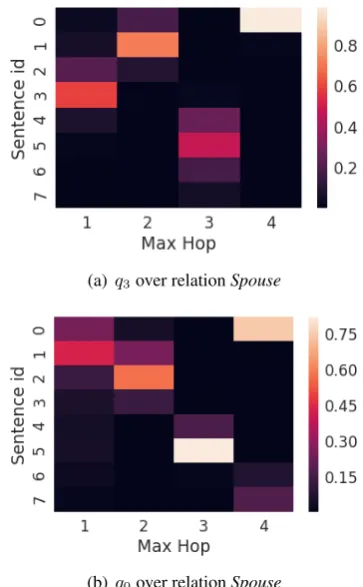
Figure 6: Attention weights for queries withH = 4
For each query, we show its
correspond-ing heat map of attention values over
different hops. The case we choose is
id Relation Time Spot Sentence
0 NA 1957-01-01 Her early career was marked by
her collaboration with singer Stelios Kazantzidis.
1 NA 1960-01-01 ... instances of Marinella in films of
Greek cinema, from the 1960 by 1966 withStelios Kazantzidis...
2 Spouse 1964-05-07 Marinella married Stelios
Kazantzidison 7 May 1964 ...
3 Spouse 1964-05-07 Stelios Kazantzidis married
Marinellaon 7 May 1964 ...
4 NA 1966-09-01 In September 1966 he divorced
Marinella...
5 NA 1968-01-01 FollowingMarinella’s departure Litsa
Diamandi ...
6 NA 1968-01-01 Marinellasang on some songs ...
7 NA 1968-01-01 Marinella had an ”answer back” to
[image:12.595.130.470.63.321.2]that latter song ...
Table 4: Aligned sentences ofhStelios Kazantzidis , Marinellai
of the sentence set (id 4 to 6), which contains sentences related to divorce, departure and so on. These findings prove the claim that our model can achieve more accurate relation extraction by exploitation of remote instances.
Also, we demonstrate that the model has differ-ent attdiffer-entions for queries at differdiffer-ent time spots. In Figure6(b), we still observe the case ofhStelios Kazantzidis, spouse, Marinellai. But, the atten-tion of queryq0 focuses on a different path com-pared with queryq3. It first focuses on the remote instances with id0 and 1. Then the model shifts to the supporting sentences. After that, it highly focuses on sentence 5, which supports two enti-ties’ departure. All these findings show that the temporal encodings significantly affect the result of attention.
The differences between the attentions of quries