Inducing Search Keys for Name Filtering
L. Karl Branting The MITRE Corporation 7467 Ridge Road, Suite 140 Hanover, MD 21076, U.S.A.
Abstract
This paper describes ETK (Ensemble of Transformation-based Keys) a new algo-rithm for inducing search keys for name filtering. ETK has the low computational cost and ability to filter by phonetic sim-ilarity characteristic of phonetic keys such as Soundex, but is adaptable to alternative similarity models. The accuracy of ETK in a preliminary empirical evaluation suggests that it is well-suited for phonetic filtering applications such as recognizing alternative cross-lingual transliterations.
1 Introduction
The task of name matching—recognizing when two orthographically distinct strings are likely to denote the same individual—occurs in a wide variety of im-portant applications, including law enforcement, na-tional security, and maintenance of government and commercial records. Coreference resolution, speech understanding, and detection of aliases and duplicate names all require name matching.
The orthographic variations that give rise to the name-matching task can result from a variety of fac-tors, including transcription and OCR errors, and spelling variations. In many applications, cross-lingual transliterations are a particularly important source of variation. For example, romanized Ara-bic names are phonetic transcriptions of sounds that have no direct equivalent in English, e.g., “Mo-hamed” or “Muhammet” are two of many possible transliterations for the same Arabic name.
Name matching can be viewed as a type of range query in which the input is a set of patterns (such
as names on an immigration-control watch list), a collection of text strings (such as a passenger list), a distance metric for calculating the degree of relevant dissimilarity between pairs of strings, and a match threshold expressing the maximum allowable dis-tance between matching names. The goal is to find all text/pattern pairs whose distance under the metric is less than or equal to the threshold. In the simplest case, patterns and the text strings with which they are matched are both individual words. In the gen-eral case, the text may not be segmented into strings corresponding to possible names.
Distance metrics for name matching are typically computationally expensive. For example, determin-ing the edit distance between two strdetermin-ings of lengthn andmrequires, in the general case,nmsteps. Met-rics based on algorithms that learn from examples of strings that should match (Bilenko et al., 2003; Ristad and Yianilos, 1998) and metrics that use pho-netic similarity criterion, e.g., (Kondrak, 2000) are no less expensive than edit distance.
The computational expense of distance metrics means that tractable name matching on large texts typically requires an inexpensive, high-recall
filter-ing step to find a subset of the original text to
which the expensive similarity metric will be ap-plied. Desiderata for filtering include the following:
1. High recall. The recall of the entire name-matching process is bounded by the recall of the filtering step, so high filtering recall is es-sential.
2. Efficiency. Filtering is useful only to the ex-tend that it requires less computational expense than applying the similarity metric to each pat-tern/text pair. The computational expense of
a filtering algorithm itself must therefore be less than the cost of the metric calls eliminated through the filtering process. Typically, the cost of the metric is so much higher than the filter-ing cost that the latter can be neglected. Under these circumstances, precision is a satisfactory proxy for efficiency.
3. Adaptability to specific distance metrics. High precision and recall are achievable in fil-tering only if the filfil-tering criterion corresponds to the distance metric. For example, if a dis-tance metric is based on phonetic differences between strings, a filtering algorithm that se-lects candidate text strings based on ortho-graphic differences may perform poorly. Sim-ilarly, poor performance may result from use of a filtering algorithm based on phonetic dif-ferences if the distance metric is based on or-thographic differences. For example,“LAYTON”
and “LEIGHTON”differ by a large edit distance but are phonetically identical (in most dialects), whereas“BOUGH”and“ROUGH”are orthograph-ically similar but phonetorthograph-ically dissimilar. An ideal filtering algorithm should be adaptable to any particular distance metric.
This paper describes ETK (Ensemble of Transformation-based Keys) a new algorithm for inducing filters that satisfy the three criteria above. ETK is similar to phonetic search key algorithms such as Soundex and shares phonetic search key algorithms’ low computational expense and ability to filter by phonetic similarity. However, ETK has the advantage that it is adaptable to alter-native distance metrics and is therefore applicable to a wider range of circumstances than static key algorithms.
The next section describes previous work in name filtering. Section 3 describes the ETK algorithm in detail, and a preliminary evaluation on English and German surnames is set forth in Section 4.
2 Previous Work
The division of the retrieval task into an inexpensive, high-recall filtering stage followed by a more expen-sive high-precision stage emerged independently in a variety of different areas of computer science. This
approach is termed two-stage retrieval in the Infor-mation Retrieval literature (Shin and Zhang, 1998),
MAC/FAC by some researchers in analogy
(Gen-tner and Forbus, 1991), blocking in the statistical record linkage literature (Cohen et al., 2003), and
fil-tering in the approximate string matching literature
(Navarro, 2001).
The two most common approaches to filtering that have been applied to name matching are in-dexing by phonetic keys and inin-dexing by ngrams. Two less well known filtering algorithms that often have higher recall than filtering by phonetic keys or ngrams are pivot-based retrieval and partition
filter-ing.
Phonetic Key Indexing. In phonetic key index-ing, names are indexed by a phonetic representa-tion created by a key funcrepresenta-tion that maps sequences of characters to phonetic categories. Such key functions partition the name space into equivalence classes of names having identical phonetic represen-tations. Each member of a partition is indexed by the shared phonetic representation.
The oldest phonetic key function is apparently Soundex, which was patented in 1918 and 1922 by Russell and Odell (U.S. Patents 1,261,167 and 1,435,663) and described in (Knuth, 1975). Despite Soundex’s has many well-known limitations, includ-ing inability to handle different first letters with identical pronunciations (e.g., Soundex of “Kris” is K620, but Soundex of “Chris” is C620), trun-cation of long names, and bias towards English pronunciations, Soundex is still in use in many law enforcement and national security applications (Dizard, 2004). A number of alternative phonetic encodings have been developed in response to the limitations of Soundex, e.g., (Taft, 1970; Gadd, 1990; Zobel and Dart, 1996; Philips, 1990; Philips, 2000; Hodge and Austin, 2001; Christen, 2006). While each of these alternatives has some advan-tages over Soundex, none is adaptable to alterna-tive distance metrics. For purposes of comparison, Phonex (Gadd, 1990) was included in the evalua-tion below because it was found to be the most ac-curate phonetic key for last names in an evaluation by (Christen, 2006).
each pattern string is indexed by every n-element substring, i.e., every sequence of n contiguous char-acters occurring in the pattern string (typically, the original string is padded with special leading and trailing characters to distinguish the start and end of the name). The candidates for each target string are retrieved using the ngrams in the target as indices (Cohen et al., 2003). Typical values for n are 3 or 4.
Pivot-Based Retrieval. Pivot-based retrieval techniques are applicable to domains, such as name matching, in which entities are not amenable to vector representation but for which the distance metric satisfies the triangle inequality (Chavez et al., 2001).1
The key idea is to organize the index around a small group of elements, called pivots. In retrieval, the distance between the query probeqand any ele-ment ecan be estimated based on the distances of each to one or more pivots. There are numerous pivot-based metric space indexing algorithms. An instructive survey of these algorithms is set forth in (Chavez et al., 2001).
One of the oldest, and often best-performing, pivot-based indices is Burkhart-Keller Trees (BKT) (Burkhard and Keller, 1973; Baeza-Yates and Navarro, 1998). BKT is suitable for discrete-valued distance metrics. Construction of a BKT starts with selection of an arbitrary element as the root of the tree. The ith child of the root consists of all ele-ments of distance i from the root. A new BKT is recursively constructed for each child until the num-ber of elements in a child falls below a predefined bucket size.
A range query on a BKT with distance metric d, probe q, range k, and pivot p is performed as follows. If the BKT is a leaf node, then the dis-tance metricdis applied betweenqand each element of the leaf node, and those elements e for which d(q, e) < k are returned. Otherwise, all subtrees with index ifor which |d(q, e)−i| ≤ kare recur-sively searched.
While all names within kof a query are
guaran-1
Edit distance satisfies the triangle inequality because any string A can be transformed into another string C by first transforming A to any other string B, then transforming B into C. Thus, distance(A,C) cannot be greater than edit-distance(A,B)+edit-distance(B,C) for any strings A, B, and C.
teed to be retrieved by a BKT (i.e., recall is 100%), there are no guarantees on precision. During search, one application of the distance metric is required at each internal node traversed, and a distance-metric application is required for each candidate element in leaf nodes reached during the traversal. The number of nodes searched is exponential ink(Chavez et al., 2001).
Partition Filtering. Partition filtering (Wu and
Manber, 1991; Navarro and Baeza-Yates, 1999), is an improvement over ngram filtering that relies on the observation that if a pattern string P of length mis divided into segments of length ⌊ m
(k+1)⌋, then any string that matchesP with at mostkerrors must contain an exact match for at least one of the seg-ments (intuitively, it would take at least k + 1 er-rors, e.g., edit operations, to alter all of these seg-ments). Strings indexed by⌊(km+1)⌋-length segments can be retrieved by an efficient exact string match-ing algorithm, such as suffix trees or Aho-Corasick trees. This is necessary because partitions, unlike ngrams, vary in length.
Partition filtering differs from ngram filtering in two respects. First, ngrams overlap, whereas par-tition filtering involves parpar-titioning each string into non-overlapping segments. Second, the choice of n in ngram filtering is typically independent of k, whereas the size of the segments in filtering is cho-sen based onk. Since in most applications nis in-dependent of k, ngram retrieval, like phonetic key indexing, lacks any guaranteed lower bound on call, whereas partition filtering guarantees 100% re-call when the distance metric is edit distance.
3 The ETK algorithm
3.1 Motivation
Any key function partitions the universe of strings into equivalence classes of strings that share a com-mon key. If a key function is to serve as a fil-ter, matching names must be members of the same equivalence class. However, no single partition can produce equivalence classes that both include all matching pairs and exclude all non-matching pairs.2
2
A search key that creates partitions in which there is a low probability that non-matching pairs share a common equivalence class will have high precision, although possibly low recall. However, the recall of an ensemble of search keys, each having non-zero recall and each being independent of the others, can be expected to be greater than the recall of any in-dividual key. A high-precision and high-recall index can therefore be constructed if one can find, for a given similarity metric and match threshold, a suf-ficiently large set of key functions that (1) are in-dependent, (2) each have high-precision under the metric and threshold, and (3) have non-zero recall.
The objective of ETK is to learn a set of inde-pendent, high-precision key functions from training data consisting of equivalence classes of names that satisfy the matching criteria. The similarity metric and threshold are implicit in the training data. Thus, under this approach a key function can be learned even if the similarity model is unknown, provided that sufficient equivalence classes are available.
For each equivalence class, ETK attempts to find the shortest transformation rules capable of con-verting all members of the equivalence class into an identical orthographic representation. The entire collection of transformation rules for all equivalence classes, which in general has many inconsistencies, is then partitioned into separate consistent subsets. Each subset of transformation rules constitutes an independent key function. Each pattern name is in-dexed by each key produced by applying a key func-tion to it, and the candidate matches for a new name consist of all pattern names that share at least one key.
The equivalence classes of matching names can be obtained either through some a priori source (such as alias lists or manual construction) or by ap-plying the similarity metric to pairs in a training set,
e.g., repeated leave-one-out retrievals with a known
distance metric. In the former case, the keys are purely empirical; in the later the key functions are in effect a way of compiling the distance metric to speed retrieval.
and C into a different equivalence class, a query on C would re-quire a partition that puts B and C in the same equivalence class and A in a different equivalence class, and a query on B would require a partition in which all three were in the same equiva-lence class. Thus, three independent keys would be needed to satisfy all three queries while excluding non-matching names.
3.2 Procedure
Inducing Transformation Rules. The inductive process starts with a collection of equivalence classes under a given distance metric and match threshold k. A collection of transformation rules are derived from these equivalence classes as follows. For each equivalence classEC:
• The element of EC with the least mean pair-wise edit distance to the other class members (breaking ties by preferring shorter elements) is selected as the centroid. For example, if EC is{LEIGHTON LAYTON SLEIGHTON}, then
LEIGHTONwould be the centroid because it has a smaller edit distance to the other elements than they do to each other.
• For each elementEother than the centroid, dy-namic programming is used to find an align-ment ofEwith the centroid that maximizes the number of corresponding identical characters.3 For example, the alignment ofLEIGHTON and
LAYTONwould be:
LAY--TON LEIGHTON
• For each character c of the centroid, all win-dows of characters in E of length from 1 to some constant maxWindow centered on the character in the source corresponding toc are found, skipping blank characters. Each map-ping from a window to c constitutes a rule. For example, for maxWindow 7 and the align-ment above, the transformation rules for theE
inLEIGHTONwould be:
$$LAYTO→E $LAYT→E LAY→E A→E
3
Transformation rules derived from multiple equivalence classes typically have many incon-sistencies, i.e., rules with identical left-hand sides (LHSs) but different right hand sides (RHSs). All RHSs for a given LHS are grouped together and ranked by frequency of occurrence in the training data. For example, the frequency of alternative rules for the middle characters
LAN and LEI for the U.S. name pronunciation set withk= 1discussed below is:
LAY→E 5 LEI→A 2
LAY→A 4 LEI→E 1
LAY→AN 3 LEI→- 1
Key Formation. The transformation rules are sub-divided two different ways: by LHS, e.g., separating rules for LAY from those for LEI, and by RHS fre-quency, e.g., separatingLAY→E(the most frequent rule forLAY) fromLAY→A(the next most frequent). The highest frequency RHS rules from the example above are:
LAY→E LEI→A
and the next most frequent are:
LAY→A LEI→E
If rules are divided into lLHS subsets, and each subset is further subdivided by taking ther highest ranked RHSs (with RHSs ranked lower than r ig-nored), the result is a total of lr subsets. Each of theselrsubsets defines a key function. For each po-sition in a word to which the key function is to be applied (padded with leading and training markers), the rule with the longest (i.e., most specific) LHS that matches the window centered at that position is used to determine the corresponding character in the key. If no rules apply, the character in the key is the same as that in the original word.
For example, suppose that the word to which the key is to be applied isCREIGHTONand transforma-tions includeLEIGHTO→-,EIGHT→-andIGH→G. The character in the key corresponding to the Gin
CREIGHTONwould be-(i.e., a deletion) because the
EIGHTis the longest LHS matching at that position. The key consists of the concatenation of the RHSs produced by successively applying the key function to each position in the orginal word.
This procedure is similar to window-based pronunciation-learning algorithms, e.g., (Sejnowski and Rosenberg, 1987; Bakiri and Dietterich, 1999), but differs in that the objective is not determining a correct pronunciation, but is instead transforming words that are similar under a given metric into a single, consistent orthographic representation.
3.3 Filtering with ETK
Thelrsubsets of transformation rules induced from a given set of equivalence classes define an ensem-ble of key functions. To filter potential matches with this ensemble, each pattern is added to a hash table indexed by each key generated by a key function. Candidate matches to a text string consist of all pat-terns indexed by the keys generated from the text by the ensemble of key functions. For example, sup-pose that (as is the case with the rule sets for Amer-ican names, pronunciation distance, and k = 0) patterns ROLLINSand ROWLAND have keys that in-clude{ROWLINS ROLINS}and{RONLLAND ROLAN}, respectively, and that textRAWLINShas keys that in-clude {ROWLINS RALINS}. Then ROLLINS but not
ROWLANDwould be retrieved because it is indexed by a key shared withROWLINS.4
4 Evaluation
The retrieval accuracy of ETK was compared to that of BKT, filtering by partition, ngram filtering, Phonex, and Soundex on sets of U.S. and German names. The U.S. name set consisted of the 5,000 most common last names identified during the most recent U.S. Census5 which have pronunciations in cmudict, the CMU pronouncing dictionary.6 The German name set consisted of the first 5963 en-tries in the HADI-BOMP collection7 whose part of speech isNAM.
The filtering algorithms were compared with re-spect to two alternative distance metrics. The first was pronunciation distance, which consists of edit
4In the evaluation below, the original string itself is added
as an additional index key. This addition slightly increases both recall and precision.
5The names were taken from the 1990
U.S. Census collection of 88,799 last names at
http://www.census.gov/genealogy/names/names files.html. 6
http://www.speech.cs.cmu.edu/cgi-bin/cmudict.
7
distance between pronunciations represented us-ing the cmudict phoneme set for U.S. names and the HADI-BOMP phoneme set for German names. Stress values were removed from cmudict pronun-ciations, and syllable divisions were removed from HADI-BOMP pronunciations. When there were multiple pronunciations for a name in cmudict, the first was used. In cmudict, for example, MEUSE
and MEWES have pronunciation distance of 0 be-cause both have pronunciationM Y UW Z. In HADI-BOMP,HELGARDandHERBARThave pronunciation distance 2 because their pronunciations areh E l g a r tandh E r b a r t. The second distance metric was edit distance with unit weights for insertions, deletions, and substitutions. In practice, appropriate distance metrics might be Jaro (Jaro, 1995), Winkler (Win-kler, 1999), or some metric specialized to a particu-lar phonetic or error model. Pronunciation and edit distance were chosen as representative of phonetic and non-phonetic metrics.
Training data for ETK for a given language, match thresholdk, and similarity metric consisted of all sets of at least 2 names containing only elements were withinkof some element of the set under the metric. These training sets were created by perform-ing a retrieval on every name in each collection us-ing BKT, which has 100% recall. For each retrieval, the true positives from BKT’s return set were de-termined by applying the similarity metric between each return set element and the query. If there were at least 2 true positives (including the query itself), the set of true positives was included in the training set.8
ETK was tested using cross validation, so that names in the training set and those in the testing set were disjoint. Specifically, all names in the testing set were removed from each collection in the train-ing set. If at least 2 names remained, the collection was retained. ETK’s maxWindow size was 7, as in the examples above.
In BKT, the bucket size (maximum number of ements in any leaf node) was 2, and the longest el-ement (rather than a random elel-ement) was selected
8
Note that each set of true positives is a cluster having the query as its centroid and radius kunder the distance metric.
The triangle inequality guarantees that the maximum distance between any pair of names in the collection is no greater than 2k.
as the root of each subtree. The rationale for this choice is that there is typically more variance in dis-tance from a longer word than from a shorter word, and greater variance increases the branching factor in BKT, reducing tree depth and therefore the num-ber of nodes visited during search.
Since the importance of precision in filtering is that it determines the number of calls to the sim-ilarity metric required for a given level of recall, precision figures for BKT include internal calls to the similarity metric, that is, calls during indexing. Thus, precision of BKT is the number of true posi-tives divided by the number of all posiposi-tives plus the number of internal metric calls.
In Soundex and Phonex indexing, each name was indexed by its Soundex (Phonex) key. Similarly, in ngram filtering each name was indexed by all its ngrams, with special leading and trailing char-acters added. Retrieval was performed by finding the Soundex or Phonex encoding or the ngrams of each query and retrieving every name indexed by the Soundex or Phonex encoding or any ngram. Preci-sion was measured with duplicates removed.
In partition filtering, each name was indexed by each of itsk+ 1partitions, and the partitions them-selves were organized in an Aho-Curasick tree (Gus-field, 1999). Retrieval was performed by apply-ing the Aho-Curasick tree to the query to determine all partitions occurring in the query and retrieving the names corresponding to each partition, remov-ing duplicates.
4.1 Optimizing LHS and RHS Subdivisions
The first experiment was performed to clarify the op-timal sizes of l, the number of LHS subdivisions, and r, the number of RHS ranks. ETK was tested on the U.S. name set withk= 1, pronunciation dis-tance as similarity metric, and 10-fold cross valida-tion forl∈ {1,2,4,8,16,32}andr∈ {1,2}.
Table 1: F-measure for l ∈ {1,2,4,8,16,32} and r ∈ {1,2,} on U.S. names with pronunciation dis-tance andk= 1in 10-fold cross validation.
1 2 4 8 16 32
1 0.1431 0.2112 0.3039 0.3550 0.3428 0.2928
2 0.1469 0.1858 0.1520 0.0729 0.0264 0.0108
4.2 Comparison of ETK to Other Filter Algorithms
The retrieval accuracy of ETK was compared to that of BKT, partition, ngram, Phonex, and Soundex on the U.S. and German name sets for pronunciation distance with k ∈ {0,1,2} and for edit distance with k ∈ {1,2}. In tests involving pronuncia-tion distance BKT was tested under two condipronuncia-tions: with the pronunciation distance function available to BKT during indexing and retrieval; and the dis-tance function unavailable, so that BKT indexing and retrieval was performed on the surface form even though the actual similarity metric was pro-nunciation distance. This is intended to simulate the situation in which examples of matching names are available but the underlying similarity metric is unknown. Ngram and partition filtering were per-formed on letters only.
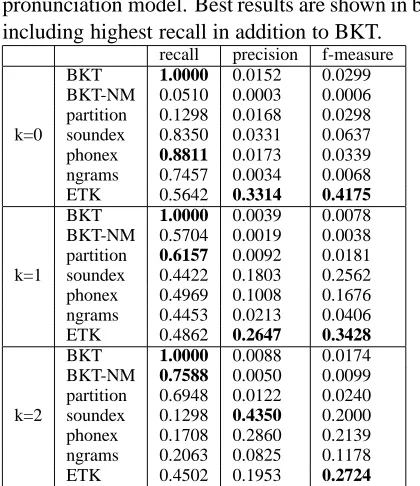
Tables 2 and 3 show recall, precision, and f-measure for pronunciation distance on U.S. and Ger-man names, respectively, with k ∈ {0,1,2}, l = 16, and r = 1. ETK has the highest f-measure under all conditions because its precision is con-sistently higher than that of the other algorithms. This is because each key function in ETK applies only transformations representing orthographic dif-ferences between names in the same equivalence class. Thus, the transformations are very conserva-tive. BKT always has recall of 1.0 when the pronun-ciation model is available, but in many cases a model may be unavailable. When no model is available, no single algorithm consistently has the highest recall. Ngrams, partition, Phonex, and BKT each had the highest recall in at least one language/error thresh-old combination.
[image:7.612.312.522.113.356.2]Tables 4 and 5 show recall, precision, and f-measure for edit distance on U.S. and German names, respectively, with k ∈ {1,2}, l = 16, and r = 1 (k = 0 would be an exact match on the surface form, for which all algorithms would have
Table 2: Recall, precision, and f-measure for pro-nunciation distance on U.S. surnames. K is maxi-mum permitted error. BKT-NM is BKT without the pronunciation model. Best results are shown in bold, including highest recall in addition to BKT.
recall precision f-measure BKT 1.0000 0.0152 0.0299 BKT-NM 0.0510 0.0003 0.0006 partition 0.1298 0.0168 0.0298 k=0 soundex 0.8350 0.0331 0.0637 phonex 0.8811 0.0173 0.0339 ngrams 0.7457 0.0034 0.0068 ETK 0.5642 0.3314 0.4175
BKT 1.0000 0.0039 0.0078 BKT-NM 0.5704 0.0019 0.0038 partition 0.6157 0.0092 0.0181 k=1 soundex 0.4422 0.1803 0.2562 phonex 0.4969 0.1008 0.1676 ngrams 0.4453 0.0213 0.0406 ETK 0.4862 0.2647 0.3428
BKT 1.0000 0.0088 0.0174 BKT-NM 0.7588 0.0050 0.0099 partition 0.6948 0.0122 0.0240 k=2 soundex 0.1298 0.4350 0.2000 phonex 0.1708 0.2860 0.2139 ngrams 0.2063 0.0825 0.1178 ETK 0.4502 0.1953 0.2724
recall 1.0). Again, ETK has the highest f-measure because of its consistently high precision.
4.3 Training Set Size
The sensitivity of ETK to training set size was tested by performing 50-fold cross-validation with train-ing sets for pronunciation distance on U.S. names of sizes in{48, 96, 191, 381, 762, 1524, 3047}drawn from the 3047 equivalence classes in the 5000 U.S. names with pronunciation distance andk = 1. As shown in Figure 1, the learning curve rises steeply for the entire range of training set sizes considered in this experiment.
5 Conclusion
indi-Table 3: Recall, precision, and f-measure for pro-nunciation distance on German names. K is maxi-mum permitted error. Best results are shown in bold.
recall precision f-measure BKT 1.0000 0.0056 0.0110 BKT-NM 0.1600 0.0003 0.0007 partition 0.1223 0.0059 0.0112 k=0 soundex 0.7059 0.0125 0.0235 phonex 0.8997 0.0061 0.0122 ngrams 0.9348 0.0016 0.0031 ETK 0.7715 0.3606 0.4915
BKT 1.0000 0.0013 0.0026 BKT-NM 0.7923 0.0006 0.0013 partition 0.7865 0.0031 0.0062 k=1 soundex 0.3969 0.0533 0.0940 phonex 0.5048 0.0270 0.0512 ngrams 0.6866 0.0090 0.0178 ETK 0.5503 0.3820 0.4510
[image:8.612.72.277.112.337.2]BKT 1.0000 0.0018 0.0037 BKT-NM 0.8533 0.0010 0.0021 partition 0.8384 0.0029 0.0058 k=2 soundex 0.1311 0.1209 0.1258 phonex 0.1693 0.0640 0.0929 ngrams 0.2801 0.0255 0.0468 ETK 0.3496 0.1687 0.2276
Table 4: Recall, precision, and f-measure for edit distance on U.S. surnames.
recall precision f-measure BKT 1.0000 0.0024 0.0048 partition 1.0000 0.0106 0.0210 k=0 soundex 0.3537 0.1010 0.1572 phonex 0.3937 0.0564 0.0986 ngrams 0.8408 0.0288 0.0557 ETK 0.6768 0.3244 0.4386
BKT 1.0000 0.0052 0.0103 partition 1.0000 0.0139 0.0275 k=1 soundex 0.1038 0.2692 0.1498 phonex 0.1288 0.1696 0.1464 ngrams 0.4112 0.1300 0.1976 ETK 0.4001 0.3565 0.3770
Table 5: Recall, precision, and f-measure for edit distance on German names.
recall precision f-measure BKT 1.0000 0.0009 0.0018 partition 1.0000 0.0045 0.0091 k=0 soundex 0.5266 0.0826 0.1429 phonex 0.6101 0.0374 0.0704 ngrams 0.8880 0.0134 0.0264 ETK 0.6647 0.4957 0.5679
[image:8.612.320.534.149.294.2]BKT 1.0000 0.0017 0.0034 partition 1.0000 0.0048 0.0096 k=1 soundex 0.1592 0.2052 0.1793 phonex 0.2019 0.1063 0.1392 ngrams 0.4036 0.0516 0.0915 ETK 0.3986 0.3466 0.3708
Figure 1: F-measure for U.S. names for training sets containing varying numbers of collections, withk= 1,l= 16, andr= 1. Each training instance consists of all names within k of some centriod under the metric.
vidual match criteria. In filtering under pronunci-ation distance, ETK’s f-measure for German names was similar to its f-measure for U.S. names (actually higher fork∈ {0,1}) whereas Soundex and Phonex were approximately an order of magnitude lower.
Although ETK consistently had the highest f-measure in this experiment, it does not follow that ETK is necessarily the most desirable name filter for any particular application. In many applications re-call may be much more important than precision. In such cases, it may be essential to choose the highest recall algorithm notwithstanding a lower f-measure. However, the highest recall algorthms can lead to a very large number of distance-metric applications. For example, in some data sets the number of nodes examined by BKT during retrieval is a significant proportion of the entire pattern set.
ETK has the disadvantage of requiring a large set of training examples consisting of equivalence sets of strings that match under the metric and maximum allowable error. Where such large numbers of equiv-alence sets are unavailable, it may be better to use simpler and less-informed filters.
[image:8.612.73.273.384.520.2]In summary, this work has demonstrated that en-sembles of keys induced from equivalence classes of names under a specific distance metric and max-imum allowable error can filter names with high f-measure. The experimental results illustrate the ben-efits both of acquiring keys that are adapted to spe-cific similarity criteria and of indexing with multiple independent keys.
References
R. A. Baeza-Yates and G. Navarro. 1998. Fast approx-imate string matching in a dictionary. In String
Pro-cessing and Information Retrieval, pages 14–22.
G. Bakiri and T. Dietterich. 1999. Achieving high-accuracy text-to-speech with machine learning. Data
mining in speech synthesis.
M. Bilenko, W. W. Cohen, S. Fienberg, R. J. Mooney, and P. Ravikumar. 2003. Adaptive name-matching in information integration. IEEE Intelligent Systems, 18(5):16–23.
W. A. Burkhard and R. M. Keller. 1973. Some ap-proaches to best-match file searching. Commun. ACM, 16(4):230–236.
E. Chavez, G. Navarro, R. A. Baeza-Yates, and J. L. Mar-roquin. 2001. Searching in metric spaces. ACM
Com-puting Surveys, 33(3):273–321.
P. Christen. 2006. A comparison of personal name matching: Techniques and practical issues. In
Pro-ceedings of the ICDM 2006 Workshop on Mining Com-plex Data (MCD), December.
W. W. Cohen, P. Ravikumar, and S. E. Fienberg. 2003. A comparison of string distance metrics for name-matching tasks. In Proceedings of the IJCAI-2003
Workshop on Information Integration on the Web,
pages 73–78, Acapulco, Mexico, August.
R. I. Damper, Y. Marchand, J. D. S. Marsters, and A. I. Bazin. 2004. Aligning letters and phonemes for speech synthesis. In Proceedings of 5th International
Speech Communication Association (ISCA) Workshop on Speech Synthesis, pages 209–214, Pittsburgh, PA.
W. Dizard. 2004. Obsolete algorithm tangles ter-rorst/criminal watch lists. Government Computer News, 23(12), August 17.
T. Gadd. 1990. Phonix: The algorithm. Program:
auto-mated library and information systems, 24(4).
D. Gentner and K. Forbus. 1991. MAC/FAC: A model of similarity-based retrieval. In Thirteenth Annual
Con-ference of the Cognitive Science Society, pages 504–
509.
D. Gusfield. 1999. Algorithms on Strings, Trees, and
Sequences. Cambridge University Press.
V. J. Hodge and J. Austin. 2001. An evaluation of pho-netic spell checkers. Technical report, Department of Computer Science, University of York.
M. A. Jaro. 1995. Probabilistic linkage of large public health data files. Statistics in Medicine, 14(5–7):491– 498.
D. E. Knuth. 1975. Fundamental Algorithms, volume III of The Art of Computer Programming. Addison-Wesley, Reading, Massachusetts.
G. Kondrak. 2000. A new algorithm for the alignment of phonetic sequences. In Proceedings of the first
confer-ence on North American chapter of the Association for Computational Linguistics, pages 288–295, San
Fran-cisco, CA, USA. Morgan Kaufmann Publishers Inc.
G. Navarro and R. Baeza-Yates. 1999. Very fast and simple approximate string matching. Information
Pro-cessing Letters, 72:65–70.
G. Navarro. 2001. A guided tour to approximate string matching. ACM Computing Surveys, 33(1):31–88,
March.
L. Philips. 1990. Hanging on the metaphone. Computer
Language Magazine, 7(12), December.
L. Philips. 2000. The double metaphone search algo-rithm. C/C++ Users Journal, 18(1), June 1.
E. S. Ristad and P. N. Yianilos. 1998. Learning string-edit distance. IEEE Transactions on Pattern Analysis
and Machine Intelligence, 20(5):522–532.
T.J Sejnowski and C.R. Rosenberg. 1987. Parallel net-works that learn to pronounce english text. Complex
Systems, 1:145–168.
D. Shin and B. Zhang. 1998. A two-stage retrieval model for the TREC-7 ad hoc task. In Text REtrieval
Confer-ence, pages 439–445.
R. Taft. 1970. Name search techniques: New york state identification and intelligence system. Technical Re-port 1, State of New York.
W. E. Winkler. 1999. The state of record linkage and cur-rent research problems. Technical report, Statistical Research Division, U.S. Census Bureau, Washington, DC.
S. Wu and U. Manber. 1991. Fast text searching with errors. Technical Report TR-91-11, University of Ari-zona.