A Sequence Alignment Model Based on the Averaged Perceptron
Dayne Freitag Fair Isaac Corporation 3661 Valley Centre Drive San Diego, CA 92130, USA [email protected]
Shahram Khadivi Lehrstuhl f¨ur Informatik 6 Computer Science Department
RWTH Aachen University D-52056 Aachen, Germany [email protected]
Abstract
We describe a discriminatively trained se-quence alignment model based on the av-eraged perceptron. In common with other approaches to sequence modeling using per-ceptrons, and in contrast with comparable generative models, this model permits and transparently exploits arbitrary features of input strings. The simplicity of perceptron training lends more versatility than compa-rable approaches, allowing the model to be applied to a variety of problem types for which a learned edit model might be useful. We enumerate some of these problem types, describe a training procedure for each, and evaluate the model’s performance on sev-eral problems. We show that the proposed model performs at least as well as an ap-proach based on statistical machine transla-tion on two problems of name translitera-tion, and provide evidence that the combina-tion of the two approaches promises further improvement.
1 Introduction
Sequence alignment is a problem that crops up in many forms, both in computational linguistics (CL) and in other endeavors. The ability to find an op-timal alignment between two sequences has found application in a number of areas of CL, includ-ing phonetic modelinclud-ing (Ristad and Yianilos, 1998), name transcription (Huang et al., 2004), and dupli-cate detection or information integration (Bilenko
and Mooney, 2003; McCallum et al., 2005). Se-quence alignment is a member of a broader class of problems which we might call sequence
transduc-tion, to which one of the core CL challenges,
ma-chine translation, belongs.
Under the assumption that one string (the target) is produced through a series of local edits to another string (the source), and given an edit cost matrix, the optimal sequence of edits can be efficiently com-puted through dynamic programming (Needleman and Wunsch, 1970). While the cost matrix tradition-ally has been set by hand, several recent papers have proposed determining edit costs empirically. These proposals arise from a variety of learning paradigms, including generative models (Ristad and Yianilos, 1998; Bilenko and Mooney, 2003), conditional ran-dom fields (McCallum et al., 2005), maximum-margin methods (Joachims, 2003), and gradient boosting (Parker et al., 2006). While approaches based on generative models support only limited fea-ture engineering, discriminative approaches share the advantage of allowing arbitrary features of the input sequences.
We describe a new sequence alignment model based on the averaged perceptron (Collins, 2002), which shares with the above approaches the ability to exploit arbitrary features of the input sequences, but is distinguished from them by its relative sim-plicity and the incremental character of its training procedure. The fact that it is an online algorithm makes it straightforward to adapt to a range of prob-lems. To show this, we evaluate the approach on several different tasks, some of them merely illus-trative, but some with clear practical significance,
particularly the problem of named entity transcrip-tion.
2 The Algorithm
2.1 The Formalism
Suppose we are given two sequences, sm1 ∈ Σ∗s
and tn
1 ∈ Σ ∗
t. We desire a real-valued function
A(s,t)which assigns high scores to pairs s,twith
high affinity, where affinity is an application-specific notion (e.g., tis a likely phoneme sequence
repre-sented by the letter sequences). If we stipulate that
this score is the sum of the individual scores of a series of edits, we can find the highest-scoring such series through a generalization of the standard edit distance:
A(si1,tj1) =
max
a,tj(s, i,t, j) +A(si1,t j−1 1 )
asi,(s, i,t, j) +A(si −1 1 ,t
j 1)
asi,tj(s, i,t, j) +A(si −1 1 ,t
j−1 1 )
(1)
withA(∅,∅) = 0. The functionasi,tj(s, i,t, j) rep-resents the score of substituting tj forsi; a,tj and
asi,represent insertion and deletion, respectively. If we assume constant-time computation of primitive edit costs, this recursive definition ofAallows us to find the highest scoring series of edits for a given sequence pair in time proportional to the product of their lengths. Note thatais indexed by the charac-ters involved in an edit (i.e., inserting ‘e’ generally has a different cost than inserting ‘s’). Note further that the score associated with a particular operation may depend on any features computable from the respective positions in the two sequences.
In the experiments reported in this paper, we as-sume that each local function ais defined in terms of p + q features, {f1,· · ·, fp, fp+1,· · ·, fp+q}, and that these features have the functional form
Σ∗× N 7→ R. In other words, each feature takes a sequence and an index and returns a real value. The firstpfeatures are defined over sequences from the source alphabet, while the remaining q are de-fined over the target alphabet.1 In this paper we use character n-gram indicator features.
1
Of course, features that depend jointly on both sequences may also be of interest.
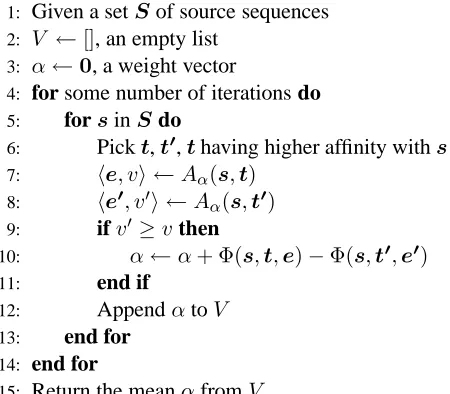
1: Given a setSof source sequences 2: V ←[], an empty list
3: α←0, a weight vector
4: for some number of iterations do
5: forsinS do
6: Pickt,t0,thaving higher affinity withs
7: he, vi ←Aα(s,t)
8: he0, v0i ←A
α(s,t0)
9: ifv0 ≥vthen
10: α←α+ Φ(s,t,e)−Φ(s,t0,e0)
11: end if
12: AppendαtoV 13: end for
14: end for
[image:2.612.316.541.59.256.2]15: Return the meanαfromV
Table 1: The training algorithm. Aα is the affinity function under model parameters α, returning edit sequenceeand scorev.
The score of a particular edit is a linear combina-tion of the corresponding feature values:
a(s, i,t, j) =
p X
k=1
αk·fk(s, i) + p+q X
k=p+1
αk·fk(t, j)
(2) The weightsαk are what we seek to optimize in or-der to tune the model for our particular application.
2.2 A Perceptron-Based Edit Model
In this section we present a general-purpose exten-sion of perceptron training for sequence labeling, due to Collins (2002), to the problem of sequence alignment. Take αto be a model parameterization, and letAα(s,t) return an optimal edit sequencee, with its scorev, given input sequencessand t
un-derα. Elements of sequence eare character pairs
hcs, cti, with cs ∈ Σs ∪ {} and ct ∈ Σt ∪ {}, whererepresents the empty string. LetΦ(s,t,e)
be a feature vector, having the same dimensional-ity asα, for a source, target, and corresponding edit sequence. This feature vector is the sum of feature vectors at each point in eas it is played out along
input sequencessandt.
with the source sequence (Line 6). If the scores re-turned by our current model (Lines 7 and 8) agree with our ordering, we do nothing. Otherwise, we update the model using the perceptron training rule (Line 10). Ultimately, we returnαaveraged over all
datapoint presentations.
2.3 Training Modes
The algorithm presented in Table 1 does not specify how the two target sequencestandt0are to be cho-sen in Line 6. The answer to this question depends on the application. There are fundamentally two set-tings, depending on whether or not target strings are drawn from the same set as source strings; we will call the setting in which source and target strings in-habit the same set the affinity setting, and refer to the the case where they form different sets as the
trans-duction setting. Here, we sketch four problem
sce-narios, two from each setting, and specify a target selection procedure appropriate for each.
Affinity, ranking. The task poses a latent affinity between strings, but we can measure it only indi-rectly. In particular, we can order some of the target sequences according to their affinity with a source sequences. In this case, we train as follows: Order
a sample of the target sequences according to this partial order. Let t and t0 be two sequences from this order, such thattis ordered higher thant0.
Affinity, classification. The sequences inΣ∗ can be grouped into classes, and we wish the model to assign high affinity to co-members of a class and low affinity to members of different classes. Train as follows: For eachs, sampletfrom among its
co-members and t0 from among the members of other classes.
Transduction, ranking. The data is presented as source-target pairs, where each tis a transduction
of the corresponding s. We wish to learn a model
which, given a novels, will enable us to rank
can-didate transductions. Train as follows: Givens, let tbe the target sequence provided to us. Sample t0 from among the other target sequences.
Transduction, generation. We are again given source-target pairs. We wish to learn to generate a probable target string, given a novel source string. Train as follows: Generate at0that is approximately optimal according to the current model. Note that since edit decisions are based in part on (arbitrary)
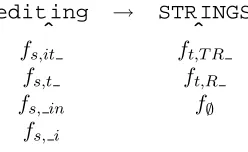
edit
ˆ
ing → STR
ˆ
INGS
fs,it ft,T R
fs,t ft,R
fs, in f∅
[image:3.612.365.489.61.137.2]fs, i
Table 2: Features with non-zero value for an exam-ple string pair and a model of order 2.
features of the target sequence, and since generation involves construction of the target sequence, it is not uncommon for a greedy generator to make edit de-cisions which are locally optimal, but which result several edits later in a partially constructed sequence in which no good edits are available. Thus, the prob-lem of generation does not correspond to a simple recurrence relation like Equation 1. Consequently, we experimented with several heuristic approaches to generation and found that a beam search works well.
3 Evaluation
To establish the effectiveness of the model, we trained it on a range of problems, including instances of each of the four settings enumerated above. Prob-lems ranged from the merely illustrative to a non-trivial application of computational linguistics.
3.1 Feature Construction
Without exception, the features we provide to the algorithm are the same in all experiments. Given a user-specified order k, we define a Boolean fea-ture for every distinct character gram observed in the data of lengthkor smaller. Recall that there are two disjoint sets of features, those defined over strings drawn from the source and target alphabets, respec-tively. Given a source string and index, those fea-tures have value 1 whose corresponding grams (of sizek or smaller) are observed preceding or follow-ing the index (precedfollow-ing features are distinct from following ones); given a target string and index, we observe only preceding grams. Although it is pos-sible to observe following grams in the target string in some settings, it is not possible in general (i.e., not when generating strings). We therefore adhere to this restriction for convenience and uniformity.
are midway through the conversion of the source string “editing” into the target string “STRINGS”. Below the two strings are those gram features which have non-zero value at the indicated cursors. The underbar character encodes on which side of the cur-sor a gram is observed. Note that an empty-gram feature, which always tests true, is also included, al-lowing us to experiment with 0-order models.
3.2 Illustrative Problems
To test the ability of the model to recover known edit affinities, we experimented with a simple artifi-cial problem. Using a large list of English words, we define an edit affinity that is sensitive only to consonants. Specifically, the affinity between two words is the maximum number of consonant self-substitutions, with any substitutions involving the first five consonants counting for five normal substi-tutions. Thus, substituting ‘b’ for ‘b’ contributes 5 to the score, substituting ‘z’ for ‘z’ contributes 1, while operations other than self-subsitutions, and any op-erations involving vowels, contribute 0.
One epoch of training is conducted as follows. For each word sin the training set, we choose 10 other words from the set at random and sort these words according to both the true and estimated affin-ity. Lettbe the string with highest true affinity; let
t0 (the decoy) be the string with highest estimated affinity. We performed 3-fold cross-validation on a collection of 33,432 words, in each fold training the model for 5 epochs.2
Our performance metric is ranking accuracy, the fraction of target string pairs to which the estimated ranking assigns the same order as the true one. Dur-ing testDur-ing, for each source strDur-ing, we sample at ran-dom 1000 other strings from the hold-out data, and count the fraction of all pairs ordered correctly ac-cording to this criterion.
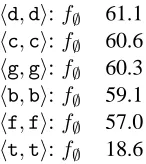
A 0-order model successfully learns to rank strings according to this affinity with 99.3% ac-curacy, while ranking according to the unmodified Levenshtein distance yields 76.4%. Table 3 shows the 6 averaged weights with the highest magnitude
2
Here and in other experiments involving the edit model, the number of epochs was set arbitrarily, and not based on perfor-mance on a development set. Beyond the number of epochs re-quired for convergence, we have not observed much sensitivity in test accuracy to the number of epochs.
[image:4.612.391.464.60.142.2]hd,di:f∅ 61.1 hc,ci:f∅ 60.6 hg,gi:f∅ 60.3 hb,bi:f∅ 59.1 hf,fi:f∅ 57.0 ht,ti:f∅ 18.6
Table 3: Largest weights in a consonant-preserving edit affinity in which the first five consonants are given 5 times as much weight as others.
from a model trained on one of the folds. In pre-senting weights, we follow the formatting conven-tion edit:feature. Since the model in quesconven-tion is of order 0, all features in Table 3 are the “empty fea-ture.” Note how idempotent substitutions involving the 5 highly weighted consonants are weighted sig-nificantly higher than the remaining operations.
3.3 Rhyming
While the above problem illustrates the ability of the proposed algorithm to learn latent alignment affinities, it is expressible as a order-0 model. A somewhat more interesting problem is that of mod-eling groups of rhyming words. This problem is an instance of what we called the “classification” scenario in Section 2.3. Because English letters have long since lost their direct correspondence to phonemes, the problem of distinguishing rhyming English words is difficult for a knowledge-lean edit model. What’s more, the importance of a letter is dependent on context; letters near the end of a word are more likely to be significant.
We derived groups of rhyming words from the CMU pronouncing dictionary (CMU, 1995), dis-carding any singleton groups. This yielded 21,396 words partitioned into 3,799 groups, ranging in size from 464 words (nation, location, etc.) down to 2. We then divided the words in this data set at random into three groups for cross-validation.
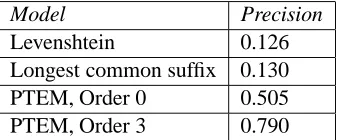
Model Precision
Levenshtein 0.126
Longest common suffix 0.130 PTEM, Order 0 0.505 PTEM, Order 3 0.790
Table 4: Micro-averaged break-even precision on the task of grouping rhyming English words.
For each word in the hold-out set, we scored and ranked all rhyming words in the same set, as well as enough non-rhyming words to total 1000. We then recorded the precision at the point in this rank-ing where recall and precision are most nearly equal. Our summary statistic is the micro-averaged break-even precision.
Table 4 presents the performance of the proposed model and compares it with two simple baselines. Not surprisingly, performance increases with in-creasing order. The simple heuristic approaches fare quite poorly by comparison, reflecting the subtlety of the problem.
3.4 Transcription
Our work was motivated by the problem of named entity transcription. Out-of-vocabulary (OOV) terms are a persistent problem in statistical machine translation. Often, such terms are the names of en-tities, which typically have low corpus frequencies. In translation, the appropriate handling of names is often to transcribe them, to render them idiomati-cally in the target language in a way that preserves, as much as possible, their phonetic structure. Even when an OOV term is not a name, transcribing it preserves information that would otherwise be dis-carded, leaving open the possibility that downstream applications will be able to make use of it.
The state of the art in name transcription involves some form of generative model, sometimes in com-bination with additional heuristics. The generative component may involve explicitly modeling pho-netics. For example, Knight and Graehl (1998) employ cascaded probabilistic finite-state transduc-ers, one of the stages modeling the orthographic-to-phonetic mapping. Subsequently, Al-Onaizan and Knight (2002) find they can boost perfor-mance by combining a phonetically-informed model
Task Train Dev Eval ELen FLen
[image:5.612.102.272.60.130.2]A-E 8084 1000 1000 6.5 4.9 M-E 2000 430 1557 16.3 23.0
Table 5: Characteristics of the two transcription data sets, Arabic-English (A-E) and Mandarin-English (M-E), including number of training, development, and evaluation pairs (Train, Dev, and Eval), and mean length in characters of English and foreign strings (ELen and FLen).
with one trained only on orthographic correspon-dences. Huang et al. (2004), construct a probabilis-tic Chinese-English edit model as part of a larger alignment solution, setting edit weights in a heuris-tic bootstrapped procedure.
In rendering unfamiliar written Arabic words or phrases in English, it is generally impossible to achieve perfect performance, because many sounds, such as short vowels, diphthong markers, and dou-bled consonants, are conventionally not written in Arabic. We calculate from our experimental datasets that approximately 25% of the characters in the En-glish output must be inferred. Thus, a character error rate of 25% can be achieved through simple translit-eration.
3.4.1 Transcribing names
We experimented with a list of 10,084 personal names distributed by the Linguistic Data Consor-tium (LDC). Each entry in the database includes an arabic name in transliterated ASCII (SATTS method) and its English rendering. The Arabic names appear as they would in conventional writ-ten Arabic, i.e., lacking short vowels and other di-acritics. We randomly segregated 1000 entries for evaluation and used the rest for training. The A-E row in Table 5 summarizes some of this data set’s characteristics.
We trained the edit model as follows. For each training pair the indicated English rendering con-stitutes our true target (t), and we use the current model to generate an alternate string (t0), updating the model in the eventt0yields a higher score thant. This was repeated for 10 epochs. We experimented with a model of order 3.
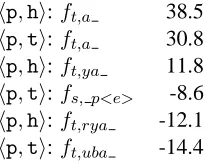
ac-hp,hi:ft,a 38.5 hp,ti:ft,a 30.8 hp,hi:ft,ya 11.8 hp,ti:fs, p<e> -8.6 hp,hi:ft,rya -12.1 hp,ti:ft,uba -14.4
Table 6: Some of the weights governing the han-dling of the tah marbouta (
) in an order-3 Arabic-English location name transcription model. Buck-walter encoding of Arabic characters is used here for purposes of display. The symbol “<e>” represents end of string.
curacy of 0.552. It is difficult to characterize the strength of this result relative to those reported in the literature. Al-Onaizan and Knight (2002) report a 1-best accuracy of 0.199 on a corpus of Arabic person names (but an accuracy of 0.634 on English names), using a “spelling-based” model, i.e., a model which has no access to phonetic information. However, the details of their experiment and model differ from ours in a number of respects.
It is interesting to see how a learned edit model handles ambiguous letters. Table 6 shows the weights of some of the features governing the han-dling of the character
(tah marbouta) from exper-iments with Arabic place names. This character, which represents the “t” sound, typically appears at the end of words. It is generally silent, but is spoken in certain grammatical constructions. In its silent form, it is typically transcribed “ah” (or “a”); in its spoken form, it is transcribed “at”. The weights in the table reflect this ambiguity and illustrate some of the criteria by which the model chooses the ap-propriate transcription. For example, the negative weight on the feature fs, p<e> inhibits the produc-tion of “t” at the end of a phrase, where “h” is almost always more appropriate. Similarly, “h” is more common following “ya” in the target string (often as part of the larger suffix “iyah”). However, the pre-ceding context “rya” is usually observed in the word “qaryat”, meaning “village” as in “the village of ...” In this grammatical usage, the tah marbouta is spo-ken and therefore rendered with a “t”. Consequently, the corresponding weight in the “h” interpretation is inhibitory.
The Al-Onaizan and Knight spelling model can be regarded as a statistical machine translation (SMT) system which translates source language characters to target language characters in the ab-sence of phonetic information. For comparison with state of the art, we used the RWTH phrase-based SMT system (Zens et al., 2005) to build an Arabic-to-English transliteration system. This sys-tem frames the transcription problem as follows. We are given a sequence of source language charac-ters sm1 representing a name, which is to be trans-lated into a sequence of target language characters
tn1. Among all possible target language character se-quences, we will choose the character sequence with the highest probability:
ˆ
tn1ˆ = argmax n,tn
1
{Pr(tn1|sm1 )} (3)
The posterior probabilityPr(tn1|sm1 )is modeled di-rectly using a log-linear combination of several models (Och and Ney, 2002), including a character-based phrase translation model, a character-character-based lexicon model, a 4-gram character sequence model, a character penalty and a phrase penalty. The first two models are used for both directions: Arabic to English and English to Arabic. We do not use any reordering model because the target character sequence is always monotone with respect to the source character sequence. More details about the baseline system can be found in (Zens et al., 2005).
We remark in passing that while the perceptron-based edit model is a general algorithm for learn-ing sequence alignments uslearn-ing simple features, the above SMT approach combines several models, some of which have been the subject of research in the fields of speech recognition and machine trans-lation for several years. Furthermore, we made an effort to optimize the performance of the SMT ap-proach on the tasks presented here.
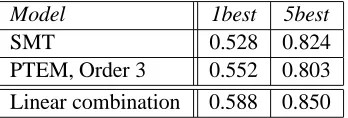
sta-Model 1best 5best
SMT 0.528 0.824
[image:7.612.100.274.60.119.2]PTEM, Order 3 0.552 0.803 Linear combination 0.588 0.850
Table 7: 1-best and 5-best transcription accuracies. The successive improvements in 1-best accuracy are significant at the 95% confidence level.
tistically significant improvement over both systems at the 95% confidence level.
3.4.2 Ranking transcriptions
In some applications, instead of transcribing a name in one language into another, it is enough just to rank candidate transcriptions. For example, we may be in possession of comparable corpora in two languages and the means to identify named entities in each. If we can rank the likely transcriptions of a name, we may be able to align a large portion of the transliterated named entities, potentially extend-ing the coverage of our machine translation system, which will typically have been developed using a smaller parallel corpus. This idea is at the heart of several recent attempts to improve the handling of named entities in machine translation (Huang et al., 2004; Lee and Chang, 2003). A core component of all such approaches is a generative model simi-lar in structure to the “spelling” model proposed by Al-Onaizan and Knight.
When ranking is the objective, we can adopt a training procedure that is much less expensive than the one used for generation. Lettbe the correct tran-scription for a source string (s). Sample some num-ber of strings at random (200 in the following exper-iments) from among the transcriptions in the training set of strings other thans. Lett0be the string having highest affinity withs, updating the model, as usual, ift0scores higher thant.
In addition to the Arabic-English corpus, we also experiment with a corpus distributed by the LDC of full English names paired with their Mandarin spelling. The M-E row of Table 5 summarizes char-acteristics of this data set. Because we are inter-ested in an approximate comparison with similar ex-periments in the literature, we selected at random 2430 for training and 1557 for evaluation, which
are the data sizes used by Lee and Chang (2003) for their experiments. In these experiments, the Chinese names are represented as space-separated pinyin without tonal markers.
Note that this problem is probably harder than the Arabic one, for several reasons. For one thing, the letters in a Mandarin transcription of a foreign name represent syllables, leading to a somewhat lossier rendering of foreign names in Mandarin than in Ara-bic. On a more practical level, this data set is noisier, occasionally containing character sequences in one string for which corresponding characters are lack-ing from its paired strlack-ing. On the other hand, the Mandarin problem contains full names, rather than name components, which provides more context for ranking.
We trained the edit model on both data sets us-ing both the samplus-ing procedure outlined above and the self-generation training regime, in each case for 20 epochs, producing models of orders from 1 to 3. However, we found that the efficiency of the phrase-based SMT system described in the previous section would be limited for this task, mainly due to two reasons: the character-based phrase models due to possible unseen phrases in an evaluation corpus, and the character sequence model as all candidate tran-scriptions confidently belong to the target language. Therefore, to make the phrase-based SMT system robust against data sparseness for the ranking task, we also make use of the IBM Model 4 (Brown et al., 1993) in both directions. The experiments show that IBM Model 4 is a reliable model for the ranking task. For each evaluation pair, we then ranked all available evaluation transcriptions, recording where in this list the true transcription fell.
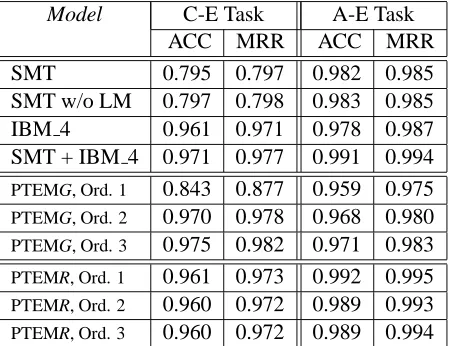
Table 8 compares the various models, showing the fraction of cases for which the true transcription was ranked highest, and its mean reciprocal rank (MRR). Both the phrase-based SMT model and the edit model perform well on this task. While the best configuration of PTEM out-performs the best SMT model, the differences are not significant at the 95% confidence level. However, compare these perfor-mance scores to those returned by the system of Lee and Chang (2003), who reported a peak MRR of 0.82 in similar experiments involving data different from ours.
Model C-E Task A-E Task
ACC MRR ACC MRR
SMT 0.795 0.797 0.982 0.985
SMT w/o LM 0.797 0.798 0.983 0.985 IBM 4 0.961 0.971 0.978 0.987 SMT + IBM 4 0.971 0.977 0.991 0.994
PTEMG, Ord. 1 0.843 0.877 0.959 0.975
PTEMG, Ord. 2 0.970 0.978 0.968 0.980
PTEMG, Ord. 3 0.975 0.982 0.971 0.983
PTEMR, Ord. 1 0.961 0.973 0.992 0.995
PTEMR, Ord. 2 0.960 0.972 0.989 0.993
[image:8.612.74.299.60.233.2]PTEMR, Ord. 3 0.960 0.972 0.989 0.994
Table 8: Performance on two transcription ranking tasks, showing fraction of cases in which the correct transcription was ranked highest, accuracy (ACC) and mean reciprocal rank of the correct transcription (MRR).
those in which the model was trained using the same procedure as for generation (PTEMG), and those in which the quicker ranking-specific train-ing regime was used (PTEMR). The comparison is interesting, inasmuch it does not support the con-clusion that one regime is uniformly superior to the other. While generation regime yields the best per-formance on Arabic (using a high-order model), the ranking regime scores best on Mandarin (with a low-order model). When training a model to generate, it seems clear that more context in the form of larger n-grams is beneficial. This is particularly true for Mandarin, where an order-1 model probably does not have the capacity to generate plausible decoys.
4 Discussion
This paper is not the first to show that perceptron training can be used in the solution of problems involving transduction. Both Liang, et al (2006), and Tillmann and Zhang (2006) report on effective machine translation (MT) models involving large numbers of features with discriminatively trained weights. The training of these models is an in-stance of the “Generation” scenario outlined in Sec-tion 2.3. However, because machine translaSec-tion is a more challenging problem than name transcrip-tion (larger vocabularies, higher levels of
ambigu-ity, non-monotonic transduction, etc.), our general-purpose approach to generation training may be in-tractable for MT. Instead, much of the focus of these papers are the heuristics that are required in order to train such a model in this fashion, including feature selection using external resources (phrase tables), staged training, and generating to BLEU-maximal sequences, rather than the reference target.
Klementiev and Roth (2006) explore the use of a perceptron-based ranking model for the purpose of finding name transliterations across comparable cor-pora. They do not calculate an explicit alignment be-tween strings. Instead, they decompose a string pair into a collection of features derived from charac-ter n-grams heuristically paired based on their loca-tions in the respective strings. Thus, Klementiev and Roth, in common with the two MT approaches de-scribed above, carefully control the features used by the perceptron. In contrast to these approaches, our algorithm discovers latent alignments, essentially selecting those features necessary for good perfor-mance on the task at hand.
As noted in the introduction, several previous pa-pers have proposed general, discriminatively trained sequence alignment models, as alternatives to the generative model proposed by Ristad and Yianilos. McCallum, et al. (2005), propose a conditional ran-dom field for sequence alignment, designed for the important problem of duplicate detection and infor-mation integration. Comprising two sub-models, one for matching strings and one for non-matching, the model is trained on sequence pairs explicitly labeled “match” or “non-match,” and some care is apparently needed in selecting appropriate non-matching strings. It is therefore unclear how this model would be extended to problems involving ranking or generation.
increase the approach’s scope. Note that where di-rectly maximizing the margin is feasible, it has been shown empirically to be superior to perceptron train-ing (Altun et al., 2003).
Parker et al. (2006), propose to align sequences by gradient tree boosting. This approach has the attrac-tive characteristic that it supports a factored repre-sentation of edits (a characteristic it shares with Mc-Callum et al.). Although this paper does not evaluate the method on any problems from computational lin-guistics (the central problem is musical information retrieval), gradient tree boosting has been shown to be an effective technique for other sorts of sequence modeling drawn from computational linguistics (Di-etterich et al., 2004).
5 Conclusion
Motivated by the problem of Arabic-English tran-scription of names, we adapted recent work in per-ceptron learning for sequence labeling to the prob-lem of sequence alignment. The resulting algorithm shows clear promise not only for transcription, but also for ranking of transcriptions and structural clas-sification. We believe this versatility will lead to other successful applications of the idea, both within computational linguistics and in other fields involv-ing sequential learninvolv-ing.
Acknowledgment of support
This material is based upon work supported by the Defense Advanced Research Projects Agency (DARPA/IPTO) under Contract HR0011-06-C-0023. Any opinions, findings and conclusions or recommendations expressed in this material are those of the authors and do not necessarily reflect the views of the Defense Advanced Research Projects Agency (DARPA).
References
Y. Al-Onaizan and K. Knight. 2002. Machine translit-eration of names in Arabic text. In Proceedings of
the ACL-02 workshop on computational approaches to semitic languages.
Y. Altun, I. Tsochantaridis, and T. Hofmann. 2003. Hid-den Markov support vector machines. In Proceedings
of ICML-2003.
M. Bilenko and R. Mooney. 2003. Adaptive duplicate detection using learnable string similarity measures. In Proceedings of KDD-2003.
P. F. Brown, S. A. Della Pietra, V. J. Della Pietra, and R. L. Mercer. 1993. The mathematics of statistical machine translation: Parameter estimation.
Computa-tional Linguistics, 19(2), June.
CMU. 1995. The CMU pronouncing dictionary.
http://www.speech.cs.cmu.edu/cgi-bin/cmudict. Ver-sion 0.6.
M. Collins. 2002. Discriminative training methods for hidden Markov models: theory and experiments with perceptron algorithms. In Proceedings of
EMNLP-2002.
T. Dietterich, A. Ashenfelter, and Y. Bulatov. 2004. Training conditional random fields via gradient tree boosting. In Proceedings of ICML-2004.
F. Huang, S. Vogel, and A. Waibel. 2004. Improving named entity translation combining phonetic and se-mantic similarities. In Proceedings of HLT-NAACL
2004.
T. Joachims. 2003. Learning to align sequences: a maximum-margin approach. Technical report, Cornell University.
A. Klementiev and D. Roth. 2006. Weakly supervised named entity transliteration and discovery from mul-tilingual comparable corpora. In Proceedings of
Col-ing/ACL 2006.
K. Knight and J. Graehl. 1998. Machine transliteration.
Computational Linguistics, 24(4).
C.-J. Lee and J.S. Chang. 2003. Acquisition of English-Chinese transliterated word pairs from parallel-aligned texts using a statistical machine transliteration model. In Proceedings of the HLT-NAACL 2003 Workshop on
Building and Using Parallel Texts.
P. Liang, A. Bouchard-Cˆot´e, D. Klein, and B. Taskar. 2006. An end-to-end discriminative approach to machine translation. In Proceedings of COLING
2006/ACL 2006.
A. McCallum, K. Bellare, and F. Pereira. 2005. A condi-tional random field for discriminatively-trained finite-state string edit distance. In Proceedings of UAI-2005.
S.B. Needleman and C.D. Wunsch. 1970. A general method applicable to the search for similarities in the amino acid sequence of two proteins. Journal of Molecular Biology, 48.
C. Parker, A. Fern, and P Tadepalli. 2006. Gradient boosting for sequence alignment. In Proceedings of
AAAI-2006.
E.S. Ristad and P.N. Yianilos. 1998. Learning string-edit distance. IEEE Transactions on Pattern Analysis and
Machine Intelligence, 20.
C. Tillmann and T. Zhang. 2006. A discriminative global training algorithm for statistical MT. In Proceedings
of Coling/ACL 2006.
R. Zens, O. Bender, S. Hasan, S. Khadivi, E. Matusov, J. Xu, Y. Zhang, and H. Ney. 2005. The RWTH phrase-based statistical machine translation system. In
Proceedings of the International Workshop on Spoken Language Translation (IWSLT), pages 155–162,