Using Foreign Inclusion Detection to Improve Parsing Performance
Beatrice Alex, Amit Dubey and Frank Keller
School of Informatics University of Edinburgh
2 Buccleuch Place Edinburgh, EH8 9LW, UK
{balex,adubey,keller}@inf.ed.ac.uk
Abstract
Inclusions from other languages can be a significant source of errors for monolgual parsers. We show this for English in-clusions, which are sufficiently frequent to present a problem when parsing German. We describe an annotation-free approach for accurately detecting such inclusions, and de-velop two methods for interfacing this ap-proach with a state-of-the-art parser for Ger-man. An evaluation on the TIGER cor-pus shows that our inclusion entity model achieves a performance gain of 4.3 points in F-score over a baseline of no inclusion de-tection, and even outperforms a parser with access to gold standard part-of-speech tags.
1 Introduction
The status of English as a global language means that English words and phrases are frequently bor-rowed by other languages, especially in domains such as science and technology, commerce, adver-tising, and current affairs. This is an instance of guage mixing, whereby inclusions from other lan-guages appear in an otherwise monolingual text. While the processing of foreign inclusions has re-ceived some attention in the text-to-speech (TTS) lit-erature (see Section 2), the natural language process-ing (NLP) community has paid little attention both to the problem of inclusion detection, and to poten-tial applications thereof. Also the extent to which inclusions pose a problem to existing NLP methods has not been investigated.
In this paper, we address this challenge. We focus on English inclusions in German text. Anglicisms
and other borrowings from English form by far the most frequent foreign inclusions in German. In spe-cific domains, up to 6.4% of the tokens of a Ger-man text can be English inclusions. Even in regular newspaper text as used for many NLP applications, English inclusions can be found in up to 7.4% of all sentences (see Section 3 for both figures).
Virtually all existing NLP algorithms assume that the input is monolingual, and does not contain for-eign inclusions. It is possible that this is a safe assumption, and inclusions can be dealt with ac-curately by existing methods, without resorting to specialized mechanisms. The alternative hypothe-sis, however, seems more plausible: foreign inclu-sions pose a problem for existing approaches, and sentences containing them are processed less ac-curately. A parser, for example, is likely to have problems with inclusions – most of the time, they are unknown words, and as they originate from another language, standard methods for unknown words guessing (suffix stripping, etc.) are unlikely to be successful. Furthermore, the fact that inclusions are often multiword expressions (e.g., named enti-ties) means that simply part-of-speech (POS) tag-ging them accurately is not sufficient: if the parser posits a phrase boundary within an inclusion this is likely to severely decrease parsing accuracy.
In this paper, we focus on the impact of En-glish inclusions on the parsing of German text. We describe an annotation-free method that accurately recognizes English inclusions, and demonstrate that inclusion detection improves the performance of a state-of-the-art parser for German. We show that the way of interfacing the inclusion detection and the parser is crucial, and propose a method for modify-ing the underlymodify-ing probabilistic grammar in order to
enable the parser to process inclusions accurately. This paper is organized as follows. We review re-lated work in Section 2, and present the English in-clusion classifier in Section 3. Section 4 describes our results on interfacing inclusion detection with parsing, and Section 5 presents an error analysis. Discussion and conclusion follow in Section 6.
2 Related Work
Previous work on inclusion detection exists in the TTS literature. Here, the aim is to design a sys-tem that recognizes foreign inclusions on the word and sentence level and functions at the front-end to a polyglot TTS synthesizer. Pfister and Romsdor-fer (2003) propose morpho-syntactic analysis com-bined with lexicon lookup to identify foreign words in mixed-lingual text. While they state that their sys-tem is precise at detecting the language of tokens and determining the sentence structure, it is not eval-uated on real mixed-lingual text. A further approach to inclusion detection is that of Marcadet et. al (2005). They present experiments with a dictionary-driven transformation-based learning method and a corpus-based n-gram approach and show that a com-bination of both methods yields the best results. Evaluated on three mixed-lingual test sets in differ-ent languages, the combined approach yields word-based language identification error rates (i.e. the per-centage of tokens for which the language is identi-fied incorrectly) of 0.78% on the French data, 1.33% on the German data and 0.84% on the Spanish data. Consisting of 50 sentences or less for each language, their test sets are very small and appear to be se-lected specifically for evaluation purposes. It would therefore be interesting to determine the system’s performance on random and unseen data and exam-ine how it scales up to larger data sets.
Andersen (2005), noting the importance of rec-ognizing anglicisms to lexicographers, tests algo-rithms based on lexicon lookup, character n-grams and regular expressions and a combination thereof to automatically extract anglicisms in Norwegian text. On a 10,000 word subset of the neologism archive (Wangensteen, 2002), the best method of combin-ing character n-grams and regular expression match-ing yields an accuracy of 96.32% and an F-score of 59.4 (P = 75.8%, R = 48.8%). This result is
unsur-prisingly low as no differentiation is made between full-word anglicisms and tokens with mixed-lingual morphemes in the gold standard.
In the context of parsing, Forst and Kaplan (2006) have observed that the failure to properly deal with foreign inclusions is detrimental to a parser’s accu-racy. However, they do not substantiate this claim using numeric results.
3 English Inclusion Detection
Previous work reported by Alex (2006; 2005) has focused on devising a classifier that detects angli-cisms and other English inclusions in text written in other languages, namely German and French. This inclusion classifier is based on a lexicon and search engine lookup as well as a post-processing step.
The lexicon lookup is performed for tokens tagged as noun (NN ), named entity (NE ), foreign material (FM ) or adjective (ADJA/ADJD ) using the German and English CELEX lexicons. Tokens only found in the English lexicon are classified as En-glish. Tokens found in neither lexicon are passed to the search engine module. Tokens found in both databases are classified by the post-processing module. The search engine module performs lan-guage classification based on the maximum nor-malised score of the number of hits returned for two searches per token, one for each language (Alex, 2005). This score is determined by weighting the number of hits, i.e. the “absolute frequency” by the estimated size of the accessible Web corpus for that language (Alex, 2006). Finally, the rule-based post-processing module classifies single-character tokens and resolves language classification ambiguities for interlingual homographs, English function words, names of currencies and units of measurement. A further post-processing step relates language infor-mation between abbreviations or acronyms and their definitions in combination with an abbreviation ex-traction algorithm (Schwartz and Hearst, 2003). Fi-nally, a set of rules disambiguates English inclusions from person names (Alex, 2006).
Domain EI tokens EI types EI TTR Accuracy Precision Recall F
Internet 6.4% 5.9% 0.25 98.13% 91.58% 78.92% 84.78
Space 2.8% 3.5% 0.33 98.97% 84.02% 85.31% 84.66
[image:3.612.313.535.185.342.2]EU 1.1% 2.1% 0.50 99.65% 82.16% 87.36% 84.68
Table 1: English inclusion (EI) token and type statistics, EI type-token-ratios (TTR) as well as accuracy, precision, recall and F-scores for the unseen German test sets.
overview of the percentages of English inclusion to-kens and types within the gold standard annotation of each test set, and illustrates how well the English inclusion classifier is able to detect them in terms of F-score. The figures show that the frequency of English inclusions varies considerably depending on the domain but that the classifier is able to detect them equally well with an F-score approaching 85 for each domain.
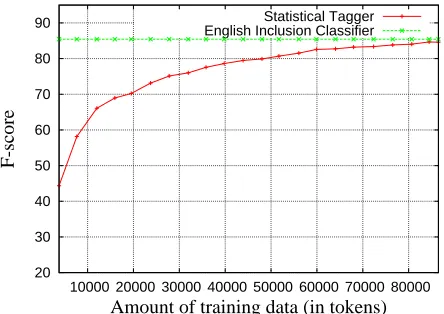
The recognition of English inclusions bears sim-ilarity to classification tasks such as named en-tity recognition, for which various machine learning (ML) techniques have proved successful. In order to compare the performance of the English inclusion classifier against a trained ML classifier, we pooled the annotated English inclusion evaluation data for all three domains. As the English inclusion classifier does not rely on annotated data, it can be tested and evaluated once for the entire corpus. The ML classi-fier used for this experiment is a conditional Markov model tagger which is designed for, and proved suc-cessful in, named entity recognition in newspaper and biomedical text (Klein et al., 2003; Finkel et al., 2005). It can be trained to perform similar informa-tion extracinforma-tion tasks such as English inclusion detec-tion. To determine the tagger’s performance over the entire set and to investigate the effect of the amount of annotated training data available, a 10-fold cross-validation test was conducted whereby increasing sub-parts of the training data are provided when test-ing on each fold. The resulttest-ing learntest-ing curves in Figure 1 show that the English inclusion classifier has an advantage over the supervised ML approach, despite the fact the latter requires expensive hand-annotated data. A large training set of 80,000 tokens is required to yield a performance that approximates that of our annotation-free inclusion classifier. This system has been shown to perform similarly well on unseen texts in different domains, plus it is easily
20 30 40 50 60 70 80 90
10000 20000 30000 40000 50000 60000 70000 80000
F-score
Amount of training data (in tokens)
Statistical Tagger English Inclusion Classifier
Figure 1: Learning curve of a ML classifier versus the English inclusion classifier’s performance.
extendable to a new language (Alex, 2006).
4 Experiments
The primary focus of this paper is to apply the En-glish inclusion classifier to the German TIGER tree-bank (Brants et al., 2002) and to evaluate the clas-sifier on a standard NLP task, namely parsing. The aim is to investigate the occurrence of English in-clusions in more general newspaper text, and to ex-amine if the detection of English inclusions can im-prove parsing performance.
The TIGER treebank is a bracketed corpus con-sisting of 40,020 sentences of newspaper text. The English inclusion classifier was run once over the entire TIGER corpus. In total, the system detected English inclusions in 2,948 of 40,020 sentences (7.4%), 596 of which contained at least one multi-word inclusion. This subset of 596 sentences is the focus of the work reported in the remainder of this paper, and will be referred to as the inclusion set.
is a trait trait of TIGER treebank annotation (Brants et al., 2002). The non-terminal nodes of the tree rep-resent the phrase categories, and the edge labels the grammatical functions. In the example sentence, the English inclusion is contained in a proper noun (PN ) phrase with a grammatical function of type noun kernel element (NK ). Each terminal node is POS-tagged as a named entity (NE ) with the grammatical function ot type proper noun component (PNC ).
4.1 Data
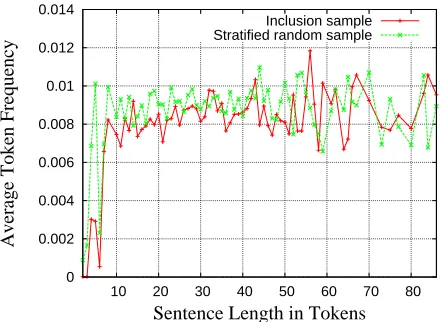
Two different data sets are used in the experiments: (1) the inclusion set, i.e., the sentences containing multi-word English inclusions recognized by the in-clusion classifier, and (2) a stratified sample of sen-tences randomly extracted from the TIGER corpus, with strata for different sentence lengths. The strata were chosen so that the sentence length distribution of the random set matches that of the inclusion set. The average sentence length of this random set and the inclusion set is therefore the same at 28.4 tokens. This type of sampling is necessary as the inclusion set has a higher average sentence length than a ran-dom sample of sentences from TIGER, and because parsing accuracy is correlated with sentence length. Both the inclusion set and the random set consist of 596 sentences and do not overlap.
4.2 Parser
The parsing experiments were performed with a state-of-the-art parser trained on the TIGER corpus which returns both phrase categories and grammati-cal functions (Dubey, 2005b). Following Klein and Manning (2003), the parser uses an unlexicalized probabilistic context-free grammar (PCFG) and re-lies on treebank transformations to increase parsing accuracy. Crucially, these transformations make use of TIGER’s grammatical functions to relay pertinent lexical information from lexical elements up into the tree.
The parser also makes use of suffix analysis. However, beam search or smoothing are not em-ployed. Based upon an evaluation on the NEGRA treebank (Skut et al., 1998), using a 90%-5%-5% training-development-test split, the parser performs with an accuracy of 73.1 F-score on labelled brack-ets with a coverage of 99.1% (Dubey, 2005b). These figures were derived on a test set limited to sentences
containing 40 tokens or less. In the data set used in this paper, however, sentence length is not lim-ited. Moreover, the average sentence length of our test sets is considerably higher than that of the NE-GRA test set. Consequently, a slightly lower perfor-mance and/or coverage is anticipated, albeit the type and domain as well as the annotation of both the NE-GRA and the TIGER treebanks are very similar. The minor annotation differences that do exist between NEGRA and TIGER are explained in Brants et. al (2002).
4.3 Parser Modifications
We test several variations of the parser. The baseline parser does not treat foreign inclusions in any spe-cial way: the parser attempts to guess the POS tag and grammatical function labels of the word using the same suffix analysis as for rare or unseen Ger-man words. The additional versions of the parser are inspired by the hypothesis that inclusions make parsing difficult, and this difficulty arises primarily because the parser cannot detect inclusions prop-erly. Therefore, a suitable upper bound is to give the parser perfect tagging information. Two further versions interface with our inclusion classifier and treat words marked as inclusions differently from native words. The first version does so on a word-by-word basis. In contrast, the inclusion entity ap-proach attempts to group inclusions, even if a group-ing is not posited by phrase structure rules. We now describe each version in more detail.
In the TIGER annotation, preterminals include both POS tags and grammatical function labels. For example, rather than a preterminal node hav-ing the category PRELS (personal pronoun), it is given the categoryPRELS-OA (accusative personal pronoun). Due to these grammatical function tags, the perfect tagging parser may disambiguate more syntactic information than provided with POS tags alone. Therefore, to make this model more realistic, the parser is required to guess grammatical functions (allowing it to, for example, mistakenly tag an ac-cusative pronoun as nominative, dative or genitive). This gives the parser information about the POS tags of English inclusions (along with other words), but does not give any additional hints about the syntax of the sentence.
S
NP-SB
ART-NK
Das
ADJA-NK
sch¨onste
PN-NK
NE-PNC
Road
NE-PNC
Movie VVFIN-HD
kam
PP-MO
APPR-AC
aus
ART-NK
der
NE-NK
[image:5.612.151.476.60.212.2]Schweiz
Figure 2: Example parse tree of a German TIGER sentence containing an English inclusion. Translation: The nicest road movie came from Switzerland.
NE FM NN KON CARD ADJD APPR
[image:5.612.114.256.287.514.2]1185 512 44 8 8 1 1
Table 2: POS tags of foreign inclusions.
PN
FOM
. . .
FOM
. . .
(a) Whenever aFOM is
encoun-tered...
PN
FP
FOM
. . .
FOM
. . .
(b) ...a new FP category is
cre-ated
Figure 3: Tree transformation employed in the in-clusion entity parser.
of information from the inclusion detector. To inter-face the detector with the parser, we simply mark any inclusion with a special FOM (foreign mate-rial) tag. The word-by-word parser attempts to guess POS tags itself, much like the baseline. However, whenever it encounters aFOM tag, it restricts itself to the set of POS tags observed in inclusions during training (the tags listed in Table 2). When aFOM is detected, these and only these POS tags are guessed; all other aspects of the parser remain the same.
The word-by-word parser fails to take advantage of one important trend in the data: that foreign in-clusion tokens tend to be adjacent, and these adja-cent words usually refer to the same entity. There is nothing stopping the word-by-word parser from positing a constituent boundary between two adja-cent foreign inclusions. The inclusion entity model was developed to restrict such spurious bracketing. It does so by way of another tree transformation. The new categoryFP (foreign phrase) is added be-low any node dominating at least one token marked FOM during training. For example, when encoun-tering aFOM sequence dominated by PN as in Fig-ure 3(a), the tree is modified so that it is theFP rule which generates theFOM tokens. Figure 3(b) shows the modified tree. In all cases, a unary rulePN→FP is introduced. As this extra rule decreases the proba-bility of the entire tree, the parser has a bias to intro-duce as few of these rules as possible – thus limiting the number of categories which expand to FOM s. Once a candidate parse is created during testing, the inverse operation is applied, removing theFP node.
4.4 Method
Data P R F Dep. Cov. AvgCB 0CB ≤2CB
Baseline model
Inclusion set 56.1 62.6 59.2 74.9 99.2 2.1 34.0 69.0 Random set 63.3 67.3 65.2 81.1 99.2 1.6 40.4 75.1
Perfect tagging model
Inclusion set 61.3 63.0 62.2 75.1 92.7 1.7 41.5 72.6 Random set 65.8 68.9 67.3 82.4 97.7 1.4 45.9 77.1
Word-by-word model
Inclusion set 55.6 62.8 59.0 73.1 99.2 2.1 34.2 70.2 Random set 63.3 67.3 65.2 81.1 99.2 1.6 40.4 75.1
Inclusion entity model
[image:6.612.128.480.59.261.2]Inclusion set 61.3 65.9 63.5 78.3 99.0 1.7 42.4 77.1 Random set 63.4 67.5 65.4 80.8 99.2 1.6 40.1 75.7
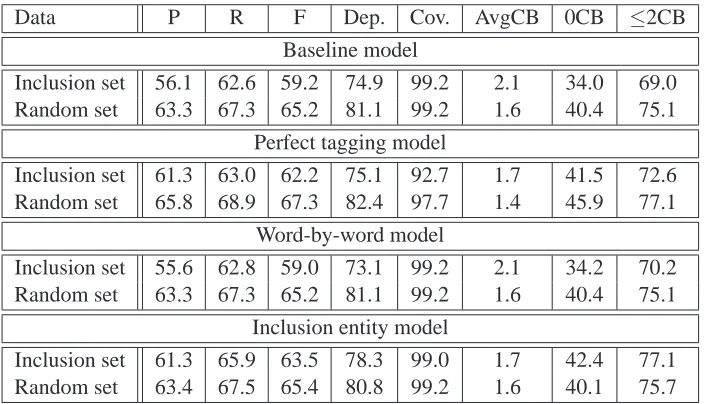
Table 3: Baseline and perfect tagging for inclusion and random sets and results for the word-by-word and the inclusion entity models.
intersected with the inclusion set (or, respectively, the random set). The evaluation metrics are calcu-lated on this subset of the inclusion set (or random set), using the parser trained on the corresponding training data. This process ensures that the test sen-tences are not contained in the training data.
The overall performance metrics of the parser are calculated on the aggregated totals of the five held out test sets. For each experiment, we report pars-ing performance in terms of the standard PARSE-VAL scores (Abney et al., 1991), including cov-erage (Cov), labeled precision (P) and recall (R), F-score, the average number of crossing brackets (AvgCB), and the percentage of sentences parsed with zero and with two or fewer crossing brack-ets (0CB and ≤2CB). In addition, we also report dependency accuracy (Dep), calculated using the approach described in Lin (1995), using the head-picking method used by Dubey (2005a). The la-beled bracketing figures (P, R and F), and the de-pendency score are calculated on all sentences, with those which are out-of-coverage getting zero nodes. The crossing bracket scores are calculated only on those sentences which are successfully parsed.
4.5 Baseline and Perfect Tagging
The baseline, for which the unmodified parser is used, achieves a high coverage at over 99% for both the inclusion and the random sets (see Table 3).
However, scores differ for the bracketing measures. Using stratified shuffling1, we performed a t-test on precision and recall, and found both to be signif-icantly worse in the inclusion condition. Overall, the harmonic mean (F) of precision and recall was 65.2 on the random set, 6 points better than 59.2 F observed on the inclusion set. Similarly, depen-dency and cross-bracketing scores are higher on the random test set. This result strongly indicates that sentences containing English inclusions present dif-ficulty for the parser, compared to length-matched sentences without inclusions.
When providing the parser with perfect tagging information, scores improve both for the inclusion and the random TIGER samples, resulting in F-scores of 62.2 and 67.3, respectively. However, the coverage for the inclusion set decreases to 92.7% whereas the coverage for the random set is 97.7%. In both cases, the lower coverage is caused by the parser being forced to use infrequent tag sequences, with the much lower coverage of the inclusion set likely due to infrequent tags (notable FM ), solely associated with inclusions. While perfect tagging increases overall accuracy, a difference of 5.1 in F-score remains between the random and inclusion test sets. Although smaller than that of the baseline runs, this difference shows that even with perfect tagging,
1This approach to statistical testing is described in: http:
parsing English inclusions is harder than parsing monolingual data.
So far, we have shown that the English inclusion classifier is able to detect sentences that are difficult to parse. We have also shown that perfect tagging helps to improve parsing performance but is insuffi-cient when it comes to parsing sentences containing English inclusions. In the next section, we will ex-amine how the knowledge provided by the English inclusion classifier can be exploited to improve pars-ing performance for such sentences.
4.6 Word-by-word Model
The word-by-word model achieves the same cover-age on the inclusion set as the baseline but with a slightly lower F of 59.0. All other scores, includ-ing dependency accuracy and cross bracketinclud-ing re-sults are similar to those of the baseline (see Ta-ble 3). This shows that limiting the parser’s choice of POS tags to those encountered for English inclu-sions is not sufficient to deal with such constructions correctly. In the error analysis presented in Sec-tion 5, we report that the difficulty in parsing multi-word English inclusions is recognizing them as con-stituents, rather than recognizing their POS tags. We attempt to overcome this problem with the inclusion entity model.
4.7 Inclusion Entity Model
The inclusion entity parser attains a coverage of 99.0% on the inclusion set, similiar to the cover-age of 99.2% obtained by the baseline model on the same data. On all other measures, the inclu-sion entity model exceeds the performance of the baseline, with a precision of 61.3% (5.2% higher than the baseline), a recall of 65.9% (3.3% higher), an F of 63.5 (4.3 higher) and a dependency accu-racy of 78.3% (3.4% higher). The average number of crossing brackets is 1.7 (0.4 lower), with 42.4% of the parsed sentences having no crossing brack-ets (8.2% higher), and 77.1% having two or fewer crossing brackets (8.1% higher). When testing the inclusion entity model on the random set, the per-formance is very similar to the baseline model on this data. While coverage is the same, F and cross-brackting scores are marginally improved, and the dependency score is marginally deteriorated. This shows that the inclusion entity model does not harm
0 0.002 0.004 0.006 0.008 0.01 0.012 0.014
10 20 30 40 50 60 70 80
Average Token Frequency
Sentence Length in Tokens
[image:7.612.314.535.65.226.2]Inclusion sample Stratified random sample
Figure 4: Average relative token frequencies for sen-tences of equal length.
the parsing accuracy of sentences that do not actu-ally contain foreign inclusions.
Not only did the inclusion entity parser perform above the baseline on every metric for the inclusion set, its performance also exceeds that of the perfect tagging model on all measures except precision and average crossing brackets, where both models are tied. These results clearly indicate that the inclusion entity model is able to leverage the additional infor-mation about English inclusions provided by our in-clusion classifier. However, it is also important to note that the performance of this model on the in-clusion set is still consistently lower than that of all models on the random set. This demonstrates that sentences with inclusions are more difficult to parse than monolingual sentences, even in the presence of information about the inclusions that the parser can exploit.
Phrase cat. Frequency Example
PN 91 The Independent
CH 10 Made in Germany
NP 4 Peace Enforcement
CNP 2 Botts and Company
[image:8.612.74.291.60.147.2]– 2 Chief Executives
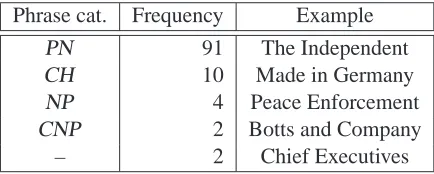
Table 4: Gold phrase categories of inclusions.
5 Error Analysis
The error analysis is limited to 100 sentences se-lected from the inclusion set parsed with both the baseline and the inclusion entity model. This sam-ple contains 109 English inclusions, five of which are false positives, i.e., the output of the English in-clusion classifier is incorrect. The precision of the classifier in recognizing multi-word English inclu-sions is therefore 95.4% for this TIGER sample.
Table 4 illustrates that the majority of multi-word English inclusions are contained in a proper noun (PN ) phrase, including names of companies, politi-cal parties, organizations, films, newspapers, etc. A less frequent phrasal category is chunk (CH ) which tends to be used for slogans, quotes or expressions like Made in Germany. Even in this small sam-ple, annotations of inclusions as eitherPN or CH , and not the other, can be misleading. For example, the organization Friends of the Earth is annotated as aPN , whereas another organization International Union for the Conservation of Nature is marked as a CH in the gold standard. This suggests that the annotation guidelines on foreign inclusions could be improved when differentiating between phrase cate-gories containing foreign material.
For the majority of sentences (62%), the baseline model predicts more brackets than are present in the gold standard parse tree (see Table 5). This number decreases by 11% to 51% when parsing with the in-clusion entity model. This suggests that the baseline parser does not recognize English inclusions as con-stituents, and instead parses their individual tokens as separate phrases. Provided with additional infor-mation of multi-word English inclusions in the train-ing data, the parser is able to overcome this problem. We now turn our attention to how accurately the various parsers are at predicting both phrase brack-eting and phrase categories (see Table 6). For 46
Phrase bracket (PB) frequency BL IE
PBPRED>PBGOLD 62% 51%
PBPRED<PBGOLD 11% 13%
[image:8.612.319.529.61.120.2]PBPRED=PBGOLD 27% 36%
Table 5: Bracket frequency of the predicted baseline (BL) and inclusion entity (IE) model output com-pared to the gold standard.
(42.2%) of inclusions, the baseline model makes an error with a negative effect on performance. In 39 cases (35.8%), the phrase bracketing and phrase cat-egory are incorrect, and constituent boundaries oc-cur within the inclusion, as illustrated in Figure 5(a). Such errors also have a detrimental effect on the parsing of the remainder of the sentence. Overall, the baseline model predicts the correct phrase brack-eting and phrase category for 63 inclusions (57.8%). Conversely, the inclusion entity model, which is given information on tag consistency within inclu-sions via the FOM tags, is able to determine the correct phrase bracketing and phrase category for 67.9% inclusions (10.1% more), e.g. see Figure 5(b). Both the phrase bracketing and phrase category are predicted incorrectly in only 6 cases (5.5%). The inclusion entity model’s improved phrase boundary prediction for 31 inclusions (28.4% more correct) is likely to have an overall positive effect on the pars-ing decisions made for the context which they ap-pear in. Nevertheless, the inclusion entity parser still has difficulty determining the correct phrase cate-gory in 25 cases (22.9%). The main confusion lies between assigning the categoriesPN , CH and NP , the most frequent phrase categories of multi-word English inclusions. This is also partially due to the ambiguity between these phrases in the gold stan-dard. Finally, few parsing errors (4) are caused by the inclusion entity parser due to the markup of false positive inclusions (mainly boundary errors).
6 Discussion and Conclusion
Ger-...
PN-NK
NP-PNC
NE-NK
Made
PP-MNR
APPR-AD
In
NE-NK
Heaven
(a) Partial parsing output of the baseline model with a con-stiuent boundary in the English inclusion.
...
PN-NK
FOM
Made
FOM
In
FOM
Heaven
[image:9.612.113.253.63.207.2](b) Partial parsing output of the inclusion en-tity model with the English inclusion parsed cor-rectly.
Figure 5: Comparing baseline model output to inclusion entity model output.
Errors No. of inclusions (in %)
Parser: baseline model, data: inclusion set Incorrect PB and PC 39 (35.8%)
Incorrect PC 5 (4.6%)
Incorrect PB 2 (1.8%)
Correct PB and PC 63 (57.8%)
Parser: inclusion entity model, data: inclusion set Incorrect PB and PC 6 (5.5%)
Incorrect PC 25 (22.9%)
Incorrect PB 4 (3.7%)
Correct PB and PC 74 (67.9%)
Table 6: Baseline and inclusion entity model errors for inclusions with respect to their phrase bracketing (PB) and phrase category (PC).
man performs substantially worse on a set of sen-tences with English inclusions compared to a set of length-matched sentences randomly sampled from the same corpus. The lower performance on the inclusion set persisted even when the parser when given gold standard POS tags in the input.
To overcome the poor accuracy of parsing inclu-sions, we developed two methods for interfacing the parser with an existing annotation-free inclusion de-tection system. The first method restricts the POS tags for inclusions that the parser can assign to those found in the data. The second method applies tree transformations to ensure that inclusions are treated as phrases. An evaluation on the TIGER corpus shows that the second method yields a performance
gain of 4.3 in F-score over a baseline of no inclusion detection, and even outperforms a model involving perfect POS tagging of inclusions.
To summarize, we have shown that foreign inclu-sions present a problem for a monolingual parser. We also demonstrated that it is insufficient to know where inclusions are or even what their parts of speech are. Parsing performance only improves if the parser also has knowledge about the structure of the inclusions. It is particularly important to know when adjacent foreign words are likely to be part of the same phrase. As our error analysis showed, this prevents cascading errors further up in the parse tree.
Finally, our results indicate that future work could improve parsing performance for inclusions further: we found that parsing the inclusion set is still harder than parsing a randomly sampled test set, even for our best-performing model. This provides an up-per bound on the up-performance we can expect from a parser that uses inclusion detection. Future work will also involve determining the English inclusion classifier’s merit when applied to rule-based parsing.
Acknowledgements
[image:9.612.69.299.273.433.2]References
Steven Abney, Dan Flickenger, Claudia Gdaniec, Ralph Grishman, Philip Harrison, Donald Hindle, Robert In-gria, Frederick Jelinek, Judith Klavans, Mark Liber-man, Mitchell P. Marcus, Salim Roukos, Beatrice San-torini, and Tomek Strzalkowski. 1991. Procedure for quantitatively comparing the syntactic coverage of En-glish grammars. In Ezra Black, editor, HLT’91:
Pro-ceedings of the workshop on Speech and Natural Lan-guage, pages 306–311, Morristown, NJ, USA.
Associ-ation for ComputAssoci-ational Linguistics.
Beatrice Alex. 2005. An unsupervised system for identi-fying English inclusions in German text. In
Proceed-ings of the 43rd Annual Meeting of the Association for Computational Linguistics (ACL 2005), Student Re-search Workshop, pages 133–138, Ann Arbor,
Michi-gan, USA.
Beatrice Alex. 2006. Integrating language knowledge resources to extend the English inclusion classifier to a new language. In Proceedings of the 5th
Interna-tional Conference on Language Resources and Evalu-ation (LREC 2006), Genoa, Italy.
Gisle Andersen. 2005. Assessing algorithms for auto-matic extraction of Anglicisms in Norwegian texts. In
Corpus Linguistics 2005, Birmingham, UK.
Sabine Brants, Stefanie Dipper, Silvia Hansen, Wolfgang Lezius, and George Smith. 2002. The TIGER Tree-bank. In Proceedings of the Workshop on Treebanks
and Linguistic Theories (TLT02), pages 24–41,
So-zopol, Bulgaria.
Amit Dubey. 2005a. Statistical Parsing for German:
Modeling syntactic properties and annotation differ-ences. Ph.D. thesis, Saarland University, Germany.
Amit Dubey. 2005b. What to do when lexicalization fails: parsing German with suffix analysis and smooth-ing. In Proceedings of the 43rd Annual Meeting of
the Association for Computational Linguistics (ACL 2005), pages 314–321, Ann Arbor, Michigan, USA.
Jenny Finkel, Shipra Dingare, Christopher D. Manning, Malvina Nissim, Beatrice Alex, and Claire Grover. 2005. Exploring the boundaries: Gene and protein identification in biomedical text. BMC
Bioinformat-ics, 6(Suppl 1):S5.
Martin Forst and Ronald M. Kaplan. 2006. The impor-tance of precise tokenizing for deep grammars. In
Pro-ceedings of the 5th International Conference on Lan-guage Resources and Evaluation (LREC 2006), pages
369–372, Genoa, Italy.
Dan Klein and Christopher D. Manning. 2003. Ac-curate unlexicalized parsing. In Proceedings of the
41st Annual Meeting of the Association for Com-putational Linguistics (ACL 2003), pages 423–430,
Saporo, Japan.
Dan Klein, Joseph Smarr, Huy Nguyen, and Christo-pher D. Manning. 2003. Named entity recognition
with character-level models. In Proceedings of the
Seventh Conference on Natural Language Learning (CoNLL-03), pages 180–183, Edmonton, Canada.
Dekang Lin. 1995. A dependency-based method for evaluating broad-coverage parsers. In Proceedings
of the International Joint Conference on Artificial In-telligence (IJCAI-95), pages 1420–1425, Montreal,
Canada.
Jean-Christophe Marcadet, Volker Fischer, and Claire Waast-Richard. 2005. A transformation-based learn-ing approach to language identification for mixed-lingual text-to-speech synthesis. In Proceedings of
Interspeech 2005 - ICSLP, pages 2249–2252, Lisbon,
Portugal.
Beat Pfister and Harald Romsdorfer. 2003. Mixed-lingual analysis for polyglot TTS synthesis. In
Proceedings of Eurospeech 2003, pages 2037–2040,
Geneva, Switzerland.
Ariel Schwartz and Marti Hearst. 2003. A simple algorithm for identifying abbreviation definitions in biomedical text. In Proceedings of the Pacific
Sym-posium on Biocomputing (PSB 2003), pages 451–462,
Kauai, Hawaii.
Wojciech Skut, Thorsten Brants, Brigitte Krenn, and Hans Uszkoreit. 1998. A linguistically interpreted corpus of German newspaper text. In Proceedings of
the Conference on Language Resources and Evalua-tion (LREC 1998), pages 705–712, Granada, Spain.
Boye Wangensteen. 2002. Nettbasert nyordsinnsamling.