Tagging and Linking Web Forum Posts
Su Nam Kim, Li Wang and Timothy Baldwin
Dept of Computer Science and Software Engineering University of Melbourne, Australia
[email protected], [email protected],[email protected]
Abstract
We propose a method for annotating post-to-post discourse structure in online user forum data, in the hopes of improving troubleshooting-oriented information ac-cess. We introduce the tasks of: (1) post classification, based on a novel dialogue act tag set; and (2) link classification. We also introduce three feature sets (structural features, post context features and seman-tic features) and experiment with three dis-criminative learners (maximum entropy, SVM-HMM and CRF). We achieve above-baseline results for both dialogue act and link classification, with interesting diver-gences in which feature sets perform well over the two sub-tasks, and go on to per-form preliminary investigation of the inter-action between post tagging and linking.
1 Introduction
With the advent of Web 2.0, there has been an ex-plosion of web authorship from individuals of all walks of life. Notably, social networks, blogs and web user forums have entered the mainstream of modern-day society, creating both new opportuni-ties and challenges for organisations seeking to en-gage with clients or users of any description. One area of particular interest is web-based user sup-port, e.g. to aid a user in purchasing a gift for a friend, or advising a customer on how to config-ure a newly-acquired wireless router. While such interactions traditionally took place on an indi-vidual basis, leading to considerable redundancy for frequently-arising requests or problems, user forums support near-real-time user interaction in the form of a targeted thread made up of individ-ual user posts. Additionally, they have the poten-tial for perpetual logging to allow other users to benefit from them. This in turn facilitates “sup-port sharing”—i.e. the ability for users to look
over the logs of past support interactions to deter-mine whether there is a documented, immediately-applicable solution to their current problem—on a scale previously unimaginable. This research is targeted at this task of enhanced support sharing, in the form of text mining over troubleshooting-oriented web user forum data (Baldwin et al., to appear).
One facet of our proposed strategy for enhanc-ing information access to troubleshootenhanc-ing-oriented web user forum data is to preprocess threads to uncover the “content structure” of the thread, in the form of its post-to-post discourse structure. Specifically, we identify which earlier post(s) a given post responds to (linking) and in what man-ner (tagging), in an amalgam of dialogue act tag-ging (Stolcke et al., 2000) and coherence-based discourse analysis (Carlson et al., 2001; Wolf and Gibson, 2005). The reason we do this is gauge the relative role/import of individual posts, to in-dex and weight component terms accordingly, ul-timately in an attempt to enhance information ac-cess. Evidence to suggest that this structure can enhance information retrieval effectiveness comes from Xi et al. (2004) and Seo et al. (2009) (see Section 2).
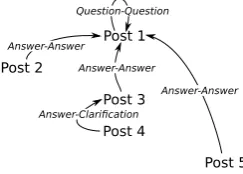
To illustrate the task, consider the thread from the CNET forum shown in Figure 1, made up of 5 posts (Post 1, ..., Post 5) with 4 distinct partici-pants (A, B, C, D). In the first post,Ainitiates the thread by requesting assistance in creating a web form. In response,Bproposes a Javascript-based solution (i.e. responds to the first post with a pro-posed solution), and C proposes an independent solution based on .NET (i.e. also responds to the first post with a proposed solution). Next, A re-sponds toC’s post asking for details of how to in-clude this in a web page (i.e. responds to the third post asking for clarification), and in the final post,
Dproposes a different solution again (i.e. responds to the first post with a different solution again).
HTML Input Code - CNET Coding & scripting Forums UserA HTML Input Code
Post 1 . . . Please can someone tell me how to create an input box that asks the user to enter their ID, and then allows them to press go. It will then redirect to the page . . .
UserB Re: html input code
Post 2 Part 1: create a form with a text field. See . . . Part 2: give it a Javascript action . . . UserC asp.net c# video
Post 3 Ive prepared for you video.link click . . . UserA Thank You!
Post 4 Thanks a lot for that . . . I have Microsoft Vi-sual Studio 6, what program should I do this in? Lastly, how do I actually include this in my site?. . .
UserD A little more help
[image:2.595.72.295.62.263.2]Post 5 . . . You would simply do it this way: . . . You could also just . . . An example of this is:. . .
Figure 1: Snippeted posts in a CNET thread
123456
123457
123458
123459
12345A
1234567123456
1234567123456
1234567123456 123456789A6BCDAEBF2
[image:2.595.119.241.302.389.2]53EBF2753EBF2
Figure 2: Post links and dialogue act labels for the example thread in Figure 1
In this, we therefore end up with a tree-based de-pendency link structure, with each post (other than the initial post) relating back to a unique preced-ing post via a range of link types, as indicated in Figure 2. Note, however, that more generally, it is possible for a post to link to multiple preced-ing posts (e.g. refutpreced-ing one proposed solution, and proposing a different solution to the problem in the initial post).
Our primary contributions in this paper are: (1) a novel post label set for post structure in web forum data, and associated dataset; and (2) a se-ries of results for post dependency linking and la-belling, which achieve strong results for the re-spective tasks.
2 Related Work
Related work exists in the broad fields of dialogue processing, discourse analysis and information re-trieval, and can be broken down into the following tasks: (1) dialogue act tagging; (2) discourse “dis-entanglement”; (3) community question answer-ing; and (4) newsgroup/user forum search.
Dialogue act (DA) taggingis a means of cap-turing the function of a given utterance relative to an encompassing discourse, and has been pro-posed variously as a means of enhancing dialogue summarisation (Murray et al., 2006), and track-ing commitments and promises in email (Cohen et al., 2004; Lampert et al., 2008), as well as be-ing shown to improve speech recognition accu-racy (Stolcke et al., 2000). A wide range of DA tag sets have been proposed, usually customised to a particular medium such as speech dialogue (Stolcke et al., 2000; Shriberg et al., 2004), task-focused email (Cohen et al., 2004; Wang et al., 2007; Lampert et al., 2008) or instant messag-ing (Ivanovic, 2008). The most immediately rel-evant DA-based work we are aware of is that of Xi et al. (2004), who proposed a 5-way classifi-cation for newsgroup data (including QUESTION
and AGREEMENT/AMMENDMENT), but did not present any results based on the tagset.
A range of supervised models have been applied to DA classification, including graphical mod-els (Ji and Bilmes, 2005), kernel methods (Wang et al., 2007), dependency networks (Carvalho and Cohen, 2005), transformation-based learning (Samuel et al., 1998), maxent models (Ang et al., 2005) and HMMs (Ivanovic, 2008). There is some contention about the import of context in DA classification, with the prevailing view being that context aids classification (Carvalho and Cohen, 2005; Ang et al., 2005; Ji and Bilmes, 2005), but also evidence to suggest that strictly local mod-elling is superior (Ries, 1999; Serafin and Di Eu-genio, 2004).
In this work, we draw on existing work (esp. Xi et al. (2004)) in proposing a novel DA tag set customised to the analysis of troubleshooting-oriented web user forums (Section 3), and com-pare a range of text classification and structured classification methods for post-level DA classifi-cation.
informa-tion need of the initiator by a particular approach; if there are competing approaches proposed in a single thread, multiple sub-discourses will neces-sarily arise. The data structure used to represent the disentangled discourse varies from a simple connected sub-graph (Elsner and Charniak, 2008), to a stack/tree (Grosz and Sidner, 1986; Lemon et al., 2002; Seo et al., 2009), to a full directed acyclic graph (DAG: Ros´e et al. (1995), Wolf and Gibson (2005), Schuth et al. (2007)). Disentan-glement has been carried out via analysis of di-rect citation/user name references (Schuth et al., 2007; Seo et al., 2009), topic modelling (Lin et al., 2009), and clustering over content-based features for pairs of posts, optionally incorporating various constraints on post recency (Elsner and Charniak, 2008; Wang et al., 2008; Seo et al., 2009).
In this work, we follow Ros´e et al. (1995) and Wolf and Gibson (2005) in adopting a DAG repre-sentation of discourse structure, and draw on the wide set of features used in discourse entangle-ment to model coherence.
Community question answering (cQA)is the task of identifying question–answer pairs in a given thread, e.g. for the purposes of thread sum-marisation (Shrestha and McKeown, 2004) or au-tomated compilation of resources akin to Yahoo! Answers. cQA has been applied to both mail-ing list and user forum threads, conventionally based on question classification, followed by rank-ing of candidate answers relative to each question (Shrestha and McKeown, 2004; Ding et al., 2008; Cong et al., 2008; Cao et al., 2009). The task is somewhat peripheral to our work, but relevant in that it involves the implicit tagging of certain posts as containing questions/answers, as well as link-ing the posts together. Once again, we draw on the features used in cQA in this research.
There has been a spike of recent interest in newsgroup/user forum search. Xi et al. (2004) proposed a structured information retrieval (IR) model for newsgroup search, based on author fea-tures, thread structure (based on the tree defined by the reply-to structure), thread “topology” features and content-based features, and used a supervised ranking method to improve over a baseline IR sys-tem. Elsas and Carbonell (2009) — building on earlier work on blog search (Elsas et al., 2008) — proposed a probabilistic IR approach which ranks user forum threads relative to selected posts in the overall thread, and again demonstrated the
superi-ority of this method over a model which ignores thread structure. Finally, Seo et al. (2009) auto-matically derived thread structure from user forum threads, and demonstrated that the IR effectiveness over the “threaded” structure was superior to that using a monolithic document representation.
The observations and results of Xi et al. (2004) and Seo et al. (2009) that threading information (or in our case “disentangled” DAG structure) en-hances IR effectiveness is a core motivator for this research.
3 Post Label Set
Our post label set contains 12 categories, intended to capture the typical interactions that take place in troubleshooting-oriented threads on technical fo-rums. There are 2 super-categories (QUESTION, ANSWER) and 3 singleton classes (RESOLUTION, REPRODUCTION, and OTHER). QUESTION, in
turn, contains 4 sub-classes (QUESTION, ADD, CONFIRMATION, CORRECTION), while ANSWER
contains 5 sub-classes (ANSWER, ADD, CONFIR -MATION, CORRECTION, and OBJECTION), par-tially mirroring the sub-structure of QUESTION. We represent the amalgam of a super- and sub-class as QUESTION-ADD, for example.
All tags other than QUESTION-QUESTIONand OTHERare relational, i.e. relate a given post to a unique earlier post. A given post can potentially be labelled with multiple tags (e.g. confirm details of a proposed solution, in addition to providing ex-tra details of the problem), although, based on the strictly chronological ordering of posts in threads, a post can only link to posts earlier in the thread (and can also not cross thread boundaries). Addi-tionally, the link structure is assumed to be tran-sitive, in that if post A links to post B and post B to post C, post A is implicitly linked to post C. As such, an explicit link from post A to post C should exist only in the case that the link between them is not inferrable transitively.
Detailed definitions of each post tag are given below. Note thatinitiator refers to the user who started the thread with the first post.
QUESTION-QUESTION(Q-Q): the post con-tains a new question, independent of the thread context that precedes it. In general, QUESTION-QUESTION is reserved for the first post in a given thread.
supple-ments a question by providing additional information, or asking a follow-up question.
QUESTION-CONFIRMATION(Q-CONF): the post points out error(s) in a question without correcting them, or confirms details of the question.
QUESTION-CORRECTION(Q-CORR): the post corrects error(s) in a question.
ANSWER-ANSWER(A-A): the post proposes an answer to a question.
ANSWER-ADD(A-ADD): the post supplements an answer by providing additional informa-tion.
ANSWER-CONFIRMATION(A-CONF): the post points out error(s) in an answer without correcting them, or confirms details of the answer.
ANSWER-CORRECTION(A-CORR): the post corrects error(s) in an answer.
ANSWER-OBJECTION(A-OBJ): the post ob-jects to an answer on experiential or theoreti-cal grounds (e.g.It won’t work.).
RESOLUTION(RES): the post confirms that an answer works, on the basis of implementing it.
REPRODUCTION(REP): the post either: (1) confirms that the same problem is being ex-perienced (by a non-initiator, e.g.I’m seeing the same thing.); or (2) confirms that the an-swer should work.
OTHER(OTHER): the post does not belong to any of the above classes.
4 Feature Description
In this section, we describe our post feature repre-sentation, in the form of four feature types.
4.1 Lexical features
As our first feature type, we use simple lexical fea-tures, in the form of unigram and bigram tokens contained within a given post (without stopping). We also POS tagged and lemmatised the posts, postfixing the lemmatised token with its POS tag (using Lingua::EN::Tagger and morpha (Min-nen et al., 2001)). Finally, we bin together the
counts for each token, and represent it via its raw frequency.
4.2 Structural features
The identity of the post author, and position of the post within the thread, can be indicators of the post/link structure of a given post. We represent the post author as a simple binary feature indicat-ing whether s/he is the thread initiator, and the post position via its relative position in the thread (as a ratio, relative to the total number of posts).
4.3 Post context features
As mentioned in Section 2, post context has gen-erally (but not always) been shown to enhance the classification accuracy of DA tagging tasks, in the form of Markov features providing predicted post labels for previous posts, or more simply, post-to-post similarity. We experiment with a range of post context features, all of which are compatible with features both from the same label set as that being classified (e.g. link features for link classifi-cation), as well as features from a second label set (e.g. DA label features for link classification).
Previous Post: There is a strong prior for posts to link to their immediately preceding post (as ob-served for 79.9% of the data in our dataset), and also strong sequentiality in our post label set (e.g. a post following a Q-Q is most likely to be an A-A). As such, we represent the predicted post label of the immediately preceding post, as a first-order Markov feature, as well as a binary feature to in-dicate whether the author of the previous post also authored the current post.
Previous Post from Same Author: A given user tends to author posts of the same basic type (e.g. QUESTION or ANSWER) in a given thread,
and pairings such as A-A and A-CONF from a given author are very rare. To capture this obser-vation, we look to see if the author of the current post has posted earlier in the thread, and if so, in-clude the label and relative location (in posts) of their most recent previous post.
Full History: As a final option, we include the predictions for all postsP1, ..., Pi−1preceding the
current postPi.
4.4 Semantic features
Title Similarity: For forums such as CNET which include titles for individual posts (as rep-resented in Figure 1), a post having the same or similar title as a previous post is often a strong indicator that it responds to that post. This both provides a strong indicator of which post a given post responds (links) to, and can aid in DA tag-ging. We use simple cosine similarity to find the post with the most-similar title, and represent its relative location to the current post.
Post Similarity: Posts of the same general type tend to have similar content and be linked. For example, A-A and A-ADD posts tend to share content. We capture this by identifying the post with most-similar content based on cosine similar-ity, and represent its relative location to the current post.
Post Characteristics: We separately represent the number of question marks, exclamation marks and URLs in the current post. In general, ques-tion marks occur in QUESTIONand CONFIRMA
-TIONposts, exclamation marks occur in RES and OBJECTION posts, and URLs occur in A-A and A-ADDposts.
User Profile: Some authors tend to answer tions more, while others tend to ask more ques-tions. We capture the class priors for the author of the current post by the distribution of post labels in their posts in the training data.
5 Experimental Setup
As our dataset, we collected 320 threads contain-ing a total of 1,332 posts from the Operatcontain-ing Sys-tem, Software, Hardware, and Web Development sub-forums ofCNET.1
The annotation of post labels and links was car-ried by two annotators in a custom-built web inter-face which supported multiple labels and links for a given post. For posts with multilabels, we used a modified version of Cohen’s Kappa, which re-turnedκvalues of 0.59 and 0.78 for the post label and link annotations, respectively. Any disagree-ments in labelling were resolved through adjudi-cation.
Of the 1332 posts, 65 posts have multiple labels (which possibly link to a common post) and 22 posts link to two different links. The majority post label in the dataset is A-A (40.30%).
1http://forums.cnet.com/?tag=
TOCleftColumn.0
We built machine learners using a conven-tional Maximum Entropy (ME) learner,2as well as two structural learners, namely: (1) SVM-HMMs (Joachims et al., 2009), as implemented in SVM-struct3, with a linear kernel; and (2) conditional
random fields (CRFs) using CRF++.4 SVM-HMMs and CRFs have been successfully applied to a range of sequential tagging tasks such as syllabification (Bartlett et al., 2009), chunk pars-ing (Sha and Pereira, 2003) and word segmen-tation (Zhao et al., 2006). Both are discrimina-tive models which capture structural dependen-cies, which is highly desirable in terms of mod-elling sequential preferences between post labels (e.g. A-CONFtypically following a A-A). SVM-HMM has the additional advantage of scaling to large numbers of features (namely the lexical fea-tures). As such, we only experiment with lexical features forSVM-HMMandME.
All of our evaluation is based on stratified 10-fold cross-validation, stratifying at the thread level to ensure that if a given post is contained in the test data for a given iteration, all other posts in that same thread are also in the test data (or more pertinently, not in the training data). We evalu-ate using micro-averaged precision, recall and F-score (β = 1). We test the statistical significance
of all above-baseline results using randomised es-timation (p < 0.05; Yeh (2000)), and present all
such results in bold in our results tables.
In our experiments, we first look at the post classification task in isolation (i.e. we predict which labels to associate with each post, under-specifying which posts those labels relate to). We then move on to look at the link classification task, again in isolation (i.e. we predict which previous posts each post links to, underspecifying the na-ture of the link). Finally, we perform preliminary investigation of the joint task of DA and link clas-sification, by incorporating DA class features into the link classification task.
6 DA Classification Results
Our first experiment is based on post-level dia-logue act (DA) classification, ignoring link struc-ture in the first instance. That is, we predict the labels on edges emanating from each post in the DAG representation of the post structure, without
2http://maxent.sourceforge.net/ 3http://www.cs.cornell.edu/People/tj/
svm_light/svm_hmm.html
Features CRF SVM-HMM ME
Lexical — .566 .410
[image:6.595.317.513.60.148.2]Structural .742 .638 .723
Table 1: DA classification F-score with lexical and structural features (above-baseline results inbold)
specifying the edge destination. Returning to our example in Figure 2, e.g., the gold-standard clas-sification for Post 1 would be Q-Q, Post 2 would be A-A, etc.
As a baseline for DA classification, simple ma-jority voting attains an F-score of 0.403, based on the A-A class. A more realistic baseline, how-ever, is a position-conditioned variant, where the first post is always classified as Q-Q, and all sub-sequent posts are classified as A-A, achieving an F-score of 0.641.
6.1 Lexical and structural features
First, we experiment with lexical and structural features (recalling that we are unable to scale the
CRFmodel to full lexical features). Lexical fea-tures produce below-baseline performance, while simple structural features immediately lead to an improvement over the baseline forCRFandME.
The reason for the poor performance with lex-ical features is that our dataset contains only around 1300 posts, each of which is less than 100 words in length on average. The models are sim-ply unable to generalise over this small amount of data, and in the case ofSVM-HMM, the presence of lexical features, if anything, appears to obscure the structured nature of the labelling task (i.e. the classifier is unable to learn the simple heuristic used by the modified majority class baseline).
The success of the structural features, on the other hand, points to the presence of predictable sequences of post labels in the data. That SVM-HMM is unable to achieve baseline performance with structural features is slightly troubling.
6.2 Post context features
Next, we test the two post context features: Previ-ous Post(P) andPrevious Post from Same Author
(A). Given the success of structural features, we retain these in our experiments. Note that the la-bels used in the post context are those which are interactively learned by that model for the previ-ous posts.
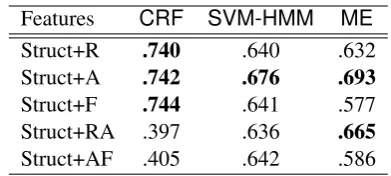
Table 2 presents the results for structural
fea-Features CRF SVM-HMM ME
[image:6.595.88.277.63.107.2]Struct+R .740 .640 .632 Struct+A .742 .676 .693 Struct+F .744 .641 .577 Struct+RA .397 .636 .665 Struct+AF .405 .642 .586
Table 2: DA classification F-score with structural and DA-based post context features (R = “Previ-ous Post”, A = “Previ“Previ-ous Post from Same Author”, and F = “Full History”; above-baseline results in bold)
tures combined with DA-based post context; we do not present any combinations of Previous Post and Full History, as Full History includes the Pre-vious Post.
Comparing back to the original results using only the structural results, we can observe that Pre-vious Post from Same Author and Full History (A and F, resp., in the table) lead to a slight incre-ment in F-score for both CRFand SVM-HMM, but degrade the performance ofME. Previous Post leads to either a marginal improvement, or a drop in results, most noticeably for ME. It is slightly surprising that the CRF should benefit from con-text features at all, given that it is optimising over the full tag sequence, but the impact is relatively localised, and when all sets of context features are used, the combined weight of noisy features appears to swamp the learner, leading to a sharp degradation in F-score.
6.3 Semantic features
We next investigate the relative impact of the se-mantic features, once again including structural features in all experiments. Table 3 presents the F-score using the different combinations of semantic features.
Similarly to the post context features, the se-mantic features produced slight increments over the structural features in isolation, especially for
CRF and ME. For the first time, SVM-HMM
incorporat-Features CRF SVM-HMM ME
[image:7.595.328.501.60.284.2]Struct+T .751 .636 .660 Struct+P .747 .636 .662 Struct+C .738 .587 .630 Struct+U .722 .564 .620 Struct+TP .740 .627 .720 Struct+TC .744 .646 .589 Struct+TU .738 .600 .609 Struct+PC .745 .630 .583 Struct+PU .736 .626 .605 Struct+CU .730 .599 .619 Struct+TPC .739 .622 .580 Struct+TPU .729 .613 .6120 Struct+TCU .750 .611 .6120 Struct+PCU .738 .616 .614 Struct+TPCU .737 .619 .605
Table 3: DA classification F-score with semantic features (T = “Title Similarity”, P = “Post Simi-larity”, C = “Post Characteristics”, and U = “User Profile”; above-baseline results inbold)
ing structural features and title similarity, at an F-score of 0.751.
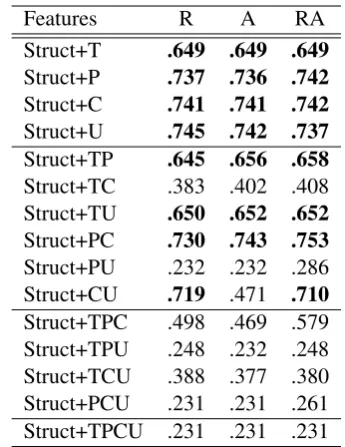
To further explore the interaction between post context and semantic features, we builtCRF clas-sifiers for different combinations of post context and semantic features, and present the results in Table 4.5 We achieved moderate gains in F-score, with all post context features, in combination with structural features, post similarity and post char-acteristics achieving an F-score of 0.753, slightly higher than the best result achieved for just struc-tural and post context features.
It is important to refer back to the results for lexical features (comparable to what would have been achieved with a standard text categorisation approach to the task), and observe that we have achieved far higher F-scores using features cus-tomised to user forum data. It is also important to reflect that post context (in terms of the features and the structured classification results of CRF) appears to markedly improve our results, contrast-ing with the results of Ries (1999) and Serafin and Di Eugenio (2004).
5We omit the results for Full History post context for rea-sons of space, but there is relatively little deviation from the numbers presented.
Features R A RA
Struct+T .649 .649 .649 Struct+P .737 .736 .742 Struct+C .741 .741 .742 Struct+U .745 .742 .737 Struct+TP .645 .656 .658 Struct+TC .383 .402 .408 Struct+TU .650 .652 .652 Struct+PC .730 .743 .753 Struct+PU .232 .232 .286 Struct+CU .719 .471 .710 Struct+TPC .498 .469 .579 Struct+TPU .248 .232 .248 Struct+TCU .388 .377 .380 Struct+PCU .231 .231 .261 Struct+TPCU .231 .231 .231
Table 4: DA classification F-score forCRFwith different combinations of post context features and semantic features (R = “Previous Post”, and A = “Previous Post from Same Author”; T = “Ti-tle Similarity”, P = “Post Similarity”, C = “Post Characteristics”, and U = “User Profile”; above-baseline results inbold)
7 Link Classification Results
Our second experiment is based on link classifi-cation in isolation. Here, we predict unlabelled edges, e.g. in Figure 2, the gold-standard classifi-cation for Post 1 would be NULL, Post 2 would be Post 1, Post 3 would be Post 1, etc.
Note that the initial post cannot link to any other post, and also that the second post always links to the first post. As this is a hard constraint on the data, and these posts simply act to inflate the overall numbers, we exclude all first and second posts from our evaluation of link classification.
We experimented with a range of baselines as presented in Table 5, but found that the best per-former by far was the simple heuristic of linking each post (except for the initial post) to its imme-diately preceding post. This leads to an F-score of 0.631, comparable to that for the post classifica-tion task.
7.1 Lexical and structural features
Once again, we started by exploring the effective-ness of lexical and structural features using the three learners, as detailed in Table 6.
[image:7.595.76.285.62.285.2]Baseline Prec Rec F-score Previous post .641 .622 .631 First post .278 .269 .274 Title similarity .311 .301 .306 Post similarity .255 .247 .251
Table 5: Baselines for link classification
Features CRF SVM-HMM ME
Lexical — .154 .274
[image:8.595.90.275.61.133.2]Structural .446 .220 .478
Table 6: Link classification F-score with lexical and structural features (above-baseline results in bold)
structural features are more effective than lexical features for link classification, but this time, nei-ther feature set approaches the baseline F-score for any of the learners. Once again, the results for
SVM-HMMare well below those for the other two learners.
7.2 Post context features
Next, we experiment with link-based post con-text features, in combination with the structural features, as the results were found to be consis-tently better when combined with the structural features (despite the below-baseline performance of the structural features in this case). The link-based post context features in all cases are gener-ated using theCRFwith structural features from Table 6. As before, we do not present any combi-nations of Previous Post and Full History, as Full History includes the Previous Post
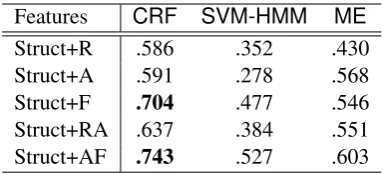
As seen in Table 9, here, for the first time, we achieve an above-baseline result for link classifi-cation, for SVM and ME based on Previous Post from Same Author in isolation, and also some-times in combination with the other feature sets. The results for CRF also improve, but not to a level of statistical significance over the baseline. Similarly to the results for DA classification, the results for CRFdrop appreciably when we com-bine feature sets.
7.3 Semantic features
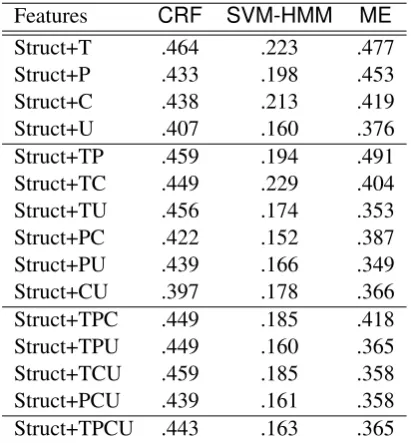
Finally, we experiment with semantic features, once again in combination with structural features. The results are presented in Table 8.
The results for semantic features largely
mir-Features CRF SVM-HMM ME
[image:8.595.88.275.170.213.2]Struct+R .234 .605 .618 Struct+A .365 .665 .665 Struct+F .624 .648 .615 Struct+RA .230 .615 .661 Struct+AF .359 .663 .621
Table 7: Link classification F-score with structural and link-based post context features (R = “Previ-ous Post”, A = “Previ“Previ-ous Post from Same Author”, and F = “Full History”; above-baseline results in bold)
Features CRF SVM-HMM ME
Struct+T .464 .223 .477 Struct+P .433 .198 .453 Struct+C .438 .213 .419 Struct+U .407 .160 .376 Struct+TP .459 .194 .491 Struct+TC .449 .229 .404 Struct+TU .456 .174 .353 Struct+PC .422 .152 .387 Struct+PU .439 .166 .349 Struct+CU .397 .178 .366 Struct+TPC .449 .185 .418 Struct+TPU .449 .160 .365 Struct+TCU .459 .185 .358 Struct+PCU .439 .161 .358 Struct+TPCU .443 .163 .365
Table 8: Link classification F-score with semantic features (T = “Title Similarity”, P = “Post Simi-larity”, C = “Post Characteristics”, and U = “User Profile”; above-baseline results inbold)
ror those for post classification: small improve-ments are observed for title similarity withCRF, but otherwise, the results degrade across the board, and the combination of different feature sets com-pounds this effect.
The best overall result achieved for link classifi-cation is thus the 0.743 forCRFwith the structural and post context features.
We additionally experimented with combina-tions of features as for post classification, but were unable to improve on this result.
7.4 Link Classification using DA Features
[image:8.595.314.520.238.460.2]Features CRF SVM-HMM ME
[image:9.595.85.277.61.148.2]Struct+R .586 .352 .430 Struct+A .591 .278 .568 Struct+F .704 .477 .546 Struct+RA .637 .384 .551 Struct+AF .743 .527 .603
Table 9: Link classification F-score with structural and post-based post context features (R = “Previ-ous Post”, A = “Previ“Previ-ous Post from Same Author”, and F = “Full History”; above-baseline results in bold)
above, by rolling the two tasks into a single clas-sification task, or alternatively by looking to joint modelling methods. As a preliminary step in this direction, and means of exploring the interaction between the two tasks, we repeat the experiment based on post context features from above (see Section 7.2), but rather than using link-based post context, we use DA-based post context.
As can be seen in Table 9, the results for SVM-HMM and ME drop appreciably as compared to the results using link-based post context in Table 9, while the results forCRFjump to the highest level achieved for the task for all three learners. The effect can be ascribed to the ability of CRF to natively model the (bidirectional) link classifica-tion history in the process of performing structured learning, and the newly-introduced post features complementing the link classification task.
8 Discussion and Future Work
Ultimately, we require both DA and link classifica-tion of each post, which is possible in (at least) the following three ways: (1) by combining the out-puts of the component classifiers described above; (2) by rolling the two tasks into a single classifi-cation task; or (3) by looking to joint modelling methods. Our results in Section 7.4 are suggestive of the empirical potential of performing the two tasks jointly, which we hope to explore in future work.
One puzzling effect observed in our experi-ments was the generally poor results for SVM. Er-ror analysis indicates that the classifier was heav-ily biased towards the high-frequency classes, e.g. classifying all posts as either Q-Q or A-A for DA classification. The classifications for the other two learners were much more evenly spread across the different classes.
CRFwas limited in that it was unable to cap-ture lexical feacap-tures, but ultimately, lexical fea-tures were found to be considerably less effec-tive than structural and post context features for both tasks, and the ability of the CRF to opti-mise the post labelling over the full sequence of posts in a thread more than compensated for this shortcoming. Having said this, there is more work to be done exploring synergies between the dif-ferent feature sets, especially for DA classifica-tion where all feature sets were found to produce above-baseline results.
Another possible direction for future research is to explore the impact of inter-post time on link structure, based on the observation that follow-up posts from the initiator tend to be tempo-rally adjacent to posts they respond to with rela-tively short time intervals, while posts from non-initiators which are well spaced out tend not to re-spond to one another. Combining this with pro-filing of the cross-thread behaviour of individual forum participants (Weimer et al., 2007; Lui and Baldwin, 2009), and formal modelling of “forum behaviour” is also a promising line of research, taking the lead from the work of G¨otz et al. (2009), inter alia.
9 Conclusion
In this work, we have proposed a method for analysing post-to-post discourse structure in on-line user forum data, in the form of post link-ing and dialogue act tagglink-ing. We introduced three feature sets: structural features, post con-text features and semantic features. We exper-imented with three learners (maximum entropy,
SVM-HMMandCRF), and established thatCRF
is the superior approach to the task, achieving above-baseline results for both post and link clas-sification. We also demonstrated the complemen-tarity of the proposed feature sets, especially for the post classification task, and carried out a pre-liminary exploration of the interaction between the linking and dialogue act tagging tasks.
Acknowledgements
This research was supported in part by funding from Microsoft Research Asia.
References
classifica-tion in multiparty meetings. In Proceedings of the 2005 IEEE International Conference on Acous-tics, Speech, and Signal Processing (ICASSP 2005), pages 1061–1064, Philadelphia, USA.
Timothy Baldwin, David Martinez, Richard Penman, Su Nam Kim, Marco Lui, Li Wang, and Andrew MacKinlay. to appear. Intelligent Linux informa-tion access by data mining: the ILIAD project. In Proceedings of the NAACL 2010 Workshop on Com-putational Linguistics in a World of Social Media: #SocialMedia, Los Angeles, USA.
Susan Bartlett, Grzegorz Kondrak, and Colin Cherry. 2009. On the syllabification of phonemes. In Pro-ceedings of the North American Chapter of the As-sociation for Computational Linguistics – Human Language Technologies 2009 (NAACL HLT 2009), pages 308–316, Boulder, USA.
Xin Cao, Gao Cong, Bin Cui, Christian S. Jensen, and Ce Zhang. 2009. The use of categorization infor-mation in language models for question retrieval. In Proceedings of the 18th ACM Conference on Infor-mation and Knowledge Management (CIKM 2009), pages 265–274, Hong Kong, China.
Lynn Carlson, Daniel Marcu, and Mary Ellen Okurowski. 2001. Building a discourse-tagged corpus in the framework of rhetorical structure the-ory. In Proceedings of the Second SIGdial Work-shop on Discourse and Dialogue, pages 1–10, Aal-borg, Denmark. Association for Computational Lin-guistics Morristown, NJ, USA.
Vitor R. Carvalho and William W. Cohen. 2005. On the collective classification of email ”speech acts”. In Proceedings of 28th International ACM-SIGIR Conference on Research and Development in Infor-mation Retrieval (SIGIR 2005), pages 345–352.
William W. Cohen, Vitor R. Carvalho, and Tom M. Mitchell. 2004. Learning to classify email into “speech acts”. In Proceedings of the 2004 Con-ference on Empirical Methods in Natural Lan-guage Processing (EMNLP 2004), pages 309–316, Barcelona, Spain.
Gao Cong, Long Wang, Chin-Yew Lin, Young-In Song, and Yueheng Sun. 2008. Finding question-answer pairs from online forums. InProceedings of 31st International ACM-SIGIR Conference on Re-search and Development in Information Retrieval (SIGIR’08), pages 467–474, Singapore.
Shilin Ding, Gao Cong, Chin-Yew Lin, and Xiaoyan Zhu. 2008. Using conditional random fields to ex-tract context and answers of questions from online forums. InProceedings of the 46th Annual Meet-ing of the ACL: HLT (ACL 2008), pages 710–718, Columbus, USA.
Jonathan L. Elsas and Jaime G. Carbonell. 2009. It pays to be picky: An evaluation of thread retrieval in online forums. In Proceedings of 32nd Inter-national ACM-SIGIR Conference on Research and
Development in Information Retrieval (SIGIR’09), pages 714–715, Boston, USA.
Jonathan L. Elsas, Jaime Arguello, Jamie Callan, and Jaime G. Carbonell. 2008. Retrieval and feed-back models for blog feed search. InProceedings of 31st International ACM-SIGIR Conference on Re-search and Development in Information Retrieval (SIGIR’08), pages 347–354, Singapore.
Micha Elsner and Eugene Charniak. 2008. You talk-ing to me? a corpus and algorithm for conversation disentanglement. InProceedings of the 46th Annual Meeting of the ACL: HLT (ACL 2008), pages 834– 842, Columbus, USA.
Michaela G¨otz, Jure Leskovec, Mary McGlohon, and Christos Faloutsos. 2009. Modeling blog dynamics. In Proceedings of the Third International Confer-ence on Weblogs and Social Media (ICWSM 2009), pages 26–33, San Jose, USA.
Barbara J. Grosz and Candace L. Sidner. 1986. Atten-tion, intention and the structure of discourse. Com-putational Linguistics, 12(3):175–204.
Edward Ivanovic. 2008. Automatic instant messaging dialogue using statistical models and dialogue acts. Master’s thesis, University of Melbourne.
Gang Ji and Jeff Bilmes. 2005. Dialog act tag-ging using graphical models. In Proceedings of the 2005 IEEE International Conference on Acous-tics, Speech, and Signal Processing (ICASSP 2005), pages 33–36, Philadelphia, USA.
Thorsten Joachims, Thomas Finley, and Chun-Nam John Yu. 2009. Cutting-plane training of structural SVMs. Machine Learning, 77(1):27–59.
Andrew Lampert, Robert Dale, and C´ecile Paris. 2008. The nature of requests and commitments in email messages. InProceedings of the AAAI 2008 Workshop on Enhanced Messaging, pages 42–47, Chicago, USA.
Oliver Lemon, Alex Gruenstein, and Stanley Pe-ters. 2002. Collaborative activities and multi-tasking in dialogue systems. Traitement Automa-tique des Langues (TAL), Special Issue on Dialogue, 43(2):131–154.
Chen Lin, Jiang-Ming Yang, Rui Cai, Xin-Jing Wang, Wei Wang, and Lei Zhang. 2009. Modeling se-mantics and structure of discussion threads. In Pro-ceedings of the 18th International Conference on the World Wide Web (WWW 2009), pages 1103–1104, Madrid, Spain.
Guido Minnen, John Carroll, and Darren Pearce. 2001. Applied morphological processing of English. Nat-ural Language Engineering, 7(3):207–223.
Gabriel Murray, Steve Renals, Jean Carletta, and Jo-hanna Moore. 2006. Incorporating speaker and dis-course features into speech summarization. In Pro-ceedings of the Main Conference on Human Lan-guage Technology Conference of the North Amer-ican Chapter of the Association of Computational Linguistics, pages 367–374.
Klaus Ries. 1999. HMM and neural network based speech act detection. InProceedings of the 1999 IEEE International Conference on Acoustics, Speech, and Signal Processing (ICASSP-99), pages 497–500, Phoenix, USA.
Carolyn Penstein Ros´e, Barbara Di Eugenio, Lori S. Levin, and Carol Van Ess-Dykema. 1995. Discourse processing of dialogues with multiple threads. InProceedings of the 33rd Annual Meet-ing of the Association for Computational LMeet-inguis- Linguis-tics, pages 31–38, Cambridge, USA.
Ken Samuel, Carbeery Sandra Carberry, and K. Vijay-Shanker. 1998. Dialogue act tagging with transformation-based learning. In Proceedings of the 36th Annual Meeting of the ACL and 17th In-ternational Conference on Computational Linguis-tics (COLING/ACL-98), pages 1150–1156, Mon-treal, Canada.
Anne Schuth, Maarten Marx, and Maarten de Rijke. 2007. Extracting the discussion structure in com-ments on news-articles. InProceedings of the 9th Annual ACM International Workshop on Web Infor-mation and Data Management, pages 97–104, Lis-boa, Portugal.
Jangwon Seo, W. Bruce Croft, and David A. Smith. 2009. Online community search using thread struc-ture. InProceedings of the 18th ACM Conference on Information and Knowledge Management (CIKM 2009), pages 1907–1910, Hong Kong, China.
Riccardo Serafin and Barbara Di Eugenio. 2004. FLSA: Extending latent semantic analysis with fea-tures for dialogue act classification. InProceedings of the 42nd Annual Meeting of the Association for Computational Linguistics (ACL 2004), pages 692– 699, Barcelona, Spain.
Fei Sha and Fernando Pereira. 2003. Shallow pars-ing with conditional random fields. InProceedings of the 3rd International Conference on Human Lan-guage Technology Research and 4th Annual Meeting of the NAACL (HLT-NAACL 2003), pages 213–220, Edmonton, Canada.
Lokesh Shrestha and Kathleen McKeown. 2004. De-tection of question-answer pairs in email conver-sations. In Proceedings of the 20th International Conference on Computational Linguistics (COLING 2004), pages 889–895, Geneva, Switzerland.
Elinzabeth Shriberg, Raj Dhillon, Sonali Bhagat, Jeremy Ang, and Hannah Carvey. 2004. The ICSI meeting recorder dialog act (MRDA) corpus. In Proceedings of the 5th SIGdial Workshop on Dis-course and Dialogue, pages 97–100, Cambridge, USA.
Andreas Stolcke, Klaus Ries, Noah Coccaro, Eliz-abeth Shriberg, Rebecca Bates, Daniel Jurafsky, Pail Taylor, Rachel Martin, Carol Van Ess-Dykema, and Marie Meteer. 2000. Dialogue Act Mod-eling for Automatic Tagging and Recognition of Conversational Speech. Computational Linguistics, 26(3):339–373.
Yi-Chia Wang, Mahesh Joshi, and Carolyn Ros´e. 2007. A feature based approach to leveraging context for classifying newsgroup style discussion segments. In Proceedings of the 45th Annual Meeting of the As-sociation for Computational Linguistics Companion Volume Proceedings of the Demo and Poster Ses-sions (ACL 2007), pages 73–76, Prague, Czech Re-public.
Yi-Chia Wang, Mahesh Joshi, William W. Cohen, and Carolyn Ros´e. 2008. Recovering implicit thread structure in newsgroup style conversations. In Pro-ceedings of the Second International Conference on Weblogs and Social Media (ICWSM 2008), pages 152–160, Seattle, USA.
Markus Weimer, Iryna Gurevych, and Max M¨uhlh¨auser. 2007. Automatically assessing the post quality in online discussions on software. In Proceedings of the 45th Annual Meeting of the ACL: Interactive Poster and Demonstration Sessions, pages 125–128, Prague, Czech Republic.
Florian Wolf and Edward Gibson. 2005. Representing discourse coherence: A corpus-based study. Com-putational Linguistics, 31(2):249–287.
Wensi Xi, Jesper Lind, and Eric Brill. 2004. Learning effective ranking functions for newsgroup search. In Proceedings of 27th International ACM-SIGIR Conference on Research and Development in In-formation Retrieval (SIGIR 2004), pages 394–401. Sheffield, UK.
Alexander Yeh. 2000. More accurate tests for the sta-tistical significance of result differences. In Pro-ceedings of the 18th International Conference on Computational Linguistics (COLING 2000), pages 947–953, Saarbr¨ucken, Germany.