Abstract—Twenty first century businesses need to accomplish high quality, low cost products, whilst remaining responsive to specific and rapidly changing customer demands. This aim leads to flexible human and technical resources utilization for efficient product realization. This paper describes a new approach to the conceptual design of human systems based on combined use of enterprise process understanding and simulation modeling techniques. The proposed simulation modeling facilitates a systematic and quantitative design of human system such that the competencies they possesses and reachable behaviors they can achieve, must closely match changes in business and production requirements induced by customer demands.
Index Terms— Modular Approach, Postponement, Reconfiguration, Responsiveness
I. INTRODUCTION
Today’s manufacturing world is typified by global manufacturing operations and competitions which force companies to develop greater capabilities for a quick market dynamic response. To cope with quick market dynamics, Manufacturing Enterprises (ME’s) must be able to restructure and re-engineer businesses rapidly and effectively whilst keeping suitable production paradigm such as mass customization, economy of scope and scale and so forth..
To adopt this flexibility in production various technologies, tools and approaches have been developed so far. But beside having the flexible technological setup MEs also need to provide a flexible human resource in general which could be appropriately deployed in production environment. However, for most ME’s it is not clear about the level of best choice of people and technical (IT and machine) resources to solve current and near future product realization according to the customer demands. For example the change in production volumes and product functionality will equally impact upon the capabilities and capacities, and this in turn necessitate the significance of re-design and re-configuration of production systems to achieve a fast and effective product realization.
According to the customer’s demands this paper proposes an integrated modeling approach to re-design and reconfigure human and technical resources to achieve a considerable improvement in product processing rate. The
Manuscript received March 8, 2010. This work was supported by a case study Display System International a Manufacturer of International Brands Display items.
U. Ghani is with the Wolfson School of Mechanical and Manufacturing of Loughborough University, LE11 3TU UK (phone: 01509 227682; e-mail: U.Ghani@ lboro.ac.uk).
R. Weston is with Wolfson School of Mechanical and Manufacturing of Loughborough University, UK (e-mail: [email protected]).
R.Harrison is with Wolfson School of Mechanical and Manufacturing of Loughborough University UK (e-mail: [email protected]).
adopted approach explores the use of role-based process modeling techniques as basis for resource allocation in form of a team. To do so various aspects of human system design can be improved to enhance production systems performance and responsiveness.
To illustrate the application of modeling/simulation approach a case study company was chosen which is referred to as Display Systems International (DSI). DSI is a multinational firm producing display systems for a number of cosmetic, electronic and tobacco manufacturer whose main clients are Boots, Superdrug Ltd, L’Oreal, Rimmel, Maybelline, MaxFactor, Vodafone, T-mobile and Gillette [1].
DSI produces display products of various types in different quantities to satisfy dynamic orders from different clients. To do so, they must utilize a common base of human ware and techno ware in an efficient, responsive and customized manner. To achieve this task DSI has to realize the need of intensive engineering efforts and research, but this paper considers only how to improve the human resource utilization in the products assembly processes. This is well understood that it is the human ware that drives DSI’s primary product realization goals.
Various tools can be used to analyze and maximize the utilization of human resource during production. However the approach adopted in this paper is, to visualize and express the problem caused by the improper allocation of human resource through modeling the DSI processes. Also to make sure the identification of roles associated with human resources not only for the curing of problems in the assembly line but also for the efficient responsive modules production, to incorporate the postponement approach with the help of product families [2].
The approach adopted in this paper provides a broader guideline for possible improvements in resource utilization and processes.
II. APPROACH DEVELOPMENT AND METHODOLOGY
Manufacturing philosophies provide a general picture about the factors and characteristics which enable Manufacturing Enterprises to adapt different production environments according to the needs like costs, responsiveness, demands and customization. These also give an overall scenario of the stakes like, all type of resource utilization techniques causing the transfer of benefits to the markets [3]. Similarly it also provides an understanding of production environment as, what and how different planning and scheduling be incorporate within the production. This provides guidance about the causes and effects of different products flow dynamism on the basis of following variances;
1) Order volume variances 2) Products feature wise variances
Matching Teams to Process Oriented Roles
Figure 1 Methodology to be followed
3) A mix of the above two[2]
To deal with these variances it is needed to make sure about the proper and accurate resource allocation for this product dynamism. It is understood that the human resource is the sole driver of any business execution from concept to reality. Therefore it should be focused on to utilize human resource properly with an aim to remain competitive in global market [4].
To improve the production processes for product variances, this paper is looking for the grouping of human resource in form of a team for the specified targets according to the production environment. To do so various options like simulation and static modelling are available, which can be used as a tool to test and analyze the approach adopted [5].
For a responsive, efficient as well as mass customized Economy of scale and scope production requires a close loop analysis which encompasses both product volume dynamics, and product variances. To incorporate the customer desires in the product realization, the postponement technique must be employed on the assembly line, which demands products to be flexible in assembly processes. To adopt this production technique with the utilization of simulation tool it is possible to develop the instruction rules for a supervisor to select teams for the different product families [6]. The methodology followed is depicted in figure 1 which incorporates the product ordering sequence as well as the processes required to accomplish the task. The figure explains that processes must be developed side by side once the products orders been placed. Having theses two parameters, it is needed to first develop the static models for the processes identification, and then with the help of these static activities the dynamic simulation models can be devised which would provide the opportunity to identify the number of resources and their roles while treating away the bottlenecks and achieve a balanced optimized assembly line.
III. DEVELOPING PRODUCT FAMILIES
A product family is defined as a set of products whose functions are similar. These functional similarities can be translated into similarities in the physical domain (components connections, subassemblies) and processes taking place in the assembly. The more similarities products
share, the more unified or standardized the assembly system will be. A product family may have its origin in a differentiation process of a base product or in an aggregation processes of distinct products [7].
The case study used in this paper produces the display products units for a number of international brands having different functionalities. On the basis of production process variations and functionalities these units have been classified in 5 families. These are;
1) Beauty items Display Units 2) Drug items display units 3) Perfume items display unit 4) Phones display unit 5) Shave items display unit
But the paper focuses initially on the processes and roles development for two product;
1) Beauty items display product and 2) Drugs display product
With the aim to develop a balanced assembly line having an optimized team, as a first step the beauty items display units assembly has been considered. This same line is then considered for the drugs display products assembly processes. This multi-product assembly line requires to reconfigure on the basis of human resource competencies for a desired team to cope the variations of assembly processes according to the orders placed. The aim here is to develop a team for the modules production having a postponement distribution marketing system.
IV. PROCESS DEVELOPMENT
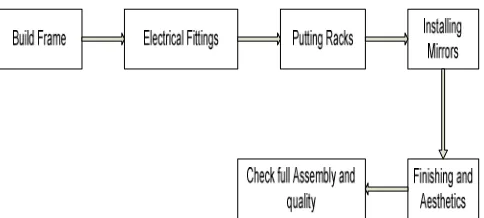
Process is a set of activities which converts something to the useable form. It either provides a supplement for the succeeding actions or produces the end user product. This paper is looking for the assembly processes of two product families for Display System International. The proposed processes for the two products assemblies are shown in figure 2 and figure 3.
[image:2.595.307.549.575.684.2]All these processes are required in the assembly shop for the delivery of final product. These processes have to be drawn first in the CIMOSA static modeling tool, starting from domain to activity diagram.
[image:2.595.306.549.730.778.2]Figure 1 Processes for Beauty items Display Products
V. DATA DEVELOPMENT FOR SIMULATION
Simulation is a tool to analyze dynamic behavior of the processes to be performed. As order volumes and its production needs are not fixed and static. Therefore simulation provides a dynamic analysis approach to visualize the processes and activities needed, rather than to test the model in actual condition.
Simul8 has been used here as a simulation tool for the development of human teams based on roles assignment for the process execution. Simul8 has the ability to analyze the discrete events, DSI faces in its production processes for two product families. On the basis of order dynamics and product variances, one week orders of DSI consist of total 6 products having size variation from small 0.5 meter and 1m product, to medium 1.5m and 2m, and then large 2.5m and 3m. It is assumed that the processing time for each category is same (which is in reality varies slightly).
[image:3.595.309.544.65.208.2]Products processing times, their volume dynamics (weekly and daily production) and inter arrival times are given in table 1 and table 2 respectively.
Table 1 Processing time at work centers
Beauty Items Display Small Medium Large Work
Centre
0.5m 1m 1.5m 2m 2.5m 3m
Operator Build
Frame 36 36 39.6 39.6 43.6 43.6 2
Wiring 16 16 17.6 17.6 19.4 19.4 1
Insert Rackin g
29 29 31.9 31.9 35 35 2
Insert Mirror s
8 8 8.8 8.8 8.9 8.9 1
Aesthe
tics 7 7 7.7 7.7 7.8 7.8
1
Final Qualit y
[image:3.595.46.292.311.724.2]12 12 13.2 13.2 14.5 14.5 1
Table 2 Order Volume and Product Dynamics
Product Variances
Small unit 0.5m
Small Unit
1m
Medium unit 1.5m
Medium unit 2m
Large Unit 2.5m
Large unit
3m Order
dynamics/week
60 50 35 55 40 45
Daily Average With 5 days
working 12 10 7 11 8 9
Inter arrival time with 8 hours working
40
Min 48
Min
68.57
Min
43.64
Min 60
Min 53.4
Min
VI. SIMULATION MODELING AND RESULTS
Here the aim is to increase the product processing rate by matching the resources to the roles, in accordance with the orders placed by the customers. To do so first the
assembly line is analyzed for ‘As Is’ situation, and this line
is brought to a ‘To Be’ status while focusing on the team needed.
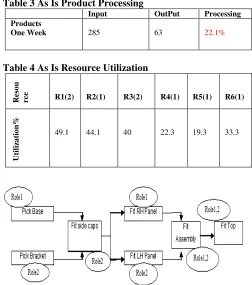
The ‘As Is’ model of the current assembly line is in model 1. The model possesses a bottleneck in the very start of the line, and after the compilation of this model the associated ‘As Is’ results for product processing and resource utilization are available in table3, and table 4 respectively. Product processing for one week order has a result of just 22.1%, pointing to improper resource utilization and poor management. The resource utilization results provide an idea that the assembly line is not balanced and needs to be properly managed. This paper provides a guideline as how to recognize the roles, and develop proper team to treat a bottleneck and then project the same idea to all of the assembly line bottlenecks identified by simulation tool.
A. Modeling the Work Centre Roles
[image:3.595.302.554.488.773.2]Figure 4 represent the roles of build frame work centre in an ‘As Is’ situation which needs to develop its ‘To Be’ status.
Table 3 As Is Product Processing
Input OutPut Processing
Products
One Week 285 63 22.1%
Table 4 As Is Resource Utilization
R
es
o
u
rc
e R1(2) R2(1) R3(2) R4(1) R5(1) R6(1)
U
ti
li
za
ti
o
n
%
49.1 44.1 40 22.3 19.3 33.3
Model 4 To Be Final Assembly line Table 5 As Is Processing times
S.No Activities Human Resource
Roles
Opt
Time
(Min)
1 Picking the base and fit plastic lines Role 1 3
2 Picking sides panels Role 2 3
3 Combine these Role 2 2
4 Fit the Right Hand Panel Role 1 6
5 Fit the Left hand panel Role 2 6
6 Fit the top Role 1,2 10
7 Fit the Top Piece with electrical box , Role 1,2 6
Total 36 (S)
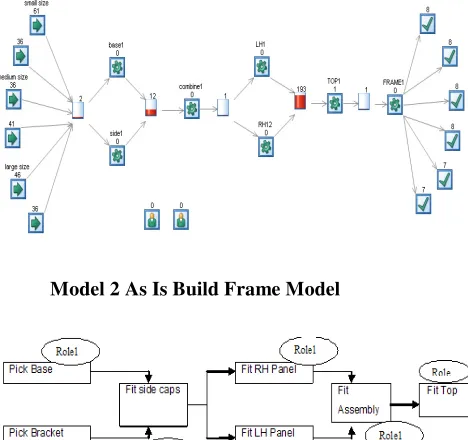
[image:4.595.44.292.62.221.2]The associated ‘As Is’ processing times for this work centre are in table 5. The ‘As Is’ Simulation of this Work centre with two operators is shown in model 2. The result shows that the resources used are 99% and 94% while product processing rate is just 18%. This result suggest to assign more resources and to shuffle the activities roles for product processing. After assigning another resource the desired ‘To Be’ roles of the Build frame are in figure 5, and the associated processing times are in table 6.
Figure 4 To Be Build Frame Process Roles
Table 6 To Be Processing Time of Build Frame Opt Time (Min)
S.No Activities Resource
Roles S M L
1 Picking the base and
fit plastic lines
Role 1 3 3 3
2 Picking sides panels Role 2 3 3 3
3 Combine these Role 3 2 2 2
4 Fit the Right Panel Role 1 2.5 3.5 4.5
5 Fit the Left panel Role 2 3 4 5
6 Fit the top Role 1 1 3 3
7 Fit the electrical box Role 2 3 4 5
Total 17.5 22.5 25.5
Model 3 To Be Build Frame Model
The results of ‘To Be’ build frame work center as in model 3 shows that the processing is 100% while having no item in queue, but the resource utilization is a little bit less than the ‘As Is’ status. This could be managed by re-assigning the tasks when finally all the bottlenecks removed with having a balanced assembly line. To achieve this only reshuffling of resources is required according to the different roles. Having this approach in mind put this ‘To Be’ model in assembly line, and run the simulation to check further results for the identification of more bottlenecks. If there are yet some bottlenecks then they could be treated in the same way as like the first work center. For instance to check the bottlenecks for the electrical wiring insert racking, mirrors, aesthetic and final assembly and quality work centers.
B. Final Balance Assembly Line
[image:4.595.49.283.355.575.2]After removing all bottlenecks, the desired balanced assembly line is in mode 4, having an operational team of nine operators and one supervisor. This is the final model with all of the reshuffling of resources been taken place among the work centers. The results of this ‘To Be’ model indicates a significant improvement over the ‘As Is’ model 1. The product processing for this model are given in table 7, with 96% product processing rate, while all of the resources including machines and humans are properly managed and fully utilized to their optimum capacities. The resource utilization is given in the table 8.
Table 7 To Be Product Processing for Final Assembly Input Out Put % Processing
Products in
one week 275 264 96 %
Table 8 To Be Proposed Team for Final Assembly
Table 9 To Be roles for the Final Assembly Team
S.No Resources Process Oriented roles
1. Supervisor Managing to whole team and assembly cell
2. Resource1(R1) 1. Picking Base. 2. Work on Left Hand racks. 3. Putting top on frame 3. Resource2(R2) 1. Picking Side panels
2. Putting Right hand racks 3. Final frame structure
4. Resource3(R3) 1. Combine the base and side panels 2. Final assembly and quality checks
5. Resource4(R4) 1. Wire Mapping
2. Final assembly and quality checks 6. Resource5(R5) 1. Drilling holes
2. Electrical wiring 7. Resource6(R6) 1. Insert Bottom Racking
2. Inserting Middle racks
8. Resource7(R7) 1. Inserting mirrors 9. Resource8(R8) 1. Adding aesthetics 10 Resource9(R9) 1. Insert Right hand racks
2. Insert left hand racks.
Table9 shows that the final team consists of 10 crew members with one supervisor, along with their associated roles.
Having these guidelines and associated roles, supervisor is now able to assign the human resource either in a form of a team or individually to get maximum efficiency and utilization.
VII. RECONFIGURATION OF LINE
For rapid manufacturing changes in assembly line, reconfiguration is required in order to quickly adjust the production capacity according to the orders dynamics and market requirements [9].
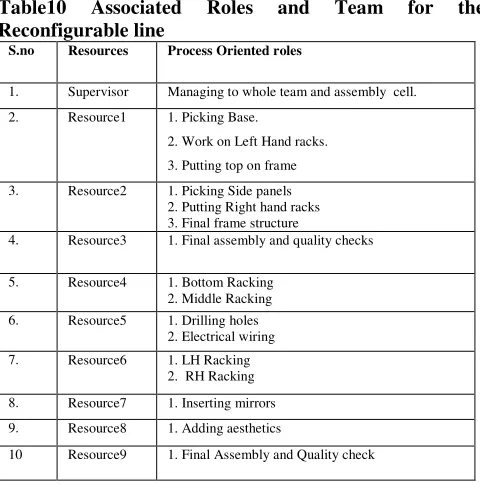
In case of DSI, it needs to reconfigure the assembly line for two products, one is the beauty items display and the second is the drug items display. The team, its utilization and roles could be identified through simulation. The line setup presented in model 5, and the proposed team and their roles are in the table 10.
Table10 Associated Roles and Team for the Reconfigurable line
S.no Resources Process Oriented roles
1. Supervisor Managing to whole team and assembly cell.
2. Resource1 1. Picking Base.
2. Work on Left Hand racks.
3. Putting top on frame
3. Resource2 1. Picking Side panels 2. Putting Right hand racks 3. Final frame structure
4. Resource3 1. Final assembly and quality checks
5. Resource4 1. Bottom Racking 2. Middle Racking 6. Resource5 1. Drilling holes
2. Electrical wiring
7. Resource6 1. LH Racking
2. RH Racking
8. Resource7 1. Inserting mirrors
9. Resource8 1. Adding aesthetics
10 Resource9 1. Final Assembly and Quality check
VIII. MODULE PRODUCTION FOR POSTPONEMENT
To bring the customer wishes in the final product assembly, it is needed to develop the modules for postponement purpose, keeping in view Make to Stock (MTS) approach. This could be done either to shift the semi assembled product to the retailer or keep it in the factory store, which in turn is based on strong forecasting for selling pattern of the product in the market as well as on the relation with the customer. The concept of postponement helps to avoid the unnecessary processes in the assembly line at shop floor, and thus to minimize the financial risk if the product is not going in sale. The postponement also provides an opportunity for the customer to add his wishes in the assembly of the final product at the retailer site, and enjoy more flexibility in form of functionality and aesthetics [8].
Reconfiguration of the line is required to adopt the postponement. This will need to reassign the roles, as some of the processes like the aesthetic work centre and the middle racks installation will be postponed for the customer decisions at the retailer store.
Resources Utilization % Resources Utilization%
R1 68 R6 60
R2 76 R7 94
R3 83 R8 82
R4 76 R9 77
R5 55 R10 Supervisor
Model 5 Reconfiguration Of Assembly line for Drug and Beauty Items
[image:5.595.48.287.625.748.2]Table 11 Proposed Team and Roles for Postponement
Model 6 represent the line configuration for the module production having the postponement approach down to market, while table 11 present the team and their assigned roles in this situation. The benefits of postponement are, to decrease the resource utilization, and maximize the opportunity of product variances by adding different alternatives like the aesthetics according to the customer desires.
The desired team consists of eight people having one supervisor and seven operators. This is the optimized team for postponed modules production, resulting in saving of two operators over the first case as in model 1 for a make to order situation on a one week basis.
IX. CONCLUSION AND FUTURE WORK
With the identification of importance level for the human resource allocation and their effective utilization in the assembly processes now it is very clear that, through a systematic approach an enterprise can accomplish its targets in term of the reconfigurable and agile setup and their corresponding resource allocation. The proposed methodology is very clearly optimizes the resource allocation for the assembly processes in case study, through matching teams to the process roles in customized volume dynamics for the various products. This approach is also effective for postponement to incorporate customer desires in the product development and selection. The main outcomes of the paper are
1) A balanced line for the assembly process 2) An optimized team having maximum utilization 3) Understanding of the software
This approach for resource allocation and utilization could be extended to any multi-volume products ordering, having functional and assembly process variations. This approach also provides a generic guiding rules for the assembly line operations required in different industries. The case study analyzed only two products assembly processes, the beauty items and drug displays. The same model has the capacity to be used for a series of products and to develop different teams. These teams could be integrated to develop a general team to be used in the whole factory.
It is possible to examine the assembly line on financial basis to produce customized product while having a cost saving team and line configuration.
ACKNOWLEDGEMENT
I heartly acknowledge the support and data provided for the completion of the result from all of the MSI team especially who are in close collaboration with the DSI International under the supervision of Professor Richard Weston.
References
[1] S. Rashid., K. Agyapong-Kodua, R.H Weston R. H (2008) Productivity enhancement in a manufacturing enterprise by improving management process, conference proceedings, Brunel, 6 ICMR [2] Clair, 2007 M.Sc Report Wolfson School of Mechanical and
Manufacturing Loughborough
[3] W. Levinson . and R. Rerick. (2002) ‘Lean Enterprise’: a synergistic approach to minimizing waste’, American Society for Quality Control.
[4] G. Zulcb. and Jagdev H. (2005) Integrating Human Aspects in Production Management. Springer
[5] R. Pew. (2007) Human-system Integration in the System Development Process: A New Look. National Academy Press
[6] Zihua Cui, Richard Weston 2009 ‘MSI Research Institute Wolfson School’ Annual Report
[7] Tollenaere, 2005, Journal of Intelligent Manufacturing’, 16, 371–390, [8] Alberto Jose, Michel Tollenaere, 2005 ‘Journal of Intelligent
Manufacturing’, 16, 371–390
[9] A. Hoda. El maraghy, 2006 Flexible and reconfigurable
manufacturing Paradigm Int J Flex Manufacturing Sys, 17: 261-276
S.no Resources Process Oriented roles
1. Supervisor Managing whole team
2. Resource1 1. Picking Base.
2. Work on Left Hand racks.
3. Putting top on frame
3. Resource2 1. Picking Side panels 2. Putting Right hand racks 3. Final frame structure
4. Resource3 1. Combine the base and side panels 2. Final assembly and quality checks
5. Resource4 1. Wire Mapping
2. Final assembly and quality checks 6. Resource5 1. Drilling holes
2. Electrical wiring 3. Putting Bottom Racks 7. Resource6 1. Inserting mirrors
8 Resource7 1. Insert Right hand racks