Adapting Text instead of the Model: An Open Domain Approach
Gourab Kundu, Dan Roth
University of Illinois at Urbana Champaign Urbana, IL 61801
{kundu2,danr}@illinois.edu
Abstract
Natural language systems trained on labeled data from one domain do not perform well on other domains. Most adaptation algorithms proposed in the literature train a new model for the new domain using unlabeled data. How-ever, it is time consuming to retrain big mod-els or pipeline systems. Moreover, the domain of a new target sentence may not be known, and one may not have significant amount of unlabeled data for every new domain.
To pursue the goal of anOpen Domain NLP
(train once, test anywhere), we proposeADUT (ADaptation Using label-preserving Transfor-mation), an approach that avoids the need for retraining and does not require knowledge of the new domain, or any data from it. Our ap-proach applies simple label-preserving formations to the target text so that the trans-formed text is more similar to the training do-main; it then applies the existing model on the transformed sentences and combines the predictions to produce the desired prediction on the target text. We instantiateADUT for the case of Semantic Role Labeling (SRL) and show that it compares favorably with ap-proaches that retrain their model on the target domain. Specifically, this “on the fly” adapta-tion approach yields 13% error reducadapta-tion for a single parse system when adapting from the news wire text to fiction.
1 Introduction
In several NLP tasks, systems trained on annotated data from one domain perform well when tested
on the same domain but adapt poorly to other do-mains. For example, all systems of CoNLL 2005 shared task (Carreras and Màrquez, 2005) on Se-mantic Role Labeling showed a performance degra-dation of almost 10% or more when tested on a dif-ferent domain.
Most works in domain adaptation have focused on learning a common representation across train-ing and test domains (Blitzer et al., 2006; DauméIII, 2007; Huang and Yates, 2009). Using this represen-tation, they retrain the model for every new domain. But these are not Open Domain Systems since the model needs to be retrained for every new domain. This is very difficult for pipeline systems like SRL where syntactic parser, shallow parser, POS tagger and then SRL need to be retrained. Moreover, these methods need to have a lot of unlabeled data that is taken from the same domain, in order to learn mean-ingful feature correspondences across training and test domain. These approaches cannot work when they do not have a lot of unlabeled data from the test domain or when the test domain in itself is very di-verse, e.g., the web.
The contribution of this paper is a new frame-work for adaptation. We propose ADUT (ADap-tation Using label-preserving Transformation) as a framework in which a previously learned model can be used on an out-of-domain example without re-training and without looking at any labeled or unla-beled data for the domain of the new example. The framework transforms the test sentence to generate sentences that have, in principle, identical labeling but that are more like instances from the training do-main. Consequently, it is expected that the
ing model will make better predictions on them. All these predictions are then combined to choose the most probable and consistent prediction for the test sentence.
ADUT is a general technique which can be ap-plied to any natural language task. In this paper, we demonstrate its usefulness on the task of semantic role labeling (Carreras and Màrquez, 2005). Start-ing with a system that was trained on the news text and does not perform well on fiction, we show that ADUT provides significant improvement on fiction, and is competitive with the performance of algo-rithms that were re-trained on the test domain.
The paper is organized as follows. Section 2 dis-cusses two motivating examples. Section 3 gives a formal definition of our adaptation framework. Sec-tion 4 describes the transformaSec-tion operators that we applied for this task. Section 5 presents our joint in-ference approach. Section 6 describes our semantic role labeling system and our experimental results are in Section 7. Section 8 describes the related works for domain adaptation. Finally in Section 9 we con-clude the paper with a discussion.
2 Motivating Examples
One of the key reasons for performance degradation of an NLP tool is unseen features such as words in the new domain that were not seen in the training domain. But if an unknown word is replaced by a known word without changing the labeling of the sentence, tools perform better. For example, in the task of syntactic parsing, the unknown wordcheckup
causes the Charniak parser to make a wrong co-ordination decision on the sentence
He was discharged from the hospital af-ter a two-day checkup and he and his par-ents had what Mr. Mckinley described as a “celebration lunch” at the cafeteria on the campus.
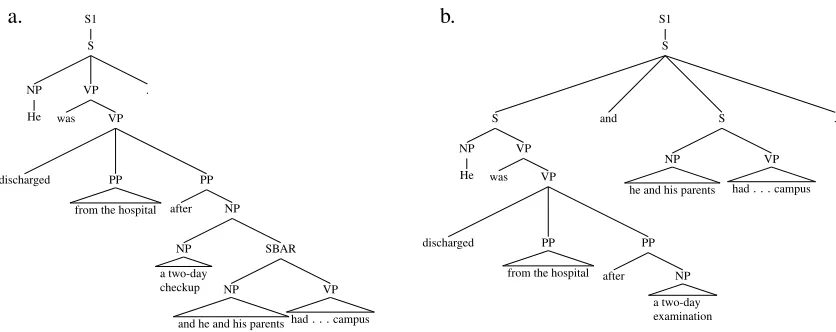
If we replace the word checkup with its hyper-nymexaminationwhich appears in training data, the parse gets corrected. Figure 1 shows both original and corrected parse trees.
For the task of semantic role labeling, systems do not perform well on the predicates that are infre-quent in training domain. But if an infreinfre-quent
predi-cate is replaced with a frequent predipredi-cate from train-ing domain such that both predicates have similar semantic argument structure, the system performs better. Consider the following sentence
Scotty gazed out at ugly gray slums.
The semantic role for the phraseat ugly gray slums
with respect to predicategazeisA1. But the pred-icate gaze appears only once in training data and our model predicts at ugly gray slumsasAM-LOC
instead of A1. But if gaze is replaced with look
which occurs328times in training data and has sim-ilar argument structure (in the same VerbNet class as
gaze), the system makes the correct prediction.
3 Problem Formulation
Let the in-domain distribution be Di and out-of-domain distribution be Do. We have a model f trained over a set of labeled examples drawn from
Di. IfDiandDoare very dissimilar,f will not per-form well on examples drawn fromDo. The prob-lem is to get good performance fromf onDo with-out retrainingf.
We define aTransformationgto be a function that maps an exampleeinto a set of examplesE. Sog: X → 2X where X is the entire space of examples. In this paper, we only consider theLabel-preserving Transformationswhich satisfy the property that all transformed examples in E have the same label as input example e, i.e., ∀x x ∈ Sk ⇒ g(x) ⊂ Sk whereSk is the set of examples with label k. Let
Gbe a set of label-preserving transformation func-tions.G={g1,g2,. . .,gp}.
At evaluation time, for test example d, we will applyGto get a set of examplesT1. LetT2={d0 ∈
T1 : Di(d0) > Di(d)}. So all examples inT2 have
same label asd but have a higher probability than
dto be drawn from the in-domain distribution. So
f should perform better on examples inT2 than on
d. For eachd0 ∈ T2,f will produce scores for the
output labels. The scores will be combined subject to constraints to produce the final output.
4 Transformation Functions
a. S1
S
NP
He VP
was VP
discharged PP
from the hospital PP
after NP
NP
a two-day checkup
SBAR
NP
and he and his parents VP
had. . .campus .
b. S1
S
S
NP
He VP
was VP
discharged PP
from the hospital PP
after NP
a two-day examination
and S
NP
he and his parents VP
[image:3.612.97.515.51.217.2]had. . .campus .
Figure 1: a.Original Parse tree b. Corrected Parse tree after replacement of unknown wordcheckupbyexamination
and transformed sentence. Thus, after annotating the transformed sentence with SRL, we can transfer the roles to the original sentence through this map-ping. Transformation functions can be divided into two categories. The first category is Transforma-tions From List which uses external resources like WordNet, VerbNet and Word Clusters. The second isLearned Transformationsthat uses transformation rules that have been learned from training data.
4.1 Transformation From List
I. Replacement of Predicate:
As noted in (Huang and Yates, 2010), 6.1% of the predicates in the Brown test set do not appear in WSJ training set and 11.8% appear at most twice. Since the semantic roles of a sentence depend on the pred-icate, these infrequent predicates hurt SRL perfor-mance on new domains. Note that since all predi-cates in PropBank are verbs, we will use the words
predicateandverbinterchangeably.
We count the frequency of each predicate and its accuracy in terms of F1 score over the training data. If the frequency or the F1 score of the predicate in the test sentence is below a threshold, we perturb that predicate. We take all the verbs in the same class of VerbNet1as the original verb (in case the verb is present in multiple classes, we take all the classes). In case the verb is not present in VerbNet, we take its synonyms from WordNet. If there is no synonym in WordNet, we take the hypernyms.
From this collection of new verbs, we select verbs that have a high accuracy and a high frequency in
1
http://verbs.colorado.edu/ mpalmer/projects/verbnet.html
training. We replace the original verb with each of these new verbs and generate one new sentence for each new verb; the sentence is retained if the parse score for the new sentence is higher than the parse score for the original sentence.2 VerbNet has de-fined a set of verb-independent thematic roles and grouped the verbs according to their usage in frames with identical thematic roles. But PropBank anno-tation was with respect to each verb. So the same thematic role is labeled as different roles for dif-ferent verbs in PropBank. For example, bothwarn
andadvisebelong to the same VerbNet class (37.9) and take thematic roles of Recipient (person being warned or advised) andTopic(topic of warning or advising). ButRecipientwas marked asA2forwarn
andA1for adviseandTopicwas marked asA1 for
warn and A2 for advise in PropBank annotation. Semlink3provides a mapping from the thematic role to PropBank role for each verb. After the SRL anno-tates the new sentence with PropBank roles for the new verb, we map the PropBank roles of the new verb to their corresponding thematic roles and then map the thematic roles to the corresponding Prop-Bank roles for the original verb.
II. Replacement and Removal of Quoted Strings:
Quoted sentences can vary a lot from one domain to another. For example, in WSJ, quoted sentences are like formal statements but in Brown, these are like informal conversations. We generate the trans-formations in the following ways:
1) We use the content of the quoted string as one
2
Parse score is the parse probability returned by Charniak or Stanford parser. 3
sentence. 2) We replace each quoted string in turn with a simple sentence (This is good) to generate a new sentence. 3) If a sentence has a quoted string in the beginning, we move that quoted string after the first NP and VP that immediately follow the quoted string. For example, from the input sentence, “We just sit quiet”, he said.we generate the sentences 1)
We just sit quiet 2)“This is good”, he said. 3)He said, “We just sit quiet”.
III. Replacement of Unseen Words:
A major difficulty for domain adaptation is that some words in the new domain do not appear in the training domain. In the Brown test set, 5% of total words were never seen in the WSJ training set.
Given an unseen word which is not a verb, we replace it with WordNet synonyms and hypernyms that were seen in the training data. We used the clusters obtained in (Liang, 2005) from running the Brown algorithm (Brown et al., 1992) on Reuters 1996 dataset. But since this cluster was generated automatically, it is noisy. So we chose replacements from the Brown clusters selectively. We only replace those words for which the POS tagger and the syn-tactic parser predicted different tags. For each such word, we find its cluster and select the set of words from the cluster. We delete from this set all words that do not take at least one part-of-speech tag that the original word can take (from WordNet). For each candidate synonym or hypernym or cluster member, we get a new sentence. Finally we only keep those sentences that have higher parse scores than the orig-inal sentence.
IV. Sentence Split based on Stop Symbols:
We split each sentence based on stop symbols like
;and.. Each of the splitted sentences becomes one transformation of the original sentence.
V. Sentence Simplification:
We have a set of heuristics for simplifying the constituents of the parse tree; for example, replac-ing an NP with its first and last word, removal of PRN phrases etc. We apply these heuristics and gen-erate simpler sentences until no more simplification is possible. Examples of our heuristics are given in Table 1.
Note that we can use composition of multiple transformation functions as one function. A compo-sitionp1 p2(s) =∪a∈p1(s)p2(a). We apply III,
IIII, IVI and VI.
Node Input Example Simplified Example Operation
NP He and sheran. Heran. replace
NP The big manran. The manran. replace
ADVP He ranfast. He ran. delete
PP He ranin the field. He ran. delete
PRN He– though sick –ran. He ran. delete
VP Hewalkedand ran. He ran. delete
TO I want himtorun. I want that he can ran. rewrite
Table 1: Examples of Simplifications (Predicate is run)
4.2 Learned Transformations
The learned model is inaccurate over verbs and roles that are infrequent in the training data. The purpose of the learned transformation is to transfer such a phrase in the test sentence in place of a phrase of a simpler sentence; this is done such that there exists a mapping from the role of the phrase in the new sentence to the role of the phrase in the original sen-tence.
Phrase Representation: A phrase tuple is a 3-tuple(t, i, h)where,tis the phrase type,iis the in-dex, andhis the headword of the phrase. We denote byP Rthe Phrase Representation of a sentence – an ordered list of phrase tuples. A phrase tuple corre-sponds to a node in the tree. We only consider phrase tuples that correspond to nodes that are (1) a sibling of the predicate node or (2) a sibling of an ancestor of the predicate node. Phrase tuples inP Rare sorted based on their position in the sentence. Theindexi
of the phrase tuple containing the predicate is taken to be zero with the indices of the phrase tuples on the left (right) sequentially decreasing (increasing).
Transformation Rule: We denote by Label(n, s)
the semantic role of nth phrase in the P R of the sentence s. Let Replace(ns, nt, ss, st) be a new sentence that results from inserting the phrasensin sentencess instead of phrasentin sentencest. We will refer to st as target sentenceand to nt as the
target phrase. Letspbe a sequence of phrase tuples named assource pattern. If Label(ns, ss) =r1and
Label(nt,Replace(ns, nt, ss, st)) =r2, then denote
f(r2) = r1. In this case we call the6-tuple (st,nt,
label correspondence function.
Example: Consider the sentencest =“But it did
not sing."and the rule τ: (st, nt, p, sp, ns, f). Let:
nt=−3,p=entitle,
sp= [−2, N P, φ][−1, AU X, φ][0, V, entitle][1, φ, to] ns=−2, f ={<A0, A2>} ∪ {<Ai, Ai>|i6= 0}.
The P R of τ.st is {[−4, CC, But] [−3, NP, it] [−2, AUX, did] [−1, RB, not] [0, VB, sing] [1, ., .]}. Consider the input sentencess: Mr. X was entitled
to a discount .withP Rof {[−2, NP, X] [−1, AUX, was] [0, V, entitle] [1, PP, to][2, ., .]}. Sinceτ.spis a subsequence of theP Rofss,τ will apply to the predicateentitleofss. The transformed sentence is:
str =Replace(τ.ns, τ.nt, ss, τ.st) = But Mr. X
did not sing. withP R of {[−4, CC, But] [−3, NP, X] [−2, AUX, did] [−1, RB, not] [0, VB, sing] [1, ., .]}. If the SRL system assigns the semantic role ofA0to the phraseMr. X ofstr, the semantic role ofMr. X inss can be recovered through τ.f since
τ.f(A0) =A2 =Label(−2, ss).
While checking if τ.sp is a subsequence of the
P R of the input sentence, φ in each tuple of τ.sp
has to be considered a trivial match. So τ will match the sentenceHe is entitled to a reward. with
P R = {[−2, NP, He] [−1, AUX, is] [0, V, entitle] [1, PP, to][2, ., .]} but will not match the sentence
The conference was entitled a big success. with
P R = {[−2, NP, conference] [−1, AUX, was] [0, V, entitle] [1, S,success][2, ., .]}(mismatch position is bolded). The index of a phrase tuple cannot beφ, only the head word or type can beφ and the rules with more φstrings in the source pattern are more general since they can match more sentences.
Algorithm 1GenerateRules
1: Input: predicatev, semantic roler, Training sentencesD, SRL ModelM
2: Output: set of rulesR
3: R⇐GetInitialRules(v, r, D, M)
4: repeat
5: J⇐ExpandRules(R)
6: K⇐R∪J
7: sortKbased on accuracy, support, size of source pattern 8: select some rulesR⊂Kbased on database coverage 9: untilall rules inRhave been expanded before
10: return R
The algorithm for finding rules for a semantic role
r of a predicatev is given in Algorithm 1. It is a specific to general beam search procedure that starts with a set of initial rules (Line3, detail in Algorithm
2) and finds new rules from these rules (Line5, de-tail in Algorithm 3). In Line7, the rules are sorted by decreasing order of accuracy, support and number ofφstrings in the source pattern. In Line8, a set of rules are selected to cover all occurrences of the se-mantic rolerwith the predicateva specific number of times. This process continues until no new rules are found. Note that these rules need to be learned only once and can be used for every new domain.
Algorithm 2GetInitialRules
1: Input: predicatev, semantic roler, Training sentencesD, SRL-ModelM
2: Output: Set of initial rulesI 3: I⇐φ
4: T ⇐ {s∈D: length(s)<=e} 5: S⇐ {s∈D:shas rolerfor predicatev} 6: M⇐Set of all semantic roles
7: foreach phrasep1ins1∈Swith gold labelrfor predicatevdo
8: foreach phrasep2ins2∈Tlabeled as a core argumentdo
9: ifs16=s2andp1andp2have same phrase typesthen
10: τ⇐empty rule 11: τ.st⇐s2, τ.p⇐v
12: τ.nt⇐index ofp2inP Rofs2
13: τ.ns⇐index ofp1inP Rofs1
14: τ.sp⇐phrase tuples for phrases fromp1tovand two
phrases aftervinP Rofs1
15: L⇐φ
16: foreach sentences3∈Dwith predicatevdo
17: ifτ.spis a subsequence ofP Rofs3then
18: x⇐replace(τ.ns, τ.nt, s3, τ.st)
19: annotatexwith SRL usingM
20: r1 ⇐the gold standard semantic role of the
phrase with indexτ.nsinP Rofs3
21: r2⇐Label(τ.nt, x)
22: ifr2∈/Lthen
23: insert(r2, r1)inτ.f
24: L=L∪ {r2}
25: end if
26: end if
27: end for
28: foreach rolej∈M−Ldo
29: insert(j, j)inτ.f
30: end for
31: I⇐I∪{τ} 32: end if
33: end for
34: end for
35: return I
The algorithm for generating initial rules for the semantic rolerof predicatevis given in Algorithm 2. Shorter sentences are preferred to be target sen-tences(Line4). A ruleτ is created for every (p1,p2)
pair where p1, p2 are phrases, p1 has the semantic
role r in some sentence s1, p2 is labeled as a core
argument(A0−A5) in some sentence inT and the phrase types of p1 and p2 in their respective parse
training corpus with predicateτ.pis a potential can-didate for applying τ(Line 16) if τ.sp is a subse-quence ofP Rofs3(Line17). After applyingτtos3,
a transformed sentencexis created(Line18). Lines
20−26 find the semantic roler2 of the transferred
phrase from SRL annotation of x using model M
and create a mapping fromr2 to the gold standard
roler1of the phrase ins3.Lmaintains the set of
se-mantic roles for which mappings have been created. In lines28−30, all unmapped roles are mapped to themselves.
The algorithm for creating new rules from a set of existing rules is given in Algorithm 3. Lines4−
13generate all immediate more general neighbors of the current rule by nullifying the headword or phrase type element in any of the phrase tuples in its source pattern.
Algorithm 3ExpandRules
1: Input: a set of rulesR
2: Output: a set of expanded rulesE 3: E⇐φ
4: foreach phrase tuplecin the source pattern ofr∈Rdo
5: ifcis not the tuple for predicatethen
6: create a new ruler0with all components ofr 7: mark the head word ofcin the source pattern ofr0toφ
8: addr0toE
9: create a new ruler00with all components ofr
10: mark the phrase type ofcin the source pattern ofr00toφ 11: addr00toE
12: end if
13: end for
14: return E
5 Combination by Joint Inference
The transformation functions transform an input sentence into a set of sentencesT. From each trans-formed sentenceti, we get a set of argument can-didates Si. Let S = S
|T|
i=1Si be the set of all ar-guments. Argument classifier assigns scores for each argument over the output labels(roles) in S
that is then converted into a probability distribu-tion over the possible labels using the softmax func-tion (Bishop, 1995). Note that multiple arguments with the same span can be generated from multiple transformed sentences.
First, we take all arguments fromS with distinct span and put them inS0. For each argumentargin
S0, we calculate scores over possible labels as the sum over the probability distribution (over output la-bels) of all arguments inSthat have the same span
asargdivided by the number of sentences inT that containedarg. This results in a set of arguments with distinct spans and for each argument, a set of scores over possible labels. Following the joint inference procedure in (Punyakanok et al., 2008), we want to select a label for each argument such that the total score is maximized subject to some constraints. Let us index the setS0 asS01:M whereM =|S0|. Also assume that each argument can take a label from a setP. The set of arguments in S01:M can take a set of labelsc1:M ∈P1:M. Given some constraints, the resulting solution space is limited to a feasible set F; the inference task is: c1:M =arg max
c1:M∈F(P1:M) PM
i=1score(S0i =ci).
The constraints used are: 1) No overlapping or embedding argument. 2) No duplicate argument for core arguments A0-A5 and AA. 3) For C-arg, there has to be an arg argument.
6 Experimental Setup
In this section, we discuss our experimental setup for the semantic role labeling system. Similar to the CoNLL 2005 shared tasks, we train our system using sections 02-21 of the Wall Street Journal portion of Penn TreeBank labeled with PropBank. We test our system on an annotated Brown corpus consisting of three sections (ck01 - ck03).
Since we need to annotate new sentences with syntactic parse, POS tags and shallow parses, we do not use annotations in the CoNLL distribution; in-stead, we re-annotate the data using publicly avail-able part of speech tagger and shallow parser1,
Char-niak 2005 parser (CharChar-niak and Johnson, 2005) and Stanford parser (Klein and Manning, 2003).
Our baseline SRL model is an implementation of (Punyakanok et al., 2008) which was the top per-forming system in CoNLL 2005 shared task. Due to space constraints, we omit the details of the system and refer readers to (Punyakanok et al., 2008).
7 Results
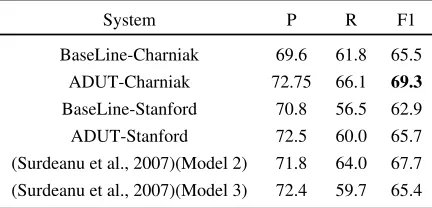
Results for ADUT using only the top parse of Char-niak and Stanford are shown in Table 2. The Base-line model using top Charniak parse ( BaseLine-Charniak) and top Stanford parse ( BaseLine-Stanford) score respectively 76.4 and 73.3 on the
1
WSJ test set. Since we are interested in adaptation, we report and compare results for Brown test set only. On this set, bothADUT-Charniakand ADUT-Stanford significantly outperform their respective baselines. We compare with the state-of-the-art sys-tem of (Surdeanu et al., 2007). In (Surdeanu et al., 2007), the authors use three models: Model
1 and 2 do sequential tagging of chunks obtained from shallow parse and full parse. Model3assumes each predicate argument maps to one syntactic con-stituent and classifies it individually. So Model 3
matches our baseline model. ADUT-Charniak out-performs the best individual model (Model 2) of (Surdeanu et al., 2007) by 1.6% and Model 3 by 3.9%. We also tested another system that used clus-ter features and word embedding features computed following (Collobert and Weston, 2008). But we did not see any performance improvement on Brown over baseline.
System P R F1
BaseLine-Charniak 69.6 61.8 65.5 ADUT-Charniak 72.75 66.1 69.3 BaseLine-Stanford 70.8 56.5 62.9 ADUT-Stanford 72.5 60.0 65.7 (Surdeanu et al., 2007)(Model 2) 71.8 64.0 67.7 (Surdeanu et al., 2007)(Model 3) 72.4 59.7 65.4
Table 2: Comparing single parse system on Brown.
All state-of-the-art systems for SRL are a com-bination of multiple systems. So we combined
ADUT-Stanford, ADUT-Charniak and another sys-temADUT-Charniak-2based on2nd best Charniak parse using joint inference. In Table 3, We com-pare with (Punyakanok et al., 2008) which was the top performing system in CoNLL 2005 shared task. We also compare with the multi parse system of (Toutanova et al., 2008) which uses a global joint model using multiple parse trees. In (Surdeanu et al., 2007), the authors experimented with several com-bination strategies. Their first comcom-bination strategy was similar to ours where they directly combined the outputs of different systems using constraints (de-noted as Consin Table 3). But their best result on Brown set was obtained by treating the combina-tion of multiple systems as a meta-learning problem.
They trained a new model to score candidate argu-ments produced by individual systems before com-bining them through constraints (denoted asLBIin Table 3). We also compare with (Huang and Yates, 2010) where the authors retrained a SRL model us-ing HMM features learned over unlabeled data of WSJ and Brown.
System P R F1 Retrain
[image:7.612.314.555.163.267.2](Punyakanok et al., 2008) 73.4 62.9 67.8 × (Toutanova et al., 2008) NR NR 68.8 × (Surdeanu et al., 2007) (Cons) 78.2 62.1 69.2 × (Surdeanu et al., 2007) (LBI) 81.8 61.3 70.1 × ADUT-combined 74.3 67.0 70.5 × (Huang and Yates, 2010) 77.0 70.9 73.8 X
[image:7.612.77.293.326.430.2]Table 3: Comparison of the multi parse system on Brown.
Table 3 shows that ADUT-Combined performs better than(Surdeanu et al., 2007) (Cons)when in-dividual systems have been combined similarly. We believe that the techniques in (Surdeanu et al., 2007) of using multiple models of different kinds (two based on sequential tagging of chunks to capture ar-guments whose boundaries do not match a syntac-tic constituent) and training an additional model to combine the outputs of individual systems are or-thogonal to the performance improvement that we have and applying these methods will further in-crease the performance of our final system which is a research direction we want to pursue in future.
We did an ablation study to determine which transformations help and by how much. Table 4 presents results when only one transformation is ac-tive at a time. We see that each transformation im-proves over the baseline.
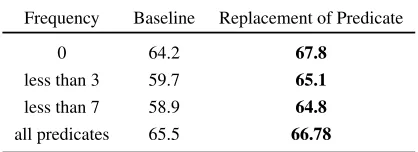
The effect of the transformation ofReplacement of Predicateon infrequent verbs is shown in Table 5. This transformation improves F1 as much as 6% on infrequent verbs.
The running time forADUT-Charniakon Brown set is8hours compared to SRL training time of20
Transformation P R F1
Baseline 69.6 61.8 65.5
Replacement of Unknown Words 70.6 62.1 66.1 Replacement of Predicate 71.2 62.8 66.8 Replacement of Quotes 71.0 63.4 67.0 Simplification 70.3 62.9 66.4 RuleTransformation 70.9 62.2 66.2 Sentence Split 70.8 62.1 66.2
[image:8.612.76.296.55.188.2]Together 72.75 66.1 69.3
Table 4: Ablation Study for ADUT-Charniak
Frequency Baseline Replacement of Predicate
0 64.2 67.8
less than 3 59.7 65.1
less than 7 58.9 64.8
all predicates 65.5 66.78
Table 5: Performance on Infrequent Verbs for the Trans-formation ofReplacement of Predicate
8 Related Work
Traditional adaptation techniques like (DauméIII, 2007; Chelba and Acero, 2004; Finkel and Man-ning, 2009; Jiang and Zhai, 2007; Blitzer et al., 2006; Huang and Yates, 2009; Ando and Zhang, 2005; Ming-wei Chang and Roth, 2010) need to re-train the model for every new domain. In (Umansky-Pesin et al., 2010), there was no retraining; instead, a POS tag was predicted for every unknown word in the new domain by considering contexts of that word collected by web search queries. We differ from them in that our transformations are label-preserving; moreover, our transformations aim at making the target text resemble the training text. We also present an algorithm to learn transformation rules from training data. Our application domain, SRL, is also more complex and structured than POS tagging.
In (McClosky et al., 2010), the task of multiple source parser adaptation was introduced. The au-thors trained parsing models on corpora from dif-ferent domains and given a new text, used a linear combination of trained models. Their approach re-quires annotated data from multiple domains as well as unlabeled data for the new domain, which is not
needed in our framework. In (Huang and Yates, 2010), the authors trained a HMM over the Brown test set and the WSJ unlabeled data. They derived features from Viterbi optimal states of single words and spans of words and retrained their models us-ing these features. In (Vickrey and Koller, 2008), a large number of hand-written rules were used to simplify the parse trees and reduce syntactic vari-ation to overcome feature sparsity. We have sev-eral types of transformations, and use less than 10 simplification heuristics, based on replacing larger phrases with smaller phrases and deleting unneces-sary parse tree nodes. There are also some methods for unsupervised semantic role labeling (Swier and Stevenson, 2004), (Abend et al., 2009) that easily adapt across domains but their performances are not comparable to supervised systems.
9 Conclusion
We presented a framework for adaptating natural languagetextso thatmodelscan be used across do-mains without modification. Our framework sup-ports adapting to new domains without any data or knowledge of the target domain. We showed that our approach significantly improves SRL performance over the state-of-the-art single parse based system on Brown set. In the future, we would like to extend this approach to other NLP problems and study how combining multiple systems can further improve its performance and robustness.
Acknowledgements This research is sponsored by the Army Research Laboratory (ARL) under agreement W911NF-09-2-0053 and by the Defense Advanced Research Projects Agency (DARPA) Ma-chine Reading Program under Air Force Research Laboratory (AFRL) prime contract no. FA8750-09-C-0181. Any opinions, findings, conclusions or rec-ommendations are those of the authors and do not necessarily reflect the view of the ARL, the DARPA, AFRL, or the US government.
References
Omri Abend, Roi Reichart, and Ari Rappoport. 2009. Unsupervised argument identification for semantic role labeling . InProceedings of the ACL.
[image:8.612.81.290.226.302.2]and unlabeled data . Journal of Machine Learning Re-search.
Christopher Bishop. 1995. Neural Networks for Pattern recognition, chapter 6.4: Modelling conditional distri-butions. Oxford University Press.
John Blitzer, Ryan McDonald, and Fernando Pereira. 2006. Domain adaptation with structural correspon-dence learning. InProceedings of the Conference on Empirical Methods in Natural Language Processing (EMNLP).
Peter F. Brown, Peter V. deSouza, Robert L. Mercer, Vin-cent J. D. Pietra, and Jenifer C. Lai. 1992. Class-based n-gram models of natural language. Computational Linguistics, 18(4):467–479.
Xavier Carreras and Lluís Màrquez. 2005. Introduction to the conll-2005 shared task: Semantic role labeling . InProceedings of CoNLL.
Eugene Charniak and Mark Johnson. 2005. Coarse-to-fine n-best parsing and maxent discriminative rerank-ing. InProceedings of ACL.
Ciprian Chelba and Alex Acero. 2004. Little data can help a lot. InProceedings of the Conference on Empirical Methods in Natural Language Processing (EMNLP).
Ronan Collobert and Jason Weston. 2008. A unified ar-chitecture for natural language processing: Deep neu-ral networks with multitask learning. InProceedings of ICML.
Hal DauméIII. 2007. Frustratingly easy domain adapta-tion. InProceedings of the the Annual Meeting of the Association of Computational Linguistics (ACL). Jenny R. Finkel and Christopher D. Manning. 2009.
Hi-erarchical bayesian domain adaptation . In Proceed-ings of NAACL.
Fei Huang and Alexander Yates. 2009. Distributional representations for handling sparsity in supervised sequence-labeling . InProceedings of ACL.
Fei Huang and Alexander Yates. 2010. Open-domain semantic role labeling by modeling word spans. In
Proceedings of ACL.
Jing Jiang and ChengXiang Zhai. 2007. Instance weight-ing for domain adaptation in nlp. InProceedings of ACL.
Dan Klein and Christopher D. Manning. 2003. Fast exact inference with a factored model for natural language parsing. InProceedings of NIPS.
Percy Liang. 2005. Semi-supervised learning for natural language. Masters thesis, Massachusetts Institute of Technology.
David McClosky, Eugene Charniak, and Mark Johnson. 2010. Automatic domain adaptation for parsing. In
Proceedings of NAACL.
Michael Connor Ming-wei Chang and Dan Roth. 2010. The necessity of combining adaptation methods. In
Proceedings of the Conference on Empirical Meth-ods in Natural Language Processing (EMNLP), Mas-sachusetts, USA.
Vasin Punyakanok, Dan Roth, and Wen tau Yih. 2008. The importance of syntactic parsing and inference in semantic role labeling. Computational Linguistics, 34(2).
Mihai Surdeanu, Lluís Màrquez, Xavier Carreras, and Pere R. Comas. 2007. Combination strategies for se-mantic role labeling. Journal of Artificial Intelligence Research, 29:105–151.
Robert S. Swier and Suzanne Stevenson. 2004. Unsuper-vised semantic role labelling. InProceedings of Em-pirical Methods in Natural Language Processing. Kristina Toutanova, Aria Haghighi, and Christopher D.
Manning. 2008. A global joint model for semantic role labeling. Computational Linguistics, 34:161–191. Shulamit Umansky-Pesin, Roi Reichart, and Ari Rap-poport. 2010. A multi-domain web-based algorithm for pos tagging of unknown words . InProceedings of Coling.