Cross-topic Argument Mining from Heterogeneous Sources
Christian Stab* and Tristan Miller*† and Benjamin Schiller* and Pranav Rai* and Iryna Gurevych*†
*Ubiquitous Knowledge Processing Lab (UKP-TUDA) Department of Computer Science, Technische Universität Darmstadt
https://www.ukp.tu-darmstadt.de/
†Research Training Group AIPHES
Department of Computer Science, Technische Universität Darmstadt
https://www.aiphes.tu-darmstadt.de/
Abstract
Argument mining is a core technology for au-tomating argument search in large document collections. Despite its usefulness for this task, most current approaches are designed for use only with specific text types and fall short when applied to heterogeneous texts. In this pa-per, we propose a new sentential annotation scheme that is reliably applicable by crowd workers to arbitrary Web texts. We source an-notations for over 25,000 instances covering eight controversial topics. We show that in-tegrating topic information into bidirectional long short-term memory networks outperforms vanilla BiLSTMs by more than 3 percentage points in F1in two- and three-label cross-topic settings. We also show that these results can be further improved by leveraging additional data for topic relevance using multi-task learning.
1 Introduction
Information retrieval and question answering are by now mature technologies that excel at answering factual queries on noncontroversial topics. How-ever, they provide no specialized support for queries where there is no single canonical answer, as with topics that are controversial or opinion-based. For such queries, the user may need to carefully assess the stance, source, and supportability for each of the answers. These processes can be supported by argument mining (AM), a nascent area of natural language processing concerned with the automatic recognition and interpretation of arguments.
In this paper, we apply AM to the task of argu-ment search—that is, searching a large document collection for arguments relevant to a given topic. Searching for and classifying relevant arguments plays an important role in decision making ( Sven-son,1979), legal reasoning (Wyner et al.,2010), and
the critical reading, writing, and summarization of persuasive texts (Kobayashi,2009;Wingate,2012). Automating the argument search process could ease much of the manual effort involved in these tasks, particularly if it can be made to robustly handle arguments from different text types and topics.
But despite its obvious usefulness, this sort of argument search has attracted little attention in the research community. This may be due in part to the limitations of the underlying models and training resources, particularly as they relate to heteroge-neous sources. That is, most current approaches to AM are designed for use with particular text types, faring poorly when applied to new data ( Dax-enberger et al.,2017). Indeed, asHabernal et al.
(2014) observe, while there is a great diversity of perspectives on how arguments can be best charac-terized and modelled, there is no “one-size-fits-all” argumentation theory that applies to the variety of text sources found on the Web.
To approach these challenges, we propose the novel task of topic-based sentential argument min-ing. Our contributions are as follows: (1) We propose a new argument annotation scheme ap-plicable to the information-seeking perspective of argument search. We show it to be general enough for use on heterogeneous data sources, and simple enough to be applied manually by untrained annota-tors at a reasonable cost. (2) We introduce a novel corpus of heterogeneous text types annotated with topic-based arguments.1 The corpus includes over 25,000 instances covering eight controversial topics. This is the first known resource that can be used to evaluate the performance of argument mining methods across topics in heterogeneous sources. (3) We investigate different approaches for incorpo-rating topic information into neural networks and
show that including the topic vector into theiii- and ccc-gates of the LSTM cell outperforms common attention-based approaches in two- and three-label cross-topic experiments. (4) We further improve the performance of the modified LSTM cell by leveraging additional data for topic relevance in a multi-task learning setup. (5) In the more challeng-ing setup of cross-topic experiments, we show that our models yield considerably better performance than common BiLSTM models when little data of the target topic is available.
2 Related work
Most existing approaches treat argument mining at the discourse level, focusing on tasks such as segmenting argumentative discourse units (Ajjour et al.,2017;Goudas et al.,2014), classifying the function of argumentative discourse units (for ex-ample, asclaimsorpremises) (Mochales-Palau and Moens,2009;Stab and Gurevych,2014), and rec-ognizing argumentative discourse relations (Eger et al.,2017;Stab and Gurevych,2017;Nguyen and Litman,2016). These discourse-level approaches address the identification of argumentative struc-tures within a single document but do not consider relevance to externally defined topics.
To date, there has been little research on the iden-tification of topic-relevant arguments for argument search. Wachsmuth et al.(2017) present a generic argument search framework. However, it relies on already-structured arguments from debate por-tals and is not yet able to retrieve arguments from arbitrary texts. Levy et al.(2014) investigate the identification of topic-relevant claims, an approach that was later extended with evidence extraction to mine supporting statements for claims (Rinott et al., 2015). However, both approaches are de-signed to mine arguments from Wikipedia articles; it is unclear whether their annotation scheme is applicable to other text types. It is also uncertain that it can be easily and accurately applied by un-trained annotators, since it requires unitizing (i.e., finding the boundaries of argument components at the token level). Hua and Wang (2017) identify sentences in cited documents that have been used by an editor to formulate an argument. By contrast, we do not limit our approach to the identification of sentences related to a givenargument, but rather focus on the retrieval of any argument relevant to a giventopic. The fact that we are concerned with retrieval of arguments also sets our work apart from
the discourse-agnostic stance detection task of Mo-hammad et al.(2016), which is concerned with the identification of sentences expressing support or opposition to a given topic, irrespective of whether those sentences contain supporting evidence (as opposed to mere statements of opinion).
Cross-domain AM experiments have so far been conducted only for discourse-level tasks such as claim identification (Daxenberger et al.,2017), argu-mentative segment identification (Al-Khatib et al.,
2016), and argumentative unit segmentation (Ajjour et al.,2017). However, the discourse-level argu-mentation models these studies employ seem to be highly dependent on the text types for which they were designed; they do not work well when applied to other text types (Daxenberger et al.,2017). The crucial difference between our own work and prior cross-domain experiments is that we investigate AM from heterogeneous texts across different top-icsinstead of studying specific discourse-level AM tasks across restricted text types of existing corpora.
3 Corpus creation
There exists a great diversity in models of argumen-tation, which differ in their perspective, complexity, terminology, and intended applications (Bentahar et al.,2010). For the present study, we propose a model which, though simplistic, is nonetheless well-suited to the argument search scenario. We define an argument as a span of text expressing evidence or reasoning that can be used to either support or oppose a given topic. An argument need not be “direct” or self-contained—it may pre-suppose some common or domain knowledge, or the application of commonsense reasoning—but it must be unambiguous in its orientation to the topic. Atopic, in turn, is some matter of controversy for which there is an obvious polarity to the possible outcomes—that is, a question of being eitherfor
oragainst the use or adoption of something, the commitment to some course of action, etc. In some graph-based models of argumentation (Stab,2017, Ch. 2), what we refer to as atopicwould be part of a(major) claimexpressing a positive or nega-tive stance, and ourargumentswould bepremises
topic sentence label nuclear energy Nuclear fission is the process that is used in nuclear reactors to produce high
amount of energy using element called uranium.
non-argument
nuclear energy It has been determined that the amount of greenhouse gases have decreased by almost half because of the prevalence in the utilization of nuclear power.
supporting argument
minimum wage A 2014 study [. . . ] found that minimum wage workers are more likely to report poor health, suffer from chronic diseases, and be unable to afford balanced meals.
opposing argument
minimum wage We should abolish all Federal wage standards and allow states and localities to set their own minimums.
non-argument
Table 1: Example annotations illustrating our annotation scheme.
advantage of this approach is that it allows annota-tors to classify text spans without having to read large amounts of context and without having to consider relations to other topics or arguments.
In this work, we consider only those topics that can be concisely and implicitly expressed through keywords, and those arguments that consist of indi-vidual sentences. Some examples, drawn from our dataset, are shown in Table1. Note that while the fourth example expresses opposition to the topic, under our definition it is properly classified as a non-argument because it is a mere statement of stance that provides no evidence or reasoning.
Data. For our experiments we gathered a large collection of manually annotated arguments that cover a variety of topics and that come from a variety of text types. We started by randomly se-lecting eight topics (see Table2) from online lists of controversial topics.2 For each topic, we made a Google query for the topic name, removed re-sults not archived by the Wayback Machine,3and truncated the list to the top 50 results. This re-sulted in a set of persistent, topic-relevant, largely polemical Web documents representing a range of genres and text types, including news reports, editorials, blogs, debate forums, and encyclopedia articles. We preprocessed each document with Apache Tika (Mattmann and Zitting,2011) to re-move boilerplate text. We then used the Stanford CoreNLP tools (Manning et al.,2014) to perform tokenization, sentence segmentation, and part-of-speech tagging on the remaining text, and removed all sentences without verbs or with less than three tokens. This left us with a raw dataset of 27,520 sentences (about 2,700 to 4,400 per topic).
Annotators classified the sentences using a browser-based interface that presents a set of
in-2https://www.questia.com/library/
controversial-topics,https://www.procon.org/ 3https://web.archive.org/
structions, a topic, a list of sentences, and a multiple-choice form for specifying whether each sentence is a supporting argument, an opposing argument, or not an argument with respect to the topic. (In pre-liminary experiments, we presented annotators with a fourth option for sentences that are ambiguous or incomprehensible. However, we found that these constituted less than 1% of the distribution and so mapped all such answers to the “no argument” class.)
Annotation experiments. We tested the applica-bility of our annotation scheme by untrained anno-tators by performing an experiment where we had a group of “expert” annotators and a group of un-trained annotators classify the same set of sentences, and then compared the two groups’ classifications. The data for this experiment consisted of 200 sen-tences randomly selected from each of our eight topics. Our expert annotators were two graduate-level language technology researchers who were fully briefed on the nature and purpose of the ar-gument model. Our untrained annotators were anonymous American workers from the Amazon Mechanical Turk (AMT) crowdsourcing platform. Each sentence was independently annotated by the two expert annotators and ten crowd workers.
topic docs sentences no argument support argument oppose argument
abortion 50 3,929 2,427 680 822
cloning 50 3,039 1,494 706 839
death penalty 50 3,651 2,083 457 1,111
gun control 50 3,341 1,889 787 665
marijuana legalization 50 2,475 1,262 587 626
minimum wage 50 2,473 1,346 576 551
nuclear energy 50 3,576 2,118 606 852
school uniforms 50 3,008 1,734 545 729
[image:4.595.114.484.64.180.2]total 400 25,492 14,353 4,944 6,195
Table 2: Corpus size and class distribution.
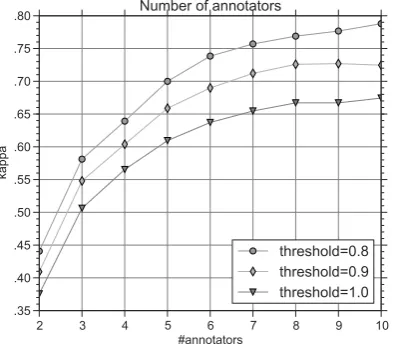
Figure 1: Influence of the number of crowd annotators and different MACE thresholds onκ.
determine the relationship between inter-annotator agreement and the number of crowd workers, we performed this procedure with successively lower numbers of crowd workers, going from the original ten annotators per instance down to two. The re-sults are visualized in Fig.1. We found that using seven annotators and a MACE threshold of 0.9 results inκ=0.723; this gives us similar reliability as with the expert annotators without sacrificing much coverage. Table3shows theκand percentage agreement for this setup, as well as the agreement between our expert annotators, broken down by topic.
We proceeded with annotating the remaining instances in our dataset using seven crowd work-ers each, paying a rate corresponding to the US federal minimum wage of $7.25/hour. Our total expenditure, including AMT processing fees, was $2,774.02. After MACE denoising, we were left with 25,492 gold-standard annotations. Table2 pro-vides statistics on the size and class distribution of the final corpus. We are releasing the gold-standard annotations for this dataset, and code for retrieving
expert–expert crowd–expert
% κ % κ
abortion .884 .651 .834 .660 cloning .845 .712 .821 .704 death penalty .851 .657 .770 .576 gun control .907 .783 .796 .638 marijuana legalizat. .850 .729 .854 .749 minimum wage .885 .779 .858 .745 nuclear energy .809 .686 .889 .825 school uniforms .864 .767 .931 .889 average .862 .721 .844 .723
Table 3: Agreement between experts, and between the expert and crowd gold standards.
the original sentences from the Wayback Machine, under a Creative Commons licence.
4 Approaches for identifying arguments
[image:4.595.83.281.220.392.2]4.1 Integrating topic information
Since arguments need to be relevant to the given topic, we posit that providing topic information to the learner results in a more robust prediction capability in cross-topic setups. Below, we present two models that integrate the topic, one that uses an attention mechanism and another that includes the topic vector directly in the LSTM cell.
Outer-attention BiLSTM (outer-att). To let the model learn which parts of the sentence are relevant (or irrelevant) to the given topic, we use an attention-based neural network (Bahdanau et al.,2014) that learns an importance weighting of the input words depending on the given topic. In particular, we adopt an outer-attention mechanism similar to the one proposed by Hermann et al. (2015), which has achieved state-of-the-art results in related tasks such as natural language inference and recognizing textual entailment (Rocktäschel et al.,2015;Wang and Jiang,2016). We combine the attention mech-anism with a common BiLSTM model and, at time stept, determine the importance weighting for each hidden statehhh(t)as
mmm(t)=tanh(WWWhhhh(t)+WWWpppp) (1)
fattention(hhh(t),ppp)= exp(www
T mmmm(t))
Í
texp(wwwTmmmm(t))
(2)
whereWWWh,WWWp, andwwwmare trainable parameters of
the attention mechanism andpppis the average of all word embeddings of topic wordsv1, . . . ,vnτ. Using the importance weighting, we determine the final, weighted hidden output statesssas
αt ∝ fattention(hhh(t),ppp) (3)
sss=
n
Õ
t=1 h h
h(t)αt. (4)
Finally, we feedsssinto a dense layer with a softmax activation function to get predictions for our two-or three-label setups.
Contextual BiLSTM (biclstm). A more direct approach to integrating an argument’s topic is the
contextual LSTM (CLSTM) architecture (Ghosh et al.,2016), where topic information is added as another term to all four gates of an LSTM cell. We, however, hypothesize that topic information is more relevant at theiii- andccc-gates, the former because it has the biggest impact on how a new token is processed and the latter because it is closely linked
i
c
t
ct-1 x
h p
t-1 t
xtp ht-1
h
ot xt ht-1
t t
ht-1
[image:5.595.321.526.377.483.2]xt ft
Figure 2: Architecture of a CLSTM cell.
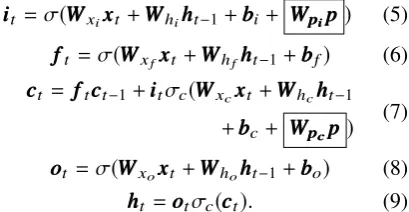
to how the sequence seen so far is to be interpreted and stored. To this end, we experimented with several modifications to the original CLSTM such as removing peepholes—i.e., removing gates’ access to the cell stateccc(Gers and Schmidhuber,2000)— and removing topic information from one or more gates. Empirical results on the validation set show that topic integration at theiii- andccc-gates only, and removal of all peephole connections, does indeed outperform the original CLSTM on our task by 1 percentage point. Our modified CLSTM (Fig.2) is defined as
iiit =σ(WWWxixxxt+WWWhihhht−1+bbbi+ WWWpppiiippp) (5)
ffft =σ(WWWxfxxxt+WWWhfhhht−1+bbbf) (6)
ccct = ffftccct−1+iiitσc(WWWxcxxxt+WWWhchhht−1 +bbbc+ WWWpppcccppp)
(7)
ooot =σ(WWWxoxxxt+WWWhohhht−1+bbbo) (8)
h
hht =oootσc(ccct). (9)
Hereiii, fff, and ooorepresent the input, forget, and output gates;cccthe cell memory;xxxt the embedded
token of a sentence at timestept;hhht−1 the previ-ous hidden state; and bbbthe bias. σ and σc are
the activation and recurrent activation functions, respectively. The novel terms for topic integration are outlined. We use this model bidirectionally, as we did with our BiLSTM network, and hence refer to it asbiclstm.
4.2 Leveraging additional data
x
auxx
mainy
auxdense & softmax private
RNN sharedRNN privateRNN
p
auxp
mainy
main [image:6.595.103.259.61.180.2]dense & softmax
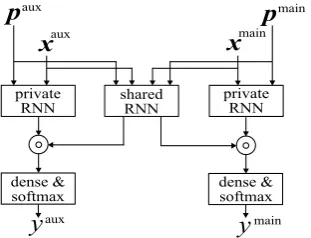
Figure 3: Multi-task learning architecture. The} sym-bol denotes the concatenation operator.
from which we expect to learn (a) topic-relevance and (b) the capability to distinguish between sup-porting and attacking arguments. The first corpus, DIP2016 (Habernal et al., 2016), consists of 49 queries from the educational domain and 100 doc-uments for each query. Each document has its sentences annotated for relevance (true/false) to the query.4 The second corpus, from SemEval-2016 Task 6 (Mohammad et al.,2016), consists of around 5000 multi-sentence tweets, a corresponding topic (e.g., “atheism”), and the author’s stance on the topic (for/against/neither).
For ourmtlandtrlapproaches, we consider every possible pairing of a model (biclstm,outer-att, and thebilstmbaseline we introduce in §5) with an aux-iliary corpus (DIP2016, SemEval). We formalize our datasets asSk = {(xxxki,pppik,yik)|i = 0, . . . ,|Sk|},
wherek can be either our main dataset or an aux-iliary dataset, xxxki denotes a single sentence as a sequence of word embeddings and yik its corre-sponding label in k, andpppki represents the corre-sponding averaged topic vector.
Transfer learning (trl). For trl, we use the ap-proach ofparameter transfer(Pan and Yang,2010)— i.e., we do not modify the model used. Instead, we train the model twice: the first time, we train the model on the chosen auxiliary corpus, and the second time, we keep the trained model’s weights and train it with our own corpus. For the three-label setting, we have to modify the transfer model slightly for the DIP2016 corpus, since it provides only two labels for each training sample. In this case, we simply add a layer with two neurons on top of the layer with three neurons for training with the DIP2016 corpus and remove it afterwards for training with our corpus.
4We only use 300K of the corpus’s 600K samples to ease hyperparameter tuning for our computation-heavy models.
Multi-task learning (mtl). For mtl, we use a shared–private model (Liu et al., 2017), which showed promising results for text classification and word segmentation (Chen et al.,2017). (We also experimented with their adversarial approach to learn topic-invariant features, but abandoned this due to low scores.) Themtlbase model consists of a private recurrent neural network (RNN) for both the auxiliary dataset and our dataset, plus a shared RNN that both datasets use (Fig.3). The last hidden states of the RNNs are concatenated and fed through a dense layer and a softmax activation function. The model is trained in an alternating fashion—i.e., after each epoch the loss for the other dataset is minimized until each dataset has run for the set number of epochs, where the last epoch is always executed on our dataset. At prediction time, only the private RNN trained on our dataset and the shared RNN are used. The core idea is that the shared RNN learns what is relevant for both tasks, while the private ones learn only the task-specific knowledge.
For the cases of mtl+bilstm+corpus,mtl+biclstm+
corpus, andmtl+outer-att+corpus, we simply switch the RNN with our bilstm, biclstm, and outer-att, respectively. Formtl+outer-att+corpus, we add the outer attention mechanism (see §4.1), modified for use with themtlmodel, after each of the private RNNs, while additionally feeding it a second topic vector—the last hidden state of the shared RNN:
m
mm(t)=tanh(WWWrhhhr(t)+WWWshhhs+WWWpppp) (10)
fattention(hhhr(t),hhhs,ppp)=
exp(wwwTmmmm(t))
Í
texp(wwwTmmmm(t))
(11)
αt ∝ fattention(hhhr(t),hhhs,ppp) (12)
sss=
n
Õ
t=1
hhhr(t)αt (13)
whereWWWr,WWWs, andWWWpare trainable weight
matri-ces,hhhr(t)is the hidden state of the privatebilstmat
timestept,hhhsis the last hidden state of the shared
model, andpppis the average of all word embeddings of topic wordsv1, . . . ,vnτ.
5 Evaluation
two labels three labels
model F1 Parg Rarg F1 Parg+ Parg− Rarg+ Rarg−
[image:7.595.78.511.63.269.2]bilstm(baseline) .6069±.0074 .7339±.0110 .3844±.0122 .3796±.0079 .3484±.0479 .4710±.0210 .0963±.0148 .2181±.0181 lr-uni(baseline) .5854±.0131 .6519±.0093 .3587±.0264 .3821±.0056 .2782±.0293 .4217±.0171 .1176±.0165 .2119±.0203 outer-att .6213±.0106 .7309±.0108 .4138±.0237 .3873±.0081 .3651±.0244 .4696±.0169 .1042±.0173 .2381±.0117 biclstm .6414±.0129 .6244±.0132 .7035±.0261 .4242±.0122 .2675±.0148 .3887±.0141 .2817±.0369 .4028±.0496 tr+bilstm+semeval .6297±.0073 .7500±.0047 .4233±.0125 .3698±.0142 .3128±.0422 .4075±.0640 .0897±.0256 .2089±.0133 tr+outer-att+semeval .6293±.0057 .7297±.0122 .4336±.0156 .3871±.0089 .3160±.0397 .4469±.0369 .1245±.0160 .2264±.0147 tr+biclstm+semeval .6433±.0182 .6625±.0128 .6181±.0259 .3953±.0122 .2606±.0356 .4226±.0203 .1743±.0385 .3643±.0574 tr+bilstm+dip2016 .6254±.0133 .7073±.0114 .4200±.0253 .3628±.0136 .2396±.0605 .4470±.0319 .0517±.0284 .2298±.0245 tr+outer-att+dip2016 .6074±.0115 .7112±.0245 .4031±.0238 .3438±.0233 .2060±.1012 .4171±.0521 .1105±.0821 .2096±.0793 tr+biclstm+dip2016 .6110±.0206 .6954±.0491 .4904±.0502 .3595±.0226 .2272±.0516 .3474±.0539 .1191±.0856 .2886±.0714 mtl+bilstm+semeval .6126±.0093 .7270±.0087 .3906±.0177 .3765±.0081 .3248±.0304 .4812±.0340 .0888±.0137 .2153±.0162 mtl+outer-att+semeval .6221±.0100 .7186±.0123 .4219±.0187 .3764±.0071 .3185±.0393 .4763±.0213 .0878±.0173 .2149±.0295 mtl+biclstm+semeval .6519±.0079 .6495±.0143 .6690±.0333 .4147±.0105 .2769±.0332 .3819±.0141 .2465±.0497 .4069±.0501 mtl+bilstm+dip2016 .6145±.0097 .7312±.0100 .3979±.0208 .3757±.0057 .3255±.0382 .4647±.0255 .0841±.0144 .2261±.0192 mtl+outer-att+dip2016 .6263±.0079 .7176±.0100 .4327±.0178 .3842±.0070 .3427±.0365 .4502±.0240 .1007±.0147 .2327±.0146 mtl+biclstm+dip2016 .6662±.0148 .6463±.0105 .6719±.0489 .4285±.0139 .2947±.0383 .3815±.0221 .2722±.0582 .3483±.0528
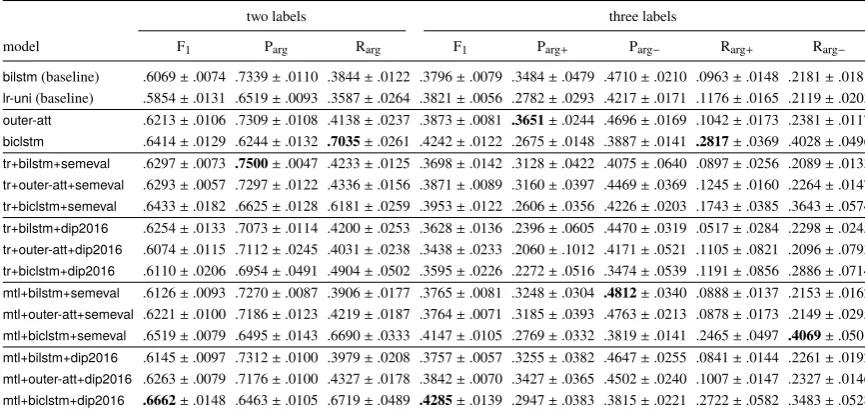
Table 4: Results for each model on the test sets. Bold numbers indicate the highest score in the column.
data (10%) of seven topics for training and parame-ter tuning, and use the test data (20%) of the eighth topic for testing. For encoding the words of sen-tenceςςς and topicτττ, we use 300-dimensional word embeddings trained on the Google News dataset by
Mikolov et al.(2013). To handle out-of-vocabulary words, we create separate random word vectors for each.5
Since reporting single performance scores is insufficient to compare non-deterministic learn-ing approaches like neural networks (Reimers and Gurevych,2017), we report all results as averages over ten runs with different random seeds. As eval-uation measures, we report the average macro F1, as well as the precision and the recall for the argument class (Parg, Rarg). For the three-label approach, we split the precision and recall for predicting support-ing (Parg+, Rarg+) and attacking arguments (Parg−, Rarg−). As baselines, we use a simple bidirectional LSTM (Hochreiter and Schmidhuber, 1997), as well as a logistic regression model with lowercased unigram features, which has been shown to be a strong baseline for various other AM tasks ( Dax-enberger et al.,2017;Stab and Gurevych,2017). We refer to these models as bilstmand lr-uni, re-spectively. All neural networks are trained using the Adam optimizer (Kingma and Ba,2015) and cross-entropy loss function. For finding the best model, we run each for ten epochs and take the best model based on the lowest validation loss. In addition to that, we tune the hyperparameters of all
5Each dimension is set to a random number between −0.01 and 0.01. Digits are mapped to the same random word vector.
neural networks (see Appendix A). To accelerate training, we truncate sentences at 60 words.6
5.1 Results
Two-label setup. The results in Table 4 show that all our models outperform the baselines for two-label prediction.7 F1 for biclstm improves by 3.5 percentage points over thebilstm baseline and by 5.6 over lr-uni. A main reason for this proves to be the substantial increase in recall for our topic-integrating models—outer-attand especially biclstm—in comparison to our baselines. These results show that knowledge of the argument’s topic has a strong impact on argument prediction capa-bility. Further, we observe that integratingbiclstm in a multi-task learning setup in order to draw knowledge about topic relevance from the DIP2016 corpus (mtl+biclstm+dip2016) improves F1by an additional 2.5 percentage points. It achieves an F1 of 0.6662, which is 19.48 percentage points less than the human upper bound of 0.861. When using the SemEval corpus, which holds less task-relevant knowledge for our two-label approach, we are able to gain only 1 percentage point when integrating it intomtl+biclstm+corpus.
For the transfer learning models that integrate the topic (tr+biclstm+corpusandtr+outer-att+corpus), the parameter transfer is mostly ineffective. If no topic is provided (tr+bilstm+corpus), the transfer learning models are able to improve over the base-linebilstm. This shows that the parameter transfer
6Only 244 of our sentences (<1%) exceed this length.
itself can be of use, but confuses the model when combined with topic integration.
In general, we observe an overall lower score for trlmodels that use the DIP2016 corpus compared to those using the SemEval corpus. In contrast to themtlmodel, fortrlmodelsallparameters are transferred to the main task, not just parameters that represent shared knowledge. Thus, we suspect the lower scores of thetrlmodels with DIP2016 are due to overfitting on the vast number of samples which shape the parameters much more than the comparatively small SemEval corpus could.
Three-label setup. For the three-label approach, we observe overall lower scores due to the addi-tional difficulty in distinguishing supporting from opposing arguments. As already observed in the two-label setup,biclstmoutperforms both thebilstm andlr-unibaselines; here, the former by 4.5 and the latter by 4.2 percentage points in F1. Again, this is caused by a substantial increase in recall and shows the impact that the available topic information has on the classifier’s predictive power.
For transfer learning, we see similar results as for the two-label approach; both the DIP2016 and SemEval corpora have a generally negative impact when compared to the respective base models. The SemEval corpus does not provide the knowledge required to distinguish supporting from attacking arguments. We conclude that the original purpose of the SemEval task, stance recognition, is too different from our own. But in multi-task learning, where only the shared parameters are taken, we observe slight improvements when usingbiclstm with DIP2016; this correlates with the same model in the two-label setup.
5.2 Error analysis
To understand the errors of our best model, mtl-biclstm-dip, and the nature of this task, we manually analyzed 100 sentences randomly sampled from the false positive and false negative arguments of the three-label experiments (combining supporting and attacking arguments). Among the false positives, we found 48 off-topic sentences that were wrongly classified as arguments. The 52 on-topic false positives consist of non-argumentative background information or mere opinions without evidence (as with the first and fourth examples of Table 1) and questions about the topic. Among the false negatives, we found 65 arguments that did not explicitly refer to the topic but to related aspects that
depend on background knowledge. For instance, the model fails to establish an argumentative link between the topic “gun control” and the Second Amendment to the US Constitution. Lastly, we inspected arguments that are incorrectly classified as supporting and/or opposing a topic. We found several samples in which the term “against” is not correctly interpreted and the argument is classified as supporting a topic. Similarly, for arguments incorrectly classified as attacking, we find various samples where the word “oppose” is used not to oppose the topic but to strengthen a supporting argument, as in “There is reason even for people who oppose the use of marijuana to support its legalization. . . ”
5.3 Adapting to new topics
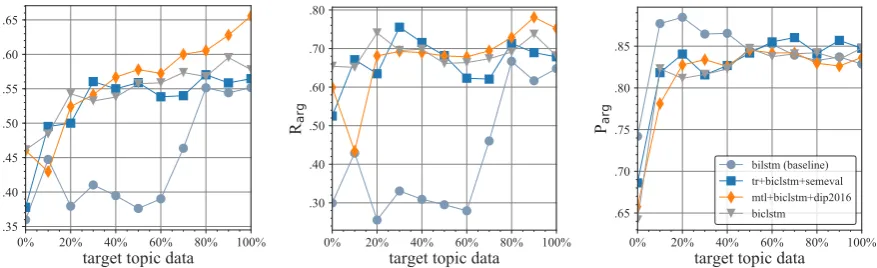
To evaluate the performance of the models in data-scarce scenarios, we gradually add target topic data to the training data and analyze the model performance on the target test set. Figure4shows model performance (F1, Parg, and Rarg) on the “marijuana legalization” topic when adding different amounts of randomly sampled topic-specific data to the training data (x-axes).8 As the results show, the models that integrate the topic achieve higher recall when adding target topic data to the training data. Forbilstm, we observe a drastic difference when compared to the other models; the recall for arguments stays at around 30% and rises only when integrating more than 60% target topic data. In strong contrast, topic-integrating models retrieve a much higher number of actual arguments at target topic augmentation levels as low as 20%. Further, and equally important, this does not come at the cost of precision; on the contrary, the precision is mostly steady and slowly rising after around 20% of target topic integration, leading to an overall higher F1for these models. Finally, in comparing F1between topic-integrating models andbilstm, we conclude that the former need much less target topic data to substantially improve their score, making them more robust in situations of data scarcity.
6 Conclusion
We have presented a new approach for searching a document collection for arguments relevant to a given topic. First, we introduced an annotation scheme suited to the information-seeking
0% 20% 40% 60% 80% 100%
target topic data
.35 .40 .45 .50 .55 .60 .65
F1
0% 20% 40% 60% 80% 100%
target topic data
.30 .40 .50 .60 .70 .80
Rar
g
0% 20% 40% 60% 80% 100%
target topic data
.65 .70 .75 .80 .85
Par
g
[image:9.595.82.521.68.202.2]bilstm (baseline) tr+biclstm+semeval mtl+biclstm+dip2016 biclstm
Figure 4: Model performance (y-axes) according to the amount of target topic data in the train sets (x-axes) for the “marijuana legalization” topic in the three-label setup.
tive of argument search and showed that it is cheaply but reliably applicable by untrained annotators to arbitrary Web texts. Second, we presented a new corpus, including over 25,000 instances over eight topics, that allows for cross-topic experiments us-ing heterogeneous text types. Third, we conducted cross-topic experiments and showed that integrating topic information of arguments with our contextual BiLSTM leads to better generalization to unknown topics. Fourth, by leveraging knowledge from simi-lar datasets and integrating our contextual BiLSTM into a multi-task learning setup, we were able to gain an improvement over our strongest baseline of 5.9 percentage points in F1in the two-label setup and 4.6 in the three-label setup. Finally, by gradu-ally adding target topic data to our training set, we showed that, when available, even small amounts of target topic data (20%) have a strong positive influence on the recall of arguments.
In a separate, simultaneously written paper (Stab et al.,2018) we evaluate our models in real-world application scenarios by applying them to a large document collection and comparing the results to a manually produced gold standard. An on-line argument search engine implementing our ap-proach is now available for noncommercial use
at https://www.argumentsearch.com/.
Fur-thermore, we are experimenting with language adaptation and plan to extend the tool to the Ger-man language. Preliminary results are presented inStahlhut(2018). We also intend to investigate methods for grouping similar arguments.
Acknowledgements
This work has been supported by the German Fed-eral Ministry of Education and Research (BMBF) under the promotional reference 03VP02540
(Ar-gumenText) and the DFG-funded research training group “Adaptive Preparation of Information form Heterogeneous Sources” (AIPHES, GRK 1994/1).
References
Yamen Ajjour, Wei-Fan Chen, Johannes Kiesel, Hen-ning Wachsmuth, and Benno Stein. 2017. Unit seg-mentation of argumentative texts. InProceedings of the 4th Workshop on Argument Mining, pages 118– 128. Association for Computational Linguistics.
Khalid Al-Khatib, Henning Wachsmuth, Matthias Ha-gen, Jonas Köhler, and Benno Stein. 2016. Cross-domain mining of argumentative text through distant supervision. InProceedings of the 2016 Conference of the North American Chapter of the Association for Computational Linguistics: Human Language Tech-nologies, pages 1395–1404. Association for Compu-tational Linguistics.
Dzmitry Bahdanau, Kyunghyun Cho, and Yoshua Bengio. 2014. Neural machine translation by jointly learning to align and translate. CoRR, abs/1409.0473.
Jamal Bentahar, Bernard Moulin, and Micheline Bélanger. 2010. A taxonomy of argumentation mod-els used for knowledge representation. Artificial In-telligence Review, 33(3):211–259.
Jean Carletta. 1996. Assessing agreement on classi-fication tasks: The kappa statistic. Computational Linguistics, 22(2):249–254.
Xinchi Chen, Zhan Shi, Xipeng Qiu, and Xuanjing Huang. 2017. Adversarial multi-criteria learning for chinese word segmentation. In Proceedings of the 55th Annual Meeting of the Association for Com-putational Linguistics, volume 1, pages 1193–1203. Association for Computational Linguistics.
on Empirical Methods in Natural Language Pro-cessing, pages 2045–2056. Association for Compu-tational Linguistics.
Steffen Eger, Johannes Daxenberger, and Iryna Gurevych. 2017. Neural end-to-end learning for computational argumentation mining. In Proceed-ings of the 55th Annual Meeting of the Association for Computational Linguistics (Volume 1: Long Pa-pers), pages 11–22. Association for Computational Linguistics.
Felix A. Gers and Jürgen Schmidhuber. 2000. Recur-rent nets that time and count. In Proceedings of the IEEE–INNS–ENNS International Joint Confer-ence on Neural Networks, volume 3, pages 189–194. IEEE.
Shalini Ghosh, Oriol Vinyals, Brian Strope, Scott Roy, Tom Dean, and Larry P. Heck. 2016. Contextual LSTM (CLSTM) models for large scale NLP tasks.
CoRR, abs/1602.06291.
Theodosis Goudas, Christos Louizos, Georgios Petasis, and Vangelis Karkaletsis. 2014. Argument extrac-tion from news, blogs, and social media. In Artifi-cial Intelligence: Methods and Applications, volume 8445 of Lecture Notes in Computer Science, pages 287–299. Springer International Publishing.
Ivan Habernal, Judith Eckle-Kohler, and Iryna Gurevych. 2014. Argumentation mining on the Web from information seeking perspective. In Proceed-ings of the Workshop on Frontiers and Connections between Argumentation Theory and Natural Lan-guage Processing, volume 1341 ofCEUR Workshop Proceedings, pages 26–39. CEUR-WS.org.
Ivan Habernal, Maria Sukhareva, Fiana Raiber, Anna Shtok, Oren Kurland, Hadar Ronen, Judit Bar-Ilan, and Iryna Gurevych. 2016. New Collection An-nouncement: Focused Retrieval Over the Web. In
Proceedings of the 39th International ACM SIGIR Conference on Research and Development in Infor-mation Retrieval, pages 701–704. ACM.
Karl Moritz Hermann, Tomas Kocisky, Edward Grefen-stette, Lasse Espeholt, Will Kay, Mustafa Suleyman, and Phil Blunsom. 2015. Teaching machines to read and comprehend. InAdvances in Neural Information Processing Systems, pages 1693–1701.
Sepp Hochreiter and Jürgen Schmidhuber. 1997. Long short-term memory. Neural Computation, 9(8):1735–1780.
Dirk Hovy, Taylor Berg-Kirkpatrick, Ashish Vaswani, and Eduard Hovy. 2013. Learning whom to trust with MACE. InProceedings of the 2013 Conference of the North American Chapter of the Association for Computational Linguistics: Human Language Tech-nologies, pages 1120–1130. Association for Compu-tational Linguistics.
Xinyu Hua and Lu Wang. 2017. Understanding and de-tecting diverse supporting arguments of diverse types. InProceedings of the 55th Annual Meeting of the As-sociation for Computational Linguistics, volume 2, pages 203–208. Association for Computational Lin-guistics.
Diederik P. Kingma and Jimmy Ba. 2015. Adam: A method for stochastic optimization. InProceedings of the 3rd International Conference on Learning Rep-resentations.
Keiichi Kobayashi. 2009. Comprehension of relations among controversial texts: Effects of external strat-egy use. Instructional Science, 37(4):311–324.
Ran Levy, Yonatan Bilu, Daniel Hershcovich, Ehud Aharoni, and Noam Slonim. 2014. Context depen-dent claim detection. In Proceedings of COLING 2014, the 25th International Conference on Compu-tational Linguistics: Technical Papers, pages 1489– 1500. Dublin City University and Association for Computational Linguistics.
Pengfei Liu, Xipeng Qiu, and Xuanjing Huang. 2017. Adversarial multi-task learning for text classification. In Proceedings of the 55th Annual Meeting of the Association for Computational Linguistics, volume 1, pages 1–10.
Christopher D. Manning, Mihai Surdeanu, John Bauer, Jenny Finkel, Steven J. Bethard, and David Mc-Closky. 2014. The Stanford CoreNLP natural lan-guage processing toolkit. InProceedings of 52nd An-nual Meeting of the Association for Computational Linguistics: System Demonstrations, pages 55–60. Association for Computational Linguistics.
Chris A. Mattmann and Jukka Zitting. 2011.Tika in Ac-tion. Manning Publications, Greenwich, CT, USA.
Tomas Mikolov, Ilya Sutskever, Kai Chen, Greg S. Cor-rado, and Jeff Dean. 2013. Distributed representa-tions of words and phrases and their compositionality. In Advances in Neural Information Processing Sys-tems 26, pages 3111–3119. Curran Associates, Inc.
Raquel Mochales-Palau and Marie-Francine Moens. 2009. Argumentation mining: The detection, classi-fication and structure of arguments in text. In Pro-ceedings of the 12th International Conference on Ar-tificial Intelligence and Law, pages 98–107. ACM.
Saif Mohammad, Svetlana Kiritchenko, Parinaz Sob-hani, Xiaodan Zhu, and Colin Cherry. 2016. SemEval-2016 Task 6: Detecting stance in tweets. In Proceedings of the 10th International Workshop on Semantic Evaluation, pages 31–41. Association for Computational Linguistics.
Sinno Jialin Pan and Qiang Yang. 2010. A survey on transfer learning. IEEE Transactions on Knowledge and Data Engineering, 22(10):1345–1359.
Nils Reimers and Iryna Gurevych. 2017. Reporting score distributions makes a difference: Performance study of LSTM-networks for sequence tagging. In
Proceedings of the 2017 Conference on Empirical Methods in Natural Language Processing, pages 338–348. Association for Computational Linguis-tics.
Ruty Rinott, Lena Dankin, Carlos Alzate Perez, Mitesh M. Khapra, Ehud Aharoni, and Noam Slonim. 2015. Show me your evidence – An automatic method for context dependent evidence detection. In Proceedings of the 2015 Conference on Empiri-cal Methods in Natural Language Processing, pages 440–450. Association for Computational Linguistics.
Tim Rocktäschel, Edward Grefenstette, Karl Moritz Hermann, Tomáš Kočisk`y, and Phil Blunsom. 2015. Reasoning about entailment with neural attention.
arXiv preprint arXiv:1509.06664.
Nitish Srivastava, Geoffrey Hinton, Alex Krizhevsky, Ilya Sutskever, and Ruslan Salakhutdinov. 2014. Dropout: A simple way to prevent neural networks from overfitting. Journal of Machine Learning Re-search, 15(1):1929–1958.
Christian Stab. 2017. Argumentative Writing Support by Means of Natural Language Processing. Dr.-Ing. thesis, Technische Universität Darmstadt.
Christian Stab, Johannes Daxenberger, Chris Stahlhut, Tristan Miller, Benjamin Schiller, Christopher Tauch-mann, Steffen Eger, and Iryna Gurevych. 2018. Ar-gumenText: Searching for arguments in heteroge-neous sources. InProceedings of the 16th Annual Conference of the North American Chapter of the Association for Computational Linguistics: Human Language Technologies: Demonstrations (NAACL-HLT 2018), pages 21–25.
Christian Stab and Iryna Gurevych. 2014. Identifying argumentative discourse structures in persuasive es-says. In Proceedings of the 2014 Conference on Empirical Methods in Natural Language Processing, pages 46–56. Association for Computational Linguis-tics.
Christian Stab and Iryna Gurevych. 2017. Parsing argu-mentation structures in persuasive essays. Computa-tional Linguistics, 43(3):619–659.
Chris Stahlhut. 2018. Searching arguments in German with ArgumenText. InProceedings of the First Bien-nial Conference on Design of Experimental Search & Information Retrieval Systems, volume 2167 of
CEUR Workshop Proceedings, page 104.
Ola Svenson. 1979. Process descriptions of decision making. Organizational Behavior and Human Per-formance, 23(1):86–112.
Henning Wachsmuth, Martin Potthast, Khalid Al Khatib, Yamen Ajjour, Jana Puschmann, Jiani Qu, Jonas Dorsch, Viorel Morari, Janek Bevendorff, and Benno Stein. 2017. Building an argument search engine for the web. InProceedings of the 4th Work-shop on Argument Mining, pages 49–59. Association for Computational Linguistics.
Shuohang Wang and Jing Jiang. 2016. Learning natural language inference with LSTM. InProceedings of the 2016 Conference of the North American Chap-ter of the Association for Computational Linguistics: Human Language Technologies, pages 1442–1451. Association for Computational Linguistics.
Ursula Wingate. 2012. ‘Argument!’ Helping students understand what essay writing is about. Journal of English for Academic Purposes, 11(2):145–154.