Proceedings of the 2019 Conference on Empirical Methods in Natural Language Processing and the 9th International Joint Conference on Natural Language Processing, pages 6210–6215,
6210
Improving Fine-grained Entity Typing with Entity Linking
Hongliang Dai1, Donghong Du1,3, Xin Li2, and Yangqiu Song1
1Department of CSE, HKUST
2Tencent Technology (SZ) Co., Ltd.
1{hdai,yqsong}@cse.ust.hk
2
3
Abstract
Fine-grained entity typing is a challenging problem since it usually involves a relatively large tag set and may require to understand the context of the entity mention. In this pa-per, we use entity linking to help with the fine-grained entity type classification process. We propose a deep neural model that makes pre-dictions based on both the context and the in-formation obtained from entity linking results. Experimental results on two commonly used datasets demonstrates the effectiveness of our approach. On both datasets, it achieves more than 5% absolute strict accuracy improvement over the state of the art.
1 Introduction
Given a piece of text and the span of an entity men-tion in this text, fine-grained entity typing (FET) is the task of assigning fine-grained type labels to the mention (Ling and Weld, 2012). The as-signed labels should be context dependent (Gillick et al.,2014). For example, in the sentence “Trump threatens to pull US out of World Trade Organi-zation,” the mention “Trump” should be labeled as /person and /person/politician, although Donald Trump also had other occupations such as busi-nessman, TV personality, etc.
This task is challenging because it usually uses a relatively large tag set, and some mentions may require the understanding of the context to be cor-rectly labeled. Moreover, since manual annotation is very labor-intensive, existing approaches have to rely on distant supervision to train models (Ling and Weld,2012;Ghaddar and Langlais,2018).
Thus, the use of extra information to help with the classification process becomes very important. In this paper, we improve FET with entity linking (EL). EL is helpful for a model to make typing de-cisions because if a mention is correctly linked to
its target entity, we can directly obtain the type in-formation about this entity in the knowledge base (KB). For example, in the sentence “There were some great discussions on a variety of issues fac-ing Federal Way,” the mention “Federal Way” may be incorrectly labeled as a company by some FET models. Such a mistake can be avoided after link-ing it to the city Federal Way, Washlink-ington. For cases that require the understanding of the context, using entity linking results is also beneficial. In the aforementioned example where “Trump” is the mention, obtaining all the types of Donald Trump in the knowledge base (e.g., politician, business-man, TV personality, etc.) is still informative for inferring the correct type (i.e., politician) that fits the context, since they narrows the possible labels down.
However, the information obtained through EL should not be fully trusted since it is not always accurate. Even when a mention is correctly linked to an entity, the type information of this entity in the KB may be incomplete or outdated. Thus, in this paper, we propose a deep neural fine-grained entity typing model that flexibly predicts labels based on the context, the mention string, and the type information from KB obtained with EL.
We conduct experiments on two commonly used FET datasets. Experimental results show that introducing information obtained through entity linking and having a deep neural model both helps to improve FET performance. Our model achieves more than 5% absolute strict accuracy improve-ment over the state of the art on both datasets.
Our contributions are summarized as follows:
• We propose a deep neural fine-grained entity typing model that utilizes type information from KB obtained through entity linking.
• We address the problem that our model may overfit the weakly labeled data by using a variant of the hinge-loss and introducing noise during training.
• We demonstrate the effectiveness of our ap-proach with experimental results on com-monly used FET datasets.
Our code is available at https://github. com/HKUST-KnowComp/IFETEL.
2 Related Work
An early effort of classifying named entities into fine-grained types can be found in (Fleischman and Hovy, 2002), which only focuses on per-son names. Latter, datasets with larger type sets are constructed (Weischedel and Brunstein,2005; Ling and Weld, 2012; Choi et al., 2018). These datasets are more preferred by recent studies (Ren et al.,2016a;Murty et al.,2018).
Most of the existing approaches proposed for FET are learning based. The features used by these approaches can either be hand-crafted (Ling and Weld, 2012; Gillick et al., 2014) or learned from neural network models (Shimaoka et al., 2017; Xu and Barbosa, 2018; Xin et al., 2018). Since FET systems usually use distant supervi-sion for training, the labels of the training samples can be noisy, erroneous or overly specific. Several studies (Ren et al.,2016b;Xin et al.,2018;Xu and Barbosa, 2018) address these problems by sepa-rating clean mentions and noisy mentions, mod-eling type correction (Ren et al., 2016a), using a hierarchy-aware loss (Xu and Barbosa,2018), etc. (Huang et al., 2016) and (Zhou et al., 2018) are two studies that are most related to this paper. Huang et al.(2016) propose an unsupervised FET system where EL is an importat component. But they use EL to help with clustering and type name
selection, which is very different from how we use it to improve the performance of a supervised FET model. (Zhou et al., 2018) finds related entities based on the context instead of directly applying EL. The types of these entities are then used for inferring the type of the mention.
3 Method
LetT be a predefined tag set, which includes all the types we want to assign to mentions. Given a mentionm and its context, the task is to predict a set of types τ ⊂ T suitable for this mention. Thus, this is a multi-class, multi-label classifica-tion problem (Ling and Weld, 2012). Next, we will introduce our approach for this problem in de-tail, including the neural model, the training of the model, and the entity linking algorithm we use.
3.1 Fine-grained Entity Typing Model
Input Each input sample to our FET system contains one mention and the sentence it belongs to. We denotew1, w2, ..., wn as the words in the current sentence, wp1, wp2, ..., wpl as the words
in the mention string, where n is the number of words in the sentence,p1, ..., plare the indices of the words in the mention string,lis the number of words in the mention string. We also use a set of pretrained word embeddings.
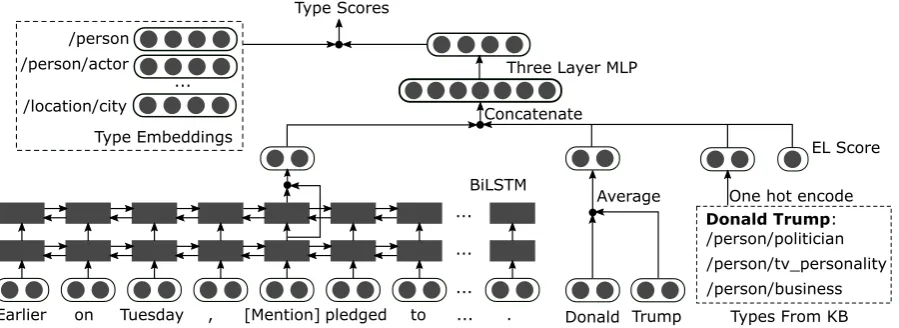
Our FET approach is illustrated in Figure 1. It first constructs three representations: context representation,mention string representation, and
KB type representation. Note that the KB type representation is obtained from a knowledge base through entity linking and is independent of the context of the mention.
Context Representation To obtain the context representation, we first use a special tokenwm to represent the mention (the token “[Mention]” in Figure 1). Then, the word sequence of the sen-tence becomes w1, ..., wpl−1, wm, wpl+1, ..., wn.
Their corresponding word embeddings are fed into two layers of BiLSTMs. Leth1m andh2m be the output of the first and the second layer of BiL-STMs forwm, respectively. We usefc = h1m + h2mas the context representation vector.
Mention String Representation Let x1, ...,xl be the word embeddings of the mention string wordswp1, ..., wpl. Then the mention string
Earlier on
/person/politician
Tuesday , [Mention] pledged to .
...
... Donald Trump
... ...
/person/tv_personality /person/business
Types From KB
Donald Trump: One hot encode Type Scores
Three Layer MLP
Concatenate Type Embeddings
/person /person/actor
/location/city ...
BiLSTM
Average
[image:3.595.77.527.62.226.2]EL Score
Figure 1: Our approach. The example sentence is “Earlier on Tuesday,Donald Trumppledged to help hard-hit U.S. farmers caught in the middle of the escalating trade war.” Here, the correct label for the mentionDonald Trumpshould be /person, /person/politician. “[Mention]” is a special token that we use to represent the mention.
KB Type Representation To obtain the KB type representation, we run an EL algorithm for the current mention. If the EL algorithm returns an entity, we retrieve the types of of this entity from the KB. We use Freebase as our KB1. Since the types in Freebase is different from T, the target type set, they are mapped to the types in T with rules similar to those used in (Zhou et al.,2018). Afterwards, we perform one hot encoding on these types to get the KB Type Representationfe. If the EL algorithm returns NIL (i.e., the mention cannot be linked to an entity), we simply one hot encode the empty type set.
Prediction Apart from the three representations, we also obtain the score returned by our entity linking algorithm, which indicates its confidence on the linking result. We denote it as a one dimen-sional vectorg. Then, we getf =fc⊕fs⊕fe⊕g, where⊕means concatenation. f is then fed into an MLP that contains three dense layers to obtain um, out final representation for the current men-tion samplem. Lett1, t2, ..., tkbe all the types in T, wherek=|T|. We embed them into the same space as um by assigning each of them a dense vector (Yogatama et al.,2015). These vectors are denoted ast1, ...,tk. Then the score of the
men-tionmhaving the typeti ∈T is calculated as the dot product ofumandti:
s(m, ti) =um·ti. (1)
We predicttias a type ofmifs(m, ti)>0.
1We use Freebase mainly because it is widely used by
ex-isting studies. Wikidata is an alternative.
3.2 Model Training
Following existing studies, we also generate train-ing data by ustrain-ing the anchor linksin Wikipedia. Each anchor link can be used as a mention. These mentions are labeled by mapping the Freebase types of the target entries to the tag set T (Ling and Weld,2012).
Since the KB type representations we use in our FET model are also obtained through map-ping Freebase types, they will perfectly match the automatically generated labels for the mentions that are correctly linked (i.e., when the entity re-turned by the EL algorithm and the target entry of the anchor link are the same). For example, in Figure 1, suppose the example sentence is a training sample obtained from Wikipedia, where “Donald Trump” is an anchor link points to the Wikipedia page of Donald Trump. After map-ping the Freebase types of Donald Trump to the target tag set, this sample will be weakly anno-tated as /person/politician, /person/tv personality, and /person/business, which is exactly the same as the type information (the “Types From KB” in Figure1) obtained through EL. Thus, during train-ing, when the EL system links the mention to the correct entity, the model only needs to output the types in the KB type representation. This may cause the trained model to overfit the weakly la-beled training data. For most types of entities such as locations and organizations, it is fine since they usually have the same types in different contexts. But it is problematic for person mentions, as their types can be context dependent.
mention is linked to a person entity by our entity linking algorithm, we add a random fine-grained person type label that does not belong to this en-tity while generating the KB type representation. For example, if the mention is linked to a person with types /person/actor and /person/author, a ran-dom label /person/politician may be added. This will force the model to still infer the type labels from the context even when the mention is cor-rectly linked, since theKB type representationno longer perfectly match the weak labels.
To make it more flexible, we also propose to use a variant of the hinge loss used by (Abhishek et al., 2017) to train our model:
L=X
m
[X
t∈τm
max(0,1−s(m, t))
+ X
t∈τ¯m
λ(t) max(0,1 +s(m, t))]
(2)
whereτmis the correct type set for mentionm,τ¯m is the incorrect type set. λ(t) ∈[1,+∞)is a pre-defined parameter to impose a larger penalty if the type t is incorrectly predicted as positive. Since the problem of overfitting the weakly annotated labels is more severe for person mentions, we set λ(t) = λP iftis a fine-grained person type, and λ(t) = 1for all other types.
During training, we also randomly set the EL results of half of the training samples to be NIL. So that the model can perform well for mentions that cannot be linked to the KB at test time.
3.3 Entity Linking Algorithm
In this paper, we use a simple EL algorithm that directly links the mention to the entity with the greatest commonness score. Commonness (Pan et al.,2015;Medelyan and Legg, 2008) is calcu-lated base on the anchor links in Wikipedia. It es-timates the probability of an entity given only the mention string. In our FET approach, the com-monness score is also used as the confidence on the linking result (i.e., thegused in the prediction part of Subsection3.1). Within a same document, we also use the same heuristic used in (Ganea and Hofmann, 2017) to find coreferences of generic mentions of persons (e.g., “Matt”) to more specific mentions (e.g., “Matt Damon”).
We also tried other more advanced EL methods in our experiments. However, they do not improve the final performance of our model. Experimental results of using the EL system proposed in (Ganea and Hofmann,2017) is provided in Section4.
4 Experiments
4.1 Setup
We use two datasets: FIGER (GOLD) (Ling and Weld,2012) and BBN (Weischedel and Brunstein, 2005). The sizes of their tag sets are 113 and 47, respectively. FIGER (GOLD) allows mentions to have multiple type paths, but BBN does not. An-other commonly used dataset, OntoNotes (Gillick et al., 2014), is not used since it contains many pronoun and common noun phrase mentions such as “it,” “he,” “a thrift institution,” which are not suitable to directly apply entity linking on.
Following (Ling and Weld, 2012), we gen-erate weakly labeled datasets for training with Wikipedia anchor links. Since the tag sets used by FIGER (GOLD) and BBN are different, we create a training set for each of them. For each dataset, 2,000 weakly labeled samples are ran-domly picked to form a development set. We also manually annotated 50 person mentions collected from news articles for tuning the parameterλP.
We use the 300 dimensional pretrained GloVe word vectors provided by (Pennington et al., 2014). The hidden layer sizes of the two layers of BiLSTMs are both set to 250. For the three-layer MLP, the size of the two hidden three-layers are both set to 500. The size of the type embeddings is 500. λP is set to 2.0. We also apply batch nor-malization and dropout to the input of each dense layer in our three-layer MLP during training.
We use strict accuracy, Macro F1, and Micro F1 to evaluate fine-grained typing performance (Ling and Weld,2012).
4.2 Compared Methods
We compare with the following existing ap-proaches: AFET (Ren et al., 2016a), AAA (Ab-hishek et al., 2017), NFETC (Xu and Barbosa, 2018), and CLSC (Chen et al.,2019).
Dataset FIGER (GOLD) BBN
Approach Accuracy Macro F1 Micro F1 Accuracy Macro F1 Micro F1
AFET 53.3 69.3 66.4 67.0 72.7 73.5
AAA 65.8 81.2 77.4 73.3 79.1 79.2
NFETC 68.9 81.9 79.0 72.1 77.1 77.5
CLSC - - - 74.7 80.7 80.5
Ours (NonDeep NoEL) 65.9 81.7 78.0 69.3 81.4 81.5 Ours (NonDeep) 72.3 85.4 82.6 79.1 87.9 88.4 Ours (DirectTrain) 69.1 85.2 82.2 - - -Ours (NoEL) 69.8 82.7 80.4 80.5 87.5 88.0 Ours (LocAttEL) 75.1 86.3 83.9 82.8 88.9 89.5 Ours (Full) 75.5 87.1 84.6 82.5 89.2 89.6
Table 1: Fine-grained entity typing performance. The performance of “Ours (DirectTrain)” on BBN is omitted since this dataset does not have fine-grained types for person.
the entity linking approach proposed in (Ganea and Hofmann,2017) instead of our own common-ness based approach. Ours (Full), Ours (Direct-Train), andOurs (NonDeep)all use our own com-monness based entity linking approach.
4.3 Results
The experimental results are listed in Table1. As we can see, our approach performs much better than existing approaches on both datasets.
The benefit of using entity linking in our ap-proach can be verified by comparingOurs (Full)
and Ours (NoEL). The performance on both datasets decreases if the entity linking part is re-moved. Especially on FIGER (GOLD), the strict accuracy drops from 75.5 to 69.8. Using entity linking improves less on BBN. We think this is be-cause of three reasons: 1) BBN has a much smaller tag set than FIGER (GOLD); 2) BBN does not al-low a mention to be annotated with multiple type paths (e.g., labeling a mention with both /build-ing and /location is not allowed), thus the task is easier; 3) By making the model deep, the perfor-mance on BBN is already improved a lot, which makes further improvement harder.
The improvement of our full approach over
Ours (DirectTrain) on FIGER (GOLD) indicates that the techniques we use to avoid overfitting the weakly labeled data are also effective.
Ours (LocAttEL), which uses a more advanced EL system, does not achieve better performance than Ours (Full), which uses our own EL ap-proach. After manually checking the results of the two EL approaches and the predictions of our
model on FIGER (GOLD), we think this is mainly because: 1) Our model also uses the context while making predictions. Sometimes, if it “thinks” that the type information provided by EL is incorrect, it may not use it. 2) The performances of differ-ent EL approaches also depends on the dataset and the types of entities used for evaluation. We find that on FIGER (GOLD), the approach in (Ganea and Hofmann,2017) is better at distinguishing lo-cations and sports teams, but it may also make some mistakes that our simple EL method does not. For example, it may incorrectly link “March,” the month, to an entity whose Wikipedia descrip-tion fits the context better. 3) For some mendescrip-tions, although the EL system links it to an incorrect en-tity, the type of this entity is the same with the cor-rect entity.
5 Conclusions
We propose a deep neural model to improve fine-grained entity typing with entity linking. The problem of overfitting the weakly labeled train-ing data is addressed by ustrain-ing a variant of the hinge loss and introducing noise during training. We conduct experiments on two commonly used dataset. The experimental results demonstrates the effectiveness of our approach.
Acknowledgments
References
Abhishek Abhishek, Ashish Anand, and Amit Awekar. 2017. Fine-grained entity type classification by jointly learning representations and label embed-dings. In Proceedings of EACL, volume 1, pages 797–807.
Bo Chen, Xiaotao Gu, Yufeng Hu, Siliang Tang, Guop-ing Hu, YuetGuop-ing Zhuang, and Xiang Ren. 2019. Improving distantly-supervised entity typing with compact latent space clustering. InProceedings of NAACL, page 28622872.
Eunsol Choi, Omer Levy, Yejin Choi, and Luke Zettle-moyer. 2018. Ultra-fine entity typing. In Proceed-ings of ACL, pages 87–96.
Michael Fleischman and Eduard Hovy. 2002. Fine grained classification of named entities. In Proceed-ings of COLING, pages 1–7. Association for Com-putational Linguistics.
Octavian-Eugen Ganea and Thomas Hofmann. 2017. Deep joint entity disambiguation with local neural attention. InProceedings of EMNLP, pages 2619– 2629.
Abbas Ghaddar and Phillippe Langlais. 2018. Trans-forming wikipedia into a large-scale fine-grained en-tity type corpus. InProceedings of LREC.
Dan Gillick, Nevena Lazic, Kuzman Ganchev, Jesse Kirchner, and David Huynh. 2014. Context-dependent fine-grained entity type tagging. arXiv preprint arXiv:1412.1820.
Lifu Huang, Jonathan May, Xiaoman Pan, and Heng Ji. 2016. Building a fine-grained entity typing system overnight for a new x (x= language, domain, genre). arXiv preprint arXiv:1603.03112.
Xiao Ling and Daniel S Weld. 2012. Fine-grained entity recognition. In Proceedings of AAAI, vol-ume 12, pages 94–100.
Olena Medelyan and Catherine Legg. 2008. Integrat-ing cyc and wikipedia: Folksonomy meets rigor-ously defined common-sense. Wikipedia and Arti-ficial Intelligence: An Evolving Synergy, page 13. Shikhar Murty, Patrick Verga, Luke Vilnis, Irena
Radovanovic, and Andrew McCallum. 2018. Hi-erarchical losses and new resources for fine-grained entity typing and linking. InProceedings of ACL, volume 1, pages 97–109.
Xiaoman Pan, Taylor Cassidy, Ulf Hermjakob, Heng Ji, and Kevin Knight. 2015. Unsupervised entity link-ing with abstract meanlink-ing representation. In Pro-ceedings of NAACL, pages 1130–1139.
Jeffrey Pennington, Richard Socher, and Christopher Manning. 2014. Glove: Global vectors for word representation. In Proceedings of EMNLP, pages 1532–1543.
Xiang Ren, Wenqi He, Meng Qu, Lifu Huang, Heng Ji, and Jiawei Han. 2016a. AFET: Automatic fine-grained entity typing by hierarchical partial-label embedding. InProceedings of EMNLP, pages 1369–1378.
Xiang Ren, Wenqi He, Meng Qu, Clare R Voss, Heng Ji, and Jiawei Han. 2016b. Label noise reduction in entity typing by heterogeneous partial-label em-bedding. InProceedings of SIGKDD, pages 1825– 1834. ACM.
S Shimaoka, P Stenetorp, K Inui, and S Riedel. 2017. Neural architectures for fine-grained entity type classification. In Proceedings of EACL, vol-ume 15, pages 1271–1280. Association for Compu-tational Linguistics.
Ralph Weischedel and Ada Brunstein. 2005. BBN pro-noun coreference and entity type corpus. Linguistic Data Consortium, Philadelphia.
Ji Xin, Yankai Lin, Zhiyuan Liu, and Maosong Sun. 2018. Improving neural fine-grained entity typing with knowledge attention. InProceedings of AAAI. Ji Xin, Hao Zhu, Xu Han, Zhiyuan Liu, and Maosong
Sun. 2018. Put it back: Entity typing with language model enhancement. In Proceedings of EMNLP, pages 993–998.
Peng Xu and Denilson Barbosa. 2018. Neural fine-grained entity type classification with hierarchy-aware loss. In Proceedings of NAACL-HLT, vol-ume 1, pages 16–25.
Dani Yogatama, Daniel Gillick, and Nevena Lazic. 2015. Embedding methods for fine grained entity type classification. In Proceedings of ACL, vol-ume 2, pages 291–296.