Contextual Inter-modal Attention for Multi-modal Sentiment Analysis
Deepanway Ghosal†, Md Shad Akhtar†, Dushyant Chauhan†, Soujanya Poria?,
Asif Ekbal†and Pushpak Bhattacharyya†
†Department of Computer Science & Engineering, Indian Institute of Technology Patna, India
{deepanway.me14,shad.pcs15,1821CS18,asif,pb}@iitp.ac.in
?School of Computer Science and Engineering, Nanyang Technological University, Singapore
Abstract
Multi-modal sentiment analysis offers various challenges, one being the effective combina-tion of different input modalities, namelytext,
visualandacoustic. In this paper, we propose a recurrent neural network based multi-modal attention framework that leverages the con-textual information for utterance-level senti-ment prediction. The proposed approach ap-plies attention on multi-modal multi-utterance representations and tries to learn the contribut-ing features amongst them. We evaluate our proposed approach on two multi-modal senti-ment analysis benchmark datasets,viz. CMU Multi-modal Opinion-level Sentiment Inten-sity (CMU-MOSI) corpus and the recently re-leased CMU Multi-modal Opinion Sentiment and Emotion Intensity (CMU-MOSEI) corpus. Evaluation results show the effectiveness of our proposed approach with the accuracies of 82.31% and 79.80% for the MOSI and MO-SEI datasets, respectively. These are approxi-mately 2 and 1 points performance improve-ment over the state-of-the-art models for the datasets.
1 Introduction
Traditionally, sentiment analysis (Pang and Lee, 2005, 2008) has been applied to a wide variety of texts (Hu and Liu, 2004; Liu, 2012; Turney, 2002;Akhtar et al.,2016,2017;Mohammad et al., 2013). In contrast, multi-modal sentiment analysis has recently gained attention due to the tremen-dous growth of many social media platforms such as YouTube, Instagram, Twitter, Facebook (Chen et al., 2017; Poria et al., 2016, 2017d,b; Zadeh et al., 2017, 2016) etc. It depends on the infor-mation that can be obtained from more than one modality (e.g. text, visual and acoustic) for the analysis. The motivation is to leverage the vari-eties of (often distinct) information from multiple sources for building an efficient system. For
ex-ample, it is a non-trivial task to detect the senti-ment of a sarcastic sentence “My neighbours are home!! it is good to wake up at 3am in the morn-ing.” as negativeconsidering only the textual in-formation. However, if the system has access to some other sources of information, e.g.visual, it can easily detect the unpleasant gestures of the speaker and would classify it with the negative sentiment polarity. Similarly, for some instances acoustic features such as intensity, pitch, pause etc. have important roles to play in the correctness of the system. However, combining these informa-tion in an effective manner is a non-trivial task that researchers often have to face (Zadeh et al.,2017; Chen et al.,2017).
A video provides a good source for extracting multi-modal information. In addition to thevisual frames, it also provides information such as acous-ticandtextualrepresentation ofspoken language. Additionally, a speaker can utter multiple utter-ances in a single video and these utterutter-ances can have different sentiments. The sentiment informa-tion of an utterance often has inter-dependence on other contextual utterances. Classifying such an utterance in an independent manner poses many challenges to the underlying algorithm.
multi-modal framework is that the presence of noise in one modality can affect the overall performance. To better address these concerns we propose a novel fusion method by focusing on inter-modality relations computed between the target utterance and its context. We argue that in multi-modal sen-timent classification, not only the relation among two modalities of the same utterance is important, but also relatedness with the modalities across its context are important.
Think of an utterance Ut that constitutes of
three modalities, say At (i.e. audio), Vt (i.e.
vi-sual) andTt(i.e. text). Let us also assumeUkbeing
a member of the contextual utterances consisting of the modalities - Ak, Vk and Tk. In this case,
our model computes the relatedness among the modalities (for e.g.,VtandTk) ofUtandUkin
or-der to produce a richer multi-modal representation for final classification. The attention mechanism is then used to attend to the important contextual utterances having higher relatedness or similarity (computed using inter-modality correlations) with the target utterance.
Unlike previous approaches that simply apply attentions over the contextual utterance for classi-fication, we attend over the contextual utterances by computing correlations among the modali-ties of the target utterance and the context ut-terances. This explicitly helps us to distinguish which modalities of the relevant contextual utter-ances are more important for sentiment predic-tion of the target utterance. The model facilitates this modality selection by attending over the con-textual utterances and thus generates better multi-modal feature representation when these multi- modali-ties from the context are combined with the modal-ities of the target utterance. We evaluate our pro-posed approach on two recent benchmark datasets, i.e. CMU-MOSI (Zadeh et al., 2016) and CMU-MOSEI (Zadeh et al.,2018c), with one being the largest (CMU-MOSEI) available dataset for multi-modal sentiment analysis (c.f. Section4.1). Evalu-ation shows that the proposed attention framework attains better performance than the state-of-the-art systems for various combinations of input modal-ities (i.e.text,visual&acoustic).
The main contributions of our proposed work are three-fold:a)we propose a novel technique for multi-modal sentiment analysis;b)we propose an effective attention framework that leverages con-tributing features across multiple modalities and
neighboring utterances for sentiment analysis; and
c)we present the state-of-the-art systems for senti-ment analysis in two different benchmark datasets.
2 Related Work
A survey of the literature suggests that multi-modal sentiment prediction is relatively a new area as compared to textual based sentiment prediction (Morency et al.,2011;Mihalcea,2012;Poria et al., 2016, 2017b; Zadeh et al., 2018a). A good re-view covering the literature from uni-modal anal-ysis to multi-modal analanal-ysis is presented in ( Po-ria et al., 2017a). An application of multi-kernel learning based fusion technique was proposed in (Poria et al., 2016), where they employed deep convolutional neural networks for extracting the textual features and fused it with other (visual & acoustic) modalities for prediction.
Zadeh et al.(2016) introduced the multi-modal dictionary to better understand the interaction be-tween facial gestures and spoken words when ex-pressing the sentiment. Authors introduced the MOSI dataset, the first of its kind to enable the studies of multi-modal sentiment intensity analy-sis.Zadeh et al.(2017) proposed a Tensor Fusion Network (TFN) model to learn the intra-modality and inter-modality dynamics of the three modali-ties (i.e. text, visual and acoustic). They reported the improved accuracy using multi-modality on the CMU-MOSI dataset. An application to lever-age on the gated multi-modal embedded Long Short Term Memory (LSTM) with temporal at-tention (GME-LSTM(A)) for the word-level fu-sion of multi-modality inputs is proposed in (Chen et al.,2017). The Gated Multi-modal Embedding (GME) alleviates the difficulties of fusion while the LSTM with Temporal Attention (LSTM(A)) performs word-level fusion.
2-3% over the state-of-the-art models for the dif-ferent datasets.
The fundamental difference between our pro-posed method and the existing works is that our framework applies focus on the neighboring ut-terances to leverage contextual information for utterance-level sentiment prediction. To the best of our knowledge, our current work is the very first of its kind that attempts to employ multi-modal at-tention block (exploiting neighboring utterances) for sentiment prediction. We use multi-modal at-tentionframework that leverages contributing fea-tures acrossmultiple modalitiesand the neighbor-ing utterancesfor sentiment analysis.
3 Proposed Methodology
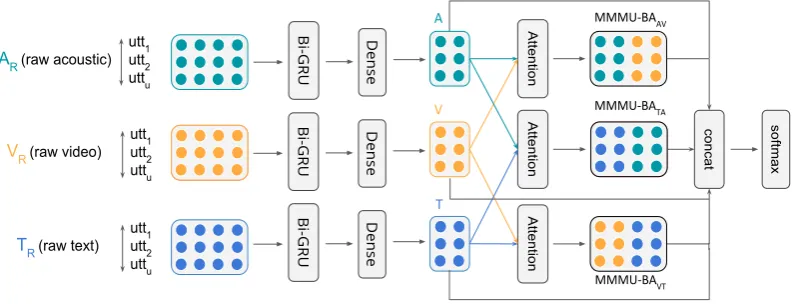
In our proposed framework, we aim to leverage the multi-modal and contextual information for predicting the sentiment of an utterance. Utter-ances of a particular speaker in a video represent the time series information and it is logical that the sentiment of a particular utterance would af-fect the sentiments of the other neighboring utter-ances. To model the relationship with the neigh-boring utterances and multi-modality, we propose a recurrent neural network based multi-modal at-tention framework. The proposed framework takes multi-modal information (i.e.text,visual& acous-tic) for a sequence of utterances and feeds it into three separate bi-directional Gated Recurrent Unit (GRU) (Cho et al., 2014). This is followed by a dense (fully-connected) operation which is shared across the time-steps or utterances (one each for text, visual & acoustic). We then apply multi-modal attention on the outputs of the dense layers. The objective is to learn the joint-association be-tween the multiple modalities & utterances, and to emphasize on the contributing features by putting more attention to these. In particular, we employ bi-modal attention framework, where an atten-tion funcatten-tion is applied to the representaatten-tions of pairwise modalities i.e. visual-text, text-acoustic and acoustic-visual. Finally, the outputs of pair-wise attentions along with the representations are concatenated and passed to thesoftmax layer for classification. We call our proposed architecture
Multi-Modal Multi-Utterance - Bi-Modal Atten-tion (MMMU-BA) framework. An overall archi-tecture of the proposedMMMU-BAframework is illustrated in Figure1. Please refer to Figure3 in appendix for illustration of attention computation.
For comparison, we also experiment with two other variants of the proposed MMMU-BA framework i.e. a). Multi-Modal Uni-Utterance-Self Attention (MMUU-SA) framework and b). Multi-Utterance-Self Attention (MU-SA) frame-work. The architecture of these variants differ with respect to the attention computation module and the naming conventions “MMMU”, “MMUU” or “MU” signify the information that partici-pates in the attention computation. For example, in MMMU-BA, we compute attention over the multi-modal and multi-utterance inputs, whereas inMMUU-SA, the attention is computed over the mutli-modal but uni-utterance inputs. In contrast, we compute attention over only multi-utterance in-puts inMU-SA. Rest of the components for all the three variants remain same.
3.1 Multi-modal Multi-utterance - Bi-modal Attention (MMMU-BA) Framework
Assuming a particular video has‘u’utterances, the raw utterance levelmulti-modal features are rep-resented asTR ∈Ru×300(raw text),VR ∈Ru×35
(raw visual) and AR ∈ Ru×74 (raw acoustic).
Three separate Bi-GRU layers with forward & backward state concatenation are first applied on the raw data followed by the fully-connected dense layers, resulting in T ∈ Ru×d(text),V ∈ Ru×d
(visual) and A ∈ Ru×d (acoustic), where ‘d’ is
the number of neurons in the dense layer. Finally, pairwise-attentionsare computed on various com-binations of three modalities- (V,T), (T,A) & (A, V). In particular the attention betweenV andT is computed as follows:
•Bi-modal Attention:Modality representations of V & T are obtained from the Bi-GRU network, and hence contain the contextual information of the utterances for each modality. At first, we com-pute a pair of matching matricesM1, M2 ∈Ru×u
over two representations that account for the cross-modality information.
M1=V.TT & M2=T.VT
• Multi-Utterance Attention: As mentioned ear-lier, in the proposed model we aim to leverage the contextual information of each utterance for the prediction. We compute the probability distribu-tion scores (N1 ∈ Ru×u & N2 ∈ Ru×u) over
Bi-GRU Dense
Bi-GRU Dense
Bi-GRU Dense
AR(raw acoustic)
utt1 utt2 uttu
VR(raw video) utt1 utt2 uttu
TR(raw text) utt1 utt2 uttu
Attention
Attention
Attention
[image:4.595.99.498.69.221.2]concat softmax
Figure 1: Overall architecture of the proposed MMMU-BA framework.
utterances. Finally, soft attention is applied over the multi-modal multi-utterance attention matrices to compute the modality-wise attentive representa-tions (i.e.O1&O2).
N1(i, j) =
eM1(i,j)
Pu
k=1eM1(i,k)
for i, j= 1, .., u
N2(i, j) =
eM2(i,j)
Pu
k=1eM2(i,k)
for i, j= 1, .., u.
O1 =N1.T & O2 =N2.V
• Multiplicative Gating & Concatenation: Fi-nally, a multiplicative gating function following (Dhingra et al., 2016) is computed between the multi-modal utterance specific representations of each individual modality and the other modalities. This element-wise matrix multiplication assists in attending to the important components of multiple modalities and utterances.
A1 =O1V & A2 =O2T
Attention matricesA1&A2are then concatenated to obtain the MMMU-BAVT ∈ Ru×2d betweenV
andT.
MMMU-BAV T =concat[A1, A2]
MMMU-BAAV & MMMU-BATA computations:
Similar to MMMU-BAVT, we follow the same procedure to compute MMMU-BAAV & MMMU-BATA. For a data source comprising of raw vi-sual (VR), acoustic (AR) & text (TR) modalities,
at first, we compute the bi-modal attention pairs for each combination i.e.MMMU-BAVT, MMMU-BAAV & MMMU-BATA. Finally, motivated by the residual skip connection network (He et al.,2016),
we concatenate the bi-modal attention pairs with individual modalities (i.e.V,A &T) to boost the gradient flow to the lower layers. This concate-nated feature is then used for final classification.
3.2 Multi-Modal Uni-Utterance - Self Attention (MMUU-SA) Framework
MMUU-SAframework does not account for infor-mation from the other utterances at the attention level, rather it utilizes multi-modal information of single utterance for predicting the sentiment. For a video having‘q’utterances,‘q’separate attention blocks are needed, where each block computes the self-attention over multi-modal information of a single utterance. LetXup ∈ R
3×dis the
informa-tion matrix of thepthutterance where the three‘d’ dimensional rows are the outputs of the dense lay-ers for the three modalities.
The attention matrix Aup ∈ R
3×dis computed
separately for, p = 1st,2nd, ...qth utterances. Fi-nally, for each utterancep,Aup andXup are
con-catenated and passed to the output layer for clas-sification. Please refer to the appendix for more details.
3.3 Multi-Utterance - Self Attention (MU-SA) Framework
InMU-SAframework, we apply self attention on the utterances of each modality separately, and use these for classification. In contrast to MMUU-SA framework, MU-SA utilizes the contextual infor-mation of the utterances at the attention level. Let,
T ∈ Ru×d (text), V ∈
Ru×d (visual) and A ∈ Ru×d(acoustic) are the outputs of the dense
multi-utterance information of a single modality and computes the self attention matrix. Attention matricesAt,AvandAaare computed for text,
vi-sual and acoustic, respectively. FinallyAv,At,Aa, V,T &Aare concatenated and passed to the out-put layer for classification.
4 Datasets, Experiments and Analysis
In this section we describe the datasets used for our experiments and report the results along with the necessary analysis.
4.1 Datasets
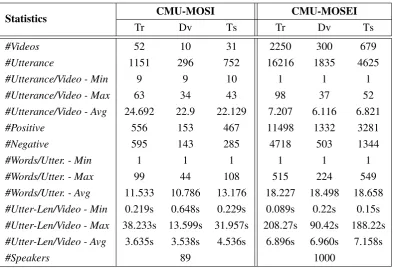
We evaluate our proposed approach on two benchmark datasets, namely CMU Multi-modal Opinion-level Sentiment Intensity (CMU-MOSI) corpus (Zadeh et al.,2016) and the recently pub-lished CMU Multi-modal Opinion Sentiment and Emotion Intensity (CMU-MOSEI) dataset (Zadeh et al.,2018c). CMU-MOSI dataset consists of 93 videos spanning over 2199 utterances. Each utter-ance has a sentiment label associated with it. It has 52, 10 & 31 videos in training, validation & test set accounting for 1151, 296 & 752 utterances.
CMU-MOSEI has 3229 videos with 22676 ut-terances from more than 1000 online YouTube speakers. The training, validation & test set com-prise of 16216, 1835 & 4625 utterances, respec-tively. More details about these datasets are pre-sented in the appendix.
Each utterance in CMU-MOSI dataset has been annotated as either positive or negative, whereas in CMU-MOSEI dataset labels are in the continuous range of -3 to +3. However, in this work we project the instances of CMU-MOSEI in atwo-class clas-sificationsetup withvalues ≥ 0 signify positive sentiments andvalues < 0signify negative sen-timents. We adopt such a strategy to be consistent with the previous published works on CMU-MOSI datasets (Poria et al.,2017b;Chen et al.,2017).
4.2 Feature extraction
We use the CMU-Multi-modal Data SDK1(Zadeh et al., 2018a) for feature extraction. For MOSEI dataset,word-level features were provided where textfeatures were extracted byGloVe embeddings, visualfeatures by Facets2 &acousticfeatures by CovaRep (Degottex et al., 2014). Thereafter, we
1
https://github.com/A2Zadeh/ CMU-MultimodalDataSDK
2https://pair-code.github.io/facets/
compute the average ofword-levelfeatures in an utterance to obtain the utterance-level features. For each word, the dimension of the feature vector is set to 300 (text), 35 (visual) & 74 (acoustic).
In contrast, for MOSI dataset we use utterance-level features3 provided in (Poria et al., 2017b). These utterance-level features represent the out-puts of a convolutional neural network (Karpathy et al.,2014), 3D convolutional neural network (Ji et al., 2013) & openSMILE (Eyben et al., 2010) fortext,visual&acousticmodalities, respectively. Dimensions of utterance-level features are 100, 100 & 73 fortext,visual&acoustic, respectively.
4.3 Experiments
We evaluate our proposed approach for CMU-MOSI (test data) & CMU-MOSEI (dev data) 4. Accuracy score is used as the evaluation metric.
We use Bi-directional GRUs having 300 neu-rons, each followed by a dense layer consisting of 100 neurons. Utilizing the dense layer, we project the input features of all the three modalities to the same dimensions. We setdropout=0.5 (MOSI) & 0.3 (MOSEI) as a measure of regularization. In addition, we also usedropout=0.4 (MOSI) & 0.3 (MOSEI)for the Bi-GRU layers. We employReLu activation function in the dense layers, and soft-maxactivation in the final classification layer. For training the network we set the batch size=32, use Adam optimizer withcross-entropy loss function and train for 50 epochs. We report the average re-sult of 5 runs for all our experiments.
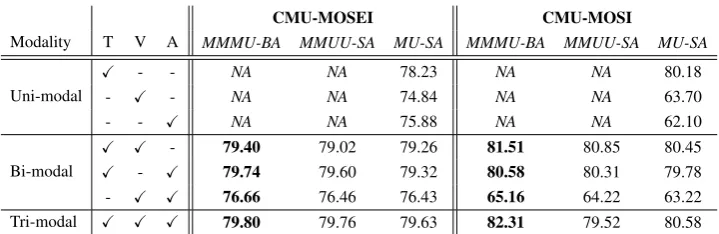
We experiment with all the valid combinations of uni-modal (where only one modality is taken at a time),bi-modal(any two modalities are taken at a time) and tri-modal (all three modalities are taken at a time) inputs fortext,visualandacoustic. In multi-modal attention frameworks i.e. MMMU-BA&MMUU-SA, the attention is computed over at least two modalities, hence, these two frame-works are not-applicable (NA) for uni-modal ex-periments in Table1).
For MOSEI dataset, we obtain better per-formance with text. Subsequently, we take two modalities at a time for constructing bi-modal in-puts and feed it to the network. Fortext-acoustic input pairs, we obtain the highest accuracies with 79.74%, 79.60% and 79.32% for MMMU-BA,
3
https://github.com/SenticNet/ contextual-sentiment-analysis
4Gold annotation of CMU-MOSEI test data wasn’t
Modality T V A
CMU-MOSEI CMU-MOSI
MMMU-BA MMUU-SA MU-SA MMMU-BA MMUU-SA MU-SA
Uni-modal
X - - NA NA 78.23 NA NA 80.18
- X - NA NA 74.84 NA NA 63.70
- - X NA NA 75.88 NA NA 62.10
Bi-modal
X X - 79.40 79.02 79.26 81.51 80.85 80.45
[image:6.595.119.479.60.177.2]X - X 79.74 79.60 79.32 80.58 80.31 79.78 - X X 76.66 76.46 76.43 65.16 64.22 63.22 Tri-modal X X X 79.80 79.76 79.63 82.31 79.52 80.58
Table 1: Experimental results on CMU-MOSEI and CMU-MOSI datasets. MMMU-BA & MMUU-SA frameworks require atleast two modalities to compute the attentions, hence, these two frameworks are not-applicable (NA)foruni-modalinputs. All results are average of 5 runs with different random seeds.
T:Text,V:Visual,A:Acoustic. Results are reported in accuracy.
MMUU-SAandMU-SAframeworks, respectively. The results that we obtain from the bi-modal com-binations suggest that the text-acoustic combina-tion is a better choice than the others as it improves the overall performance. Finally, we experiment with tri-modal inputs and observe an improved performance of 79.80%, 79.76% and 79.63% for MMMU-BA,MMUU-SAandMU-SAframeworks, respectively. This improvement entails that combi-nation of all the three modalities is a better choice. The performance improvement was also found to be statistically significant (T-test) than the bi-modality and uni-bi-modality inputs. Further, we ob-serve that the MMMU-BAframework reports the best accuracy of 79.80% for the MOSEI dataset, thus supporting our claim that multi-modal atten-tion framework (i.e. MMMU-BA) captures more information than the self-attention frameworks (i.e.MMUU-SA&MU-SA).
4.4 Analysis of Attention Mechanism
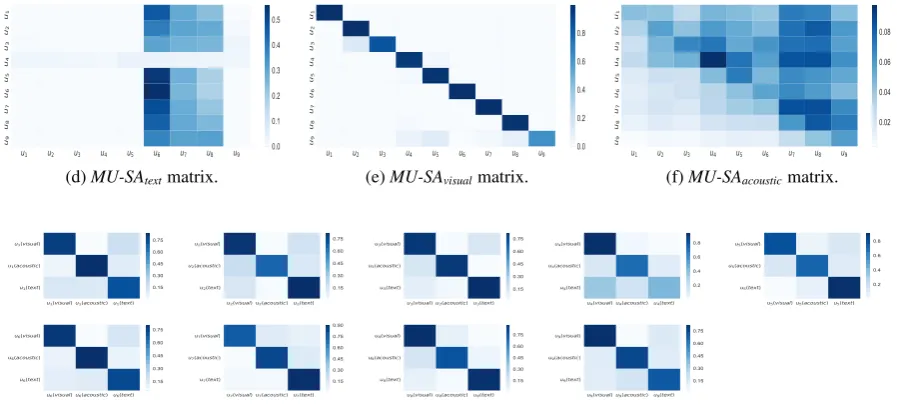
We analyze the attention values to understand the learning behavior of the proposed architecture. To illustrate, we take an example video from the CMU-MOSI test dataset. The transcript of the ut-terances for this particular video are presented in Table 2. The gold sentiments are positive for all the utterances exceptu3 &u4. We found that the proposed tri-modalMMMU-BAmodel predicts the labels of all the nine instances correctly, whereas other models make at least one misclassification. For the proposed tri-modalMMMU-BAmodel, the heatmaps of the pair-wiseMMMU-BAsoftmax at-tention weightsN1&N2 ofvisual-text, acoustic-visual&text-acousticare illustrated in Figure2a, Figure2b& Figure2c, respectively.N1 &N2are the softmax attention weights obtained from the
pairwise matching matrices M1 &M2. Elements of the rows ofN1 &N2 matrices signify differ-ent weights across multiple utterances. From the attention heatmaps, it is evident that by applying different weights across contextual utterances and modalities the model is able to predict labels of all the utterances correctly. All the heatmaps justify that the model learns to incorporate multi-modal & multi-utterance information and thus is able to cor-rectly predict the labels of all the utterances. For example, heatmap of MMMU-BAVT (Figure 2a) signifies that elements ofN1 are weighted higher thanN2, and thus the model puts more attention on thetextualpart and relatively lesser on thevisual part (asN1is multiplied with T &N2is multiplied with V). Also it can be concluded that textual fea-tures of the first few utterances are the most help-ful compared to the rest of the textual features and visual features.
The softmax attention weights oftext (Nt),
vi-sual (Nv) & acoustic (Na) in tri-modal MU-SA
model are illustrated in Figure 2d, Figure 2e & Figure2f, respectively. The attention matrices are 9*9 dimensional. This model wrongly predicts the label of the utterance u5. On the other hand, softmax attention weights in tri-modalMMUU-SA model are illustrated in Figure 2g. Nine separate attention weights (Nu1, Nu2, .., Nu9) are
com-puted for the nine utterances. This model wrongly predicts the labels of the utterancesu4&u5.
Transcript Gold Label Predicted
MMMU-BA MMUU-SA MU-SA
u1 well he plays that well so he‘s good villain Positive Positive Positive Positive u2 he also has some really cool guns so that its like a
desert eagle but it has to barrels to it
Positive Positive Positive Positive
u3 it‘s pretty pretty scary looking Negative Negative Negative Negative u4 i wouldn‘t want that pointed at me Negative Negative Positive Negative
u5 and i who would i mean Positive Positive Negative Negative
[image:7.595.87.512.61.208.2]u6 um like i said i thought the movie was great Positive Positive Positive Positive u7 the action they do have is really well done Positive Positive Positive Positive u8 um they did a good job with car Positive Positive Positive Positive u9 they did a good job with fight scenes Positive Positive Positive Positive
Table 2: Transcript, gold labels and predicted labels of a video in CMU-MOSI dataset having nine utter-ances. 7 utterances are labeled positive whereas 2 utterances are labeled negative. Predicted labels are for our different tri-modal models. Bolded labels are misclassified by at least one model.
u1u2u3u4u5u6u7u8u9u1u2u3u4u5u6u7u8u9 u9 u8 u7 u6 u5 u4 u3 u2 u1
(a)Softmax attention weightsN1&N2
for MMMU- BAVT.
u1u2u3u4u5u6u7u8u9u1u2u3u4u5u6u7u8u9 u9 u8 u7 u6 u5 u4 u3 u2 u1
(b)Softmax attention weightsN1 &N2
for MMMU- BAAV.
u1u2u3u4u5u6 u7u8u9u1u2u3u4u5u6u7u8u9
u 9 u 8 u 7 u 6 u 5 u 4 u 3 u 2 u 1
(c)Softmax attention weightsN1 &N2
for MMMU- BATA.
u1 u2 u3 u4 u5 u6 u7 u8 u9 u9 u8 u7 u6 u5 u4 u3 u2 u1
(d)MU-SAtextmatrix.
u1 u2 u3 u4 u5 u6 u7 u8 u9 u9 u8 u7 u6 u5 u4 u3 u2 u1
(e)MU-SAvisualmatrix.
u1 u2 u3 u4 u5 u6 u7 u8 u9
u 9 u 8 u 7 u 6 u 5 u 4 u 3 u 2 u 1
(f)MU-SAacousticmatrix.
u1(visual) u1(acoustic) u1(text) u1(text)
u1(acoustic) u1(visual)
u2(visual) u2(acoustic) u2(text) u2(text)
u2(acoustic) u2(visual)
u3(visual) u3(acoustic) u3(text) u3(text)
u3(acoustic) u3(visual)
u4(visual) u4(acoustic) u4(text) u4(text)
u4(acoustic) u4(visual)
u5(visual) u5(acoustic) u5(text) u5(text)
u5(acoustic) u5(visual)
u6(visual) u6(acoustic) u6(text) u6(text)
u6(acoustic) u6(visual)
u7(visual) u7(acoustic) u7(text) u7(text)
u7(acoustic) u7(visual)
u8(visual) u8(acoustic) u8(text) u8(text)
u8(acoustic) u8(visual)
u9(visual) u9(acoustic) u9(text) u9(text)
u9(acoustic) u9(visual)
(g) Softmax attention weights (Nu1,Nu2, ..,Nu9) forMMUU-SAmodel.
Figure 2: (a), (b) & (c): Pair-wise softmax attention weightsN1 &N2 ofvisual-text,acoustic-visual & text-acousticin Tri-modalMMMU-BAmodel. Solid line at the center represents boundary ofN1 &N2. The heatmaps represent attention weights of a particular utterance with respect to other utterances inN1 &N2. (d), (e) & (f) Softmax attention weights oftext(Nt),visual(Nv) andacoustic(Na) in Tri-modal
MU-SA model. This model wrongly predicts the label of utteranceu5. (g) Softmax attention weights of the 9 utterances (NU1,NU2, ..,NU9) in Tri-modal MMUU-SA model. This model wrongly predicts the
[image:7.595.75.524.403.607.2]T V A CMU-MOSEI CMU-MOSI
w/ attention w/o attention w/ attention w/o attention
[image:8.595.76.288.62.127.2]X X - 79.40 78.27 81.51 80.71 X - X 79.74 78.12 80.58 80.18 - X X 76.66 76.32 65.16 63.69 X X X 79.80 79.02 82.31 80.89
Table 3: Analysis of attention mechanism in MMMU-BA architecture. w/ attention → with multi-modal multi utterance attention mechanism andw/o attention→without attention mechanism.
accuracy without attention framework against 79.80% accuracy with attention framework. Sta-tisticalT-testshows these improvements to be sig-nificant. We also observed the similar trends for bi-modal inputs in both the datasets. All these ex-periments (c.f. Table3) suggest that the attention framework is an important component in our pro-posed architecture, and in absence of this the net-work finds it more difficult for learning in all the cases (i.e. bi-modal & tri-modal input setups).
We successfully show that attention computa-tion on pairwise combinacomputa-tion of modalities (i.e. bi-modal attention framework) is more effective than the combination of self-attention on single modal-ity. Further for the completeness of the proposed approach, we also experiment with tri-modal at-tention framework (atat-tention is computed on three modalities at a time). Though the results that we obtain are convincing, it does not improve the per-formance over the bi-modal attention framework. We obtain the accuracies of 79.58% & 81.25% on MOSEI and MOSI, respectively, for the tri-modal attention framework.
4.5 Comparative Analysis
For MOSI datasets we compare the performance of our proposed approach with the the following state-of-the-art systems: i). Poria et al. (2017b )-LSTM-based sequence model to capture the con-textual information of the utterances; ii). Poria et al. (2017c)- Tensor level fusion technique for combining all the three modalities; iii). Chen et al. (2017)-A gated multi-modal embedded LSTM with temporal attention (GME-LSTM(A)) for word-level fusion of multi-modality inputs. and iv). Zadeh et al. (2018a)- Multiple attention blocks for capturing the information across the three modalities.
In Table 4 we present the comparative perfor-mance between our proposed model and other state-of-the-art systems. In MOSI dataset, Poria
et al. (2017b; 2017c) reported the accuracies of 80.3% & 81.3 %, respectively, utilizing tri-modal inputs.Zadeh et al.(2018a) obtained an accuracy of & 77.4%.Chen et al.(2017) reported accuracies of 75.7% (LSTM(A)) & 76.5% (GME-LSTM(A)) for two variants of their model. In contrast to the state-of-the-art systems, our proposed model at-tains an improved accuracy of 82.31% when we utilize all the three modalities, i.e. text, visual & acoustic. Our proposed system also obtains better performance as compared to the state-of-the-arts for bi-modal inputs.
For MOSEI dataset, we evaluate against the fol-lowing systems: i)Poria et al.(2017b), ii)Zadeh et al.(2018a), and iii)Zadeh et al.(2018b), where authors proposed a memory fusion network for multi-view sequential learning. We evaluate the system ofPoria et al.(2017b) on MOSEI dataset and obtain 77.64% accuracy with the tri-modal in-puts. Authors in (Zadeh et al., 2018a) & (Zadeh et al., 2018b) reported the accuracy 76.0% and 76.4%, respectively, with the tri-modal inputs. In comparison, our proposed approach yields an ac-curacy of 79.80%. As reported in Table4the pro-posed approach also attains better performance for all the bi-modal and uni-modal input combinations when compared toPoria et al.(2017b).
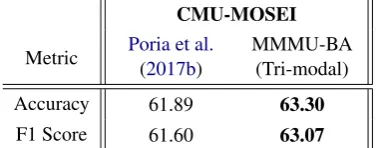
As reported in Table4, we observe that the per-formance achieved in our proposed approach is significantly better in comparison to the state-of-the-art systems withp-value< 0.05(obtained us-ing T-test). For further analysis, we also report re-sults for three-class classification (positive, neu-tral & negative classes) problem setup for MOSEI dataset in Table7. Note that this setup is not feasi-ble in MOSI as labels are only positive or negative.
4.6 Error Analysis
Modality T V A
CMU-MOSEI CMU-MOSI
Poria et al. (2017b)
Zadeh et al. (2018a)
Zadeh et al. (2018b)
Proposed Poria et al. (2017b)
Poria et al. (2017c)
Chen et al.(2017)
Zadeh et al. (2018a)
Proposed
LSTM(A)
GME-LSTM(A)
Uni-modal
X - - 76.75 - - 78.23 78.1 - 71.3 - - 80.18
- X - 71.84 - - 74.84 60.3 - 52.3 - - 63.70
- - X 70.94 - - 75.88 55.8 - 55.4 - - 62.10
Bi-modal
X X - 77.03 - - 79.40 79.3 79.9 74.3 - - 81.51
X - X 76.89 - - 79.74 80.2 80.1 73.5 - - 80.58
- X X 72.74 - - 76.66 62.1 62.9 - - - 65.16
Tri-modal X X X 77.64 76.0 76.4 79.80 80.3 81.3 75.7 76.5 77.4 82.31
[image:9.595.75.520.61.217.2]T-test (p-values) - - - 0.0025 - - - 0.0006
Table 4: Comparative analysis of the proposed approach with recent state-of-the-art systems. Significance T-testp-values<0.05
MOSEI
102 234
1230 269
Positive Negative
63 215
404 70
Positive Negative
MOSI
Table 5: Con-fusion matrix for tri-modal MMMU-BA.
Text Actual Predicted Possible Reason
MOSI
At first I thought the movie would appeal more to younger audience. negative positive
Implicit sentiment.
Its really non-stop from beginning to end. negative positive
But its action isn’t particularly memorable. negative positive
Negation & strong word.
I mean I don’t regret seeing it. positive negative
Um I was really looking forward to it. negative positive Sarcastic sentence.
MOSEI
And when I was going to school it was really difficult for me to find avenues and resources to be able to reach higher education.
negative positive
Implicit sentiment.
We could have a decision from the court on the stay any day now. positive negative
Holidays never really happen in online courses I guess. negative positive
Negation & strong word.
Young people dropping out of the labour market are actually not counted anymore as unemployed as they are inactive.
positive negative
[image:9.595.87.280.454.528.2]Thank you for your efforts and consideration. negative positive Sarcastic sentence.
Table 6:Error Analysis:Frequent error cases and their possible reasons of failure for the tri-modalMMMU-BAframework.
Metric
CMU-MOSEI
Poria et al. (2017b)
MMMU-BA (Tri-modal)
Accuracy 61.89 63.30
F1 Score 61.60 63.07
Table 7: Three class (positive, negative, neutral) classification results in MOSEI dataset.
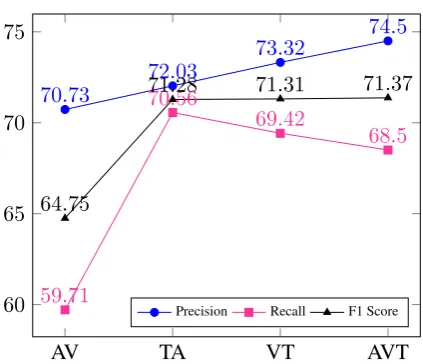
refer to the appendix for PR curves of different in-put combinations.
We further analyze our outputs qualitatively and list a few frequently occurring error categories with examples in Table6.
5 Conclusion
In this paper, we have proposed a recurrent neu-ral network based multi-modal attention frame-work that leverages the contextual information for utterance-level sentiment prediction. The network learns on top of three modalities, viz. text, vi-sual and acoustic, considering sequence of
utter-ances in a video. Through evaluation results on two benchmark datasets (one being the popular & commonly used (MOSI) and other being the most recent & largest (MOSEI) dataset for multi-modal sentiment analysis), we successfully showed that the proposed attention based framework performs better than various state-of-the-art systems.
In future, we would like to investigate new tech-niques, and explore the ways to handle implicit sentiment and sarcasm. Future direction of work also include adding more dimensions, e.g. emo-tion analysis & intensity predicemo-tion.
6 Acknowledgment
References
Md Shad Akhtar, Deepak Gupta, Asif Ekbal, and Push-pak Bhattacharyya. 2017. Feature selection and en-semble construction: A two-step method for aspect based sentiment analysis. Knowledge-Based Sys-tems, 125:116 – 135.
Md Shad Akhtar, Ayush Kumar, Asif Ekbal, and Push-pak Bhattacharyya. 2016. A Hybrid Deep Learning Architecture for Sentiment Analysis. In Proceed-ings of the 26th International Conference on Com-putational Linguistics (COLING 2016): Technical Papers, December 11-16, 2016, pages 482–493, Os-aka, Japan.
Minghai Chen, Sen Wang, Paul Pu Liang, Tadas Bal-truˇsaitis, Amir Zadeh, and Louis-Philippe Morency. 2017. Multimodal sentiment analysis with word-level fusion and reinforcement learning. In Proceed-ings of the 19th ACM International Conference on Multimodal Interaction, pages 163–171. ACM. Kyunghyun Cho, Bart Van Merri¨enboer, Caglar
Gul-cehre, Dzmitry Bahdanau, Fethi Bougares, Holger Schwenk, and Yoshua Bengio. 2014. Learning phrase representations using rnn encoder-decoder for statistical machine translation. arXiv preprint arXiv:1406.1078.
G. Degottex, J. Kane, T. Drugman, T. Raitio, and S. Scherer. 2014. Covarep - a collaborative voice analysis repository for speech technologies. In
2014 IEEE International Conference on Acous-tics, Speech and Signal Processing (ICASSP), pages 960–964.
Bhuwan Dhingra, Hanxiao Liu, Zhilin Yang,
William W Cohen, and Ruslan Salakhutdinov. 2016. Gated-attention readers for text comprehen-sion.arXiv preprint arXiv:1606.01549.
Florian Eyben, Martin W¨ollmer, and Bj¨orn Schuller. 2010. Opensmile: the munich versatile and fast open-source audio feature extractor. InProceedings of the 18th ACM international conference on Multi-media, pages 1459–1462. ACM.
Kaiming He, Xiangyu Zhang, Shaoqing Ren, and Jian Sun. 2016. Deep residual learning for image recog-nition. In Proceedings of the IEEE conference on computer vision and pattern recognition, pages 770– 778.
M. Hu and B. Liu. 2004. Mining and summarizing customer reviews. InProceedings of the 10th KDD, pages 168–177, Seattle, WAs.
Shuiwang Ji, Wei Xu, Ming Yang, and Kai Yu. 2013. 3d convolutional neural networks for human action recognition. IEEE transactions on pattern analysis and machine intelligence, 35(1):221–231.
Andrej Karpathy, George Toderici, Sanketh Shetty, Thomas Leung, Rahul Sukthankar, and Li Fei-Fei.
2014. Large-scale video classification with convolu-tional neural networks. InProceedings of the IEEE conference on Computer Vision and Pattern Recog-nition, pages 1725–1732.
Bing Liu. 2012. Sentiment Analysis and Opinion Min-ing. Synthesis Lectures on Human Language Tech-nologies. Morgan & Claypool Publishers.
Rada Mihalcea. 2012. Multimodal sentiment analy-sis. In Proceedings of the 3rd Workshop in Com-putational Approaches to Subjectivity and Sentiment Analysis, WASSA@ACL 2012, July 12, 2012, Jeju Is-land, Republic of Korea, page 1.
Saif Mohammad, Svetlana Kiritchenko, and Xiaodan Zhu. 2013. NRC-Canada: Building the state-of-the-art in sentiment analysis of tweets. In Second Joint Conference on Lexical and Computational Se-mantics (*SEM), Volume 2: Proceedings of the Sev-enth International Workshop on Semantic Evalua-tion (SemEval 2013), pages 321–327, Atlanta, Geor-gia, USA. Association for Computational Linguis-tics.
Louis-Philippe Morency, Rada Mihalcea, and Payal Doshi. 2011. Towards multimodal sentiment anal-ysis: harvesting opinions from the web. In Pro-ceedings of the 13th International Conference on Multimodal Interaction, ICMI 2011, Alicante, Spain, November 14-18, 2011, pages 169–176.
Bo Pang and Lillian Lee. 2005. Seeing Stars: Ex-ploiting Class Relationships for Sentiment Catego-rization with Respect to Rating Scales. In Proceed-ings of the 43rd Annual Meeting on Association for Computational Linguistics, ACL ’05, pages 115– 124, Stroudsburg, PA, USA. Association for Com-putational Linguistics.
Bo Pang and Lillian Lee. 2008. Opinion mining and sentiment analysis. Found. Trends Inf. Retr., 2(1-2):1–135.
Soujanya Poria, Erik Cambria, Rajiv Bajpai, and Amir Hussain. 2017a. A review of affective computing: From unimodal analysis to multimodal fusion. In-formation Fusion, 37:98–125.
Soujanya Poria, Erik Cambria, Devamanyu Hazarika, Navonil Majumder, Amir Zadeh, and Louis-Philippe Morency. 2017b. Context-dependent sentiment analysis in user-generated videos. InProceedings of the 55th Annual Meeting of the Association for Com-putational Linguistics (Volume 1: Long Papers), vol-ume 1, pages 873–883.
Soujanya Poria, Iti Chaturvedi, Erik Cambria, and Amir Hussain. 2016. Convolutional mkl based mul-timodal emotion recognition and sentiment analysis. In Data Mining (ICDM), 2016 IEEE 16th Interna-tional Conference on, pages 439–448. IEEE. Soujanya Poria, Haiyun Peng, Amir Hussain, Newton
Howard, and Erik Cambria. 2017d. Ensemble appli-cation of convolutional neural networks and multiple kernel learning for multimodal sentiment analysis.
Neurocomputing, 261:217–230.
P. D. Turney. 2002. Thumbs up or thumbs down?: Se-mantic orientation applied to unsupervised classifi-cation of reviews. InProceedings of the 40th Asso-ciation for Computational Linguistics (ACL), pages 417–424, Philadelphia, USA.
A Zadeh, PP Liang, S Poria, P Vij, E Cambria, and LP Morency. 2018a. Multi-attention recurrent net-work for human communication comprehension. In
Thirty-Second AAAI Conference on Artificial Intel-ligence (AAAI-2018), pages 5642 – 5649, New Or-leans, USA.
A. Zadeh, R. Zellers, E. Pincus, and L. P. Morency. 2016. Multimodal Sentiment Intensity Analysis in Videos: Facial Gestures and Verbal Messages. IEEE Intelligent Systems, 31(6):82–88.
Amir Zadeh, Minghai Chen, Soujanya Poria, Erik Cambria, and Louis-Philippe Morency. 2017. Ten-sor fusion network for multimodal sentiment analy-sis. InProceedings of the 2017 Conference on Em-pirical Methods in Natural Language Processing, pages 1103–1114, Copenhagen, Denmark. Associ-ation for ComputAssoci-ational Linguistics.
Amir Zadeh, Paul Pu Liang, Navonil Mazumder, Soujanya Poria, Erik Cambria, and Louis-Philippe Morency. 2018b. Memory Fusion Network for Multi-view Sequential Learning. arXiv preprint arXiv:1802.00927.
Amir Zadeh, Paul Pu Liang, Soujanya Poria, Erik Cam-bria, and Louis-Philippe Morency. 2018c. Mul-timodal Language Analysis in the Wild: CMU-MOSEI Dataset and Interpretable Dynamic Fusion Graph. In Proceedings of the 56th Annual Meet-ing of the Association for Computational LMeet-inguistics (Volume 1: Long Papers), pages 2236–2246. Associ-ation for ComputAssoci-ational Linguistics.
7 Appendix
7.1 Multi-Modal Uni-Utterance - Self Attention (MMUU-SA) Framework
LetXp ∈ R3×d is the information matrix of the pthutterance where the three‘d’dimensional rows
are the outputs of the time-distributed dense layer for the three modalities. Computation in the pth
attention block proceeds as follows:
Mup =Xup.X
T up
Nup(i, j) =
eMup(i,j)
P3
k=1e
Mup(i,k) for i, j= 1,2,3;
Oup =Nup.Xup
Aup =OupXup
The attention matrix Aup ∈ R
3×dis computed
separately for, p = 1st,2nd, ...qth utterances. Fi-nally, for each utterancep,Aup andXup are
con-catenated and passed to the output layer for classi-fication.
7.2 Multi-Utterance - Self Attention (MU-SA) Framework
InMU-SAframework, we apply self attention on the utterances of each modality separately, and use these for classification. In contrast to MMUU-SA framework, MU-SA utilizes the contextual infor-mation of the utterances at the attention level. Let,
T ∈ Ru×d (text), V ∈
Ru×d (visual) and A ∈ Ru×d(acoustic) are the outputs of the dense
lay-ers. For the three modalities, three separate atten-tion blocks are required, where each block takes multi-utterance information of a single modality and computes the self attention matrix. Specifi-cally, theMU-SAattention (Av) onV (visual) will
be computed as follows,
Mv =V.VT
Nv(i, j) =
eMv(i,j)
Pu
k=1eMv(i,k)
for i, j= 1, .., u
Ov =Nv.V
Av =OvV
The attention matrixAp ∈ R3×dis computed for p= 1st,2nd, ...uthutterances. Finally, for each ut-teranceu,ApandXpare concatenated and passed
to the output layer with softmax activation for classification.
7.3 Dataset Statistics
Dataset statistics are presented in Table8.
7.4 Attention Computation
Statistics CMU-MOSI CMU-MOSEI
Tr Dv Ts Tr Dv Ts
#Videos 52 10 31 2250 300 679
#Utterance 1151 296 752 16216 1835 4625
#Utterance/Video - Min 9 9 10 1 1 1
#Utterance/Video - Max 63 34 43 98 37 52
#Utterance/Video - Avg 24.692 22.9 22.129 7.207 6.116 6.821
#Positive 556 153 467 11498 1332 3281
#Negative 595 143 285 4718 503 1344
#Words/Utter. - Min 1 1 1 1 1 1
#Words/Utter. - Max 99 44 108 515 224 549
#Words/Utter. - Avg 11.533 10.786 13.176 18.227 18.498 18.658 #Utter-Len/Video - Min 0.219s 0.648s 0.229s 0.089s 0.22s 0.15s #Utter-Len/Video - Max 38.233s 13.599s 31.957s 208.27s 90.42s 188.22s #Utter-Len/Video - Avg 3.635s 3.538s 4.536s 6.896s 6.960s 7.158s
#Speakers 89 1000
[image:12.595.103.497.60.328.2](a) Data Statistics.Tr→Train set;Dv→Development set;Ts→Test set;
Table 8: Dataset statistics for MOSI (Zadeh et al.,2016) and MOSEI (Zadeh et al.,2018c).
X
X
X
X
Row softmax
Row softmax
*
*
* X
Figure 3:MMMU-BAVTattention computation.
7.5 Precision-Recall (PR) curve
[image:12.595.104.499.381.543.2]AV TA VT AVT
60 65 70 75 80
63.49
79.69 80.31
81.28
60.91
78.93
80.67 80.97
60.24
79.27 80.48
81.12
[image:13.595.74.286.118.298.2]Precision Recall F1 Score
Figure 4:Precision,Recall&F-measurefor differ-ent input combinations inMMMU-BAarchitecture of MOSI dataset.
AV TA VT AVT
60 65 70 75
70.73
72.03
73.32
74.5
59.71
70.56
69.42
68.5
64.75
71.28 71.31 71.37
Precision Recall F1 Score
[image:13.595.74.286.470.652.2]