98
Multi-Document Summarization with Determinantal Point Processes and
Contextualized Representations
Sangwoo Cho♠, Chen Li♦, Dong Yu♦, Hassan Foroosh♠, Fei Liu♠
♠Computer Science Department, University of Central Florida ♦Tencent AI Lab, Bellevue, WA, USA
[email protected] {ailabchenli, dyu}@tencent.com {foroosh,feiliu}@cs.ucf.edu
Abstract
Emerged as one of the best performing tech-niques for extractive summarization, determi-nantal point processes select the most probable set of sentences to form a summary according to a probability measure defined by modeling sentence prominence and pairwise repulsion. Traditionally, these aspects are modelled using shallow and linguistically informed features, but the rise of deep contextualized representa-tions raises an interesting question of whether, and to what extent, contextualized representa-tions can be used to improve DPP modeling. Our findings suggest that, despite the success of deep representations, it remains necessary to combine them with surface indicators for ef-fective identification of summary sentences.
1 Introduction
Determinantal point processes, shortened as DPP, is one of a number of optimization techniques that perform remarkably well in summarization com-petitions (Hong et al.,2014). These optimization-based summarization methods include integer lin-ear programming (Gillick and Favre,2009), min-imum dominating set (Shen and Li,2010), maxi-mizing submodular functions under a budget con-straint (Lin and Bilmes, 2010; Yogatama et al.,
2015), and DPP (Kulesza and Taskar,2012). DPP is appealing to extractive summarization, since not only has it demonstrated promising performance on summarizing text/video content (Gong et al.,
2014;Zhang et al.,2016;Sharghi et al.,2018), but it has the potential of being combined with deep neural networks for better representation and se-lection (Gartrell et al.,2018).
The most distinctive characteristic of DPP is its decomposition into thequalityanddiversity mea-sures (Kulesza and Taskar,2012). Aquality mea-sure is a positive number indicating how important
a sentence is to the extractive summary. A diver-sitymeasure compares a pair of sentences for re-dundancy. If a sentence is of high quality, anyset
containing it will have a high probability score. If two sentences contain redundant information, they cannot both be included in the summary, thus any
setcontaining both of them will have a low proba-bility. DPP focuses on selecting the most probable
set of sentences to form a summary according to sentence quality and diversity measures.
To better measure quality and diversity aspects, we draw on deep contextualized representations. A number of models have been proposed recently, including ELMo (Peters et al.,2018), BERT ( De-vlin et al., 2018), XLNet (Yang et al., 2019;Dai et al.,2019), RoBERTa (Liu et al.,2019) and many others. These representations encode a given text into a vector based on left and right context. With carefully designed objectives and billions of words used for pretraining, they have achieved astonish-ing results in several tasks includastonish-ing predictastonish-ing en-tailment relationship, semantic textual similarity, and question answering. We are particularly inter-ested in leveraging BERT for better sentence qual-ity and diversqual-ity estimates.
This paper extends on previous work (Cho et al.,
2019) by incorporating deep contextualized repre-sentations into DPP, with an emphasis on better sentence selection for extractive multi-document summarization. The major research contributions of this work include the following: (i) we make a first attempt to combine DPP with BERT repre-sentations to measure sentence quality and diver-sity and report encouraging results on benchmark summarization datasets; (ii) our findings suggest that it is best to model sentencequality, i.e., how important a sentence is to the summary, by com-bining semantic representations and surface indi-cators of the sentence, whereas pairwise sentence
repre-sentations only; (iii) our analysis reveals that com-bining contextualized representations with surface features (e.g., sentence length, position, centrality, etc) remains necessary, as deep representations, al-beit powerful, may not capture domain-specific se-mantics/knowledge such as word frequency.
2 DPP for Summarization
Determinantal point process (Kulesza and Taskar, 2012) defines a probability measure P over all subsets (2|Y|) of a ground set containing all docu-ment sentencesY={1,2,· · ·,N}. Our goal is to identify a most probable subsetY, corresponding to an extractive summary, that achieves the high-est probability score. The probability measure P
is defined as
P(Y;L) = det(LY)
det(L+I), (1) X
Y⊆Y
det(LY) =det(L+I), (2)
where det(·) is the determinant of a matrix; I is the identity matrix;L ∈RN×Nis a positive semi-definite (PSD) matrix, known as theL-ensemble;
Lij indicates the correlation between sentencesi andj; andLY is a submatrix ofLcontaining only entries indexed by elements ofY. As illustrated in Eq. (1), the probability of an extractive summary
Y ⊆ Y is thus proportional to the determinant of the matrixLY.
Kulesza and Taskar (2012) introduce a decom-position of theL-ensemble matrix: Lij =qi·Sij·
qj whereqi ∈R+is a positive number indicating
thequality of a sentence and Sij is a measure of
similaritybetween sentencesiandj. TheqandS
model the sentence quality and pairwise similar-ity respectively and contribute to theL-ensemble matrix. A log-linear model is used to determine sentence quality: qi = exp(θ>f(i)), where f(i) is a feature vector for sentenceiandθare feature weights to be learned during DPP training. We op-timizeθby maximizing log-likelihood with gradi-ent descgradi-ent, illustrated as follows:
L(θ)=
M
X
m=1
logP( ˆY(m);L(m)(θ)), (3)
∇θ=
M
X
m=1
X
i∈Yˆ(m)
f(i)−X
j
[image:2.595.308.524.62.138.2]f(j)Kjj(m), (4)
Figure 1: BERT-simand BERT-imputilize embeddings for tokens, segments, token position in a sentence and sentence position in a document. These embeddings are element-wisely added up then fed into the model.
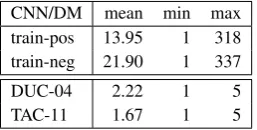
CNN/DM mean min max train-pos 13.95 1 318 train-neg 21.90 1 337
DUC-04 2.22 1 5
TAC-11 1.67 1 5
Table 1: Position of summary-worthy sentences in a document for single-doc (CNN/DM) and multi-doc datasets (DUC-04, TAC11). ‘pos’ are summary-worthy document sentences; ‘neg’ are sentences that are ran-domly sampled from the same document.
whereMis the total number of training instances;
ˆ
Y(m)is the ground-truth summary of them-th in-stance;K =L(L+I)−1is the kernel matrix and
P( ˆY(m);L(m)(θ))is defined by Eq. (1). We refer the reader to (Kulesza and Taskar,2012) for details on gradient derivation (Eq. (4)). In the following we describe two BERT models to respectively esti-mate sentence pairwise similarity and importance. The trained models are then plugged into the DPP framework for computingS andq.
2.1 BERT Architecture
We introduce two models that fine-tune the BERT-base architecture (Devlin et al.,2018) to calculate the similarity between a pair of sentences
(BERT-sim) and learn representations that characterize the importance of a single sentence (BERT-imp). Im-portantly, training instances for both BERT mod-els are derived fromsingle-document summariza-tion dataset (Hermann et al.,2015) by Lebanoff et al. (2019), containing a collection of single sen-tences (or sentence pairs) and their associated la-bels. During testing, the trained BERT models are applied to single sentences and sentence pairs de-rived frommulti-documentinput to obtain quality and similarity measures.
[image:2.595.352.481.205.270.2]pro-duce a vector representing the input sentence pair. The vector, denoted byu∈Rd, is the final hidden
state corresponding to the “[CLS]” token (d=768), which is used as the aggregate sequence represen-tation. u is passed through a feed-forward layer with the same dimensiond, followed by a dropout layer, and a final softmax prediction layer to clas-sify whether a pair of sentences contain redundant information or not. Once the model is trained, we can apply it to a pair of sentencesiandjto obtain the similarity scoreSij.
BERT-impuses a similar architecture to predict if any single sentence is important to the summary. Once the model is trained, we can apply it to thei -th sentence to generate a vectoruiwhich is used as the feature representationf(i)for thei-th sentence when computingqi.
The embedding layer, illustrated in Fig.1, con-sists of several types of embeddings, respectively representing tokens, segments, the token position in a sentence and sentence position within a given document. These embeddings are element-wisely added up then fed to the model. The sentence po-sition embeddings are incorporated in this work to capture the position of a sentence in the article. It is utilized only by BERT-imp, as position matters for sentence importance but not quite so for pair-wise similarity. As shown in Table1, positive sen-tences in the training data (see§3.1) tend to appear at the beginning of an article, consistently more so than negative sentences. Further, ground-truth summary sentences of the DUC and TAC datasets are likely to appear among the first five sentences of an article, indicating position embeddings are crucial for training the BERT-impmodel.
2.2 DPP Training
DPP training focuses on estimating the weights of features used inqi=exp(θ>f(i)), which is a log-linear model used for computing sentence quality. The sentence similarity scoresSijare produced by BERT-sim; they do not change during DPP train-ing. We obtain contextualized representations for thei-th sentence, i.e.,f(i)∈Rd, from the
penulti-mate layer (ui) of BERT-imp.
In addition, a number of surface indicators1, de-noted byvi ∈ Rd
0
, are extracted for sentence i. To combine surface indicators and contextualized
1The sentence features include the length and position of
a sentence, the cosine similarity between sentence and docu-ment TF-IDF vectors (Kulesza and Taskar,2011). We abstain from using sophisticated features to avoid model overfitting.
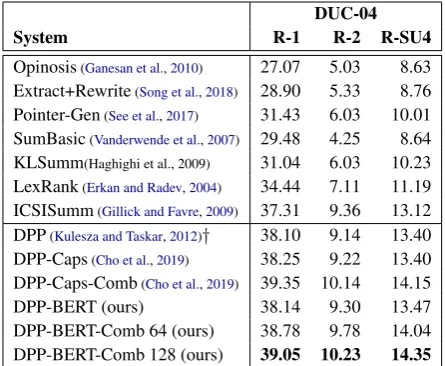
DUC-04
System R-1 R-2 R-SU4
Opinosis(Ganesan et al.,2010) 27.07 5.03 8.63 Extract+Rewrite(Song et al.,2018) 28.90 5.33 8.76 Pointer-Gen(See et al.,2017) 31.43 6.03 10.01 SumBasic(Vanderwende et al.,2007) 29.48 4.25 8.64 KLSumm(Haghighi et al., 2009) 31.04 6.03 10.23 LexRank(Erkan and Radev,2004) 34.44 7.11 11.19 ICSISumm(Gillick and Favre,2009) 37.31 9.36 13.12
DPP(Kulesza and Taskar,2012)† 38.10 9.14 13.40
DPP-Caps(Cho et al.,2019) 38.25 9.22 13.40 DPP-Caps-Comb(Cho et al.,2019) 39.35 10.14 14.15
DPP-BERT (ours) 38.14 9.30 13.47
[image:3.595.306.529.62.245.2]DPP-BERT-Comb 64 (ours) 38.78 9.78 14.04 DPP-BERT-Comb 128 (ours) 39.05 10.23 14.35
Table 2: Results on the DUC-04 dataset evaluated by ROUGE.†indicates our reimplementation of Kulesza and Taskar (2012) system.
representations, we concatenateui andvi as sen-tence features. We also take a weighted average2 ofSij andCij as an estimate of pairwise sentence similarity, where Cij is the cosine similarity of sentence TF-IDF vectors. DPP training learns fea-ture weightsθ∈RD, whereD=d+d0if the
sen-tence features are concatenated, otherwiseD=d. DPP is trained on multi-document summarization data with gradient descent (Eq. (4)).
3 Experiments
In this section we describe the dataset used to train the BERT-simand BERT-impmodels, benchmark datasets for multi-document summarization, and experimental settings. Our system shows competi-tive results comparing to state-of-the-art methods. Example summaries are provided to demonstrate the effectiveness of the proposed method.
3.1 Dataset
CNN / DailyMail This dataset (Hermann et al.,
2015) is utilized to train the BERT-simand
BERT-impmodels. For BERT-sim, we pair each human summary sentence with its most similar document sentence to create a positive instance; negative in-stances are randomly sampled sentence pairs. For BERT-imp, the most similar document sentence receives a label of 1; randomly sampled sentences are labelled as 0. In total, our training / dev / test sets contain 2,084,798 / 105,936 / 86,144 sentence pairs and the instances are balanced.
DUC/TAC We evaluate our DPP approach (§2) on multi-document summarization datasets in-cluding DUC and TAC (Over and Yen,2004;Dang and Owczarzak,2008). The task is to generate a summary of 100 words from a collection of news articles. We report ROUGE F-scores (Lin,2004)3 on DUC-04 (trained on DUC-03) and TAC-11 (trained on TAC-08/09/10) following standard set-tings (Hong et al.,2014). Ground-truth extractive summaries used in DPP training are obtained from Cho et al. (2019).
3.2 Experiment Settings
We implement our system using TensorFlow on an NVIDIA 1080Ti GPU. We consider the maximum length of a sentence to be 64 or 128 words. The batch size is 64 for the 64 max sentence length and 32 for 128. We use Adam optimizer (Kingma and Ba,2015) with the default setting and set learning rate to be 2e-5. We train BERT-impand BERT-sim
on CNN/DM. The prediction accuracy of
BERT-simand BERT-imp(with length-128) are respec-tively 96.11% and 69.05%. Similar results are ob-served with length-64: 95.79% and 69.63%.
3.3 Summarization Results
We compare our system with strong summariza-tion baselines (Table2and3).SumBasic( Vander-wende et al.,2007),KL-Sum(Haghighi and Van-derwende,2009), andLexRank(Erkan and Radev,
2004) are extractive approaches;Opinosis( Gane-san et al., 2010), Extract+Rewrite (Song et al.,
2018), and Pointer-Gen (See et al., 2017) are abstractive methods; ICSISumm (Gillick et al.,
2009) is an ILP-based summarization method; and
DPP-Caps-Comb, DPP-Capsare results
combin-ing DPP and capsule networks reported by Cho et al. (2019) w/ and w/o using sentence TF-IDF sim-ilarity (Ci,j).
We experiment with variants of our DPP model:
DPP-BERT, DPP-BERT-Combined. The former
utilizes the outputs from BERT-simand BERT-imp
to computeSijandqi, whereas the latter combines BERT-simoutput with sentence TF-IDF similarity (Ci,j), and concatenates BERT-impfeatures with linguistically informed features.
Our DPP methods outperform both extractive and abstractive baselines, indicating the effective-ness of optimization-based methods for extractive multi-document summarization. Furthermore, we
3with options-n 2 -m -w 1.2 -c 95 -r 1000 -l 100
TAC-11
System R-1 R-2 R-SU4
Opinosis(Ganesan et al.,2010) 25.15 5.12 8.12 Extract+Rewrite(Song et al.,2018) 29.07 6.11 9.20 Pointer-Gen(See et al.,2017) 31.44 6.40 10.20 SumBasic(Vanderwende et al.,2007) 31.58 6.06 10.06 KLSumm(Haghighi et al., 2009) 31.23 7.07 10.56 LexRank(Erkan and Radev,2004) 33.10 7.50 11.13
DPP(Kulesza and Taskar,2012)† 36.95 9.83 13.57
DPP-Caps(Cho et al.,2019) 36.61 9.30 13.09 DPP-Caps-Comb(Cho et al.,2019) 37.30 10.13 13.78
DPP-BERT (ours) 37.04 10.18 13.79
[image:4.595.308.526.61.233.2]DPP-BERT-Comb 64 (ours) 38.46 10.79 14.45 DPP-BERT-Comb 128 (ours) 38.59 11.06 14.65
Table 3: ROUGE results on the TAC-11 dataset.
observe thatDPP-BERT-Combinedyields the best performance, achieving 10.23% and 11.06% F-scores respectively on DUC-04 and TAC-11. This finding suggests that sentence similarity scores and importance features from theDPP-BERT sys-tem and TF-IDF based features can complement each other to boost system performance. We con-jecture that TF-IDF sentence vectors are effective at representing topical terms (e.g.,3 million), thus helping DPP better select representative sentences. Another observation is thatDPP-BERTand
DPP-BERT-Combined consistently outperform
DPP-Capsand DPP-Caps-Comb, indicating its
excel-lence for DPP-based summarization.
In Table4we show example system summaries and a human-written reference summary.
DPP-BERTandDPP-BERT-Combinedboth are capable
of selecting a balanced set of representative and diverse summary sentence from multi-documents.
DPP-BERT-Combined selects more relevant
sen-tences thanDPP-BERT comparing to the human summary, leading to better ROUGE scores.
4 Conclusion
Human Reference Summary
•On March 1, 2007, the Food/Drug Administration (FDA) started a broad safety review of children’s cough/cold remedies.
•They are particularly concerned about use of these drugs by in-fants.
•By September 28th, the 356-page FDA review urged an outright ban on all such medicines for children under six.
•Dr. Charles Ganley, a top FDA official said “We have no data on these agents of what’s a safe and effective dose in Children.” The review also stated that between 1969 and 2006, 123 children died from taking decongestants and antihistimines.
•On October 11th, all such infant products were pulled from the markets.
DPP-BERT Summary
•The petition is far from the first warning about children using the medicines.
• The FDA will formally consider revising labeling at a meeting scheduled for Oct. 18-19.
•Federal drug regulators have started a broad review of the safety of popular cough and cold remedies meant for children, a top offi-cial said Thursday.
•Similarly, hydrocodone has never been shown to be safe and ef-fective in children, and its dangers as a powerful and potentially addictive narcotic are clear.
DPP-BERT-Combined Summary
•The U.S. government is warning parents not to give cough and cold medicines to children under 2 without a doctor’s order, part of an overall review of the products’ safety and effectiveness for youngsters.
• Drug makers on Thursday voluntarily pulled kids’ cold medicines off the market less than two weeks after the U.S. gov-ernment warned of potential health risks to infants.
•Safety experts for the Food and Drug Administration urged the agency on Friday to consider an outright ban on over-the-counter, multi-symptom cough and cold medicines for children under 6.
•In high doses, cold medicines can affect the heart’s electrical sys-tem, leading to arrhythmias.
Table 4: Example system summaries and their human reference summary. Sentences selected by DPP-BERT-Combined are more similar to the human summary than those of DPP-BERT; both include diverse sentences.
Acknowledgments
We are grateful to the anonymous reviewers for their helpful suggestions. This research was sup-ported in part by the National Science Foundation grant IIS-1909603.
References
Sangwoo Cho, Logan Lebanoff, Hassan Foroosh, and Fei Liu. 2019. Improving the similarity measure of determinantal point processes for extractive
multi-document summarization. InProceedings of the
An-nual Meeting of the Association for Computational Linguistics (ACL).
Zihang Dai, Zhilin Yang, Yiming Yang, Jaime Car-bonell, Quoc Le, and Ruslan Salakhutdinov. 2019.
Transformer-XL: Attentive language models beyond
a fixed-length context. InProceedings of the Annual
Meeting of the Association for Computational Lin-guistics (ACL).
Hoa Trang Dang and Karolina Owczarzak. 2008.
Overview of the TAC 2008 update summarization task. In Proceedings of Text Analysis Conference (TAC).
Jacob Devlin, Ming-Wei Chang, Kenton Lee, and Kristina Toutanova. 2018. BERT: pre-training of deep bidirectional transformers for language
under-standing.arXiv:1810.04805.
G¨unes Erkan and Dragomir R. Radev. 2004. LexRank: Graph-based lexical centrality as salience in text
summarization. Journal of Artificial Intelligence
Research.
Kavita Ganesan, ChengXiang Zhai, and Jiawei Han. 2010. Opinosis: A graph-based approach to ab-stractive summarization of highly redundant opin-ions. In Proceedings of the International Confer-ence on Computational Linguistics (COLING). Mike Gartrell, Elvis Dohmatob, and Jon Alberdi.
2018. Deep determinantal point processes.
https://arxiv.org/abs/1811.07245.
Dan Gillick and Benoit Favre. 2009.A scalable global
model for summarization. In Proceedings of the
NAACL Workshop on Integer Linear Programming for Natural Langauge Processing.
Dan Gillick, Benoit Favre, Dilek Hakkani-Tur, Berndt Bohnet, Yang Liu, and Shasha Xie. 2009. The
ICSI/UTD summarization system at TAC 2009. In
Proceedings of TAC.
Boqing Gong, Wei-Lun Chao, Kristen Grauman, and Fei Sha. 2014. Diverse sequential subset selection
for supervised video summarization. InProceedings
of Neural Information Processing Systems (NIPS). Aria Haghighi and Lucy Vanderwende. 2009.
Explor-ing content models for multi-document summariza-tion. InProceedings of the North American Chap-ter of the Association for Computational Linguistics (NAACL).
Karl Moritz Hermann, Tomas Kocisky, Edward Grefenstette, Lasse Espeholt, Will Kay, Mustafa Su-leyman, and Phil Blunsom. 2015. Teaching
ma-chines to read and comprehend. InProceedings of
Neural Information Processing Systems (NIPS). Kai Hong, John M Conroy, Benoit Favre, Alex
Kulesza, Hui Lin, and Ani Nenkova. 2014. A repos-itory of state of the art and competitive baseline
sum-maries for generic news summarization. In
Proceed-ings of the Ninth International Conference on Lan-guage Resources and Evaluation (LREC).
Diederik P. Kingma and Jimmy Ba. 2015. Adam: A
method for stochastic optimization. InProceedings
of the International Conference on Learning Repre-sentations (ICLR).
Alex Kulesza and Ben Taskar. 2011. Learning
de-terminantal point processes. InProceedings of the
Alex Kulesza and Ben Taskar. 2012. Determinantal Point Processes for Machine Learning. Now Pub-lishers Inc.
Logan Lebanoff, Kaiqiang Song, Franck Dernoncourt, Doo Soon Kim, Seokhwan Kim, Walter Chang, and Fei Liu. 2019.Scoring sentence singletons and pairs
for abstractive summarization. In Proceedings of
the Annual Meeting of the Association for Compu-tational Linguistics (ACL).
Chin-Yew Lin. 2004. ROUGE: a package for
au-tomatic evaluation of summaries. In Proceedings
of ACL Workshop on Text Summarization Branches Out.
Hui Lin and Jeff Bilmes. 2010. Multi-document sum-marization via budgeted maximization of
submodu-lar functions. InProceedings of NAACL.
Yinhan Liu, Myle Ott, Naman Goyal, Jingfei Du, Man-dar Joshi, Danqi Chen, Omer Levy, Mike Lewis, Luke Zettlemoyer, and Veselin Stoyanov. 2019.
RoBERTa: A robustly optimized BERT pretraining
approach.https://arxiv.org/pdf/1907.11692.pdf.
Paul Over and James Yen. 2004. An introduction to
DUC-2004. National Institute of Standards and
Technology.
Matthew E. Peters, Mark Neumann, Mohit Iyyer, Matt Gardner, Christopher Clark, Kenton Lee, and Luke Zettlemoyer. 2018. Deep contextualized word
rep-resentations. InProceedings of the North American
Chapter of the Association for Computational Lin-guistics (NAACL).
Abigail See, Peter J. Liu, and Christopher D. Manning. 2017.Get to the point: Summarization with
pointer-generator networks. InProceedings of the Annual
Meeting of the Association for Computational Lin-guistics (ACL).
Aidean Sharghi, Ali Borji, Chengtao Li, Tianbao Yang, and Boqing Gong. 2018. Improving sequential determinantal point processes for supervised video
summarization. In Proceedings of the European
Conference on Computer Vision (ECCV).
Chao Shen and Tao Li. 2010. Multi-document
summa-rization via the minimum dominating set. In
Pro-ceedings of the International Conference on Com-putational Linguistics (COLING).
Kaiqiang Song, Lin Zhao, and Fei Liu. 2018.
Structure-infused copy mechanisms for abstractive
summarization. InProceedings of the International
Conference on Computational Linguistics (COL-ING).
Lucy Vanderwende, Hisami Suzuki, Chris Brockett, and Ani Nenkova. 2007. Beyond SumBasic: Task-focused summarization with sentence simplification
and lexical expansion. Information Processing and
Management, 43(6):1606–1618.
Zhilin Yang, Zihang Dai, Yiming Yang, Jaime Carbonell, Ruslan Salakhutdinov, and Quoc V. Le. 2019. XLNet: Generalized
autoregres-sive pretraining for language understanding.
https://arxiv.org/abs/1906.08237.
Dani Yogatama, Fei Liu, and Noah A. Smith. 2015.
Extractive summarization by maximizing semantic
volume. InProceedings of the Conference on
Em-pirical Methods on Natural Language Processing (EMNLP).
Ke Zhang, Wei-Lun Chao, Fei Sha, and Kristen Grau-man. 2016. Video summarization with long
short-term memory. InProceedings of the European