Proceedings of the 2018 EMNLP Workshop SCAI: The 2nd Int’l Workshop on Search-Oriented Conversational AI, pages 9–16 2018 Association for Computational Linguistics
9
Autonomous Sub-domain Modeling for Dialogue Policy with Hierarchical
Deep Reinforcement Learning
Giovanni Yoko Kristianto1, Huiwen Zhang2, 3, Bin Tong1, Makoto Iwayama1, Yoshiyuki Kobayashi1
1Hitachi Central Research Laboratory, Tokyo, Japan
2Shenyang Institute of Automation, Chinese Academy of Sciences, Shenyang, China 3University of Chinese Academy of Sciences, Beijing, China
{yokogiovanni.kristianto.oq, bin.tong.hh, makoto.iwayama.nw, yoshiyuki.kobayashi.gp}@hitachi.com [email protected]
Abstract
Solving composites tasks, which consist of several inherent sub-tasks, remains a challenge in the research area of dialogue. Current stud-ies have tackled this issue by manually de-composing the composite tasks into several sub-domains. However, much human effort is inevitable. This paper proposes a dialogue framework that autonomously models mean-ingful sub-domains and learns the policy over them. Our experiments show that our frame-work outperforms the baseline without sub-domains by 11% in terms of success rate, and is competitive with that with manually defined sub-domains.
1 Introduction
Modeling a composite dialogue (Peng et al.,
2017), which consists of several inherent sub-tasks, is in high demand due to the complexity of human conversation. For instance, a compos-ite dialogue of making a hotel reservation involves several sub-tasks, such as looking for a hotel that meets the user’s constraints, booking the room, and paying for the room. The completion of a composite dialogue requires the fulfillment of all involved sub-tasks. In this paper, we focus on the development of a dialogue agent that can discover inherent sub-tasks autonomously from a compos-ite domain, learn a policy to fulfill each sub-task, and learn a policy among these sub-tasks to solve the composite task. Composite dialogues are dif-ferent from multi-domain dialogues. In multi-domain dialogue systems (Cuay´ahuitl et al.,2016;
Gasic et al., 2016), each dialogue typically in-volves one domain, and consequently, its fulfill-ment does not need policy across domains.
To develop a dialogue agent that can handle a composite task, using standard flat reinforcement learning (RL), which are often used for dialogues with a simple task (Young et al.,2013;Gaˇsi´c and
Young, 2014; Williams et al., 2017; Casanueva et al., 2017; Li et al., 2017), might be inappro-priate. Flat RL methods, such as DQN (Mnih et al., 2015), could suffer from the curse of di-mensionality, that is the number of parameters to be learned grows exponentially with the size of any compact encoding of system state. There-fore, flat RL is unable to learn reliable value func-tions (Kulkarni et al.,2016) for a composite task. A composite task has a larger state space and ac-tion set, longer trajectory, and more sparse rewards than a simple task. Hierarchical reinforcement learning (HRL) (Dietterich, 2000; Parr and Rus-sell, 1997) is a technique to model complex di-alogues (Cuay´ahuitl, 2009). Peng et al. (2017) andBudzianowski et al. (2017) used the options framework (Sutton et al.,1999) to solve the above problems in composite dialogues and showed its superiority over flat RL. In their work, however, each option (i.e. sub-task) and its property (e.g. starting and terminating conditions, and valid ac-tion set) had to be manually defined. Such hand-crafted options ease the policy learning in a com-posite task, but much human effort is inevitable.
To solve the above problems, we propose to model sub-domains autonomously without any human intervention. The modeled sub-domains imitate the intentions to fulfill sub-tasks in a dia-logue, which consequently can be reused by simi-lar yet different domains. Challenges to achieve such autonomous sub-domain modeling include (i) how to discover meaningful sub-domains and their properties (i.e. starting conditions, termi-nating conditions, and the policies), and (ii) how to have a coherent interaction among these sub-domains so that the dialogue agent can accom-plish a dialogue goal efficiently. To tackle these challenges, we propose a unified framework that integrates option discovery (Bacon et al., 2017;
opti-mal policies over options. With an evaluation in-volving a task of reserving hotel room, we confirm that our framework achieves a significant improve-ment over flat RL by11%in terms of success rate, and is competitive with the framework with man-ually defined options (Budzianowski et al.,2017).
2 Hierarchical Policy Management
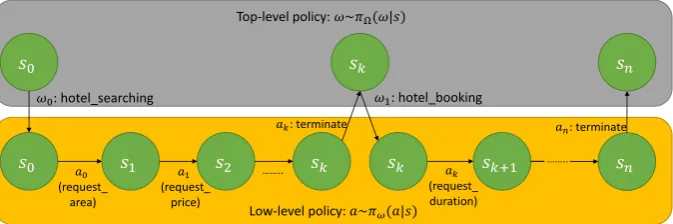
A composite task can be decomposed into a se-quence of sub-domains, which are also called op-tions. The composite task is accomplished when all these sub-domains are fulfilled. Following the options framework (Sutton et al., 1999), our dia-logue agent handles the composite task by design-ing two levels of policies in a hierarchical struc-ture, as shown in Figure1.
Top-level policy (Ê
·)
option ñ1è•:ñ O;
Low-level policy (ÊÓ)
dialogue action =1è := O;
Internal Evaluator
intrinsic reward NÜ
=
= extrinsic reward NØ dialogue states O
User
Dialogue Policy
dialogue action
[image:2.595.73.292.302.361.2]OáNØ ñ
Figure 1: Overview of our dialogue policy.
In this hierarchical policy framework,Sdenotes the dialogue state space,Ωthe option space, andA the action set. For a dialogue states∈ S, the top-level policyπΩ determines which option ω ∈ Ω should be chosen. Then, the policyπω determines
which primitive action a ∈ A should be chosen in option ω for s. As shown by the example in Figure2, a primitive action is an action lasting for one time step, while an option is an action last-ing several time steps. For eachs, a dialogue ac-tion, which is a primitive acac-tion, is returned to the user. The dialogue system will receive an extrin-sic reward re and a new belief state s0. An opti-mal policyπ∗maximizes the expected discounted return Gt = Eπ,P[P∞k=0γkre,t+k+1|st] at every
time stept, wherePis a transition probability ker-nel,γ ∈ [0,1]is a discount factor, andre,t0 is the extrinsic reward obtained at stept0.
Figure2shows an example of the execution of our hierarchical dialogue policy in a dialogue do-main about hotel room reservation. This dodo-main comprises two sub-domains, i.e., searching for a hotel and booking a hotel room. In this exam-ple, we assume that the dialogue system has prior knowledge regarding these sub-domains. In this paper, we propose a dialogue framework that can autonomously discover such sub-domains.
3 Autonomous Sub-Domain Modeling
An option is defined as 3-tupleω =hIω, πω, βωi,
whereIω ⊆ S is the initiation set of states where ω can be chosen, πω : S × A → [0,1] is the
policy of ω, and β : S → [0,1]is the termina-tion conditermina-tion of ω. To autonomously discover options and learn their policies, we proposed to in-tegrate option-critic (OC) (Bacon et al.,2017) and proto-value functions (PVFs) (Mahadevan,2007;
Machado et al.,2017) into a unified framework.
3.1 Option-Critic Architecture
OC is a gradient-based approach for simultane-ously learning intra-option policiesπω and termi-nation functions βω. It learns options gradually
from its interactions with environment. It uses op-tion value funcop-tionQΩ(s, ω)defined as follows.
QΩ(s, ω) = X
a
πω(a|s)QU(s, ω, a)
QU(s, ω, a) =r(s, a) +γ
X
s0
P(s0|s, a)U(ω, s0)
U(ω, s0) = (1−βω(s0))QΩ(s0, ω) +βω(s0)VΩ(s0)
QU(s, ω, a) is the value of executing an action in the context of a state-option pair, and U(ω, s0)is the utility froms0 onwards, given that we arrive in
s0usingω. We parameterizeπωbyθandβωbyϑ. The learning algorithm of OC involves two steps:
• options evaluation: updating QΩ and QU with temporal difference errors; and
• options improvement: updating θ with ∂QΩ
∂θ
andϑwith ∂QΩ
∂ϑ .
To obtain policyπΩover options, we combine OC with intra-option Q-learning (Sutton et al.,1999). Hereinafter, this combination is denoted as HRL-OC.
HRL-OC optimizes the options and their poli-cies for maximizing the cumulative extrinsic re-ward. It is focused less on discovering meaning-ful options (Bacon et al.,2017), which may result in unnatural sub-domains in a successful conver-sation. To tackle this issue, we use PVFs, which are capable of capturing the geometry of the state space, to discover meaningful sub-domains.
3.2 Proto-Value Functions as Options
O4
O4 O5 O6 OÞ
OÞ
OÞ OÞ>5 Oá
Oá Top-level policy: ñ1è•:ñ O;
Low-level policy: =1è := O;
ñ4: hotel_searching ñ5: hotel_booking
=4 (request_
area)
=5 (request_
price)
YYXX =Þ: terminate
=Þ (request_ duration)
[image:3.595.132.469.63.175.2]YYXX =á: terminate
Figure 2: An example of the execution of our hierarchical dialogue policy in hotel reservation domain. At timet= 0andt=k, given the belief statest, top-level policyπΩtakes optionsω0andω1, respectively. ω0lasts forkturns until its policyπωi takes terminate action, whileω1lasts forn−kturns.
further demonstrated that PVFs implicitly define options. PVF-based option discovery extracts op-tions from the topology structure of the state space and is capable of providing denseintrinsicrewards for each option. The discovery process is given be-low.
Given a set of sampled state transitions, we con-struct an adjacency matrixW between belief states using Gaussian kernel. Then, we apply eigen-decomposition to the combinatorial graph Lapla-cian of W. Each eigenvector (i.e. PVF)eω
cor-responds to an option with intrinsic reward func-tion rωi (s, s0) = eω[s0]−eω[s]for a state
transi-tion fromstos0. Since our dialogue system has continuous belief states, we interpolate the value of eigenvectors to novel states using Nystr¨om ap-proximation (Mahadevan, 2007). The number of generated intrinsic reward functions is equal to the number of dialogue states inW, but we used intrinsic reward functions from eigenvectors with the smallest eigenvalues.
An option ω, which corresponds to an eigen-vectoreω, can be interpreted as a desire to reach
a belief state s that has the highest value of
eω[s](Machado et al., 2017). In our experiment,
such a state usually represents a dialogue goal or a state where user’s inherent sub-domain changes (e.g. user starts the booking sub-domain once she finds the hotel satisfying her requirements).
3.3 Policy Learning with Intrinsic Rewards
To realize a dialogue framework that can dis-cover effective and meaningful sub-domains, we feed PVFs into HRL-OC, then follows HRL-OC’s learning procedure. Here, PVFs act as an inter-nal evaluator of the dialogue policy. We formu-late the r(s, a) in QU to be r(s, a) = αriω + (1−α)re. Hereinafter, this model is denoted as
OC PVF. We can regard OC as HRL-OC PVF withα= 0.
We also introduce alternative dialogue frame-works by applying the intrinsic rewards from PVFs directly to HRL algorithms. We train each policy πω in HRL using a specific intrinsic re-ward function rωi. We implemented the hier-archical deep Q-networks (HRL-DQN; Kulkarni et al. (2016)), and policy gradient-DQN (HRL-PG DQN), i.e., REINFORCE (Williams,1992) as the top-level policy and DQN low-level policy. This assesses whether using only general-purpose intrinsic rewards, which are designed for explo-ration, is good for maximizing extrinsic rewards.
4 Experimental Setup
We conducted three evaluations on (i) the effec-tiveness of our autonomous sub-domain ing compared to the manual sub-domain model-ing, (ii) the performance difference between flat RL (i.e. without modeling) and the HRL with au-tonomous modeling, and (iii) the impact of using PVFs in discovering meaningful sub-domains.
4.1 Dialogue Domain
Following the setting in Budzianowski et al.
• State: the belief states∈ Swith 239 dimen-sions that captures distribution over user’s in-tents and requestable slots
• Action set A: 44 dialogue actions, which consists of 8 slot-independent actions and 36 slot-dependent actions.
• Reward: -1 at each turn, and 0 or 20 (failed or success dialogue) at the end of dialogue
• Discount factorγ: 0.95
• Maximum number of turns: 30
4.2 User Simulator
We used an agenda-based user simulator ( Schatz-mann et al.,2007) with which the belief states per-fectly capture the user intent. At the start of each dialogue, the simulated user randomly sets its goal that consists of searching for a hotel and either booking it or paying for it. User will proceed to the booking or payment sub-domain only after achiev-ing the goal of the hotel searchachiev-ing sub-domain.
At the beginning of each sub-domain execution, the user’s goal for that sub-domain is randomly generated using database. The agenda is popu-lated by converting all goal constraints into in-formacts, and all goal requests into requestacts. For instance, inform(price=moderate)indicates a user requirement, and request(address) indicates the user asking for the address of the hotel returned by the system. Furthermore, in different dialogue episodes, the simulated user might convey its re-quirements (i.e. slot values) within a sub-domain to the dialogue system in different orders.
4.3 Dialogue Frameworks
Implementation As the benchmarks without
sub-domain, we used flat RL algorithms (i.e. DQN, and PG with REINFORCE). For the bench-mark with manual modeling, we used the frame-work introduced by Budzianowski et al. (2017), which utilized hierarchical Gaussian Process RL (HRL-GP).
All deep (flat and hierarchical) RL agents con-sist of 2 hidden layers (150 units in layer 1, and 75 (70 for PG) in layer 2). We used Adam optimizer, a mini-batch size of 32, and-greedy strategy for
exploration. In HRL-DQN and HRL-PG DQN
agents, top-level and low-level policies have sepa-rate policy networks, each of which has 2 hidden layers as specified above. In these agents, the low-level policies share the same policy network.
Dur-ing execution, we pass the information of the op-tion taken by the top-level policy to the low-level policy network. In HRL-OC and HRL-OC PVF agents, the policy, the criticQΩ, and the termina-tion networks share the same 2 hidden layers, but each of them has its own output layer.
For discovering PVFs, we generated state tran-sition samples using hand-crafted rules (Ultes et al.,2017). We sub-sampled 1,000 unique states using trajectory sampling, and builtW from them.
Prior Knowledge In the manual sub-domain
modeling, the agent has two types of prior knowl-edge as follows.
• sub-domains comprising a dialogue (i.e. ho-tels, booking, payment).
• a valid action set for each sub-domain.
All sub-domains share the same 8 slot-independent actions, but each of them has its own slot-dependent actions.
To assess the impact of each type of prior knowl-edge, we implemented an HRL-GP framework that uses both types of knowledge and its vari-ant HRL-GP2 that uses only sub-domain infor-mation. Both frameworks have separated policies to handle each sub-domain, but HRL-GP2 deals with a more complex situation since it has to se-lect an action from the union of actions sets from all sub-domains, that is 44 dialogue actions in to-tal. Unlike HRL-GP and HRL-GP2, our frame-works with autonomous modeling (HRL-DQN, HRL-PG DQN, HRL-OC, HRL-OC PVF) cannot access any prior knowledge. They initially per-ceive dialogues as a single domain problem and attempt to discover the meaningful sub-domains.
Evaluation We trained each policy in the frame-works for 30 iterations, each of which consists of 200 episodes. In the end of each iteration, we eval-uated the performance of the models using 200 episodes. The metric we used for evaluation is the average success rate (SR) of dialogues.
Benchmark SR(%) Our framework SR(%)
FlatRL (DQN) 66.9 HRL-DQN 49.6
FlatRL (PG) 62.0 HRL-PG DQN 51.0
HRL-GP 84.8 HRL-OC 73.4
HRL-GP2 75.9 HRL-OC PVF 72.1
(a) SR of different frameworks (b)HRL-OC PVFw/ different # of options (c) HRL-OC PVF with differentα
Figure 3: Learning curves of different dialogue frameworks
5 Experimental Results
5.1 Success Rate
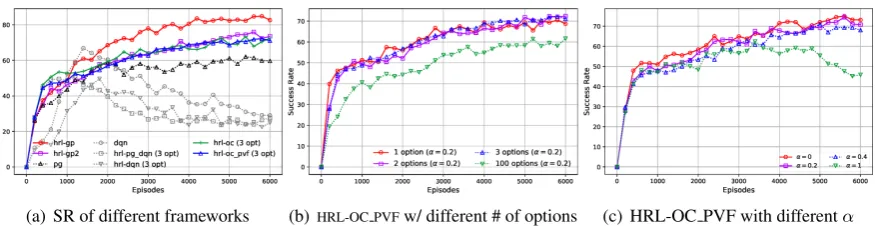
The experimental results are shown in Table1and Figure 3. First, the flat RL, which is a DQN, achieved an SR of up to 66.9%, but it was unsta-ble. The more stable flat framework, PG, obtained 62%. Our frameworks with autonomous modeling (HRL-OC and HRL-OC PVF) outperformed flat RL significantly. However, DQN and HRL-PG DQN performed worse than flat RL. This sug-gests that using only intrinsic rewards from PVFs is not adequate for constructing sub-domains that are effective in accumulating extrinsic rewards. Since HRL-OC optimizes its options for maxi-mizing the accumulated extrinsic reward, it has a better SR compared to DQN and HRL-PG DQN, which did not use any extrinsic rewards. The frameworks with manual modeling, i.e. HRL-GP and HRL-GP2, reached an SR of 84.8 and 75.9%, respectively. One of the frame-works with autonomous modeling (i.e. HRL-OC) achieved up to 73.4%. Note that, in HRL-OC, all primitive actions are used for each option, which is the same as HRL-GP2. Although HRL-OC does not have any prior knowledge about sub-domains in a dialogue, it is competitive with the framework with strong supervision on sub-domains. This in-dicates that HRL-OC is able to learn effective sub-goals in a composite-task dialogue.
As shown in Figure 3, learning curves of dif-ferent dialogue frameworks are examined. Fig-ure 3(a) shows that HRL-OC and HRL-OC PVF have steeper learning curves than HRL-GP in the first 1000 episodes, which indicates that our frameworks can shorten learning time. Figure3(b)
reports that the use of 2 or 3 options is optimal. Using too many options is harmful because the agent will require more episodes to learn the opti-mal policy over options. Figure3(c)shows the
ef-fect of the interpolation ratioαfor combining both
extrinsic and intrinsic rewards on the SR. How-ever, PVFs seem ineffective with respect to SR. To haveα > 0 reduces the SR of HRL-OC PVF with 3 options.
5.2 Discovered Sub-domains
According to our observation, the HRL-OC PVF with α = 0.2, however, discovered more mean-ingful sub-domains than HRL-OC. To assess the meaningfulness of the discovered sub-domains, we examined how similar these sub-domains to those inherent in the user’s agenda. We judge the similarity using the average dialogue turn distance between the turn when the user simulator enters a sub-domain and that when the agent switches sub-domains. The ideal case is to have a turn dis-tance of 1, i.e., once a user enters a sub-domain, the agent responds by switching the active option in the next turn. Table2shows that compared to HRL-OC, the integration of PVFs results in sub-domains whose boundaries are similar to those of the user’s sub-domains.
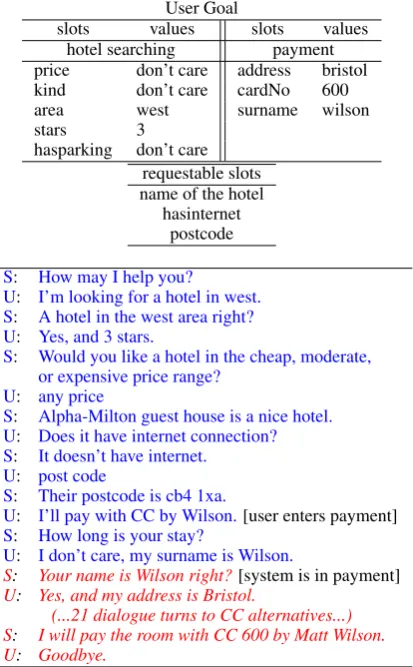
Table3shows that the integration of PVFs into HRL-OC makes the agent capable of changing the active domain soon after the user enters a sub-domain. This indicates that PVFs can detect in-teresting belief states. In our further examination, PVFs successfully discover states that indicate di-alogue goal, sub-task switching, and request of al-ternatives from the sampled transitions.
Agents i
th iteration
1 2 3 4 5
HRL-OC 2.8 2.8 4.0 3.9 5.3
HRL-OC PVF (α= 0.2) 2.6 2.5 3.0 2.8 2.8 HRL-OC PVF (α= 0.4) 2.9 3.0 3.4 3.2 3.9
User Goal
slots values slots values
hotel searching payment
price don’t care address bristol
kind don’t care cardNo 600
area west surname wilson
stars 3
hasparking don’t care requestable slots name of the hotel
hasinternet postcode
S: How may I help you?
U: I’m looking for a hotel in west.
S: A hotel in the west area right?
U: Yes, and 3 stars.
S: Would you like a hotel in the cheap, moderate,
or expensive price range?
U: any price
S: Alpha-Milton guest house is a nice hotel.
U: Does it have internet connection?
S: It doesn’t have internet.
U: post code
S: Their postcode is cb4 1xa.
U: I’ll pay with CC by Wilson.[user enters payment]
S: How long is your stay?
U: I don’t care, my surname is Wilson.
S: Your name is Wilson right?[system is in payment]
U: Yes, and my address is Bristol.
[image:6.595.80.287.63.397.2](...21 dialogue turns to CC alternatives...) S: I will pay the room with CC 600 by Matt Wilson. U: Goodbye.
Table 3: Sample dialogue by HRL-OC PVF (S: agent, U: user). Different font styles and colors indicate different sub-domains activated by agent.
5.3 Discussion
Our experiments show that our proposed frame-work outperforms the baseline, and is competi-tive with with the framework with manually de-fined sub-domains. Even though the experiments are done using a simulator, the simulated user pro-duces dialogue behavior realistic enough for train-ing and testtrain-ing. As mentioned in Section4.2, the simulated user specifies its requirements within a sub-domain to the dialogue system in a random or-der. In addition, the simulator may also not spec-ify several slot values. Such a behavior simulates a situation in which a human user forgets to specify some goal constraints.
In the experiments, the simulator has a con-straint, that is it executes the inherent sub-domains in a fixed order. The fixed order of sub-domains, i.e. hotel search and then followed by either book-ing or payment, can still simulate the real world conversational data, since an activity of reserv-ing a hotel room is commonly accomplished in
such order. In other tasks, however, a fixed or-der of inherent sub-domains may not simulate the real conversation well. Nevertheless, even when the order of the inherent sub-domains are not fixed, we suggest that our proposed frame-work could still discover options that imitate the inherent sub-domains. This holds when the in-herent sub-domains are executed sequentially, and the environment dynamics within each inherent sub-domain is invariant to the execution order of the sub-domains. Another challenging situation is when the inherent sub-domains are executed in an interleaved manner. This simulates a scenario in which a user frequently switches the active sub-domain before the current sub-sub-domain is fulfilled. A further investigation is required to examine the options discovered in such a situation.
6 Conclusion
We proposed a framework that autonomously dis-covers sub-domains for a composite-task dialogue. Experimental results shows that our framework with autonomous modeling is competitive with the framework with manually defined sub-domains. Analysis also showed that the integration of PVFs leads to meaningful sub-domains.
For future work, we consider the adjustment of the PVFs construction, such as the distance met-ric between states, the construction of the adja-cency matrix, and the use of successor representa-tion (Dayan,1993;Barreto et al.,2017). We may also need to further examine the discovered op-tions when the inherent sub-domains are executed in several different manners and orders. Finally, it is also interesting to investigate the effectiveness of reusing the learned options in other related dia-logue domains.
References
Pierre-Luc Bacon, Jean Harb, and Doina Precup. 2017.
The Option-Critic Architecture. InProceedings of the 31st AAAI Conference on Artificial Intelligence, pages 1726–1734, San Francisco, California, USA.
Andr´e Barreto, Will Dabney, R´emi Munos, Jonathan J. Hunt, Tom Schaul, David Silver, and Hado P. van Hasselt. 2017. Successor features for transfer in re-inforcement learning. InAdvances in Neural Infor-mation Processing Systems 30, pages 4058–4068, California, USA.
Rojas-Barahona, and Milica Gaˇsi´c. 2017. Sub-domain Modelling for Dialogue Management with Hierarchical Reinforcement Learning. In Proceed-ings of the 18th Annual SIGDIAL Meeting on Dis-course and Dialogue, pages 86–92, Saarbr¨ucken, Germany.
I˜nigo Casanueva, Paweł Budzianowski, Pei-Hao Su, Nikola Mrkˇsi´c, Tsung-Hsien Wen, Stefan Ultes, Lina Rojas-Barahona, Steve Young, and Milica Gaˇsi´c. 2017. A Benchmarking Environment for Reinforcement Learning Based Task Oriented Dia-logue Management.CoRR, abs/1711.1.
Heriberto Cuay´ahuitl. 2009. Hierarchical Reinforce-ment Learning for Spoken Dialogue Systems. Ph.D. thesis, University of Edinburgh.
Heriberto Cuay´ahuitl, Seunghak Yu, Ashley Williamson, and Jacob Carse. 2016. Deep Re-inforcement Learning for Multi-Domain Dialogue Systems. In Advances in Neural Information Processing Systems 29 Workshop on Deep Rein-forcement Learning, Barcelona, Spain.
Peter Dayan. 1993. Improving generalization for tem-poral difference learning: The successor representa-tion.Neural Computation, 5(4):613–624.
Thomas G. Dietterich. 2000. Hierarchical Reinforce-ment Learning with the MAXQ Value Function De-composition. Journal of Artificial Intelligence Re-search, 13:227–303.
M. Gasic, N. Mrksic, P. H. Su, D. Vandyke, T. H. Wen, and S. Young. 2016. Policy committee for adaptation in multi-domain spoken dialogue sys-tems. 2015 IEEE Workshop on Automatic Speech Recognition and Understanding, ASRU 2015 - Pro-ceedings, pages 806–812.
Milica Gaˇsi´c and Steve Young. 2014. Gaussian pro-cesses for POMDP-based dialogue manager opti-mization. IEEE Transactions on Audio, Speech and Language Processing, 22(1):28–40.
Tejas D. Kulkarni, Karthik R. Narasimhan, Ardavan Saeedi, and Joshua B. Tenenbaum. 2016. Hierarchi-cal Deep Reinforcement Learning: Integrating Tem-poral Abstraction and Intrinsic Motivation. In Ad-vances in Neural Information Processing Systems 29, pages 3675–3683, Barcelona, Spain.
Xiujun Li, Yun-Nung Chen, Lihong Li, Jianfeng Gao, and Asli Celikyilmaz. 2017. End-to-End Task-Completion Neural Dialogue Systems. In Proceed-ings of the Eighth International Joint Conference on Natural Language Processing, IJCNLP, pages 733– 743, Taipei, Taiwan.
Marlos C. Machado, Marc G. Bellemare, and Michael Bowling. 2017. A Laplacian Framework for Option Discovery in Reinforcement Learning. In Proceed-ings of the 34th International Conference on Ma-chine Learning, ICML 2017, pages 2295–2304, Syd-ney, NSW, Australia.
Sridhar Mahadevan. 2007. Proto-value Functions : A Laplacian Framework for Learning Representation and Control in Markov Decision Processes.Journal of Machine Learning Research, 8:2169–2231.
Volodymyr Mnih, Koray Kavukcuoglu, David Silver, Andrei A. Rusu, Joel Veness, Marc G. Bellemare, Alex Graves, Martin Riedmiller, Andreas K. Fidje-land, Georg Ostrovski, Stig Petersen, Charles Beat-tie, Amir Sadik, Ioannis Antonoglou, Helen King, Dharshan Kumaran, Daan Wierstra, Shane Legg, and Demis Hassabis. 2015. Human-level con-trol through deep reinforcement learning. Nature, 518(7540):529–533.
Ronald Parr and Stuart Russell. 1997. Reinforcement learning with hierarchies of machines. InAdvances in Neural Information Processing Systems 10, pages 1043–1049, Denver, Colorado, USA.
Baolin Peng, Xiujun Li, Lihong Li, Jianfeng Gao, Asli Celikyilmaz, Sungjin Lee, and Kam-Fai Wong. 2017. Composite Task-Completion Dialogue Pol-icy Learning via Hierarchical Deep Reinforcement Learning. InProceedings of the 2017 Conference on Empirical Methods in Natural Language Process-ing, EMNLP 2017, pages 2231–2240, Copenhagen, Denmark.
Jost Schatzmann, Blaise Thomson, Karl Weilhammer, Hui Ye, and Steve Young. 2007. Agenda-based user simulation for bootstrapping a pomdp dialogue sys-tem. InHuman Language Technologies 2007: The Conference of the North American Chapter of the Association for Computational Linguistics; Com-panion Volume, Short Papers, pages 149–152. As-sociation for Computational Linguistics.
Richard S. Sutton, Doina Precup, and Satinder Singh. 1999. Between MDPs and semi-MDPs: A frame-work for temporal abstraction in reinforcement learning.Artificial Intelligence, 112(1–2):181–211.
Stefan Ultes, Lina Rojas-barahona, Pei-Hao Su, David Vandyke, Dongho Kim, Paweł Budzianowski, and Nikola Mrksic. 2017. PyDial : A Multi-domain Sta-tistical Dialogue System Toolkit. In Proceedings of the 55th Annual Meeting of the Association for Computational Linguistics, ACL 2017, pages 73–78, Vancouver, Canada.
Jason D. Williams, Kavosh Asadi, and Geoffrey Zweig. 2017. Hybrid Code Networks: practical and effi-cient end-to-end dialog control with supervised and reinforcement learning. InProceedings of the 55th Annual Meeting of the Association for Computa-tional Linguistics, ACL 2017, pages 665–677, Van-couver, Canada.
R. J. Williams. 1992. Simple statistical gradient-following algorithms for connectionist reinforce-ment learning. Machine Learning, 8:229–256.