Proceedings of the Third Conference on Machine Translation (WMT), Volume 1: Research Papers, pages 165–176
Effective Parallel Corpus Mining using Bilingual Sentence Embeddings
Mandy Guoa∗, Qinlan Shenb†∗, Yinfei Yanga∗, Heming Gea, Daniel Cera, Gustavo Hernandez Abregoa, Keith Stevensa, Noah Constanta,
Yun-Hsuan Sunga, Brian Stropea, Ray Kurzweila
aGoogle AI
Mountain View, CA, USA
bCarnegie Mellon University Pittsburgh, PA, USA
Abstract
This paper presents an effective approach for parallel corpus mining using bilingual sen-tence embeddings. Our embedding models are trained to produce similar representations ex-clusively for bilingual sentence pairs that are translations of each other. This is achieved using a novel training method that introduces hard negatives consisting of sentences that are not translations but have some degree of se-mantic similarity. The quality of the result-ing embeddresult-ings are evaluated on parallel cor-pus reconstruction and by assessing machine translation systems trained on gold vs. mined sentence pairs. We find that the sentence em-beddings can be used to reconstruct the United Nations Parallel Corpus (Ziemski et al.,2016) at the sentence-level with a precision of 48.9% for en-fr and 54.9% for en-es. When adapted to document-level matching, we achieve a par-allel document matching accuracy that is com-parable to the significantly more computa-tionally intensive approach ofUszkoreit et al.
(2010). Using reconstructed parallel data, we are able to train NMT models that perform nearly as well as models trained on the orig-inal data (within 1-2 BLEU).
1 Introduction
Volumes of quality parallel training data are criti-cal to neural machine translation (NMT) systems. While large distributed systems have proven use-ful for mining parallel documents (Uszkoreit et al., 2010; Antonova and Misyurev, 2011), these ap-proaches are computationally intensive and rely on heavily engineered subsystems. Recent work has approached the problem by training lightweight end-to-end models based on word and sentence-level embeddings (Gr´egoire and Langlais, 2017; Bouamor and Sajjad, 2018; Schwenk, 2018). We propose a novel method for training bilin-gual sentence embeddings that proves useful for
∗equal contribution
†Work done during an internship at Google AI.
sentence-level mining of parallel data. Sen-tences are encoded using Deep Averaging Net-works (DANs) (Iyyer et al., 2015), a simple bag of n-grams architecture that has been shown to provide surprisingly competitive performance on a number of tasks including sentence classifica-tion (Iyyer et al.,2015;Cer et al.,2018), conversa-tion input-response predicconversa-tion (Yang et al.,2018), and email response prediction (Henderson et al., 2017). Separate encoders are used for each lan-guage with candidate source and target sentences being paired based on the dot-product of their em-bedded representations. Training maximizes the dot-product score of sentence pairs that are trans-lations of each other at the expense of sampled negatives. We contrast using random negatives with carefully selected hard negatives that chal-lenge the model to distinguish between true trans-lation pairs versus non-transtrans-lation pairs that ex-hibit some degree of semantic similarity.
The efficiency of the sentence encoders and the use of a dot-product operation to score candidate sentence pairs is well suited for parallel corpus mining. Efficient encoders reduce the amount of computational resources required to obtain sen-tence embeddings for a large collection of un-paired sentences. Once the sentence embeddings are available, efficient nearest neighbour search (Vanderkam et al.,2013;Johnson et al.,2017) can be used to identify candidate translation pairs.
The language pairs English-French (en-fr) and English-Spanish (en-es) are used in our experi-ments. Our results show that introducing hard neg-ative sentence pairs, which are semantically simi-lar but that are not translations of each other, sys-tematically outperforms using randomly selected negatives. Our method can be used to reconstruct the United Nations Parallel Corpus (Ziemski et al., 2016) at the sentence-level with a level of preci-sion of 48.9% P@1 for en-fr and 54.9% P@1 for en-es. When we adapt our method to
level pairings we achieve a matching accuracy that is comparable to that of the much heavier weight and more computationally intensive approach of Uszkoreit et al.(2010). Training an NMT model using the reconstructed corpus results in models that perform nearly as well as those trained on the original parallel corpus (within 1-2 BLEU). Finally, our method has a modest degree of cor-relation with the pair quality scores provided by Zipporah (Xu and Koehn, 2017). However, our method has higher agreement with human judg-ments, and our approach to filter the ParaCrawl corpus results in NMT systems with higher BLEU scores.
2 Approach
This section introduces our bilingual sentence em-bedding model and the translation candidate rank-ing task we use for trainrank-ing. We then present our method for selecting hard negative sentence pairs that are not translations of each other but have some degree of semantic similarity. Finally, we detail the use of our bilingual sentence em-beddings to search for sentences that are transla-tions of each other, as well as an adaptation to the matching process to parallel documents.
2.1 Translation Candidates Ranking Task Given a pair of sentences that are translations of each otherxandy, the translation candidate rank-ing task attempts to rank the true translationyover all other sentences,Y, in the given language. This can be accomplished by modeling the translation probability distributionP(y|x). Provided with a scoring functionφthat assesses the compatibility betweenxandy, the distribution can be expressed as the following log-linear model:
P(y|x) = e
φ(x,y) P
¯
y∈Yeφ(x,y¯)
(1)
To avoid summing over all possible target sen-tences, the normalization term is approximated by summing over the compatibility score for match-ingxtoK−1sampled negatives together with the compatibility score for the positive candidate:
Papprox(y|x) =
eφ(x,y)
PK
k=1eφ(x,yk)
(2)
This formulation is similar to early work on dis-criminative training of log-linear translation de-coding models (Och and Ney, 2002). However,
rather than using a weighted sum of manually engineered features, we define φ to be the dot-product of sentence embeddings for the source,u,
and target, v, with φ(x, y) =u>·v. A similar log-linear sentence embedding based formulation of P(y|x) has been previously used for conver-sation and e-mail response prediction (Henderson et al.,2017;Yang et al.,2018).
2.2 Bilingual Sentence Embeddings
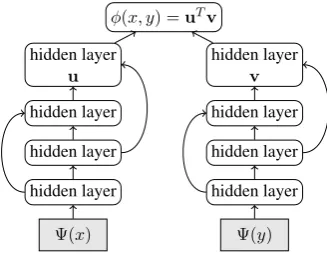
Bilingual sentence embeddings are obtained us-ing the dual-encoder architecture illustrated in Figure 1. We use Deep Averaging Networks (DANs) (Iyyer et al.,2015) to compute sentence-level embedding vectors by first averaging word and bi-gram level embeddings, denoted as Ψ(x) andΨ(y), for the source and target sentences, re-spectively. 1 The word and bi-gram level
embed-dings are not pretrained but are rather learned dur-ing traindur-ing of the sentence encoders. The aver-aged representation is provided to a feedforward deep neural network (DNN). Across hidden layers we include residual connections with a skip level of1. The final bilingual sentence embeddings are
u andv, which are taken from the last layer of
the source and target encoders, respectively. The dot-product of the sentence embeddings,uT·v, is
used to compute the translation score,φ(x, y).
Ψ(x) Ψ(y)
hidden layer hidden layer hidden layer hidden layer
u
hidden layer hidden layer hidden layer hidden layer
[image:2.595.332.496.454.581.2]v φ(x, y) =uTv
Figure 1: Dual-encoder architecture, where a group of hidden layers encodes source sentencexto uand a sepa-rate group encodes target sentenceytovsuch that the score
φ(x, y)is the dot-productuT
·v.
The dual-encoders are trained for the translation candidate ranking task by maximizing the log like-lihood of Papprox. This objective is particularly
1Our implementation sums the word and bi-gram
embed-dings and then divides the result bysqrt(n), wherenis the
sentence length. The intuition behind dividing bysqrt(n)
Source (Target) Negatives
en-fr
Random Sa respiration devient laborieuse
How to display and access shared files Benoit Faucon Lieu London
(Comment afficher et acc´eder aux fichiers partag´es) Hard Acc`es l’environment des fichiers partag´es Des ´el´ements comme des fichiers de dossiers
Random RCS 871, o`u le juge Fauteux explique
The General Delegation for Armaments Avis sur les hˆotels
(La d´el´egation g´en´erale pour l’armement) Hard La 9e arm´ee , command´ee par le g´en´eral Foch La d´el´egation militaire hongroise compos´ee de ...
en-es
Random Alquiler mensual desde : 890 USD
Oil and gas investments ¿Qu´e m´as se deja para preguntar? (Inversiones en petr´oleo y gas) Hard Petr´oleo y gas
Petr´oleo y Gas Petroqu´ımica p´agina
Random Ve el perfil completo de Fleishman
In Spain, it has clearly chosen the gratuity Le´on de monta˜na en roca
[image:3.595.74.537.60.238.2](En Espa˜na, se ha elegido claramente la gratuidad) Hard Dejar propina es una costumbre chilena Este es un t´ıpico restaurante espa˜nol de Espa˜na
Table 1: Example of random negatives and hard negatives for en-fr and en-es.
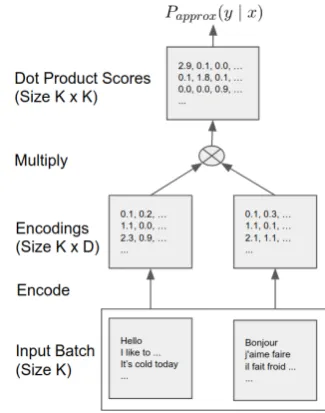
well suited for mini-batch training. As illustrated in Figure 2, within a batch, each source and tar-get translation pair serves as a positive example for that particular pairing with alternative pairings within the same batch treated as negative exam-ples. Given an ordered collection of embeddings for source and target translation pairs, all of the dot-product scores necessary to computePapprox
can be determined using a single matrix multipli-cation of the encoding matrices,UandV>.2
Af-ter the matrix multiplication the scores assigned to true translation pairs can be found on the di-agonal while the scores for incorrect pairings are off-diagonal.
Within our experiments, models differ in their selection of the K − 1 sampled negatives. Our preliminary models make use of the random sam-pling strategy that has been proven successful in prior work (Henderson et al., 2017; Yang et al., 2018). Using this strategy consists of randomly composing batches of translation pairs and us-ing the matrix multiplication approach described above to obtain within batch negatives for each in-correct pairing We employ random shuffling dur-ing traindur-ing resultdur-ing in different random negatives for each ui across epochs. As described below
we also explore introducing additional hard neg-atives. This is achieved by extending the target embeddings matrix V with the sentence
embed-dings for the hard negatives, which introduces ad-ditional off-diagonal values within the matrix of dot-product scores.
2The encoding matrices are composed of the ordered
sentence embeddings for all of the source and target sen-tences within a batch,U = (u0,u1, ...,uk−1) and V = (v0,v1, ...,vk−1).
Figure 2: Matrix multiply trick for dot product model with random sampling.
[image:3.595.331.494.279.486.2]perfor-mance might even be harmed by including seman-tically similar sentences with sufficient differences in meaning between them.3
We improve the mining of true translation pairs by making model training more challenging through the introduction of hard negatives – se-mantically similar translations that are close but not quite identical to the correct translation. The hard negatives are selected using a baseline model trained with randomly sampled negatives. For each source sentence, we identify M hard nega-tives with target embeddings that achieve high dot-product scores with the source sentence embed-ding but that are not the correct translation. Exam-ples of hard negatives extracted using the baseline model are provided in Table1. Compared to the random negatives, hard negatives are semantically more similar to the correct target translation.
As described above, the hard negatives are ap-pended to the target embedding matrixV.
There-fore, instead of training withK candidates, each translation input will be compared withK+K∗M candidates, whereK is the batch size. In practice, getting hard negatives for the entire dataset is very time consuming. We only obtain hard negatives for20%of the data and use random negative sam-pling for the remainder of the training set.
2.4 Mining Parallel Data
One approach to mining parallel data with bilin-gual sentence-level embeddings is to indepen-dently pair individual source and target candidates based on the similarity of their embeddings. Prior work that explored this approach found that the re-sulting mined sentence pairs produced poor BLEU scores when used for MT training unless they were combined with traditional human translated corpora with known alignments (Schwenk,2018). We explore both sentence-level and level mining of parallel corpora. For document-level mining, we introduce a novel selection crite-rion that takes into account the confidence of sen-tence alignments within a document and sensen-tence position information.
2.4.1 Document Matching
Parallel documents are identified as follows: For a given source document, we first run an approxi-mate nearest neighbor (ANN) search for each sen-tence in the document. This gives usNtarget
sen-3e.g., adding or removing important details according to
the sentence similarity scale proposed byAgirre et al.(2012).
tences for each source sentence (ranked in order of closest match). Let Y be the bag of all tar-get sentences that appear as a match for at least one source sentence. Then for each sentence in Y, we look up the document from which they came. We score each candidate document using Eq3.4This scoring function takes into account the
sentence-level nearest neighbor rank of the match for source sentence x to target sentencey in the document being scored, r(x, y). The match rank is linearly combined with a normalized confidence score,f1(x, y), for the match betweenxandy as well as the absolute difference between the tence position index of the source and target sen-tences,f2(x, y). The sum of the scoring terms is weighted by the hyperparameters,w1 andw2.
X
y∈D∩Y
−r(x, y) +w1∗f1(x, y) +w2∗f2(x, y)
(3) 2.4.2 Calibrated Confidence Score
The raw dot product score, φ(x, y), is a poor choice for the confidence score, f1(x, y). The score fromφ(x, y) provides a relative metric of a translated sentence’s match quality with respect to the source sentence, but it is not a globally consis-tent measurement of how good a translation pair is. Scores are not necessarily in the same range nor do they have comparable relative values for different input source sentences. As a result, if we chooseφ(x, y)to score confidence, there is no sin-gle threshold we can use to filter out bad results.
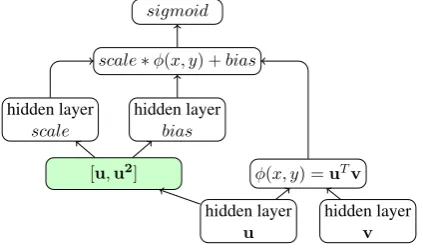
In order to obtain more consistent confidence scores, we propose a novel score normalization model based on dynamic scaling and shifting of the dot product scores. As illustrated in Figure3, the dynamic scaling and shifting values are com-puted from the source embedding,u, and a
point-wise squaring of the values within the source em-bedding, u2. The vectors u andu2 are concate-nated. The scale and bias terms are computed as
4Selecting the target document that appears the most in
a weighted sum of the concatenated vectors val-ues. After the dynamic scaling and bias terms are used to calibrate the dot-product score, the result-ing calibrated dot-product is passed to a sigmoid in order to obtain a final confidence value between 0 and 1. The weights used to compute the scale and bias terms are trained on held out supervised data.
hidden layer u
hidden layer v φ(x, y) =uTv
[u,u2] hidden layer
scale
hidden layer bias scale∗φ(x, y) +bias
[image:5.595.75.287.182.306.2]sigmoid
Figure 3: Scoring model based on dual-encoder architec-ture.
It is worth noting that because the hidden lay-ers forscale andbiasonly use features from the source embeddings, it will not affect the ranking of targets. Thus, we still always use dot-product similarity, φ(x, y), to retrieve targets via nearest neighbor search. For document-level matching, we convert the dot-product values into the cali-brated confidence scores, f1(x, y), without need-ing to reinspect the target embeddneed-ings.
3 Experiments
We train our proposed model on two language pairs: English-French (en-fr) and English-Spanish (en-es). First, we evaluate the performance on the translation candidate ranking task, comparing the dual-encoder architectures with random negative sampling versus using hard negatives. Then, we present results for document-level matching using Uszkoreit et al.(2010)’s method as a strong base-line. We explore training NMT systems using our method to both filter and re-construct parallel cor-pora. Finally, we assess the level or agreement be-tween our method and human judgments.
3.1 Data
For training the model, we construct a parallel corpus using a system similar to the approach described in Uszkoreit et al. (2010). The final constructed corpus contains around 600M en-fr sentence pairs and 470M en-es sentence pairs.
To assess the quality of the parallel corpus, we ask human annotators to manually evaluate the constructed pairs. The human annotators judge whether 200 randomly selected sentence pairs for both en-fr and en-es are GOOD or BAD transla-tions. We find that the GOOD translation rate is around 80% for both language pairs. The con-structed parallel corpus is split into two parts: a training set (90%) and a held-out dev set (10%), with the held-out dev set being used for our pre-liminary reconstruction experiments.
The UN corpus (Ziemski et al.,2016) is used for additional corpus reconstruction experiments. The corpus consists of 800k manually translated UN documents from 1990 to 2014 for the six official UN languages. 86k of these documents are fully aligned at the sentence-level for all 15 language pairs. We make use of the fully aligned en-fr and en-es document pairs and extract all aligned sen-tence pairs from those document pairs. There are a total of 11.3 million aligned sentence pairs each for en-fr and en-es. Assuming that we have no knowledge about which documents and sentences are aligned, the task is to reconstruct the document and sentence pairs.
We evaluate trained translation models on wmt13 (Bojar et al., 2013) and wmt14 (Bojar et al., 2014) for en-es and en-fr, respectively. Translation models are trained using data taken from the parallel corpus described above that was constructed using Uszkoreit et al. (2010)’s method. Additional translation experiments make use of ParaCrawl5, a dataset containing 4 billion
noisy translation pairs for en-fr and 2 billion pairs for en-es. Within Paracrawl, each pair contains pre-computed scores by Zipporah (Xu and Koehn, 2017) and the Bicleaner tool, which estimates the translation quality of the pair. We make use of the Zipporah scores to compare translation models trained on filtered versions of the corpus selected using Zipporah versus our method.
3.2 Experimental Configuration
Model configuration and hyperparameters for our sentence embedding models are set mostly based on defaults taken from prior work with very min-imal tuning on the held-out dev set. For each lan-guage, we build a vocabulary consisting of 200 thousands unigram and 200 thousands bi-gram to-kens. All inputs are tokenized and normalized
fore being fed to the model. We employ an SGD optimizer with a batch size of 128. The learning rate is set to 0.01 with a learning decay of 0.96 ev-ery 5 million steps. We train for 50 million steps.
For each encoder layer, we employ a four-layer DNN model which contains 320, 320, 500 and 500 hidden units for each layer respectively. We apply a ReLU activation in the first three layers and no activation in the final layer. We enable residual connections between layers with a skip level of 1. There is no parameter sharing between the source and target encoder layers. The size of the unigram and bi-gram embeddings is set to 320 and the em-beddings are updated during the training process. The sentence embedding size is set to 512 for both source and target languages.
The calibrated confidence score is trained jointly with the translation candidate ranking task but with a stop gradient that prevents the con-fidence task from modifying the bilingual sen-tence encoders. The tasks are trained in a mul-titask framework with multiple workers, where 90% of the workers optimize the translation can-didate ranking task and the remaining 10% opti-mize the confidence task. We use the same config-uration for confidence as when training the trans-lation candidate ranking task. Both use the same batch size 128, meaning there is 1 positive and 127 negative candidates selected for each pass over an example. We apply a dropout of 0.4 before feed-ing the feature vector[u,u2]into the hidden layers that calculatescaleandbias.
3.3 Dev Set Sentence-level Matching
We first evaluate the trained models on the trans-lation target retrieval task and use precision at N (P@N) as our evaluation metric. For every source sentence in the dev set, we run the model and find the nearest neighbors from a set of possible tar-get sentences. Previous work (Henderson et al., 2017;Yang et al., 2018) usually evaluated P@N from 100 examples (1 positive and 99 negatives). We find that this does not work well for the trans-lation target ranking task. Rather, the P@N of 100 metric goes up to 99.9% quickly and provides no differentiation between models trained with differ-ent configurations.
In this work, we evaluate the P@N from the true target sentence (positive) and 10 million ran-dom selected target (negatives) given a source sen-tence. We score all selected targets using the
trans-lation pair scoring model and rank them accord-ingly. The P@N score evaluates if the true trans-lation target (positive) is in the top N target candi-dates. We evaluate the model with random sam-pling and M hard negatives for M=5, 10, 20. Recall that the number of negatives is equal to the batch size for the models trained with random sampling. The number of negatives for hard neg-ative models, however, isK +K ∗M whereK is the batch size. To make a fair comparison, we also evaluate a model trained with additional dom samples, by augmenting the number of ran-dom negatives toK+K∗20.
Table2shows the P@N results of the proposed models for N=1, 3, 10. The model with random negatives provides a strong baseline for finding the right translation target, with a P@1 metric of 70.49% for en-fr and 67.81% for en-es. The aug-mented random negative model performs better than the base random negative model for en-es. However, the hard negative models outperform the random negative models across all metrics. Even with only 5 hard negatives, the P@1 metrics im-proved by 8% for en-fr and 3% for en-es. The ad-dition of more hard negatives, however, does not always further improve performance.
4 Reconstructing the United Nations Corpus
In this section, we demonstrate that the proposed model can be used to efficiently reconstruct the United Nations (UN) Parallel Corpus (Ziemski et al.,2016).
4.1 UN Sentence-level Matching
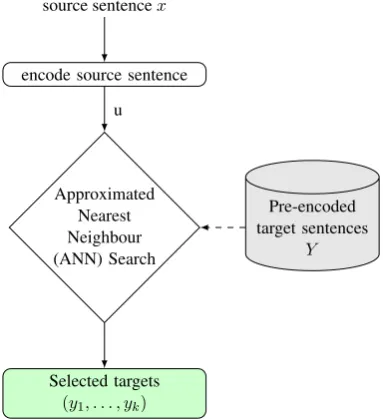
We first apply the dual-encoder model to mine target candidates at the sentence-level. As men-tioned in section 1, one of the advantages of the dual-encoder model is that it is straightforward to use it to encode the source and target sen-tences separately. Taking advantage of this prop-erty, we first pre-encode all target sentences into a target database, and then we iterate through the source sentences to retrieve the potential targets for each one of them using an approximated near-est neighbour (ANN) search (Vanderkam et al., 2013). The target sentence retrieval pipeline us-ing ANN search is shown in Figure4.
Negative Selection Approach P@1 P@3en-fr P@10 P@1 P@3en-es P@10
Random Negatives 70.49 80.03 86.39 67.81 77.37 84.42
Random Negatives (Augmented) 70.67 79.99 86.14 70.47 79.79 86.33
(5) Hard Negatives 78.31 85.30 89.52 73.46 82.37 87.75
(10) Hard Negatives 77.06 84.04 88.70 74.92 83.29 88.14
[image:7.595.109.491.62.159.2](20) Hard Negatives 78.29 85.06 89.58 74.84 82.86 88.23
Table 2: Precision at N (P@N) results on the evaluation set for models built using the random negatives and (M) hard negatives. Models attempt to select the true translation target for a source sentence against 10M randomly selected targets.
source sentencex
encode source sentence
Approximated Nearest Neighbour (ANN) Search
Pre-encoded target sentences
Y
Selected targets
(y1, . . . , yk)
[image:7.595.84.276.232.442.2]u
Figure 4: Target sentence retrieval pipeline.
hard negative model with 20 hard negatives for each example. As shown in table 3, with ran-dom negatives, the P@1 metric is 34.83% for en-fr and 44.89% for en-es. Adding hard negatives boosts the performance on all metrics, improving the P@1 metric more than 10% absolute in both en-fr and en-es – 48.9% for en-fr and 54.9% for en-es.
4.2 UN Document-level Matching
In our final reconstruction experiment, we make use of the document-level matching method out-lined in section 2.4.1. The hyperparameters N, w1, andw2 are set to10,5, and−2, respectively, based on prior experiments with the translation matching task on the dev set. We compare using the document matching score proposed by Eq. (3) to scoring document pairs by counting the num-ber of Viterbi aligned sentences linking the two together. As a strong baseline, we also include the
application ofUszkoreit et al.(2010)’s method to the UN dataset.
Table 4shows the document matching accura-cies. Using Eq. (3) to score document matches outperforms counting mutually aligned sentences. Moreover, while our approach is simpler and less computationally intensive than Uszkoreit et al. (2010)’s, it obtains a promising level of perfor-mance.
5 Evaluation Using a Translation Model
As a proof of concept on using our mined trans-lation pairs as training data, we train transtrans-lation models with original versus mined parallel sen-tence pairs from UN corpus, and with filtered ParaCrawl data using Zipporah score versus us-ing our model’s confidence score. We evaluate on wmt13 (Bojar et al., 2013) and wmt14 (Bo-jar et al., 2014) testing sets for es and en-fr, respectively, with performance assessed using BLEU (Papineni et al.,2002).
Negative Selection Approach P@1 P@3en-fr P@10 P@1 P@3en-es P@10
Random Negative 34.83 47.99 61.20 44.89 58.13 70.36
Random Negative (Augmented) 36.51 49.07 61.37 47.08 59.55 71.34
[image:8.595.111.487.62.132.2](20) Hard Negative 48.90 62.26 73.03 54.94 67.78 78.06
Table 3: Precision at N (P@N) of target sentence retrieval on the UN corpus. Models attempt to select the true translation target for a source sentence from the entire corpus (11.3 million aligned sentence pairs.)
[image:8.595.308.525.188.259.2]Matching method en-fr en-es Alignment Counts 82.1 85.1 Our approach Eq. (3) 89.0 90.4 Uszkoreit et al.(2010) 93.4 94.4
Table 4: Accuracy of document matching on UN corpus.
5.1 Mined UN Corpus
We compare translation models trained on the re-constructed UN corpora for en-fr and en-es with models trained on the original UN pairs, which we use as Oracle models.
We examine two versions of the reconstructed corpora. In the first version, we take the highest scoring match at the sentence-level as the mined parallel sentence pairs and these pairs are then fil-tered by their calibrated confidence score6 with
default threshold 0.5. In the second version, we perform document-level matching over the UN dataset. Within paired documents, we follow Uszkoreit et al.(2010) and employ a dynamic pro-gramming sentence alignment algorithm informed by sentence length and multilingual probabilistic dictionaries. In both versions, we drop sentence pairs where both sides are either identical or a lan-guage detector declares them to be in the wrong language. As a post-processing step, the resulting translations are resegmented using the Moses to-kenizer and true-cased before evaluation (Koehn et al.,2007).
Table 5 shows the results obtained from the models trained on the different variations of the parallel data. The models trained with mined pairs perform very close to the Oracle model, demon-strating the effectiveness of the proposed parallel corpus mining approach. Training on the mined sentence-level pairs even does slightly better than using the Oracle data for en-es. This is
presum-6The confidence model is trained with a dev set which
consist of 1/10 of UN corpora, these data are removed from training.
en-fr en-es
(wmt14) (wmt13) Mined sentence-level 29.63 29.03
Mined document-level 30.05 27.09
[image:8.595.88.277.188.246.2]Oracle 30.96 28.81
Table 5: BLEU scores on WMT testing sets of the NMT models trained on original UN pairs (Ora-cle) and on two versions of mined UN corpora.
en-fr en-es
(wmt14) (wmt13)
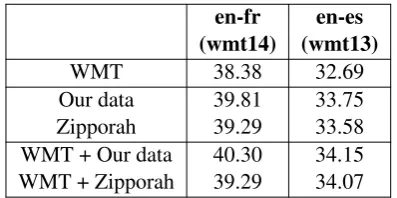
WMT 38.38 32.69
Our data 39.81 33.75
Zipporah 39.29 33.58
WMT + Our data 40.30 34.15
WMT + Zipporah 39.29 34.07
Table 6: BLEU scores on WMT testing sets of the NMT models trained on different data: 1) WMT training sets, 2) filtered ParaCrawl data, and 3) combined data of WMT and filtered ParaCrawl.
ably because the mined pairs are cleaner due to the filtering step. We notice, however, that training on the UN corpus gives translation results that are much lower than the state-of-the-art on the WMT evaluation sets. This is likely due to the fact that the UN parallel corpus is small and drawn from a particularly restricted domain.
5.2 Filtered ParaCrawl data
We compare the performance of training trans-lation models7 on ParaCrawl data filtered using
Zipporah scores versus our scoring method. For this experiment, our confidence score is fine-tuned on the ParaCrawl corpus using an addi-tional 900k positive and 900k negative exam-ples selected based on having extreme Zipporah
[image:8.595.317.516.323.422.2]scores.8 With Zipporah, we select all examples
from ParaCrawl with a Zipporah score greater than or equal to 0, which is the threshold used in the of-ficial release. There are 43 million such pairs in en-fr and 24 million in en-es. We then select the same number of pairs from the ParaCrawl data that have the highest scores from our fine-tuned model. As illustrated in Table6, the performance achieved by the ParaCrawl trained models on the WMT test data is quite high, both achieves better perfor-mance comparing with the baseline model trained on WMT training set. This suggests that fil-tered ParaCrawl data is a good source of general-purpose training material. Models trained on our filtered data slightly outperform those trained on data filtered by Zipporah. Row 4 and 5 also show the performance of models trained on the com-bined data of WMT and our filtered ParaCrawl and combined data of WMT and Zipporah filtered data respectively9. Combining the datasets further
im-proves the translation performance about 0.5 blue score, and model trained on WMT and our filtered ParaCrawl data achieves the best performance.
5.3 Qualitative Analysis of Filtered ParaCrawl Data
On the ParaCrawl corpus we find that the Pear-son’sr between Zipporah and our calibrated con-fidence scores is only 0.4. This correlation is quiet low given the level of translation perfor-mance achieved by both methods when they are used to select training pairs for an NMT system and suggests that the two methods may provide complementary information.
We access the agreement of the two methods on extreme score values.10 We sample a balanced
data set consisting of 100k pairs with extreme pos-itive Zipphora values and 100k pairs with extreme negative values. At a threshold of 0.5 and with-out an fine-tuning, our method agrees with the ex-treme Zipporah scores with an accuracy of 78.2% for en-fr and 80.5% for en-es. However, using the confidence scores fine-tuned to ParaCrawl from
8Extreme positive score values from Zipporah are
consid-ered to be those in the top 1% of the agreement scores found in the ParaCrawl corpus. Extreme negative score values are considered to be agreement scores in the bottom 50% of the Zipporah scores for ParaCrawl.
9The sizes of WMT training set and filtered ParaCrawl are
very close, so we simply mix the data together without any up sampling or down sampling.
10For this analysis we use the same definition of extreme
Zipporah scores as in section5.2
en-fr en-es
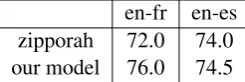
zipporah 72.0 74.0
[image:9.595.354.477.63.104.2]our model 76.0 74.5
Table 7: GOOD translation rate (%) annotated by translation professionals.
section5.2, we achieve a high level of agreement of 98.4% for en-fr and 98.6% with fine-tuning.
We perform an evaluation using human judg-ments comparing our scoring model against Zip-porah scores on the ParaCrawl data. As in the fil-tering experiments, we select all examples from ParaCrawl with a Zipporah score greater than or equal to zero and then select a matching number of pairs with the highest scores from our model. We then sample 200 examples from each set and send them to translation professionals for evalua-tion. Each example is examined by one annota-tor that labels the pair as either a GOOD or BAD translation. A GOOD translation means more than 70% of a sentence is correctly translated in the paired sentences, meaning most of the information is conveyed.
Table 7 shows the GOOD translation rate for each sampled subset. The performance between the two approaches is close for en-es and the pro-posed score normalization model is 4% better for en-fr. In our analysis of the BAD translation pairs, one common failure pattern from the proposed model is that one of the sentences is only partially translated in the other sentence. This is likely be-cause we are still missing enough of these types of hard negatives in the training data. We also find our model produces more pairs where the sen-tences on both sides are identical. These identical pairs are mostly labeled as BAD translations be-cause they are unlikely to be actual translations.
6 Related Work
Another direction, however, is to identify bi-texts using only textual information, as the meta-data associated with documents can often be sparse or unreliable (Uszkoreit et al.,2010). Some text-based approaches for identifying bitexts rely on methods such as n-gram scoring (Uszkor-eit et al., 2010), named entity matching (Do et al., 2009), and cross-language information re-trieval (Utiyama and Isahara,2003;Munteanu and Marcu,2005).
There is active research on using embedding-based approaches where texts are mapped to an embedding space in order to determine whether they are bitexts.Gr´egoire and Langlais(2017) use a Siamese network (Yin et al.,2015) to map source and target language sentences into the same space, then classify whether the sentences are parallel based on labelled data. Hassan et al. (2018) ob-tain English and Chinese sentence embeddings in a shared space by averaging encoder states from a bilingual shared encoder NMT system. The cosine similarity between these sentence embeddings is then used as a measure of cross-lingual similarity between the sentences, which can then be used to filter out noisy sentence pairs. Schwenk (2018) use a similar approach but learn a joint embedding over nine languages. Our model differs from pre-vious approaches, as it uses a dual-encoder archi-tecture instead of an encoder-decoder archiarchi-tecture. Not only is the dual-encoder architecture is more efficient (Henderson et al., 2017), it also allows us to directly train toward extracting parallel sen-tences from a collection of candidates.
7 Conclusion
In this paper, we present an effective parallel cor-pus mining approach using sentence embeddings produced by a bilingual dual-encoder model. The proposed model encodes source sentences and tar-get sentences into sentence embeddings separately and then calculates the dot-product score for these two embedding vectors to assess translation pair quality. We propose the selection of hard negatives that consist of semantically similar sentence pairs that are not translations of each other. Our exper-iments reveal that using hard negatives improves the ability of our model to identify true translation pairs. We find the proposed method to be useful for both mining and filtering parallel data. Our method compares favorably to Zipporah for filter-ing, while for mining it provides a lightweight
al-ternative toUszkoreit et al.(2010)’s method.
Acknowledgement
We thank our teammates from Descartes, Trans-late and other Google groups for their feedback and suggestions. Special thanks goes to Wei Wang and Melvin Johnson for extracting translation data and discussions on NMT models.
References
Eneko Agirre, Daniel Cer, Mona Diab, and Aitor Gonzalez-Agirre. 2012. Semeval-2012 task 6: A pi-lot on semantic textual similarity. In *SEM 2012: The First Joint Conference on Lexical and Compu-tational Semantics – Volume 1: Proceedings of the main conference and the shared task, and Volume 2: Proceedings of the Sixth International Workshop on Semantic Evaluation (SemEval 2012), pages 385– 393, Montr´eal, Canada. Association for Computa-tional Linguistics.
Alexandra Antonova and Alexey Misyurev. 2011. Building a web-based parallel corpus and filtering out machine-translated text. InProceedings of the 4th Workshop on Building and Using Comparable Corpora: Comparable Corpora and the Web, pages 136–144. Association for Computational Linguis-tics.
Ondˇrej Bojar, Christian Buck, Chris Callison-Burch, Christian Federmann, Barry Haddow, Philipp Koehn, Christof Monz, Matt Post, Radu Soricut, and Lucia Specia. 2013. Findings of the 2013 Work-shop on Statistical Machine Translation. In Pro-ceedings of the Eighth Workshop on Statistical Ma-chine Translation, pages 1–44, Sofia, Bulgaria. As-sociation for Computational Linguistics.
Ondˇrej Bojar, Christian Buck, Christian Federmann, Barry Haddow, Philipp Koehn, Johannes Leveling, Christof Monz, Pavel Pecina, Matt Post, Herve Saint-Amand, et al. 2014. Findings of the 2014 workshop on statistical machine translation. In Pro-ceedings of the ninth workshop on statistical ma-chine translation, pages 12–58.
Houda Bouamor and Hassan Sajjad. 2018. H2@bucc18: Parallel sentence extraction from comparable corpora using multilingual sentence embeddings. InProceedings of the Eleventh Inter-national Conference on Language Resources and Evaluation (LREC 2018), Paris, France. European Language Resources Association (ELRA).
Jiang Chen and Jian-Yun Nie. 2000. Parallel web text mining for cross-language ir. In Content-Based Multimedia Information Access-Volume 1, pages 62–77. Centre de Hautes Etudes Interna-tionale D’Informatique Documentaire.
Thi-Ngoc-Diep Do, Viet-Bac Le, Brigitte Bigi, Laurent Besacier, and Eric Castelli. 2009. Mining a compa-rable text corpus for a vietnamese-french statistical machine translation system. InProceedings of the Fourth Workshop on Statistical Machine Transla-tion, pages 165–172. Association for Computational Linguistics.
Francis Gr´egoire and Philippe Langlais. 2017. A deep neural network approach to parallel sentence extrac-tion. arXiv preprint arXiv:1709.09783.
Hany Hassan, Anthony Aue, Chang Chen, Vishal Chowdhary, Jonathan Clark, Christian Feder-mann, Xuedong Huang, Marcin Junczys-Dowmunt, William Lewis, Mu Li, et al. 2018. Achieving hu-man parity on automatic chinese to english news translation. arXiv preprint arXiv:1803.05567.
Matthew Henderson, Rami Al-Rfou, Brian Strope, Yun-Hsuan Sung, L´aszl´o Luk´acs, Ruiqi Guo, San-jiv Kumar, Balint Miklos, and Ray Kurzweil. 2017. Efficient natural language response suggestion for smart reply. CoRR, abs/1705.00652.
Mohit Iyyer, Varun Manjunatha, Jordan Boyd-Graber, and Hal Daum´e III. 2015. Deep unordered compo-sition rivals syntactic methods for text classification. In Proceedings of the 53rd Annual Meeting of the Association for Computational Linguistics and the 7th International Joint Conference on Natural Lan-guage Processing (Volume 1: Long Papers), pages 1681–1691, Beijing, China. Association for Com-putational Linguistics.
Jeff Johnson, Matthijs Douze, and Herv´e J´egou. 2017. Billion-scale similarity search with gpus. arXiv preprint arXiv:1702.08734.
Philipp Koehn, Hieu Hoang, Alexandra Birch, Chris Callison-Burch, Marcello Federico, Nicola Bertoldi, Brooke Cowan, Wade Shen, Christine Moran, Richard Zens, Chris Dyer, Ondˇrej Bojar, Alexandra Constantin, and Evan Herbst. 2007. Moses: Open source toolkit for statistical machine translation. In
Proceedings of the 45th Annual Meeting of the ACL on Interactive Poster and Demonstration Sessions, ACL ’07, pages 177–180, Stroudsburg, PA, USA. Association for Computational Linguistics.
Dragos Stefan Munteanu and Daniel Marcu. 2005. Im-proving machine translation performance by exploit-ing non-parallel corpora. Computational Linguis-tics, 31(4):477–504.
Dragos Stefan Munteanu and Daniel Marcu. 2006. Ex-tracting parallel sub-sentential fragments from non-parallel corpora. InProceedings of the 21st Interna-tional Conference on ComputaInterna-tional Linguistics and
the 44th Annual Meeting of the Association for Com-putational Linguistics, pages 81–88. Association for Computational Linguistics.
Franz Josef Och and Hermann Ney. 2002. Discrim-inative training and maximum entropy models for statistical machine translation. In Proceedings of the 40th Annual Meeting on Association for Com-putational Linguistics, ACL ’02, pages 295–302, Stroudsburg, PA, USA. Association for Computa-tional Linguistics.
Kishore Papineni, Salim Roukos, Todd Ward, and Wei-Jing Zhu. 2002. Bleu: a method for automatic eval-uation of machine translation. In Proceedings of the 40th annual meeting on association for compu-tational linguistics, pages 311–318. Association for Computational Linguistics.
Philip Resnik. 1999. Mining the web for bilingual text. In Proceedings of the 37th Annual Meeting of the Association for Computational Linguistics on Com-putational Linguistics, pages 527–534. Association for Computational Linguistics.
Philip Resnik and Noah A Smith. 2003. The web as a parallel corpus. Computational Linguistics, 29(3):349–380.
M. Schuster and K. Nakajima. 2012. Japanese and ko-rean voice search. In2012 IEEE International Con-ference on Acoustics, Speech and Signal Processing (ICASSP), pages 5149–5152.
Holger Schwenk. 2018. Filtering and mining parallel data in a joint multilingual space. arXiv preprint arXiv:1805.09822.
Lei Shi, Cheng Niu, Ming Zhou, and Jianfeng Gao. 2006. A dom tree alignment model for mining paral-lel data from the web. InProceedings of the 21st In-ternational Conference on Computational Linguis-tics and the 44th Annual Meeting of the Association for Computational Linguistics, pages 489–496. As-sociation for Computational Linguistics.
Jakob Uszkoreit, Jay M. Ponte, Ashok C. Popat, and Moshe Dubiner. 2010. Large scale parallel docu-ment mining for machine translation. In Proceed-ings of the 23rd International Conference on Com-putational Linguistics, COLING ’10, pages 1101– 1109, Stroudsburg, PA, USA. Association for Com-putational Linguistics.
Masao Utiyama and Hitoshi Isahara. 2003. Reliable measures for aligning japanese-english news articles and sentences. InProceedings of the 41st Annual Meeting on Association for Computational Linguis-tics, pages 72–79. Association for Computational Linguistics.
Ashish Vaswani, Noam Shazeer, Niki Parmar, Jakob Uszkoreit, Llion Jones, Aidan N Gomez, Łukasz Kaiser, and Illia Polosukhin. 2017. Attention is all you need. InAdvances in Neural Information Pro-cessing Systems, pages 5998–6008.
Hainan Xu and Philipp Koehn. 2017. Zipporah: a fast and scalable data cleaning system for noisy web-crawled parallel corpora. InProceedings of the 2017 Conference on Empirical Methods in Natural Lan-guage Processing, pages 2945–2950.
Christopher C Yang and Kar Wing Li. 2002. Mining english/chinese parallel documents from the world wide web. InProceedings of the 11th International World Wide Web Conference, Honolulu, USA.
Yinfei Yang, Steve Yuan, Daniel Cer, Sheng-yi Kong, Noah Constant, Petr Pilar, Heming Ge, Yun-Hsuan Sung, Brian Strope, and Ray Kurzweil. 2018. Learning semantic textual similarity from conver-sations. In The 3rd Workshop on Representation Learning for NLP (RepL4NLP), Melbourne, Aus-tralia. Association for Computational Linguistics.
Wenpeng Yin, Hinrich Sch¨utze, Bing Xiang, and Bowen Zhou. 2015. Abcnn: Attention-based convo-lutional neural network for modeling sentence pairs.
arXiv preprint arXiv:1512.05193.