CRF Autoencoder for Unsupervised Dependency Parsing
∗Jiong Cai, Yong Jiang and Kewei Tu
{caijiong,jiangyong, tukw}@shanghaitech.edu.cn School of Information Science and Technology
ShanghaiTech University, Shanghai, China
Abstract
Unsupervised dependency parsing, which tries to discover linguistic dependency structures from unannotated data, is a very challenging task. Almost all previous work on this task focuses on learning gen-erative models. In this paper, we de-velop an unsupervised dependency pars-ing model based on the CRF autoencoder. The encoder part of our model is discrim-inative and globally normalized which al-lows us to use rich features as well as uni-versal linguistic priors. We propose an exact algorithm for parsing as well as a tractable learning algorithm. We evaluated the performance of our model on eight multilingual treebanks and found that our model achieved comparable performance with state-of-the-art approaches.
1 Introduction
Unsupervised dependency parsing, which aims to discover syntactic structures in sentences from un-labeled data, is a very challenging task in natural language processing. Most of the previous work on unsupervised dependency parsing is based on generative models such as the dependency model with valence (DMV) introduced by Klein and Manning (2004). Many approaches have been proposed to enhance these generative models, for example, by designing advanced Bayesian priors (Cohen et al., 2008), representing dependencies with features (Berg-Kirkpatrick et al.,2010), and representing discrete tokens with continuous vec-tors (Jiang et al.,2016).
Besides generative approaches, Grave and El-hadad (2015) proposed an unsupervised discrim-∗This work was supported by the National Natural
Sci-ence Foundation of China (61503248).
inative parser. They designed a convex quadratic objective function under the discriminative clus-tering framework. By utilizing global features and linguistic priors, their approach achieves state-of-the-art performance. However, their approach uses an approximate parsing algorithm, which has no theoretical guarantee. In addition, the perfor-mance of the approach depends on a set of manu-ally specified linguistic priors.
Conditional random field autoencoder (Ammar et al.,2014) is a new framework for unsupervised structured prediction. There are two components of this model: an encoder and a decoder. The en-coder is a globally normalized feature-rich CRF model predicting the conditional distribution of the latent structure given the observed structured input. The decoder of the model is a generative model generating a transformation of the struc-tured input from the latent structure. Ammar et al. (2014) applied the model to two sequential structured prediction tasks, part-of-speech induc-tion and word alignment and showed that by uti-lizing context information the model can achieve better performance than previous generative mod-els and locally normalized modmod-els. However, to the best of our knowledge, there is no previous work applying the CRF autoencoder to tasks with more complicated outputs such as tree structures.
In this paper, we propose an unsupervised dis-criminative dependency parser based on the CRF autoencoder framework and provide tractable al-gorithms for learning and parsing. We performed experiments in eight languages and show that our approach achieves comparable results with previ-ous state-of-the-art models.
These stocks eventually reopened ROOT
x
y1
y2
y3
y4
These
stocks
eventually
reopened
ˆ x4 ˆ x3 ˆ x2 ˆ x1
[image:2.595.75.288.64.219.2]Encoder Decoder
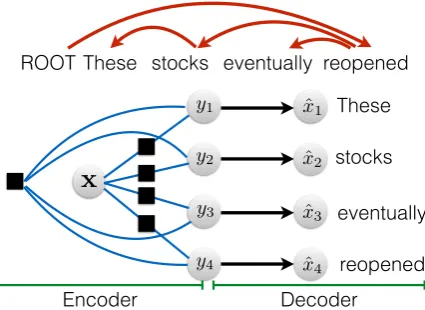
Figure 1: The CRF Autoencoder for the input sen-tence “These stocks eventually reopened” and its corresponding parse tree (shown at the top). x andxˆare the original and reconstructed sentence. y is the dependency parse tree represented by a sequence where yi contains the token and index of the parent of token xi in the parse tree, e.g.,
y1 = hstocks,2i and y2 = hreopened,4i. The encoder is represented by a factor graph (with a global factor specifying valid parse trees) and the decoder is represented by a Bayesian net.
2 Method
2.1 Model
Figure 1 shows our model with an example in-put sentence. Given an inin-put sentence x = (x1, x2, . . . , xn), we regard its parse tree as the latent structure represented by a sequence y = (y1, y2, . . . , yn)whereyiis a pairhti, hii,tiis the head token of the dependency connecting to token
xiin the parse tree, andhiis the index of this head token in the sentence. The model also contains a reconstruction output, which is a token sequence
ˆ
x = (ˆx1,xˆ2, . . . ,xˆn). Throughout this paper, we setxˆ =x.
The encoder in our model is a log-linear model represented by a first-order dependency parser. The score of a dependency tree can be factorized as the sum of scores of its dependencies. For each dependency arc(x, i, j), whereiandjare the in-dices of the head and child of the dependency, a feature vectorf(x, i, j) is specified. The score of a dependency is defined as the inner product of the feature vector and a weight vectorw,
φ(x, i, j) =wTf(x, i, j)
The score of a dependency treeyof sentencexis
φ(x,y) =
n
X
i=1
φ(x, hi, i)
We define the probability of parse treeygiven sen-tencexas
P(y|x) = exp(Zφ((xx),y))
Z(x)is the partition function,
Z(x) = X
y0∈Y(x)
exp(φ(x,y0))
whereY(x)is the set of all valid parse trees ofx. The partition function can be efficiently computed inO(n3)time using a variant of the inside-outside algorithm (Paskin,2001) for projective tree struc-tures, or using the Matrix-Tree Theorem for non-projective tree structures (Koo et al.,2007).
The decoder of our model consists of a set of categorical conditional distributions θx|t, which represents the probability of generating token x
conditioned on tokent. So the probability of the reconstruction outputˆxgiven the parse treeyis
P(ˆx|y) =Yn
i=1
θˆxi|ti
The conditional distribution ofxˆ,ygivenxis
P(y,xˆ|x) =P(y|x)P(ˆx|y)
2.1.1 Features
Following McDonald et al. (2005) and Grave et al. (2015), we define the feature vector of a de-pendency based on the part-of-speech tags (POS) of the head, child and context words, the direc-tion, and the distance between the head and child of the dependency. The feature template used in our parser is shown in Table1.
2.1.2 Parsing
Given parameters w andθ, we can parse a sen-tence x by searching for a dependency tree y which has the highest probabilityP(ˆx,y|x).
y∗= arg max
y∈Y(x)logP(ˆx,y|x)
= arg max
y∈Y(x) n
X
i=1
φ(x, hi, i) + logθxˆi|ti
POSi×dis×dir POSj×dis×dir
POSi×POSj×dis×dir
[image:3.595.323.510.61.149.2]POSi×POSi−1×POSj×dis×dir POSi×POSi+1×POSj×dis×dir POSi×POSj×POSj−1×dis×dir POSi×POSj×POSj+1×dis×dir
Table 1: Feature template of a dependency, where
i is the index of the head, j is the index of the child,dis=|i−j|, anddiris the direction of the dependency.
For projective dependency parsing, we can use Eisners algorithm (1996) to find the best parse in O(n3) time. For non-projective dependency parsing, we can use the Chu-Liu/Edmond algo-rithm (Chu and Liu,1965;Edmonds,1967;Tarjan, 1977) to find the best parse inO(n2)time.
2.2 Parameter Learning 2.2.1 Objective Function
Spitkovsky et al. (2010) shows that Viterbi EM can improve the performance of unsupervised de-pendency parsing in comparison with EM. There-fore, instead of using negative conditional log like-lihood as our objective function, we choose to use negative conditional Viterbi log likelihood,
−XN
i=1
log
max
y∈Y(xi)P(ˆxi,y|xi)
+λΩ(w) (1)
where Ω(w) is a L1 regularization term of the encoder parameterwandλis a hyper-parameter controlling the strength of regularization.
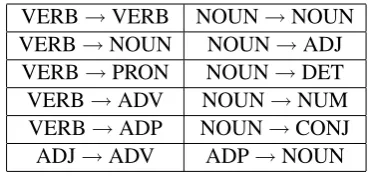
To encourage learning of dependency relations that satisfy universal linguistic knowledge, we add a soft constraint on the parse tree based on the universal syntactic rules following Naseem et al. (2010) and Grave et al. (2015). Hence our objec-tive function becomes
−
N
X
i=1
log
max
y∈Y(xi)P(ˆxi,y|xi)Q α(x
i,y)
+λΩ(w)
whereQ(x,y)is a soft constraint factor over the parse tree, andαis a hyper-parameter controlling the strength of the constraint factor. The factorQ
is also decomposable by edges in the same way as the encoder and the decoder, and therefore our parsing algorithm can still be used with this factor
VERB→VERB NOUN→NOUN VERB→NOUN NOUN→ADJ
[image:3.595.92.272.62.159.2]VERB→PRON NOUN→DET VERB→ADV NOUN→NUM VERB→ADP NOUN→CONJ ADJ→ADV ADP→NOUN
Table 2: Universal linguistic rules
taken into account.
Q(x,y) = exp X
i
1[(ti→xi)∈ R]
!
where1[(ti → xi) ∈ R]is an indicator function of whether dependency ti → xi satisfies one of the universal linguistic rules inR. The universal linguistic rules that we use are shown in Table2 (Naseem et al.,2010).
2.2.2 Algorithm
We apply coordinate descent to minimize the ob-jective function, which alternately updateswand θ. In each optimization step of w, we run two epochs of stochastic gradient descent, and in each optimization step ofθ, we run two iterations of the Viterbi EM algorithm.
To update w using stochastic gradient de-scent, for each sentence x, we first run the pars-ing algorithm to find the best parse tree y∗ =
arg maxy∈Y(x)(P(ˆx,y|x)Qα(x,y)); then we can calculate the gradient of the objective function based on the following derivation,
∂logP(ˆx,y∗|x) ∂w
= ∂logP∂w(y∗|x) +∂logP∂w(ˆx|y∗)
= ∂logP(y∗|x)
∂w
= ∂
Pn
i=1wTf(x, hi, i)−logZ(x)
∂w
= X
(i,j)∈D(x)
f(x, i, j)
1[yj∗=hi, xii]−µ(x, i, j)
whereD(x)is the set of all possible dependency arcs of sentencex, 1[·] is the indicator function, andµ(x, i, j)is the expected count defined as fol-lows,
µ(x, i, j) = X
y∈Y(x)
Basque Czech Danish Dutch Portuguese Slovene Swedish Avg Length:≤10
DMV(EM) 41.1 31.3 50.8 47.1 36.7 36.7 43.5 41.0
DMV(Viterbi) 47.1 27.1 39.1 37.1 32.3 23.7 42.6 35.5
Neural DMV (EM) 46.5 33.1 55.6 49.0 30.4 42.2 44.3 43.0
Neural DMV (Viterbi) 48.1 28.6 39.8 37.2 36.5 39.9 47.9 39.7
Convex-MST (No Prior) 29.4 36.5 49.3 31.3 46.4 33.7 35.5 37.4 Convex-MST (With Prior) 30.0 46.1 51.6 35.3 55.4 63.7 50.9 47.5
CRFAE (No Prior) 49.0 33.9 28.8 39.3 47.6 34.7 51.3 40.6
CRFAE (With Prior) 49.9 48.1 53.4 43.9 68.0 52.5 64.7 54.3
Length: All
DMV(EM) 31.2 28.1 40.3 44.2 23.5 25.2 32.0 32.0
DMV(Viterbi) 40.9 20.4 32.6 33.0 26.9 16.5 36.2 29.5
Neural DMV (EM) 38.5 29.3 46.1 46.2 16.2 36.6 32.8 35.1
Neural DMV (Viterbi) 41.8 23.8 34.2 33.6 29.4 30.8 40.2 33.4
Convex-MST (No Prior) 30.5 33.4 44.2 29.3 38.3 32.2 28.3 33.7 Convex-MST (With Prior) 30.6 40.0 45.8 35.6 46.3 51.8 40.5 41.5
CRFAE (No Prior) 39.8 25.4 24.2 35.2 52.2 26.4 40.0 34.7
[image:4.595.90.512.60.262.2]CRFAE (With Prior) 41.4 36.8 40.5 38.6 58.9 43.3 48.5 44.0
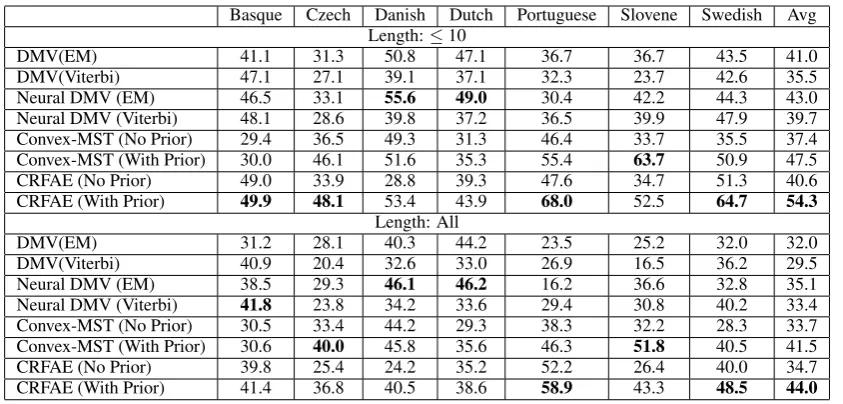
Table 4: Parsing accuracy on seven languages. Our model is compared with DMV (Klein and Manning, 2004), Neural DMV (Jiang et al.,2016), and Convex-MST (Grave and Elhadad,2015)
Methods WSJ10 WSJ
Basic Setup
Feature DMV(Berg-Kirkpatrick et al.,2010) 63.0 -UR-A E-DMV(Tu and Honavar,2012) 71.4 57.0 Neural E-DMV(Jiang et al.,2016) 69.7 52.5 Neural E-DMV(Good Init) (Jiang et al.,2016) 72.5 57.6
Basic Setup + Universal Linguistic Prior Convex-MST(Grave and Elhadad,2015) 60.8 48.6 HDP-DEP(Naseem et al.,2010) 71.9
-CRFAE 71.7 55.7
Systems Using Extra Info
LexTSG-DMV(Blunsom and Cohn,2010) 67.7 55.7
CS(Spitkovsky et al.,2013) 72.0 64.4
MaxEnc(Le and Zuidema,2015) 73.2 65.8
Table 3: Comparison of recent unsupervised de-pendency parsing systems on English. Basic setup is the same as our setup except that linguistic prior is not used. Extra info includes lexicalization, longer training sentences, etc.
The expected count can be efficiently computed using the Matrix-Tree Theorem (Koo et al.,2007) for non-projective tree structures or using a variant of the inside-outside algorithm for projective tree structures (Paskin,2001).
To updateθusing Viterbi EM, in the E-step we again use the parsing algorithm to find the best parse treey∗ for each sentence x; then in the
M-step we updateθby maximum likelihood estima-tion.
θc|t=
P
xPi1[xi =c, y∗i =h·, ti]
P
c0PxPi1[xi =c0, y∗i =h·, ti]
3 Experiments
3.1 Setup
We experimented with projective parsing and used the informed initialization method proposed by Klein and Manning (2004) to initialize our model before learning. We tested our model both with and without using the universal linguistic rules. We used AdaGrad to optimizew. We used POS tags of the input sentence as the tokens in our model. We learned our model on training sen-tences of length ≤ 10 and reported the directed dependency accuracy on test sentences of length
≤10 and on all test sentences.
3.2 Results on English
We evaluated our model on the Wall Street Jour-nal corpus. We trained our model on section 2-21, tuned the hyperparameters on section 22, and tested our model on section 23. Table3shows the directed dependency accuracy of our model (CR-FAE) compared with recently published results. It can be seen that our method achieves a compara-ble performance with state-of-the-art systems.
[image:4.595.74.290.317.459.2]3.3 Multilingual Results
We evaluated our model on seven languages from the PASCAL Challenge on Grammar Induction (Gelling et al.,2012). We did not use the Arabic corpus because the number of training sentences with length≤10 is less than 1000. The result is shown in Table 4. The accuracies of DMV and Neural DMV are from Jiang et.al (2016). Both our model (CRFAE) and Convex-MST were tuned on the validation set of each corpus. It can be seen that our method achieves the best results on av-erage. Besides, our method outperforms Convex-MST both with and without linguistic prior. From the results we can also see that utilizing universal linguistic prior greatly improves the performance of Convex-MST and our model.
4 Conclusion
In this paper, we propose a new discriminative model for unsupervised dependency parsing based on CRF autoencoder. Both learning and inference of our model are tractable. We tested our method on eight languages and show that our model is competitive to the state-of-the-art systems.
The code is available at https://github. com/caijiong/CRFAE-Dep-Parser
References
Waleed Ammar, Chris Dyer, and Noah A Smith. 2014. Conditional random field autoencoders for unsuper-vised structured prediction. In Advances in Neural Information Processing Systems, pages 3311–3319. Taylor Berg-Kirkpatrick, Alexandre Bouchard-Cˆot´e,
John DeNero, and Dan Klein. 2010. Painless un-supervised learning with features. In Human Lan-guage Technologies: The 2010 Annual Conference of the North American Chapter of the Association for Computational Linguistics, pages 582–590. As-sociation for Computational Linguistics.
Phil Blunsom and Trevor Cohn. 2010. Unsupervised induction of tree substitution grammars for depen-dency parsing. In Proceedings of the 2010 Con-ference on Empirical Methods in Natural Language Processing, pages 1204–1213. Association for Com-putational Linguistics.
Yoeng-Jin Chu and Tseng-Hong Liu. 1965. On shortest arborescence of a directed graph. Scientia Sinica, 14(10):1396.
Shay B Cohen, Kevin Gimpel, and Noah A Smith. 2008. Logistic normal priors for unsupervised prob-abilistic grammar induction. InAdvances in Neural Information Processing Systems, pages 321–328.
Jack Edmonds. 1967. Optimum branchings. Journal of Research of the National Bureau of Standards B, 71(4):233–240.
Jason M Eisner. 1996. Three new probabilistic models for dependency parsing: An exploration. In Pro-ceedings of the 16th conference on Computational linguistics-Volume 1, pages 340–345. Association for Computational Linguistics.
Douwe Gelling, Trevor Cohn, Phil Blunsom, and Joao Grac¸a. 2012. The pascal challenge on grammar in-duction. InProceedings of the NAACL-HLT Work-shop on the Induction of Linguistic Structure, pages 64–80. Association for Computational Linguistics. Edouard Grave and No´emie Elhadad. 2015. A convex
and feature-rich discriminative approach to depen-dency grammar induction. InACL (1), pages 1375– 1384.
Yong Jiang, Wenjuan Han, and Kewei Tu. 2016. Un-supervised neural dependency parsing. In Proceed-ings of the 2016 Conference on Empirical Methods in Natural Language Processing, pages 763–771, Austin, Texas. Association for Computational Lin-guistics.
Dan Klein and Christopher D Manning. 2004. Corpus-based induction of syntactic structure: Models of de-pendency and constituency. In Proceedings of the 42nd Annual Meeting on Association for Computa-tional Linguistics, page 478. Association for Com-putational Linguistics.
Terry Koo, Amir Globerson, Xavier Carreras P´erez, and Michael Collins. 2007. Structured prediction models via the matrix-tree theorem. In Joint Con-ference on Empirical Methods in Natural Language Processing and Computational Natural Language Learning (EMNLP-CoNLL), pages 141–150. Phong Le and Willem Zuidema. 2015. Unsupervised
dependency parsing: Let’s use supervised parsers. InProceedings of the 2015 Conference of the North American Chapter of the Association for Computa-tional Linguistics: Human Language Technologies, pages 651–661, Denver, Colorado. Association for Computational Linguistics.
Ryan McDonald, Koby Crammer, and Fernando Pereira. 2005. Online large-margin training of de-pendency parsers. In Proceedings of the 43rd an-nual meeting on association for computational lin-guistics, pages 91–98. Association for Computa-tional Linguistics.
Tahira Naseem, Harr Chen, Regina Barzilay, and Mark Johnson. 2010. Using universal linguistic knowl-edge to guide grammar induction. InProceedings of the 2010 Conference on Empirical Methods in Nat-ural Language Processing, pages 1234–1244. Asso-ciation for Computational Linguistics.
Valentin I Spitkovsky, Hiyan Alshawi, and Daniel Ju-rafsky. 2013. Breaking out of local optima with count transforms and model recombination: A study in grammar induction. In EMNLP, pages 1983– 1995.
Valentin I Spitkovsky, Hiyan Alshawi, Daniel Jurafsky, and Christopher D Manning. 2010. Viterbi training improves unsupervised dependency parsing. In Pro-ceedings of the Fourteenth Conference on Computa-tional Natural Language Learning, pages 9–17. As-sociation for Computational Linguistics.
Robert Endre Tarjan. 1977. Finding optimum branch-ings.Networks, 7(1):25–35.