Source-Side Left-to-Right or Target-Side Left-to-Right?
An Empirical Comparison of Two Phrase-Based Decoding Algorithms
Yin-Wen Chang Google Research, New York
Michael Collins∗ Google Research, New York [email protected]
Abstract
This paper describes an empirical study of the phrase-based decoding algorithm pro-posed byChang and Collins(2017). The algorithm produces a translation by pro-cessing the source-language sentence in strictly left-to-right order, differing from commonly used approaches that build the target-language sentence in left-to-right order. Our results show that the new al-gorithm is competitive with Moses (Koehn et al., 2007) in terms of both speed and BLEU scores.
1 Introduction
Phrase-based models (Koehn et al., 2003; Och and Ney, 2004) have until recently been a state-of-the-art method for statistical machine transla-tion, and Moses (Koehn et al., 2007) is one of the most used phrase-based translation systems. Moses uses a beam search decoder based on a dy-namic programming algorithm that constructs the target-language sentence from left to right (Koehn et al.,2003). Neural machine translation systems (Kalchbrenner and Blunsom, 2013; Cho et al.,
2014; Sutskever et al., 2014), which have given impressive improvements over phrase-based sys-tems, also typically use models and decoders that construct the target-language string in strictly left-to-right order.
Recently, Chang and Collins (2017) proposed a phrase-based decoding algorithm that processes thesource-language string in strictly left-to-right order. Reordering is implemented by maintaining multiple sub-strings in the target-language, with phrases being used to extend these sub-strings by various operations (see Section2for a full descrip-tion). With a fixed distortion limit on reordering,
∗On leave from Columbia University.
the time complexity of the algorithm is linear in terms of sentence length, and is polynomial time in other factors.
Chang and Collins(2017) present the algorithm and give a proof of its time complexity, but do not describe experiments, leaving an open question of whether the algorithm is useful in practice. This paper complements the original paper by studying the algorithm empirically. In addition to an exact dynamic programming implementation, we study the use of beam search with the algorithm, and an-other pruning method that restricts the maximum number of target-language strings maintained at any point. The experiments show that the algo-rithm is competitive with Moses in terms of both speed and translation quality (BLEU score).
The new decoding algorithm is of interest for a few reasons. While the experiments in this pa-per are with phrase-based translation systems, the method could potentially be extended to neural translation, for example with an attention-based model that is in some sense monotonic (left-to-right). The decoder may be relevant to work on si-multaneous translation (He et al.,2016). The ideas may be applicable to string-to-string transduction problems other than machine translation.
2 A Sketch of the Decoding Algorithm of Chang and Collins(2017)
This section gives a sketch of the decoding algo-rithm ofChang and Collins(2017). We first define the phrase-based decoding problem, and then de-scribe the algorithm.
2.1 The Phrase-based Decoding Problem
Throughout this paper we will consider the follow-ing decodfollow-ing problem. Given a source sentence
x1. . . xn forn ≥ 1, a phrase p = (s, t, e)
speci-fies a possible translation fromxs. . . xtto a string
Sub-derivation State
1,1,<s>
1,
1,<s>, 1,<s>
p= 2,3,we must
, operation = replaceπ1byCONCAT(π1, p)
1,1,<s>
2,3,we must
3,
1,<s>, 3,must
p= 4,4,also
, operation = replaceπ1byCONCAT(π1, p)
1,1,<s>
2,3,we must
4,4,also
4,
1,<s>, 4,also
p= 5,6,these criticisms
, operation = add a new sequenceπ2=hpi
1,1,<s>
2,3,we must
4,4,also
,
5,6,these criticisms 6,
1,<s>, 4,also
, 5,these,6,criticisms
p= 7,7,seriously
, operation = replaceπ2byCONCAT(π2, p)
1,1,<s>
2,3,we must
4,4,also
,
5,6,these criticisms
7,7,seriously 7,
1,<s>, 4,also
, 5,these,7,seriously
p= 8,8,take
, operation = replaceπ1, π2byCONCAT(π1, p, π2)
1,1,<s>
2,3,we must
4,4,also
8,8,take
5,6,these criticisms
7,7,seriously
8,
1,<s>, 7,seriously
p= 9,9,</s>
, operation = replaceπ1byCONCAT(π1, p)
1,1,<s>
2,3,we must
4,4,also
8,8,take
5,6,these criticisms
7,7,seriously
9,9,</s>
9,
1,<s>, 9,</s>
Figure 1: Illustrations of how the new algorithm produces the output translation. We note each phrase that is being added and the operation it takes to generate the next segments of phrase sequence.
of target-language words e = e1. . . em. We use
s(p),t(p), ande(p)to refer to the three elements of a phrase p. A derivation is a sequence of L
phrases,p1. . . pL. The derivation gives a
transla-tion by concatenating the target-language strings
e(p1). . . e(pL).
We will always assume that x1 = <s>, the start-of-sentence symbol, and xn = </s>,
the end-of-sentence symbol. The only phrases covering positions 1 and n are (1,1,<s>) and (n, n,</s>).
A derivation p1. . . pL isvalid if each word in
the source sentence is translated exactly once, and if fori= 2. . . Lwe have|t(pi−1)+1−s(pi)| ≤d,
wheredis the distortion limit. The score for any derivation is
f(p1. . . pL) = λ(e(p1). . . e(pL)) + L
X
i=1 κ(pi)
+XL
i=2
η× |t(pi−1) + 1−s(pi)|
where the parameter η is the distortion penalty,
λ(e) is a language model score for the word se-quence e, andκ(p) is the score for phrase p un-der the phrase-based model. For example unun-der a bigram language model, we have λ(e1. . . em) =
Pm
i=2λ(ei|ei−1).whereλ(v|u)is the score for
bi-gram(u, v).
The phrase-based decoding problem is to find
arg max
p1...pL∈P
f(p1. . . pL)
whereP is the set of all valid derivations for the input sentence.
2.2 The Decoding Algorithm
At a high level, the decoding algorithm ofChang and Collins (2017) differs from the commonly-used approach ofKoehn et al.(2003) in two im-portant respects:
1. The decoding algorithm proceeds in strictly left-to-right order in thesourcesentence.
2. Each sub-derivation (item) in the beam con-sists ofmultiplesequences of phrases, instead of a single sequence.
To be more precise, each sub-derivation in the decoding algorithm consists of:
1. An integer j specifying the length of the derivation (i.e., that words x1. . . xj have
been translated).
2. A set of segments {π1, π2, . . . , πr} where
r ≥ 1. Each segment π is a sequence
of phrases. The segment π1 always has
(1,1,<s>) as its first element. Each word
x1. . . xj is translated exactly once in these
segments.
As one example, the sub-derivation
(1,{h(1,1,<s>)i}) is always the initial
sub-derivation, with only the first word x1
π1 = h(1,1,<s>)i. A more complex
sub-derivation is
(7,{h(1,1,<s>)(2,3,we must)(4,4,also)i, h(5,6,these criticisms)(7,7,seriously)i}) (1)
which translates wordsx1. . . x7, and has two
seg-ments,
π1 =h(1,1,<s>)(2,3,we must)(4,4,also)i π2 =h(5,6,these criticisms)(7,7,seriously)i
We now describe how sub-derivations can be built as the source sentence is processed in left-to-right order. A derivation(j,{π1. . . πr})can be
extended as follows:
1. First select some phrase p = (j + 1, t, e) where the phrase-based lexicon specifies that wordsxj+1. . . xtcan be translated as the
En-glish sequencee=e1. . . em.
2. Second, extend the derivation using one of the following operations (we useCONCATto denote an operation that concatenates two or more phrase sequences):
(a) Replace πi for some i ∈ 1. . . r by
CONCAT(πi, p).
(b) Replace πi for some i ∈ 2. . . r by
CONCAT(p, πi).
(c) Replace πi, πi0 for integers i 6= i0 by CONCAT(πi, p, πi0)
(d)Create a new segmentπr+1=hpi.
Figure 1 shows the sequence of steps, and the resulting sequence of sub-derivations, in the trans-lation of a German sentence.
A few remarks:
Remark 1. The score for each of the operations
(a)-(d) described above is easily calculated using a combination of phrase, language model, and dis-tortion scores.
Remark 2. The distortion limit can be used to
rule out some of the operations (a)-(d) above, de-pending on the phrasepand the start/end points of each of the segmentsπ1. . . πr.
Remark 3. Dynamic programming can be used
with this algorithm. Under a bigram language model, the dynamic programming state for a sub-derivation (j,{π1. . . πr}) records the words and
positions at the start and end of each segment
π1. . . πr. For example under a bigram language
0 20 40 60 80 100 120
[image:3.595.332.502.67.188.2]0 1 2 3 4 5 6 7 8 1e8
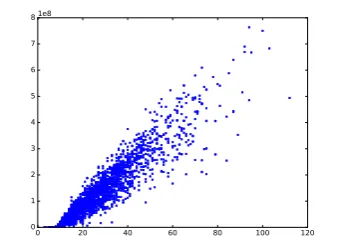
Figure 2: The total number of dynamic program-ming transitions and the sentence length.
model the sub-derivation(7, . . .) in Eq.1 would be mapped to the dynamic-programming state (7,{(1,<s>,4,also),(5,these,7,seriously)}). See
Chang and Collins(2017) for more details.
Remark 4. It is simple to use beam search in
conjunction with the algorithm. Different deriva-tions of the same length j are compared in the beam. A heuristic—typically a lower-order lan-guage model—can be used to score the firstn−1 words in each segmentπ1· · ·πr: this can be used
as the “future score” for each item in the beam. This is arguably simpler than the future scores used in (Koehn et al., 2003), which have to take into account the fact that different items in the beam correspond to translations of different sub-sets of words in the source sentence. In our ap-proach different derivations of the same length j
have translated the same set of words x1· · ·xj.
For example in the sub-derivation (7, . . .) given above (Eq. 1), and given a trigram language model, the initial bigramthese criticismsinπ2 is scored as pu(these)×pb(criticisms|these) where
pu andpbare unigram and bigram language
mod-els.
3 Experiments
The original motivation for Chang and Collins
(2017) was to develop a dynamic-programming al-gorithm for phrase-based decoding that for a fixed distortion limit d was polynomial time in other factors: the resulting dynamic programming algo-rithm isO(nd!lhd+1) time, wheredis the
d SegmentD Segment2 Moses
BLEU time BLEU time BLEU time cs-en 8 13.671 5m31s 17.42 2m49s 17.56 3m32s
[image:4.595.72.295.62.208.2]de-en 12 25.89 9m02s 26.69 5m25s 26.69 7m37s es-en 4 32.02 4m27s 32.01 3m58s 32.03 4m01s fi-en 8 23.02 5m03s 23.66 3m09s 23.73 3m37s fr-en 4 31.42 4m58s 31.43 4m23s 31.45 4m20s it-en 4 28.44 4m26s 28.44 3m57s 28.41 3m36s nl-en 8 24.96 7m53s 25.13 5m20s 25.16 5m56s pt-en 4 31.06 4m28s 31.05 4m00s 31.05 3m31s sv-en 4 31.33 3m58s 31.35 3m30s 31.34 3m02s vi-en 8 20.482 3m39s 20.96 2m08s 20.95 2m40s
Figure 3: Comparison of beam search under the new decoding algorithm and the Moses decoder. We show the BLEU score and the decoding time of three beam search based decoding methods.
section describes experiments comparing beam search under the new algorithm to the method of
Koehn et al.(2003). Throughout this section we refer to the algorithm ofChang and Collins(2017) as the “new” decoding algorithm.
Data. We use the Europarl parallel corpus (Ver-sion 7)3 (Koehn,2005) for all language pairs
ex-cept for Vietnamese-English (vi-en). For Czech-English (cs-en), we use the Newstest2015 as the development set and Newstest2016 as the test set. For European languages other than Czech, we use the development and test set released for the Shared Task of WPT 20054. For vi-en, we use the
IWSLT’15 data.
3.1 Search Space with a Bigram Model
We first analyze the properties of the algorithm by running the exact decoding algorithm with a bi-gram language model and a fixed distortion limit of four, with no pruning. In Figure2, we plot the number of transitions computed versus sentence length for translation of 2,000 German sentences to English. The figure confirms that the search space grows linearly with the number of words in the source sentence.
3.2 Beam Search under the New Algorithm
Even though the exact algorithm is linear time in the input sentence length, other factors (the
depen-1Unable to produce translations for 36 sentences. 2Unable to produce translations for one sentence. 3http://www.statmt.org/europarl/
4ACL 2005 Workshop on Building and Using Parallel Texts.
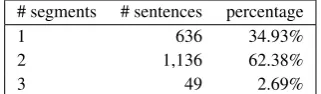
# segments # sentences percentage
1 636 34.93%
2 1,136 62.38%
3 49 2.69%
(a) The distribution of the number of segments required for the optimal solutions. Note that the distortion limit is four.
# segments # sentences percentage
1 119,428 15.97%
2 541,833 72.44%
3 82,869 11.08%
4 3,747 0.50%
5 128 0.02%
6 1 0.00%
[image:4.595.336.497.63.110.2](b) The distribution of the number of segments required for reordering the parsed German sentence.
Figure 4: The number of segments required for German-to-English translation.
dence ond,l, andh, as described above) make the exact algorithm too costly to be useful in practice. We experiment with beam search under the new algorithm,5both with and without further pruning
or restriction.
We experimented with asegment constrainton the new algorithm: more specifically, we describe experiments with a hard limitr≤2on the number of segmentsπ1. . . πrused in any translation.
Figure3shows results using a trigram language model for the new algorithm with beam search
(SegmentD), the new algorithm with beam search
and a hard limitr≤2on the number of segments
(Segment2), and Moses. A beam size of 100 is
used with all the algorithms. For each language pair, we pick the distortion limit that maximizes the BLEU score for Moses. Moses was used to train all the translation models. It can be seen that
theSegment2algorithm gives very similar
perfor-mance to Moses, whileSegmentDhas inferior per-formance for languges which require a larger dis-tortion limit.
3.3 Experiments on the Number of Segments Required for German-to-English
Translation
Finally, we investigate empirically how many seg-ments (the maximum value ofr) are required for translation from German to English. In a first ex-periment, we use the system ofChang and Collins
(2011) to give exact search for German-to-English
translation under a trigram language model with a distortion limitd= 4, and then look at the maxi-mum value forrfor each optimal translation. Out of 1,821 sentences, 34.9% have a maximum value of r = 1, 62.4% have r = 2, and 2.69% have
r = 3(Table4a). No optimal translations require a value ofrgreater than3. It can be seen that very few translations require more than 2 segments.
In a second experiment, we take the reordering system ofCollins et al.(2005) and test the maxi-mum value for r on each sentence to capture the reordering rules. Table4bgives the results. It can be seen that over 99% of sentences require a value ofr = 3or less, again suggesting that for at least this language pair, a choice ofr = 3orr = 4is large enough to capture the majority of reorderings (assuming that the rules ofCollins et al.(2005) are comprehensive).
4 Conclusion
The goal of this paper was to understand the em-pirical performance of a newly proposed decoding algorithm that operates from left to right on the source side. We compare our implementation of the new algorithm with the Moses decoder. The experimental results demonstrate that the new al-gorithm combined with beam search and segment-based pruning is competitive with the Moses de-coder. Future work should consider integration of the method with more recent models, in particular neural translation models.
References
Yin-Wen Chang and Michael Collins. 2011. Exact de-coding of phrase-based translation models through Lagrangian relaxation. InProceedings of the 2011 Conference on Empirical Methods in Natural Lan-guage Processing (EMNLP). Association for Com-putational Linguistics, pages 26–37.
Yin-Wen Chang and Michael Collins. 2017. A
polynomial-time dynamic programming algorithm for phrase-based decoding with a fixed distortion limit. Transactions of the Association for Compu-tational Linguistics5:59–71.
Kyunghyun Cho, Bart Van Merri¨enboer, Caglar Gul-cehre, Dzmitry Bahdanau, Fethi Bougares, Holger Schwenk, and Yoshua Bengio. 2014. Learning phrase representations using rnn encoder-decoder for statistical machine translation. In Proceedings of the 2014 Empirical Methods in Natural Language Processing (EMNLP). pages 1724–1734.
Michael Collins, Philipp Koehn, and Ivona Kuˇcerov´a. 2005. Clause restructuring for statistical machine translation. InProceedings of the 43rd annual meet-ing on association for computational lmeet-inguistics. As-sociation for Computational Linguistics, pages 531– 540.
He He, Jordan Boyd-Graber, and Hal Daum´e III. 2016. Interpretese vs. translationese: The uniqueness of human strategies in simultaneous interpretation. In
North American Association for Computational Lin-guistics.
Nal Kalchbrenner and Phil Blunsom. 2013. Recurrent continuous translation models. In Proceedings of the 2013 Conference on Empirical Methods in Nat-ural Language Processing (EMNLP). pages 1700– 1709.
Philipp Koehn. 2005. Europarl: A parallel corpus for statistical machine translation. InMT summit. vol-ume 5, pages 79–86.
Philipp Koehn, Hieu Hoang, Alexandra Birch, Chris Callison-Burch, Marcello Federico, Nicola Bertoldi, Brooke Cowan, Wade Shen, Christine Moran, Richard Zens, Chris Dyer, Ondˇrej Bojar, Alexandra Constantin, and Evan Herbst. 2007. Moses: Open source toolkit for statistical machine translation. In
Proceedings of the 45th annual meeting of the ACL on interactive poster and demonstration sessions. Association for Computational Linguistics, pages 177–180.
Philipp Koehn, Franz Josef Och, and Daniel Marcu. 2003. Statistical phrase-based translation. In
Proceedings of the 2003 Conference of the North American Chapter of the Association for Computa-tional Linguistics on Human Language Technology-Volume 1. Association for Computational Linguis-tics, pages 48–54.
Franz Josef Och and Hermann Ney. 2004. The align-ment template approach to statistical machine trans-lation.Computational linguistics30(4):417–449. Ilya Sutskever, Oriol Vinyals, and Quoc V Le. 2014.