Cross-Lingual Induction and Transfer of Verb Classes
Based on Word Vector Space Specialisation
Ivan Vuli´c1 , Nikola Mrkši´c2 andAnna Korhonen1 1Language Technology Lab, University of Cambridge, UK
2Dialogue Systems Group, University of Cambridge, UK {iv250,nm480,alk23}@cam.ac.uk
Abstract
Existing approaches to automatic VerbNet-style verb classification are heavily de-pendent on feature engineering and there-fore limited to languages with mature NLP pipelines. In this work, we propose a novel cross-lingual transfer method for inducing VerbNets for multiple languages. To the best of our knowledge, this is the first study which demonstrates how the architectures for learning word embeddings can be ap-plied to this challenging syntactic-semantic task. Our method uses cross-lingual trans-lation pairs to tie each of the six target lan-guages into a bilingual vector space with English, jointly specialising the representa-tions to encode the relational information from English VerbNet. A standard cluster-ing algorithm is then run on top of the VerbNet-specialised representations, using vector dimensions as features for learning verb classes. Our results show that the pro-posed cross-lingual transfer approach sets new state-of-the-art verb classification per-formance across all six target languages explored in this work.
1 Introduction
Playing a key role in conveying the meaning of a sentence, verbs are famously complex. They dis-play a wide range of syntactic-semantic behaviour, expressing the semantics of an event as well as rela-tional information among its participants ( Jackend-off,1972;Gruber,1976;Levin,1993, inter alia).
Lexical resources which capture the variabil-ity of verbs are instrumental for many Natural Language Processing (NLP) applications. One of the richest verb resources currently available for English is VerbNet (Kipper et al.,2000;Kipper,
2005).1 Based on the work of Levin (1993), this
largely hand-crafted taxonomy organises verbs into classes on the basis of their shared syntactic-semantic behaviour. Providing a useful level of gen-eralisation for many NLP tasks, VerbNet has been used to support semantic role labelling (Swier and Stevenson,2004;Giuglea and Moschitti,2006), se-mantic parsing (Shi and Mihalcea, 2005), word sense disambiguation (Brown et al., 2011), dis-course parsing (Subba and Di Eugenio,2009), in-formation extraction (Mausam et al.,2012), text mining applications (Lippincott et al.,2013;Rimell et al.,2013), research into human language acqui-sition (Korhonen,2010), and other tasks.
This benefit for English NLP has motivated the development of VerbNets for languages such as Spanish and Catalan (Aparicio et al.,2008), Czech (Pala and Horák, 2008), and Mandarin (Liu and Chiang, 2008). However, end-to-end manual re-source development using Levin’s methodology is extremely time consuming, even when supported by translations of English VerbNet classes to other languages (Sun et al.,2010;Scarton et al.,2014). Approaches which aim to learn verb classes au-tomatically offer an attractive alternative. How-ever, existing methods rely on carefully engi-neered features that are extracted using sophisti-cated language-specific resources (Joanis et al.,
2008;Sun et al.,2010;Falk et al.,2012, i.a.), rang-ing from accurate parsers to pre-compiled subcate-gorisation frames (Schulte im Walde,2006;Li and Brew,2008;Messiant,2008). Such methods are limited to a small set of resource-rich languages.
It has been argued that VerbNet-style classifica-tion has a strong cross-lingual element (Jackendoff,
1992;Levin,1993). In support of this argument,
Majewska et al.(2017) have shown that English VerbNet has high translatability across different,
1http://verbs.colorado.edu/∼mpalmer/projects/verbnet.html
even typologically diverse languages. Based on this finding, we propose an automatic approach which exploits readily available annotations for English to facilitate efficient, large-scale development of VerbNets for a wide set of target languages.
Recently, unsupervised methods for inducing dis-tributed word vector space representations orword embeddings(Mikolov et al.,2013a) have been suc-cessfully applied to a plethora of NLP tasks (Turian et al.,2010;Collobert et al., 2011;Baroni et al.,
2014, i.a.). These methods offer an elegant way to learn directly from large corpora, bypassing the feature engineering step and the dependence on ma-ture NLP pipelines (e.g., POS taggers, parsers, ex-traction of subcategorisation frames). In this work, we demonstrate how these models can be used to support automatic verb class induction. Moreover, we show that these models offer the means to ex-ploit inherent cross-lingual links in VerbNet-style classification in order to guide the development of new classifications for resource-lean languages. To the best of our knowledge, this proposition has not been investigated in previous work.
There has been little work on assessing the suit-ability of embeddings for capturing rich syntactic-semantic phenomena. One challenge is their re-liance on the distributional hypothesis (Harris,
1954), which coalesces fine-grained syntactic-semantic relations between words into a broad rela-tion of semantic relatedness (e.g.,coffee:cup) (Hill et al.,2015;Kiela et al.,2015). This property has an adverse effect when word embeddings are used in downstream tasks such as spoken language un-derstanding (Kim et al.,2016a,b) or dialogue state tracking (Mrkši´c et al.,2016,2017a). It could have a similar effect on verb classification, which relies on the similarity in syntactic-semantic properties of verbs within a class. In summary, we explore three important questions in this paper:
(Q1) Given their fundamental dependence on the distributional hypothesis, to what extent can unsupervised methods for inducing vector spaces facilitate the automatic induction of VerbNet-style verb classes across different languages?
(Q2)Can one boost verb classification for lower-resource languages by exploiting general-purpose cross-lingual resources such as BabelNet (Navigli and Ponzetto,2012;Ehrmann et al.,2014) or bilin-gual dictionaries such as PanLex (Kamholz et al.,
2014) to construct better word vector spaces for these languages?
(Q3)Based on the stipulated cross-linguistic va-lidity of VerbNet-style classification, can one ex-ploit rich sets of readily available annotations in one language (e.g., the full English VerbNet) to automatically bootstrap the creation of VerbNets for other languages? In other words, is it possi-ble to exploit a cross-lingual vector space to trans-fer VerbNet knowledge from a resource-rich to a resource-lean language?
To investigate Q1, we induce standard distribu-tional vector spaces (Mikolov et al.,2013b;Levy and Goldberg,2014) from large monolingual cor-pora in English and six target languages. As ex-pected, the results obtained with this straightfor-ward approach show positive trends, but at the same time reveal its limitations for all the languages in-volved. Therefore, the focus of our work shifts to Q2 and Q3. The problem of inducing VerbNet-oriented embeddings is framed as vector space spe-cialisation using the available external resources: BabelNet or PanLex, and (English) VerbNet. For-malised as an instance of post-processing seman-tic specialisationapproaches (Faruqui et al.,2015;
Mrkši´c et al.,2016), our procedure is steered by two sets of linguistic constraints:1)cross-lingual (translation) links between languages extracted from BabelNet (targeting Q2); and2)the available VerbNet annotations for a resource-rich language. The two sets of constraints jointly target Q3.
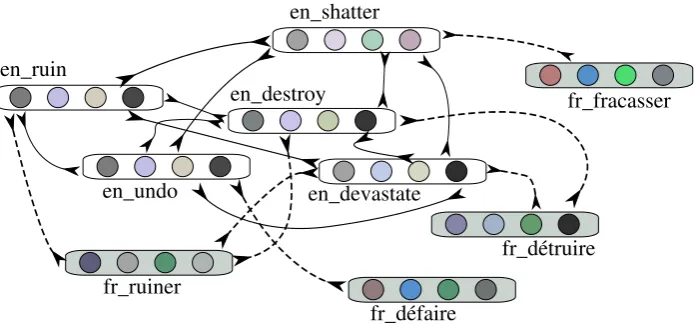
The main goal of vector space specialisation is to pull examples standing in desirable relations, as described by the constraints, closer together in the transformed vector space. The specialisation process can capitalise on the knowledge of Verb-Net relations in thesourcelanguage (English) by using translation pairs to transfer that knowledge to each of thetarget languages. By constructing shared bilingual vector spaces, our method facili-tates the transfer of semantic relations derived from VerbNet to the vector spaces of resource-lean target languages. This idea is illustrated by Fig.1.
fr_défaire fr_ruiner
fr_fracasser
fr_détruire en_shatter
en_undo en_ruin
[image:3.595.125.473.61.224.2]en_devastate en_destroy
Figure 1: Transferring VerbNet information from a resource-rich to a resource-lean language through a word vector space: anEnglish→Frenchtoy example. Representations of words described by two types of ATTRACTconstraints are pulled closer together in the joint vector space. (1) Monolingual pairwise
constraints in English (e.g.,(en_ruin, en_shatter), (en_destroy, en_undo)) reflect theENVerbNet structure
and are generated from the readily available verb classification in English (solid lines). They are used to specialise the distributionalENvector subspace for the VerbNet relation. (2) Cross-lingual English-French
pairwise constraints (extracted from BabelNet) describe cross-lingual synonyms (i.e., translation links) such as(en_ruin, fr_ruiner) or (en_shatter, fr_fracasser)(dashed lines). The post-processing fine-tuning specialisation procedure based on (1) and (2) effectively transforms the initial distributional French vector subspace to also emphasise the VerbNet-style structure, facilitating the induction of verb classes in French.
fine-tuning process (thus answering Q3).2We
re-port state-of-the-art verb classification performance for all six languages in our experiments. For in-stance, we improve the state-of-the-art F-1 score from prior work from 0.55 to 0.79 for French, and from 0.43 to 0.74 for Brazilian Portuguese.
2 Methodology: Specialising for VerbNet Motivation: Verb Classes and VerbNet Verb-Net is a hierarchical, domain-independent, broad-coverage verb lexicon based on Levin’s classifica-tion and taxonomy of English (EN) verbs (Levin,
1993;Kipper,2005). Verbs are grouped into classes (e.g. the classPUT-9.1 for verbs such asplace,
po-sition,insert, andarrange) based on their shared meaning components and syntactic behaviour, de-fined in terms of their participation in diathesis alternations, i.e., alternating verb frames that are related with the same or similar meaning. Verb-Net extends and refines Levin’s classification, pro-viding more fine-grained syntactic and semantic information for individual classes. Each VerbNet class is characterised by its member verbs, syntac-tic frames, semansyntac-tic predicates and typical verb
2On a high level, we demonstrate that a constraints-driven fine-tuning framework can specialise word embeddings to reflect VerbNet-style relations which rely not only on verb sense similarity, but also on similarity in syntax, selectional preferences, and diathesis alternations.
arguments.3The current version of VerbNet (v3.2)
contains 8,537 distinct English verbs grouped into 273 VerbNet main classes.
The inter-relatedness of syntactic behaviour and meaning of verbs is not limited to English (Levin,
1993). The basic meaning components underlying verb classes are said to becross-linguistically valid (Jackendoff,1992;Merlo et al.,2002)4and
there-fore the classification has a strong cross-lingual di-mension. A recent investigation ofMajewska et al.
(2017) show that it is possible to manually translate VerbNet classes and class members to different, ty-pologically diverse languages with high accuracy.
The practical usefulness of VerbNet style clas-sification both within and across languages has been limited by the fact that few languages boast resources similar to the English VerbNet. Some VerbNets have been developed completely manu-ally from scratch, aiming to capture properties spe-cific to the language in question, e.g., the resources for Spanish and Catalan (Aparicio et al., 2008),
3The usefulness of VerbNet is further accentuated by avail-able mappings (Loper et al.,2007) to a number of other verb re-sources such as WordNet (Fellbaum,1998), FrameNet (Baker et al.,1998), and PropBank (Palmer et al.,2005).
Czech (Pala and Horák,2008), and Mandarin (Liu and Chiang,2008). Other VerbNets were created semi-automatically, with the help of other lexical resources, e.g., for French (Pradet et al.,2014) and Brazilian Portuguese (Scarton and Aluısio,2012). These approaches involved substantial amounts of specialised linguistic and translation work. Finally, automatic methods have been developed, e.g., for French (Sun et al., 2010;Falk et al., 2012) and Brazilian Portuguese (Scarton et al.,2014), with in-sufficient accuracy (as emphasised in Sect.4). Until now, work in this area has been limited to a small number of languages, due to the large requirements in terms of human input and/or the availability of mature NLP pipelines which exist only for a few resource-rich languages (e.g., English, German).
In this work, we propose a novel, fully auto-mated approach for inducing VerbNets for multiple languages - one based on cross-lingual transfer. Unlike earlier approaches, our method does not require any parsed data or manual annotations for the target language. It encodes the cross-linguistic validity of Levin-style verb classifications into the vector-space specialisation framework (Sect.2.1) driven by linguistic constraints. A standard cluster-ing algorithm is then run on top of the VerbNet-specialised representations using vector dimen-sions as features to learn verb clusters (Sect.2.2). Our approach attains state-of-the-art verb classifi-cation performance across all six target languages.
2.1 Vector Space Specialisation
Specialisation Model Our departure point is a state-of-the-art specialisation model for fine-tuning vector spaces termed PARAGRAM(Wieting et al.,
2015).5 The PARAGRAM procedure injects
simi-larity constraints between word pairs in order to make their vector space representations more sim-ilar; we term these the ATTRACTconstraints. Let V =VstVtbe the vocabulary consisting of the source language and target language vocabularies
VsandVt, respectively. LetC be the set of word pairs standing in desirable lexical relations; these include:1)verb pairs from the same VerbNet class (e.g. (en_transport, en_transfer) from verb class
SEND-11.1); and2)the cross-lingual synonymy 5The original PARAGRAMmodel as well as other fine-tuning models from prior work inject pairwise linguistic con-straints into existing vector spaces in order to improve their ability to capture semantic similarity/paraphrasability. In this work, we demonstrate that the same generic specialisation framework can be used to transform vector spaces to capture other types of lexical relations such as VerbNet relations.
pairs (e.g. (en_peace, fi_rauha)). Given the initial distributional space and collections of such AT -TRACTpairsC, the model gradually modifies the
space to bring the designated word vectors closer together, working in mini-batches of sizek. The method’s cost function can be expressed as:
O(BC) =OC(BC) +R(BC) (1) The first term of the method’s cost function (i.e., OC) pulls the ATTRACTexamples(xl, xr) ∈ C closer together (see Fig.1for an illustration).BC refers to the current mini-batch of ATTRACT
con-straints. This term is expressed as follows:
OC(BC) =
X
(xl,xr)∈BC
τ(δatt+xltl−xlxr) +τ(δatt+xrtr−xlxr) (2)
τ(x) = max(0, x)is the standard rectified linear unit or the hinge loss function (Tsochantaridis et al.,
2004;Nair and Hinton,2010).δattis the “attract” margin: it determines how much vectors of words from ATTRACTconstraints should be closer to each
other than to their negative examples. The negative exampletifor each wordxiin any ATTRACTpair is always the vector closest toxi taken from the pairs in the current mini-batch, distinct from the other word paired withxi, andxiitself.6
The second R(BC) term is the regularisation which aims to retain the semantic information en-coded in the initial distributional space as long as this information does not contradict the used AT -TRACTconstraints. Letxiniti refer to the initial
dis-tributional vector of the word xi and let V(BC) be the set of all word vectors present in the given mini-batch. Ifλreg denotes the L2 regularisation constant, this term can be expressed as:
R(BC) = X
xi∈V(BC) λreg
x
init
i −xi
2 (3)
Linguistic Constraints: Transferring VerbNet-Style Knowledge The fine-tuning procedure ef-fectively blends the knowledge from external re-sources (i.e., the input ATTRACTset of constraints)
with distributional information extracted directly from large corpora. We show how to propagate annotations from a knowledge source such as Verb-Net from source to target by combining two types of constraints within the specialisation framework:
LEARN-14 BREAK-45.1 ACCEPT-77 (learn, study) (break, dissolve) (accept, understand) (learn, relearn) (crash, crush) (accept, reject) (read, study) (shatter, split) (repent, rue) (cram, relearn) (break, rip) (reject, discourage) (read, assimilate) (crack, smash) (encourage, discourage) (learn, assimilate) (shred, splinter) (reject, discourage) (read, relearn) (snap, tear) (disprefer, understand)
Table 1: Example pairwise ATTRACTconstraints
extracted from three VerbNet classes in English.
a) cross-lingual (translation) links between lan-guages, and b)available VerbNet annotations in a resource-rich language transformed into pair-wise constraints. Cross-lingual constraints such
as (pl_wojna, it_guerra) are extracted from
Ba-belNet (Navigli and Ponzetto,2012), a large-scale resource which groups words into cross-lingual
BABELsynsets (and is currently available for 271
languages). The wide and steadily growing cover-age of langucover-ages in BabelNet means that our pro-posed framework promises to support the transfer of VerbNet-style information to numerous target languages (with increasingly high accuracy).
To establish that the proposed transfer approach is in fact independent of the chosen cross-lingual information source, we also experiment with an-other cross-lingual dictionary: PanLex (Kamholz et al.,2014), which was used in prior work on cross-lingual word vector spaces (Duong et al., 2016;
Adams et al.,2017). This dictionary currently cov-ers around 1,300 language varieties with over 12 million expressions, thus offering support also for low-resource transfer settings.7
VerbNet constraints are extracted from the En-glish VerbNet class structure in a straightforward manner. For each class V Ni from the 273 Verb-Net classes, we simply take the set of allni verbs
CLi = {v1,i, v2,i, . . . , vni,i}associated with that class, including its subclasses, and generate all unique pairs (vk, vl) so that vk, vl ∈ CLi and
vk 6= vl. Example VerbNet pairwise constraints are shown in Tab.1. Note that VerbNet classes in practice contain verb instances standing in a variety of lexical relations, including synonyms, antonyms, troponyms, hypernyms, and the class membership is determined on the basis of connections between the syntactic patterns and the underlying semantic relations (Kipper et al.,2006,2008).
7Similar to BabelNet, the translations in PanLex were de-rived from various sources such as glossaries, dictionaries, and automatic inference from other languages. This results in a high-coverage lexicon containing a certain amount of noise.
2.2 Clustering Algorithm
Given the initial distributional or specialised collec-tion of target language vectorsVt, we apply an
off-the-shelf clustering algorithm on top of these vec-tors in order to group verbs into classes. Following prior work (Brew and Schulte im Walde,2002;Sun and Korhonen,2009;Sun et al.,2010), we employ the MNCut spectral clustering algorithm (Meila and Shi, 2001), which has wide applicability in similar NLP tasks which involve high-dimensional feature spaces (Chen et al., 2006; von Luxburg,
2007;Scarton et al.,2014, i.a.). Again, following prior work (Sun et al.,2010,2013), we estimate the number of clustersKClustusing the self-tuning method ofZelnik-Manor and Perona(2004). This algorithm finds the optimal number by minimising a cost function based on the eigenvector structure of the word similarity matrix. We refer the reader to the relevant literature for further details.
3 Experimental Setup
Languages We experiment with six target lan-guages: French (FR), Brazilian Portuguese (PT),
Italian (IT), Polish (PL), Croatian (HR), and Finnish
(FI). All statistics regarding the source and size of
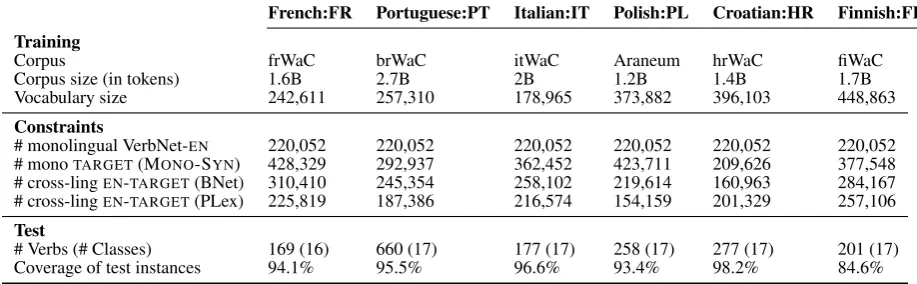
training and test data, and linguistic constraints for each target language are summarised in Tab.2.
Automatic approaches to verb class induction have been tried out in prior work forFRandPT. To
the best of our knowledge, our cross-lingual study is the first aiming to generalise an automatic induc-tion method to more languages using an underlying methodology which is language-pair independent.
Initial Vector Space: Training Data and Setup
All target language vectors were trained on large monolingual running text using the same setup: 300-dimensional word vectors, the frequency cut-off set to 100, bag-of-words (BOW) contexts, and the window size of 2 (Levy and Goldberg,2014;
Schwartz et al.,2016). All tokens were lowercased, and all numbers were converted to a placeholder symbol<NUM>.8 FRandIT word vectors were
trained on the standard frWaC and itWaC corpora (Baroni et al.,2009), and vectors for other target languages were trained on the corpora of simi-lar style and size:HRvectors were trained on the
French:FR Portuguese:PT Italian:IT Polish:PL Croatian:HR Finnish:FI Training
Corpus frWaC brWaC itWaC Araneum hrWaC fiWaC
Corpus size (in tokens) 1.6B 2.7B 2B 1.2B 1.4B 1.7B
Vocabulary size 242,611 257,310 178,965 373,882 396,103 448,863
Constraints
# monolingual VerbNet-EN 220,052 220,052 220,052 220,052 220,052 220,052 # monoTARGET(MONO-SYN) 428,329 292,937 362,452 423,711 209,626 377,548
# cross-lingEN-TARGET(BNet) 310,410 245,354 258,102 219,614 160,963 284,167
# cross-lingEN-TARGET(PLex) 225,819 187,386 216,574 154,159 201,329 257,106
Test
# Verbs (# Classes) 169 (16) 660 (17) 177 (17) 258 (17) 277 (17) 201 (17)
[image:6.595.71.530.64.206.2]Coverage of test instances 94.1% 95.5% 96.6% 93.4% 98.2% 84.6%
Table 2: Statistics of the experimental setup for each target language: training/test data and constraints. Coveragerefers to the percentage of test verbs represented in the target language vocabularies.
vectors on ptWaC (Wagner Filho et al.,2016),FI
vectors on fiWaC (Ljubeši´c et al.,2016), andPL
vectors on the Araneum Polonicum Maius Web cor-pus (Benko,2014). Note that we do not utilise any VerbNet-specific knowledge in the target language to induce and further specialise these word vectors.
SourceENvectors were taken directly from the
work ofLevy and Goldberg(2014): they are trained with SGNS on the cleaned and tokenised Polyglot Wikipedia (Al-Rfou et al.,2013) containing∼75M sentences, ∼1.7B word tokens and a vocabulary of∼180k words after lowercasing and frequency cut-off. To measure the importance of the starting source language space as well as to test if syntactic knowledge on the source side may be propagated to the target space, we test two variantENvector
spaces: SGNS with (a) BOW contexts and the win-dow size 2 (SGNS-BOW2); and (b) dependency-based contexts (SGNS-DEPS) (Padó and Lapata,
2007;Levy and Goldberg,2014).
Linguistic Constraints We experiment with the following constraint types: (a) monolingual syn-onymy constraints in each target language extracted from BabelNet (Mono-Syn); (b) cross-lingualEN -TARGET constraints from BabelNet; (c)
cross-lingual EN-TARGETconstraints plusENVerbNet
constraints (see Sect.2.1and Fig.1). Unless stated otherwise, we use BabelNet as the default source of cross-lingual constraints for (b) and (c).
Vector Space Specialisation The PARAGRAM
model’s parameters are adopted directly from prior work (Wieting et al.,2015) without any additional fine-tuning:δatt = 0.6,λreg = 10−9, k= 50. We train for 5 epochs without early stopping using Ada-Grad (Duchi et al.,2011). PARAGRAMis in fact a
special case of the more general ATTRACT-REPEL
specialisation framework (Mrkši´c et al.,2017b): we use this more recent and more efficient TensorFlow implementation of the model in all experiments.9 Test Data The development of an automatic verb classification approach requires an initial gold stan-dard (Sun et al., 2010): these have been devel-oped forFR (Sun et al.,2010),PT(Scarton et al.,
2014),IT,PL,HR, andFI(Majewska et al.,2017).
They were created using the methodology ofSun et al.(2010), based on theENgold standard ofSun
et al.(2008) which contains 17 fine-grained Levin classes with 12 member verbs each. For instance, the classPUT-9.1 in French contains verbs such as
accrocher, déposer, mettre, répartir, réintégrer, etc.
Evaluation Measures We use standard evalua-tion measures from prior work on verb clustering (Ó Séaghdha and Copestake, 2008;Sun and Ko-rhonen,2009;Sun et al.,2010;Falk et al.,2012, i.a.). The meanprecisionof induced verb clusters labelledmodified purity(MPUR) is computed as:
MPUR=
P
C∈Clust,nprev(C)>1nprev(C)
#test_verbs (4)
Here, each cluster C from the set of all KClust induced clustersClustis associated with its preva-lent class/cluster from the gold standard, and the number of verbs in an induced clusterCtaking this prevalent class is labellednprev(C). All other verbs not taking the prevalent class are considered er-rors.10#test_verbsdenotes the total number of test
verb instances. The second measure targetingrecall isweighted class accuracy(WACC), computed as:
WACC=
P
C∈Goldndom(C)
#test_verbs (5)
9https://github.com/nmrksic/attract-repel 10Clusters withn
FR PT IT PL HR FI Target language
0.50 0.55 0.60 0.65 0.70 0.75 0.80 0.85
F-1
Sc
or
e
(C
lu
st
er
in
g)
Distributional Mono-Syn XLing (BabelNet) XLing+VerbNet-EN
(a) EN Vectors: SGNS-BOW2
FR PT IT PL HR FI
Target language 0.50
0.55 0.60 0.65 0.70 0.75 0.80 0.85
F-1
Sc
or
e
(C
lu
st
er
in
g)
Distributional Mono-Syn XLing (BabelNet) XLing+VerbNet-EN
[image:7.595.80.521.66.207.2](b) EN Vectors: SGNS-DEPS
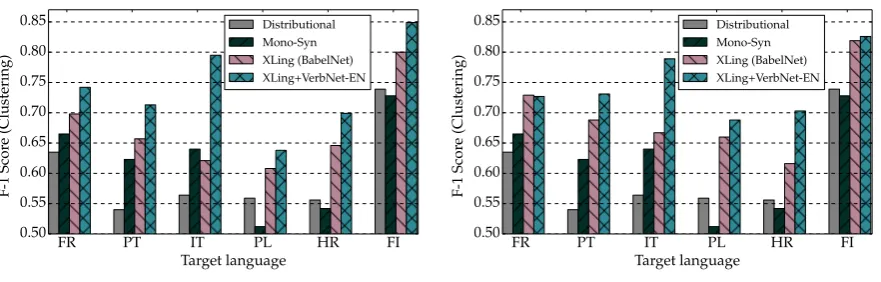
Figure 2:F-1 scores in six target languages using the post-processing specialisation procedure from Sect.2.1and different sets of constraints:Distributionalrefers to the initial vector space in each target language;Mono-Synis the vector space tuned using monolingual synonymy constraints from BabelNet; XLinguses cross-lingualEN-TARGETconstraints from BabelNet (TARGETrefers to any of the six target
languages);XLing+VerbNet-EN is a fine-tuned vector space which uses both cross-lingualEN-TARGET
constraints plusENVerbNet constraints. Results are provided with (a) SGNS-BOW2 and (b) SGNS-DEPS
source vector space in English for theXLingandXLing+VerbNetvariants, see Sect.3.
For each clusterC from the set of gold standard clustersGold, we have to find the dominant cluster from the set of induced clusters: this cluster has the most verbs in common with the gold clusterC, and that number isndom(C). As measures of precision and recall,MPURandWACCmay be combined into
an F-1 score, computed as the balanced harmonic mean, which we report in this work.11
4 Results and Discussion
Cross-Lingual Transfer Model F-1 verb classifi-cation scores for the six target languages with dif-ferent sets of constraints are summarised in Fig.2. We can draw several interesting conclusions. First, the strongest results on average are obtained with the model which transfers the VerbNet knowledge from English (as a resource-rich language) to the resource-lean target language (providing an an-swer to question Q3, Sect.1). These improvements are visible across all target languages, empirically demonstrating the cross-lingual nature of VerbNet-style classifications. Second, using cross-lingual constraints alone (XLing) yields strong gains over initial distributional spaces (answering Q1 and Q2). Fig.2also shows that cross-lingual similarity con-straints are more beneficial than the monolingual ones, despite a larger total number of the
monolin-11We have also experimented with V-measure (Rosenberg
and Hirschberg,2007), another standard evaluation measure which balances between homogeneity (precision) and com-pleteness (recall); we do not report these scores for brevity as similar trends in results are observed.
gual constraints in each language (see Tab.2). This suggests that such cross-lingual similarity links are strong implicit indicators of class membership. Namely, target language words which map to the same source language word are likely to be syn-onyms and consequently end up in the same verb class in the target language. However, the cross-lingual links are even more useful as means for transferring the VerbNet knowledge, as evidenced by additional gains withXLing+VerbNet-EN.
The absolute classification scores are the low-est for the two Slavic languages:PLandHR. This
may be partially explained by the lowest number of cross-lingual constraints for the two languages cov-ering only a subset of their entire vocabularies (see Tab.2and compare the total number of constraints forHRandPLto the numbers for e.g.FIorFR).
An-other reason for weaker performance of these two languages could be their rich morphology, which induces data sparsity both in the initial vector space estimation and in the coverage of constraints.
State-of-the-Art A direct comparison of previ-ous state-of-the-art classification scores available for FR (Sun et al., 2010) and PT (Scarton et al.,
2014) on the same test data exemplifies the extent of improvement achieved by our transfer model. F-1 scores improve from 0.55 to 0.75 forFRand
from 0.43 to 0.73 forPT.Scarton et al.(2014)
assump-French Italian
Vector space XLing XLing+VN XLing XLing+VN
EN+FR 0.698 0.742 – –
EN+IT – – 0.621 0.795
EN+FR+IT 0.728 0.745 0.650 0.768 EN+FR+PL 0.697 0.717 – –
[image:8.595.72.291.63.160.2]EN+IT+PL – – 0.658 0.765 EN+FI+FR+IT 0.719 0.751 0.662 0.777 EN+FR+IT+PT 0.710 0.718 0.688 0.760
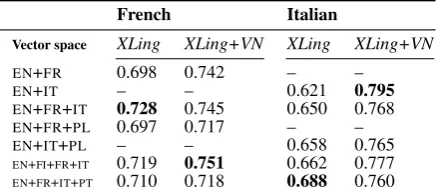
Table 3: The effect of multilingual vector space specialisation. Results are reported forFRandIT
using: a) cross-lingual constraints only (XLing); and b) the VerbNet transfer model (XLing+VN).
tion of cross-linguistic class consistency directly through a specialised vector space, and also avoids any reliance on target-language-specific NLP tools.
Starting Source Vector Space Fig. 2a and Fig. 2b enable a brief analysis of the influence of the starting ENvector space on the results for
each target language. We observe small but consis-tent gains with SGNS-DEPS, which utilises syn-tactic information stemming from a dependency parser on the source side, over SGNS-BOW for the
XLingvariant. The improvements are +2.1 points
on average, visible for 5 out of 6 target languages. We again see an increase in performance with the
XLing+VerbNetmodel, but we do not observe any
major difference between the two starting source spaces now: average slight score difference of 0.3 is in favour of SGNS-BOW2, which outperforms SGNS-DEPS for 3 out of 6 target languages. This finding indicates that VerbNet-based linguistic con-straints are more important for the final classifica-tion performance, and mitigate the artefacts of the starting distributional source space.
Bilingual vs. Multilingual The transfer model can operate with more than two languages, effec-tively inducing a multilingual vector space. We analyse such multilingual training based on the re-sults onFRandIT(Tab.3). On average, the results
withXLingimprove with more languages (see also
the results for ENin Tab. 4), as the model relies
on more constraints for the vector space special-isation. Yet additional languages do not lead to clear improvements withXLing+VerbNet: we hy-pothesise that the specialisation procedure becomes dominated by cross-lingual constraints which may diminish the importance of VerbNet-basedEN
con-straints. The language configuration in the mul-tilingual vector space also makes a difference:
VC:XLing Sim:XLing Sim:XLing+VN
EN-Dist 0.484 0.275 –
+FR 0.608 0.556 0.481
+PT 0.633 0.537 0.466
+IT 0.602 0.524 0.476
+PL 0.597 0.469 0.431
+HR 0.582 0.497 0.446
+FI 0.662 0.598 0.491
+FR+IT 0.633 0.571 0.526
+FI+FR+IT 0.641 0.635 0.558
+FR+IT+PT 0.674 0.596 0.515
EN-VN 0.956 – 0.358
Table 4: Comparison of verb classification (VC) and verb semantic similarity (Sim) for English. VC is measured on the EN test set of Sun et al.
(2008).Simis measured on SimVerb-3500 (Gerz et al.,2016). The scores are Spearman’sρ corre-lation scores. EN-Dist is the initial distributional
English vector space: SGNS-BOW2; EN-VN is
the same space transformed using monolingualEN
VerbNet constraints only, an upper bound for the specialisation-based approach inEN.
e.g., combiningPL with the Romance languages
degrades the performance, while FI surprisingly
boosts it slightly. For brevity, we only report the results forFRandIT. Similar trends are observed
when making the transition from bilingual to multi-lingual vector spaces for other target languages.
Clustering Algorithm Since vector space spe-cialisation is detached from the application of the clustering algorithm, our framework allows straightforward experimentation with other algo-rithms. Following prior work (Brew and Schulte im Walde, 2002; Sun et al., 2010), we also test K-means clustering. Results for the six languages
using the EN SGNS-BOW2 source space and
Xling+VerbNet-ENare on average 3.8 points lower
than the ones reported in Fig.2a. K-Means is out-performed for each target language, confirming the superiority of spectral clustering established in prior work, e.g., (Scarton et al.,2014). On the other hand, we find results with another clustering algo-rithm, hierarchical agglomerative clustering with Ward’s linkage (Ward,1963), on par with spectral clustering (1.4 points on average in favour of spec-tral, which is better on 4 out of 6 languages). We believe that further gains in verb class induction could be achieved by additional fine-tuning of the clustering algorithm.
[image:8.595.307.525.64.198.2]cross-FR PT IT PL HR FI Target language
0.50 0.55 0.60 0.65 0.70 0.75 0.80 0.85
F-1
Sc
or
e
(C
lu
st
er
in
g)
[image:9.595.80.282.68.192.2]Distributional Mono-Syn XLing (PanLex) XLing+VerbNet-EN
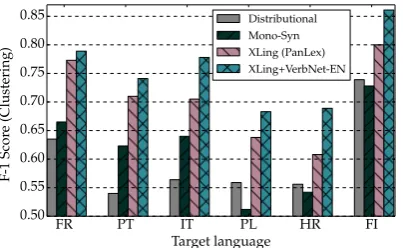
Figure 3:F-1scores when PanLex is used as the source of cross-lingual ATTRACTconstraints
(in-stead of BabelNet). EN Vectors: SGNS-BOW2.
lingual information again leads to large gains with the cross-lingual transfer model, as is evident from Fig.3. This suggests that the proposed approach does not depend on a particular source of infor-mation - it can be used with any general-purpose bilingual dictionary. We mark slight improvements for 3/6 target languages when comparing the results with the ones from Fig.2a. The new state-of-the-art F-1 scores are 0.79 forFRand 0.74 forPT. Verb Classification vs. Semantic Similarity
An interesting question originating from prior work on verb representation learning, e.g., (Baker et al.,
2014) touches upon the correlation between verb classification and semantic similarity. Due to the availability of VerbNet constraints and a recent sim-ilarity evaluation set (SimVerb-3500; it contains hu-man similarity ratings for 3,500 verb pairs) (Gerz et al.,2016), we perform the analysis on English: the results are summarised in Tab.4. They clearly indicate that cross-lingual synonymy constraints are useful for both relationship types (compare the scores withXLing), with strong gains over the non-specialised distributional space. However, the inclu-sion of VerbNet information, while boosting classi-fication scores for target languages and (trivially) for EN, deteriorates EN similarity scores across
the board (compareXLing+VN against XLingin Tab.4). This suggests that the VerbNet-style class membership is definitely not equivalent to pure semantic similarity captured by SimVerb.
4.1 Further Discussion and Future Work
This work has proven the potential of transferring lexical resources from rich to resource-poor languages using general-purpose cross-lingual dictionaries and bilingual vector spaces as means of transfer within a semantic specialisation
frame-work. However, we believe that the proposed basic framework may be upgraded and extended across several research paths in future work.
First, in the current work we have operated with standard single-sense/single-prototype representa-tions, thus effectively disregarding the problem of verb polysemy. While several polysemy-aware verb classification models for English were de-veloped recently (Kawahara et al., 2014; Peter-son et al., 2016), the current lack of polysemy-aware evaluation sets in other languages impedes this line of research. Evaluation issues aside, one idea for future work is to use the ATTRACT-REPEL
specialisation framework for sense-aware cross-lingual transfer relying on recently developed multi-sense/prototype word representations (Neelakantan et al.,2014;Pilehvar and Collier,2016, inter alia). Another challenge is to apply the idea from this work to enable cross-lingual transfer of other struc-tured lexical resources available in English such as FrameNet (Baker et al.,1998), PropBank (Palmer et al., 2005), and VerbKB (Wijaya and Mitchell,
2016). Other potential research avenues include porting the approach to other typologically diverse languages and truly low-resource settings (e.g., with only limited amounts of parallel data), as well as experiments with other distributional spaces, e.g. (Melamud et al.,2016). Further refinements of the specialisation and clustering algorithms may also result in improved verb class induction.
5 Conclusion
We have presented a novel cross-lingual transfer model which enables the automatic induction of VerbNet-style verb classifications across multiple languages. The transfer is based on a word vector space specialisation framework, utilised to directly model the assumption of cross-linguistic validity of VerbNet-style classifications. Our results indicate strong improvements in verb classification accu-racy across all six target languages explored. All automatically induced VerbNets are available at: github.com/cambridgeltl/verbnets.
Acknowledgments
References
Oliver Adams, Adam Makarucha, Graham Neubig, Steven Bird, and Trevor Cohn. 2017. Cross-lingual word embeddings for low-resource language model-ing. InProceedings of EACL, pages 937–947.
Rami Al-Rfou, Bryan Perozzi, and Steven Skiena. 2013.Polyglot: Distributed word representations for
multilingual NLP. InProceedings of CoNLL, pages
183–192.
Juan Aparicio, Mariona Taulé, and Maria Antònia Martí. 2008. AnCora-Verb: A lexical resource for the semantic annotation of corpora. InProceedings of LREC, pages 797–802.
Collin F. Baker, Charles J. Fillmore, and John B. Lowe. 1998. The Berkeley FrameNet project. In Proceed-ings of ACL, pages 86–90.
Simon Baker, Roi Reichart, and Anna Korhonen. 2014.
An unsupervised model for instance level
subcate-gorization acquisition. InProceedings of EMNLP,
pages 278–289.
Marco Baroni, Silvia Bernardini, Adriano Ferraresi, and Eros Zanchetta. 2009. The WaCky wide web: A collection of very large linguistically processed
web-crawled corpora. Language Resources and
Evalua-tion, 43(3):209–226.
Marco Baroni, Georgiana Dinu, and Germán Kruszewski. 2014. Don’t count, predict! A systematic comparison of context-counting vs. context-predicting semantic vectors. InProceedings of ACL, pages 238–247.
Vladimír Benko. 2014. Aranea: Yet another family of
(comparable) Web corpora. InProceedings of TSD,
pages 247–254.
Chris Brew and Sabine Schulte im Walde. 2002. Spec-tral clustering for German verbs. InProceedings of EMNLP, pages 117–124.
Susan Windisch Brown, Dmitriy Dligach, and Martha Palmer. 2011. VerbNet class assignment as a WSD task. InProceedings of IWCS, pages 85–94.
Jinxiu Chen, Donghong Ji, Chew Lim Tan, and Zhengyu Niu. 2006. Relation extraction using la-bel propagation based semi-supervised learning. In Proceedings of ACL, pages 129–136.
Ronan Collobert, Jason Weston, Léon Bottou, Michael Karlen, Koray Kavukcuoglu, and Pavel P. Kuksa. 2011. Natural language processing (almost) from
scratch. Journal of Machine Learning Research,
12:2493–2537.
John C. Duchi, Elad Hazan, and Yoram Singer. 2011.
Adaptive subgradient methods for online learning
and stochastic optimization. Journal of Machine
Learning Research, 12:2121–2159.
Long Duong, Hiroshi Kanayama, Tengfei Ma, Steven Bird, and Trevor Cohn. 2016. Learning crosslingual word embeddings without bilingual corpora. In Pro-ceedings of EMNLP, pages 1285–1295.
Maud Ehrmann, Francesco Cecconi, Daniele Vannella, John Philip Mccrae, Philipp Cimiano, and Roberto Navigli. 2014. Representing multilingual data as linked data: The case of BabelNet 2.0. In Proceed-ings of LREC, pages 401–408.
Ingrid Falk, Claire Gardent, and Jean-Charles Lamirel. 2012. Classifying French verbs using French and English lexical resources. In Proceedings of ACL, pages 854–863.
Manaal Faruqui, Jesse Dodge, Sujay Kumar Jauhar, Chris Dyer, Eduard Hovy, and Noah A. Smith. 2015.
Retrofitting word vectors to semantic lexicons. In Proceedings of NAACL-HLT, pages 1606–1615. Christiane Fellbaum. 1998.WordNet.
Daniela Gerz, Ivan Vuli´c, Felix Hill, Roi Reichart, and Anna Korhonen. 2016. SimVerb-3500: A large-scale evaluation set of verb similarity. In Proceed-ings of EMNLP, pages 2173–2182.
Ana-Maria Giuglea and Alessandro Moschitti. 2006.
Semantic role labeling via FrameNet, VerbNet and
PropBank. InProceedings of ACL, pages 929–936.
Jeffrey Gruber. 1976. Lexical structure in syntax and semantics.
Zellig S. Harris. 1954. Distributional structure. Word, 10(23):146–162.
Felix Hill, Roi Reichart, and Anna Korhonen. 2015.
SimLex-999: Evaluating semantic models with (gen-uine) similarity estimation. Computational Linguis-tics, 41(4):665–695.
Ray S. Jackendoff. 1972. Semantic interpretation in generative grammar.
Ray S. Jackendoff. 1992.Semantic structures.
Eric Joanis, Suzanne Stevenson, and David James. 2008. A general feature space for automatic verb classification. Natural Language Engineering, 14(3):337–367.
David Kamholz, Jonathan Pool, and Susan M. Colow-ick. 2014. PanLex: Building a resource for panlin-gual lexical translation. InProceedings of LREC, pages 3145–3150.
Daisuke Kawahara, Daniel W. Peterson, and Martha Palmer. 2014. A step-wise usage-based method for
inducing polysemy-aware verb classes. In
Proceed-ings of ACL, pages 1030–1040.
Douwe Kiela, Felix Hill, and Stephen Clark. 2015.
Specializing word embeddings for similarity or
re-latedness. InProceedings of EMNLP, pages 2044–
Joo-Kyung Kim, Marie-Catherine de Marneffe, and Eric Fosler-Lussier. 2016a. Adjusting word embed-dings with semantic intensity orders. InProceedings of the 1st Workshop on Representation Learning for NLP, pages 62–69.
Joo-Kyung Kim, Gokhan Tur, Asli Celikyilmaz, Bin Cao, and Ye-Yi Wang. 2016b. Intent detection us-ing semantically enriched word embeddus-ings. In Pro-ceedings of IEEE SLT.
Karin Kipper. 2005. VerbNet: A broad-coverage, com-prehensive verb lexicon. Ph.D. thesis.
Karin Kipper, Hoa Trang Dang, and Martha Stone Palmer. 2000. Class-based construction of a verb lexicon. InProceedings of AAAI, pages 691–696. Karin Kipper, Anna Korhonen, Neville Ryant, and
Martha Palmer. 2006. Extending VerbNet with novel verb classes. InProceedings of LREC. Karin Kipper, Anna Korhonen, Neville Ryant, and
Martha Palmer. 2008. A large-scale classification of english verbs.Language Resources and Evaluation, 42(1):21–40.
Anna Korhonen. 2010. Automatic lexical classifica-tion: Bridging research and practice. Philoshophi-cal Transactions A of the Royal Society, 368:3621– 3632.
Beth Levin. 1993.English verb classes and alternation, A preliminary investigation.
Omer Levy and Yoav Goldberg. 2014.
Dependency-based word embeddings. In Proceedings of ACL,
pages 302–308.
Jianguo Li and Chris Brew. 2008. Which are the best features for automatic verb classification. In Pro-ceedings of ACL, pages 434–442.
Thomas Lippincott, Laura Rimell, Karin Verspoor, and Anna Korhonen. 2013. Approaches to verb subcat-egorization for biomedicine. Journal of Biomedical Informatics, 46(2):212–227.
Mei-Chun Liu and Ting-Yi Chiang. 2008. The con-struction of Mandarin VerbNet: A frame-based study of statement verbs. Language and Linguistics, 9(2):239–270.
Nikola Ljubeši´c and Filip Klubiˇcka. 2014.
{bs,hr,sr}WaC – Web corpora of Bosnian, Croatian and Serbian. InProceedings of the 9th Web as Cor-pus Workshop, pages 29–35, Gothenburg, Sweden. Association for Computational Linguistics.
Nikola Ljubeši´c, Tommi Pirinen, and Antonio Toral. 2016. Finnish Web corpus fiWaC 1.0. Slovenian language resource repository CLARIN.SI.
Edward Loper, Szu-Ting Yi, and Martha Palmer. 2007. Combining lexical resources: Mapping between PropBank and VerbNet. InProceedings of IWCS.
Ulrike von Luxburg. 2007. A tutorial on spectral clus-tering.Statistics and Computing, 17(4):395–416.
Olga Majewska, Ivan Vuli´c, Diana McCarthy, Yan Huang, Akira Murakami, Veronika Laippala, and Anna Korhonen. 2017. Investigating the cross-lingual translatability of verbnet-style classification. Language Resources and Evaluation.
Mausam, Michael Schmitz, Robert Bart, Stephen Soderland, and Oren Etzioni. 2012. Open language learning for information extraction. InProceedings of EMNLP, pages 523–534.
Marina Meila and Jianbo Shi. 2001. A random walks
view of spectral segmentation. In Proceedings of
AISTATS.
Oren Melamud, Jacob Goldberger, and Ido Dagan. 2016. Context2vec: Learning generic context
em-bedding with bidirectional LSTM. InProceedings
of CoNLL, pages 51–61.
Paola Merlo, Suzanne Stevenson, Vivian Tsang, and Gianluca Allaria. 2002. A multilingual paradigm for automatic verb classification. InProceedings of ACL, pages 207–214.
Cédric Messiant. 2008. A subcategorization acquisi-tion system for French verbs. InProceedings of ACL Student Research Workshop, pages 55–60.
Tomas Mikolov, Kai Chen, Gregory S. Corrado, and Jeffrey Dean. 2013a. Efficient estimation of word representations in vector space. InProceedings of ICLR Workshop Papers.
Tomas Mikolov, Ilya Sutskever, Kai Chen, Gregory S. Corrado, and Jeffrey Dean. 2013b. Distributed rep-resentations of words and phrases and their composi-tionality. InProceedings of NIPS, pages 3111–3119.
Nikola Mrkši´c, Diarmuid Ó Séaghdha, Blaise Thom-son, Milica Gaši´c, Lina Rojas-Barahona, Pei-Hao Su, David Vandyke, Tsung-Hsien Wen, and Steve Young. 2016. Counter-fitting word vectors to lin-guistic constraints. InProceedings of NAACL, pages 142–148.
Nikola Mrkši´c, Diarmuid Ó Séaghdha, Blaise Thom-son, Tsung-Hsien Wen, and Steve Young. 2017a.
Neural Belief Tracker: Data-driven dialogue state tracking. InProceedings of ACL.
Nikola Mrkši´c, Ivan Vuli´c, Diarmuid Ó Séaghdha, Ira Leviant, Roi Reichart, Milica Gaši´c, Anna Korho-nen, and Steve Young. 2017b. Semantic specialisa-tion of distribuspecialisa-tional word vector spaces using mono-lingual and cross-mono-lingual constraints. Transactions of the ACL.
Roberto Navigli and Simone Paolo Ponzetto. 2012. Ba-belNet: The automatic construction, evaluation and application of a wide-coverage multilingual seman-tic network.Artificial Intelligence, 193:217–250. Arvind Neelakantan, Jeevan Shankar, Alexandre
Pas-sos, and Andrew McCallum. 2014. Efficient non-parametric estimation of multiple embeddings per
word in vector space. InProceedings of EMNLP,
pages 1059–1069.
Diarmuid Ó Séaghdha and Ann Copestake. 2008. Se-mantic classification with distributional kernels. In Proceedings of COLING, pages 649–656.
Sebastian Padó and Mirella Lapata. 2007.
Dependency-based construction of semantic space models.
Com-putational Linguistics, 33(2):161–199.
Karel Pala and Aleš Horák. 2008. Can complex valency frames be universal? In Proceedings of RASLAN, pages 41–49.
Martha Palmer, Paul Kingsbury, and Daniel Gildea. 2005. The Proposition Bank: An annotated cor-pus of semantic roles. Computational Linguistics, 31(1):71–106.
Daniel W. Peterson, Jordan Boyd-Graber, Martha Palmer, and Daisuke Kawahara. 2016. Leveraging VerbNet to build corpus-specific verb clusters. In Proceedings of *SEM, pages 102–107.
Mohammad Taher Pilehvar and Nigel Collier. 2016.
De-conflated semantic representations. In Proceed-ings of EMNLP, pages 1680–1690.
Quentin Pradet, Laurence Danlos, and Gaël de Chalen-dar. 2014. Adapting VerbNet to French using exist-ing resources. InProceedings of LREC, pages 1122– 1126.
Laura Rimell, Thomas Lippincott, Karin Verspoor, He-len L. Johnson, and Anna Korhonen. 2013. Acqui-sition and evaluation of verb subcategorization re-sources for biomedicine. Journal of Biomedical In-formatics, 46(2):228–237.
Andrew Rosenberg and Julia Hirschberg. 2007. V-measure: A conditional entropy-based external
clus-ter evaluation measure. InProceedings of EMNLP,
pages 410–420.
Carolina Scarton and Sandra Aluısio. 2012. Towards a cross-linguistic VerbNet-style lexicon for Brazilian Portuguese. InProceedings of the LREC 2012 Work-shop on Creating Cross-language Resources for Dis-connected Languages and Styles.
Carolina Scarton, Lin Sun, Karin Kipper Schuler, Mag-ali Sanches Duran, Martha Palmer, and Anna Korho-nen. 2014. Verb clustering for Brazilian Portuguese. InProceedings of CICLing, pages 25–39.
Sabine Schulte im Walde. 2006.Experiments on the au-tomatic induction of German semantic verb classes. Computational Linguistics, 32(2):159–194.
Roy Schwartz, Roi Reichart, and Ari Rappoport. 2016.
Symmetric patterns and coordinations: Fast and en-hanced representations of verbs and adjectives. In Proceedings of NAACL-HLT, pages 499–505. Lei Shi and Rada Mihalcea. 2005. Putting pieces
to-gether: Combining FrameNet, VerbNet and Word-Net for robust semantic parsing. InProceedings of CICLing, pages 100–111.
Rajen Subba and Barbara Di Eugenio. 2009. An ef-fective discourse parser that uses rich linguistic
in-formation. In Proceedings of NAACL-HLT, pages
566–574.
Lin Sun and Anna Korhonen. 2009. Improving verb clustering with automatically acquired selectional
preferences. InProceedings of EMNLP, pages 638–
647.
Lin Sun, Anna Korhonen, and Yuval Krymolowski. 2008. Verb class discovery from rich syntactic data. InProceedings of CICLing, pages 16–27.
Lin Sun, Diana McCarthy, and Anna Korhonen. 2013.
Diathesis alternation approximation for verb cluster-ing. InProceedings of ACL, pages 736–741. Lin Sun, Thierry Poibeau, Anna Korhonen, and Cédric
Messiant. 2010. Investigating the cross-linguistic potential of VerbNet-style classification. In Proceed-ings of COLING, pages 1056–1064.
Robert S. Swier and Suzanne Stevenson. 2004. Unsu-pervised semantic role labelling. InProceedings of EMNLP, pages 95–102.
Ioannis Tsochantaridis, Thomas Hofmann, Thorsten Joachims, and Yasemin Altun. 2004. Support vector machine learning for interdependent and structured output spaces. InProceedings of ICML.
Joseph P. Turian, Lev-Arie Ratinov, and Yoshua Ben-gio. 2010. Word representations: A simple and
gen-eral method for semi-supervised learning. In
Pro-ceedings of ACL, pages 384–394.
Ivan Vuli´c and Anna Korhonen. 2016. Is "universal syntax" universally useful for learning distributed word representations?InProceedings of ACL, pages 518–524.
Jorge Alberto Wagner Filho, Rodrigo Wilkens, Leonardo Zilio, Marco Idiart, and Aline Villavi-cencio. 2016. Crawling by readability level. In Proceedings of PROPOR, pages 306–318.
Joe H. Ward. 1963. Hierarchical grouping to optimize an objective function. Journal of the American Sta-tistical Association, 58(301):236–244.
Derry Tanti Wijaya and Tom M. Mitchell. 2016. Map-ping verbs in different languages to knowledge base relations using web text as interlingua. In Proceed-ings of NAACL-HLT, pages 818–827.