Sieve-Based Spatial Relation Extraction with Expanding Parse Trees
Jennifer D’Souza and Vincent Ng
Human Language Technology Research Institute University of Texas at Dallas
Richardson, TX 75083-0688
{jld082000,vince}@hlt.utdallas.edu
Abstract
A key challenge introduced by the cent SpaceEval shared task on spatial re-lation extraction is the identification of
MOVELINKs, a type of spatial relation in
which up to eight spatial elements can participate. To handle the complexity of extracting MOVELINKs, we combine two
ideas that have been successfully applied to information extraction tasks, namely
tree kernelsandmulti-pass sieves, propos-ing the use of an expandpropos-ing parse tree as a novel structured feature for train-ingMOVELINK classifiers. Our approach
yields state-of-the-art results on two key tasks in SpaceEval.
1 Introduction
Spatial relation extraction is the task of determin-ing the relation among a set of spatial elements. Although it has thus far received much less atten-tion than temporal relaatten-tion extracatten-tion, there has been a surge of interest in it in recent years, as evidenced by the organization of the three shared tasks on spatial relation extraction, namely the spatial role labeling tasks in 2012 (Kordjamshidi et al., 2012) and 2013 (Kolomiyets et al., 2013), as well as this year’s SpaceEval task (Pustejovsky et al., 2015). The task has also evolved over the years, with new types of spatial elements and/or spatial relations being defined in each shared task. For instance, while the first two shared tasks have focused on extracting spatial relations between
stationary objects, SpaceEval examines for the first time spatial relations on objectsin motion.
Extracting spatial relations on objects in mo-tion, or MOVELINKs, is very challenging. The
challenge stems in part from the fact that a
MOVELINK involves two mandatory participants
(with rolesmoverandtrigger) and up to six op-tionalparticipants (with other semantic roles). As
Figure 1: AMOVELINKexample.
an example, consider the MOVELINK that can be
extracted from the sentence “John walked from Boston to Cambridge”. As shown in Figure 1, this
MOVELINK involves six spatial elements: “John”
as themover, “walked” as thetrigger, “Boston” as the source, “Cambridge” as the goal, and “from” and “to” as themotion signals.
Given the complexity of MOVELINKs, any
ap-proach that attempts tojointlyidentify all the spa-tial elements involved in a MOVELINK and their
roles is computationally infeasible. On the other extreme, one can tackle the task by identifying each element involved in a MOVELINK indepen-dentlyof the other elements. In fact, this is roughly the approach adopted by our participating sys-tem in SpaceEval (D’Souza and Ng, 2015), which achieved the best results in one of the SpaceE-val tasks involvingMOVELINKextraction.
Specif-ically, this system trains one classifier for each
optional role r to identify the filler for r in a
MOVELINK independently of the other optional
roles. Although this approach has achieved state-of-the-art performance, it is arguably not ideal: in-tuitively, dependencies exist among elements of different roles, and not capturing them may harm system performance.
Our goal in this paper is to advance the state of the art in spatial relation extraction, focusing on the extraction of MOVELINKs by addressing
the aforementioned weakness. The key question is: how can we capture the dependencies among the spatial elements involved without sacrificing computational tractability? To address this ques-tion, we combine two ideas that have been suc-cessfully applied to a variety of information ex-traction tasks, namely multi-pass sieves
nathan et al., 2010; Lee et al., 2013) and tree kernels (Moschitti, 2004; Moschitti, 2006). Re-call that a sieve-based approach is composed of a pipeline ofsievesordered by precision, where the decisions made by earlier sieves can be exploited by later sieves in order to incrementally construct a complex structure. When applied toMOVELINK
identification, we can create a sieve for identifying each role, so that (1) spatial elements correspond-ing to different roles are incrementally added to a
MOVELINK, and (2) earlier attachment decisions
can be exploited as additional contextual informa-tion by later sieves. Hence, compared to a joint approach, a sieve-based approach achieves com-putational tractability by modelingpartial, rather thanfulldependencies among the spatial elements. While a sieve-based approach allows us to ex-ploit additional contextual information provided by earlier sieves, we still have to specify how we encode such contextual information. Motivated by the successful application of tree kernels to rela-tion extracrela-tion (e.g., Zelenko et al. (2003), Cu-lotta and Sorensen (2004), Bunescu and Mooney (2005), Zhou et al. (2007)), we propose to (1) encode the syntactic context in which the spa-tial elements extracted by the sieves appear us-ing a syntactic parse tree, and then (2) employ the tree as an (additional) structured feature for train-ing the classifier associated with each sieve. This novel combination of sieves and tree-based struc-tured features results in what we call an expand-ing parse tree. Specifically, as a spatial element for a MOVELINK is extracted by a (role-specific)
sieve, it will be added to the structured feature for the classifier associated with the following sieve. In other words, the parse tree corresponding to the structured feature will keep expanding as we move along the sieves in the pipeline. This con-trasts with previous applications of tree kernels, where a structured feature is created from a static parse subtree for extractingexactly twoarguments involved in a relation. To our knowledge, this is the first attempt to combine sieves and parse trees to create expanding trees to extract complex rela-tions involving multiple arguments.
2 Corpus and Task Definition
In this section, we introduce our corpus and the spatial relation extraction task. Owing to space limitations, we will only discuss those aspects that are relevant to the SpaceEval tasks we focus on.
2.1 The SpaceEval Corpus
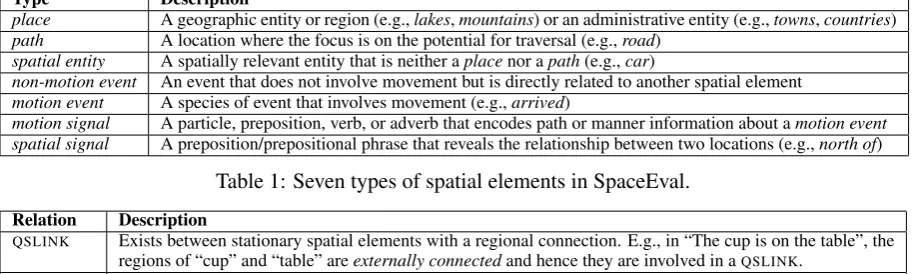
We use as our corpus the SpaceEval training cor-pus, which is a subset of ISO-SpaceBank (Puste-jovsky and Yocum, 2013). The corpus consists of 59 travel narratives annotated with seven types of spatial elements (Table 1) and three types of spatial relations (Table 2), following the ISO-Space (2012) annotation specifications. Different types of spatial elements have different attributes. The only attribute that is relevant to our work is
semantic type, which is one of the attributes of a
spatial entity. Semantic typeexpresses the type of the relation it triggers and can take one of three values: topological, directional, or both.
What is missing in Table 2 about spatial rela-tions is that each element participating in a re-lation has a role. Each QSLINK/OLINK involves
exactly three elements participating astrajector
(the object of interest), landmark (the ground-ing location), andtrigger(the relation indicator). On the other hand, a MOVELINK has two fixed
participants and up to six optional participants. The two mandatory MOVELINK participants are mover (object in motion) and trigger (verb de-noting motion). Five of the optional participants express different aspects of the mover in space, namely,source(the spatial element at the begin-ning of the motion path), midpoint (the spatial elements along the motion path),goal(the spatial element at the end of the motion path),path(the spatial element that reflects the path of motion), and landmark (the grounding location). The sixth optional participant, motion signal, con-nects the spatial aspect to the mover. Note that all spatial relations areintra-sentential.
2.2 The Spatial Relation Extraction Task Given a set ofnspatial elements, the spatial rela-tion extracrela-tion task aims to (1) determine whether the elements form a spatial relation of a par-ticular type, and if so, (2) classify the roles of each participating element. For example, from the sentence “The cup is on the table”, two re-lations can be extracted: QSLINK(cuptrajector,
tablelandmark, ontrigger) and OLINK(cuptrajector,
tablelandmark, ontrigger). As another
exam-ple, from the sentence “John walked from Boston to Cambridge”, aMOVELINKwith
partici-pants Johnmover, walkedtrigger, frommotion signal,
Bostonsource, tomotion signal, and Cambridgegoal
Type Description
place A geographic entity or region (e.g.,lakes,mountains) or an administrative entity (e.g.,towns,countries)
path A location where the focus is on the potential for traversal (e.g.,road)
spatial entity A spatially relevant entity that is neither aplacenor apath(e.g.,car)
non-motion event An event that does not involve movement but is directly related to another spatial element
motion event A species of event that involves movement (e.g.,arrived)
[image:3.595.72.529.69.206.2]motion signal A particle, preposition, verb, or adverb that encodes path or manner information about amotion event spatial signal A preposition/prepositional phrase that reveals the relationship between two locations (e.g.,north of)
Table 1: Seven types of spatial elements in SpaceEval. Relation Description
QSLINK Exists between stationary spatial elements with a regional connection. E.g., in “The cup is on the table”, the regions of “cup” and “table” areexternally connectedand hence they are involved in aQSLINK.
OLINK Exists between stationary spatial elements expressing their relative or absolute orientations. E.g., in the above sentence, “cup” and “table” are involved in anOLINK, which conveys that “cup” is orientedabove“table”. MOVELINK Exists between spatial elements in motion. E.g., in “John walked from Boston to Cambridge”, there is a
MOVELINKinvolving mover “John”, motion verb “walked”, source “Boston”, and goal “Cambridge”.
Table 2: Three types of spatial relations in SpaceEval.
3 Related Work
Broadly speaking, existing spatial relation extrac-tion systems have adopted either a pipeline ap-proach or ajointapproach to these subtasks. Given a set of spatial elements, a pipeline spatial relation extraction system (1) extracts thetriggers, (2) de-termines whether a spatial relation exists between each extractedtriggerand each of the remaining spatial elements, and (3) classifies the role of each non-trigger in each pair of spatially-related ele-ments (Kordjamshidi et al., 2011; Bastianelli et al., 2013; Kordjamshidi and Moens, 2015).
The major weakness of pipeline approaches is that errors in trigger identification can propagate to the relation classification component, whose errors can in turn propagate to the role labeling component. To address this weakness, Roberts et al. (2012; 2013) investigatedjoint approaches. Given a set of spatial elements with an assign-ment of roles to each eleassign-ment, a joint spatial re-lation extraction system uses a binary classifier to determine whether these elements form a spa-tial relation with the roles correctly assigned to all participating elements. In other words, the clas-sifier will output a 1 if and only if (1) the ele-ments in the set form a relation and (2) their roles in the relation are correct. The systems participat-ing in SpaceEval all seem to be in favor of joint approaches (D’Souza and Ng, 2015; Nichols and Botros, 2015; Salaberri et al., 2015).
4 Baseline System
To ensure that we have a state-of-the-art baseline system for spatial relation extraction, we employ our SpaceEval participating system (D’Souza and
Ng, 2015), which achieved the best results on task 3a in the official SpaceEval evaluation.1
This Baseline system performs joint role la-beling and relation classification using an ensem-ble of classifiers. Specifically, it trains one clas-sifier for extracting QSLINKs and OLINKs, and
seven classifiers for extractingMOVELINKs.
Cre-ating these eight classifiers permits (1) separCre-ating the treatment of MOVELINKs from QSLINKs and OLINKs (because the former involves objects in
motion while the latter involve stationary objects); and (2) simplifying the extraction ofMOVELINKs
(because its optional participants are extracted in-dependentlyof each other by these classifiers).
4.1 Training the Baseline Classifiers
In this subsection, we describe how we train the Baseline classifiers, which include one clas-sifier for identifying QSLINKs and OLINKs
(Sec-tion 4.1.1) and seven classifiers for identifying
MOVELINKs (Section 4.1.2).
4.1.1 TheLINKClassifier
We collapse QSLINKs and OLINKs to a single
re-lation type, LINK, identifying these two types of
links using theLINKclassifier. To understand why
we can do this, recall from Section 2.1 that inQS -LINKs andOLINKs, thetriggerhas to be aspatial signalelement having a semantic type attribute. If its semantic type is topological, it triggers a QS -LINK; if it is directional, it triggers anOLINK; and
1Since the official annotated test data is not available to
if it is both, it triggers both relation types. Hence, if aLINKis identified by our classifier, we can
sim-ply use the semantic type of the relation’strigger
to determine whether the relation is aQSLINK, an OLINK, or both.
We create training instances for training aLINK
classifier as follows. Following the joint ap-proach described above, we create one training instance for each possible role labeling of each triplet of distinct spatial elements in each sen-tence in a training document. The role labels assigned to the spatial elements in each triplet are subject to the following constraints: (1) each triplet contains a trajector, a landmark, and a trigger; (2) neither the trajector nor the
landmark are of type spatial signal or motion signal; and (3) the trigger is a spatial signal. These role constraints are derived from the data annotation scheme. Note that a LINK may have
at most oneimplicitparticipant. For instance, the relationLINK(balloontrajector, uptrigger) extracted
from the sentence “The balloon went up” has an implicitlandmark. To allow for implicit partic-ipants, from each training instance we have cre-ated thus far, we create three additional training instances, where exactly one of the three partici-pants has the valueIMPLICIT.
A training instance is labeled as positive if and only if the elements in the triplet form a rela-tion and their roles are correct. As an example, for the QSLINK and OLINK sentence in Table 2,
exactly one positive instance, LINK(cuptrajector,
tablelandmark, ontrigger), will be created.
Each instance is represented using the 31 fea-tures, which can be broadly divided into seven types: lexical, grammatical, semantic, positional, distance, entity attributes, and entity roles.2 We
train the LINK classifier using the SVM learning
algorithm as implemented in the SVMlight
soft-ware package (Joachims, 1999). To optimize clas-sifier performance, we tune two parameters, the regularization parameterCand the cost-factor pa-rameter J, to maximize F-score on the develop-ment data.3 Since joint tuning of these parameters
is computationally expensive, we employ a hill-climbing algorithm to find a local maximum,
al-2Space limitations preclude a description of these
fea-tures. See D’Souza and Ng (2015) for details.
3Cis chosen from the set{0.01, 0.05, 0.1, 0.5, 1.0, 10.0,
50.0, 100.0}, andJis chosen from the set{0.01, 0.05, 0.1, 0.5, 1.0, 2.0, 4.0, 6.0}. All other learning parameters are set to their default values. In particular, a linear kernel is used.
tering one parameter at a time to optimize F-score by holding the other parameter fixed.
4.1.2 The SevenMOVELINKClassifiers
If we adopted the aforementioned joint method as is for extracting MOVELINKs, each instance
would correspond to an octuple of the form (triggeri,moverj, sourcek,midpointm, goaln, landmarko, pathp, motion signalr), where
each participant in the octuple is either a dis-tinct spatial element with a role or the NULL
el-ement (if it is not present in the relation). How-ever, generating role permutations for octuples from all spatial elements in a sentence is com-putationally infeasible. For this reason, we sim-plify MOVELINK extraction as follows. First,
we decompose theMOVELINKoctuple into seven
smaller tuples including one pair and six triplets. These seven tuples are: [1] (triggeri, moverj);
[2] (triggeri, moverj, sourcek); [3] (triggeri, moverj, midpointm); [4] (triggeri, moverj, goaln); [5] (triggeri, moverj, landmarko); [6]
(triggeri, moverj, pathp); and [7] (triggeri, moverj,motion signalr). Then, we create seven
separate classifiers for identifying these seven
MOVELINKtuples, respectively.
Using this decomposition for MOVELINK
in-stances, we can generate instances for each clas-sifier using the aforementioned joint approach as is. For instance, to train classifier [1], we gener-ate pairs of the form (triggeri, moverj), where triggeri and moverj are spatial elements
pro-posed as a candidate trigger and a candidate
mover, respectively. Positive training instances are those (triggeri, moverj) pairs annotated as
being part of a MOVELINK in the training data,
while the rest of the candidate pairs are negative training instances. The instances for training the remaining six classifiers are generated similarly.
As in theLINKclassifier, we enforce global role
constraints when creating training instances for the MOVELINKclassifiers. Specifically, the roles
assigned to the spatial elements in each training instance of each MOVELINKclassifier are subject
to six constraints: (1) thetriggerhas typemotion event; (2) the mover has type place, path, spa-tial entity, ornon-motion event; (3) thesource, the
goal, and thelandmarkcan beNULLor have type place, path, spatial entity, or non-motion event; (4) themidpointcan beNULLor have typeplace, path, orspatial entity; (5) thepath can be NULL
beNULLor have typemotion signal.
Our method for decomposing the octuple by role can be justified as follows. Sincetriggerand
moverare mandatoryMOVELINKparticipants, we
have a classifier for classifying this core aspect of a MOVELINK. The next six classifiers, [2]
to [7], aim to improve the core MOVELINK
ex-traction by exploiting the contextual dependencies with each of its unique spatial aspects, namely
source, midpoint, goal, landmark, path, and
motion signal.
As an example, for the MOVELINK sentence
in Table 2, we will create three positive in-stances: (Johnmover, walkedtrigger) for
classi-fier [1], (Johnmover, walkedtrigger, Bostonsource)
for classifier [2], and (Johnmover, walkedtrigger,
Cambridgegoal) for classifier [4].
We represent each training instance using the 31 features that were used to train the LINK
classi-fier. We train each of the MOVELINK classifiers
using SVMlight. We tune theC andJ parameters
to maximize F-score on the development data us-ing the hill-climbus-ing algorithm described earlier.4
4.2 Applying the Baseline Classifiers
After training, we apply the resulting classifiers to classify the test instances, which are created in the same way as the training instances. As noted be-fore, each LINK extracted from a test document
by the LINK classifier is further qualified as QS -LINK, OLINK, or both based on the semantic type
of itstrigger. TheMOVELINKs are extracted from
a test document by combining the outputs from the sevenMOVELINKclassifiers.
There is a caveat, however: different
MOVELINK classifiers can make conflicting
decisions. For instance, classifier [1] might mis-classify (Johnmover, walkedtrigger) as negative,
whereas classifier [2] might correctly classify (Johnmover, walkedtrigger, Bostonsource) as
pos-itive. To resolve these conflicting decisions, we give preference to positive decisions, meaning that in this case we will posit “John” and “walked” as having the roles of mover and trigger
respectively. There are two more sources of conflicts. First, a spatial element may be assigned different roles for a givenMOVELINKby different
classifiers. Second, the global constraint that each
MOVELINKcan have at most onesource, at most
4See Footnote 3 for the set of values ofCandJused for
parameter tuning.
one goal, and at most one landmark can be violated. To resolve these conflicts, we select for each spatial element the role that was predicted with highest confidence by the SVM classifiers subject to the global constraint.5
5 Our Multi-Pass Sieve Approach
In this section, we describe two methods for em-ploying sieves for extracting spatial relations.
5.1 Using Sieves without Trees
To motivate our first method, recall that the Base-line resolves conflicting decisions in a heuristic manner. For instance, it prefers positive to nega-tive decisions, effecnega-tively favoring recall over pre-cision for spatial relation extraction. It is not clear whether this ad-hoc decision is good or not. As another example, when more than one role is assigned to the same spatial element in a
MOVELINK, it favors the role associated with the
highest SVM confidence. This, however, is also an ad-hoc decision: recall that each classifier’s pa-rameters are tuned independently of the others, so different confidence values assigned by different classifiers are not directly comparable.
Employing sieves for spatial relation extrac-tion obviates the need for such ad-hoc decisions. In our implementation, we have eight sieves, each of which corresponds to exactly one of the eight classifiers employed by the Baseline. Re-call from the introduction that these sieves are ordered as a pipeline. So, whenever a con-flict arises, earlier sieves’ decisions have prece-dence over later sieves’ decisions. Returning to the conflicting decisions mentioned before, if sieve 1 misclassifies (Johnmover, walkedtrigger)
as negative, whereas sieve 2 correctly classifies (Johnmover, walkedtrigger, Bostonsource) as
posi-tive, then we will posit that no MOVELINKexists
between “John” and “walked” because we have more confidence in sieve 1’s decision than sieve 2’s decision. As another example, if two classi-fiers assign different roles to the same spatial ele-ment, then we will choose the role assigned by the classifier associated with the earlier sieve.
Given the above discussion, it should be clear that the ordering of the sieves is important. Typ-ically, sieves are ordered by precision, with the hope of reducing the number of erroneous
deci-5We use the distance from the hyperplane as a measure of
sions passed from the earlier sieves to the later sieves (e.g., Raghunathan et al. (2010), Lee et al. (2013), Chambers et al. (2014)). Motivated by this observation, we order the sieves as follows. We set sieve 0 to be theLINKclassifier and sieve 1 to
be the (trigger,mover) classifier, and then order the remaining sieves by precision. Specifically, we compute the precision of each sieve on the devel-opment data, then add sieves into the pipeline in decreasing order of precision.
5.2 Using Sieves with Trees
Next, we describe our second method for applying sieves to spatial relation extraction. To motivate this method, recall that one important property of a sieve-based approach is that later sieves can ex-ploit earlier sieves’ decisions when making their own decisions. However, our first method of using sieves makes limited use of the decisions made by earlier sieves. In particular, while each sieve ex-ploits the knowledge of whether a spatial element has been assigned a role by an earlier sieve, it does not exploit the knowledge of what the role is.
Our second method exploits the role decisions made by earlier sieves, but another question arises: how can we encode these role decisions so that they can be best exploited by later sieves? One possibility is to employ them as additional fea-tures for training the classifiers associated with later sieves. Motivated by previous work on tree kernels for relation extraction, we employ parse trees as astructuredfeature to encode the syntac-tic relationships among the roles extracted so far for a givenMOVELINK.
We create the structured feature as follows. To strike a better balance between having a rich repre-sentation of the context surrounding a spatial rela-tion and improving the learner’s ability to general-ize, we extract asubtreefrom a parse tree and use it as the value of the structured feature. Specif-ically, given relation candidate triplet (e1,e2,e3),
where spatial elementse1,e2, and e3 are posited
in rolesr1,r2, andr3, respectively, and the
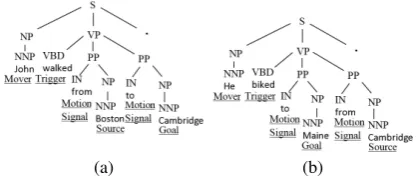
asso-ciated syntactic parse treeT, we extract our parse subtree from T as follows. First, we identify the smallest subtree that covers all three spatial ele-ments and call its root r. Second, for each path from each spatial element tor, we include in the parse subtree all the nodes that lie on the path and their immediate children. Third, we simplify the subtree by removing the POS nodes above
[image:6.595.312.521.64.152.2](a) (b)
Figure 2: Syntactic parse trees for two example sentences containingMOVELINKs.
each spatial element, effectively attaching it to its grandparent. Finally, for better generalization, we replace each spatial element with its role.
Since this subtree centers on a spatial relation, we call it aspatial relation centered tree(SRCT). As mentioned before, we will use SRCTs in com-bination with our sieve-based approach. This re-sults in a novel application of structured features: to our knowledge, all trees that were previously used as structured features were static. By con-trast, SRCTs expand as we move along the sieve pipeline. We will discuss examples of how to cre-ate SRCTs below.
Creating training instances with structured fea-tures is straightforward. Recall that a structured feature is used as an additional feature when train-ing each classifier. In other words, it will be used in combination with the original 31 features. The training instance creation method used by the Baseline remains unchanged. All we need to do is to add a SRCT as a structured feature to each training instance.
Consider the sentence “John walked from Boston to Cambridge”, whose parse tree is shown in Figure 2(a). Since only one MOVELINK can
be extracted from it, only one positive training instance will be created for each classifier. As-sume that sieve 1 contains the (trigger, mover) classifier; sieve 2 contains the (trigger, mover,
motion signal) classifier; and sieve 3 contains the (trigger,mover,goal) classifier. Figure 3(a) shows the SRCTs used in the corresponding posi-tive instances, while Figure 3(b) shows the SRCTs associated with randomly chosen negative in-stances used to train the classifiers in these sieves. To train a classifier on instances containing the original 31 features and SRCTs, we employ SVMlight−T K(Moschitti, 2004; Moschitti, 2006),
(a) SRCTs associated with positive training instances in sieves 1, 2, and 3.
(b) SRCTs associated with randomly chosen negative training instances in sieves 1, 2, and 3.
Figure 3: SRCTs associated with training in-stances created for the sentence in Figure 2a.
kernel; and (3) combines these two kernels using a composite kernel. Specifically, we define compos-ite kernelKc for combining linear kernelKl and
convolution kernelKtas follows:
Kc(F1, F2) =Kl(F1, F2) +T·Kt(T1, T2),
where F1 andF2 are the set of 31 features from
two training instances,T1andT2are their SRCTs,
and T is the combination parameter. We em-ploy the hill-climbing algorithm described before to tune the C, J and T parameters to maximize F-score on the development data.6
The test instances with structured features are created in the same way as the training instances, with one notable difference. Note that roles are used to create structured features. While they are available in training, they are not available in the test documents. Hence, to create SRCTs for a test instance, we have to employ the rolespredictedby preceding sieves. This is precisely how we exploit the role decisions made by earlier sieves in later sieves. This also explains why the SRCTs expand: more and more roles will be attached to a SRCT as it passes through the sieve pipeline.
As an example, consider the test sentence “He biked to Maine from Cambridge”, whose parse tree is shown in Figure 2(b). Figure 4(a) shows the SRCTs generated when each sieve makes the correct decisions. Specifically, sieve 1 correctly identifies “He” as the mover and “biked” as the
trigger. The roles (correctly) extracted by sieve 1 (shown in boxes) are incorporated into the SRCT created in sieve 2. Similarly, themotion signals
6To tuneT, we attempted values between 0 and 2 in
in-crements of 0.2. To tuneCandJ, we attempted the values specified in Footnote 3.
(a) SRCTs associated with correctly classified test instances in sieves 1, 2, and 3.
[image:7.595.271.527.64.201.2](b) SRCTs associated with incorrectly classified test instances in sieves 1, 2, and 3.
Figure 4: SRCTs associated with test instances for the sentence in Figure 2b.
(correctly) extracted by sieve 2 are incorporated into the SRCT created in sieve 3. Figure 4(b) shows the SRCTs generated for misclassified in-stances. Assume that sieve 1 misclassifies the test instance underlying the SRCT (as positive). As we can see, this mistake is propagated to the SRCTs generated in later sieves.
Note that the precision of a sieve may change with the addition of SRCTs. For this reason, the sieves need to be reordered using the algorithm de-scribed in the previous subsection.
6 Evaluation
6.1 Experimental Setup
SpaceEval tasks. We evaluate our approach in tasks 1d and 3a of SpaceEval. These two tasks evaluate a system’s ability to extract (trajector,
landmark, trigger) triplets in QSLINKs and OLINKs as well as (trigger, mover) pairs in MOVELINKs using gold spatial elements (1d) and
automatically extracted spatial elements (3a). To extract the spatial elements needed for task 3a, we follow Bastianelli et al.’s (2013) sequence labeling approach, except that we train the sequence labeler using a CRF rather than an HMM.7
Dataset. Since the annotated test set used in SpaceEval’s official evaluation is not available
QSLINK OLINK MOVELINK OVERALL
False True False True False True
R P F R P F R P F R P F R P F R P F R P F
Baseline 99.5 99.4 99.5 46.9 48.9 47.9 100 99.4 99.7 50.3 100 66.9 91.3 99.8 95.3 84.8 61.5 71.3 78.8 84.8 81.7 Sieve 99.5 99.4 99.5 46.9 48.9 47.9 100 99.4 99.7 50.3 100 66.9 94.7 99.8 97.2 79.4 72.1 75.5 78.5 86.6 82.3 + SRCTs 99.8 99.4 99.6 43.1 66.4 52.3 100 99.4 99.7 43.7 100 60.8 97.1 99.8 98.4 77.3 82.3 79.7 76.8 91.2 83.4
(a) Results obtained using gold spatial elements.
QSLINK OLINK MOVELINK OVERALL
False True False True False True
R P F R P F R P F R P F R P F R P F R P F
Baseline 99.8 99.9 99.9 28.5 11.5 16.4 100 99.9 100 31.2 100 47.5 92.3 50.0 64.9 54.0 17.1 26.0 67.6 63.1 65.3 Sieve 99.8 99.9 99.9 28.5 11.5 16.4 100 99.9 100 31.2 100 47.5 96.1 50.0 65.8 42.5 25.3 31.7 66.4 64.4 65.4 + SRCTs 99.8 99.9 99.9 28.3 12.9 17.8 100 99.9 100 31.2 100 47.5 94.7 50.0 65.5 56.2 24.5 34.2 68.4 64.6 66.4
[image:8.595.74.531.62.187.2](b) Results obtained using extracted spatial elements.
Table 3: Results for extracting spatial relations.
to us at the time of writing, we conduct our evaluation on the SpaceEval training corpus, which contains 1890 spatial relations (886 QS -LINKs, 225 OLINKs, and 779 MOVELINKs) and
1139 MOVELINK optional roles (95sources, 65 midpoints, 310goals, 77landmarks, 100paths, and 492 motion signals). We partition the 59 narratives in the corpus into five folds and report five-fold cross-validation results. In each fold ex-periment, we employ three folds for training, one fold for development, and one fold for testing. Evaluation metrics. To evaluate the results for the two SpaceEval tasks, we employ the official SpaceEval scoring program, which reports results in terms of recall, precision, and F-score on the three types of spatial relations in isolation and in combination. To evaluate the results for extracting
MOVELINKoptional roles, we compute the recall,
precision, and F-score for each role.
6.2 Results and Discussion
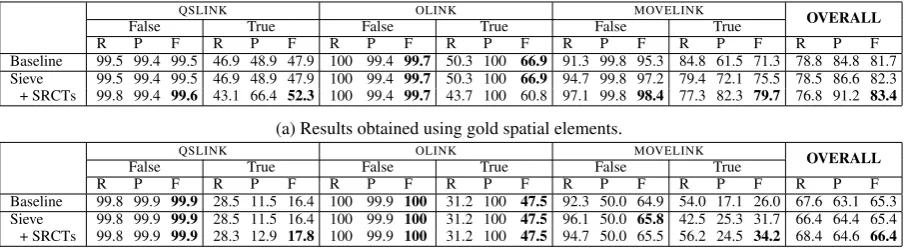
Tables 3a and 3b show the spatial relation ex-traction results for three systems — the Base-line (row 1), our Sieve approach without SRCTs (row 2), and our Sieve approach with SRCTs (row 3) — obtained using gold and extracted spa-tial elements, respectively.
The official scoring program reports spatial re-lation extraction results in terms of recall (R), precision (P), and F-score (F). For QSLINKs
and OLINKs, it reports results on (1) extracting
spatially-related (trajector,landmark,trigger) triplets (see the “True” columns) and (2) identify-ing that no spatial relation exists among a (can-didatetrajector, candidatelandmark, candidate
trigger) triplet (see the “False” columns). For
MOVELINKs, it reports results on (1) extracting
spatially-related (trigger, mover) pairs (see the
“True” columns) and (2) identifying that no spa-tial relation exists between a (candidate trigger, candidatemover) pair (see the “False” columns). Since the pairs/triplets without links considerably outnumber those with links, the OVERALL scores are dominated by the performances on “False”, which, as expected, are high.
Of particular interest are theMOVELINKscores
under the “True” columns. When gold spatial el-ements are used, Sieve significantly outperforms Baseline (p < 0.001) owing to substantial gains in precision with smaller losses in recall.8 Adding
SRCTs to Sieve further boosts performance signif-icantly (p <0.005). As we can see, Sieve+SRCTs outperforms Baseline by 8.4% absolute F-score on extracting (trigger, mover) pairs. With respect to the OVERALL score, which also takes into ac-count QSLINKs and OLINKs, Sieve+SRCTs
out-performs Baseline significantly by 1.7% absolute F-score. Similar trends can be observed for the results obtained using extracted spatial elements. Note that Baseline and Sieve have the same QS -LINKandOLINKresults because the LINK
classi-fier is associated with the first sieve.
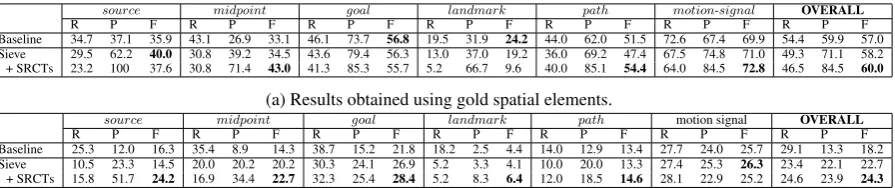
Tables 4a and 4b show the results on extract-ing MOVELINK optional roles using gold and
extracted spatial elements, respectively. When gold elements are used, Sieve insignificantly out-performs Baseline on source, midpoint, and
motion signal. When used with SRCTs, Sieve insignificantly outperforms Baseline on source,
midpoint, path, and motion signal. Overall, Sieve+SRCTs insignificantly outperforms Base-line by 3.0% absolute F-score.9 While the results 8All statistical significance tests are pairedt-tests, withp
set to 0.05 unless otherwise stated.
9A closer examination of the results reveals why the
devel-source midpoint goal landmark path motion-signal OVERALL
R P F R P F R P F R P F R P F R P F R P F
Baseline 34.7 37.1 35.9 43.1 26.9 33.1 46.1 73.7 56.8 19.5 31.9 24.2 44.0 62.0 51.5 72.6 67.4 69.9 54.4 59.9 57.0 Sieve 29.5 62.2 40.0 30.8 39.2 34.5 43.6 79.4 56.3 13.0 37.0 19.2 36.0 69.2 47.4 67.5 74.8 71.0 49.3 71.1 58.2 + SRCTs 23.2 100 37.6 30.8 71.4 43.0 41.3 85.3 55.7 5.2 66.7 9.6 40.0 85.1 54.4 64.0 84.5 72.8 46.5 84.5 60.0
(a) Results obtained using gold spatial elements.
source midpoint goal landmark path motion signal OVERALL
R P F R P F R P F R P F R P F R P F R P F
Baseline 25.3 12.0 16.3 35.4 8.9 14.3 38.7 15.2 21.8 18.2 2.5 4.4 14.0 12.9 13.4 27.7 24.0 25.7 29.1 13.3 18.2 Sieve 10.5 23.3 14.5 20.0 20.2 20.2 30.3 24.1 26.9 5.2 3.3 4.1 10.0 20.0 13.3 27.4 25.3 26.3 23.4 22.1 22.7 + SRCTs 15.8 51.7 24.2 16.9 34.4 22.7 32.3 25.4 28.4 5.2 8.3 6.4 12.0 18.5 14.6 28.1 22.9 25.2 24.6 23.9 24.3
[image:9.595.79.527.61.155.2](b) Results obtained using extracted spatial elements.
Table 4: Results for extractingMOVELINKoptional roles.
[image:9.595.307.526.203.257.2]obtained using extracted elements exhibit different trends, Sieve+SRCTs’s OVERALL improvement of 6.1% absolute F-score over Baseline is signifi-cant (p <0.001).
Table 5 shows the results of these systems on extracting entireMOVELINKs, where aMOVELINK
is considered correctly extracted ifallof its partic-ipating elements and their roles are correct. Note that none of the SpaceEval tasks employ this strin-gent but informative evaluation measure. As we can see, Sieve+SRCTs insignificantly outperforms Baseline by 2.3–3.0% absolute F-score, regardless of whether gold or extracted elements are used.
6.3 Error Analysis
In this subsection, we analyze the errors made by the best-performing system, Sieve+SRCTs, with respect to the extraction ofMOVELINKs given our
focus on this type of spatial relation.
Extracting (mover, trigger) pairs. The major source of recall error stems from the system’s in-ability to extract movers that are unseen in the training data. This error could be addressed using a named entity recognizer and WordNet categories related to people, places, animals, etc. The major source of precision error arises frommissinggold annotations. Consider the sentence “I found my-self biking...” Our system correctly extracted “bik-ing” as thetriggerand “I” as themover, but was considered wrong because “myself”, not “I”, was annotated as themoverin the gold standard. Extracting optional roles. A major source of recall/precision error stems from the system’s in-ability to exploit contextual cues that are reli-able indicators of a particular role. For instance, a statistical analysis of the training data reveals that sources are commonly preceded by prepo-sitions such as “from” and “or”, whereas goals
opment data are not necessarily the same as those that yield the best results on the test data.
Gold Extracted
R P F R P F
Baseline 40.6 50.4 45.0 21.7 15.3 18.0 Sieve 40.7 50.4 45.0 20.9 14.9 17.4 + SRCTs 40.5 59.0 48.0 23.3 18.0 20.3 Table 5: Results for extracting entireMOVELINKs
using gold and extracted elements.
are commonly associated with verbs such as “re-turn”, “visit”, “arrive”, and “reach”. This prob-lem could be addressed by encoding these cues explicitly as additional features for training the role-specific classifiers. Another source of recall error can be attributed to the lack of background knowledge. Consider the sentence “We had only 70 more km to Cluj taking this way, but if get-ting back to Ciucea and on to Cluj the normal way would have been 25 km longer”. Despite correctly extracting “Cluj” as the goal, the system failed to extract “Ciucea” as themidpoint. This prob-lem could be alleviated by exploiting geographi-cal knowledge concerning these cities in external knowledge sources such as Wikipedia.
7 Conclusions
We have examined the under-studied task of spa-tial relation extraction, focusing on spaspa-tial rela-tions of objects in motion. Our approach exploited expanding parse trees, which resulted from a novel combination of multi-pass sieves and tree ker-nels, achieving state-of-the-art results on two key SpaceEval tasks. To facilitate comparison with fu-ture work on this task, we released the source code of our spatial relation extraction system.10
Acknowledgments
We thank the three anonymous reviewers for their comments. This work was supported in part by NSF Grants IIS-1147644 and IIS-1219142.
References
Emanuele Bastianelli, Danilo Croce, Daniele Nardi, and Roberto Basili. 2013. Unitor-HMM-TK: Struc-tured kernel-based learning for spatial role labeling. InProceedings of the 7th International Workshop on Semantic Evaluation, pages 573–579.
Razvan Bunescu and Raymond Mooney. 2005. A shortest path dependency kernel for relation extrac-tion. InProceedings of Human Language Technol-ogy Conference and Conference on Empirical Meth-ods in Natural Language Processing, pages 724– 731.
Nathanael Chambers, Taylor Cassidy, Bill McDowell, and Steven Bethard. 2014. Dense event ordering with a multi-pass architecture. Transactions of the Association for Computational Linguistics, 2:273– 284.
Aron Culotta and Jeffrey Sorensen. 2004. Dependency tree kernels for relation extraction. InProceedings of the 42nd Meeting of the Association for Compu-tational Linguistics, Main Volume, pages 423–429. Jennifer D’Souza and Vincent Ng. 2015. UTD:
Ensemble-based spatial relation extraction. In Pro-ceedings of the 9th International Workshop on Se-mantic Evaluation, pages 862–869.
Thorsten Joachims. 1999. Making large-scale SVM learning practical. In Bernhard Scholkopf and Alexander Smola, editors,Advances in Kernel Meth-ods - Support Vector Learning, pages 44–56. MIT Press.
Oleksandr Kolomiyets, Parisa Kordjamshidi, Steven
Bethard, and Marie-Francine Moens. 2013.
SemEval-2013 Task 3: Spatial role labeling. In Pro-ceedings of the 7th International Workshop on Se-mantic Evaluation, pages 255–266.
Parisa Kordjamshidi and Marie-Francine Moens. 2015. Global machine learning for spatial ontology population. Web Semantics: Science, Services and Agents on the World Wide Web, 30(C):3–21.
Parisa Kordjamshidi, Martijn Van Otterlo, and Marie-Francine Moens. 2011. Spatial role labeling: To-wards extraction of spatial relations from natural language. ACM Transactions on Speech and Lan-guage Processing, 8(3):4.
Parisa Kordjamshidi, Steven Bethard, and Marie-Francine Moens. 2012. SemEval-2012 Task 3: Spa-tial role labeling. InProceedings of the 6th Inter-national Workshop on Semantic Evaluation, pages 365–373.
Heeyoung Lee, Angel Chang, Yves Peirsman, Nathanael Chambers, Mihai Surdeanu, and Dan Ju-rafsky. 2013. Deterministic coreference resolu-tion based on entity-centric, precision-ranked rules.
Computational Linguistics, 39(4):885–916.
Alessandro Moschitti. 2004. A study on convolution kernels for shallow statistic parsing. InProceedings of the 42nd Meeting of the Association for Compu-tational Linguistics, Main Volume, pages 335–342.
Alessandro Moschitti. 2006. Making tree kernels prac-tical for natural language processing. In Proceed-ings of the 11th Conference of the European Chap-ter of the Association for Computational Linguistics, pages 113–120.
Eric Nichols and Fadi Botros. 2015.
SpRL-CWW: Spatial relation classification with indepen-dent multi-class models. In Proceedings of the 9th International Workshop on Semantic Evaluation, pages 895–901.
James Pustejovsky and Zachary Yocum. 2013. Cap-turing motion in ISO-SpaceBank. Proceedings of the 9th Joint ISO - ACL SIGSEM Workshop on In-teroperable Semantic Annotation, pages 25–34.
James Pustejovsky, Jessica Moszkowicz, and Marc Verhagen. 2012. A linguistically grounded an-notation language for spatial information. TAL, 53(2):87–113.
James Pustejovsky, Parisa Kordjamshidi, Marie-Francine Moens, Aaron Levine, Seth Dworman, and Zachary Yocum. 2015. SemEval-2015 Task 8: SpaceEval. InProceedings of the 9th International Workshop on Semantic Evaluation, pages 884–894.
Karthik Raghunathan, Heeyoung Lee, Sudarshan Ran-garajan, Nate Chambers, Mihai Surdeanu, Dan Ju-rafsky, and Christopher Manning. 2010. A multi-pass sieve for coreference resolution. In Proceed-ings of the 2010 Conference on Empirical Methods in Natural Language Processing, pages 492–501.
Kirk Roberts and Sanda M. Harabagiu. 2012. UTD-SpRL: A joint approach to spatial role labeling. In
Proceedings of the 6th International Workshop on Semantic Evaluation, pages 419–424.
Kirk Roberts, Michael A. Skinner, and Sanda M. Harabagiu. 2013. Recognizing spatial containment relations between event mentions. InProceedings of the 10th International Conference on Computational Semantics – Long Papers, pages 216–227.
Haritz Salaberri, Olatz Arregi, and Be˜nat Zapirain.
2015. IXAGroupEHUSpaceEval: (X-Space) A
WordNet-based approach towards the automatic recognition of spatial information following the ISO-Space annotation scheme. In Proceedings of the 9th International Workshop on Semantic Eval-uation, pages 856–861.