Experiments with Generative Models for Dependency Tree Linearization
Richard Futrell and Edward Gibson
Department of Brain and Cognitive Sciences Massachusetts Institute of Technology
{futrell, egibson}@mit.edu
Abstract
We present experiments with generative models for linearization of unordered la-beled syntactic dependency trees (Belz et al., 2011; Rajkumar and White, 2014). Our linearization models are derived from generative models for dependency struc-ture (Eisner, 1996). We present a series of generative dependency models designed to capture successively more information about ordering constraints among sister dependents. We give a dynamic program-ming algorithm for computing the condi-tional probability of word orders given tree structures under these models. The models are tested on corpora of 11 languages us-ing test-set likelihood, and human ratus-ings for generated forms are collected for En-glish. Our models benefit from represent-ing local order constraints among sisters and from backing off to less sparse distri-butions, including distributions not condi-tioned on the head.
1 Introduction
We explore generative models for producing lin-earizations of unordered labeled syntactic depen-dency trees. This specific task has attracted at-tention in recent years (Filippova and Strube, 2009; He et al., 2009; Belz et al., 2011; Bohnet et al., 2012; Zhang, 2013) because it forms a useful part of a natural language generation pipeline, especially in machine translation (Chang and Toutanova, 2007) and summarization (Barzi-lay and McKeown, 2005). Closely related tasks are generation of sentences given CCG parses (White and Rajkumar, 2012), bags of words (Liu et al., 2015), and semantic graphs (Braune et al., 2014).
Here we focus narrowly on testing probabilistic generative models for dependency tree
lineariza-tion. In contrast, the approach in most previ-ous work is to apply a variety of scoring func-tions to trees and linearizafunc-tions and search for an optimally-scoring tree among some set. The prob-abilistic linearization models we investigate are derived from generative models for dependency trees (Eisner, 1996), as most commonly used in unsupervised grammar induction (Klein and Man-ning, 2004; Gelling et al., 2012). Generative de-pendency models have typically been evaluated in a parsing task (Eisner, 1997). Here, we are interested in the inverse task: inferring a distri-bution over linear orders given unordered depen-dency trees.
This is the first work to consider generative de-pendency models from the perspective of word ordering. The results can potentially shed light on how ordering constraints are best represented in such models. In addition, the use of proba-bilistic models means that we can easily define well-motivated normalized probability distribu-tions over orders of dependency trees. These dis-tributions are useful for answering scientific ques-tions about crosslinguistic word order in quan-titative linguistics, where obtaining robust esti-mates has proven challenging due to data sparsity (Futrell et al., 2015).
The remainder of the work is organized as fol-lows. In Section 2 we present a set of generative linearization models. In Section 3 we compare the performance of the different models as mea-sured by test-set probability and human accept-ability ratings. We also compare our performance with other systems from the literature. Section 4 concludes.
2 Generative Models for Projective Dependency Tree Linearization
We investigate head-outward projective generative dependency models. In these models, an ordered dependency tree is generated by the following kind
ROOT
comes AP
from the
story
this root
nmod
case det
[image:2.595.74.279.65.144.2]nsubj det
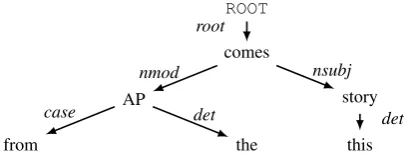
Figure 1: Example unordered dependency tree. Possible linearizations include (1) This story comes from the APand (2)From the AP comes this story. Order 2 is the original order in the corpus, but order 1 is much more likely under our models.
of procedure. Given a head node, we use some generative process G to generate a depth-1 sub-tree rooted in that head node. Then we apply the procedure recursively to each of the depen-dent nodes. By applying the procedure starting at aROOTnode, we generate a dependency tree. For example, to generate the dependency tree in Fig-ure 1 from the nodecomesdown, we take the head
comes and generate the subtree
comes
story AP
nsubj nmod
,
then we take the headstoryand generate
story
this
det
, and so on. In this work, we experiment with differ-ent specific generative processesGwhich generate a local subtree conditioned on a head.
2.1 Model Types
Here we describe some possible generative pro-cessesGwhich generate subtrees conditioned on a head. These models contain progressively more information about ordering relations among sister dependents.
A common starting point for G is Eisner Model C (Eisner, 1996). In this model, dependents on one side of the head are generated by repeatedly sampling from a categorical distri-bution until a special stop-symbol is generated. The model only captures the propensity of depen-dents to appear on the left or right of the head, and does not capture any order constraints between sister dependents on one side of the head.
We consider a generalization of Eisner Model C which we call Dependent N-gram models. In a Dependent N-gram model, we generate depen-dents on each side the head by sampling a se-quence of dependents from an N-gram model. Each dependent is generated conditional on the
N − 1 previously generated dependents from the head outwards. We have two separate N-gram sequence distributions for left and right dependents. Eisner Model C can be seen as a Dependent N-gram model withN = 1.
We also consider a model which can capture many more ordering relations among sister depen-dents: given a head h, sample a subtree whose head ishfrom a Categorical distribution over sub-trees. We call this the Observed Orders model because in practice we are simply sampling one of the observed orders from the training data. This generative process has the capacity to capture the most ordering relations between sister dependents. 2.1.1 Distributions over Permutations of
Dependents
We have discussed generative models for ordered dependency trees. Here we discuss how to use them to make generative models for word orders conditional on unordered dependency trees.
Suppose we have a generative processGfor de-pendency trees which takes a head h and gener-ates a sequence of dependentswl to the left ofh
and a sequence of dependentswrto the right ofh.
Letwdenote the pair(wl,wr), which we call the
configurationof dependents. To get the probabil-ity of somew given an unordered subtreeu, we want to calculate the probability ofwgiven thatG has generated the particular multisetWof depen-dents corresponding tou. To do this, we calculate:
p(w|W) = p(pw,(WW))
= p(Zw),
(1)
where
Z = X w0∈W
p(w0) (2)
and W is the set of all possible configurations
(wl,wr)compatible with multisetW. That is,W
is the set of pairs of permutations of multisetsWl
andWr for all possible partitions ofW intoWl
andWr. The generative dependency model gives
us the probabilityp(w).
Al-gorithm 1 as memoized recursive functions. When N = 1(Eisner Model C),Zis more simply:
Zemc=pL(stop)×pR(stop)
× X
(Wl,Wr)∈PARTS(W)
|Wl|!× |Wr|!
× Y
w∈Wl
pL(w) Y
w∈Wr
pR(w),
(3)
where PARTS(W) is the set of all partitions of multiset W into two multisets Wl and Wr, pL
is the probability mass function for a dependent to the left of the head,pRis the function for a
depen-dent to the right, andstopis a special symbol in the support ofpLandpRwhich indicates that
gen-eration of dependents should halt. The probability mass functions may be conditional on the headh. These methods for calculatingZ make it possible to transform a generative dependency model into a model of dependency treeorderingconditional on local subtree structure.
Algorithm 1 Compute the sum of probabilities of all configurations of dependents W under a Dependent gram model with two component N-gram models of orderN: pRfor sequences to the
right of the head andpLfor sequences to the left.
memoized functionRIGHT NORM(r,c)
if|r|= 0then
returnpR(stop|c) end if
Z ←0
fori= 1 :|r|do
r0←elements ofrexcept theith
c0←appendritocthen truncate to lengthN−1
Z ←Z+pR(ri|c)×RIGHT NORM(r0,c0)
end for returnZ
end memoized function
memoized functionLEFT NORM(r,c)
Z ←pL(stop|c)×RIGHT NORM([start],r) fori= 1 :|r|do
r0←elements ofrexcept theith
c0←appendritocthen truncate to lengthN−1
Z ←Z+pL(ri|c)×LEFT NORM(r0,c0)
end for returnZ
end memoized function
Result isLEFT NORM(W,[start])
2.2 Labelling
The previous section discussed the question of the structure of the generative process for depen-dency trees. Here we discuss an orthogonal mod-eling question, which we calllabelling: what in-formation about the labels on dependency tree nodes and edges should be included in our
mod-els. Dependency tree nodes are labeled with word-forms, lemmas, and parts-of-speech (POS) tags; and dependency tree edges are labeled with rela-tion types. A model might generate orders of de-pendents conditioned on all of these labels, or a subset of them. For example, a generative depend-necy model might generate (relation type, depen-dent POS tag) tuples conditioned on the POS tag of the head of the phrase. When we use such a model for dependency linearization, we would say the model’s labelling is relation type, dependent POS, and head POS. In this study, we avoid in-cluding wordforms or lemmas in the labelling, to avoid data sparsity issues.
2.3 Model Estimation and Smoothing
In order to alleviate data sparsity in fitting our models, we adopt two smoothing methods from the language modelling literature.
All categorical distributions are estimated us-ing add-k smoothing where k = 0.01. For the Dependent N-gram models, this means adding k pseudocounts for each possible dependent in each context. For the Observed Orders model, this means adding k pseudocounts for each possible permutation of the head and its dependents.
We also experiment with combining our mod-els into mixture distributions. This can be viewed as a kind of back-off smoothing (Katz, 1987), where the Observed Orders model is the model with the most context, and Dependent N-grams and Eisner Model C are backoff distributions with successively less context. Similarly, models with less information in the labelling can serve as back-off distributions for models with more information in the labelling. For example, a model which is conditioned on the POS of the head can be backed off to a model which does not condition on the head at all. We find optimal mixture weights us-ing the Baum-Welch algorithm tuned on a held-out development set.
3 Evaluation
probabil-Labelling Model Basque Czech English Finnish French German Hebrew Indonesian Persian Spanish Swedish
HDR
oo -6.83 -7.58 -5.23 -7.35 -10.86 -8.36 -9.74 -8.99 -10.39 -11.31 -8.83 n1 -6.12 -8.97 -5.08 -7.15 -11.54 -9.81 -9.63 -8.68 -10.63 -13.19 -8.37 n2 -4.86 -6.35 -2.87 -5.30 -6.86 -6.60 -5.91 -5.98 -5.54 -7.47 -4.92 n3 -5.92 -6.59 -3.13 -5.68 -7.34 -7.02 -6.81 -6.69 -6.49 -8.06 -5.68 n123 -4.58 -6.18 -2.60 -5.11 -6.67 -6.19 -5.77 -5.73 -5.51 -7.36 -4.72 oo+n123 -4.52 -5.95 -2.57 -5.04 -6.58 -5.92 -5.68 -5.68 -5.47 -7.27 -4.68
HDR+R
oo -5.56 -6.78 -3.94 -6.25 -9.63 -7.42 -7.95 -7.51 -9.19 -9.54 -7.28 n1 -6.08 -8.97 -5.07 -7.16 -11.54 -9.79 -9.58 -8.67 -10.62 -13.17 -8.35 n2 -4.49 -6.31 -2.62 -5.17 -6.79 -6.34 -5.62 -5.67 -5.42 -7.40 -4.67 n3 -4.86 -6.41 -2.61 -5.20 -7.08 -6.43 -6.07 -6.02 -6.04 -7.70 -5.02 n123 -4.41 -6.15 -2.48 -5.01 -6.59 -5.99 -5.54 -5.53 -5.42 -7.29 -4.53 oo+n123 -4.29 -5.84 -2.44 -4.88 -6.50 -5.74 -5.40 -5.47 -5.38 -7.09 -4.46
Table 1: Average log likelihood of word order per sentence in test set under various models. Under “Labelling”,HDRmeans conditioning on Head POS, Dependent POS, and Relation Type, andRmeans conditioning on Relation Type alone (see Section 2.2). Under “Model”,oois the Observed Orders model, n1is the Dependent 1-gram model (Eisner Model C),n2is the Dependent 2-gram model, andn3is the Dependent 3-gram model (see Section 2.1). In both columns, x+y means a mixture of modelx and modely;n123means n1+n2+n3.
ities assigned to held-out sentences indicate that there are possible orders which our model is miss-ing. As a precision-like measure, we get human acceptability ratings for sentence reorderings gen-erated by our model.
We carry out our evaluations using the de-pendency corpora of the Universal Dependen-cies project (v1.1) (Agi´c et al., 2015), with the train/dev/test splits provided in that dataset. We remove nodes and edges dealing with punctuation. Due to space constraints, we only present results from 11 languages here.
3.1 Test-Set Probability
Here we calculate average probabilities of word orders per sentence in the test set. This number can be interpreted as the (negative) average amount of information contained in the word order of a sen-tence beyond information about dependency rela-tions.
The results for selected languages are shown in Table 1. The biggest gains come from us-ing Dependent N-gram models with N > 1, and from backing off the model labelling. The Observed Orders model does poorly on its own, likely due to data sparsity; its performance is much improved when backing off from condition-ing on the head. Eisner Model C (n1) also per-forms poorly, likely because it cannot represent any ordering constraints among sister dependents. The fact it helps to back off to distributions not conditioned on the head suggests that there are commonalities among distributions of dependents
of different heads, which could be exploited in fur-ther generative dependency models.
3.2 Human Evaluation
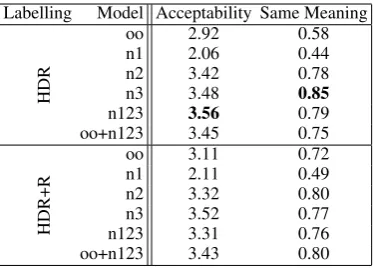
We collected human ratings for sentence reorder-ings sampled from the English models from 54 na-tive American English speakers on Amazon Me-chanical Turk. We randomly selected a set of 90 sentences from the test set of the English Universal Dependencies corpus. We generated a reordering of each sentence according to each of 12 model configurations in Table 1. Each participant saw an original sentence and a reordering of it, and was asked to rate how natural each version of the sentence sounded, on a scale of 1 to 5. The or-der of presentation of the original and reoror-dered forms was randomized, so that participants were not aware of which form was the original and which was a reordering. Each participant rated 56 sentence pairs. Participants were also asked whether the two sentences in a pair meant the same thing, with “can’t tell” as a possible answer.
Labelling Model Acceptability Same Meaning
HDR
oo 2.92 0.58
n1 2.06 0.44
n2 3.42 0.78
n3 3.48 0.85
n123 3.56 0.79
oo+n123 3.45 0.75
HDR+R
oo 3.11 0.72
n1 2.11 0.49
n2 3.32 0.80
n3 3.52 0.77
n123 3.31 0.76
[image:5.595.87.274.61.195.2]oo+n123 3.43 0.80
Table 2: Mean acceptability rating out of 5, and proportion of reordered sentences with the same meaning as the original, for English models. La-bels as in Table 1.
2.0 2.4 2.8 3.2 3.6
−5 −4 −3
Test set log probability
Mean acceptability
labelling hdr
hdr+r
modeltype n1
n123
n2
n3
oo
oo+n123
Figure 2: Comparison of test set probability (Ta-ble 1) and acceptability ratings (Ta(Ta-ble 2) for En-glish across models. A least-squares linear regres-sion line is shown. Labels as in Table 1.
the models which yield poor test set probability also have poor acceptability ratings.
3.3 Comparison with other systems
Previous work has focused on the ability to cor-rectly reconstruct the word order of an observed dependency tree. Our goal is to explicitly model a distribution over possible orders, rather than to re-cover a single correct order, because many orders are often possible, and the particulator order that a dependency tree originally appeared in might not be the most natural. For example, our models typ-ically reorder the sentence “From the AP comes this story” (in Figure 1) as “This story comes from the AP”; the second order is arguably more natu-ral, though the first is idiomatic for this particular phrase. So we do not believe that BLEU scores
and other metrics of similarity to a “correct” or-dering are particularly relevant for our task.
Previous work uses BLEU scores (Papineni et al., 2002) and human ratings to evaluate genera-tion of word orders. To provide some comparabil-ity with previous work, we report BLEU scores on the 2011 Shared Task data here. The systems re-ported in Belz et al. (2011) achieve BLEU scores ranging from 23 to 89 for English; subsequent work achieves BLEU scores of 91.6 on the same data (Bohnet et al., 2012). Drawing the highest-probability orderings from our models, we achieve a top BLEU score of 57.7 using the model config-uration hdr/oo. Curiously, hdr/oo is typically the worst model configuration in the test set probabil-ity evaluation (Section 3.1). The BLEU perfor-mance is in the middle range of the Shared Task systems. The human evaluation of our models is more optimistic: the best score for Meaning Sim-ilarity in the Shared Task was 84/100 (Bohnet et al., 2011), while sentences ordered according to our models were judged to have the same meaning as the original in 85% of cases (Table 2), though these figures are based on different data. These comparisons suggest that these generative models do not provide state-of-the-art performance, but do capture some of the same information as previous models.
3.4 Discussion
Overall, the most effective models are the Dependent N-gram models. The naive approach to modeling order relations among sister depen-dents, as embodied in the Observed Orders model, does not generalize well. The result suggests that models like the Dependent N-gram model might be effective as generative dependency models.
4 Conclusion
We have discussed generative models for depen-dency tree linearization, exploring a path less trav-eled by in the dependency linearization literature. We believe this approach has value for answering scientific questions in quantitative linguistics and for better understanding the linguistic adequacy of generative dependency models.
Acknowledgments
[image:5.595.77.287.274.437.2]References
ˇZeljko Agi´c, Maria Jesus Aranzabe, Aitziber Atutxa, Cristina Bosco, Jinho Choi, Marie-Catherine de Marneffe, Timothy Dozat, Rich´ard Farkas, Jennifer Foster, Filip Ginter, Iakes Goenaga, Koldo Gojenola, Yoav Goldberg, Jan Hajiˇc, An-ders Trærup Johannsen, Jenna Kanerva, Juha Kuokkala, Veronika Laippala, Alessandro Lenci, Krister Lind´en, Nikola Ljubeˇsi´c, Teresa Lynn, Christopher Manning, H´ector Alonso Mart´ınez, Ryan McDonald, Anna Missil¨a, Simonetta Monte-magni, Joakim Nivre, Hanna Nurmi, Petya Osen-ova, Slav Petrov, Jussi Piitulainen, Barbara Plank, Prokopis Prokopidis, Sampo Pyysalo, Wolfgang Seeker, Mojgan Seraji, Natalia Silveira, Maria Simi, Kiril Simov, Aaron Smith, Reut Tsarfaty, Veronika Vincze, and Daniel Zeman. 2015. Universal de-pendencies 1.1. LINDAT/CLARIN digital library at Institute of Formal and Applied Linguistics, Charles University in Prague.
Regina Barzilay and Kathleen R McKeown. 2005. Sentence fusion for multidocument news summa-rization. Computational Linguistics, 31(3):297– 328.
Anja Belz, Michael White, Dominic Espinosa, Eric Kow, Deirdre Hogan, and Amanda Stent. 2011. The first surface realisation shared task: Overview and evaluation results. In Proceedings of the 13th Eu-ropean Workshop on Natural Language Generation, pages 217–226.
Bernd Bohnet, Simon Mille, Benoˆıt Favre, and Leo Wanner. 2011. StuMaBa : from deep represen-tation to surface. In Proceedings of the 13th Eu-ropean workshop on natural language generation, pages 232–235.
Bernd Bohnet, Anders Bj¨orkelund, Jonas Kuhn, Wolf-gang Seeker, and Sina Zarrieß. 2012. Generating non-projective word order in statistical linearization. In Proceedings of the 2012 Joint Conference on Empirical Methods in Natural Language Process-ing and Computational Natural Language LearnProcess-ing, pages 928–939.
Fabienne Braune, Daniel Bauer, and Kevin Knight. 2014. Mapping between english strings and reen-trant semantic graphs. In Int. Conf. on Language Resources and Evaluation (LREC).
Pi-Chuan Chang and Kristina Toutanova. 2007. A discriminative syntactic word order model for ma-chine translation. InProceedings of the 45th Annual Meeting of the Association for Computational Lin-guistics, page 9.
Jason M Eisner. 1996. Three new probabilistic models for dependency parsing: An exploration. In Pro-ceedings of the 16th Conference on Computational Linguistics, pages 340–345.
Jason M Eisner. 1997. An empirical comparison of probability models for dependency grammar. Tech-nical report, IRCS Report 96–11, University of Pennsylvania.
Katja Filippova and Michael Strube. 2009. Tree lin-earization in English: Improving language model based approaches. In Proceedings of NAACL-HLT (Short Papers).
Richard Futrell, Kyle Mahowald, and Edward Gibson. 2015. Quantifying word order freedom in depen-dency corpora. In Proceedings of the Third In-ternational Conference on Dependency Linguistics (Depling 2015), pages 91–100, Uppsala, Sweden. Douwe Gelling, Trevor Cohn, Phil Blunsom, and Joao
Grac¸a. 2012. The pascal challenge on grammar in-duction. InProceedings of the NAACL-HLT Work-shop on the Induction of Linguistic Structure, pages 64–80.
Wei He, Haifeng Wang, Yuqing Guo, and Ting Liu. 2009. Dependency based Chinese sentence realiza-tion. InProceedings of the Joint Conference of the 47th Annual Meeting of the ACL and the 4th Interna-tional Joint Conference on Natural Language Pro-cessing of the AFNLP, pages 809–816.
Slava M Katz. 1987. Estimation of probabilities from sparse data for the language model component of a speech recognizer. Acoustics, Speech and Signal Processing, IEEE Transactions on, 35(3):400–401. Dan Klein and Christopher D Manning. 2004.
Corpus-based induction of syntactic structure: Models of de-pendency and constituency. In Proceedings of the 42nd Annual Meeting of the Association for Compu-tational Linguistics, page 478.
Yijia Liu, Yue Zhang, Wanxiang Che, and Bing Qin. 2015. Transition-based syntactic linearization. In
Proceedings of NAACL.
Kishore Papineni, Salim Roukos, Todd Ward, and Wei-Jing Zhu. 2002. Bleu: a method for automatic eval-uation of machine translation. InProceedings of the 40th Annual Meeting of the Association for Compu-tational Linguistics, pages 311–318.
Rajakrishnan Rajkumar and Michael White. 2014. Better surface realization through psycholinguistics.
Language and Linguistics Compass, 8(10):428–448. Michael White and Rajakrishnan Rajkumar. 2012. Minimal dependency length in realization ranking. In Proceedings of the 2012 Joint Conference on Empirical Methods in Natural Language Process-ing and Computational Natural Language LearnProcess-ing, pages 244–255.