Finding Function in Form: Compositional Character Models for
Open Vocabulary Word Representation
Wang Ling Tiago Lu´ıs Lu´ıs Marujo Ram´on Fernandez Astudillo Silvio Amir Chris Dyer Alan W Black Isabel Trancoso
L2F Spoken Systems Lab, INESC-ID, Lisbon, Portugal
Language Technologies Institute, Carnegie Mellon University, Pittsburgh, PA, USA Instituto Superior T´ecnico, Lisbon, Portugal
{lingwang,lmarujo,cdyer,awb}@cs.cmu.edu
{ramon.astudillo,samir,tmcl,isabel.trancoso}@inesc-id.pt
Abstract
We introduce a model for construct-ing vector representations of words by composing characters using bidirectional LSTMs. Relative to traditional word rep-resentation models that have independent vectors for each word type, our model requires only a single vector per char-acter type and a fixed set of parame-ters for the compositional model. De-spite the compactness of this model and, more importantly, the arbitrary nature of the form–function relationship in lan-guage, our “composed” word representa-tions yield state-of-the-art results in lan-guage modeling and part-of-speech tag-ging. Benefits over traditional baselines are particularly pronounced in morpholog-ically rich languages (e.g., Turkish).
1 Introduction
Good representations of words are important for good generalization in natural language process-ing applications. Of central importance are vec-tor space models that capture functional (i.e., se-mantic and syntactic) similarity in terms of ge-ometric locality. However, when word vectors are learned—a practice that is becoming increas-ingly common—most models assume that each word type has its own vector representation that can vary independently of other model compo-nents. This paper argues that this independence assumption is inherently problematic, in particular in morphologically rich languages (e.g., Turkish). In such languages, a more reasonable assumption would be that orthographic (formal) similarity is evidence for functional similarity.
However, it is manifestly clear that similarity in form is neither a necessary nor sufficient condi-tion for similarity in funccondi-tion: small orthographic differences may correspond to large semantic or syntactic differences (buttervs. batter), and large orthographic differences may obscure nearly per-fect functional correspondence (richvs. affluent). Thus, any orthographically aware model must be able to capturenon-compositionaleffects in addi-tion to more regular effects due to, e.g., morpho-logical processes. To model the complex form– function relationship, we turn to long short-term memories (LSTMs), which are designed to be able to capture complex non-linear and non-local dy-namics in sequences (Hochreiter and Schmidhu-ber, 1997). We use bidirectional LSTMs to “read” the character sequences that constitute each word and combine them into a vector representation of the word. This model assumes that each charac-ter type is associated with a vector, and the LSTM parameters encode both idiosyncratic lexical and regular morphological knowledge.
To evaluate our model, we use a vector-based model for part-of-speech (POS) tagging and for language modeling, and we report ex-periments on these tasks in several languages comparing to baselines that use more tradi-tional, orthographically-unaware parameteriza-tions. These experiments show: (i) our character-based model is able to generate similar representa-tions for words that are semantically and syntacti-cally similar, even for words are orthographisyntacti-cally distant (e.g., October and January); our model achieves improvements over word lookup tables using only a fraction of the number of parameters in two tasks; (iii) our model obtains state-of-the-art performance on POS tagging (including estab-lishing a new best performance in English); and
(iv) performance improvements are especially dra-matic in morphologically rich languages.
The paper is organized as follows: Section 2 presents our character-based model to generate word embeddings. Experiments on Language Modeling and POS tagging are described in tions 4 and 5. We present related work in Sec-tion 6; and we conclude in SecSec-tion 7.
2 Word Vectors and Wordless Word Vectors
It is commonplace to represent words as vectors. In contrast to na¨ıve models in which all word types in a vocabularyV are equally different from each other, vector space models capture the intuition that words may be different or similar along a va-riety of dimensions. Learning vector representa-tions of words by treating them as optimizable pa-rameters in various kinds of language models has been found to be a remarkably effective means for generating vector representations that perform well in other tasks (Collobert et al., 2011; Kalch-brenner and Blunsom, 2013; Liu et al., 2014; Chen and Manning, 2014). Formally, such models de-fine a matrixP ∈ Rd×|V|, which contains d
pa-rameters for each word in the vocabularyV. For a given word type w ∈ V, a column is selected by right-multiplyingPby a one-hot vector of length |V|, which we write 1w, that is zero in every di-mension except for the element corresponding to
w. Thus, Pis often referred to as word lookup table and we shall denote byeW
w ∈Rdthe embed-ding obtained from a word lookup table forw as
eW
w =P·1w. This allows tasks with low amounts of annotated data to be trained jointly with other tasks with large amounts of data and leverage the similarities in these tasks. A common practice to this end is to initialize the word lookup table with the parameters trained on an unsupervised task. Some examples of these include the skip-n-gram and CBOW models of Mikolov et al. (2013).
2.1 Problem: Independent Parameters There are two practical problems with word lookup tables. Firstly, while they can be pre-trained with large amounts of data to learn se-mantic and syntactic similarities between words, each vector is independent. That is, even though models based on word lookup tables are often ob-served to learn thatcats,kingsandqueensexist in roughly the same linear correspondences to each
other as cat, king and queen do, the model does not represent the fact that adding an s at the end of the word is evidence for this transformation. This means that word lookup tables cannot gen-erate representations for previously unseen words, such as Frenchification, even if the components,
Frenchand -ification, are observed in other
con-texts.
Second, even if copious data is available, it is impractical to actually store vectors for all word types. As each word type gets a set of parameters
d, the total number of parameters isd×|V|, where |V| is the size of the vocabulary. Even in rela-tively morphological poor English, the number of word types tends to scale to the order of hundreds of thousands, and in noisier domains, such as on-line data, the number of word types raises con-siderably. For instance, in the English wikipedia dump with 60 million sentences, there are approx-imately 20 million different lowercased and tok-enized word types, each of which would need its own vector. Intuitively, it is not sensible to use the same number of parameters for each word type.
Finally, it is important to remark that it is uncontroversial among cognitive scientists that our lexicon is structured into related forms—i.e., their parameters are not independent. The well-known “past tense debate” between connection-ists and proponents of symbolic accounts con-cerns disagreements about how humans represent knowledge of inflectional processes (e.g., the for-mation of the English past tense), not whether such knowledge exists (Marslen-Wilson and Tyler, 1998).
2.2 Solution: Compositional Models
Our solution to these problems is to construct a vector representation of a word by composing smaller pieces into a representation of the larger form. This idea has been explored in prior work by composingmorphemes into representations of words (Luong et al., 2013; Botha and Blunsom, 2014; Soricut and Och, 2015). Morphemes are an ideal primitive for such a model since they are— by definition—the minimal meaning-bearing (or syntax-bearing) units of language. The drawback to such approaches is they depend on a morpho-logical analyzer.
forms and their meanings is non-trivial (de Saus-sure, 1916). While some compositional relation-ships exist, e.g., morphological processes such as adding -ing or -ly to a stem have relatively reg-ular effects, many words with lexical similarities convey different meanings, such as, the word pairs
lesson⇐⇒lessenandcoarse⇐⇒course.
3 C2W Model
Our compositional character to word (C2W) model is based on bidirectional LSTMs (Graves and Schmidhuber, 2005), which are able to learn complex non-local dependencies in sequence models. An illustration is shown in Figure 1. The input of the C2W model (illustrated on bottom) is a single word type w, and we wish to obtain is ad-dimensional vector used to representw. This model shares the same input and output of a word lookup table (illustrated on top), allowing it to eas-ily replace then in any network.
As input, we define an alphabet of characters
C. For English, this vocabulary would contain an entry for each uppercase and lowercase letter as well as numbers and punctuation. The input word
w is decomposed into a sequence of characters
c1, . . . , cm, wherem is the length ofw. Eachci is defined as a one hot vector1ci, with one on the
index ofci in vocabularyM. We define a projec-tion layerPC ∈RdC×|C|, wheredCis the number of parameters for each character in the character setC. This of course just a character lookup table, and is used to capture similarities between charac-ters in a language (e.g., vowels vs. consonants). Thus, we write the projection of each input char-acterciaseci =PC·1ci.
Given the input vectors x1, . . . ,xm, a LSTM computes the state sequenceh1, . . . ,hm+1 by it-eratively applying the following updates:
it=σ(Wixxt+Wihht−1+Wicct−1+bi)
ft=σ(Wfxxt+Wfhht−1+Wfcct−1+bf)
ct=ftct−1+
ittanh(Wcxxt+Wchht−1+bc)
ot=σ(Woxxt+Wohht−1+Wocct+bo)
ht=ottanh(ct),
where σ is the component-wise logistic sig-moid function, and is the component-wise (Hadamard) product. LSTMs define an extra cell memory ct, which is combined linearly at each
cats cat
cats
job .... ....
...
cats
c a t s
a c
t
.... ....
s Character
Lookup Table
... Word
Lookup Table
Bi-LSTM
embeddings for word "cats"
embeddings for word "cats"
Figure 1: Illustration of the word lookup tables (top) and the lexical Composition Model (bottom). Square boxes represent vectors of neuron activa-tions. Shaded boxes indicate that a non-linearity.
timestamp t. The information that is propagated fromct−1 toctis controlled by the three gatesit,
ft, and ot, which determine the what to include from the inputxt, the what to forget fromct−1and what is relevant to the current stateht. We write W to refer to all parameters the LSTM (Wix,
Wfx,bf, . . . ). Thus, given a sequence of charac-ter representationseC
c1, . . . ,eCcm as input, the
for-ward LSTM, yields the state sequencesf0, . . . ,sfm, while the backward LSTM receives as input the re-verse sequence, and yields statessb
m, . . . ,sb0. Both LSTMs use a different set of parametersWf and Wb. The representation of the wordwis obtained by combining the forward and backward states:
eC
w =Dfsfm+Dbsb0+bd, whereDf, Db andb
deter-mine how the states are combined.
Caching for Efficiency. Relative to eW w , com-puting eC
w is computational expensive, as it re-quires two LSTMs traversals of lengthm. How-ever, eC
w only depends on the character sequence of that word, which means that unless the parame-ters are updated, it is possible to cache the value of
eC
w for each differentw’s that will be used repeat-edly. Thus, the model can keep a list of the most frequently occurring word types in memory and run the compositional model only for rare words. Obviously, caching all words would yield the same performance as using a word lookup tableeW
w , but also using the same amount of memory. Conse-quently, the number of word types used in cache can be adjusted to satisfy memory vs. perfor-mance requirements of a particular application.
At training time, when parameters are changing, repeated words within the same batch only need to be computed once, and the gradient at the output can be accumulated within the batch so that only one update needs to be done per word type. For this reason, it is preferable to define larger batches. 4 Experiments: Language Modeling Our proposed model is similar to models used to compute composed representations of sentences from words (Cho et al., 2014; Li et al., 2015). However, the relationship between the meanings of individual words and the composite meaning of a phrase or sentence is arguably more regular than the relationship of representations of charac-ters and the meaning of a word. Is our model capa-ble of learning such an irregular relationship? We now explore this question empirically.
Language modeling is a task with many appli-cations in NLP. An effective LM requires syntactic aspects of language to be modeled, such as word orderings (e.g., “John is smart” vs. “John smart is”), but also semantic aspects (e.g., “John ate fish”
vs. “fish ate John”). Thus, if our C2W model only captures regular aspects of words, such as, prefixes and suffixes, the model will yield worse results compared to word lookup tables.
4.1 Language Model
Language modeling amounts to learning a func-tion that computes the log probability, logp(w), of a sentence w = (w1, . . . , wn). This quantity can be decomposed according to the chain rule into the sum of the conditional log probabilities
Pn
i=1logp(wi | w1, . . . , wi−1). Our language model computes logp(wi | w1, . . . , wi−1) by composing representations of wordsw1, . . . , wi−1 using an recurrent LSTM model (Mikolov et al., 2010; Sundermeyer et al., 2012).
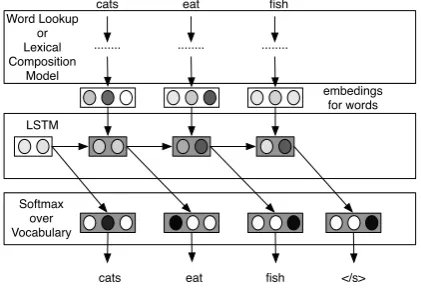
The model is illustrated in Figure 2, where we observe on the first level that each wordwiis pro-jected into their word representations. This can be done by using word lookup tableseW
wi, in which
case, we will have a regular recurrent language model. To use our C2W model, we can sim-ply replace the word lookup table with the model
f(wi) = eCwi. Each LSTM block si, is used to
predict wordwi+1. This is performed by project-ing thesiinto a vector of size of the vocabularyV and performing a softmax.
[image:4.595.312.523.303.447.2]cats eat fish
... ... ...
cats eat fish LSTM
Word Lookup or Lexical Composition
Model
Softmax over Vocabulary
embedings for words
</s>
Figure 2: Illustration of our neural network for Language Modeling.
To address OOV words in the baseline setup, these are replaced by an unknown token, and also associated with a set of embeddings. During train-ing, word types that occur once are replaced with the unknown token stochastically with 0.5 proba-bility. The same process is applied at the character level for the C2W model.
4.2 Experiments
Datasets We look at the language model perfor-mance on English, Portuguese, Catalan, German and Turkish, which have a broad range of morpho-logical typologies. While all these languages con-tain inflections, in agglutinative languages affixes tend to be unchanged, while in fusional languages they are not. For each language, Wikipedia articles were randomly extracted until 1 million words are obtained and these were used for training. For de-velopment and testing, we extracted an additional set of 20,000 words.
Setup We define the size of the word represen-tation d to 50. In the C2W model requires set-ting the dimensionality of charactersdC and cur-rent statesdCS. We setdC = 50anddCS = 150. Each LSTM state used in the language model se-quence si is set to 150 for both states and cell memories. Training is performed with mini-batch gradient descent with 100 sentences. The learn-ing rate and momentum were set to 0.2 and 0.95. The softmax over words is always performed on lowercased words. We restrict the output vocabu-lary to the most frequent 5000 words. Remaining word types will be replaced by an unknown token, which must also be predicted. The word represen-tation layer is still performed over all word types (i.e., completely open vocabulary). When using word lookup tables, the input words are also low-ercased, as this setup produces the best results. In the C2W, case information is preserved.
Evaluation is performed by computing the per-plexities over the test data, and the parameters that yield the highest perplexity over the development data are used.
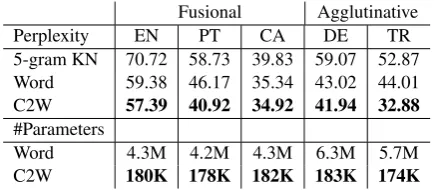
Perplexities Perplexities over the testset are re-ported on Table 4. From these results, we can see that in general, it is clear that C2W always outper-forms word lookup tables (row “Word”), and that improvements are especially pronounced in Turk-ish, which is a highly morphological language, where word meanings differ radically depending
Fusional Agglutinative
Perplexity EN PT CA DE TR
5-gram KN 70.72 58.73 39.83 59.07 52.87 Word 59.38 46.17 35.34 43.02 44.01 C2W 57.39 40.92 34.92 41.94 32.88
#Parameters
Word 4.3M 4.2M 4.3M 6.3M 5.7M
[image:5.595.308.526.63.158.2]C2W 180K 178K 182K 183K 174K
Table 1: Language Modeling Results
on the suffixes used (evde→in the house vs.
ev-den→from the house).
Number of Parameters As for the number of parameters (illustrated for block “#Parameters”), the number of parameters in word lookup tables is
V×d. If a language contains 80,000 word types (a conservative estimate in morphologically rich lan-guages), 4 million parameters would be necessary. On the other hand, the compositional model con-sists of 8 matrices of dimensionsdCS×dC+2dCS. Additionally, there is also the matrix that com-bines the forward and backward states of size
d× 2dCS. Thus, the number of parameters is roughly 150,000 parameters—substantially fewer. This model also needs a character lookup table with dC parameters for each entry. For English, there are 618 characters, for an additional 30,900 parameters. So the total number of parameters for English is roughly 180,000 parameters (2 to 3 pa-rameters per word type), which is an order of mag-nitude lower than word lookup tables.
Performance As for efficiency, both representa-tions can label sentences at a rate of approximately 300 words per second during training. While this is surprising, due to the fact that the C2W model requires a composition over characters, the main bottleneck of the system is the softmax over the vocabulary. Furthermore, caching is used to avoid composing the same word type twice in the same batch. This shows that the C2W model, is rela-tively fast compared operations such as a softmax.
increased John Noahshire phding reduced Richard Nottinghamshire mixing improved George Bucharest modelling
expected James Saxony styling decreased Robert Johannesburg blaming
[image:6.595.82.284.62.128.2]targeted Edward Gloucestershire christening
Table 2: Most-similar in-vocabular words under the C2W model; the two query words on the left are in the training vocabulary, those on the right are nonce (invented) words.
in-vocabulary words and two nonce words1.This makes our model generalize significantly better than lookup tables that generally use unknown to-kens for OOV words. Furthermore, this ability to generalize is much more similar to that of human beings, who are able to infer meanings for new words based on its form.
5 Experiments: Part-of-speech Tagging As a second illustration of the utility of our model, we turn to POS tagging. As morphology is a strong indicator for syntax in many languages, a much effort has been spent engineering fea-tures (Nakagawa et al., 2001; Mueller et al., 2013). We now show that some of these features can be learnt automatically using our model.
5.1 Bi-LSTM Tagging Model
Our tagging model is likewise novel, but very straightforward. It builds a Bi-LSTM over words as illustrated in Figure 3. The input of the model is a sequence of featuresf(w1), . . . , f(wn). Once again, word vectors can either be generated us-ing the C2W model f(wi) = eCwi, or word
lookup tablesf(wi) = eWwi. We also test the
us-age of hand-engineered features, in which case
f1(wi), . . . , fn(wi). Then, the sequential fea-tures f(w1), . . . , f(wn) are fed into a bidirec-tional LSTM model, obtaining the forward states
sf0, . . . ,sfn and the backward statessbN+1, . . . ,sb0. Thus, state sfi contains the information of all words from 0 to i andsb
i from n to i. The for-ward and backfor-ward states are combined, for each index from1ton, as follows:
li = tanh(Lfsfi +Lbsbi +bl),
whereLf,Lbandb
lare parameters defining how the forward and backward states are combined.
1software submitted as supplementary material
The size of the forward sf and backward states
sb and the combined state l are hyperparameters of the model, denoted asdfW S,db
W S anddW S, re-spectively. Finally, the output labels for index i
are obtained as a softmax over the POS tagset, by projecting the combined stateli.
[image:6.595.311.522.160.344.2]cats eat fish
... ... ...
NNS VBP NN
Bi-LSTM Word Lookup
or Lexical Composition
Model
Softmax over Labels
embedings for words
embedings for words in context
Figure 3: Illustration of our neural network for POS tagging.
5.2 Experiments
Datasets For English, we conduct experiments on the Wall Street Journal of the Penn Treebank dataset (Marcus et al., 1993), using the standard splits (sections 1–18 for train, 19–21 for tuning and 22–24 for testing). We also perform tests on 4 other languages, which we obtained from the CoNLL shared tasks (Mart´ı et al., 2007; Brants et al., 2002; Afonso et al., 2002; Atalay et al., 2003). While the PTB dataset provides standard train, tuning and test splits, there are no tuning sets in the datasets in other languages, so we withdraw the last 100 sentences from the training dataset and use them for tuning.
en-code context. Our POS tagger has three hyperpa-rameters dfW S, db
W S anddW S, which correspond to the sizes of LSTM states, and are all set to 50. As for the learning algorithm, use the same setup (learning rate, momentum and mini-batch sizes) as used in language modeling.
Once again, we replace OOV words with an un-known token, in the setup that uses word lookup tables, and the same with OOV characters in the C2W model. In setups using pre-trained word em-beddings, we consider a word an OOV if it was not seen in the labelled training data as well as in the unlabeled data used for pre-training.
Compositional Model Comparison A compar-ison of different recurrent neural networks for the C2W model is presented in Table 3. We used our proposed tagger tagger in all experiments and re-sults are reported for the English Penn Treebank. Results on label accuracy test set is shown in the column “acc”. The number of parameters in the word composition model is shown in the column “parameters”. Finally, the number of words pro-cessed at test time per second are shown in column “words/sec”.
We observe that approaches using RNN yield worse results than their LSTM counterparts with a difference of approximately 2%. This suggests that while regular RNNs can learn shorter char-acter sequence dependencies, they are not ideal to learn longer dependencies. LSTMs, on the other hand, seem to effectively obtain relatively higher results, on par with using word look up ta-bles (row “Word Lookup”), even when using for-ward (row “Forfor-ward LSTM”) and backfor-ward (row “Backward LSTM”) LSTMs individually. The best results are obtained using the bidirectional LSTM (row “Bi-LSTM”), which achieves an ac-curacy of 97.29% on the test set, surpassing the word lookup table. The convolution model (San-tos and Zadrozny, 2014) obtained slightly lower results (row “Convolutional (S&Z)”), we think this is because the convolutional model uses a max-pooling layer over series of window convolu-tions. As order is only perserved within windows, longer distance dependences are unobserved.
There are approximately 40k lowercased word types in the training data in the PTB dataset. Thus, a word lookup table with 50 dimensions per type contains approximately 2 million parameters. In the C2W models, the number of characters types (including uppercase and lowercase) is
approxi-acc parameters words/sec
Word Lookup 96.97 2000k 6K
Convolutional (S&Z) 96.80 42.5k 4K
Forward RNN 95.66 17.5k 4K
Backward RNN 95.52 17.5k 4K
Bi-RNN 95.93 40k 3K
Forward LSTM 97.12 80k 3K
Backward LSTM 97.08 80k 3K
Bi-LSTMdCS= 50 97.22 70k 3K
Bi-LSTM 97.36 150k 2K
Table 3: POS accuracy results for the English PTB using word representation models.
mately 80. Thus, the character look up table con-sists of only 4k parameters, which is negligible compared to the number of parameters in the com-positional model, which is once again 150k pa-rameters. One could argue that results in the Bi-LSTM model are higher than those achieved by other models as it contains more parameters, so we set the state sizedCS = 50(row “Bi-LSTM
dCS = 50”) and obtained similar results.
In terms of computational speed, we can ob-serve that there is a more significant slowdown when applying the C2W models compared to lan-guage modeling. This is because there is no longer a softmax over the whole word vocabulary as the main bottleneck of the network. However, we can observe that while the Bi-LSTM system is 3 times slower, it is does not significantly hurt the perfor-mance of the system.
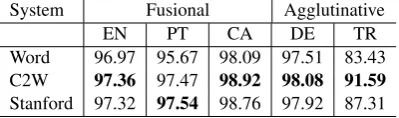
Results on Multiple Languages Results on 5 languages are shown in Table 4. In general, we can observe that the model using word lookup tables (row “Word”) performs consistently worse than the C2W model (row “C2W”). We also com-pare our results with Stanford’s POS tagger, with the default set of features, found in Table 4. Re-sults using these tagger are comparable or bet-ter than state-of-the-art systems. We can observe that in most cases we can slightly outperform the scores obtained using their tagger. This is a promising result, considering that we use the same training data and do not handcraft any features. Furthermore, we can observe that for Turkish, our results are significantly higher (>4%).
ad-System Fusional Agglutinative
EN PT CA DE TR
Word 96.97 95.67 98.09 97.51 83.43 C2W 97.36 97.47 98.92 98.08 91.59
[image:8.595.82.282.63.122.2]Stanford 97.32 97.54 98.76 97.92 87.31
Table 4: POS accuracies on different languages
ditional raw data to learn features in an unsuper-vised fashion. Generally, optimal results are ob-tained by performing both. Table 5 shows the current Benchmarks in this task for the English PTB. Accuracies on the test set is reported on col-umn “acc”. Colcol-umns “+feat” and “+data” de-fine whether hand-crafted features are used and whether additional data was used. We can see that even without feature engineering or unsupervised pretraining, our C2W model (row “C2W”) is on par with the current state-of-the-art system (row “structReg”). However, if we add hand-crafted features, we can obtain further improvements on this dataset (row “C2W + features”).
However, there are many words that do not con-tain morphological cues to their part-of-speech. For instance, the wordsnakedoes not contain any morphological cues that determine its tag. In these cases, if they are not found labelled in the training data, the model would be dependent on context to determine their tags, which could lead to errors in ambiguous contexts. Unsupervised training meth-ods such as the Skip-n-gram model (Mikolov et al., 2013) can be used to pretrain the word rep-resentations on unannotated corpora. If such pre-training placescat,dogandsnakenear each other in vector space, and the supervised POS data con-tains evidence that cat and dog are nouns, our model will be likely to labelsnakewith the same tag.
We train embeddings using English wikipedia with the dataset used in (Ling et al., 2015), and the Structured Skip-n-gram model. Results using pre-trained word lookup tables and the C2W with the pre-trained word lookup tables as additional parameters are shown in rows “word(sskip)” and “C2W + word(sskip)”. We can observe that both systems can obtain improvements over their ran-dom initializations (rows “word” and (C2W)).
Finally, we also found that when using the C2W model in conjunction pre-trained word embed-dings, that adding a non-linearity to the repre-sentations extracted from the C2W modeleC
w im-proves the results over using a simple linear
trans-+feat +data acc
word no no 96.70
C2W no no 97.36
word+features yes no 97.34
C2W+features yes no 97.57
Stanford 2.0 (Manning, 2011) yes no 97.32 structReg (Sun, 2014) yes no 97.36
word (sskip) no yes 97.42
C2W+word (sskip) no yes 97.54
C2W(tanh)+word (sskip) no yes 97.78
Morˇce (Spoustov´a et al., 2009) yes yes 97.44 SCCN (Søgaard, 2011) yes yes 97.50
Table 5: POS accuracy result comparison with state-of-the-art systems for the English PTB.
formation (row “C2W(tanh)+word (sskip)”). This setup, obtains 0.28 points over the current state-of-the-art system(row “SCCN”).
5.3 Discussion
It is important to refer here that these results do not imply that our model always outperforms ex-isting benchmarks, in fact in most experiments, results are typically fairly similar to existing sys-tems. Even in Turkish, using morphological anal-ysers in order to extract additional features could also accomplish similar results. The goal of our work is not to overcome existing benchmarks, but show that much of the feature engineering done in the benchmarks can be learnt automatically from the task specific data. More importantly, we wish to show large dimensionality word look tables can be compacted into a lookup table using characters and a compositional model allowing the model scale better with the size of the training data. This is a desirable property of the model as data be-comes more abundant in many NLP tasks.
6 Related Work
Our work, which learns representations without relying on word lookup tables has not been ex-plored to our knowledge. In essence, our model attempts to learn lexical features automatically while compacting the model by reducing the re-dundancy found in word lookup tables. Individ-ually, these problems have been the focus of re-search in many areas.
[image:8.595.311.532.63.204.2]space. Using word lookup tables is one possi-ble approach to accomplish this. Many meth-ods have been used to augment this model to learn lexical features with an additional model that is jointly maximized with the word lookup table. This is generally accomplished by either performing a component-wise addition of the em-beddings produced by word lookup tables (Chen et al., 2015), and that generated by the additional lexical model, or simply concatenating both rep-resentations (Santos and Zadrozny, 2014). Many models have been proposed, the work in (Col-lobert et al., 2011) refers that additional features sets Fi can be added to the one-hot representa-tion and multiple lookup tables IFi can be learnt
to project each of the feature sets to the same low-dimensional vector eW
w. For instance, the work in (Botha and Blunsom, 2014) shows that us-ing morphological analyzers to generate morpho-logical features, such as stems, prefixes and suf-fixes can be used to learn better representations for words. A problem with this approach is the fact that the model can only learn from what has been defined as feature sets. The models proposed in (Santos and Zadrozny, 2014; Chen et al., 2015) allow the model to arbitrary extract meaningful lexical features from words by defining composi-tional models over characters. The work in (Chen et al., 2015) defines a simple compositional model by summing over all characters in a given word, while the work in (Santos and Zadrozny, 2014) defines a convolutional network, which combines windows of characters and a max-pooling layer to find important morphological features. The main drawback of these methods is that character or-der is often neglected, that is, when summing over all character embeddings, words such asdog and
god would have the same representation accord-ing to the lexical model. Convolutional model are less susceptible to these problems as they com-bine windows of characters at each convolution, where the order within the window is preserved. However, the order between extracted windows is not, so the problem still persists for longer words, such as those found in agglutinative languages. Yet, these approaches work in conjunction with a word lookup table, as they compensate for this in-ability. Aside from neural approaches, character-based models have been applied to address mul-tiple lexically oriented tasks, such as translitera-tion (Kang and Choi, 2000) and twitter
normaliza-tion (Xu et al., 2013; Ling et al., 2013).
Compacting models has been a focus of re-search in tasks, such as language modeling and machine translation, as extremely large models can be built with the large amounts of training data that are available in these tasks. In language modeling, it is frequent to prune higher order n-grams that do not encode any additional infor-mation (Seymore and Rosenfeld, 1996; Stolcke, 1998; Moore and Quirk, 2009). The same be ap-plied in machine translation (Ling et al., 2012; Zens et al., 2012) by removing longer translation pairs that can be replicated using smaller ones. In essence our model learns regularities at the sub-word level that can be leveraged for building more compact word representations.
Finally, our work has been applied to depen-dency parsing and found similar improvements over word models in morphologically rich lan-guages (Ballesteros et al., 2015).
7 Conclusion
We propose a C2W model that builds word em-beddings for words without an explicit word lookup table. Thus, it benefits from being sen-sitive to lexical aspects within words, as it takes characters as atomic units to derive the embed-dings for the word. On POS tagging, our mod-els using characters alone can still achieve com-parable or better results than state-of-the-art sys-tems, without the need to manually engineer such lexical features. Although both language model-ing and POS taggmodel-ing both benefit strongly from morphological cues, the success of our models in languages with impoverished morphological cues shows that it is able to learn non-compositional as-pects of how letters fit together.
The code for the C2W model and our language model and POS tagger implementations is avail-able from https://github.com/wlin12/
JNN.
Acknowledgements
References
Susana Afonso, Eckhard Bick, Renato Haber, and Di-ana Santos. 2002. “Floresta sint´a(c)tica”: a tree-bank for Portuguese. InProc. LREC.
Nart B. Atalay, Kemal Oflazer, and Bilge Say. 2003. The annotation process in the Turkish treebank. In In Proc. the 4th International Workshop on Linguis-tically Interpreted Corpora (LINC).
Miguel Ballesteros, Chris Dyer, and Noah A. Smith. 2015. Improved transition-based parsing by mod-eling characters instead of words with LSTMs. In Proc. EMNLP.
Jan A. Botha and Phil Blunsom. 2014. Compositional morphology for word representations and language modelling. InProc. ICML.
Sabine Brants, Stefanie Dipper, Silvia Hansen, Wolf-gang Lezius, and George Smith. 2002. The TIGER treebank.
Danqi Chen and Christopher D. Manning. 2014. A fast and accurate dependency parser using neural net-works. InProc. EMNLP.
Xinxiong Chen, Lei Xu, Zhiyuan Liu, Maosong Sun, and Huanbo Luan. 2015. Joint learning of character and word embeddings.
Kyunghyun Cho, Bart van Merrienboer, Caglar Gul-cehre, Dzmitry Bahdanau, Fethi Bougares, Holger Schwenk, and Yoshua Bengio. 2014. Learning phrase representations using RNN encoder–decoder for statistical machine translation. InProc. EMNLP. Ronan Collobert, Jason Weston, L´eon Bottou, Michael Karlen, Koray Kavukcuoglu, and Pavel Kuksa. 2011. Natural language processing (almost) from scratch. JMLR.
Ferdinand de Saussure. 1916. Course in General Lin-guistics.
Alex Graves and J¨urgen Schmidhuber. 2005. Frame-wise phoneme classification with bidirectional LSTM and other neural network architectures. Neu-ral Networks.
Sepp Hochreiter and J¨urgen Schmidhuber. 1997. Long short-term memory.Neural Comput., 9(8).
Nal Kalchbrenner and Phil Blunsom. 2013. Recurrent continuous translation models. InProc. EMNLP. Byung-Ju Kang and Key-Sun Choi. 2000. Automatic
transliteration and back-transliteration by decision tree learning. InLREC.
Jiwei Li, Dan Jurafsky, and Eduard H. Hovy. 2015. When are tree structures necessary for deep learning of representations? CoRR, abs/1503.00185. Wang Ling, Jo˜ao Grac¸a, Isabel Trancoso, and Alan
Black. 2012. Entropy-based pruning for phrase-based machine translation. InProc. EMNLP.
Wang Ling, Chris Dyer, Alan W Black, and Isabel Trancoso. 2013. Paraphrasing 4 microblog normal-ization. InProc. EMNLP.
Wang Ling, Chris Dyer, Alan Black, and Isabel Trancoso. 2015. Two/too simple adaptations of word2vec for syntax problems. InProc. NAACL.
Shujie Liu, Nan Yang, Mu Li, and Ming Zhou. 2014. A recursive recurrent neural network for statistical machine translation. InProc. ACL.
Thang Luong, Richard Socher, and Christopher Man-ning. 2013. Better word representations with re-cursive neural networks for morphology. In Proc. CoNLL.
Christopher D. Manning. 2011. Part-of-speech tag-ging from 97% to 100%: Is it time for some linguis-tics? InProc. CICLing.
Mitchell P. Marcus, Mary Ann Marcinkiewicz, and Beatrice Santorini. 1993. Building a large anno-tated corpus of English: The Penn treebank. Com-put. Linguist.
William Marslen-Wilson and Lorraine K. Tyler. 1998. Rules, representations, and the English past tense. Trends in Cognitive Science, 2(11).
M. Antonia Mart´ı, Mariona Taul´e, Llu´ıs M´arquez, and Manuel Bertran. 2007. CESS-ECE: A multilingual and multilevel annotated corpus. InProc. LREC.
Tomas Mikolov, Martin Karafi´at, Lukas Burget, Jan Cernock`y, and Sanjeev Khudanpur. 2010. Recur-rent neural network based language model. InProc. Interspeech.
Tomas Mikolov, Ilya Sutskever, Kai Chen, Greg S. Cor-rado, and Jeff Dean. 2013. Distributed representa-tions of words and phrases and their compositional-ity. InProc. NIPS.
Robert C. Moore and Chris Quirk. 2009. Less is more: significance-based n-gram selection for smaller, bet-ter language models. InProc. EMNLP.
Thomas Mueller, Helmut Schmid, and Hinrich Sch¨utze. 2013. Efficient higher-order CRFs for morphological tagging. InProc. EMNLP.
Tetsuji Nakagawa, Taku Kudoh, and Yuji Matsumoto. 2001. Unknown word guessing and part-of-speech tagging using support vector machines. InIn Proc. the Sixth Natural Language Processing Pacific Rim Symposium.
Cicero D. Santos and Bianca Zadrozny. 2014. Learning character-level representations for part-of-speech tagging. InProc. ICML.
Anders Søgaard. 2011. Semisupervised condensed nearest neighbor for part-of-speech tagging. In Proc. ACL.
Radu Soricut and Franz Och. 2015. Unsupervised morphology induction using word embeddings. In Proc. NAACL.
Drahom´ıra Spoustov´a, Jan Hajiˇc, Jan Raab, and Miroslav Spousta. 2009. Semi-supervised training for the averaged perceptron POS tagger. In Proc. EACL.
Andreas Stolcke. 1998. Entropy-based pruning of backoff language models. In In Proc. DARPA Broadcast News Transcription and Understanding Workshop.
Xu Sun. 2014. Structure regularization for struc-tured prediction: Theories and experiments. CoRR, abs/1411.6243.
Martin Sundermeyer, Ralf Schl¨uter, and Hermann Ney. 2012. LSTM neural networks for language model-ing. InProc. Interspeech.
Wei Xu, Alan Ritter, and Ralph Grishman. 2013. Gathering and generating paraphrases from twitter with application to normalization. In Proceedings of the Sixth Workshop on Building and Using Com-parable Corpora.