University of Warwick institutional repository: http://go.warwick.ac.uk/wrap
A Thesis Submitted for the Degree of PhD at the University of Warwick
http://go.warwick.ac.uk/wrap/66703
This thesis is made available online and is protected by original copyright. Please scroll down to view the document itself.
An Exploration of the Dynamics of
Selection for Resistance to Herbicides
John Michael Lynch
A thesis submitted for the degree of Doctor of Philosophy
School of Life Sciences, University of Warwick
Contents
List of figures ... i
List of tables ... iii
Acknowledgements ... iv
Declaration ... v
Summary ... vi
1. Introduction ... 1
1.1 Weed control in agriculture ... 1
1.1.1 History of weed control in agriculture ... 1
1.1.2 Contemporary importance of agricultural pest control ... 1
1.1.3 Methods of pest control in agriculture ... 2
1.1.4 Chemical controls of pest plants ... 3
1.2 Herbicide resistance in agricultural weeds ... 5
1.2.1 History of herbicide resistance ... 5
1.2.2 Target-site resistance ... 5
1.2.3 Non-target-site resistance ... 5
1.2.4 Evolution and inheritance of target site resistance ... 7
1.2.5 Evolution and inheritance of non-target-site resistance ... 7
1.2.6 Potential epigenetic resistance ... 8
1.3 Ecological and evolutionary factors in selection for herbicide resistance ... 8
1.3.1 Selection pressure ... 8
1.3.2 Fitness costs ... 10
1.3.3 Mating system and gene flow ... 10
1.4 Management of herbicide resistance ... 11
1.4.1 Multiple herbicides ... 11
1.4.2 Variable dose strategies ... 12
1.4.3 Non-chemical control strategies ... 13
1.5 Implications in wider evolutionary biology ... 13
1.5.1 Parallels in resistance management in other pests ... 13
1.5.2 Antibiotic resistance ... 14
1.5.3 Evolution via major or minor effect genes ... 14
1.6 Herbicide resistance in Alopecurus myosuroides (Black-Grass) ... 14
1.6.1 Alopecurus myosuroides as an agricultural pest ... 14
1.6.2 Basic biology of Alopecurus myosuroides ... 15
1.6.3 Control of Alopecurus myosuroides ... 16
1.6.4 Extent of herbicide resistance in Alopecurus myosuroides ... 16
1.7 Models and model organisms in the study of herbicide resistance... 17
1.7.1 Models and predictions of herbicide resistance and its impacts ... 17
1.7.2 Model organisms ... 17
1.8 Major project objectives ... 18
2. Variation in response to ACCase- and ALS-inhibitor herbicides in susceptible Alopecurus myosuroides populations ... 19
2.1 Introduction ... 19
2.2 Materials and Methods ... 23
2.2.2 Herbicide dose-response assays ... 23
2.2.3 Statistical Analysis ... 25
2.3 Results ... 25
2.3.1 Responses to fenoxaprop-P-ethyl ... 25
2.3.2 Responses to cycloxydim... 27
2.3.3 Responses to mesosulfuron-methyl + iodosulfuron-methyl-sodium ... 28
2.4 Discussion ... 29
2.4.1 Variation in response to herbicide application ... 29
2.4.2 Levels of survival within susceptible populations ... 30
2.4.3 Implications for selection for herbicide resistance ... 32
3. Evolution of herbicide resistance in Alopecurus myosuroides by low-dose fenoxaprop-P-ethyl selection within standing genetic variation ... 33
3.1 Introduction ... 33
3.2 Materials and methods ... 37
3.2.1 Plant material ... 37
3.2.2 Initial fenoxaprop-P-ethyl selection ... 37
3.2.3 Recurrent fenoxaprop-P-ethyl selection ... 38
3.2.4 Relaxation of fenoxaprop-P-ethyl selection ... 38
3.2.5 Quantification of herbicide responses ... 39
3.2.6 Statistical analysis ... 40
3.3 Results ... 41
3.3.1 Original population (‘Oxon’) ... 41
3.3.2 First generation of selection – effects of herbicide dose and population size ... 44
3.3.3 Recurrent fenoxaprop-P-ethyl selection ... 45
3.3.4 Relaxation of fenoxaprop-P-ethyl selection ... 47
3.3.5 Differences in plant weight following fenoxaprop-P-ethyl selection ... 48
3.4 Discussion ... 50
3.4.1 Selection within pre-existing variation in low dose herbicide susceptibility can result in increased resistance ... 50
3.4.2 Impact of herbicide dose and population size in a single generation of selection for herbicide resistance ... 51
3.4.3 Recurrent selection ... 52
3.4.4 Mechanistic basis for observed effects ... 53
4. Seed production in response to competition for Alopecurus myosuroides selected for resistance to fenoxaprop-P-ethyl ... 55
4.1 Introduction ... 55
4.1.1 Fitness costs and competition ... 55
4.1.2 Impacts of fitness costs ... 57
4.1.3 Measurement of fitness and competitive ability ... 58
4.2 Materials and methods ... 60
4.2.1 Plant material ... 60
4.2.2 Experimental design ... 60
4.2.3 Plant growth conditions ... 60
4.2.4 A. myosuroides flower head length to seed output relationship ... 63
4.2.6 Response surface analysis ... 64
4.2.7 Replacement series analysis ... 65
4.3 Results ... 66
4.3.1 A. myosuroides flower head length to seed output relationship ... 66
4.3.2 Competition between susceptible and resistant A. myosuroides ... 67
4.3.3 Susceptible and resistant A. myosuroides in competition with wheat ... 70
4.4 Discussion ... 77
4.4.1 Fitness costs associated with selection for resistance ... 77
4.4.2 Competition with wheat ... 78
4.4.3 A. myosuroides variability ... 79
5. Herbicide dose rotation in Chlamydomonas reinhardtii... 81
5.1 Introduction ... 81
5.2 Materials and methods ... 84
5.2.1 Founding populations ... 84
5.2.2 Culture conditions ... 84
5.2.3 Cell count estimates ... 85
5.2.4 S-metolachlor dose response ... 86
5.2.5 Herbicide dose cycling regimes ... 87
5.2.6 Population size measures ... 89
5.2.7 Fitness comparisons of final lines ... 89
5.2.8 Statistical analyses ... 90
5.3 Results ... 90
5.3.1 Chlamydomonas reinhardtii population dynamics within herbicide rotation strategies ... 90
5.3.2 C. reinhardtii population fluctuations within a single rotation period ... 95
5.3.3 Fitness comparisons of final lines in mean dose environment ... 96
5.3.4 Fitness of C. reinhardtii experimental lines in the absence of herbicide . 97 5.4 Discussion ... 99
5.4.1 Impact of dose rotation strategies on C. reinhardtii growth ... 99
5.4.2 Herbicide resistance evolution under dose rotation strategies ... 100
5.4.3 Considerations for resistance management in agriculture ... 101
6. General Discussion ... 104
6.1 Research overview ... 104
6.1.1 Variation in herbicide response in susceptible A. myosuroides ... 104
6.1.2 Selection for herbicide resistance using reduced herbicide rates ... 105
6.1.3 Fitness and competitive impacts of selection for herbicide resistance ... 105
6.1.4 Dose rotation strategies tested in Chlamydomonas reinhardtii ... 106
6.2 Research in context ... 107
6.3 Suggestions for further research ... 108
6.3.1 Further selection experiments ... 108
6.3.2 Resistance mechanisms ... 109
6.3.3 Population Screening ... 109
i
List of figures
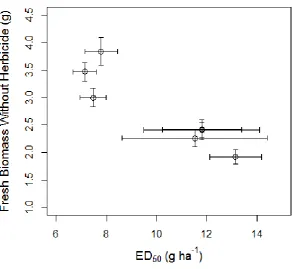
Figure 2.1: A model describing variation in maximum survivable herbicide dose for individual plants as a normally distributed trait. ... 21 Figure 2.2: Fenoxaprop-P-ethyl mortality dose response for two susceptible A. myosuroides populations ... 26 Figure 2.3: Cycloxydim mortality dose response for two susceptible A. myosuroides populations ... 27 Figure 2.4: Mesosulfuron-methyl and iodosulfuron-methyl-sodium mortality dose response for two susceptible A. myosuroides populations. ... 28 Figure 3.1: A model describing selection for quantitative resistance ... 34 Figure 3.2: Fenoxaprop-P-ethyl dose-response susceptible A. myosuroides. ... 41 Figure 3.3: Fenoxaprop-P-ethyl dose-responses for A. myosuroides after a single generation of selection for herbicide resistance ... 43 Figure 3.4: Fenoxaprop-P-ethyl dose-responses for A. myosuroides after two generations of selection for herbicide resistance at the same dose ... 46 Figure 3.5: Fenoxaprop-P-ethyl dose-responses for A. myosuroides after two generations of selection for herbicide resistance at an escalated dose. ... 46 Figure 3.6: Fenoxaprop-P-ethyl dose-responses for A. myosuroides after a generation of relaxed selection for herbicide resistance ... 47 Figure 3.7: Relationship between fresh biomass in the absence of herbicide and ED50
ii Figure 4.7: Wheat yield respnse surface model in competition with resistant and
susceptible A. myosuroides. ... 72
Figure 4.8: Seed output replacement series for resistant and susceptible A. myosuroides in competition with wheat ... 75
Figure 4.9: Wheat yield replacement series in competition with resistant and susceptible A. myosuroides.. ... 76
Figure 5.1: Relationship between C. reinhardtii cell density and optical density. .... 86
Figure 5.2: S-metolachlor dose-response for C. reinhardtii. ... 87
Figure 5.3: Effects of rotation strategy and mean dose on C. reinhardtii growth ... 91
Figure 5.4: Changes in C. reinhardtii growth over time, ... 92
Figure 5.5: C. reinhardtii growth over time for individual strategies. ... 93
Figure 5.6: Effect of weekly or biweekly phase duration on C. reinhardtii growth .. 95
Figure 5.7: Example of weekly changes in C. reinhardtii population size ... 96
Figure 5.8: Growth of final C. reinhardtii populations in the presence of the mean herbicide dose received during selection ... 97
iii
List of tables
Table 1.1: Herbicide modes of action as grouped by the Herbicide Resistance Action Committee ... 4 Table 2.1: Fenoxaprop-P-ethyl mortality dose response parameters for two susceptible A. myosuroides populations ... 26 Table 2.2: Cycloxydim mortality dose response parameters for two susceptible A. myosuroides populations ... 27 Table 2.3: Mesosulfuron-methyl and iodosulfuron-methyl-sodium mortality dose response parameters for two susceptible A. myosuroides populations ... 28 Table 3.1: Fenoxaprop-P-ethyl doses used for dose-responses following selection .. 40 Table 3.2: Fenoxaprop-P-ethyl LD50 for A. myosuroides following selection ... 42
Table 3.3: Fenoxaprop-P-ethyl ED50 for A. myosuroides following selection ... 42
iv
Acknowledgements
I would like to express my utmost gratitude to my supervisor Dr. Paul Neve. His guidance and feedback at every stage in my project has been extremely helpful, in the project itself and in developing my scientific thinking. His dedication to scientific research and patient attention to detail have been inspiring. I feel privileged to have been in his research group, and I wish him the greatest success in his new position at Rothamsted Research.
I would also like to express my thanks to the rest of the Neve group at Warwick. Every member of the group has contributed greatly to the project, assisting in large experimental set-ups and engaging in stimulating discussion regarding our research. Sincere thanks must also go to Peter Watson, Sally Mann and everyone else in Warwick Crop Centre Horticultural Services, who have been extremely helpful in preparing for and assisting with large scale experiments.
I feel deeply fortunate to have shared my time at Warwick with such a strong group of friends, and I thank all my colleagues in the School of Life Sciences and beyond, and my girlfriend Laura, for making my time living in Leamington Spa so enjoyable.
Thanks to the BBSRC for funding the project.
v
Declaration
vi
Summary
Herbicide resistance in weeds is a major threat to agricultural productivity, but the incidence of herbicide resistance in agricultural systems continues to increase. It is increasingly recognised that sustainable weed management can only be achieved by considering the ecological and evolutionary drivers of herbicide resistance evolution. Within this context, it has been suggested that selection within pre-existing variation in herbicide susceptibility, underpinned by additive genetic variation, may result in rapid evolution of herbicide resistance. In this thesis, these principles were tested in the major agricultural weed Alopecurus myosuroides (black-grass). Dose-response experiments demonstrated pre-existing phenotypic variation in response to two commercial herbicides with alternative modes of action (the ACCase inhibitor herbicide fenoxaprop-P-ethyl and the ALS inhibitors mesosulfuron-methyl and iodosulfuron-methyl-sodium) in A. myosuroides with no history of exposure to herbicide. Selection within this pre-existing variation was then tested using low doses of the herbicide fenoxaprop-P-ethyl, demonstrating rapid increases in resistance following a single generation of selection. Recurrent selection showed further, but non-significant, increases in resistance. Competition experiments were then performed to compare fitness in the absence of herbicide between the original susceptible population, and a population following two generations of selection for fenoxaprop-P-ethyl resistance. Results suggested that both resistant and susceptible
A. myosuroides populations were of similar fitness and competitiveness: seed output
1
1.
Introduction
1.1
Weed control in agriculture
1.1.1 History of weed control in agriculture
The transition to agriculture from previously foraging communities began approximately 11,000 years ago, and caused a demographic shift that has ultimately led to the current global human population of 7 billion (Bocquet-Appel, 2011). Cultivation inevitably supports other, undesired plants resulting in the proliferation and evolution of agricultural weeds (Perkins, 2002). Across much of the history of agriculture yields increased slowly, until scientific advances in the 19th century brought rapid gains (Evans, 1980). Weed control was, however, not initially a major research focus, and it is noted in the obituary of 19th century agriculturalist Sir John Bennet Lawes that while he experimented with chemical additions as fertiliser, weed control was performed manually (The Times, 1900).
In the 1940s the compound 2,4-dichlorophenoxyacetic acid, or 2,4-D, marked a major transition as the first synthetic herbicide to be commercially released (Quastel, 1950), starting an era of huge reliance on chemical controls after 1945 (Smith and Kennedy, 2002). This significantly changed the nature of farming, greatly reducing human labour and replacing it with chemical energy in pest management (Zimdahl, 2007). There are now over 300 chemicals used for herbicidal weed control (Heap, 2014a), classified into 16 different modes of action (Herbicide Resistance Action Committee, 2010), but no new major modes of herbicide action have been marketed for over 20 years (Duke, 2012).
1.1.2 Contemporary importance of agricultural pest control
2 food production is expected to come from yield gains, rather than expansion of farmed areas (FAO, 2009). It has even been suggested that we are at the point of ‘peak farming’, and over the next few decades the total farmed area could decrease (Ausubel et al., 2013). Our ability to achieve high yields is constantly compromised by pests, which can cause potential losses of up to 80% (Oerke, 2006), necessitating control.
Agricultural pests can be split into three major groups of animal pests, pathogens and weeds. These can cause losses through quantitative reductions in yields, or a decline in quality which reduces financial value – for example aesthetic attributes such as superficial damage or contamination with pests at harvesting. Of these three categories, weeds have been estimated to cause the greatest potential yield losses, equal to pathogens and animal pests combined (Oerke, 2006). The importance of weed control is further compounded as it has a much greater efficacy (at 74%) than non-virus pathogens (32%) or animal pest controls (39%) (Oerke, 2006).
1.1.3 Methods of pest control in agriculture
The development of life sciences in the nineteenth century moved pest control to a scientific, technological approach. This era saw the emergence of synthetic chemical pesticides, such as the highly toxic arsenic based compound Paris Green as an insecticide against Colorado potato beetles in the 1860s, and Bordeaux mixture - copper sulphate and calcium hydroxide - as a fungicide against downy mildew in the 1880s (Perkins, 2002). In the 20th century the use of synthetic pesticides increased dramatically in scale and diversity, beginning with commercial use of the insecticide dichlorodiphenyltrichloroethane, DDT, in the 1940s. The extremely broad use and commercial success of DDT launched the synthetic pesticide industry, with many companies investing in the development of further insecticides, fungicides and herbicides in the following decades (Perkins, 2002).
3 concerning pesticides to a wider audience, and showed the extent to which negative externalities could spread (Peshin et al., 2009). These environmental impacts and the risk of resistance evolution have led to a call for a more measured use of pesticides, and in the case of weed control, integration of non-chemical control methods (Harker et al., 2012). Non-chemical control methods are broadly split into cultural practices, which modify the cropping environment to reduce the extent and impact of weeds; and physical methods of removing weeds (Melander et al., 2005). Physical, or mechanical, controls are widespread and continue to be developed (Mohler, 2002; Vincent et al., 2001), and the efficacy of many cultural control methods has been demonstrated (Harker and O’Donovan, 2013). However, these cultural and mechanical controls generally only reach the high levels achieved by chemical control when they are applied as a combination of measures, each of which is typically much more labour-intensive (Bastiaans et al., 2008). Further potential avenues for non-chemical weed controls are currently being developed, including, for example, robotics and RNA-interference (Shaner and Beckie, 2014), and may well change the nature of weed control in the future.
1.1.4 Chemical controls of pest plants
There are a wide range of chemicals used as herbicides. Herbicides act by inhibiting the activity of an enzyme or enzymes required for normal growth and survival. Herbicides are typically defined by their target enzyme or process (table 1.1). For each herbicide mode of action multiple chemical families can exist, and within each chemical family there can be several specific active ingredients. Active ingredients of the same family can differ in their efficacy and risk of resistance evolution. The range of active ingredients available for use in individual crops and regions depends on current need and commercial status, and must be approved by a regional legislator. In the EU herbicide registrations are covered by regulation No. 1107/2009 (European Parliament, 2009). Assessments of active ingredients are made at EU level by the European Food Safety Authority. Member states then evaluate and authorise commercial products to be used at a national level. Usage will be restricted to a range of doses and application sites and/or methods.
4 societal damage caused by pesticide use in the United States has been estimated at over $8 billion per year (Pimentel, 2005). Risks to human health are often difficult to quantify, with unclear evidence for long-term exposure risks (Morrison et al., 1992). Safety of exposure to herbicides as they are applied is considered as part of the approval process, and may be updated if new concerns arise (for humans or the environment). Herbicide residue levels on food are further regulated by No. 396/2005 (European Parliament, 2005) within the EU. The relative advantages and disadvantages of pesticide use are complex but there is little doubt that there are many benefits (Cooper and Dobson, 2007), and herbicides are essential to maintain the scale of food production as farming is practised at present.
Table 1.1 Herbicide modes of action as grouped by the Herbicide Resistance Action Committee
HRAC group Mode of Action
A Inhibition of acetyl CoA carboxylase (ACCase) B Inhibition of acetolactate synthase (ALS) C1 Inhibition of photosystem II
D Photosystem I electron diversion
E Inhibition of protoporphyrinogen oxidase
F1 Bleaching through inhibition of carotenoid biosynthesis at the phytoene desaturase step (PDS)
F2 Bleaching through inhibition of 4-hydoxyphenol-pyruvate-dioxygenase (4-HPPD)
F3 Bleaching through inhibition of carotenoid biosynthesis
G Inhibition of 5-enolpyruvylshikimate-3-phosphate (EPSP) synthase H Inhibition of glutamine synthetase
I Inhibition of dihydropteroate synthase K1 Microtubule assembly inhibition
K2 Inhibition of mitosis / microtubule organisation K3 Inhibition of very long chain fatty acids (VLCFAs) L Inhibition of cellulose synthesis
M Membrane disruption
N Inhibition of lipid synthesis
O Synthetic auxins
P Inhibition of auxin transport
5
1.2
Herbicide resistance in agricultural weeds
1.2.1 History of herbicide resistance
Despite their great importance for controlling weeds, herbicides risk losing efficacy as weeds evolve resistance. Concerns over the potential for herbicide resistance were first raised as far back as 1953 (Abel, 1954). The first herbicide resistant weeds were reported in 1957 (Hilton, 1957). Since then reported cases of herbicide resistance have consistently been increasing, with reports logged by the International Survey of Herbicide-Resistant Weeds (Heap, 1997, 2014a). As of July 2014 there are 236 weed species in which resistance has been reported (Heap, 2014a). Cumulatively, herbicide resistant weeds have been estimated as causing losses of $33 billion annually in the United States alone (Zimmer, 2013).
1.2.2 Target-site resistance
Herbicide resistance mechanisms are split into two major categories of target-site and non-target-site resistance. Target-site resistance (TSR) involves the targeted enzyme becoming insensitive to the herbicide, either through a structural change that reduces herbicide binding or via increased production of the target enzyme (Powles and Yu, 2010). Herbicide binding is prevented or limited by changes in the 3D structure of target enzymes and/or by changes to the distribution of polar amino acids at the herbicide binding site (Délye et al., 2013a). These changes are usually caused by substitution of an amino acid resulting from single nucleotide substitutions. More complex changes, including codon deletions and double mutations in a single codon (Han et al., 2012), have also been observed (Délye et al., 2013a). Increased production of the target enzyme can occur through gene amplification (Gaines et al., 2010) or gene regulatory changes which increase transcription (Baerson et al., 2002).
1.2.3 Non-target-site resistance
6 NTSR can operate. Reduced leaf absorption has been demonstrated, and is thought to act through changes to cuticle thickness and/or chemistry, but the exact mechanisms are as yet unknown, and this form of NTSR has rarely been demonstrated (Vila-Aiub et al., 2012). Following penetration of the plant, altered translocation can provide resistance by reducing herbicide translocation in the xylem or phloem, sequestering herbicide to the vacuole, or excluding herbicide from leaf cells or chloroplasts (Délye, 2013). NTSR mechanisms may also metabolically degrade a herbicide, or inactivate it by conjugation of an additional chemical group (Powles and Yu, 2010). Where herbicides cause damage by releasing active oxygen species, oxidases and peroxidases may act to limit oxidative damage (Cummins et al., 2013; Délye, 2013).
7
1.2.4 Evolution and inheritance of target site resistance
The initial frequency of resistance alleles in naïve plant populations depends on spontaneous mutation rates, and any pleiotropic fitness costs resistance alleles confer. Theoretical estimates have been made predicting the frequency of major resistance alleles in unselected populations to be of the order of 1 x 10⁻⁵ to 1 x 10⁻⁶ (Jasieniuk et al., 1996), and collections from naïve populations (Darmency and Gasquez, 1990) and pre-herbicide herbarium samples (Délye et al., 2013b) have suggested even greater frequencies. Surveys of field resistance have revealed diversity in TSR resistance genotypes within small geographic areas, implying that TSR resistance alleles occur at reasonably high frequencies in weed populations, with independent mutations arising separately, rather than via rare mutation events and subsequent dispersal of resistance alleles (Délye et al., 2013a).
These TSR mutations are typically in nuclear genes that are inherited as dominant or semi-dominant traits at field application rates (Diggle and Neve, 2001). Recessive inheritance has also been reported, though the mode of inheritance was dependent upon the herbicide dose received (Délye et al., 2004). Inheritance may also be cytoplasmic, if the resistance gene is located in the chloroplast, as in resistance to triazine herbicides (Délye et al., 2013a). The chloroplast genome is predominantly maternally inherited, although pollen can contain some chloroplasts, and pollen transmission of triazine resistance has been observed (Darmency and Gasquez, 1981).
1.2.5 Evolution and inheritance of non-target-site resistance
8 therefore evolve and be inherited as a quantitative trait. The extent of additive genetic variation for NTSR, and hence the potential for quantitative responses to selection, remains unclear, but there is evidence of NTSR being under complex polygenic inheritance (Petit et al., 2010). Experiments using Lolium rigidium have demonstrated that susceptible populations exhibit survival at low herbicide rates, suggesting initial frequencies of resistance contributing alleles are high (Neve and Powles, 2005a), and selecting within these rates can very rapidly lead to resistance (Neve and Powles, 2005b).
1.2.6 Potential epigenetic resistance
There is increasing consideration given to the possibility that some herbicide resistance mechanisms may be epigenetically inherited (Délye et al., 2013a; Neve et al., 2014; Powles and Yu, 2010). Under epigenetic inheritance changes to the structure of the genome which determine gene expression are inherited without changing the DNA sequence of the genes themselves. This may occur via DNA methylation, modification of chromatin structure, or the presence of non-coding RNAs (Goldberg et al., 2007). A plant responding to environmental stresses may activate a response via these processes, which are then epigenetically inherited and the response maintained in its progeny. In plants, epigenetic inheritance has been shown for responses to biotic stress (Slaughter et al., 2012), Systemic Acquired Resistance (Luna et al., 2012) and elevated insect resistance (Rasmann et al., 2012). Given the generic nature suspected of many non-target-site resistance mechanisms it would not be surprising if some of these mechanisms, or similar, could also contribute towards herbicide resistance. At present, however, no epigenetic inheritance of herbicide resistance has been demonstrated.
1.3
Ecological and evolutionary factors in selection for herbicide
resistance
1.3.1 Selection pressure
9 alleles to the following generation, selecting for herbicide resistance. Whether the mechanisms an individual plant has are sufficient to survive, and hence which mechanisms can be selected for, will depend on what dose is applied. Herbicide dose will determine the relative fitness of individual plants with different combinations of herbicide resistance alleles, and thus which will be selected (Neve et al., 2014).
Lower herbicide doses may be within the pre-existing phenotypic variation for herbicide sensitivity, resulting in rapid increases in resistance as described above. As countries legislate to reduce doses for environmental reasons, concerns have been raised over this potential evolutionary consequence (Gressel, 2009). In contrast, many target-site resistance single resistance genes have been shown to confer a very high level of resistance, and so any TSR mutations that arise will provide resistance largely irrespective of herbicide dose applied. If doses are sufficiently high that only major effect TSR alleles confer resistance, any mutations that do provide this high level resistance will rapidly spread through the population under a strong selective sweep (Délye et al., 2013a). This has been raised as a concern in herbicide resistant GM crops which encourage strong reliance on controlling weed populations with high herbicide doses (Owen and Zelaya, 2005). This therefore presents a difficult situation for weed management, where using either low or high herbicide doses is predicted to select for an alternative form of resistance (Gressel, 2002).
10
1.3.2 Fitness costs
Herbicide resistance is clearly beneficial to fitness in allowing plants to survive herbicide exposure, but it may confer associated negative pleiotropic costs in the absence of the herbicide. These negative costs might be expected for a number of reasons: the mutations responsible for resistance could reduce normal enzyme function; increased resource allocation for resistance mechanisms may limit resources for growth or reproduction; or if an ecological interaction is compromised, such as disease resistance, then ecological costs of resistance will arise (Vila-Aiub et al., 2009a). The potential for negative cross-resistance to alternative herbicides (Beckie et al., 2012; Gressel, 2009) also represents a further resistance associated fitness cost, depending on the resistance mechanisms present and herbicide plants are exposed to. Pleiotropic effects across a weed’s complete life cycle ultimately determine fitness. If being resistant confers a major disadvantage when not exposed to herbicide, the evolution and spread of resistance will be slowed, as fewer viable offspring may be produced, which may then also be at a competitive disadvantage (to other species, including the crop, or susceptible plants of the same species).
1.3.3 Mating system and gene flow
Flowering plants have exceptionally diverse breeding systems (Barrett, 2002), which will determine the inheritance and spread of resistance. In predominantly selfing weeds, e.g. Conyza canadensis the reduced heterozygosity will slow the spread of dominant major effect alleles in contrast to obligate outcrossers such as Alopecurus
myosuroides. Conversely, this will mean recessive major effect alleles can spread
more easily in selfing species (Diggle and Neve, 2001). For polygenic traits there is reduced opportunity for additive alleles to recombine in selfing species, but the degree to which this is important will depend on the number of genes involved and how they interact epistatically (Renton et al., 2011).
11 transportation with grains and/or farm equipment (Busi et al., 2011; Gaines et al., 2007). Once a population has a very high proportion of resistant individuals, resistance alleles are likely to spread and can be introduced to another field, although evidence suggests most populations have evolved resistance independently (Délye et al., 2013a). As well as these spatial introductions, the ability of seeds to remain viable within a seed bank for several years also gives an opportunity for alleles to be introduced from a temporally distinct source (Maxwell et al., 1990). The seed bank may provide a refuge for susceptible individuals and slow evolution by reintroducing non-resistant alleles to the population. Conversely, the seed bank may also provide a reservoir of resistance alleles when the population is no longer under selection by a given herbicide.
1.4
Management of herbicide resistance
1.4.1 Multiple herbicides
12 of some herbicide rotation strategies (Gressel and Segel, 1990), and has also been suggested for insecticide resistance management (Kolaczinski and Curtis, 2004). Applying herbicides together in mixtures has been suggested as potentially offering greater protection against resistance, as individual plants must evolve mechanisms to survive more than one herbicide (Beckie and Reboud, 2009).
Strategies involving the use of multiple herbicide modes of action may, however, also select for cross-resistance to multiple herbicides (Neve et al., 2014). Cross-resistance has been documented for many herbicide Cross-resistance mechanisms, and is an important concern for resistance management (Beckie and Tardif, 2012). Cross-resistance can confer Cross-resistance within populations to herbicide modes of action to which those populations have not previously been exposed (Busi and Powles, 2013). Promoting the evolution of generalist herbicide cross-resistance would therefore not only reduce the available options for weed control when resistance to one mode of action evolves, but also risks compromising novel herbicides, reducing the potential means of controlling weeds in the future. If there is a risk of cross-resistance across multiple modes of action, herbicides should be chosen which differ in their NTSR mechanisms, where known (Délye et al., 2013a).
1.4.2 Variable dose strategies
13
1.4.3 Non-chemical control strategies
There is a diverse range of non-chemical control, which can be used to limit continuous selection for herbicide resistance (Harker and O’Donovan, 2013). Employing cultural controls and herbicides together in integrated systems can be very effective at controlling weeds, and is recommended to limit herbicide resistance evolution (Gill and Holmes, 1997; Moss and Clarke, 1994). Ensuring that weed densities remain low through cultural control when herbicides are losing efficacy will also limit reproduction of resistant plants. This will prevent large numbers of resistance alleles building up within the seed bank, and limit the likelihood of resistance spreading to neighbouring fields (Beckie, 2006; Busi et al., 2011). Despite these advantages, and legislation requiring integrated non-chemical controls in pest management (Lutman et al., 2013), there is a continued lack of integrated weed management research, and options for non-chemical control are frequently overlooked (Shaner and Beckie, 2014).
1.5
Implications in wider evolutionary biology
1.5.1 Parallels in resistance management in other pests
14 cancers is thought to act similarly to NTSR multiple herbicide resistance in plants (Cummins et al., 2013).
1.5.2 Antibiotic resistance
There is increasing concern over the global increases in antibiotic resistance, with potentially devastating consequences for medicine (McAdam et al., 2012). Similar to selection pressures for herbicide resistance, issues concerning appropriate dose strategies have been highlighted in reference to the need for full courses of antibiotics to be completed. It has been demonstrated that at low, non-lethal, antibiotic concentrations resistance mutations are still selected, and in common with herbicide resistance, the previous focus on strongly selected, major effect mutations may miss important evolutionary steps (Hughes and Andersson, 2012). The range of drug concentrations microbes may be exposed to in different parts of the body will provide different selection pressures akin to alternative herbicide doses, and has been suggested as a means of rapid antimicrobial resistance evolution (Hermsen et al., 2012). Even extremely low antibiotic concentrations as might be found in the environment have been shown to select for resistance (Gullberg et al., 2011).
1.5.3 Evolution via major or minor effect genes
Herbicide resistance evolution can also be used to inform very broad questions in evolutionary biology. As has been described above, selection for herbicide resistance can occur through standing genetic variation in minor effect NTSR mechanisms or major effect target site mutations. The relative occurrence of these modes of adaptation and their impacts are a key topic in evolutionary ecology (Barrett and Schluter, 2008). Another debate concerns the visibility of this pre-existing genetic variation, and whether it is only revealed when novel selection is imposed (McGuigan and Sgrò, 2009; Le Rouzic and Carlborg, 2008). NTSR to herbicides provides an excellent and pressing study system to explore this.
1.6
Herbicide resistance in Alopecurus myosuroides (Black-Grass)
1.6.1 Alopecurus myosuroides as an agricultural pest
Alopecurus myosuroides (black-grass) is the most important herbicide resistant weed
15 problem for winter cereals such as wheat (Triticum aestivum) and barley (Hordeum
vulgare), the two most widely grown crops in the UK (Department for Environment,
Food & Rural Affairs (DEFRA), 2013), and is also a pest in their major break crop oilseed rape (Brassica napus) (Lutman et al., 2013). As well as causing substantial yield loss by competing with the crop (Lutman et al., 2013) black-grass is also prone to the same strain of the toxic fungus ergot (Claviceps purpurea). Ergot infected black- grass can contaminate the grain when harvested and spread the fungus to the crop itself during the growing season (HGCA, 2002; Mantle et al., 1977). Ergot fungus produces alkaloids with a range of dangerous physical and neurological effects on humans and animals (Eadie, 2003), which can lead to death, and as such contaminated grain is strictly prevented from being used commercially (Lorenz and Hoseney, 1979).
1.6.2 Basic biology of Alopecurus myosuroides
A. myosuroides (black-grass) is an annual grass, normally growing to 20-80cm tall
and producing dense, narrow panicles 2-12 cm in length, and can be a range of colours, from yellow to dark purple-green, giving the name. Spikelets are 4.5 – 7mm long with glumes connected before the base (around 1/3-1/2 of the way up the spikelet), distinguishing them from other members of the genus Alopecurus (Rose, 1989). A. myosuroides is a serious problem on arable farmland and as of 2011, 53% of arable farms, spread across most of Britain, used herbicides specifically to control
A. myosuroides (Bayer Agri Services, 2012). A. myosuroides can also be found on
other cultivated ground and wastelands, generally on heavier soils (Rose, 1989).
A. myosuroides can grow in densities up to almost 3500 plants per square metre, but
16 al., 2006). Seeds show variable dormancy, correlated in particular with air temperatures (Swain et al., 2006). Seeds can remain dormant in the seedbank for at least 4 years (Moss, 1985) and potentially much longer.
1.6.3 Control of Alopecurus myosuroides
A. myosuroides has been predominantly controlled by herbicides (Lutman et al.,
2013). Many herbicides have been used in the control of black-grass, including PSII inhibitors (chlorotoluron and isproturon), ACCase inhibitors (fenoxaprop, clodinafop, propaquizafop, fluazifop-P-butyl and cycloxydim), ALS inhibitors (mesosulfuron and iodosulfuron mixtures), and tubulin formation inhibitors (propyzamide) (Lutman et al., 2013). Several pre-emergence herbicides are also important in A. myosuroides control, in particular: prosulfocarb, pendimethalin, flufenacet and diflufenican (Bailly et al., 2012). A range of cultural practises are also used, including spring cropping or delayed autumn drilling, more competitive crop cultivars, mouldboard ploughing and stubble clearance (Moss and Clarke, 1994). To both minimise the use of herbicides and limit resistance, integrated management strategies combining chemical and cultural controls are recommended to control A.
myosuroides and are now included in EU legislation (Lutman et al., 2013; Moss et
al., 2010).
1.6.4 Extent of herbicide resistance in Alopecurus myosuroides
A. myosuroides populations have already evolved resistance to all modes of action
17 and rapidity with which black-grass appears to evolve herbicide resistance makes it vital that weed control strategies incorporate evolutionary theory.
1.7
Models and model organisms in the study of herbicide
resistance
1.7.1 Models and predictions of herbicide resistance and its impacts
Many of the questions we need to address concerning weeds involve large population sizes and selection across many years, making them extremely difficult to study experimentally. For example, though it is important to understand the dynamics of black-grass resistance, it is an annual plant which evolves resistance in field populations of tens of thousands of plants over several years, making replicable, controlled experiments impossible at this scale. If the processes driving weed population and evolutionary dynamics are well enough understood, we can instead use predictive models to successfully influence management practices (Freckleton and Stephens, 2009). Predictive models can also identify where our current knowledge is limited and direct research to fill in gaps in fundamental eco-evolutionary processes, in turn leading to more accurate models and more advantageous management strategies (Neve et al., 2009).
1.7.2 Model organisms
Model organisms are widely used in biology to conveniently study processes thought to be shared among related species. The plant Arabidopsis thaliana is widely used as a botanical model species as it can be grown rapidly and takes up little space, and its genome has been fully sequenced with an extensive range of genetic resources (Mitchell-Olds, 2001). For example, A. thaliana has been used in herbicide resistance research to estimate the frequency of mutations conferring resistance (Jander et al., 2003) and interactions among multiple resistance genes (Roux et al., 2005).
18 time of microorganisms they are extremely useful for the experimental study of evolution (Elena and Lenski, 2003). C. reinhardtii has been used to study a number of aspects of the evolution of herbicide resistance, including fitness effects of evolving resistance (Vogwill et al., 2012), and the evolutionary consequences of herbicide mixtures (Lagator et al., 2013a) and cycles (Lagator et al., 2013b).
1.8
Major project objectives
This project aims to explore some of the evolutionary and ecological processes that lead to herbicide resistance. In doing this the intention is both to develop applied principles in order to most successfully manage agricultural systems and advance this area of evolutionary ecology. The project does this first by examining pre-existing variation in responses to low levels of herbicide using the agricultural weed
Alopecurus myosuroides. Low dose selection experiments then explore how
19
2.
Variation in response to ACCase- and ALS-inhibitor
herbicides in susceptible Alopecurus myosuroides populations
2.1
Introduction
Historically, herbicide resistance research has focussed on the evolution of major effect resistance alleles (section 1.2.3), but it is increasingly recognised that a range of non-target-site resistance mechanisms are also extremely important (Délye et al., 2011a). Variation within these mechanisms may cause phenotypic resistance to be distributed among a population and inherited as a quantitative trait (Délye, 2013), with important implications for the evolution of herbicide resistance (Gressel, 2009).
In a naïve population without prior exposure to herbicides there may already be variation in susceptibility to herbicides resulting from pre-existing diversity in either mechanism described above (chapter 1.2.3 and 1.2.4). Herbicide application will then drive the evolution of herbicide resistance by selection from this pre-existing variation. If low-level, dose-specific resistance exists in the population as a quantitative trait some individuals will survive low herbicide doses. In an outcrossing species, the additive genetic variation responsible for this phenotypic variation can then recombine, providing resistance to higher doses in the following generation. Rapid evolution of resistance as a result of repeated selection at low doses has been demonstrated for Lolium rigidum, where initial frequencies of low-level resistance (resistance to relatively low herbicide doses) were high (Neve and Powles, 2005b). Alternatively, major effect alleles which contribute strong resistance will be selected for at any dose to which they confer survival, and will then spread through the population by a selective sweep. Which mechanism of herbicide resistance initially evolves will depend on what pre-existing diversity exists in the naïve population and the degree of resistance this provides to herbicide dose received.
20 1.2.3 and 1.3.3). Mutation rates in plants have been estimated at 7 x 10⁻⁹ substitutions per base-pair per generation for the model plant Arabidopsis thaliana (Ossowski et al., 2010), though this is yet to be confirmed in other species. Should they arise, the persistence of these major effect resistance alleles in a population before selection will be determined by genetic drift and whether they confer a fitness cost. Theoretical estimates have suggested the frequency of major resistance alleles in susceptible populations to be of the order of 1 x 10⁻⁵ to 1 x 10-12 (Jasieniuk et al., 1996) depending on herbicide mode of action. Target-site ALS (acetolactate synthase) inhibiting herbicide resistance mutations in unselected L. rigidum have been shown to be even more frequent than this, at 1 x 10⁻⁵ to 1.2 x 10⁻⁴ (Preston and Powles, 2002).
The minor effect resistance alleles that contribute to quantitative resistance traits are thought to confer non-target-site resistance (NTSR) mechanisms (chapter 1.2). Genome-wide mutation rates will govern the frequency with which enhanced NTSR mutations arise too, but as there are multiple genes that can contribute the likelihood of individual plants already having a minor gene mutation is greater. Mutation rates have been suggested of the order of 10-2 per gamete per generation across all genes contributing to a quantitative trait (Lande, 1983). Variation within NTSR might also already be selected for prior to herbicide application as many of the genes involved belong to diverse stress-response pathways, and could be selected for enhanced ability to tolerate a range of abiotic stresses (Délye, 2013). As a result of these dynamics, resistance as a quantitative trait is expected to be driven through standing genetic variation readily found within weed populations, in contrast to TSR, the occurrence of which depends on the spontaneous mutation rate of major effect resistance alleles (Délye et al., 2013a).
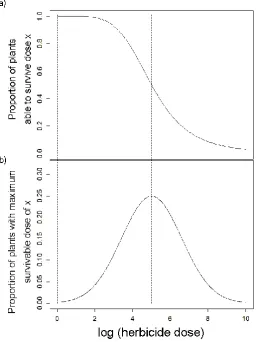
21 phenotypic resistance exists as a quantitative trait. Instead of measuring the value of the trait directly, for each herbicide dose applied the proportion of survivors is the proportion of the population for which their maximum survivable herbicide dose is at this dose or lower. If the underlying quantitative trait is normally distributed in the population, the dose-response obtained as described above will be the cumulative distribution function (CDF) of this normal distribution, as shown in figure 2.1. Differentiation of this CDF dose-response would then give the underlying trait distribution, and integrating the trait distribution would give the CDF. The CDF therefore has an inflexion point at the mean of the distribution, and the slope of the CDF reflects the variance about the mean of the trait distribution.
Figure 2.1 A model describing variation in maximum survivable herbicide dose for individual plants as a normally distributed trait (b), which corresponds to a cumulative distribution function (a) of the proportion of plants able to survive a given dose – the cumulative total of all plants whose maximum survivable dose is above the dose received. The LD50, the dose at which 50% of a population will be
22 In practice the phenotypic distribution will reflect not only the underlying quantitative trait (assumed in fig. 2.1 to be normally distributed), but also interact with environmental factors (Falconer et al., 1996). In the case of herbicide resistance the dose-response will include toxicological effects such as herbicide and adjuvant chemistries and interactions (Seefeldt et al., 1995). The dose-response of a population therefore reflects the underlying trait distribution as it responds to all toxicological effects. In herbicide resistance the log-logistic function (see methods below) is used as a standard model for dose-response relationships, including in this study, as it provides a robust fit for most experimental data and the parameters of the function are biologically informative and allow convenient comparisons. In practice, the log-logistic and normal distributions (and logistic distribution) are likely to be able to fit dose-response data similarly well within the range of doses and replication normally feasible in higher-plant herbicide studies.
In this section the conceptual model described above is used to explore the presence and extent of variation in response to herbicide application in susceptible Alopecurus
myosuroides (black-grass). Multiple target-site resistance mutations have been
identified in A. myosuroides, giving resistance to a range of herbicides, including both ACCase and ALS inhibiting herbicides, as used in this experiment. For ACCase inhibitor herbicides six separate amino acid substitutions have been shown to confer resistance in A. myosuroides: I1781L (Brown et al., 2002; Délye et al., 2002), I1781T (Kaundun et al., 2013a), W2027C, G2096A, D2078G (Délye et al., 2005), and I2041N (Délye et al., 2003) . For ALS inhibitor resistance three amino acid substitutions have been identified: two replacing proline 197; P197H (Krysiak et al., 2011) and P197T; and W574L (Délye and Boucansaud, 2008; Marshall and Moss, 2008; Marshall et al., 2013). A large range of additional substitutions, at the same and alternative amino acid residues, have been shown to confer resistance in other species for both ACCase (Kaundun, 2014) and ALS (Yu and Powles, 2014) inhibitor herbicides.
23 cytochrome P450 herbicide detoxification has previously been reported (Letouzé and Gasquez, 2003). Other cases of NTSR have been shown to be under multigenic control, though as yet mechanisms have not been confirmed (Petit et al., 2010). NTSR degradation mechanisms have also been demonstrated in the majority of A.
myosuroides plants also containing TSR (C. Knight, unpublished work). Specific
TSR mutations differ in the level of resistance they provide (Kaundun, 2014), but it is thought that many TSR mutations observed in A. myosuroides, provide a very high level of resistance, which would make additional NTSR mechanisms redundant. The existence of both mechanisms in the same plant may suggest that lower levels of NTSR were initially present before the strong resistance of TSR later evolved.
This study explores the responses of two susceptible A. myosuroides populations to three commonly used agricultural herbicides. Results are interpreted to infer whether additive genetic variation is present in these populations at sufficient frequencies to survive the doses applied. The three herbicides used are commercial formulations covering two different modes of action: the acetyl-CoA carboxylase (ACCase) inhibitors, fenoxaprop-P-ethyl and cycloxydim, and a mixture of the acetolactate synthase (ALS) inhibitors mesosulfuron-methyl and iodosulfuron-methyl-sodium.
2.2
Materials and methods
2.2.1 Plant materials
Two susceptible A. myosuroides populations without previous exposure to herbicide were obtained from Herbiseed (www.herbiseed.com). One population was collected from an organic farm in Berkshire and is subsequently denoted ‘Berks’. The other population, denoted ‘Oxon’, was originally collected from an organic farm in Oxfordshire in 2004 and maintained as an isolated breeding population with no exposure to herbicides.
2.2.2 Herbicide dose-response assays
24 above ambient air temperature. Pots were watered daily. Germination and growth rates were initially slow due to cold temperatures, so in early December all plants were moved to a glasshouse heated to 10°C in the day and 5°C at night. In both locations pots were arranged in the same 3 replicate blocks with complete randomisation within blocks.
In January 2011 plants were thinned out so that each double sown location contained only a single plant at the 1.5-3 leaf stage to be treated with herbicide, resulting in an average of 15 plants per pot. All three herbicides were applied using a Berthoud Velmorel 200 pro 16 litre pump-operated knapsack sprayer operating at a pressure of 3 bar. A Hypro Flat Fan VP 110° nozzle was used (BCPC nozzle code F110/1.2/3) which gives a spray of fine droplets and output at a flow-rate of 1 litre per minute. During spraying pumping was maintained at a regular rate to maintain full pressure. Herbicides were applied in a total volume of 165 litres per hectare maintained by setting a constant walking speed with markings on the ground and setting pace with an electronic metronome.
All three herbicides were applied at 8 different doses equivalent to 0.05, 0.1, 0.2, 0.3, 0.5, 0.75, 1 and 2 times the UK label recommended rates for A. myosuroides control. For fenoxaprop-P-ethyl these doses corresponded to (normal label rate in bold) 2.74, 5.48, 10.96, 16.43, 27.39, 41.09, 54.78 and 109.56 g active ingredient ha-1. No adjuvant was recommended for use with the fenoxaprop-P-ethyl formulation. For cycloxydim the spray rates corresponded to 10, 20, 40, 60, 100, 150, 200 and 400 g active ingredient ha-1. For the mesosulfuron-methyl and iodosulfuron-methyl-sodium mixture the rates corresponded to 20, 40, 80, 120, 200, 300, 400 and 800 g product per ha-1, which contained 30g/kg mesosulfuron-methyl and 6g/kg iodosulfuron-methyl-sodium. For every application of cycloxydim and the sulfonylurea mixture a 6.7% by weight dioxaeicosylsulphate sodium salt + 20.2% by weight 3,6-dioxoactadecylsulphate sodium salt adjuvant was included at 1 litre ha-1. Due to a mixing error for mesosulfuron-methyl and iodosulfuron-methyl-sodium the 0.5 dose (200 g ha-1) was omitted from this herbicide.
25 apparent but insufficient to cause plant mortality, C-severe symptoms likely to result in plant mortality, D-complete mortality at time of assessment.
2.2.3 Statistical analysis
Based on the four point scale above plants were classified as alive (A and B) or dead (C and D). The proportion of surviving plants per pot was then used as a dependent variable in nonlinear regression (R Development Core Team, 2013; Ritz and Streibig, 2013) for each population by herbicide treatment, fitted to a two parameter log-logistic model of survival:
𝑓(𝑥) = 1
1 + exp(𝑏(log(𝑥) − log(𝑒)))
This function 𝑓(𝑥) gives the proportion of a population which survives exposure to 𝑥 herbicide dose, where b is the slope, and e the point of inflexion about which the function is symmetric. According to this model, all plants survive zero dose and there is complete mortality at sufficiently high herbicide doses. The symmetrical inflection point therefore gives the LD50 (lethal dose 50%), the dose at which half of
the population are killed. Plant survival is modelled as a binomial response weighted by the total number of individuals in replicate pots. Model fitting was tested using a lack-of-fit test comparing the model against a saturated ANOVA model with each dose treated as a separate group. Model parameters were compared using pair-wise T-tests.
2.3
Results
2.3.1 Responses to fenoxaprop-P-ethyl
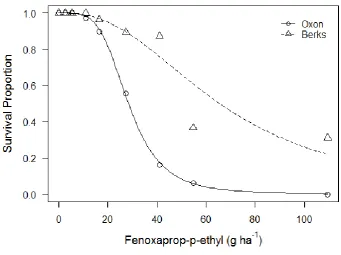
A lack-of-fit test (χ244=33.73, P=0.87) indicated that the model fit did not result in a
26 Figure 2.2 Dose response of plant survival four weeks after application of the herbicide fenoxaprop-P-ethyl for two susceptible A. myosuroides populations. Symbols are observed mean survival from 3 replicate pots. Lines represent predicted values from 2-parameter log-logistic models.
Table 2.1 Parameters for two parameter log-logistic function describing responses of two susceptible A. myosuroides populations based on plant survival four weeks after treating with the herbicide fenoxaprop-P-ethyl.
Parameter Oxon Berks
b (slope) 4.21 (±0.51) 2.46 (±0.36)
[image:37.595.111.485.539.607.2]27
2.3.2 Responses to cycloxydim
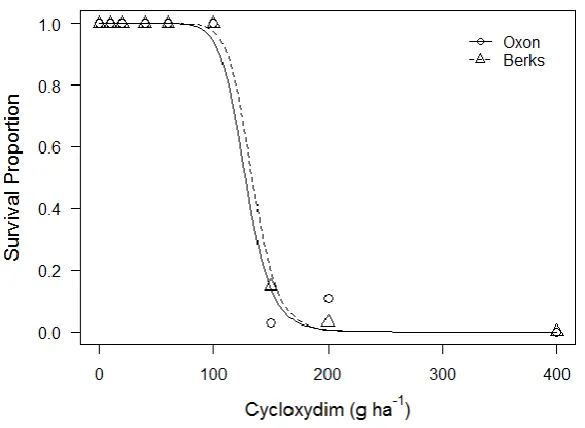
The lack-of-fit test for responses to cycloxydim was significant (χ238=66.82, P<0.01)
indicating poor model fit. Looking at the responses (fig. 2.3) it can be seen that the doses covered do not show a pattern of declining survival with increasing herbicide dose, but instead have extremely high survival until an abrupt transition to almost complete control, with minor variation in Oxon survival just beyond this threshold likely responsible for the inferior fit compared to saturated ANOVA. Both populations behaved similarly (table 2.2) and there were no significant differences between parameters.
[image:38.595.164.457.314.528.2]Figure 2.3 Dose response of plant survival four weeks after application of the herbicide cycloxydim for two susceptible A. myosuroides populations. Symbols are observed mean survival from 3 replicate pots. Lines represent predicted values from 2-parameter log-logistic models.
Table 2.2 Parameters for two parameter log-logistic function describing responses of two susceptible A. myosuroides populations based on plant survival four weeks after treating with the herbicide cycloxydim.
Parameter Oxon Berks
b (slope) 11.38 (±2.40) 12.31 (±3.11)
28
2.3.3 Responses to mesosulfuron-methyl + iodosulfuron-methyl-sodium
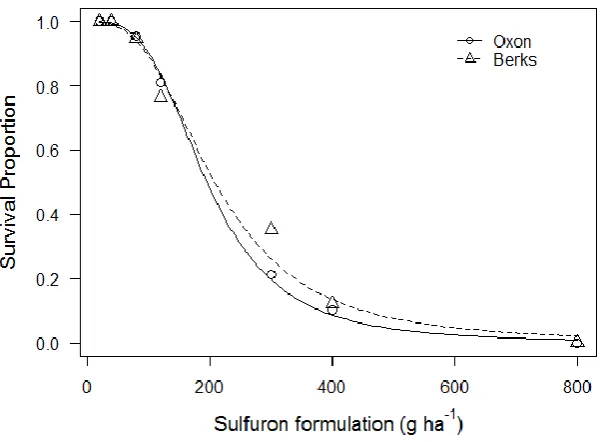
The lack-of-fit test for responses to the mesosulfuron-methyl and iodosulfuron-methyl-sodium herbicide was highly non-significant (χ238=21.71, P=0.98), indicating
good model fit. Both populations behave similarly, with survival rapidly impacted, reaching approximately 90% mortality at the field rate. There were no significant differences between populations for any parameters.
[image:39.595.159.460.255.476.2]Figure 2.4 Dose response of plant survival four weeks after application of a commercial mesosulfuron-methyl and iodosulfuron-methyl-sodium herbicide mixture for two susceptible A. myosuroides populations. Symbols are observed mean survival from 3 replicate pots. Lines represent predicted values from 2-parameter log-logistic models.
Table 2.3 Parameters for two parameter log-logistic function describing responses of two susceptible A. myosuroides populations based on plant survival four weeks after treating with a commercial herbicide mixture containing mesosulfuron-methyl and iodosulfuron-methyl-sodium
Parameter Oxon Berks
b (slope) 3.28 (±0.39) 2.84 (±0.39)
29
2.4
Discussion
2.4.1 Variation in response to herbicide application
The conceptual model presented in the introduction described how resistance could be considered as a quantitative trait. The model suggested that greater variance in the underlying quantitative trait distribution for herbicide susceptibility (fig. 2.1b) will reduce the steepness of the slope in the corresponding cumulative frequency distribution (CDF, fig. 2.1a). It was also argued that dose-response assays can broadly be considered as representing the CDF. Subsequently, we may infer that shallow dose response slopes, as observed for fenoxaprop-P-ethyl and mesosulfuron-methyl + iodosulfuron-mesosulfuron-methyl-sodium, indicate variation in phenotypic response to these herbicides in the populations tested.
In contrast, the very steep slope of the cycloxydim responses suggests there is very little variation in response to this herbicide across the populations tested. The lack of genetic variation in the population results in similar phenotypic resistance for all individuals tested, hence all are controlled above the same dose. From this it might be expected that selection at low doses of cycloxydim from these populations would not result in increasing resistance, as variation is not present to select for and recombine.
30 observed for cycloxydim. Cycloxydim is a poorly metabolisable herbicide (Kaundun et al., 2013a), suggesting that metabolic pathways provided reduced susceptibility to fenoxaprop-P-ethyl in these populations.
The variation in susceptible A. myosuroides response to herbicides observed here is perhaps unsurprising. A. myosuroides is genetically diverse within populations (Chauvel and Gasquez, 1994; Menchari et al., 2007), and so diversity may be expected in many traits, including herbicide resistance. Though the mechanisms responsible for herbicide survival here are unknown, TSR resistance is unlikely, and so the NTSR brought about by cytochrome P450s and GSTs, or similar mechanisms, are most likely. Cytochrome P450s are an extensive protein family, comprising hundreds of members in plants alone, responsible for important roles in plant defence and stress response (Morant et al., 2003). Similarly, individual plants may contain tens of different GSTs, also involved in stress responses (Frova, 2003). Given the size of these enzyme families, and their wide-ranging functions, it appears likely that within A. myosuroides populations genetic variation will be found. Variation in these protein families, and potentially in similar, as yet unconfirmed NTSR mechanisms, could in turn result in the variation in herbicide response observed here.
2.4.2 Levels of survival within susceptible populations
The frequency of individuals within a susceptible population able to survive field-rates of herbicide would typically be expected to be very low. In the Australian weed
Lolium rigidum the greatest frequency of survivors following field-rate application
of the ACCase inhibiting herbicide diclofop-methyl from an unselected population was 2.6%, while the mean was 0.43% (Neve and Powles, 2005a). These initial survivor frequencies are much higher than expected from mutation rates of major effect genes (discussed in the introduction), and were confirmed to not be caused by TSR mechanisms, suggesting resistance to field-rate herbicide application may be present according to the model presented above. However, in this experiment survivorship at field rate was even greater.
31 a result of experimental conditions. Plants were sown relatively late (compared to typical agricultural winter wheat season), and germination and early growth took place in the unusually cold December of 2010 (Met Office, 2011), which may have resulted in cold acclimation. Cold acclimation has a broad response in plants, and has been demonstrated in Arabidopsis to increase tolerance of oxidative stress resulting from herbicides (Bridger et al., 1994) and activate multiple regulatory pathways, including glutathione S-transferases (Fowler and Thomashow, 2002), known to be involved in NTSR (Powles and Yu, 2010; Yuan et al., 2007) and potentially especially important in providing resistance in A. myosuroides (Cummins et al., 2011, 2013). Even if low temperatures had not resulted in survival due to cold acclimation they could have resulted in over-estimation by slowing plant growth. Only when cells are actively dividing as the plant grows will the systemic herbicides applied in this experiment act.
Slow growth may also have led to underestimation of mortality by masking the difference between healthy plants that had only grown a small amount and plants that had not grown at all. Even under normal growth, the 4 point injury scale may have incorrectly defined some plants as survivors if there was no visible damage to the plant apparent at the point of assessment. Aside from potentially colder conditions immediately following germination, the experiment presents a much less stressful environment for plants than field conditions. In the field weeds would be expected to be under competition with the crop and other weeds, and potentially face greater exposure to pests and environmental uncertainty, and subsequently may have been less able to survive exposure to herbicide. The high levels of survival at field rate in this experiment will therefore not necessarily be observed in the field.
32 in 2010 (Moss, 2013a). While these figures undoubtedly reflect differences in awareness and testing for resistance, and both almost certainly greatly underestimate the real incidences of A. myosuroides resistance, the difference suggests a large increase in resistant A. myosuroides over the last 15 years.
Dose-responses are inherently difficult to replicate, with a range of environmental factors influencing results (Medd et al., 2001). Despite some hesitation concerning the exact levels of resistance found, a clear variation in response to herbicide was shown in this experiment. Building on this experience future dose-responses were performed with some revisions (chapter 3.2).
2.4.3 Implications for selection for herbicide resistance
The dose-responses performed suggested that there was a great deal of variation in the responses to fenoxaprop-P-ethyl and mesosulfuron-methyl + iodosulfuron-methyl-sodium for both susceptible populations tested. While there are some concerns that survival may have been over-estimated, this reflects a systematic problem occurring at all doses, which would not be expected to significantly change the overall shape of the curve. If this variation is heritable, selecting within the pre-existing variation in herbicide response would be expected to rapidly evolve enhanced resistance by selecting for and recombining the alleles responsible, increasing the mean of the quantitative trait. Conversely, the steep threshold seen in the cycloxydim dose-responses suggests that plants in both populations respond very similarly to cycloxydim, and so there is not a background of additive genetic variation to select from and increase the phenotypic resistance trait.