Original citation:
Jantjies, Mmaki and Joy, Mike (2017) Teaching through mobile technology : a reflection from high school studies in South Africa. In: Kidd, Terry T. and Morris, Lonnie R., (eds.) Handbook of Research on Instructional Systems and Educational Technology. Hershey, PA: IGI Global, pp. 299-312.
Permanent WRAP URL:
http://wrap.warwick.ac.uk/91929
Copyright and reuse:
The Warwick Research Archive Portal (WRAP) makes this work by researchers of the University of Warwick available open access under the following conditions. Copyright © and all moral rights to the version of the paper presented here belong to the individual author(s) and/or other copyright owners. To the extent reasonable and practicable the material made available in WRAP has been checked for eligibility before being made available.
Copies of full items can be used for personal research or study, educational, or not-for-profit purposes without prior permission or charge. Provided that the authors, title and full bibliographic details are credited, a hyperlink and/or URL is given for the original metadata page and the content is not changed in any way.
Publisher’s statement:
Reproduced with permission of IGI Global 2017.
A note on versions:
The version presented in WRAP is the published version or, version of record, and may be cited as it appears here.
Handbook of Research on
Instructional Systems and
Educational Technology
Terry Kidd
University of Houston-Downtown, USA
Lonnie R. Morris, Jr.
The Chicago School of Professional Psychology, USA
Published in the United States of America by IGI Global
Information Science Reference (an imprint of IGI Global) 701 E. Chocolate Avenue
Hershey PA, USA 17033 Tel: 717-533-8845 Fax: 717-533-8661 E-mail: [email protected] Web site: http://www.igi-global.com
Copyright © 2017 by IGI Global. All rights reserved. No part of this publication may be reproduced, stored or distributed in any form or by any means, electronic or mechanical, including photocopying, without written permission from the publisher. Product or company names used in this set are for identification purposes only. Inclusion of the names of the products or companies does not indicate a claim of ownership by IGI Global of the trademark or registered trademark.
Library of Congress Cataloging-in-Publication Data
British Cataloguing in Publication Data
A Cataloguing in Publication record for this book is available from the British Library.
All work contributed to this book is new, previously-unpublished material. The views expressed in this book are those of the authors, but not necessarily of the publisher.
For electronic access to this publication, please contact: [email protected]. Names: Kidd, Terry T., author.
Title: Handbook of research on instructional systems and educational technology / Terry Kidd and Lonnie R. Morris Jr., Editors.
Description: Hershey PA : Information Science Reference, [2017]
Identifiers: LCCN 2017001496| ISBN 9781522523994 (hardcover) | ISBN 9781522524007 (ebook)
Subjects: LCSH: Instructional systems--Design. | Web-based instruction. | Educational technology.
Classification: LCC LB1028.38 .K54 2017 | DDC 371.3--dc23 LC record available at https://lccn.loc.gov/2017001496
299
Copyright © 2017, IGI Global. Copying or distributing in print or electronic forms without written permission of IGI Global is prohibited.
Chapter 26
DOI: 10.4018/978-1-5225-2399-4.ch026
ABSTRACT
The use of mobile technology to support teaching and learning in schools, has extended technology learn-ing tools in schools across different socio economic divides. There have been various studies throughout the world which reflect the improvement of such technology in schools. In this chapter we reflect on a series of studies conducted in developing countries with focus on Jantjies and Joy (2012, 2013, 2014, 2015) studies. The studies were conducted in schools with the objective of providing teachers and learn-ers with multilingual mobile learning content specifically designed to support teaching and learning in their science and mathematics classrooms and beyond. This chapter provides a culmination of lessons learnt from all studies reflecting on the journey of mobile learning in schools across South Africa. The use of mobile technology to support teaching and learning in schools, has extended technology learning tools in schools across different socio economic divides. There have been various studies throughout the world which reflect the improvement of such technology in schools. In this chapter we reflect on a series of studies conducted in developing countries. The studies were conducted in schools with the objective of providing teachers and learners with multilingual mobile learning content specifically designed to support teaching and learning in their science and mathematics classrooms and beyond. This chapter provides a culmination of lessons learnt from all studies reflecting on the journey of mobile learning in schools across South Africa.
Teaching Through
Mobile Technology:
A Reflection From High School
Studies in South Africa
Mmaki Jantjies
University of the Western Cape, South Africa
Mike Joy
Teaching Through Mobile Technology
INTRODUCTION
This chapter presents two mobile learning studies conducted in mathematics and science classrooms in South Africa. The study looks at how mobile technology was used to support the process of teaching and learning in these subject areas, whilst considering the language barriers and the context.
The premise of these studies was motivated by the annual increase of mobile phone access and In-ternet access (ITU, 2015), and the use of mobile phones as learning platforms in situations where other e-learning platforms are not easily accessible. While research studies have advanced our knowledge about the platforms used to support teaching and learning, such as tablet devices in many schools, the instructional design and implementation challenges relating to mobile learning across different countries and contexts still require further research (Jaffer, Ng’ambi & Czerniewicz, 2007; UNESCO, 2012a; UNESCO, 2012b).
There is thus a need for different scenarios of mobile learning use in schools to provide various views of how we can improve mobile led design and instruction. In recognising that use of technology in schools depends on the teachers and learners, this chapter also presents the skills and contextual offerings which influence the use of mobile devices in the schools being studied. Research has highlighted the various challenges that teachers face when unable to integrate technology into their teaching process. This could be as a result of many factors, such as lack of ICT skills and support infrastructure (Bitner and Bitner, 2002; Roth, 2014), and there is thus a need to reflect on studies in different contexts.
The development of mobile learning to support high school/K12 education has seen various advance-ments across the world. In this chapter we provide a reflection on studies conducted in several schools with the objective of supporting teaching and learning in science and mathematics classrooms. In each study mobile applications were developed with education experts and teachers and the applications were used to support learning inside and outside the classroom learning context. Furthermore, learners were provided with mobile phones loaded with airtime/data which allowed them to access the learning content on their phones. The teachers would then provide various tasks which required the use of this technology when learning inside and outside the classroom. The content was also presented in multiple South African languages, as suggested by the multilingual context of the studies.
The chapter presents the challenges in the study and lessons learnt from conducting mobile learn-ing research in a developlearn-ing country context. While some of the lessons are context specific, such as the multilingual nature of the country, there are various elements of the research which resonate with the use of education technology to support teaching and learning across the world. These reflections can thus benefit teachers and researchers on how to best to develop and use mobile driven instructional design in schools.
MOBILE LEARNING IN SOUTH AFRICA
One of the earliest mobile learning project in South Africa was the MELFA project which was aimed at providing building construction workers with training content through voice recorded multilingual learning content (MELFA, 2009).
301
Teaching Through Mobile Technology
schools could access the system from their mobile phones and ask university tutors questions related to mathematics content (Butgereit, 2007; Butgereit, 2012).
MoMaths (UNESCO, 2012b) was another mobile learning project where the South African gov-ernment partnered with Nokia to create a platform where learners could access mathematics learning resources from their mobile phones, and was seen to successfully involve educators, government and a private company as stakeholders. The challenge with such projects is often the lack of continuity as a result of many factors which include funding and change of leadership.
Another notable project was the M4girls project, in partnership between the government, Nokia and Mindset, which was a pilot study to provide a platform where young girls in rural areas can get access to mathematics learning materials. The material was in the form of gaming providing a serious gaming approach to learning (Vosloo, 2009; UNESCO, 2012; Brown and Mbati, 2015).
Yoza was a project where novels were presented in multiple South African languages and accessible on mobile phone platforms allowing readers to having discussions related to the novel through an online platform (UNESCO, 2012b).
While there have been many projects that have reflected on the mobile phone as a potential learning platform, none of them has been focused on science and mathematics whilst also considering language as a barrier to learning the South African content. With this in mind, we looked at ways in which we could involve teachers in improving the process of teaching and learning through mobile phones in South African high schools.
METHODOLOGY
Two main case studies were conducted in South Africa in Gauteng and in the North West province. The North West province is a largely rural province where most of the country agricultural produce come from, while Gauteng is considered to be the economic ‘heart beat’ of South Africa. Four schools from North West participated in this study together with one from Gauteng. In both studies a mobile learning tool called M-Thuto was developed to support teaching and learning in the formal and informal class-room learning context.
South Africa has 11 official languages, even though English is the national language of instruction. In considering the cultural, and linguistic challenges of the country we presented learning technology which was available in English and Setswana in the M-Thuto system, since Setswana was the first language of most participants in the study. The sample sizes in the study were limited as a result of government ethics application process in relation to school access, however the findings of the study can be used to understand and reflect on the use of mobile learning and resources in South African schools.
In each study learners were provided with mobile phones to use for a month with access to the Internet, with each phone having being preloaded with data. In both studies the teachers played a vital role by either referring learners to the application for some of the learning objectives or by working with them through some of the study tasks using the application. Following this time, a series of data collection strategies were used to establish the experiences of the participants.
Teaching Through Mobile Technology
studies can be applied in other similar contexts. As this study is interdisciplinary and involves human beings we also note that when applied to other settings, the findings may be different (Bryman, 2012).
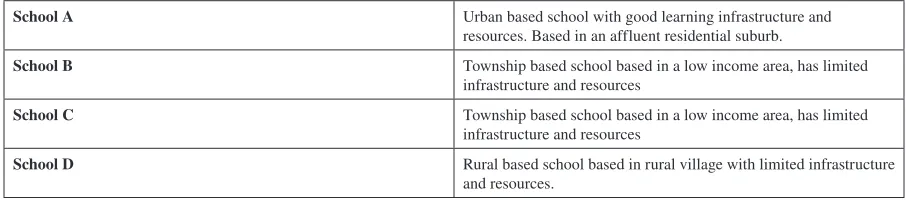
Details of the participating schools and the characteristics are presented in Table 1. Each school has been given an alphabetical name from A to D and learners have been given pseudo names to ensure anonymity.
The Technology
When developing both technologies in the study we were guided in the pedagogical perspective of the technology by Shih and Mills (2007), who stress the following important perspectives in developing pedagogy used in mobile technology:
• The importance of understanding the learners in the way they acquire knowledge;
• The local social settings and context affecting the learners’ manner in acquiring knowledge; • The varying roles of the mobile technology in the teaching and learning process;
• The factors affecting mobile learning use – the context, the teacher, the technology and the learner – affects the study.
Learners
When developing the underlying pedagogy we first had to understand the manner in which learners learn and thus we considered learning theories as they play an important role in the interaction process. We looked at constructivism and behaviourism as commonly used theories and thus modelled elements of the system around these theories as summarized in Table 2 (Ang et al., 2008; Boghossain, 2006; Hunter and Benson, 2007; Nagowah and Nagowah, 2009; Shih and Mills, 2007).
Educators
[image:7.612.70.523.621.721.2]The introduction of technology in many schools across the world tends to ignore the vital role the teacher plays in using the technology to enhance the teaching and learning process, and teachers are also often not included in the technology development process. In this light, we invited teachers and government subject advisors to help create pedagogy that would be used in the M-Thuto platform.
Table 1. School descriptions
School A Urban based school with good learning infrastructure and
resources. Based in an affluent residential suburb.
School B Township based school based in a low income area, has limited
infrastructure and resources
School C Township based school based in a low income area, has limited
infrastructure and resources
School D Rural based school based in rural village with limited infrastructure
303
Teaching Through Mobile Technology
We engaged the teachers in informal discussions by explaining the concept of mobile learning and spent time with them showing them the different roles and benefits of technology use in education. We further evaluated with them the potential challenges that came with mobile devices in the learning process and how they could consider these. The teachers also discussed the linguistic challenges that learners faced and we discussed ways in which technology could overcome these. Upon completion of the M-Thuto development process the teachers gave feedback on the system which we further improved on. In each study, teachers were thus able to align their teaching and the technology to their teaching objectives as they were part of the design and development process.
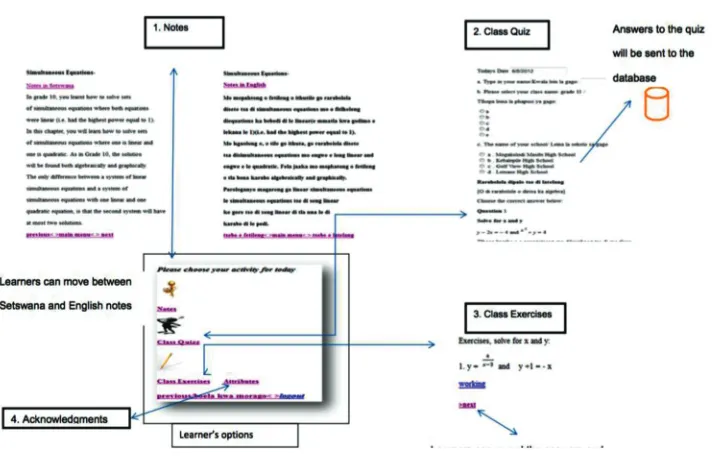
The four elements of the Figure 1 are reflected in these diagrams.
[image:8.612.92.539.125.224.2]1. The first section was a notes section which consisted of related notes formulated by a mathematics subject advisor from the department of education in North West province with inputs from teachers. Each page of notes was available in English and Setswana, since Setswana is one of the languages largely spoken in the area where this research was conducted;
Table 2. Learning theories and M-Thuto
Theory M-Thuto
Constructivism was used a theory which allows a teacher to enable
learners to create their own knowledge. Learning material encompasing class notes, access to online learning material and text book content created with the teacher allowing the learner access at any time to be able to learn. Class exercises with solutions allowing the learner to practice and reflect on their answers.
Behaviourism was used as a theory to help reinforce learning
through incentives. A class quiz section allows learners to reflect on their responses and gain marks based on their performance.
[image:8.612.140.496.495.725.2]Teaching Through Mobile Technology
2. The second section was a class quiz which allowed learners an opportunity to test their understand-ing of the topic area. Their answers were sent to the database for teachers to keep track of; 3. The third section consisted of a class exercise questions page that allowed learners to attempt
po-tential class exercise questions and popo-tential exam questions and later view the correct answer to the questions. The presentations of the answers were extensive providing the learners with ways that they could have attempted the answer;
4. The fourth section was an acknowledgement section that acknowledged the parties that contributed to the development of the learning content including the translation of the content. (Jantjies, 2014: 103).
TESTING BEFORE THE CASE STUDY
We first piloted the system with children who volunteered to participate in the pilot study chosen from the participating schools aged between 16-18 years. The pilot study was however conducted with the participants who accessed the system using their own mobile phones. The pilot aimed to establish the usability perspective of the system and the users’ interaction with the interface, whether the system was able to handle multiple users at a go, and the ability of the system to attain its objectives (i.e. providing content and multiple language views), while establishing if the data collection instruments were easy for learners to understand and evaluating the system usability. (Creswell and Clark, 2011).
STUDY 1 (JANTJIES AND JOY 2012)
Background and Methodology
In the first study, following the software development process engaging various teachers, we visited students in 4 classes in 4 schools, each aged between 16 and 19. The schools were all based in Mafikeng in the North West province of South Africa. The main language of communication in the province is Setswana with English being the official language of teaching and learning. Considering this, the con-tent of the system was available in English and Setswana with learners being able to switch views of the content. The schools were all based in different geographic locations in the city, details are presented in Table 1. In this study we used questionnaires to collect the first set of findings. Following this we interviewed some of the participants to get further data from participants who had participated in the questionnaire study. 90 learners across all 4 schools filled in questionnaires and 5 learners in each school were further interviewed.
Study Findings
Technology Use of M-Thuto by Teachers
305
Teaching Through Mobile Technology
learning activities, and all learners were provided with mobile phones for the study. During the month of technology use in which the learners were using M-Thuto, each school focused on the simultaneous equations subject area. During the study teachers used the M-Thuto software in different ways. On some days, time was allocated during class for the learners to go through exercises on simultaneous equations. The exercises each had possible answers which the learner could view after attempting the exercises. On other days the learners went through a quiz on their own on the mobile phones. The teachers gave learners tasks to revise notes on simultaneous equations from their textbooks before coming to class. The teachers planned different ways of using the technology to achieve their objectives.
Accessible Learning Resources
At the end of the month of daily technology use in the mathematics class, participants filled out question-naires with some being further interviewed on their perspectives of the technology use in their classroom and beyond the classroom context.
Participants were asked what type of learning resources they had access to and where they got access to these resources (textbooks, educational websites, online learning material. etc.). The learners coming from schools B, C and D relied on learning material which was provided to them by their teachers, and other free resources such as special edition newspaper sections which presented topic areas related to their learning content. Local newspapers often provided sections where they covered different learning areas related to the national school curriculum. Furthermore learners also relied on each other for mate-rial. Learner A reflected that, “if we find a good past mathematics paper, we photocopy it and circulate it amongst each other.” Students also had a senses of sharing resources. Students from these schools mainly came from under-resourced home environments, and thus learning resources mainly came from the teacher or school. When asked about online learning resources, most of the participants has no knowledge of existing online learning resources. Regardless of this, a total of 56% of participants from all schools reflected that their teachers would at times request them to use technology to do this home-work, i.e. search the Internet or type up their homework. When asked about access to personal mobile phones, 48% of them had full ownership of a mobile phone while others had access to their parents or family members’ mobile phones, in comparison with only 22% of them having access to computers which were all only accessible on school grounds (in computer labs).
The Use of Language for Teaching and Learning
Teaching Through Mobile Technology
When asked about code-switching (switching between languages) while talking in class to their teacher, 63% of them reflected their constant switching between English and Setswana to communicate. It was important to note that the switch was mainly in verbal learning as opposed to written content as the schools were all strict about language presentation across subject areas. It was interesting to note that the learners who did not code-switch mostly came from school A. The learners from school A, C and D reflected that their teachers also used both languages when teaching a particular subject area. It is also important to note that the teacher in school B was a foreign national and thus did not speak Setswana. Learners reflected that their books are only published in the English language.
Using M-Thuto
After establishing the background of participants and schools in relation to language and technology resources, the learners were asked about their interaction with M-Thuto over the previous month. The learners were initially asked which language they used for reading the content, which was available in both English and Setswana allowing the learners to switch at any point during their learning process. Of the 90 participants, 61% reflected that they used both languages throughout their learning process, while the remaining learners only used the English language. An important trend to notice was that the remaining students who only used the English language all came from school A. When asked about the need for similar applications which support multiple languages, 98% of them reflected that there is a need for more similar applications. Learners were also asked about the learning support perspective that the technology gave them. Many of the learners requested an extension of time on using the system as they found it beneficial in helping them access learning resources which they could previously only get as hard copy. Learners also reflected enjoying working on their own while being able to get answers in the class exercise section. We also asked the learners to mention the type of challenges they had come across while learning using M-Thuto, and slow Internet connection was identified by learners as the biggest problem.
Study Findings
307
Teaching Through Mobile Technology
not supported with the necessary technology skills to teach a 21st century technology native learner, and thus end up not being able to use technology effectively to support teaching and learning.
Considering access to technology, learning content language use came up as an important aspect of the study. Subject areas such as mathematics and science are often poorly delivered in schools as a result of multiple aspects which also include the language of teaching and learning (Botes & Mji, 2010; Setati, 2008). The learners further reflected the importance of mobile technology that is able to provide them with resources that would otherwise be provided as textbooks or physical notes. The learners enjoyed the portability of the devices as they could also access them from home.
STUDY 2 (JANTJIES AND JOY, 2013, 2015)
Background and Methodology
We conducted our study in one school based in the Gauteng province, in which 32 children from a physi-cal science class and one teacher participated. Similar to school C in study 1 the school is also based in a township which usually has middle to low income dwellers. In this study all learners were provided with smart phones. The learners were asked to create a mobile clip summarising each physical science lesson and upload it onto the M-Thuto system after the lesson. The learners were allowed to use any language of their choice. The study followed a constructivist approach where learners were expected to create their own knowledge by summarising their knowledge of the class and using online mobile resources. Participants then filled in questionnaires at the end of the study on their experiences with some participants having being interviewed in the process.
The study essentially evaluated the following:
• The role of the mobile device in supporting the construction of learning in science classrooms; • The language use in the mobile learning process;
• The experiences of the learners o relation to bilingual mobile learning.
Study Findings
Mobile Technology Use to Support Teaching and Learning
Learners were expected to log into the M-Thuto system following their physical science lessons and thus most of the learning happened in informal learning spaces. In each lesson during the day, the teacher would teach a particular topic, following this the learners would be referred to readings online and be expected to conclude by constructing their understanding of that topic and what the teacher had taught them. The frequency in which they uploaded their clips was entirely up to them and the language of creating clips was also up to them. At the end of each week, the teacher went through the clips to listen to each learner’s content. This also gave them an opportunity to listen to topic areas which the learners had not clearly grasped.
Teaching Through Mobile Technology
day’s topic. The learners were also asked on the ease of use of creating voice clips. All learners reflected that creating clips was easy, however using additional resources from the mobile phone was not as easy. A total of 53% of learners preferred using physical textbooks as a source of knowledge, and other sources which they were familiar with, as well as using the mobile phone to search for learning mate-rial. 33% preferred only conventional learning material while 13% preferred only the mobile phone as their primary learning material source. Locating free and accessible learning resources was also cited as a challenge for the learners.
The Internet was cited as one of the biggest challenges when loading voice notes. Other challenges included the limited knowledge of resources from before the study. In the interview, learner 1 reflected that, “It is difficult to focus on learning on the phone and it’s easier in a book because a phone has many distractions, especially if it has online access” (Jantjies, 2014; 138). This was contrary to learner 2 who reflected, “I found it easier to create material on my own phone and listen to myself while making sense of what I was saying. I think my personal notes are easier to understand than the ones in the book”. In relation to the content created by learners there was a clear link between what the learners had been taught in class and their audio clip understanding and interpretation of the content they created. It was interesting to note how learners were able to critique their interpretation of the topic. An example of this is when Learner 2 reflected, “The theory of atomic molecules is defined by... I think my explanation may be wrong and I would need you (the teacher) to explain it better because I was rather confused with it” (Jantjies, 2014).
Language and Learning
All participants were either second, third or fourth language speakers. When asked about the use of language by their teacher the learners expressed that the teacher would often switch between English and Sepedi (a South African official language similar to Setswana). The learners were then asked which languages they used to create the voice clips. All learners switched between English and a local language with 58% of the leaners using Sepedi and English while the rest used other South African languages including Setswana. It is important to note that the school was located in a largely Sepedi speaking area.
When going through the clips it was also interesting to note how relaxed the participants were. The learners would even go as far as asking the teacher questions during the clip recording session. The teacher further expressed that, “It was useful for me to access the audio notes of the learners. The learn-ers are free when making them which helps me realise the challenges that they might not be able to raise during class.” The class reflected a need for electronic learning resources tailored to support their resource and linguistic challenges.
Study Summary
309
Teaching Through Mobile Technology
exposed to creating their own knowledge by also looking for learning sources. The learners were used to being given learning material from specific sources such as their teacher and from their set textbooks.
It was important to note that some learners found the device to be a distraction in their learning process. The learners were familiar with the role that technology can play in their learning process. The learners were also challenged by the thought of creating their own learning content. While some enjoyed the ability to construct their own knowledge, for other learners the technology posed both a challenge and a new learning experience.
In being able to construct their own learning content, it was also interesting to note that learners could not come to the same conclusion or data as they had used differing sources to curate their mate-rial (Boghossian, 2006).
DISCUSSION
1. Mobile Learning and Infrastructure: Mobile learning is a specialised research field and still growing in developing countries as a result of contextual challenges which many countries still face. In South Africa, there are policies and various initiatives in place to support e-learning and mobile learning in schools, however infrastructure, which includes slow and expensive Internet access and localised technologies, and content, often hinder the use of such technologies and ap-plications in schools (Brown and Mbati, 2015);
2. Mobile Learning and Pedagogy: In many mobile learning studies, teachers and learners are of-ten left out of the technology development phase and thus see technology as a “foreigner” in the classroom and in the teaching and learning process. In study 2, learners at times saw technology as a distraction rather than a useful tool. While many teachers and learners have access to technology platforms such as mobile phones and computers, they tend to find these resources irrelevant to the teaching and learning process. Mobile phones are often only seen as personal devices only used for social media access. Personalised and localised mobile learning technologies are essential in considering the adoption of technology across schools (Wang et al, 2015; Georgiev et al., 2015); 3. Teachers Skills: Teachers in many countries are still unable to see the use of technology as an
enabler in the teaching and learning process. Teachers often see technology as an additional burden which they are forced to use by governments looking to embrace e-learning. It is also important to reflect on the lack of ability of many learning institutions internationally to facilitate the use of mobile device for trainee teachers. This affects their experiences and use of technology in their careers as it is seen as an extra skill which they need to gain often in their own time. There is also a lack of organised local support for teachers who try and adopt technology in their teaching process, with many teachers finding themselves isolated (Traxler and Vosloo, 2014; Kearney et al., 2015; Wang et al., 2015; Domingo et al., 2016);
Teaching Through Mobile Technology
SUMMARY
In this study we have presented two case studies that reflect the development and use of mobile learning in science and mathematics lessons. In both studies participants gave accounts of their views on the role of mobile learning in the high school learning space. Both studies reflected on the important role that teachers also play in the development of pedagogy to be used for mobile learning technologies. The study found that mobile phones are the most accessible technology in South African schools. This presents them as vital learning platforms which can be used to support teaching and learning in STEM related subject areas, reducing the resource gaps amongst schools spanning different income areas. Furthermore the study reflected that language and context of technology use become important role players in the use of technology to support teaching and learning. In both studies all participants were multilingual speak-ers who were not first language speakspeak-ers of the language of teaching and learning, which prompted the mobile pedagogy to reflect this. Thus the M-Thuto software presented learners with dual views of the same content in English and Setswana to allow them to switch at any point while learning. In our future work we aim to conduct further studies on the design of mobile learning technologies considering the context of learning in developing countries.
REFERENCES
Bitner, N., & Bitner, J. (2002). Integrating technology into the classroom: Eight keys to success. Journal of Technology and Teacher Education, 10(1), 95–100.
Boghossian, P. (2006). Behaviorism, Constructivism, and Socratic Pedagogy. Educational Philosophy and Theory, 38(6), 713–721. doi:10.1111/j.1469-5812.2006.00226.x
Brown, T. H., & Mbati, L. S. (2015). Mobile learning: Moving past the myths and embracing the oppor-tunities. The International Review of Research in Open and Distributed Learning, 16(2). doi:10.19173/ irrodl.v16i2.2071
Butgereit, L. (2007). Math on MXit: the medium is the message. 13th Annual National Congress of the Association for Mathematics Education of South Africa (AMESA).
Butgereit, L. (2012). Dr Math at your service. 4th CSIR Biennial Conference: Real problems relevant solutions.
Domingo, M. G., & Gargante, A. B. (2016). Exploring the use of educational technology in primary education: Teachers perception of mobile technology learning impacts and applications use in the class-room. Computers in Human Behavior, 56, 21–28. doi:10.1016/j.chb.2015.11.023
311
Teaching Through Mobile Technology
International Telecommunication Union (ITU). (2015). The World in 2015: ICT Facts and Figures. Retrieved from https://www.itu.int/en/ITU-D/Statistics/Documents/facts/ICTFactsFigures2015.pdf Jaffer, S., Ng’ambi, D., & Czerniewicz, L. (2007). The role of ICTs in higher education in South Africa: one strategy for addressing teaching and learning challenges. International Journal of Education and Development Using ICT, 3(4). Available at http://ijedict.dec.uwi.edu/viewarticle.php?id=421
Jantjies, M. (2014). A framework to support multilingual mobile learning: A South African perspective
(Doctoral dissertation). University of Warwick.
Jantjies, M., & Joy, M. (2012). Multilingual Mobile Learning-A Case Study of Four South African High Schools. 11th World Conference on Mobile and Contextual, 208-211.
Jantjies, M., & Joy, M. (2013). Mobile learning through indigenous languages: learning through a con-structivist approach. In 12th World conference on mobile and contextual learning. College of the North Atlanic. doi:10.5339/qproc.2013.mlearn.14
Jantjies, M., & Joy, M. (2014). A framework to support mobile learning in multilingual environments. In IADIS 10th International conference on Mobile learning. Madrid, Spain.
Jantjies, M., & Joy, M. (2015). Mobile enhanced learning in a South African context. Journal of Edu-cational Technology & Society, 18(1), 308–320.
Kearney, M., Burden, K., & Rai, T. (2015). Investigating teachers adoption of signature mobile pedago-gies. Computers & Education, 80, 48–57. doi:10.1016/j.compedu.2014.08.009
Liu, G. Z., Kuo, F. R., Shi, Y. R., & Chen, Y. W. (2015). Dedicated design and usability of a context-aware ubiquitous learning environment for developing receptive language skills: A case study. International Journal of Mobile Learning and Organisation, 9(1), 49–65. doi:10.1504/IJMLO.2015.069717
MELFA. (2009). Pilot Project with Building Industry in South Africa. Available at: www.melfaproject. net/intranet/?q=node/40
Nagowah, L., & Nagowah, S. (2009). A Reflection on the Dominant Learning Theories: Behaviourism, Cognitivism and Constructivism. The International Journal of Learning, 16(2), 280–285.
Roth, K. (2014). Technology for Tomorrows Teachers. Journal of Physical Education, Recreation & Dance, 85(4), 3–5. doi:10.1080/07303084.2014.884420
Shih, Y., & Mills, D. (2007). Setting the New Standard with Mobile Computing in Online Learning.
International Review of Research in Open and Distance Learning, 8(2), 16. doi:10.19173/irrodl.v8i2.361 UNESCO. (2012a). United Nations Educational Scientific and Cultural Organisation. Turning on Mobile learning - Illustrative Initiatives and Policy Implications in Asia. Paris, France: UNESCO.
Teaching Through Mobile Technology
UNESCO. (2013). United Nations Educational Scientific and Cultural Organisation. ICT in Education. UNESCO Mobile Learning Publications. Paris, France: UNESCO.
Vosloo, S., & Botha, A. (2009). Mobile learning South Africa examples. In Mobile Learning Institute Summit, Lusaka, Zambia.