University of Warwick institutional repository: http://go.warwick.ac.uk/wrap
A Thesis Submitted for the Degree of PhD at the University of Warwick
http://go.warwick.ac.uk/wrap/57781
This thesis is made available online and is protected by original copyright. Please scroll down to view the document itself.
1
Navigating Mathematics
Making Sense of Purpose and Activity in
Contemporary English Mathematics Education
by
Robert Ward-Penny
A thesis submitted for the degree of
Doctor of Philosophy in Education
University of Warwick, Institute of Education
2
TABLE OF CONTENTS
Page
Table of Contents 2
List of Figures 6
List of Tables 7
List of Abbreviations and Acronyms 8
Acknowledgments 9
Declaration of Inclusion of Material 9
ABSTRACT 10
INTRODUCTION 11
CHAPTER ONE: PURPOSES OF MATHEMATICS EDUCATION
1.0 The Aims of Education 14
1.1 Aims and Goals of Mathematics Education 16 1.1.1 Numeracy at the Level of the Individual 25 1.1.2 Preparation for Industry and Employment 30 1.1.3 Promotion of Interest in Mathematics 35 1.1.4 Development of Thinking and Problem-Solving Skills 38 1.1.5 Growth of a Critical Citizenship 40 1.2 Aims, Goals, Roles and Ideologies of Mathematics Education 41 1.2.1 Social and Cultural Reproduction 43 1.2.2 Mathematics as a Monitor of Performance 46 1.2.3 Mathematics as a Marker of Intelligence 47 1.3 Interactions between Goals and Roles and the Central Research
Questions
48
CHAPTER TWO: ESTABLISHING THE FIELD OF INVESTIGATION
2.0 Introduction 50
2.1 Critical Theory 50
2.2 Critical Theory and Education 53
2.2.1 Bourdieu and Freire 53
2.2.2 Critical Theory and Mathematics Education 55
2.3 Relevant Ontological Debates 56
2.3.1 Structure, Agency and Structuration 56 2.3.2 Identity and Figured Worlds 57
2.3.3 Communities of Practice 60
2.4 Selecting a Critical Methodology 62
2.4.1 Grounded Theory 64
2.4.2 Critical Grounded Theory 65
2.5 The Overarching Methodology 68
2.5.1 Theoretical Sampling 68
3 CHAPTER THREE: EXPLORING THE DECISIONS AND
EXPERIENCES OF ADULTS RETURNING TO MATHEMATICS
3.0 Introduction 75
3.0.1 Localising the Research Questions 77
3.1 Literature Review 80
3.1.1 Adults Learning Mathematics: Participation, Profiles and Politics
81
3.1.2 Mathematics as a Gatekeeper: Evidence of the Goals and Roles of Adult Mathematics in the Research Literature
85
3.1.3 The Decision to Return to Mathematics 88 3.1.4 Adult Learners and Motivation 91
3.2 Theoretical Framework 94
3.2.1 Structure, Agency and Mathematical Qualifications as Cultural Capital
94
3.2.2 Identities of Adult Learners of Mathematics 95
3.3 Methodology 96
3.3.1 Sampling and Access Issues 97 3.3.2 Questionnaire Design, Pilot, Application and Evaluation 99 3.3.3 Interview Design, Application and Analysis 101
3.3.4 Ethics 102
3.3.5 Validity and Reliability 103 3.3.6 Researcher as Instrument 105
3.3.7 Literacy and Language 106
3.4 Questionnaire Results and Analysis 107
3.4.1 Gender 108
3.4.2 Age 109
3.4.3 Educational History 111
3.4.4 The Timescale of the Decision to Return to Mathematics 114 3.4.5 Motives for Returning to Mathematics 115 3.4.6 Learning Mathematics at School and as an Adult 120 3.4.6.1 The Relationship with the Mathematics Teacher 121 3.4.6.2 Styles of Teaching 123 3.4.6.3 Tests and Assessments 124 3.4.6.4 The Use of Computers and Technology 126 3.4.6.5 Working with Others 127 3.4.6.6 Real-World Mathematics 128 3.4.6.7 Overall Learning Experience 129 3.4.6.8 Three Open-Ended Questions 132 3.5. Interview Results and Analysis 135 3.5.1 Further Insight into the Decision to Return to Mathematics 138 3.5.2 The Role of the Teacher and the Issue of Fault 142 3.5.3 Explanation, Context and the Nature of Mathematics 146
3.5.4 Fear and Confidence 149
3.5.5 Ability Grouping and School Organisation 152
3.6 Discussion 155
4 CHAPTER FOUR: EXPLORING THE DECISIONS AND
EXPERIENCES OF UNDERGRADUATES CHOOSING TO LEAVE MATHEMATICS BEHIND AFTER GRADUATION
4.0 Introduction 160
4.0.1 Localising the Research Questions 161
4.1 Literature Review 163
4.1.1 The Value of a Mathematics Degree 163 4.1.2 Pedagogy, Identity and Undergraduate Mathematics 166 4.1.3 On Leaving STEM Disciplines 167
4.2 Theoretical Framework 168
4.2.1 Undergraduate Mathematics as a Distinct Community of Practice
168
4.2.2 Narratives, Mathematical Identities and Figured Worlds 169
4.3 Methodology 170
4.3.1 The Opportunity Sample 171
4.3.2 Interview Design, Application and Analysis 172
4.3.3 Ethics 173
4.3.4 Validity and Reliability 174 4.3.5 Researchers as Instruments 175 4.3.6 A Note on the Representation of the Language used in
Dialogue
176
4.4 The Stories of the Undergraduates 177
4.4.1 John’s Story 177
4.4.2 Adam’s Story 182
4.4.3 Mark’s Story 187
4.4.4 Cathy’s Story 190
4.5 Discussion of the Local Research Questions 195 4.5.1 Local Research Questions One and Two 195 4.5.2 Local Research Question Three 199 4.6 Discussion of the Global Research Questions 201 4.7 Summary of Sustained and Developing Categories 202
CHAPTER FIVE: EXPLORING THE EXPERIENCES AND PERSPECTIVES OF GCSE CANDIDATES NEAR TO AND BENEATH THE ‘BORDERLINE’
5.0 Introduction 204
5.0.1 Localising the Research Questions 205 5.1 Literature Review and Theoretical Framework 207
5.1.1 Ability Grouping, Attainment and Affect in Secondary Mathematics
208
5.1.2 Ability Grouping and Mathematical Identities 210 5.1.3 Tiered Assessment in Mathematics 212
5.2 Methodology 213
5.2.1 Sampling and Access Issues 214 5.2.2 Questionnaire Design, Pilot, Application and Evaluation 219 5.2.3 Interview Design, Application and Analysis 223
5.2.4 Ethics 224
5
5.2.6 Literacy and Language 227
5.2.7 Researcher as Instrument 228
5.3 Questionnaire Results 229
5.3.1 Overall Results of the ATMI 229 5.3.2 Comparisons between Borderline and Lower Grade
Students’ Scores
234
5.3.3 Comparisons between Male and Female Students’ Scores 236 5.3.4 Results of Individual Schools and Teaching Groups 240
5.3.4.1 School A 242
5.3.4.2 School B 243
5.3.4.3 School C 245
5.3.4.4 School D 248
5.3.4.5 School E 250
5.3.4.6 Differences Within and Between Schools 252 5.3.5 Responses to the Final Open-Ended Questions 253 5.4 Interview Results and Analysis 256
5.4.1 Students’ Understandings of the Purposes of GCSE Mathematics
259
5.4.2 Philosophy, Purpose and Performance – One Student’s Story
266
5.4.3 Experiencing GCSE Mathematics 268 5.4.4 Agreement and Convergent Validity 274
5.5 Discussion 275
5.5.1 Discussion of the Global Research Questions 276
CHAPTER SIX: NAVIGATING MATHEMATICS
6.0 Introduction 281
6.1 The Influence of Goals and Roles on Trajectories 282 6.2 Coming to Know the Purposes of Mathematics Education 287 6.3 Navigating Layered Discourses 292 6.3.1 Dividing Up Mathematics 295
6.3.2 Deferral of Importance 297
6.3.3 Critique 298
6.3.4 Discussion of Minimisation Strategies 300 6.3.5 Purpose, Philosophy and Psychology 302 6.4 Critical Commentary on Contemporary Construction of
Mathematical Purpose and Identity
303
6.4.1 Contributions to Knowledge and Areas for Future Research 307
6.5 Conclusion 308
Appendix A: Adult Mathematics Research Questionnaire 310 Appendix B: Ethical Approval (Adult Learners) 315 Appendix C: Ethical Approval (Undergraduate Learners) 317 Appendix D: Attitudes Towards Mathematics Questionnaire 321 Appendix E: Ethical Approval (Borderline and Lower Grades Learners) 327
6
LIST OF FIGURES
Page
1.1 A Hierarchical Model of Purpose within Mathematics Education 42 2.1 Summary Structure of the Research 72 3.1a, b The Ages of the Prodigals Sample Grouped by Course Type 110 3.2a, b Highest Previous Qualification in Mathematics Grouped by Course
Type
111
3.3a, b Highest Previous Qualification in Other Subjects Grouped by Course Type
113
3.4a, b How long had you been considering a maths course? by Gender 115 3.5a, b How would you describe the effect of your relationship(s) with
your maths teacher(s) on your learning?
122
3.6a, b How would you describe the effect of the style(s) of teaching used by your maths teacher(s) on your learning?
124
3.7a, b How would you describe the effect of tests and assessments on your learning?
125
3.8a, b How would you describe your experience of having chances to work with other learners?
128
3.9a, b How would you describe your experience of working with real-world mathematical questions and tasks?
129
3.10a, b How would you describe your overall experience of learning maths?
130
5.1 Total Scores on the ATMI for the Entire Sample (n=326) 230 5.2 Distributions of Total ATMI Scores for Students in Borderline and
Lower Grade Teaching Groups
235
5.3 Distributions of Total ATMI Scores for Male and Female Students 237 5.4 Distributions of Total ATMI Scores Subdivided by Cohort and
Gender
239
5.5 Distributions of Total ATMI Scores Subdivided by School 240 5.6 Approximate Total ATMI Scores of the Interview Sample against
the Observed Distributions of Each Centre
7
LIST OF TABLES
Page
1.1 Five Goals of Mathematics Education 24 1.2 Lower end of GCSE Mathematics Results, 2011-12 (JCQ 2012) 27 3.1a, b Gender and Age of Learners on ‘Access’ courses in Research
Sample (n=1471), Benn and Burton (1994)
83
3.2a, b Gender and Age of Learners on Adult Numeracy Courses, Research Sample (n=412), Coben et al. (2007)
84
3.3 Reasons for Doing a Numeracy Course (n=412), Coben et al. (2007, p.19)
89
8
LIST OF ABBREVIATIONS AND ACRONYMS
A-level
Advanced Level
ALI
Adult Learning Inspectorate
AQA
Assessment and Qualifications Alliance
AS-level
Advanced Subsidiary Level
ATM
Association of Teachers of Mathematics
ATMI
Attitudes Toward Mathematics Inventory
BBC
British Broadcasting Corporation
BIS
Department for Business, Innovation and Skills
BSRLM
British Society for Research into Learning Mathematics
CBI
The Confederation of British Industry
CLAIT
Computer Literacy and Information Technology
CUFCO
Centre Universitaire de Formation Continue d'Angers
CVA
Contextual Value Added
DfE
Department for Education
DfEE
Department for Education and Employment
GCSE
General Certificate of Secondary Education
HLTA
Higher Level Teaching Assistant
ICT
Information and Communications Technology
IEA
International Association for the Evaluation of Educational
Achievement
JCQ
Joint Council for Qualifications
MEI
Mathematics in Education and Industry
NAO
National Audit Office
NIACE
The National Institute of Adult Continuing Education
NMC
The Nursing and Midwifery Council
NRDC
National Research and Development Centre for Adult
Literacy and Numeracy
NVQ
National Vocational Qualification
Ofsted
The Office for Standards in Education
PISA
Programme for International Student Assessment
QAA
The Quality Assurance Agency for Higher Education
QCA
Qualifications and Curriculum Authority
SAT
National Curriculum Tests
SIMS
The IEA Second International Mathematics Study
STEM
Science, Technology, Engineering and Mathematics
TA
Teaching Assistant
9
ACKNOWLEDGEMENTS
Sincere thanks are due to everyone who I have met and worked with during this journey
– as a student, a teacher, a colleague or a friend – and who have helped me in my own
navigations.
It would not have been possible to have written this thesis without the guidance,
encouragement and kindness of my supervisors, Clare Lee and Sue Johnston-Wilder.
Their knowledge and experience has been invaluable at every stage of this journey and
they have my wholehearted thanks.
I would also like to thank Ian Boote for his patience, support and timely provision of
cups of tea during the entire process.
I would further like to gratefully acknowledge the financial support the Economic and
Social Research Council for their kind funding of my MA and PhD programmes of
study.
Finally, but crucially, I would like to thank everyone who has contributed their stories
and allowed them to become part of this work. I hope I have done them justice; any
errors remain my own.
DECLARATION OF INCLUSION OF MATERIAL
The data and some of the discussion contained in chapter three formed the basis of my
dissertation which was presented as a partial requirement for the award of MA
(Educational Research Methods) from the University of Warwick in September 2009.
This component of the research has also been presented at a meeting of the BSRLM and
written up in their proceedings as Ward-Penny (2009).
The data and discussion presented in chapter four formed the basis of a journal article,
10
ABSTRACT
Mathematics education serves a number of purposes within contemporary English
society. Many of these concern the learning of knowledge and skills which an
individual may need in their everyday life or in a future occupation. Other purposes are
predicated instead on the merit afforded to mathematics by society, such that
mathematics is used as a benchmark of intelligence or as a gatekeeper to future
opportunities in education or employment.
This thesis describes a research project which explores how a variety of learners
recognise, navigate and make sense of this range of intents, and how the learners’
subsequent understanding informs both their decisions and their personal sense of
mathematical purpose. It uses a critical grounded theory methodology to research and
report the experiences of four groups of learners: adults returning to the formal study of
mathematics after leaving school; undergraduates choosing to leave mathematics behind
after completing their degrees; and GCSE students on and beneath the borderline of a
watershed C grade.
The results first support specific observations concerning each group then go on to
reveal a number of resonances and commonalities which establish how purpose is
inferred by, and how purpose influences, learners within contemporary mathematics
education. Together the findings demonstrate that the place of mathematics as cultural
capital plays a dominant role in steering mathematical trajectories. They go on to
illustrate how this role and others impact on mathematical identities, and describe how
many learners respond defensively to the current layering of discourses surrounding the
purposes of mathematics education.In particular this thesis observes the deployment of
minimisation and ego defence strategies, including partitioning mathematical learning,
deferring its import and critiquing systems within mathematics education, each of which
is advantaged by certain aspects of prevailing practice.
In conclusion this thesis considers critically how these findings might inform both
contemporary debates in mathematics education and current trends in pedagogy. It
argues in turn for renewed attention regarding how the purposes of mathematics
11 INTRODUCTION
The conception of purpose is central to both the outworking and organisation of
education. Purpose can offer motivation to learners, provide direction to educators, and
has great meaning for policy makers and researchers since “knowing where one wants
education to go, ultimately or incrementally, facilitates deciding whether one is getting
there effectively” (Cohen 2010, p.3). The import of purpose is particularly assured in
the case of mathematics, a subject set apart and awarded a particular respect by the
contemporary English government and education system (for instance see Vorderman et
al. 2011).
The purposes of mathematics education are however both manifold and multifaceted.
As a discipline, mathematics comprises of both highly abstract intellectual activity and
practical, content-driven problem solving; the act of mathematical learning can either be
dictated as social training in obedience or staged to promote self-realisation (Ernest
1991); and mathematics education itself can be theorised as something which benefits
society as a whole (Smith 2004) or as a means by which individuals can progress
economically (for instance Crawford and Cribb 2013). Such complexity, together with
the situated nature of the purposes of mathematics education, means that learners
inhabit a complicated narrative space, constructing then re-constructing figured worlds
of mathematics (Holland, Lachicotte, Skinner and Cain 1998) and their own
mathematical identities (Black, Mendick and Solomon 2009) against a changing milieu
of inferred intent.
This thesis is a study of the experiences and attitudes of an array of groups of learners,
reviewed with respect to the purposes of mathematics education. It considers the
12
purposes of mathematics education. There exists at present a multitude of pressing
concerns in mathematics education regarding, amongst other matters, levels of basic
attainment (Rashid and Brooks 2010), shortfalls in recruitment into education and
industry (Smith 2004; Reform 2008) and disaffection in school mathematics classrooms
(Boaler 2009; Nardi and Steward 2003). In recognition of such concerns and the fact
that purpose inescapably informs educational practice, the central intention of this study
is to survey, and then question the contemporary effects of the purposes of mathematics
education. In this way, the research presented below and the succeeding analysis aim
critically to interrogate the contemporary setting of contending philosophies of
mathematics education in a manner which speaks to both present debates in education
and current trends in pedagogy.
Chapter one begins by asking what the purposes of mathematics might be, and
demonstrates how this is a complex question which requires careful consideration. This
examination of the goals and roles of mathematics enables the framing of the research
contained within this thesis and the construction of the central research questions.
Chapter two then establishes the paradigm within which the research is to be conducted,
outlining the epistemological assumptions and overarching research methodology of the
work.
Chapters three, four and five each present distinct groups of mathematics learners,
analysing their experiences and attitudes in light of the previously identified goals and
roles of mathematics education. This leads to a synoptic reflection on the results in
chapter six which highlights commonalities and thematic links and then argues for
particular ways in which supposed purpose, whether stated or implicit, significantly
13
conclusion thus returns to considering critically the aims of mathematics education, and
argues how imbalance amongst the aims as they are communicated through certain
discourses might currently be leading to adverse consequences within the current
systems and outworking of mathematics education.
More than twenty-five years ago, Skemp observed that “not only do we fail to teach
children mathematics, but we teach many of them to dislike it” (Skemp 1987, p.3). This
comment still has resonance today: in the experiences of many teachers and learners; in
the declarations of government reports; and throughout much of the extant research
literature. This thesis makes the case that the aims of mathematics education are
fundamental, such that a better understanding of the purposes of mathematics education
14 CHAPTER ONE: PURPOSES OF MATHEMATICS EDUCATION
1.0 The Aims of Education
It is impossible to state definitively the aims of education, since education is both a
philosophical and sociological concept and any use of the term invokes a fusion of
idealism, theories and culturally situated practices. Hence whilst Plato argues in his
‘Republic’ for a system that isolates and favours the most able in a society, Dewey (1897) locates social reform within the school, and Freire (1970) goes further by
suggesting that pedagogy should be explicitly designed to emancipate oppressed groups.
Equally, whilst ancient thinkers such as Aristotle and modern writers such as Steiner
have stressed that practical and theoretical skill should be held in balance, a recent white
paper issued by the Conservative government (DfE 2010) suggests that the modern
English curriculum arguably valorises academic attainment over vocational success.
These debates and many others are especially salient in the case of mathematics. With
respect to social reform, participation and achievement in mathematics education have
both been found to be linked to social class, for instance in the work of Cooper and
Dunne (1998) who found that social class was related to school children’s performance
on mathematics test items, or in that of Noyes (2009) who reported social patterns of
participation in post-compulsory secondary mathematics. With regard to utility, the
tension between pure and applied mathematical training is frequently a matter of debate,
as displayed recently in the heated arguments surrounding the proposed introduction of
a complementary “use of mathematics” A-level qualification (for instance Educators for
15
In order to navigate this diversity of intention, it is practical to engage with an initial
typology, thus simplifying the situation in a way that allows for further discussion. One
common approach (for example within Siegel 2009) is to draw a distinction between
‘epistemic’ aims and ‘moral and political’ aims. Epistemic aims are centred on the
acquisition of knowledge, and include the learning of knowledge required for
employment and industrial practices, the transmission of knowledge to enable the
survival and growth of academic disciplines, and the inculcation of cognitive skills.
Moral and political aims include the promotion of autonomy, the development of
contributory effectiveness within society, and goals particular to societal intentions,
such as the promotion of meritocratic educational equality.
Whilst this is a useful initial differentiation in many ways, it can be readily argued that
the natures of the aims given above are already very much open to interrogation, and
thus there is a demand for more sophisticated categorisation. For instance any epistemic
aims invoke, at least implicitly, a concept of truth; in this way they are made more
complex by postmodernist sensibilities (Burbules 2009), particularly when the
declaration of knowledge and truth is understood as a mechanism of power relations
(Foucault 1977). Equally, societal aims such as the promotion of a meritocracy involve
further deliberation; in the case of the final aim listed above, the concept of a
meritocracy has been challenged by some as being an illusory ideal used to maintain the
status quo (for example, McNamee and Miller Jr. 2004).
An alternative extant strategy is to consider separately aims designed to benefit or
develop society and aims designed to benefit or develop individuals. However, this
distinction is perhaps even more awkward to apply in the case of mathematics
16
(Bourdieu 1973) is frequently turned to benefit wider society in current economic and
technological climates (Roberts 2002).
A full discussion of the aims of general education lies outside of the scope of this thesis.
The brief consideration above is offered here only to institute the issues that the aims of
any type of education are diverse; that they are socially, culturally and politically
situated; that they are open to continual critical questioning; and that they are difficult to
categorise. These caveats are certainly true in the case of mathematics education and
should be taken to inform the discussion which follows.
1.1 Aims and Goals of Mathematics Education
Many aims have been associated with mathematics education over time by
governments, philosophers and practitioners of education. As part of their international
review, the Second International Mathematics Survey (SIMS) offered a ‘typical set’ of
such aims, and asked participating teachers to rank them in order of importance:
1. To understand the logical structure of mathematics.
2. To understand the nature of proof.
3. To become interested in mathematics.
4. To know mathematical facts, principles and algorithms.
5. To develop an attitude of inquiry.
6. To develop an awareness of the importance of mathematics in everyday life.
17
8. To develop an awareness of the importance of mathematics in the basic and
applied sciences.
9. To develop a systematic approach to solving problems.
(Burstein 1992, p.41)
This is a considered set of aims which is designed to be consonant with many learners’
mathematical experience. However, it has been constructed for an international
audience and is thus open to a variety of interpretations. The aims are primarily
epistemic, whilst moral and political aspects are only presented in a broad sense; there is
no detail as to what an “attitude of inquiry” might involve, or to what end it might be
directed. It is interesting to note that this exercise produced very diverse results in
different countries; Brown (1999) reports that “where US teachers prioritized the
importance of mathematics in everyday life together with knowledge, computation and
problem solving, the French preferred to nurture intellectual enquiry and the
understanding of proof” (p.79). This divergence demonstrates clearly how epistemic
aims can be culturally and historically situated.
The official aims of contemporary mathematics education in England are purportedly
laid out in the National Curriculum for England and Wales (QCA 2007). Although it is
widely understood that mathematics teachers do not follow the official curriculum
slavishly (Howson 1991, p.1) and that official positions may involve tacit or assumed
goals, the National Curriculum is an extremely meaningful document in a number of
respects. First, it informs practice and pupil experience, both directly and through the
shaping of textbooks and other intermediary writings. Second, it is an evolving
document that reflects the contemporary positioning of mathematics as a school subject
18
The evolution of the National Curriculum can readily be made apparent by comparing
editions. The section of the curriculum document which discusses the purposes of
mathematics education at greatest length is the “importance of mathematics” section.
Two versions of this section, taken from the last two editions of the National
Curriculum, are reproduced here:
Mathematics equips pupils with a uniquely powerful set of tools to understand
and change the world. These tools include logical reasoning, problem-solving
skills, and the ability to think in abstract ways.
Mathematics is important in everyday life, many forms of employment, science
and technology, medicine, the economy, the environment and development, and
in public decision-making. Different cultures have contributed to the
development and application of mathematics.
Today, the subject transcends cultural boundaries and its importance is
universally recognised. Mathematics is a creative discipline. It can stimulate
moments of pleasure and wonder when a pupil solves a problem for the first
time, discovers a more elegant solution to that problem, or suddenly sees hidden
connections.
(DfEE 1999a, p. 14)
19
economics. It is essential in public decision-making and for participation in the knowledge economy.
Mathematics equips pupils with uniquely powerful ways to describe, analyse and change the world. It can stimulate moments of pleasure and wonder for all pupils when they solve a problem for the first time, discover a more elegant solution, or notice hidden connections. Pupils who are functional in mathematics and financially capable are able to think independently in applied and abstract ways, and can reason, solve problems and assess risk.
Mathematics is a creative discipline. The language of mathematics is international. The subject transcends cultural boundaries and its importance is universally recognised. Mathematics has developed over time as a means of solving problems and also for its own sake.
(QCA 2007, p.139)
Many of the differences between these two excerpts might be considered of little direct
consequence, such as the absorption of ‘medicine’ into science and technology, or the
dissolution of ‘the economy’ into ‘business and finance’. However, some alterations
suggest a significance beyond mere phrasing or semantics; for instance the 2007 edition
stresses that mathematics is “important for all members of society” (emphasis mine)
and similarly argues for the place of mathematics in personal, as well as public
decision-making. That there is an increased emphasis on the individual is further
evident in the second paragraph which refers to “pupils who are functional in
mathematics and financially capable”. The term ‘functional’ implies a greater stress
placed upon the application of mathematics, and is likely designed to invoke the
20
(Edexcel 2010); behind this turn of phrase there is certainly a greater stress placed upon
the role of mathematics in the daily life of every individual. The National Curriculum
therefore not only suggests the current aims of mathematics education in England, but
hints at their development over time.
It is fair to say that the National Curriculum does not just simply state the atomised aims
of its version of mathematics education but also indicates wider associated goals,
wherein epistemic aims are combined, linked to implicit moral and political aims and
then purposely directed. This grouping is almost inevitable when exploring aims within
the context of a specific form of mathematics education, and thus goals, rather than
aims, may be a more meaningful unit of analysis for the purposes of critical evaluation laid out in the introduction. However, it should be noted here that the National
Curriculum stops short of stating its goals explicitly; most notably, there is no comment
on the relative weight of each aim for pupils. Further, there is no discussion of how the
goals might be differently relevant to learners; although traditionally the differentiated
curricula of England have been accompanied by differentiated aims (Brown 1999) this
is not acknowledged here, so it is left to the reader to recognise that individuals, both
pupils and teachers, will not engage equally with all aspects of the ‘importance of
mathematics’ statement.
An alternative analysis of the purposes of mathematics education which takes the
principle of grouping aims and intents even further can be found in the work of Ernest
(1991), who typifies five ideologies of mathematics education. These ideologies are
deliberately constructed as an amalgam of aims, philosophies and in some cases
pedagogic approaches. Ernest argues (pp.131-3) that philosophies of education regularly
21
explicitly in the construction of his model; a similar level of importance is attached to
the theory of the assessment of mathematical learning. This is an element of particular
contemporary relevance, with current drives towards accountability and reporting in
education favouring a curriculum for mathematics that is easily labelled, assessed and
reported (Ramaley 2007).
The five ideologies of mathematics education presented in Ernest (1991) are named
here, together with their associated ambitions:
Industrial trainer: seeks to instil a ‘back-to-basics’ numeracy and aims to use the
learning of mathematics as social training in obedience
Technological pragmatist: wants pupils to attain an appropriate level of ‘useful’
mathematics ready for employment, measured by industry-centred certification
Old humanist: aims to transmit the body of mathematical knowledge to ensure
the continuation of mathematics as an academic discipline
Progressive educator: seeks to develop creativity and self-realisation in young
learners through mathematics teaching and learning
Public educator: aims to inculcate critical awareness and democratic citizenship
through mathematical activity
(adapted from pp.138-9)
These ideologies explicitly combine epistemic and moral and political aims, and have
specific described intents. In many ways they constitute a potentially useful typology
for the purposes of this discussion. The ideologies have been designed in light of the
22
as well as with many individuals and organisations which influence policy in
mathematics education today. One noteworthy example is the organisation Mathematics in Education and Industry (MEI) which aims to support and develop mathematics in a way that is very suggestive of the ‘technological pragmatist’ ideology. Some of the
ideologies can also be seen reflected in the ‘importance of mathematics’ statement
discussed above (QCA 2007, p.139); the idea of mathematics as a “habit of mind…
essential in public decision-making” suggests the growing influence of public educators,
whereas the claim in both editions that “mathematics is a creative discipline” appeals to
the aims of the progressive educators.
Conversely, the strengths of Ernest’s model can also be construed as weaknesses. First,
although any typology is inevitably over-simplified and idealised (as Ernest himself
recognises), Ernest attempts to create a model which tidily coordinates twelve
philosophical dimensions within each group. This is highly ambitious, stepping far
beyond the conceptualisation of ‘goals’ outlined above to something much more
extensive, and thus it can be argued that Ernest’s model thus leads to a number of
unhelpful associations. For instance, it puts forward that the ‘old humanist’ group,
which perhaps most closely reflects the university-based academic elite of professional
mathematicians, holds to an absolutist philosophy of mathematics which steers their
philosophy of mathematics education. This is something of a simplification in light of
developing trends in the philosophy of mathematics (Tymoczko 1998). Second, the
historical nature of Ernest’s observations arguably serves not only to inform his
typology but to steer it. The spectre of Thatcher’s government and its utilitarian
approach to mathematics education (discussed explicitly in Ernest 1991, pp.142-3) has a
clear influence on Ernest’s construction of the ‘industrial trainer’ group which might
23
developed greatly in the twenty years since this typology was published, and many
mathematical activities in the workplace require a greater technical and mathematical
facility than has been the case previously (Hoyles, Noss, Kent and Bakker 2010); in this
way many ‘technological pragmatists’ have moved from demanding a simple
content-based curriculum to appreciating the value of a techno-mathematical literacy in a
manner which has more in common with the aims of the ‘progressive educator’ than
before.
Nonetheless, the construction of Ernest’s ideologies offers some triangulation for the
aims suggested by both SIMS and the National Curriculum, which in turn supports the
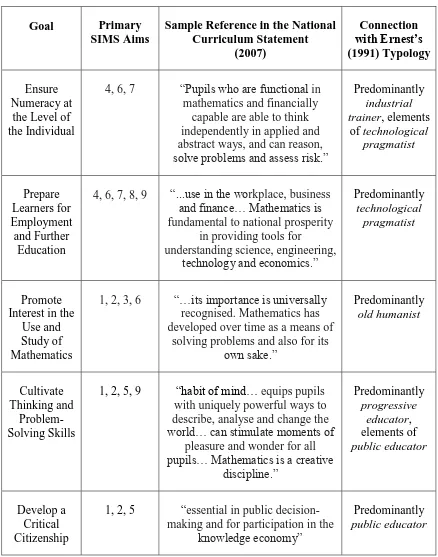
construction of a provisional model of contemporary goals, as offered in table 1.1
overleaf. Whilst these goals are neither well-defined nor mutually exclusive, they are
sufficiently grounded and described to move this discussion forward. The next part of
this chapter will consider each of these goals in detail and review the available evidence
relating to the accomplishment of that purpose under the current system. This review is
not intended as either a thorough or a rigorous critique, but is included here to
introduce, in context, some of the concepts and issues which will become relevant in the
following original research and discussion chapters. Section 1.2 will then go on to
consider some of the other, social and political purposes which mathematics education
24 Goal Primary
SIMS Aims
Sample Reference in the National Curriculum Statement (2007) Connection with Ernest’s (1991) Typology Ensure Numeracy at
the Level of the Individual
4, 6, 7 “Pupils who are functional in mathematics and financially
capable are able to think independently in applied and abstract ways, and can reason, solve problems and assess risk.”
Predominantly
industrial trainer, elements
of technological pragmatist Prepare Learners for Employment and Further Education
4, 6, 7, 8, 9 “...use in the workplace, business and finance… Mathematics is fundamental to national prosperity
in providing tools for
understanding science, engineering, technology and economics.”
Predominantly
technological pragmatist
Promote Interest in the
Use and Study of Mathematics
1, 2, 3, 6 “…its importance is universally recognised. Mathematics has developed over time as a means of
solving problems and also for its own sake.” Predominantly old humanist Cultivate Thinking and Problem-Solving Skills
1, 2, 5, 9 “habit of mind… equips pupils with uniquely powerful ways to describe, analyse and change the world… can stimulate moments of
pleasure and wonder for all pupils… Mathematics is a creative
discipline.” Predominantly progressive educator, elements of public educator Develop a Critical Citizenship
1, 2, 5 “essential in public decision-making and for participation in the
knowledge economy”
Predominantly
[image:25.595.107.545.66.623.2]public educator
25 1.1.1 Numeracy at the Level of the Individual
Although the term numeracy is widely used within both professional and public
communities, it is a problematic concept to define. Coben (2003, p.7) describes it as “a
deeply contested concept which may be best considered as mathematical activity
situated in its cultural and historical context”; there is resonance here with the
discussion above, perhaps consequent from the frequent use of the term ‘numeracy’ to
indicate a goal as well as a facility. This ambiguity permits a relatively wide use of the
term.
One invocation of numeracy in contemporary governmental practice can be found in the
“numeracy skills test” which trainee teachers in England must pass in order to attain
qualified teacher status (DfE 2013). This contains a number of specialised items such as
questions which involve the interpretation of box-and-whisker plots from within an
educational context. The inclusion of context is both nominally and theoretically
relevant here as research has shown that a number of basic mathematical practices are
performed differently in alternate contexts; in light of this result numeracy practices are
often approached from the epistemological position of situated cognition (Lave 1988;
Nunes, Schliemann and Carraher 1993). It is thus possible to put forward a notion of
numeracy based around contextualised application. However, when taken to its limit, a
definition of numeracy that is based around the situated activity of individuals is neither
satisfactory nor helpfully descriptive, since it risks admitting a difficulty that also
undermines terms such as ‘functional mathematics’ and ‘everyday mathematics’. Any
use of a criterion that depends so fully on individual contexts risks labelling all
mathematical activity as ‘numeracy’, as even the most advanced group theory might be
26
insistence that numeracy is a common core of mathematical knowledge and
understanding that is useful to everyone admits a reductive argument, which boils
numeracy down to nothing beyond elementary counting and the most simple
manipulation of number (Ward-Penny 2010). For the purposes of this discussion,
numeracy will be understood to be a mathematics-based parallel to literacy; a level of
mathematical facility that is evident across the population with a sufficient commonality
and frequency; and a range of mathematical skills that is often made necessary but not
fully demarcated by context. This conception is still somewhat broad and lacking in
rigour, but it is sufficient for the purposes of this discussion and is consonant with the
definition of numeracy outlined in official discourse, such as that given in the Moser
report: the ability “to use mathematics at a level necessary to function at work and in
society in general” (DfEE, 1999b).
The majority of pupils within the English education system encounter numeracy content
within their wider learning of mathematics. Skills such as reading the time from 12- and
24-hour clocks, using scales on measuring instruments and conducting basic
calculations involving money are included in both the National Curriculum and GCSE
specifications. The grade descriptor for GCSE Grade F offered by the examination
board AQA is highly consonant with the definition of numeracy offered above:
“…They complete straightforward calculations competently with and without a
calculator. They use simple fractions and percentages, simple formulae and
some geometric properties, including symmetry. Candidates work
mathematically in everyday and meaningful contexts. They make use of
diagrams and symbols to communicate mathematical ideas. Sometimes, they
27
It would be fallacious to equate fully qualification at the level of a GCSE Grade F with
numeracy for a number of reasons, not least because the outlined content of each
specification contains items, such as knowledge of the angle sum of the triangle, which
are not typically called upon in everyday adult living. Equally a candidate can achieve a
Grade F in GCSE mathematics in a multiplicity of ways, since the single summative
grade awarded can disguise a range of ability profiles. Still, it is reasonable to propose
that in the majority of cases a candidate with a fair functional numeracy would meet
enough of the criteria to attain either a Grade F or a higher grade on a GCSE exam;
therefore it seems to be valid to use the proportion of pupils failing to achieve this
standard as one first-order approximation of the number of pupils leaving school
without a fair standard of functional numeracy.
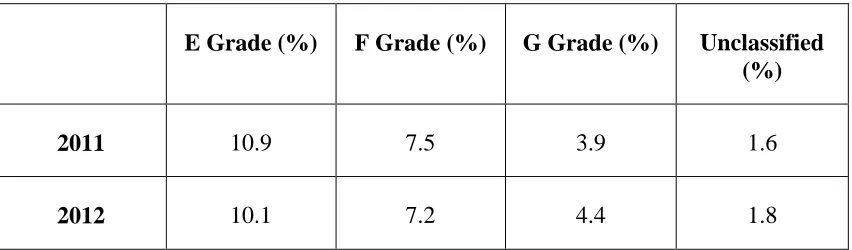
E Grade (%) F Grade (%) G Grade (%) Unclassified (%)
2011 10.9 7.5 3.9 1.6
[image:28.595.115.541.384.509.2]2012 10.1 7.2 4.4 1.8
Table 1.2 Lower end of GCSE Mathematics Results, 2011-12 (JCQ 2012)
In this way the data presented in table 1.2 suggests that between 5% and 7% of each
cohort could be considered to be functionally innumerate. This proportion, calculated as
the number of candidates attaining a G or a U grade, consisted of approximately 41,900
individuals in the 2012 cohort. Again, it should be noted that this is a first-order
approximation. This data serves as a snapshot of each cohort at one moment in time;
some of these learners undoubtedly went on to retake their exams at a later date and
attained a higher grade before leaving education. However, it should also be recognised
28
not entered for the GCSE, and so this figure could actually be an underestimate. Related
research would appear to suggest that this is indeed the case.
In their review of literacy and numeracy for 13-19 year olds, Rashid and Brooks (2010)
conduct a meta-analysis of eight relevant surveys, including multiple iterations of
TIMSS and PISA. Through this they identify a base category of a:
“very basic competence in maths, mainly limited to arithmetical computations and
some ability to comprehend and use other forms of mathematical information. While
this is valuable, it is clearly not enough to deal confidently with many of the
mathematical challenges of contemporary life. From the various surveys at age 16+ it
can be estimated that about 22% of young people in England are at this level” (p.71).
Rashid and Brooks go on to state that this proportion compares poorly with many other
industrialised countries. Although this finding is subject to a number of methodological
weaknesses inherent to meta-analyses, it is a more thorough and certainly a more
longitudinal estimate of levels of poor numeracy than a simple extrapolation from
GCSE attainment. The disparity between the earlier estimate of 6% and the estimate of
22% can be understood in a number of ways. It might be suggested that many
candidates who achieve a Grade E or F at GCSE learn mathematics in a way that helps
them to pass an examination but not to develop a lasting numeracy; further, there is
scope for claims that some parties take advantage of modular examinations at GCSE to
inflate grades.
Further evidence that the proportion of innumerate adults is close to one quarter can be
found in both historic and contemporary research. The adult study of mathematics has
been an increasingly visible and politicised field under the ‘New Labour’ government
29
study of ‘basic skills’. This surge was influenced by the findings of the Moser report
(DfEE 1999b) which had reported worrying high levels of innumeracy. The offered
estimate therein was that 23% of the population had ‘very low’ levels of numeracy, a
figure which is remarkably close to that suggested by Rashid and Brooks eleven years
later. This approximate figure was again reported in the 2011 Skills for Life survey (BIS
2012) which offered that 24% of respondents failed to perform at the key standard of
Entry Level 3 (p.32).
The similarity between the proportions noted above deserves some comment; if the
Moser report is understood to be corroborative of the more recent findings, this in turn
implies that the intervening adult numeracy initiatives have not been as successful as
might have been hoped. There are many possible reasons why this might be the case.
One possibility is that there are problems with the quality of teaching in the sector;
certainly subsequent inspection reports such as Ofsted/ALI (2003) have stated that there
remains a greater need for expertise in the teaching of numeracy, and that many courses
promote rote learning above developing understanding of the concepts involved (p.14);
although it can be argued that there is a place for rote learning in mathematics, it is
questionable whether a reliance on learning through repetition can limit learners’ later
ability to apply mathematical ideas in real-life contexts. There are also a number of
outstanding questions about exactly who is studying numeracy; one survey conducted
by the National Institute of Adult Continuing Education claimed that “those in the
highest socio-economic groups were twice as likely to study as those in the poorest”
(BBC News 2009).
The evidence presented above strongly suggests that the current mathematics education
30
numeracy, and that a significant fraction of the population could be considered
innumerate. Although it is arguably inevitable that there will always be some learners
who will consistently struggle with mathematics, the proportions discussed transcend
this minority and compare poorly with international levels of numeracy. Similarly,
whilst there have been some advances in the provision of adult numeracy courses, the
outworking and practices involved are subject to further meaningful criticism.
This failing has consequences. Reports such as Bynner and Parsons (1997) have
illustrated that poor numeracy has a harmful effect on both career prospects and job
performance; more recent research (including Parsons and Bynner 2006; Carpentieri
2008) goes further, suggesting that poor numeracy has a greater impact on employment
than poor literacy, particularly for women. Furthermore, whilst it can be argued that the
current rate of poor numeracy has a limited effect on the economic performance of the
country as a whole (Robinson 1998), at the level of the individual poor numeracy has
been linked with a number of social costs associated with unemployment and remedial
education; the Every Child a Chance Trust (2009) estimates the annual bill for these
costs at over £2 billion. In short, the functional innumeracy that persists under the
current system compromises life chances and has social and economic implications.
1.1.2 Preparation for Industry and Employment
The concerns about ‘basic skills’ discussed above remain relevant when evaluating the
second identified goal of mathematics: preparing learners with the mathematical
knowledge and skills that they are likely to need for their future employment. This
overlap is prominent in criticisms issued by employers, such as claims that schools are
failing to equip their pupils sufficiently, and complaints that companies are forced to
31
2010) suggests that these concerns are widespread, holding that 63% of employers want
schools to imbue learners with better standards of literacy and numeracy (p.10).
It can be argued that the goal of preparing learners for industry and employment is more
nuanced than the goal of equipping all learners with a basic level of numeracy, since the
mathematical demands of individual jobs are rarely codified and ever developing.
Nevertheless, it is possible to make some steps towards a broad evaluation by
considering different skill levels required in occupations and different educational
pathways.
In the first instance, learners intending to apply for semi-skilled jobs are most likely to
aim for a GCSE qualification in mathematics. The achievement of a C grade in this
examination has arguably become a de facto indicator of a fair level of quantitative literacy and logical thought that stretches beyond basic numeracy. The employment of
this curricular shorthand is easily criticised and will be discussed further in section 1.2,
but it remains true that a C grade in GCSE mathematics is widely used as a gatekeeper
qualification, managing entry to a vast range of opportunities in employment and further
education, as well as serving as an indicator which schools themselves are judged by. It
is therefore worth noting that despite years of targeted investment and effort by
governments and schools, less than 59% of the 2011 and 2012 cohorts achieved a ‘C’
grade or higher (JCQ 2012).
As with the discussion of the GCSE grades in section 1.1.1, it is important to note that
this is only a first-order approximation. On the one hand, the reported achievement rates
only comment on the proportion of learners who attain the grades by age 16 and do not
incorporate learners who succeed later on in life; conversely, they do not betray the
32
entry and scheduled retakes. The relevance of the GCSE as a preparation for
employment has also been criticised (for instance within Hoyles, Morgan and
Woodhouse 1999). It may then be valuable also to consider some of the other
mathematics qualifications which learners may encounter.
Some of the learners who do not sit the GCSE in mathematics instead take a functional
mathematics exam. The examination board Edexcel explains that the “Functional Skills
Mathematics qualifications are designed to give learners the skills to operate
confidently, effectively and independently in education, work and everyday life. They
have been created in response to employers’ perceptions that many learners are not
achieving a sufficiently firm grounding in the basics” (Edexcel 2010, p.3). In this way
these qualifications could be considered as intending to build upon basic numeracy
practices in a way that is largely consonant with the agenda of the technological
pragmatists (Ernest 1991). Functional mathematics qualifications could be taken within
a wider vocational course of study, such as the short-lived and now defunct 14-19
diplomas.
Unfortunately, despite the scope and potential of this approach, the delivery of
functional mathematics has been largely unsuccessful in schools, both currently and
historically. Ofsted (2010), in their review of the diploma qualifications, commented
that the delivery and integration of functional skills stood out as a particular weakness.
This resonates with similar criticisms levelled at the teaching of mathematics within a
previous vocational qualification, the NVQ (Wolf 2000).
This failing is indicative of a wider concern within mathematics education. Despite the
efforts of researchers, authors and curriculum designers, there are persistent challenges
33
learners. The ‘applied’ mathematical activity experienced by most learners is largely
dominated by ersatz activity supported by ‘curricular fictions’ (Hall 1999); contexts are
replaced by ‘cons’ which do not authentically relate to the pupils’ worlds and thus
imply meta-messages about the relevance of mathematics (Ward-Penny 2010). These
are not new observations, and they are present in many key reviews of mathematics
education (for example Cockroft 1982; Smith 2004); for instance the ‘Half our Future’
report (Newsom 1963), designed to evaluate the schooling of pupils of “average and
less than average ability” comments rather dryly that “the areas of carpets can be found
too often” (p. 148). Further to this it can be argued that as mathematical learning
becomes more diverse and context-led it inevitably moves away from a centrally
moderated syllabus; in her recent review of vocational education Wolf (2011) notes that
the tension between using a “wide range of realistic contexts” and preparing students for
a standardised assessment is “not a circle which can be squared” (p. 171).
Further limitations on the effectiveness of current mathematics education in preparing
learners for employment may be imposed by the changing nature of occupations. It has
long been recognised (for instance Clayton 1999) that the increasing role of ICT is
causing a shift in the mathematics required in many workplaces, and this has led writers
such as Hoyles et al. (2010) to claim that many semi-skilled jobs now require a techno-mathematical literacy which is not being properly addressed by the current school
curriculum, and that there is a perceived “‘skills’ gap in the UK workforce for
understanding and dealing with technical information expressed in symbolic form”
(p.2). A related argument is that the skills of using ICT mathematically and the
development of a capacity to model are only sporadically taught, and often only to
groups aiming for the higher grades. The epistemological position of situated cognition
34
artificial nature of classroom mathematics undermines the goal of equipping learners for
the workplace, where solutions are constructed in the course of action and activity
shapes thought (Noss 2002).
Finally in this section it seems critical to consider whether the current mathematics
education system in England is equipping enough learners for occupations that require a
high level of mathematical facility. Such jobs are often grouped under the ‘STEM’
umbrella (science, engineering, technology and mathematics) and this terminology is
common in contemporary official discourse. The Confederation of British Industry
reports that 45% of employers are having trouble finding employees for STEM posts
(CBI 2010, p.7), and reports such as Reform (2008) corroborate that there is a
significant shortage in key sectors such as finance. This conclusion is also clear in
official discourse; the Roberts Report (2002) and the subsequent Council for Industry
and Higher Education STEM Review (Smith 2007) both recognise this shortfall, with
the latter report observing that “the supply chain of STEM graduates remains leaky at
all the decision-making joints and the supply emerging is inadequate in key areas to
meet business needs” (p.3). Both of these reports comment on some of the issues
surrounding this deficit; of particular note for this discussion is the recognition that
there is a shortage of qualified teachers, and the observation that there is a particular
shortage of female mathematics graduates.
In summary, the current mathematics education system in England does not appear to
be adequately preparing many students for mathematical activity in the workplace. Poor
levels of basic skills continue to impact negatively upon a significant number of
employees and employers; mathematics education in school has not been constituted
35
workplaces are being met; and STEM careers, despite being identified as a national
priority, continue to report widespread problems with training and recruitment.
Although the diverse nature of employment and industry does not allow any definite
judgement, it would appear that the current system is failing to meet the goal of
preparing an adequate number of learners for the modern workplace in a substantive
sense.
1.1.3 Promotion of Interest in Mathematics
The third goal of mathematics education listed above is the promotion of interest in the
practice and study of mathematics. Whether mathematics is conceptualised as an
absolute body of discovered truth or as an evolving, culturally developed system of
logic and reasoning, an argument can be made that mathematics is a field of human
intellectual endeavour which should be valued in its own right, as well as for its
applications and effectiveness (for instance Hardy 2005). It follows from this position
that mathematics education should be conducted in a manner which cultivates a general
interest in mathematics and encourages learners to continue with its study, thus ensuring
the continuance of the field. The evaluation of this goal requires an examination of both
reported attitudes towards mathematics and levels of participation.
It is problematic to summarise the extant research concerning learners’ attitudes towards
mathematics; opinions are neither uniform nor static, and research often explores
affective variables as they relate to specific aspects of teaching and learning, or
measures affect within specific subgroups of learners. Nevertheless, there is a growing
body of evidence which clearly holds that learners do not see mathematics as
interesting. In one survey of 2000 secondary school children (BBC News 2004)
36
mathematics teachers were labelled the ‘most evil’; more recently Jin, Muriel and
Sibieta (2011) found that mathematics was the least favourite subject of pupils aged 14.
Negative opinions have also been expressed by adults; for instance, the three most
frequently expressed attitudes in Lim and Ernest’s (2000) research into public images of
mathematics were that mathematics was difficult, that mathematics was boring, and that
mathematics caused anxiety.
Such pejorative perspectives would appear to be inflated by aspects of current practice
in mathematics education. Research such as Nardi and Steward (2003) associates poor
attitudes to the subject with dominant pedagogic elements of the mathematics
classroom, notably the practice of rote-learning and a depersonalised presentation of the
curriculum. Picker and Berry (2000) offer that pupils’ attitudes to mathematics are
further steered by their lack of appreciation of the purpose of mathematics; in their
research into lower secondary pupils’ images of mathematicians they report that “as far
as pupils of this age are concerned, mathematicians are essentially invisible” (p.73).
Although it is proper to note once more that many pupils do engage positively with the
subject, and that research often points towards instances of good practice, it is fair to say
that for many pupils their experiences are failing to encourage interest in the study of
mathematics, and may even be doing the opposite.
A similar mixed picture emerges from the data surrounding the issue of participation in
the study of mathematics. Whilst recent years have seen some increase in the number of
candidates studying post-compulsory mathematics in the form of the mathematics
A-level, there is evidence of a gradual decline in uptake since the late 1980s (Matthews
and Pepper 2007). Similarly, although mathematics was commendably the second most
37
partly consequent of the economic return associated with the qualification (Dolton and
Vignoles 2002), and it should be stressed that there are still concerns that not enough
students are choosing to study mathematics. Further to this, participation also seems to
be linked inequitably to gender and other social characteristics (Noyes 2009).
As was the case with attitudes towards mathematics, there is an increasing awareness
that the issues surrounding participation are compounded by aspects of current practice
in the mathematics classroom. Research into the uptake of A-level mathematics, such as
Brown, Brown and Bibby (2008) demonstrates that many potential candidates move
away from the study of mathematics in a very definite, vehement way, citing as reasons
that it is too difficult, boring, and that they do not enjoy the subject. These concerns
persist into A-level; Noyes and Sealey (2012) observe in their research that the rate of
attrition is higher in A-level mathematics than in almost every other subject. They go on
to demonstrate that attrition rates vary substantially between schools, suggesting that the
quality of teaching can be very influential in steering learners’ decisions.
In contrast to many of these findings, there has been great success in recent years with
the provision of A-level further mathematics in more schools, and in 2010 further
mathematics was the fastest growing A-level (The Telegraph 2010). This success could
be used to argue that mathematics education is successfully equipping an elite core of
pupils to go on and study mathematics at university, and in this sense mathematics
education is meeting the third goal. However, this achievement is partially diluted by
further problems which emerge at university level. Alongside further instances of
standard attrition, a significant number of undergraduates studying mathematics are
becoming disaffected in higher education and are choosing to leave mathematics behind