warwick.ac.uk/lib-publications
Original citation:Vardaman, J. M., Allen, David G., Otondo, R. F., Hancock, Julie I., Shore, L. M. and Rogers, Bryan L.. (2016) Social comparisons and organizational support : implications for
commitment and retention. Human Relations, 69 (7). pp. 1483-1505. Permanent WRAP URL:
http://wrap.warwick.ac.uk/77797
Copyright and reuse:
The Warwick Research Archive Portal (WRAP) makes this work by researchers of the University of Warwick available open access under the following conditions. Copyright © and all moral rights to the version of the paper presented here belong to the individual author(s) and/or other copyright owners. To the extent reasonable and practicable the material made available in WRAP has been checked for eligibility before being made available.
Copies of full items can be used for personal research or study, educational, or not-for profit purposes without prior permission or charge. Provided that the authors, title and full bibliographic details are credited, a hyperlink and/or URL is given for the original metadata page and the content is not changed in any way.
Publisher’s statement:
http://dx.doi.org/10.1177/0018726715619687
A note on versions:
The version presented here may differ from the published version or, version of record, if you wish to cite this item you are advised to consult the publisher’s version. Please see the ‘permanent WRAP URL’ above for details on accessing the published version and note that access may require a subscription.
Social Comparisons and Organizational Support: Implications for Commitment and Retention
Abstract
Organizational support theory (OST) suggests employees develop a general perception of the
extent to which the organization values their contributions and cares about their well-being
(perceived organizational support; POS), and respond to that support through attitudes and
behaviors that are beneficial toward the organization. Although OST emphasizes both social
exchange and self-enhancement processes, most accounts of POS’s effects are rooted in social
exchange. For example, POS’s linkages with commitment and retention have been explained as
an exchange of support for positive attitudes and continued employment. This research sheds
light on self-enhancement’s less-understood role in fostering these reactions by demonstrating
the influence of social comparison effects. Drawing on a sample of 342 employees nested in 82
work-units of a US hospitality company, our analysis demonstrates favorable POS comparisons
with peers in one’s work-unit are positively associated with commitment and retention, while
unfavorable comparisons are negatively related. Results also show comparisons taking place in
less-supported work-units have stronger impact than comparisons made in those with better
support. Our findings extend OST by revealing the importance of social comparisons in
engendering responses to organizational support, and in so doing potentially explicate the
differential ways social exchange and self-enhancement operate with regard to POS.
Organizational support theory (OST) holds that perceptions of organizational support
(POS), the extent to which an employee believes the organization values an individual’s
contribution and cares about their well-being (Eisenberger et al., 1986), elicits positive attitudinal
and behavioral responses. Linkages between POS and these responses are explained as a process
of social exchange, where employees reciprocate organizational support with organizational
commitment (Campbell et al., 2013; Eisenberger et al., 1990; Maertz et al., 2007; Rhoades et al.,
2001; Shore and Wayne, 1993; Wayne et al., 1997), and retention (Allen and Shanock, 2013;
Allen et al., 2003). However, there is reason to believe these linkages are also influenced by
social comparisons which allow for socioemotional need fulfillment, a key mechanism of POS
effects as posed in OST (Eisenberger & Stinglhamber, 2011). Specifically, in addition to social
exchange processes, POS is theorized to foster positive attitudes and behaviors by fulfilling
socioemotional needs such as approval and self-esteem (Aselange and Eisenberger, 2003;
Eisenberger et al., 2004; Kurtessis et al., 2015). Indeed, Kurtessis et al. (2015: 3) suggest OST is
“often mischaracterized as predominantly a social exchange theory,” and that its emphasis on
need fulfillment is often omitted. Because it is well-accepted that social comparisons have a
strong bearing on self-enhancement (Collins, 1996; Hoorens, 1993; Wood et al., 1994), OST can
be enriched by explicating the ways in which social comparisons operate with regard to POS.
A long-held tenet of social comparison theory is that individual self-evaluations are
determined not only by one’s raw standing but also by one’s standing relative to their reference
group (Davis, 1966). Evidence suggests employees use social comparisons to make sense of their
own standing in the organization (Buunk and Gibbons, 2007; Greenberg et al., 2007; Moore,
2007). The social comparison literature demonstrates that people experience self-enhancement
negative comparisons (Buckingham and Alicke, 2002; Wood, 1989; Zell and Alicke, 2010).
Davis (1966: 17) termed these relative evaluations and their associated outcomes “frog-pond”
effects. In the context of OST, unfavorable comparisons of one’s POS with that of a reference
group could harm self-enhancement and therefore lessen the likelihood of a positive response,
while positive comparisons could augment self-enhancement and foster positive attitudes and
behaviors.
Thus, the purpose of this paper is to extend OST by examining the role of POS social
comparisons in employee attitudes and behaviors. Specifically, we investigate the influence of
these comparisons on an important attitudinal response, organizational commitment, and an
important behavioral one, retention. We further investigate the cross-level moderating impact of
the reference point against which comparisons are made. Drawing on a lagged investigation of
342 service workers nested in 82 work-units of a large hospitality company in the United States,
we test the idea that POS is sensitive to within-group comparison effects and cross-level
interaction effects. In so doing, we suggest that support is more likely to elicit a positive response
when it compares favorably and thus contributes to self-enhancement. We also seek to extend
OST by suggesting that social exchange may play a larger role when employees’ work-units are
generally well-supported, while self-enhancement may play more of a role when people are in
less-supported work-units. Hence, this paper takes steps toward exposing the differential ways in
which social exchange and self-enhancement operate with regard to POS.
Organizational Support Theory
Organizational support theory suggests employees view the caring or uncaring treatment
they receive as an indication that the organization favors or disfavors them (Rhoades and
through a process of social exchange (Emerson, 1976) by, among other things, becoming more
committed to the organization and continuing to participate in it (Allen et al., 2013; Campbell et
al., 2013; Eisenberger et al., 1990; Shore and Wayne, 1993; Wayne et al., 1997). Although social
exchange is often offered as OST’s primary explanation for POS’s relationships with outcomes,
self-enhancement gained through the fulfillment of socioemotional needs is also posited as a
factor (e.g., Eisenberger et al., 1997; Eisenberger et al., 2004; Kurtessis et al., 2015; Rhoades and
Eisenberger, 2002). The caring, approval, and respect connoted by POS may engender
socioemotional need fulfillment, and therefore foster positive reactions that are good for the
organization.
OST theorizing acknowledges the caring, approval, and respect signified by POS should
fulfill socioemotional needs and create favorable outcomes for both employees and the
organization (Rhoades and Eisenberger, 2002), and explicitly highlights the possibility that these
self-enhancing aspects provoke employee reactions (Eisenberger et al., 2004). For example,
Armeli et al. (1998) found that socioemotional need fulfillment impacts the strength of the
POS-performance relationship. Broader empirical insight on how self-enhancement from POS impacts
responses has been somewhat limited, however, hindering the development of OST’s
self-enhancement component. A social comparisons approach addresses this underdeveloped
mechanism of POS. The idea that social comparisons are made for the purposes of
self-enhancement has been a tenet of social comparison theory for quite some time (e.g., Taylor and
Lobel, 1989; Thornton and Arrowood, 1966; Wood et al., 1994), suggesting social comparisons
may be highly salient in the POS context. Supporting this idea, Zagencyzk et al. (2010: 136)
comparisons. Explicating how social comparisons impact responses to POS is therefore a key
step in further developing OST.
Social comparison theory and POS
Social comparison theory suggests individual assessments of one’s raw standing have
less influence on attitudes and behaviors than assessments of relative standing contrasted with a
reference group (Bassis, 1977; Davis, 1966; Dunn et al., 2012). Literature supports social
comparison’s influence on employee attitudes and behaviors (see Greenberg et al., 2007 and
Wood, 1989 for reviews). Research suggests the quality of employee-employer social exchange
relationships forms a basis for social comparisons. For instance, in the realm of psychological
contract (PC) fulfillment, Ho (2006) theorized that referent information influences individual PC
fulfillment evaluations, a contention supported by Henderson et al.’s (20008) finding that
favorable social comparisons regarding leader-member exchange positively influenced PC
assessments.
Social comparisons serve two functions, to create self-evaluations of one’s standing, and
to create self-enhancement through socioemotional need fulfillment (Suls et al., 2002). Festinger
(1954) suggests that comparisons to people who are similar are important for generating accurate
self-evaluations. Comparisons provide a sense of relative standing in the group, and a measuring
stick for assessing the adequacy of one’s skills, abilities, and other attributes (Helgeson et al.,
1995). The second function of social comparisons, self-enhancement, involves comparing
oneself to others in order to fulfill socioemotional needs such as self-esteem and approval (Suls
and Wheeler, 2000). Social comparison theory suggests self-enhancement is boosted by
favorable comparisons, and damaged by unfavorable ones (Taylor and Lobel, 1989). In the
because they do not provide self-enhancement. Conversely, POS comparisons that prove
favorable may evoke positive responses because they do provide such enhancement.
Analyzing social comparison effects is accomplished via the frog-pond approach. Bliese
and Jex (2002: 272-273) explain the theoretical basis of the frog-pond approach:
The distinguishing characteristic of this model is that it emphasizes the relative position of an individual within his or her group. For instance, a frog-pond model might propose that an individual’s perception of work overload is, by itself, of little interest in terms of predicting individual strain. What is important instead is the individual’s rating of work overload relative to other group members’ ratings.
The frog-pond approach therefore draws upon individual comparisons to a reference
group to explain how one derives a sense of relative standing within their environment, and how
this relative standing influences their subsequent attitudes and behaviors (Kelley, 1968). The
reference point for the focal variable in frog-pond studies is conceptually and operationally
represented by the group average in the individual’s work-unit (Bliese and Jex, 2002; Klein et
al., 1994; Henderson et al., 2008). The average support in one’s work-unit is the most salient
reference point because individuals interact and share information about support to form an
aggregate understanding of the general level of individual support in the unit, especially when
the work-unit consists of individuals similarly classified by type of job (Alicke et al., 2010;
Buckingham and Alicke, 2002; Klein, 2003; Radzevick and Moore, 2013). Comparisons versus
the work-unit average, or aggregate social comparisons, are therefore powerful in shaping
individual behavior, as demonstrated by numerous studies highlighting their effects (e.g., Alicke
et al., 2010; Buckingham and Alicke, 2002; Henderson et al., 2008; Klein, 2003; Klein, 1997;
Zell and Alicke, 2009).
In the realm of OST, aggregate comparisons may be specifically important as POS relies
(2008: 1210) suggest, “Comparison processes are particularly relevant when individuals are
likely to share a sense of what the organization is obligated to provide to them in return for their
efforts, such as what might occur in a work group in which individuals are performing relatively
similar roles.” Comparisons could be quite powerful when they involve obligations, because the
potential damage or enhancement of one’s socioemotional needs may be high under such
conditions (Aspinwall and Taylor, 1993).
Substantial research suggests individuals reciprocate organizational support through
commitment to the organization (Eisenberger et al., 2001; Rhoades and Eisenberger, 2002).
However, this relationship is likely also influenced by social comparisons. Individuals making
unfavorable POS comparisons to their peer group may not experience the self-enhancement
organizational support is supposed to provide. Unfavorable POS comparisons may make
individuals surmise that being committed to the organization in response to POS may not be
warranted. Research suggests unfavorable comparisons with one’s reference group often create
negative feelings (Bassis, 1977; Davis, 1966). Experiencing harm rather than enhancement via
unfavorable comparisons could therefore diminish one’s commitment to the organization.
Conversely, favorable comparisons should create self-enhancement, and thus engender greater
commitment.
Hypothesis 1:Individual POS relative to the group average is associated with organizational
commitment, such that more favorable comparisons are associated with higher levels of
commitment, while unfavorable comparisons are associated with lower levels of commitment.
Eisenberger et al. (1990) suggest another way individuals react to POS is by continuing to
participate in the organization. Citing social exchange as an explanation, studies have linked
play a role, however. This possibility is supported by two rationales. The first involves the idea
that individuals make comparisons to facilitate self-enhancement. Invalidating comparisons
could harm the employee’s self-image, driving them to leave the organization. Negative
comparisons in this way indicate that support received by the individual is inferior to that
received by one’s reference group. In turn, this discrepancy may suggest to the individual that
staying with the organization is not warranted because they are supported less than others which
lowers experiences of enhancement. Conversely, favorable comparisons should provide
self-worth and elicit continued participation.
The second rationale involves the idea of shocks, or jarring events, and their association with
impulsive quitting (Maertz and Campion, 2004). Substantial research suggests people sometimes
quit impulsively after experiencing a shock, such as a psychological contract violation, abusive
supervision, or unexpectedly negative feedback (Lee and Mitchell, 1994). The damage to
self-enhancement associated with unfavorable POS comparisons could constitute a shock. Negative
comparisons might represent a violation of one’s identity, an injury to one’s self-esteem, or
signify injustice to the employee (Suls and Wheeler, 2000). Individuals might react by quitting
their jobs in an impulsive fashion. Based on both rationales, we suggest favorable POS
comparisons will be positively associated with retention, and unfavorable POS comparisons will
negatively associated with retention
Hypothesis 2: Individual POS relative to the group average is associated with retention, such that
more favorable comparisons are associated with staying in the organization, while unfavorable
comparisons are associated with leaving the organization.
Empirical development of social comparison theory suggests that information obtained
through frog-pond, or within-group, comparisons are more salient than outside, or
between-group comparisons (Alicke et al., 2010; Zell and Alicke, 2009). This phenomenon is
demonstrated by the “paradoxical finding that poor students in higher quality schools tend to
have less favorable academic self-concepts than good students in lower quality schools, despite
objectively similar (or even better) performance” (Zell and Alicke, 2009: 470). While research
on the relative importance of within- and between-group effects is limited, Zell and Alicke
(2009) drew upon five studies to show that individuals typically value within-group comparisons
more. Thus, individuals prioritize comparisons of their own standing with that of the social
aggregate in the group, and generally consider their group’s relative standing with other groups
considerably less (Alicke et al., 2010; Zell and Alicke, 2009; 2010).
However, frog-pond comparisons are not immune to cross-level interaction effects. The
relative standing of the group can have a significant impact under certain conditions (Chen et al.,
1998). The group’s standing is most salient when its members perform the same job in the
organization (McFarland and Buehler, 1995; Zell and Alicke, 2009), as is the case in the present
study. We posited in Hypotheses 1 and 2 that POS comparisons would be associated with
commitment and retention behavior. However, work-units vary in how well they are supported,
and comparisons, both favorable and unfavorable, can take different forms depending on the
reference point against which they are made. For example, favorable comparisons by individuals
embedded in well-supported work-units could have a stronger or weaker impact on attitudes or
behavior than favorable comparisons made by individuals embedded in low-POS work-units.
Consider an example of two hypothetical students. Imagine student A’s academic performance
performance compares favorably to the group average at a lower-quality school. Although extant
frog-pond research suggests both of these comparisons will yield a positive self-evaluation and
provide self-enhancement, unanswered questions remain. Will the effect of the positive
comparison be greater for student A because it is made against the average at a better school? Or
is the effect greater for student B because the positive comparison demonstrates this individual is
unique and special in the group?
Integrating Baumeister et al.’s (2001: 323) idea of “bad versus good” offers a framework
for understanding these potential cross-level interaction effects. Baumeister et al. (2001) found
that ‘bad’ events are more powerful than ‘good’ in impacting psychological, social and
behavioral processes. They also highlighted studies that show negative events are more likely to
be reciprocated (e.g. abuse for abuse), while positive events (e.g. caring for caring) are
reciprocated less often (Wills et al., 1974). In this context, this suggests favorable and
unfavorable comparisons may have a differential impact when they are made versus ‘good’
(well-supported groups) and ‘bad’ (poorly-supported groups) reference points. While reference
points are not necessarily ‘events’ as conceptualized by Baumeister et al., they do serve as
anchors for decision-making, and therefore may influence the effect of the comparisons made
against them.
Drawing on Baumeister et al.’s (2001) framework, we suggest the positive responses to
favorable comparisons made against higher, or ‘good,’ reference points, may be lessened
because the support may not seem as individualized or special. When all members of a group are
supported well, favorable POS comparisons may carry less meaning because the support is not
viewed as recognition for individual contributions. This logic is consistent with a central tenet of
is considered discretionary rather than being impelled by circumstances” (Eisenberger and
Stinglhamber, 2011:.44). When well supported, individuals seek to understand why they are
being treated favorably A generally well supported work unit can raise questions as to whether
the support is discretionary since all employees are favorably treated, but also whether the good
treatment is an indication of the individual employee’s positive valuation by the organization.
By contrast, we theorize favorable comparisons contrasted with low-POS referents are
likely to have a much stronger effect. As a ‘bad’ referent, low aggregate POS in the work-unit is
more salient and enduring, and thus should be more impactful. Individuals making favorable
comparisons in low-POS work-units may feel as if the organization has recognized them
specifically, thus signaling value and respect that is not offered to the average group member.
This sense of distinction and accomplishment associated with recognition in an unsupported
group is not present for those making favorable comparisons in well-supported units. This may
strengthen the relationship between favorable comparisons and positive responses.
High and low reference points inform unfavorable comparisons as well. Unfavorable
comparisons in low POS work-units should generally be more impactful. Given the increased
impact of negative events, being the “worst of the worst” may be far more poignant than being
the “worst of the best.” Research suggests people desire positive evaluations, especially when
they feel threatened (Aspinwall and Taylor, 1993; Taylor and Lobel, 1989). Comparing
unfavorably to a poor referent may be especially disconfirming, as it directly conflicts with the
desire for self-enhancement. By contrast, a poor comparison may be dismissed somewhat when
an individual can rationalize the comparison as a by-product of membership in an elite group.
Consequently, the feelings associated with a poor within-group comparison are likely to be much
within-group effects suggests the direction of the proposed relationships in Hypothesis 1 and
Hypothesis 2 should hold in most situations, between-group effects could moderate the
magnitude of these effects. Hence, comparisons made by people embedded in low-POS
work-units should have stronger effects than those made by individuals in high-POS work-work-units.
Hypothesis 3: The effects of POS comparisons on commitment and retention behavior are
moderated by the average POS in the reference group, such that the effects of comparisons made
against lower averages are stronger, while the effects of comparisons made against higher
averages are weaker.
Methods
Sample and procedures
The sample consists of employees of a large, national hospitality company in the United
States. Participants performed various types of service functions in 23 casino/hotels across the
country, and were embedded within 82 work-units. Data were collected at two points in time. At
time 1, data related to occupation, demographics, and POS were collected. Six weeks later at
time 2, data regarding organizational commitment was collected. Employee retention was
collected from organizational records 468 days after the initial survey.
The surveys were mailed to 1,205 employees. Of those, 549 responded to both surveys,
and 342 provided complete data, for a response rate of 28%. None of the 342 participants were
involuntarily terminated. The sample was 56% female, and the average age of participants was
36 years. Eighty-two percent of the participants were full-time employees, with the remainder
employed part-time. Thirty percent of the sample were minorities.
The POS data were aggregated for the 82 job units, with each unit originating from one
location only and grouped by the job employees were performing. Sample work groups are desk
groups work in close proximity and interact frequently. Most of the work-units have job
interdependencies, while a few do not. For instance, security officers coordinate to keep the
grounds safe, workers at the concierge desk coordinate to service guests’ needs, and cocktail
servers coordinate to provide beverages for patrons. Others workers, such as casino cashiers,
work with minimal coordination but in close physical proximity with one another. A few jobs,
such as blackjack dealers, work mostly without coordinating. However, the organization
provides employees with break rooms and free meals as a matter of corporate practice, and
employees also often take breaks and have lunch with others in their units. Hence,
work-unit members in this context interact and share information. The mean size of the 82 groups was
4.2 (SD = 1.7; Min = 3; Max = 14), which is consistent with previous multilevel research (Maas
and Hox, 2005).
Measures
Perceived organizational support. Perceived organizational support was measured on a
five-point Likert-type scale from 1 = “Strongly Disagree” to 5 = “Strongly Agree.” The items
were adopted from Eisenberger et al.’s, (1997) short form measure of POS. The six items
demonstrated excellent reliability (α=.85). Sample items included “This company really cares
about my well-being,” and “This company strongly considers my goals and values.”
Organizational commitment. Organizational commitment was measured with five-items
adopted from the Organizational Commitment Questionnaire (OCQ) on a five point Likert-type
scale from 1 = “Strongly Disagree” to 5 = “Strongly Agree” (Mowday et al., 1979; α=.92).
Bozeman and Perrewe (2001) found that some OCQ items are confounded with attachment.
Based on this finding, we used five items absent of that confound. A sample item was “I really
Retention behavior. Retention behavior was collected from organizational records.
Drawing on Allen et al. (2014), who suggest moving away from dichotomous measures of
retention, we operationalized retention as the number of days the participant was employed
before separating from the organization. The number of days was measured from the initial
survey administration.
Control variables.Because meta-analytic results suggest that women are slightly more
committed to the organization than men (Mathieu and Zajac, 1990; Mayer et al., 2002), we
controlled for gender in our commitment model.Drawing on Holtom et al. (2008) and Griffeth et
al. (2000), who noted that studies show minorities and men are slightly more likely to quit their
jobs, we controlled for these factors using dummy variables in our retention behavior model.
Gender was coded “0” for male and “1” for female, while race was coded “0” for non-minorities
and “1” for minorities.
Aggregation and analysis
We used random coefficients modeling (RCM) to test all hypotheses (Cohen et al., 2003;
Raudenbush and Bryk, 2002). Two-level models were employed, where individuals constituted
level-1 cases nested within level-2 groups based on work-unit membership (n=82). The idea that
the perceptions of individuals may aggregate into a level-2 variable representing the average
individual is methodologically well-grounded, as Chan’s (1998) discussion of composition
models details the ways in which individual perceptions are aggregated to a within-group
average for comparison purposes. The work-unit mean is formed from individual responses of
support. These responses are aggregated into a reference point for perceptions of organizational
support representing the average in the work unit.This approach is well-accepted in frog-pond
research shows that referent attitudes are compositional and emergent from individual-level
attitudes because interactions and interdependencies in work units are common (Ostroff, 1992;
Schulte et al., 2009).
Random coefficients modeling (RCM) was conducted using HLM for Windows, v. 7.0
(HLM; Raudenbush et al., 2011). The level-1 POS variable was group-mean centered because
Hypotheses 1 and 2 propose frog-pond effects, making it critical to determine unbiased estimates
of within-group slopes (Hofmann and Gavin, 1998). The literature suggests group-mean
centering is the proper technique for testing such hypotheses (Bryk and Raudenbush, 1992;
Kozlowski and Klein, 2000; Van Yperen and Snijders, 2000), as “frog-pond models are tested by
creating a new individual-level variable from the raw individual variable and the group mean”
(Bliese and Jex, 2002: 272). As Hypothesis 3 proposes cross-level moderation, group-mean
centering the level-1 POS variable allows the researcher to assess cross-level interactions
(Hofmann and Gavin, 1998). A group-mean centered level-1 independent variable also “removes
all between-cluster variation from the predictor and yields a ‘pure’ estimate of the pooled
within-cluster (i.e., Level 1) regression coefficient” (Enders and Tofighi, 2007: 128). Group-mean
centered estimates of level-1 slope variation are generally more accurate than grand-mean
centered estimates because the latter produce a vague amalgam of level-1 and level-2
associations between X and Y variables (Enders and Tofighi, 2007). The level-2 variable work
unit POS was grand-mean centered in the cross-level interaction models to facilitate the
interpretation of results, as suggested by Raudenbush and Bryk (2002).
Results
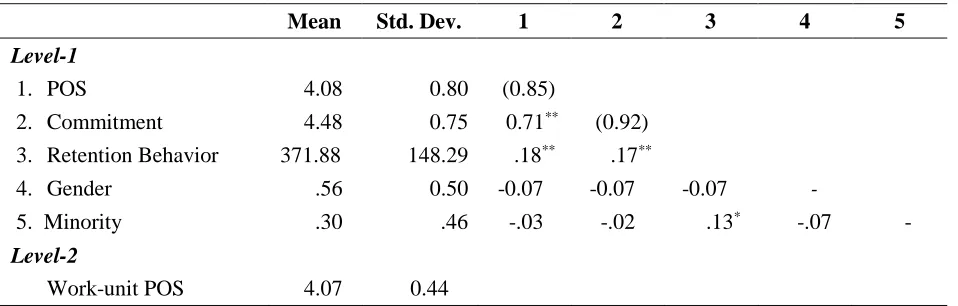
Correlations, means, standard deviations, and reliabilities (Cronbach’s alphas) for
significantly correlated (0.71). Retention behavior was significantly correlated with POS (.18)
and commitment (.17). Due to their high correlation, we conducted a confirmatory factor
analysis (CFA) to examine the distinctiveness of our commitment and POS measures. Following
Bentler (1990), we reviewed the χ2 test, the Root Mean Square Error of Approximation
(RMSEA), the Normed Fit Index (NFI), and the Goodness of Fit Index (GFI) to assess model fit.
A hypothesized two-factor model with distinct commitment and POS measures was compared to
an alternate one-factor model. The results indicate that our hypothesized two-factor model fit the
data well, (χ2 = 84.35, df = 41, p < .01; RMSEA = .056, 90% Confidence Interval RMSEA =
.039-.073; NFI = .96, GFI = .96). All items loaded significantly on their respective factors. The
alternative one-factor model fit the data poorly (χ2 = 301.36, df = 44, p < .01; Δ χ2= 217.01, df =
3, p < .01; RMSEA = .131; 90% Confidence Interval RMSEA = .117-.145; NFI = .87; GFI = .82.
Thus, the hypothesized two-factor model fit the data significantly better on all model fit
statistics, supporting examining commitment and POS as distinct constructs.
Insert Table 1 about here
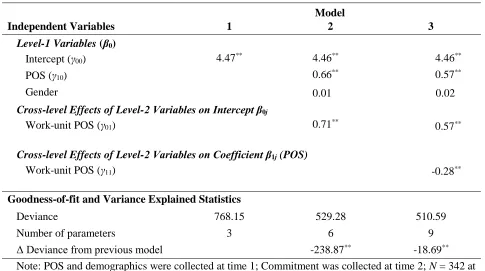
Results from RCM analyses of the relationships among POS comparisons and
commitment in Hypothesis 1 are displayed in Table 2. The results show that favorable
comparisons positively predict individual commitment (β = .66; p < .01), supporting Hypothesis
1. Table 2 also demonstrates that work-unit POS is directly associated with commitment (β =
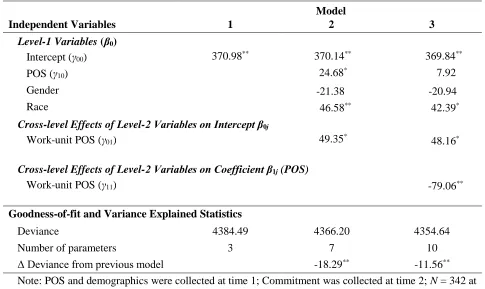
.71; p < .01). Results from RCM analyses of the relationships among POS comparisons and
retention behavior are presented in Table 3. Results demonstrate that favorable comparisons
positively predict individual retention (β = 24.68; p < .05), supporting Hypothesis 2. Table 3 also
shows that work-unit POS is directly associated with retention behavior (β = 49.35; p < .05)
Hypothesis 3 proposed that work unit POS would moderate the effect of POS
comparisons on commitment and retention behavior, such that comparisons made in high-POS
work units would weaken the relationships, and comparisons made in low-POS work units would
strengthen the relationships. Results from Table 2 show that work unit POS significantly and
negatively moderates the POS comparisons-commitment relationship (β = -.28; p < .01). Results
from Table 3 demonstrate that work unit POS significantly and negatively moderates the POS
comparisons-retention behavior relationship (β = -79.06; p < .01).
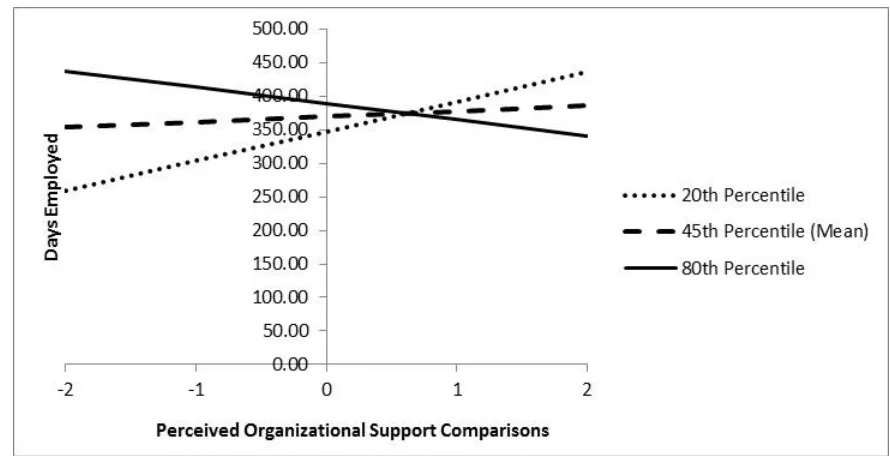
To further explore the effects of these interactions, we provide interaction plots for
groups at the 20th (the bad), 80th (the good) and 45th (mean) percentile of work unit POS. As
shown in Figure 1, although the slopes of all three lines are significant (p < .01), the relationship
between POS comparisons and commitment is stronger when comparisons are made at lower
levels of average POS, and weaker when made against higher levels of average POS. The effect
of work unit POS on the relationship between POS comparisons and retention behavior is more
complex. As Figure 2 illustrates, at low levels of work unit POS the relationship is positive and
significant (p < .01). At average levels of POS the relationship remains positive but is
non-significant (p = .57). At high levels of work-unit POS, the relationship is also non-significant (p
= .23). This finding appears to be contradicted by the apparently strong negative slope of the 80th
percentile line in Figure 2. However, that particular depiction is misleading because the standard
error of the β coefficient of the 80th percentile is about 42% higher than those of the 20th and 45th
percentiles (i.e., 19.98 vs. 12.55 and 14.04, respectively) Thus, for retention behavior, frog-pond
effects are present when comparisons are made versus low work-unit POS, but not when made
versus average or high levels of work-unit POS. Hypothesis 3 is therefore supported for
Insert Figures 1 and 2 about here
Discussion
Although OST holds that POS operates through both social exchange and
self-enhancement processes, past OST research has been rooted mostly in social exchange (Kurtessis
et al., 2015). For example, POS’s positive relationships with attitudes and behaviors such as
commitment and retention (e.g., Allen and Shanock, 2013; Rhoades et al., 2001) have been
characterized as exchanges of support, downplaying the role of self-enhancement. Our findings
contribute to OST by demonstrating how social comparisons operate in the realm of POS.
Theoretical Implications
Our findings underscore the importance of social comparisons in eliciting responses to
POS. Work-unit POS was positively and significantly associated with commitment, buttressing
the idea that social exchange plays a role because well-supported units reciprocated through
higher overall levels of commitment. However, Figure 1 demonstrates that although commitment
is generally higher in well-supported work units, it is also influenced by social comparisons.
Analysis showed favorable POS social comparisons were associated with higher levels of
commitment, while unfavorable comparisons were associated with lower levels of commitment.
Further examination of Figure 1 sheds light on the differential impact of social exchange and
self-enhancement. The positive (and significant) slopes at the 20th, 45th and 80th percentiles
suggest while comparison effects have significant impact on commitment even in well-supported
work-units, these relationships are more pronounced in less-supported work units, as evidenced
by the increasingly steeper lines for work-units at the 45th and 20th percentiles. Put differently,
responses via social exchange, but the self-enhancement gained from POS comparisons
influences the extent of that response within the work unit.
This differential impact is brought into specific relief by results on retention behavior.
Table 3 shows that work-unit POS was directly associated with longer retention, supporting the
idea that social exchange fosters retention because well-supported work-units generally
reciprocated with longer retention. However, social comparisons were quite influential. Analyses
showed favorable POS social comparisons were associated with longer terms of employment,
while unfavorable comparisons were associated with shorter terms of employment. Figure 2
demonstrates that POS comparisons at the 20th percentile of work unit POS were significantly
and strongly associated with retention, suggesting continued participation is spurred by
self-enhancing comparisons in these units. The relationship between POS comparisons and retention
became less pronounced and was statistically non-significant at the 45th and 80th percentiles,
however, suggesting self-enhancement may be less involved in retention in well-supported work
units. Hence, both commitment and retention models suggest employees respond to POS via
social exchange, and the level of that response is influenced by comparisons within work-units.
Comparison effects are stronger for both variables in low-POS work-units, however, and for
retention behavior the frog-pond effects are present only within poorly-supported work-units.
This finding sheds light on the differential circumstances in which social exchange and
self-enhancement might operate in evoking responses to POS. The more robust presence of
comparison effects in poorly supported work-units suggests self-enhancement may play a larger
role when social exchange norms are less salient. Social exchange appears to be the mechanism
when levels of support in the work-unit are generally high, although self-enhancement may have
suggest self-enhancement may be the primary mechanism for evoking positive attitudes and
behaviors. OST has long held that both social exchange and socioemotional need fulfillment are
mechanisms that play a role in how POS operates (Rhoades and Eisenberger, 2002; Kurtessis et
al., 2015). This study extends OST by clarifying self-enhancement’s importance.
Finally, results suggest the notion of “bad versus good” is relevant for social
comparisons. Comparisons contrasted with lower reference points were more impactful for both
commitment and retention; bad referents thus yielded stronger comparison effects than good
(Baumeister et al., 2001). The bad versus good effect has been empirically supported in other
organizational endeavors such as mentoring (Eby et al., 2010), but has not been conceptually or
operationally applied to reference points for social comparisons. Our findings may provide a
direction for future research by supporting the idea that comparison effects may be more
powerful when comparisons are made against bad reference points. Future research should
explore this possibility further.
Practical implications
This study offers implications for managing employees. Study results suggest support
may be most effective when it is individualized because individuals compare the support they
receive with peer groups, and those comparisons impact attitudes and behaviors. Clearly,
organizations should not be unsupportive of some employees to make others feel special, but
insights into employee social processes gleaned here might support what Rousseau et al. (2006)
term “idiosyncratic work arrangements” or “I-deals.” I-deals are special employment terms that
meet the needs of both the employee and the organization. Rather than supporting some
employees better and others worse, organizations might consider tailoring support to the needs of
past research suggest support that is discretionary rather than obligatory is most valued by
employees (Eisenberger et al., 1997). Such arrangements could signal that the employee is
uniquely valued and therefore engender greater POS. As such, findings here suggest the value of
their continued use.
Because we found that negative comparisons were less harmful in well-supported
work-units, building employee POS seems to be important. Meta-analysis shows that aspects of
fairness, such as procedural justice, voice, and politics are the strongest antecedents of POS
(Rhoades and Eisenberger, 2002). Organizations that are just, offer employees say in important
matters, and that aren’t viewed as overtly-political are best at engendering feelings of support.
This suggests organizations that are socially responsible toward employees might lessen the
effects of negative comparisons by having generally well-supported employees. Thus, in addition
to I-deals, programs that are generally supportive of employee wellness and well-being, such as
on-site child care, employee fitness centers, and family leave programs, might be effective in
fostering broad-based POS.
Limitations and Directions for Research
The study’s findings are subject to limitations. Although our retention dependent variable
is behavioral, all measures for our model of commitment were survey-based. However, features
of our research design help mitigate any concerns over common method bias. First, we separated
the collection of independent and dependent variable data in time, thus removing “occasion
factors” that could affect measurement at any one time (Spector, 2006: 229). Second, Siemsen et
al. (2010) found not only that common method variance cannot create an artificial interaction
study independent and dependent variables, the presence of a behavioral outcome in one of our
models, and the cross-level interactions in both, common method bias should not be an issue.
Although theory strongly suggests individuals doing the same jobs in the same
work-units make referent comparisons to an aggregate social referent, this is an assumption that was
not measured. However, our approach to this frog-pond analysis is well-accepted and prescribed
in the literature (Bliese and Jex 2002; Henderson et al., 2008; Klein, 1997; Klein et al., 1994;
Kozlowski and Klein, 2000). Further supporting our approach, past POS research suggests
organization members interact and share their perceived levels of organizational support with
one another (Zagenczyk et al., 2010).
Another limitation is our study response rate, which was 28%. Baruch and Holtom (2008)
found that the average response rate in field research was 35.7%, with a standard deviation of
18.8%. Although this suggests our response rate falls well within one standard deviation of the
mean of organizational field research, the possibility exists that non-responders might differ from
those who participated in the study. Further, given our focus on group-POS, it is also possible
that the overall POS of those who participated may not accurately reflect the average POS of the
group. Future research should follow techniques suggested by Baruch and Holtom (2008) for
improving response rate, such as increased use of electronic surveying.
Our findings for retention behavior may not necessarily generalize to other behaviors.
Results for retention behavior may be less powerful than for other behaviors such as job
performance because quitting one’s job is a major decision rife with risk and consequence
(Vardaman et al., 2008). It is therefore possible that social exchange is an adequate motivator to
remain with an organization as long as one feels they are receiving satisfactory support.
responses such as performance, may be more sensitive to comparison effects because they have
less consequence for the employee. By contrast, comparison effects may have had less impact on
retention behavior because quitting on the basis of diminished self-enhancement may be too
extreme of a response when one is adequately or well-supported in general. Put differently, less
risky behavioral responses may be more sensitive to comparison effects than retention behavior
because shifting one’s performance or citizenship behaviors might “cost” the employee less than
severing an employment relationship (Vardaman et al., 2015). Given that commitment was
subject to comparison effects even in well-supported work-units, while retention behavior is
subject to comparison effects only in poorly-supported work-units, this explanation is quite
plausible. Future research should consider studying POS comparison effects on less risky
behaviors such as job performance or citizenship behavior in an effort to determine if those
effects are more like those for attitudes.
Finally, our findings support the idea that OST research could benefit from studies on
how social networks operate in the realm of POS. Zagenczyk et al. (2010) found co-workers with
network ties tend to have similar levels of POS, while work on social exchange (Ho et al., 2006)
demonstrates that network position plays a role in employee feelings of obligation toward their
employer. Network research has shed light on social influence in a variety of behavioral and
attitudinal domains (e.g., Bardon et al., 2015; Mao and Shen, 2015; Vardaman et al., 2012), and
integrating social comparisons with a network approach could provide significant theoretical
insight into OST by considering how intra-organizational social networks impact POS’s
relationships with employee attitudes and behaviors.
In closing, we note the relevance of the study findings for OST. Our research departs
from most prior work on OST by more fully integrating the role of self-enhancement processes
into the study of POS and its effects. The social comparison effects uncovered in our findings
serve as an initial step in delineating the ways in which social exchange and self-enhancement
might differentially operate in POS’s relationship with attitudes and behavior. As OST research
further explores how self-enhancement processes operate with regard to POS, we hope our work
References
Alicke MD, Zell E and Bloom DL (2010). Mere categorization and the frog-pond effect.
Psychological Science 21(2): 174-177.
Allen DG, Hancock JI, Vardaman JM and McKee D (2014). Analytical mindsets in turnover research. Journal of Organizational Behavior 35: S61-S85.
Allen DG and Shanock LR (2013). Perceived organizational support and embeddedness as key mechanisms connecting socialization tactics to commitment and turnover among new employees. Journal of Organizational Behavior 34: 350-369.
Allen DG, Shore LM and Griffeth RW (2003). The role of perceived organizational support and supportive human resource practices in the turnover process. Journal of Management 29: 99-118.
Armeli S, Eisenberger R, Fasolo, P and Lynch P. (1998). Perceived organizational support and police performance: The moderating influence of socioemotional needs. Journal of Applied Psychology 83: 288-297.
Aselange R and Eisenberger R (2003). Perceived organizational support and psychological contracts: A theoretical integration. Journal of Organizational Behavior 24: 491-509.
Aspinwall LG and Taylor SE (1993). Effects of social comparison direction, threat, and self-esteem on affect, self-evaluation, and expected success. Journal of Personality and Social Psychology 64: 708-722.
Bardon T, Josserand E and Villeseche F (2015). Beyond nostalgia: Identity work in corporate alumni networks. Human Relations 68: 583-606.
Baruch Y and Holtom BC (2008). Survey response rates and trends in organizational research.
Human Relations 61: 1139-1160.
Bassis MS (1977). The campus as frog pond: A theoretical and empirical reassessment.
American Journal of Sociology 82: 1318-1326.
Baumeister RF, Bratslavsky E, Finkenbauer C, and Vohs KD (2001). Bad is stronger than good.
Review of General Psychology 5: 323-370.
Bentler PM (1990). Comparative fit indexes in structural models. Psychological Bulletin 107: 238-246.
Bliese PD and Jex SM (2002). Incorporating a Multilevel Perspective into Occupational Stress Research: Theoretical, Methodological, and Practical Implications. Journal of
Bozeman DP and Perrewe PL (2001). The effect of item content overlap on Organizational Commitment Questionnaire-turnover cognitions relationships. Journal of Applied Psychology 86: 161-173.
Bryk AS and Raudenbusch, SW (1992). Hierarchical linear models. Newbury Park, CA: Sage.
Buckingham JT and Alicke MD (2002). The influence of individual versus aggregate social comparison and the presence of others on self-evaluations. Journal of Personality and Social Psychology 83: 1117–1130.
Buunk AP and Gibbons FX (2007). Social comparison: The end of a theory and the emergence of a field. Organizational Behavior and Human Decision Processes 102: 3-21.
Campbell N, Perry SJ, Maertz CP, Allen DG and Griffeth RW (2013). All you need is…resources: The effects of justice and support on burnout and turnover. Human Relations 66(6): 759-782.
Chan D (1998). Functional relations among constructs in the same content domain at different levels of analysis: A typology of composition models. Journal of Applied Psychology 83: 234-246.
Cohen J, Cohen P, West SG and Aiken LS (2003). Applied Multiple Regression/ Correlation Analysis for the Behavior Science(3rd ed). Hillsdale, NJ: Erlbaum.
Collins RL (1996). For better or worse: The impact of upward social comparisons on self-evaluations. Psychological Bulletin 119: 51-69.
Davis JA (1966). The campus as frog pond: An application of the theory of relative deprivation to career decisions of college men. American Journal of Sociology 72: 17-31.
Dunn J, Ruedy NE and Schweitzer ME (2012). It hurts both ways: How social comparisons harm affective and cognitive trust. Organizational Behavior and Human Decision Processes 117: 2-14.
Eby LT, Butts MM, Durley J and Ragins BR (2010) Are bad experiences stronger than good ones in mentoring relationships? Evidence from the protégé and mentor perspective.
Journal of Vocational Behavior 77: 81-92.
Eisenberger R, Armeli S, Rexwinkel B, Lynch PD and Rhoades L. (2001). Reciprocation of perceived organizational support. Journal of Applied Psychology 86: 42–51.
Eisenberger R, Fasolo P and Davis LaMastro V (1990). Perceived organizational support and employee diligence, commitment, and innovation. Journal of Applied Psychology 75: 51– 59.
Eisenberger R, Huntington R, Hutchison S and Sowa, D. (1986). Perceived organizational support. Journal of Applied Psychology 71: 500-507.
Eisenberger R, Jones JR, Aselage J and Sucharski IL (2004). Perceived organizational support. In J. A. M. Coyle Shapiro, L. Shore, S. Taylor and L. Tetrick (Eds.), The employment relationship: Examining psychological and contextual perspectives (pp. 206–225). Oxford: University Press.
Eisenberger R and Stinglhamber F (2011). Perceived organizational support: Fostering enthusiastic and productive employees (pp. 9-24). Washington, DC: American Psychological Assocoation, viii.
Emerson RM (1976). Social exchange theory. Annual Review of Sociology 2: 335-362.
Enders CK and Tofighi D (2007). Centering predictor variables in cross-sectional multilevel models: A new look at an old issue. Psychological Methods 12: 121-138.
Festinger L (1954). A theory of social comparison processes. Human Relations 7: 117–140.
Greenberg J, Ashton-James CE and Ashkanasy NM (2007). Social comparison processes in organizations. Organizational Behavior and Human Decision Processes 102: 22-41.
Griffeth RW, Hom PS and Gaertner S. (2000). A meta-analysis of antecedents and correlates of employee turnover. Update, moderator tests, and research implications for the next
millennium. Journal of Management 26: 463-488.
Helgeson VS and Mickelson KD (1995). Motives for social comparison. Personality and Social Psychology Bulletin 21: 1200-1209.
Henderson DJ, Wayne SJ, Shore LM, Bommer WH and Tetrick LE (2008). Leader-member exchange, differentiation, and psychological contract fulfillment: A multilevel examination.
Journal of Applied Psychology 93: 1208-1219.
Ho VT, Rousseau DM and Levesque LL (2006). Social networks and the psychological contract: Structural holes, cohesive ties, and beliefs regarding employer obligations. Human
Relations 59(4): 459-481.
Hofmann DA and Gavin MB (1998). Centering decisions in hierarchical linear models: Implications for research in organizations. Journal of Management 24: 623-641.
Hoorens V (1993). Self-enhancement and superiority biases in social comparison. European Review of Social Psychology 4: 113-139.
Kelley HK (1968). Two functions of reference groups. In H. H. Hyman & E. Singer (Eds.),
Readings in reference group theory and research (pp. 77–83). New York: Free Press.
Klein WM (2003). Effects of objective feedback and “single other” or “average other” social comparison feedback on performance judgments and helping behavior. Personality and Social Psychology Bulletin 29: 418– 429.
Klein WM (1997). Objective standards are not enough: Affective, self-evaluative, and behavioral responses to social comparison information. Journal of Personality and Social
Psychology 72:763–774.
Klein KJ, Dansereau F and Hall RJ. (1994). Levels issues in theory development, data collection, and analysis. Academy of Management Review 19: 195–229.
Kozlowski SWJ and Klein KJ (2000). A multilevel approach to theory and research in organizations: Contextual, temporal, and emergent processes. In K. Klein & S. Kozlowski (Eds.), Multilevel theory, research, and methods in organizations:
Foundations, extensions, and new directions (pp. 3–90). San Francisco, CA: Jossey-Bass.
Kurtessis JN, Eisenberger R, Ford MT, Buffardi LC Stewart KA and Adis CS (2015). Perceived organizational support. A meta-analytic evaluation of organizational support theory.
Journal of Management. DOI: 10.1177/0149206315575554
Lee TW and Mitchell TR (1994). An alternative approach: The unfolding model of employee turnover. Academy of Management Review 19: 51-89.
Maas C JM and Hox JJ (2005). Sufficient sample sizes for multilevel modeling. Methodology 1: 86-92.
Maertz CP and Campion MA (2004). Profiles in quitting: Integrating process and content turnover theory. Academy of Management Journal 47: 566-582.
Maertz CP, Griffeth RW, Campbell NS and Allen DG (2007). The effects of perceived
organizational support and perceived supervisor support on employee turnover. Journal of Organizational Behavior 28: 1059-1079.
Mao J and Shen Y (2015). Cultural identity change in expatriates: A social network perspective.
Human Relations, 68: 1533-1566.
Mayer JP, Stanley DJ, Herscovitch L and Topolntsky L (2002). Affective, continuance, and normative commitment to the organization: A meta-analysis of antecedents, correlates, and consequences. Journal of Vocational Behavior 61: 20-52.
McFarland C and Buehler R (1995). Collective self-esteem as a moderator of the frog-pond effect in reactions to performance feedback. Journal of Personality and Social Psychology 68: 1055-1070.
Moore DA (2007). Not so above-average after all: When people believe they are worse than average and its implications for theories of bias in social comparison. Organizational Behavior and Human Decision Processes 102: 42-58.
Mowday RT, Steers RM and Porter LW (1979). The measurement of organizational commitment. Journal of Vocational Behavior 14: 224-247.
Ostroff C (1992). The relationship between satisfaction, attitudes, and performance: An organizational level analysis. Journal of Applied Psychology 77: 963-974.
Radzevick JR and Moore DA (2013). Just how comparative are comparative judgments?
Organizational Behavior and Human Decision Processes 122: 80-91.
Raudenbush SW and Bryk AS (2002). Hierarchical linear models, (2nd ed). Thousand Oaks: Sage.
Raudenbush S, Bryk A and Congdon R (2011). HLM for Windows, v. 7.0. Lincolnwood, IL: Scientific Software International.
Rhoades L and Eisenberger R (2002). Perceived organizational support: A review of the literature. Journal of Applied Psychology 87: 698-714.
Rhoades L, Eisenberger R and Armeli S (2001). Affective commitment to the organization: The contribution of perceived organizational support. Journal of Applied Psychology 86: 825– 836.
Rousseau DM, Ho VT and Greenberg J. (2006). I-deals: Idiosyncratic terms in employment relationships. Academy of Management Review 31: 977-994.
Schulte M, Ostroff C, Shmulyian S and Kinicki A. (2009). Organizational climate
configurations: Relationships to customer satisfaction, and financial performance.
Journal of Applied Psychology 94: 618-634.
Shore LM and Wayne SJ (1993). Commitment and employee behavior: Comparison of affective commitment and continuance commitment with perceived organizational support.
Siemsen E, Roth A and Oliveira P (2010). Common method bias in regression models with linear, quadratic, and interaction effects. Organizational Research Methods 13: 456-476.
Spector PE (2006). Method variance in organizational research: Truth or urban legend?
Organizational Research Methods 9: 221-232.
Suls J and Wheeler L (2000). The handbook of social comparison. New York: Kluwer Academic/Plenum.
Suls J, Martin R and Wheeler L (2002). Social comparison: Why, with whom, and with what effect? Current Directions in Psychological Science 11: 159-163
Taylor SE and Lobel M (1989). Social comparison activity under threat: downward evaluation and upward contracts. Psychological Review 96: 569-575.
Thornton DA and Arrowood AJ (1966). Self-evaluation, self-enhancement, and the locus of social comparison. Journal of Experimental Social Psychology 1: 40-48.
Van Yperen NW and Snijders TAB (2000). A multilevel analysis of the demands-control model: Is stress at work determined by factors at the group level or the individual level? Journal of Occupational Health Psychology 5:182-190.
Vardaman JM, Taylor SG, Allen DG, Gondo MB and Amis JM (2015). Translating intentions to behavior: The interaction of network structure and behavioral intentions in explaining turnover behavior. Organization Science, 26: 1177-1191.
Vardaman JM, Amis JM, Dyson B, Wright P and Randolph R (2012). Interpreting change as controllable: The role of centrality and self-efficacy. Human Relations 65: 835-859.
Vardaman JM, Allen DG, Renn RR and Moffitt KR (2008). Should I stay or should I go: The role of risk in employee turnover decisions. Human Relations 61: 1531-1563.
Wayne SJ, Shore LM and Liden RC (1997). Perceived organizational support and
leader-member exchange: A social exchange perspective. Academy of Management Journal 40: 82-111.
Wills, TA, Weiss RL and Patterson GR (1974). A behavioral analysis of the determinants of marital satisfaction. Journal of Consulting and Clinical Psychology, 6:802-811.
Wood J (1989). Theory and research concerning social comparisons of personal attributes.
Psychological Bulletin 106: 231-248.
Wood J, Giordano-Beech M, Taylor K, Michela J and Gaus V (1994). Strategies of social comparison among people with low self-esteem: Self-protection and self-enhancement.
Zagenczyk TJ, Scott KD, Gibney R, Murrell AJ and Thatcher JB (2010). Social influence and perceived organizational support: A social networks analysis. Organizational Behavior and Human Decision Processes 111: 127-138.
Zell E and Alicke MD (2010). The local dominance effect in self-evaluation: Evidence and explanations. Personality and Social Pscyhology Review 14(4): 368-384.
Zell E and Alicke MD (2009). Contextual neglect, self-evaluation, and the frog-pond effect.
Table 1. Means, standard deviations, and correlations among study variables.
Mean Std. Dev. 1 2 3 4 5
Level-1
1. POS 4.08 0.80 (0.85)
2. Commitment 4.48 0.75 0.71** (0.92)
3. Retention Behavior 371.88 148.29 .18** .17**
4. Gender .56 0.50 -0.07 -0.07 -0.07 -
5. Minority .30 .46 -.03 -.02 .13* -.07 -
Level-2
Work-unit POS 4.07 0.44
Note: POS and demographics were collected at time 1; Commitment was collected at time 2;
Reliabilities (Cronbach’s alphas) are reported in parentheses on the diagonal. N = 342 at individual
level. N = 82 at group level. ICC(1) = .09 (p < .05).
Gender and Race variables are dummy coded (0,1); Female, Minority = 1.
Table 2. Random coefficients models of commitment.
Model
Independent Variables 1 2 3
Level-1 Variables (β0)
Intercept (γ00) 4.47** 4.46** 4.46**
POS (γ10) 0.66** 0.57**
Gender 0.01 0.02
Cross-level Effects of Level-2 Variables on Intercept β0j
Work-unit POS (γ01) 0.71** 0.57**
Cross-level Effects of Level-2 Variables on Coefficient β1j (POS)
Work-unit POS (γ11) -0.28**
Goodness-of-fit and Variance Explained Statistics
Deviance 768.15 529.28 510.59
Number of parameters 3 6 9
Δ Deviance from previous model -238.87** -18.69**
Note: POS and demographics were collected at time 1; Commitment was collected at time 2; N = 342 at
individual level. N = 82 at group level. The dependent variable is organizational commitment. Full maximum likelihood estimation is used. The level-1 POS variable is group-mean centered. The level-2 Work-unit POS variable is grand mean centered for cross-level interactions. Dummy (0, 1) variables were used for gender and race. Female and Minority = 1.
*p < .05 **p < .01
Table 3. Random coefficients model of retention behavior
Model
Independent Variables 1 2 3
Level-1 Variables (β0)
Intercept (γ00) 370.98** 370.14** 369.84**
POS (γ10) 24.68* 7.92
Gender -21.38 -20.94
Race 46.58** 42.39*
Cross-level Effects of Level-2 Variables on Intercept β0j
Work-unit POS (γ01) 49.35* 48.16*
Cross-level Effects of Level-2 Variables on Coefficient β1j (POS)
Work-unit POS (γ11) -79.06**
Goodness-of-fit and Variance Explained Statistics
Deviance 4384.49 4366.20 4354.64
Number of parameters 3 7 10
Δ Deviance from previous model -18.29** -11.56**
Note: POS and demographics were collected at time 1; Commitment was collected at time 2; N = 342 at
individual level. N = 82 at group level. The dependent variable is retention behavior expressed as number
of days employed. Full maximum likelihood estimation is used. The level-1 POS variable is group-mean centered. The level-2 Work-unit POS variable is grand mean centered for cross-level interactions. Dummy (0, 1) variables were used for gender and race. Female and Minority = 1.
*p < .05 **p < .01
Note: Work-unit POS mean = 4.07. Work-unit POS standard deviation = 0.44. Y-intercepts
[image:36.612.78.527.88.318.2]correspond to γ00 values in HLM analyses. POS values are group-mean centered.
Note: Work-unit POS mean = 4.07. Work-unit POS standard deviation = 0.44. Y-intercepts
[image:37.612.83.528.98.326.2]correspond to γ00 values in HLM analyses. POS values are group-mean centered.