University of Warwick institutional repository:
http://go.warwick.ac.uk/wrap
A Thesis Submitted for the Degree of PhD at the University of Warwick
http://go.warwick.ac.uk/wrap/77645
This thesis is made available online and is protected by original copyright.
Please scroll down to view the document itself.
M A
E
G
NS I
T A T MOLEM
U N
IV
ER
SITAS WARWICEN SIS
Data Mining of Vehicle Telemetry Data
by
Phillip Taylor
A thesis submitted to The University of Warwick
in partial fulfilment of the requirements
for admission to the degree of
Doctor of Philosophy
Department of Computer Science
The University of Warwick
Abstract
Driving a safety critical task that requires a high level of attention and
work-load from the driver. Despite this, people often perform secondary tasks such
as eating or using a mobile phone, which increase workload levels and divert
cognitive and physical attention from the primary task of driving. As well as
these distractions, the driver may also be overloaded for other reasons, such as
dealing with an incident on the road or holding conversations in the car. One
solution to this distraction problem is to limit the functionality of in-car devices
while the driver is overloaded. This can take the form of withholding an
in-coming phone call or delaying the display of a non-urgent piece of information
about the vehicle.
In order to design and build these adaptions in the car, we must first have
an understanding of the driver’s current level of workload. Traditionally, driver
workload has been monitored using physiological sensors or camera systems
in the vehicle. However, physiological systems are often intrusive and camera
systems can be expensive and are unreliable in poor light conditions. It is
impor-tant, therefore, to use methods that are non-intrusive, inexpensive and robust,
such as sensors already installed on the car and accessible via the Controller
Area Network (CAN)-bus.
This thesis presents a data mining methodology for this problem, as well
as for others in domains with similar types of data, such as human activity
monitoring. It focuses on the variable selection stage of the data mining
pro-cess, where inputs are chosen for models to learn from and make inferences.
Selecting inputs from vehicle telemetry data is challenging because there are
many irrelevant variables with a high level of redundancy. Furthermore, data
in this domain often contains biases because only relatively small amounts can
to the classification task than they are really.
Over the course of this thesis, a detailed variable selection framework that
addresses these issues for telemetry data is developed. A novel blocked
per-mutation method is developed and applied to mitigate biases when selecting
variables from potentially biased temporal data. This approach is infeasible
computationally when variable redundancies are also considered, and so a novel
permutation redundancy measure with similar properties is proposed. Finally,
a known redundancy structure between features in telemetry data is used to
en-hance the feature selection process in two ways. First the benefits of performing
raw signal selection, feature extraction, and feature selection in different orders
are investigated. Second, a two-stage variable selection framework is proposed
and the two permutation based methods are combined. Throughout the thesis,
it is shown through classification evaluations and inspection of the features that
these permutation based selection methods are appropriate for use in selecting
Acknowledgements
I would like to first thank my supervisors, Nathan Griffiths and Abhir Bhalerao,
for guiding me through my PhD and offering their enthusiasm and inspiration
throughout. I also extend these thanks to Sarabjot Anand, who supervised me
in my first year but left academia to seek new pastures. I am truly grateful for
their support and this thesis would not have been possible without them. I am
also indebted to members of Jaguar Land Rover, including Zhou Xu, Thomas
Popham, Adam Gelencser, for their advice and in aiding with data collection.
Over the past eight years, the Department of Computer Science and its
members have helped develop me personally, academically and professionally. I
would like to extend special thanks to the postgraduate members of the
Soft-ware and Systems group, who offered their enthusiasm and entertainment
dur-ing lunch breaks and otherwise. I hope to continue these relationships durdur-ing
the post-doctoral position I have recently taken at the department, which is a
fortuitous opportunity I will relish.
I would not have undertaken higher education if it were not for my parents,
who have always been there for me. They have always encouraged me and told
me to aim high, but will be happy that my journey through education is coming
to an end. I extend my gratitude to my whole family, for the laughter we share
during our Sunday dinners and for reminding me of the important things in
life. I would also like to acknowledge my lifelong friends Raymond Ahmad and
Stuart MacDonald, with whom I share many memories.
Finally, I reserve my kindest thanks for Katrien Steenmans, who has
sup-ported me throughout and proofread much of my work. It is unlikely that this
thesis would be finished without her, and I will reciprocate when she is writing
hers. I am grateful to all of the Steenmans family, who have welcomed me and
Declarations
This research presented in this thesis was funded by the Engineering and
Phys-ical Sciences Research Council (EPSRC) and Jaguar Land Rover Cars (JLR).
Parts of this thesis have been previously published by the author in the following:
[144] Phillip Taylor, Fatima Adamu-Fika, Sarabjot Anand, Alain Dunoyer,
Nathan Griffiths, and Thomas Popham. Road type classification through
data mining. InInternational Conference on Automotive User Interfaces
and Interactive Vehicular Applications, pages 233–240. ACM, October
2012
In this paper some initial investigations into data mining from vehicle
telemetry data were performed using the Road Classification Dataset
(RCD). Different types of feature, feature selection method, and
clas-sification model were compared. The results of this paper influences the
methodology used throughout this thesis.
[145] Phillip Taylor, Nathan Griffiths, Abhir Bhalerao, Alain Dunoyer, Thomas
Popham, and Zhou Xu. Feature selection in highly redundant signal data:
A case study in vehicle telemetry data and driver monitoring. In
Inter-national Workshop on Autonomous Intelligent Systems: Multi-Agents and
Data Mining, pages 25–36, June 2013
This paper presents results on selecting features on a per-signal basis in a
two-stage feature selection framework. The methods used in Sections 6.3
and 6.3.1 are based on this paper.
[146] Phillip Taylor, Nathan Griffiths, Abhir Bhalerao, Derrick Watson, Zhou
Xu, and Thomas Popham. Warwick-JLR Driver Monitoring Dataset
(DMD): A public dataset for driver monitoring research. InCognitive Load
In this paper the Warwick-JLR Driver Monitoring Dataset
(WarwickDMD) was announced. It is further described in Section 3.3.
[147] Phillip Taylor, Nathan Griffiths, Abhir Bhalerao, Thomas Popham, Zhou
Xu, and Alain Dunoyer. Redundant feature selection for telemetry data.
In Longbing Cao, Yifeng Zeng, Andreas Symeonidis, Vladimir Gorodetsky,
J¨org M¨uller, and Philip Yu, editors,Agents and Data Mining Interaction,
volume 8316 ofLecture Notes in Computer Science, pages 53–65. Springer
Berlin Heidelberg, May 2014
This is an extension of [145], and is again the basis of the work in
Sec-tions 6.3 and 6.3.1.
[148] Phillip Taylor, Nathan Griffiths, and Abhir Bhalerao. Redundant feature
selection using permutation methods. In Automatic Machine Learning
Workshop, pages 1–8, July 2015
This paper introduced a method for computing efficiently the redundancies
of features while using the permutation method. The work is presented
as Chapter 5.
[149] Phillip Taylor, Nathan Griffiths, Abhir Bhalerao, Derrick Watson, Zhou
Xu, Adam Gelenscer, and Thomas Popham. Developing a public driver
monitoring dataset. InInternational Conference on Automotive User
In-terfaces and Interactive Vehicular Applications. ACM, September 2015
After completion of the WarwickDMD, its release was announced in this
paper along with some initial analysis of it. This analysis is also presented
in Section 3.3.
In addition, the following works are under review:
• Road Classification Without Location Data: A Data Mining Approach.
Submitted to Applied Artificial Intelligence.
This paper is an extension of [144] and investigates the benefits of
methodology used in this paper forms the basis of that used in this
the-sis, and the results of the experiments are presented in Section 6.2 of this
thesis.
• Feature Selection from Temporally Dependent Data Using Block
Permu-tation Methods. In preparation for submission.
This paper introduces permutation methods for temporally dependent
data such as vehicle telemetry, and the work is presented in this thesis
Abbreviations
ANOVA Analysis Of Variance
AUC Area Under the Receiver Operator Characteristic Curve
CAN Controller Area Network
CoventryDMD Coventry-JLR Driver Monitoring Dataset
DALI Driver Activity Load Index
DFT Discrete Fourier Transform
ECG Electrocardiogram
ECOC Error Correction Output Coding
EDA Electrodermal Activity
EDR Electrodermal Response
EEG Electroencephalography
GPS Global Positioning Satellites
HR Heart Rate
HRV Heart Rate Variability
HSIC Hilbert-Schmidt Independence Criterion
IID Independent and Identically Distributed
MCP Multiple Comparison Procedure
MDL Minimum Description Length
mRMR minimal Redundancy Maximal Relevance
OARD OPPORTUNITY Activity Recognition Dataset
OSS One Sided Sampling
PCA Principal Components Analysis
PCC Pearson’s Correlation Coefficient
PC Principal Component
RBF Radial Basis Function
RCD Road Classification Dataset
ROC Receiver Operator Characteristic
SCL Skin Conductance Level
SDSD Standard Deviation of Successive Differences
SMOTE Synthetic Minority Oversampling TEchnique
SR Success Rate
STD Standard Deviation
SU Symmetrical Uncertainty
SVM Support Vector Machine
SWA Steering Wheel Angle
TLX NASA-Task Load Index
Contents
Abstract i
Acknowledgements iii
Declarations iv
Abbreviations vii
List of Figures xv
List of Tables xvii
1 Introduction 1
1.1 Driver inattention monitoring . . . 2
1.2 Vehicle telemetry data . . . 2
1.3 Data mining . . . 3
1.4 Problem statement and contributions . . . 3
1.5 Structure of thesis . . . 6
2 Background 9 2.1 Data mining process: The learning approach . . . 10
2.1.1 Problem definition . . . 10
2.1.2 Data collection . . . 11
2.1.3 Data cleaning and exploration . . . 13
2.1.4 Temporal feature extraction . . . 14
2.1.5 Sampling . . . 16
2.1.6 Discretisation . . . 17
2.1.7 Feature selection . . . 18
2.2 The data mining approach: Evaluation and refinement . . . 21
2.2.1 Structure of evaluation . . . 21
2.2.2 Performance measures . . . 25
2.2.3 Refinement . . . 26
2.3 Automotive applications . . . 26
2.3.1 Driving conditions monitoring . . . 26
2.3.2 Driver monitoring . . . 29
2.4 Summary . . . 33
3 Datasets 34 3.1 Road classification dataset . . . 34
3.2 Coventry-JLR driver monitoring dataset . . . 36
3.3 Warwick-JLR driver monitoring dataset . . . 38
3.3.1 Collection protocol . . . 39
3.3.2 Data collection . . . 41
3.3.3 Preliminary analysis . . . 43
3.3.4 Ground truth for classification . . . 50
3.3.5 Data release . . . 50
3.4 Non-vehicular datasets . . . 52
3.5 Feature extraction . . . 52
3.6 Summary . . . 53
4 Temporal permutation feature relevancy 55 4.1 Introduction . . . 56
4.2 The permutation method . . . 58
4.3 Permutation methods for dependent data . . . 60
4.4 Feature ranking methods . . . 67
4.5 Experimental setup . . . 71
4.6 Results . . . 73
4.6.1 Blocked-permutation test . . . 73
4.6.3 Classification . . . 86
4.7 Conclusions . . . 94
5 Redundant permutation feature selection 96 5.1 Introduction . . . 97
5.2 A redundant permutation feature selector . . . 99
5.2.1 Permutation redundancy . . . 99
5.2.2 Redundant permutation feature selection . . . 106
5.3 Evaluation . . . 106
5.4 Conclusion . . . 115
6 Feature selection from vehicle telemetry data 117 6.1 Introduction . . . 118
6.2 Benefits of signal selection . . . 120
6.2.1 Classification and evaluation . . . 122
6.2.2 Results . . . 122
6.2.3 Discussion . . . 125
6.3 Two stage feature selection . . . 126
6.3.1 Evaluation design . . . 127
6.3.2 Results . . . 128
6.4 DMD analysis . . . 140
6.5 Conclusions . . . 146
7 Discussion and conclusions 150 7.1 Contributions . . . 152
7.2 Directions for future research . . . 156
7.3 Final remarks . . . 158
List of Figures
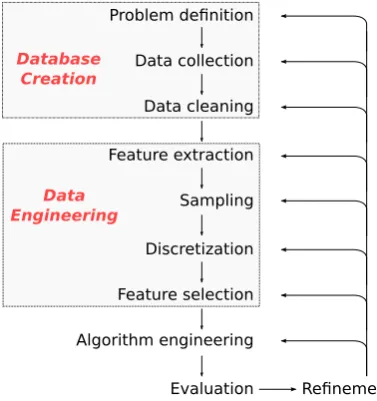
2.1 Diagram showing the data mining process . . . 10
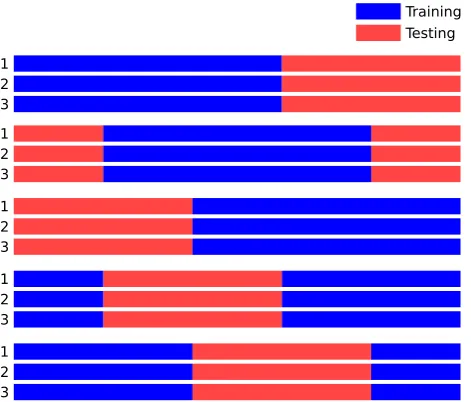
2.2 A temporal evaluation structure . . . 23
3.1 Map of the Gaydon emissions track . . . 37
3.2 Screen shot of the video recorded during the trials . . . 37
3.3 Fifteen seconds of an EDA signal . . . 43
3.4 Five seconds of an ECG signal . . . 44
3.5 Mean error rates of participants for the secondary tasks . . . 44
3.6 Mean responses to NASA TLX questions . . . 45
3.7 Mean values of HR, HRV, SCL and EDR frequency over all sub-jects for the different periods of the trial . . . 49
4.1 Dependency of three small consecutive blocks over time . . . 64
4.2 Dependency of three large consecutive blocks over time . . . 65
4.3 p-value against block size for a signal in each of the RCD, the CoventryDMD, and the WarwickDMD . . . 74
4.4 M DM I score against block size for a signal in the RCD with two further sub-samplings by factors of 10 and 100 . . . 77
4.5 M DM I score against block size for a signal in the CoventryDMD with two further sub-samplings by factors of 10 and 100 . . . 78
4.6 M DM Iscore against block size a signal in the WarwickDMD with two further sub-samplings by factors of 10 and 100 . . . 79
4.7 The relationship between the ranking strategies and ranking by MI for the RCD . . . 81
4.9 The relationship between the ranking strategies and ranking by
MI for the WarwickDMD . . . 83
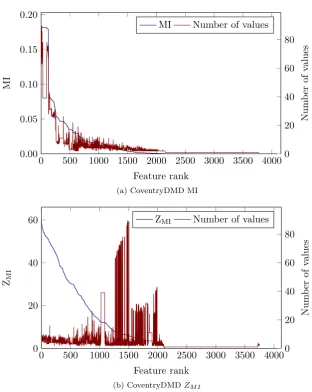
4.10 MI andZM I, plotted against the number of values in each feature
for MI andZM I rankings of the RCD . . . 87
4.11 MI andZM I, plotted against the number of values in each feature
for MI andZM I rankings of the CoventryDMD . . . 88
4.12 MI andZM I, plotted against the number of values in each feature
for MI andZM I rankings of the WarwickDMD . . . 89
4.13 Classification AUC scores for the RCD with the MI, SU, HSIC,
ZM I,M DM I andM RM I selection methods . . . 90
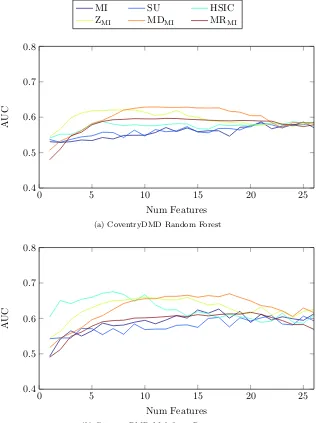
4.14 Classification AUC scores for the CoventryDMD with the MI,
SU, HSIC,ZM I,M DM I andM RM I selection methods . . . 91
4.15 Histogram of the number of times ranks were assigned to the bias
features by the MI, SU, HSIC,ZM I,M DM I, andM RM Iranking
methods for the RCD, CoventryDMD and WarwickDMD . . . . 93
5.1 Scatter plots of MI againstP M DM I . . . 101
5.2 Permutation distributions of features with increasing
dimension-alities computed from a common target . . . 102
5.3 Scatter plots of MI andZM I againstP M DM I . . . 104
5.4 Scatter plots of MI andZM I againstP CM I . . . 105
5.5 Mean AUC scores achieved over ten evaluations when selecting
between one and twenty features from the Musk 1 and TR 11
datasets . . . 109
5.6 Computation times for theM ImRM R,SU mRM R,ZM ImRM R
andP CM I methods to rank all features in simulated datasets . . 114
6.1 Processing methods for data, using PCA, MI and Feature
Ex-traction in different orders . . . 121
6.2 Carriageway classification AUC when selecting features using the
6.3 Road-type classification AUC when selecting features using the
different selection paths . . . 124
6.4 AUC performances when between one and five features were
se-lected in the first stage from the CoventryDMD, using ZM I,
P mRM R, Symmetrical Uncertainty (SU) andSU mRM R . . . . 129
6.5 AUC performances when between one and five features were
se-lected in the first stage from the RCD with carriageway labelling,
usingZM I,P mRM R, SU andSU mRM R . . . 130
6.6 AUC performances when between one and five features were
se-lected in the first stage from the RCD with road labelling, using
ZM I,P mRM R, SU andSU mRM R . . . 131
6.7 AUC performances when between one and five features were
se-lected in the first stage from the OARD, usingZM I, P mRM R,
SU andSU mRM R. . . 132
6.8 AUC performances for the CoventryDMD and RCD with
car-riageway labelling when features were selected with one feature
per signal in the first stage . . . 133
6.9 AUC performances of the Random Forest classifier for the RCD
with road labelling and the OARD when features were selected
with one feature per signal in the first stage . . . 134
6.10 Redundancies measured in P CM I for different numbers of
fea-tures selected from the CoventryDMD usingSU mRM RandP mRM R
in a two-stage selection process with between one and five features
selected in the first stage . . . 136
6.11 Redundancies measured in P CM I for different numbers of
fea-tures selected from the RCD with carriageway labelling using
SU mRM R andP mRM R in a two-stage selection process with
6.12 Redundancies measured in P CM I for different numbers of
fea-tures selected from the RCD with road labelling usingSU mRM R
andP mRM Rin a two-stage selection process with between one
and five features selected in the first stage . . . 138
6.13 Redundancies measured in P CM I for different numbers of
fea-tures selected from the OARD usingSU mRM R and P mRM R
in a two-stage selection process with between one and five features
List of Tables
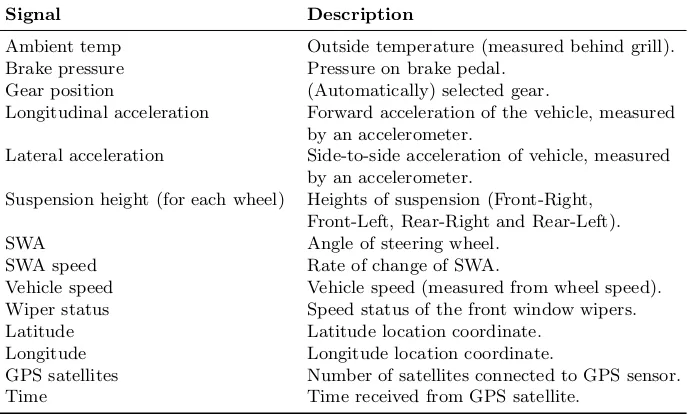
3.1 List of signals recorded in the RCD. . . 35
3.2 Label counts for the carriageway and road ground truths . . . 36
3.3 Secondary tasks drivers performed in the CoventryDMD . . . 38
3.4 The protocol for the WarwickDMD experiment . . . 40
3.5 Example of theN-back test with a block of 10 numbers . . . 40
3.6 p-values from two wayt-test and ANOVA for the physiological and selected signals of the vehicle telemetry data streams . . . . 46
3.7 Details of datasets from the UCI and Tuned IT repositories . . . 51
3.8 List of statistical and structural features extracted from each sig-nal from the RCD, CoventryDMD, WarwickDMD and OARD . . 53
4.1 List of signals taken from the RCD, the CoventryDMD, and the WarwickDMD . . . 71
4.2 Rank positions by MI, SU, HSIC, ZM I, M DM I and M RM I for illustrative signals of the RCD, the CoventryDMD and the WarwickDMD . . . 84
5.1 Number of times features selected by M ImRM R outperformed those selected by P mRM R, and vice versa, for each classifier over all train-test iterations . . . 110
5.2 Number of times features selected by SU mRM R outperformed those selected by P mRM R, and vice versa, for each classifier over all train-test iterations . . . 110
5.4 Total number of the original features from each dataset ranked
in the top five by M ImRM R, SU mRM R, and P mRM R for
different split types and a deform type of{5,10,20,30,40}% . . . 112
6.1 Redundancy for the eight selection algorithms measured by SU of
top ten features selected from the CoventryDMD, RCD-carriageway,
RCD-road, and OARD datasets . . . 141
6.2 WarwickDMD features ranked byP mRM R in a two-stage
pro-cess with one feature selected per signal in the first stage . . . . 142
6.3 Mean AUC performances when building models for different
com-binations of drivers and testing on individual driver data for the
distraction status (normal ordistracted) and a increase in heart
rate (baseline orincrease by 5 bpm) . . . 145
6.4 AUC performances for each train-test iteration with data from
individual drivers to predict the distraction status (normal or
distracted) and an increase in heart rate (baseline orincrease by
CHAPTER
1
Introduction
Driving is a safety critical task that requires a high level of attention and
work-load from the driver [123, 124, 125, 168]. Despite this, people often perform
secondary tasks such as eating or using a mobile phone, which increase
work-load levels and divert cognitive and physical attention from the primary task of
driving [140]. As well as these distractions, the driver may also be overloaded
for other reasons, such as with an incident on the road or holding conversations
in the car.
This problem of driver distraction has several potential solutions. The first,
is to remove the driver from the system with autonomous or self driving vehicles.
The technology for self driving cars is still being developed, however, and there
are many social, legal, and ethical issues to overcome before they are adopted
widely [98, 133]. Another approach is to reduce the number of tasks a driver
performs, or by simplifying the driving task [18, 150]. For example, adaptive
cruise control and automatic breaking systems are designed to reduce the
com-plexity of driving [96]. Such driver assistance systems introduce new issues that
also cause inattention, however, either because the driver is under-stimulated
and their attention lapses or because they trust the vehicle to perform tasks
that it is incapable of [19].
Another solution to this distraction problem is monitor the workload levels
of the driver [73, 161, 167], and limit the functionality of in-car devices while the
driver is overloaded [114]. This can take the form of withholding an incoming
phone call or delaying the display of non-urgent vehicle information. It may also
be possible to warn the driver when they are inattentive, or have the vehicle
1. Introduction
1.1
Driver inattention monitoring
Driver monitoring can be performed in various ways, from monitoring the
ve-hicle’s external environment to directly measuring the driver’s physiology. The
external environment provides insight into the driver’s workload through the
characteristics of the road or type of terrain [131, 132]. The driver’s physiology,
can be used to directly assess the current workload of the driver [57, 99, 127],
but physiological sensors are more intrusive. Video processing methods can also
be applied to analyse the posture, head position, and gaze of the driver, but
cameras systems can be expensive and unreliable in poor light conditions or
when the driver wears glasses. A third approach, and one that is taken in this
thesis, is to use the driving behaviour and vehicle telemetry to assess workload
of a driver.
1.2
Vehicle telemetry data
Telemetry data typically consists of measurements over time, often at high
sam-ple rates. This thesis is concerned mainly with the analysis of vehicle telemetry
data, although its contributions are relevant to temporal data found in other
do-mains, including medicine, environmental monitoring and activity monitoring.
In general the measurements are made by sensors in a system or environment [3].
Electrocardiogram (ECG) sensors in the medical domain, for example, record
measurements of current across a patient’s chest, and for earthquake detection
a seismometer measures movements in the ground.
Sensors in vehicles communicate via a Controller Area Network (CAN)-bus
[29, 30, 69], which is a broadcast protocol on which all nodes receive any
mes-sage sent over the network. Node identifiers are sent within mesmes-sages and nodes
are able to ignore messages that are irrelevant to them to avoid becoming
over-loaded. In a modern vehicle there are over 50 sensors providing over 1000
telemetric signals, including those that measure wheel speeds, Steering Wheel
1. Introduction
other aspects. All these sensors communicate over the CAN-bus, and because
a broadcast protocol is used it is possible for a data logger to connect to and
record all messages they send.
1.3
Data mining
Data mining is the process whereby data is turned into patterns to describe a
part of its structure [3, 61, 71, 84, 160]. Data is in abundance and is generated
in almost all fields, from science to business and from media to transport. This
is largely due to the ease and inexpensiveness of storing data, allowing decisions
to be deferred to subsequent processing that may not yet be developed. There
are several difficulties in processing such data, including the computational
re-sources required and avoiding useless, uninteresting or spurious findings.
In the automotive industry data is produced in and analysed by a range
of business divisions, including research and development, manufacturing, and
after-market care [78]. In this thesis, the data mining of vehicle telemetry data
is considered. Vehicle telemetry data is recorded in higher detail and for more
tasks than ever before, including fault detection and diagnosis (e.g. [20, 43, 72,
175]), road type, surface and pot-hole detection (e.g. [25, 60, 83, 103, 144]),
and driver monitoring for both safety and comfort concerns (e.g. [114, 130, 151,
152, 161]). We develop techniques that aim to minimise spurious findings from
vehicle telemetry data in these tasks, while still ensuring that those findings
are interesting and useful. Furthermore, to allow the data mining process to
be performed within a reasonable time, we address the issue of computational
expense in the proposed techniques.
1.4
Problem statement and contributions
This thesis aims to apply data mining techniques to vehicle telemetry data
prob-1. Introduction
lem statement is: Can a data mining methodology be developed that
enables non-intrusive estimation of the current workload levels of a
driver using telemetry data? To have estimation of the current workload
levels, models must take inputs from vehicle telemetry from only a short period
prior to the current time where the estimation is being performed. The models
must also be reliable enough to allow the vehicle to confidently adapt to the
workload level of the driver, by either reducing its functionality or intervening
in dangerous situations. In developing a data mining methodology for
process-ing telemetry to produce such models for estimatprocess-ing driver workload, this thesis
makes the following main contributions:
1. Developing an unbiased relevancy measure for temporal
vari-ables based on the permutation method.
Selecting features from large feature sets is an example of the Multiple
Comparison Procedure (MCP), which is responsible for input selection
er-rors, over-fitting, and over-searching [65]. Permutation methods have been
proposed as a solution to the MCP and are used to assign significance to a
test statistic, with respect to the null hypothesis of the observation being
insignificant. Permutation methods cannot be directly applied to
tem-poral data, however, and there are several approaches to using them in
ranking features. To apply permutation methods to temporal data,
there-fore, we use a blocking strategy in a similar manner to Kirch [75] and
Adolf et al. [2], and introduce a new strategy of using random block sizes.
Furthermore, to rank features we propose two non-parametric methods of
normalising a correlation statistic that can be used in a feature ranking.
2. Establishing a method for feasibly computing unbiased feature
redundancies using the permutation method.
The naive approach for computing redundancies using the permutation
method is extremely expensive computationally. Each individual
be-1. Introduction
tween them. Typically, P is in the order of thousands, which means
Mutual Information (MI) is computed thousands of times for each
per-mutation method between two variables. For relevancy computations of
mfeatures, this number of correlation computations is multiplied toP m.
When redundancies between variables are considered, the computational
complexity increases toO(P m+P m2), which is infeasible for many feature
sets. We therefore propose a method for estimating the unbiased
correla-tions by comparing permutation correlacorrela-tions computed during relevancy
comparisons. This method is then used in feature selection frameworks
such as minimal Redundancy Maximal Relevance (mRMR) [113].
3. Using known redundancy structure in features extracted from
signal data with signal selection, feature extraction, and feature
selection.
The selection of model inputs is an important stage of the data mining
process, as too many or bad inputs can cause issues in both model
perfor-mance and complexity. As well as selecting from features extracted over
sliding windows of telemetric signals, selection can also take place directly
on the raw telemetry. Selecting from raw signals, although more
compu-tationally efficient, may harm performance of models built on the data.
Extracted features can also be selected on a per-signal basis, considering
the redundancies between features extracted from the same signal first.
The selected features can then be combined for a second stage of selection
to produce the final feature set. This possibly allows for redundancy
be-tween the features to be better removed, and should improve performance
of models that use them.
4. Advancing the process of feature selection from vehicle telemetry
data for classification problems such as driver workload
estima-tion.
1. Introduction
models for classification tasks, such as classifying the current road-type
and estimating workload levels of the driver. In particular this
method-ology will focus on selecting features to use as inputs to such predictive
models that determine parameters of the driving environment and driver.
The models will then be evaluated to estimate their performance and
de-termine the efficacy of the proposed methodology.
A final contribution, supplementary to developing a data mining
method-ology, is the production of publicly available datasets for driver monitoring
research. The Road Classification Dataset (RCD) is collected over several
jour-neys and is presented as an environment classification problem. The ground
truth is the current road type the vehicle is on, and the workload level of the
driver can be estimated from this [128, 132, 136, 172]. Town roads, for instance,
entail different levels of workload than highways [131]. To estimate the current
workload level more directly, the ground truth of the Warwick-JLR Driver
Mon-itoring Dataset (WarwickDMD) is taken from physiological sensors.
Physiolog-ical measures, including Heart Rate (HR) and Electrodermal Response (EDR),
recorded from such sensors have been shown to change with respect to workload
in past research (e.g. [13, 99, 126, 136, 167]). This means that they can be used
to estimate the current workload of the driver and be converted to labels in
training data for predictive models to estimate workload. A final ground truth
is taken from the activity of the driver at a particular moment in time, which
includes normal driving and driving with secondary tasks.
1.5
Structure of thesis
The remainder of this thesis is structured as follows:
Chapter 2provides the necessary background for this thesis. The proposed
data mining methodology, based on the general data mining process [3, 70, 160],
is presented. The general data mining process describes how data should be
pre-1. Introduction
dictions. With some specialisations, the methodology described can be applied
in building predictive models from vehicle telemetry data in the automotive
domain. Two applications of data mining of vehicle telemetry are then
sum-marised, namely environment and driver monitoring.
Chapter 3 describes the datasets that are used throughout this thesis.
Three vehicle telemetry datasets, namely RCD, Coventry-JLR Driver
Monitor-ing Dataset (CoventryDMD) and WarwickDMD are described in detail. The
RCD and WarwickDMD datasets have been made publicly available to aid
research in data mining, and driver and environment monitoring. Further,
statistical analysis of WarwickDMD is presented to confirm findings made by
Mehler et al. [99], Reimer et al. [127]. Finally, other datasets collected in
non-automotive domains and that are available via UCI1 and Tuned IT2
reposi-tories are described briefly. The majority of these datasets are non-temporal
and are used in Chapter 5, where temporal issues regarding the permutation
method are not considered for simplicity. The vehicle telemetry datasets and
the OPPORTUNITY Activity Recognition Dataset (OARD) are used for
ex-periments in Chapter 6.
Chapter 4investigates the application of permutation methods for feature
selection in temporal domains. Permutation methods can be used to normalise
for several biases found in the feature selection process, namely input selection
errors, over-fitting, and over-searching. They cannot typically be applied to
temporal data, however, as one assumption they require is that samples in data
are exchangeable, which is not the case in data with high autocorrelation. This
chapter aims to overcome this limitation through treating the data in blocks,
and it is successfully used in normalising for biases in feature selection using MI.
Five potential ranking statistics are suggested and applied in selecting features
from the three vehicle telemetry datasets.
Chapter 5approaches the issue of redundancy analysis with mitigated
bi-ases using the permutation method. The permutation method itself is expensive
1. Introduction
computationally and consists of thousands of individual permutations and MI
correlation calculations. The permutation method must be performedm2times
to compute redundancies betweenmfeatures, which is infeasible in general. To
avoid this computational requirement, a new redundancy measure is proposed
based on the comparison of permutation distributions generated from a
com-mon target variable. This approach requires only mpermutation methods and
efficiently provides allm2redundancies between features. Using simulated data
with features of various noise and bias levels, we show that the approach provides
good estimates of permutation normalised MI. We then apply it in the mRMR
framework to successfully select features from the non-temporal datasets listed
in Table 3.7, having added extra features to increase the bias and redundancy
of their features.
Chapter 6combines the temporal permutation method introduced in
Chap-ter 4 with the redundancy computation approach proposed in ChapChap-ter 5 to
produce a method for selecting features from temporal data using
permuta-tion normalised correlapermuta-tion estimates and considering redundancy. Selecting
signals prior to feature extraction is also considered as this may provide further
efficiency gains in the feature selection process. Finally, a two-stage feature
se-lection process is proposed to take advantage of known redundancy structures
in features extracted from signal data. Here, features are selected first from
individual signals before being combined with those from different signals for a
second selection stage. This two-stage feature selection process is then applied
to selecting features from all of the temporal datasets described in Chapter 3.
Chapter 7concludes this thesis by summarising the research contributions
CHAPTER
2
Background
The terms data mining, data science, pattern recognition, and machine learning
are used variably in the literature and are often confused with each other, but all
have the common aim of learning patterns and building models from data. This
process of modelling data, or using it to make predictions, has become pervasive
in the modern world and is used across all scientific disciplines. Temporal, time
series or telemetry data mining has been successfully applied in medicine to
monitor patients in real time and for weather and environmental prediction
to predict the weather in the near future or the climate in years to come [3,
160]. Vehicle telemetry from aeroplanes [93], NASA’s space program [163], and
automobiles [20, 60, 78, 102, 103], has been mined for various applications,
including safety improvement, fault detection, or efficiency gains [3].
Data is gathered at unprecedented rates and is often at least partially
un-structured or undefined, which means analysing it is a complex and sometimes
difficult task even for domain experts. The advent of connected sensor
technolo-gies [3] has amplified this as it allows collection of data streams with relative
ease and often at high sample rates. In this chapter the necessary background
of this thesis is covered. In Sections 2.1 and 2.2, the data mining process and
methodology that is used throughout this thesis is outlined. The data mining
methodology is split into the learning approach, which is discussed in Section 2.1,
and evaluation and refinement, which is discussed in Section 2.2.1. Applications
of data mining methodologies in the automotive industry for driver and
2. Background
Problem definition
Data collection
Data cleaning
Feature extraction
Sampling
Discretization
Feature selection
Algorithm engineering
Evaluation Data
Engineering Database
Creation
[image:29.595.196.385.135.336.2]Refinement
Figure 2.1: Diagram showing the data mining process.
2.1
Data mining process: The learning approach
The methodology used in this thesis is based on the general data mining process
described by John [70], and is outlined in Figure 2.1. Each stage in this process
is linked and it should be iterated on as new findings are made. For instance,
discoveries during data cleaning and exploration will influence decisions in later
stages. As well as this, results from model evaluation will affect decisions in
previous stages, as the learning approach is iterated upon and refined. In this
section the learning approach is discussed, which consists of the Database
Cre-ation, Data Engineering, and Algorithm Engineering components. Each stage
in these components are described in the following sections.
2.1.1
Problem definition
The problem definition should communicate to the investigator what is required
from the data mining process and how to know if it is successful [70]. A problem
can often be formed as a question, for example “what kind of road is the vehicle
2. Background
roads that exist, and so evaluating any predictions is impossible. An improved
problem statement may then be “is the vehicle currently travelling on a single
or multiple lane road?”. Here, the aim of deciding the road type between a
deterministic set of options is clear to the practitioner.
Even if a problem statement can be understood by the practitioner, however,
it may not be complete. Analysis of the data may discover something new and
unexpected about the domain, which may mean the problem definition requires
some refinement. For example, a third kind of road with no lanes may be
discovered, leading the domain expert and practitioner to expand the current
definitions of the road types or add a third one. If the current definitions
are altered, the problem statement may then read as, “is the vehicle currently
travelling on a road with multiple lanes or not?”.
Finally, any restrictions on the resources or inputs should be clearly defined
[70]. A model that requires the vehicle to travel on the same road for a full hour
before outputting a decision would not be suitable in the real world where most
journeys are shorter than this. A final refinement is therefore needed, where
the problem statement becomes, “is the vehicle currently travelling on a road
with multiple lanes or not? The model should use inputs from vehicle telemetry
recorded in the previous 2.5 seconds only.”.
2.1.2
Data collection
The data collection stage is where a database describing the defined problem is
created [70]. The variables present in the database should describe the
prob-lem appropriately, and the conditions under which they are recorded should be
controlled carefully. For example, a problem statement such as “determine the
stopping distance of the vehicle with differing load weights and an arbitrary
driver on dry and good quality tarmac”, would require a model with inputs
such as the current travelling speed, accelerations and pedal positions. As well
as recording these signals the domain expert may suggest also to record
2. Background
distribution and allow the model to capture its effects on stopping distance.
Data should be collected using several drivers on dry tarmac roads and with
different load weight distributions, to create a database that fully describes the
problem definition. Collection under conditions other than these will introduce
noise into the database and be detrimental to the performance of models built
on the data [50]. Of course, this is often unachievable due to limits on resources
and difficulties in properly defining the problem.
Collection of vehicle telemetry data is made possible by connecting a data
logger to the Controller Area Network (CAN)-bus [29, 30, 69], which is able
to record all communications between the vehicles control units, such as the
engine, transmission or steering control units. The CAN-bus is a protocol and
medium for sensors and actuators in the vehicle to communicate with one
an-other. Devices are easily connected to a CAN, and receive all data sent over it
but process only messages relevant to themselves. The engine control unit will
receive messages sent by the audio system, for example, but will not process
them. When two devices communicate at the same time, the lower priority
device is able to recognise this and end its communication without affecting or
delaying the higher priority message. Once the higher priority broadcast has
ended, the lower priority device will reattempt its communication.
CAN is an asynchronous event based message protocol where devices
broad-cast messages on events, which can be time based [69]. For example,
Indica-torStatus may be communicated only when it is relevant and the indicator is
being used, and others such asVehicleSpeedmay be broadcast regularly at 5Hz.
These inconsistencies mean that it difficult is to process the data log and build
models on it directly, and so it is typical to re-sample the data at a common
rate, e.g. between 10−100Hz, to produce signals with samples of the same
frequency.
Finally, if the problem is to be posed as one of classification, the ground
truth used to derive the labels or targets must be assigned in a consistent and
2. Background
lead to noise in the learning process leading to poorer classification results or
invalid conclusions during evaluation. The target variable should be assigned
at the same rate as the signals, with a label for each sample in the data [3, 50].
Often, the database will be made up of several smaller datasets, either
be-cause it was split into drive cycles or bebe-cause it was collected over several
jour-neys. It is often advantageous to maintain the separate datasets and have a
mechanism for combining them throughout the data mining process. This
ap-proach provides greater flexibility than if the datasets were considered as one.
This enables individual journeys to be considered in learning, in order to
cus-tomise models for certain circumstances, and allows training and testing data
to be from separate drive cycles.
2.1.3
Data cleaning and exploration
Once a database is created, it should be inspected to ensure that all variables
were recorded as expected [70, 110]. This is to say, for example, that a signal
named VehicleSpeed represents the speed of the vehicle at the current point in
time. Traditionally, this has been performed by a human analyst, inspecting
each variable for any defects or unexpected characteristics. For instance, value
changes from one sample to the next may be expected to be small, or two
variables might be known to have a high correlation from analysis of other
related data. Observations that are at odds with any expectations may have to
be explained, and in some cases rectified, before any conclusions can be drawn
from the data. For example, rapid deceleration and high suspension activity
is unexpected in data collected during a regular commute. If the commuter
reports performing an emergency stop during that journey, however, this offers
a reasonable explanation for the spurious data. If this event is then seen to
be outside of the problem scope, a judicious practitioner may choose to then
remove this period from the database and minimise its effects on the data mining
process.
2. Background
noise, bias, or autocorrelation, that may lead to bogus concepts appearing to
be meaningful, or hiding other genuine concepts [70, 110]. This is of particular
concern in vehicle telemetry data as it inherently has high autocorrelation due
to its temporal nature, and data collection efforts invariably lead to datasets
containing signals with biases. Signals related to the duration of a journey, such
as fuel level, often appear highly related to the target variable, even though they
are unrelated to the problem definition. Other signals that are affected by this,
such as yaw rates, accelerations and engine oil temperatures, may also exhibit
minor biases that are not obvious and are unlikely to be noticed by an analyst.
Performing this manual analysis to find issues with large databases is an
extremely expensive task, and many may go unnoticed by the analyst. Typically,
only a small number of key signals that are well understood are inspected and
if these appear to have no issues, the same is assumed of the remainder. In this
thesis, we assume that noise or bias is likely to remain in the database and so
specialised techniques are developed to mitigate them later in the data mining
process during the feature selection stage (Section 2.1.7).
2.1.4
Temporal feature extraction
In temporal data mining, it is advantageous to include historical information
when performing classification [3, 5, 143, 161]. Without this, the current
sam-ple only contains information about the exact point that sensor measurements
were made. This means that no trend or statistical information contained in
signals can be used in determining the classification. We refer to this process of
incorporating historical information into the current sample astemporal feature
extraction, although in some literature it is referred to as motif extraction [3].
In this thesis the same temporal feature extraction process is applied to data
from individual journeys or drive cycles. After feature extraction, they should
again be maintained as separate datasets. A feature is extracted from a signal,
S, by applying a function,f(·), toS over a sliding window of lengthl. At time
2. Background
signal for the window,
f(st, st−1, . . . , st−l+1) =f(St,l), (2.1)
where St,l is the signal between times t and t−l+ 1. If t < l, because it is
at the beginning of the recorded signal, t samples are used in extracting the
feature. This is performed for all values of t, ensuring that a signal with n
samples produces a feature that contains n samples also to line up with the
target variable,Y.
Features can be split into two categories, namely structural and statistical.
Structural features describe the trend of the signals, whereas variations, peaks,
and averages are represented by statistical features. Several different features
of both types are extracted from each signal over different temporal windows
to produce a set of features,X={X1, X2, . . . , Xm}. Different window lengths,
combined with different features, allow different types of historical information
to be extracted from the signal. Features extracted over large window lengths
may contain more historical information, but may update slowly to changes in
circumstance and be of little value in a real time predictive model. For instance,
during an emergency stop taking 2 seconds, the mean vehicle speed over a 5
seconds sliding window would be non-zero for 7 seconds after the start of the
incident, even though the circumstances have changed drastically. Conversely,
features extracted over shorter window lengths will update more quickly, but
may have higher variance and be more susceptible to noise as they are computed
from fewer values.
Instead of extracting features, it is also possible to automatically learn
fea-tures, through genetic programming [44, 45, 100, 162] or by using deep learning
techniques such as stacks of restricted Boltzmann machines [48, 120]. Both of
these techniques have been successfully applied in learning features, and
catego-rizing images [120], music [48, 100] or performing other classification tasks from
2. Background
can be used to learn functions to transform data into a set of features that
are more descriptive of the target variable. Genetic programming produces a
function made of basic operations (and potentially of the form shown in
Equa-tion 2.1), selected for performance over generaEqua-tions of mutaEqua-tion, crossover and
reproduction [44]. In deep learning an abstract representation of the data is
produced by using multiple layers of models such as restricted Boltzmann
ma-chines, in which outputs of one layer are used as inputs to the next layer. The
data is input in the first layer and the outputs of the final layer can be used in
predictive models for classification or regression tasks [48].
2.1.5
Sampling
If the data collected has a large class imbalance, models built on it may
in-correctly bias to the majority class. The Road Classification Dataset (RCD)
described in Section 3.1 has almost six times more samples of single lane roads
than roads with multiple lanes. An apparently successful model that predicts
the road has one lane regardless of the input and would still maintain an
accu-racy of over 80%, although this would have little use in reality. One approach
to dealing with this problem is to re-sample the data, by either removing
ma-jority class samples (under-sampling), or generating copies of the minority class
samples (over-sampling) [55].
A simplistic method for under-sampling is to remove samples from the
ma-jority class at random to reduce their number and balance the class distribution.
This potentially removes information from the data, however, and may cause a
model to under-fit. In over-sampling, minority class samples are replicated at
random to increase their number, but this may lead to over-fitting. More
sophis-ticated methods include One Sided Sampling (OSS) [79] and Synthetic Minority
Oversampling TEchnique (SMOTE) [15]. OSS aims to produce the minimal set
of samples to describe the data, removing from the majority class borderline
samples that are close to the decision boundary, and redundant samples that
2. Background
along the hyper-planes between samples of the minority class. Although this
avoids over-fitting somewhat, it causes the variance of the data to increase and
over-generalises the minority class [15].
Over-sampling and under-sampling techniques are impractical in multi-class
situations, as the minority and majority classes are both hard to define and
re-sample properly [91]. One approach to mitigating imbalance in mutliclass
datasets is to use cost-sensitive learning [55], where different costs are assigned
to misclassifying a sample as a particular label. Assigning higher costs to
mis-classifying a minority class sample than a majority class sample can force the
model to adjust to the imbalance. Alternatively, Error Correction Output
Cod-ing (ECOC) can be applied, which is an ensemble classifier where the multi-class
classification problem is decomposed into several binary classifications, referred
to as dichotomies, and a model is built for each [8]. Re-sampling techniques can
then be applied in each of the dichotomies to fix both imbalance introduced by
the decomposition and any imbalance in the original dataset [91, 135].
Another consideration here is the sample size itself [70]. If there are too many
samples, it may become infeasible computationally to perform an in-depth
anal-ysis of the data, which can be mitigated through sub-sampling. In non-temporal
data, a stratified random sub-sample is used, retaining the original class
distri-butions. For temporal data, taking every tthsample is generally sufficient, and
is equivalent to lowering the recording frequency. This will have the effect of
also reducing the autocorrelation in the data, which is often beneficial for some
algorithms and evaluation strategies. Sub-sampling reduces the amount of data
a model learns from and leads to worse performance, which means sub-sampling
should not be substantial.
2.1.6
Discretisation
Many feature selection methods and learning algorithms are only able to
han-dle discrete data, and so any continuous features are discretised before further
2. Background
feature can take into blocks of contiguous values. All values of a feature within
one of these blocks are then given the same discrete value. Choosing the block
ranges however is non-trivial, and there are several methods of doing so,
includ-ing equal range or equal frequency binninclud-ing [160]. Equal range binninclud-ing splits
feature values into fixed discrete levels, while equal frequency binning uses
dis-crete levels that ensure balanced distribution in the new feature. Both of these
methods are unsupervised, however, and do not consider the predictive ability
of the features produced.
In a supervised setting the target can be used to define the discretisation
lev-els, in order to maximise the predictive performance of the discretised features.
The widely used Minimum Description Length (MDL) method, for example,
recursively splits the domain of the variable into multiple discrete levels while
maximizing the information gain at each cut point [31]. Others include the
class-attribute contingency coefficient [153], and class-attribute interdependence
maximisation [80].
2.1.7
Feature selection
Feature sets, including those of vehicle telemetry signals, often contain numerous
irrelevant and redundant features, both of which have a negative effect on the
performance and complexity of models built on data [58, 76]. For example, the
door lock status is unlikely to be useful in many situations and engine speed
is highly redundant to the vehicle speed. Supervised feature selection aims
to overcome this by selecting those features that are highly correlated to the
class labels, yet uncorrelated to each other. There are three approaches to this
in general: embedded methods, wrapper methods, and filter methods [46, 76].
Embedded feature selection processes act as part of the training of a machine
learning algorithm, for example in Decision Trees that select features to split on
to give the highest classification performance. Wrapper methods use learning
algorithms to evaluate feature sets, often performing greedy searches through
2. Background
embedded methods are often specific to learning algorithms [46] and wrapper
methods are computationally expensive [76], filter methods are often preferred.
Filter methods operate separately from the learning process [76]. Although
the performance of features selected using a filter method are somewhat
depen-dent on the learning algorithm used [39], they rank features by their expected
performance generally [76]. A filter for feature selection can be constructed
by ranking features by their individual relevance to the target and choosing a
number of the highest ranked features. Choosing features from such a ranking
does not considerredundancybetween features, however, and is therefore likely
to select several highly relevant features that each contain similar information
about a target. An improvement to this would be a filter that considers feature
relationships, selecting features with the highest performance when combined.
Such filters include, but are not limited to, minimal Redundancy Maximal
Rele-vance (mRMR) [113], feature clustering [9, 87] and particle swarm optimisation
[16, 86], each of which considers feature relationships as well as their relationship
to the target.
In any filter method for feature selection, the relevance and redundancy of
features must be quantified. In some cases, where only linear relationships are
of interest, it can be quantified by Pearson’s Correlation Coefficient (PCC).
Most domains contain non-linear relationships, which can be quantified using
information based correlation estimates such as Mutual Information (MI) [160],
which is discussed in detail in Section 4.4. To apply these information based
approaches to numeric or continuous data the probability density functions of
the variables must be estimated and integrated, and is non-trivial [81, 141]. One
method for estimating entropy with continuous data is to use a Parzen window,
but this requires the selection of parameters that cannot be determined easily
from the data [58]. Another more simplistic approach that is adopted in this
thesis is to discretise the variables [31, 58].
MI increases with the dimensionality of features, which causes rankings to
Un-2. Background
certainty (SU) aims to normalise for this bias by dividing the MI value by the
entropy of the features. SU still prefers features with many values in some
conditions, however, so the bias is not fully mitigated. Another approach to
normalising against this bias is to use permutation methods [4, 37], which are
explored in Chapters 4, 5 and 6.
Gretton et al. [42] introduced Hilbert-Schmidt Independence Criterion
(HSIC) to quantify non-linear relationships between variables and Song et al.
[137] offer proofs to show that it is unbiased. HSIC is a kernel based method to
quantify the relationships primarily between continuous variables, and is often
applied using the Radial Basis Function (RBF) kernel [137]. Where the forms of
relationship are known, or if the variable is discrete, other kernels exist [137]. It
is common also for one kernel to be used for features and another to be used for
the target variable in a classification task. Applying the kernels to each feature
individually is expensive computationally, and is often infeasible even with the
Cholesky decomposition [7]. HSIC and the Cholesky decomposition is discussed
in further detail in Section 4.4.
2.1.8
Algorithm engineering
The algorithm engineering stage encompasses the selection of the learning
algo-rithm and its parameters. For most problems there are several suitable learning
algorithms available that can be applied with little or no adaptation [70, 160].
Such common algorithms include Na¨ıve Bayes, Decision Tree, Random Forest,
Support Vector Machine (SVM) and many others [160]. Whereas these do not
model temporal artefacts, and rely on information captured in extracted
fea-tures, others such as Recurrent Neural Networks or Hidden Markov Models are
able to capture historical trends implicitly.
Many learning algorithms also require parameters to be set. For example,
the C4.5 Decision Tree [160] takes parameters that determine how aggressively
the tree should be pruned and Random Forest has parameters to set the details
2. Background
ensemble. These parameters can be optimised using an exhaustive or greedy
search, to find those that produce the model with highest performance, but this
can lead to over-fitting as it is a multiple comparisons procedure [65]. Strategies
to avoid multiple comparisons procedures or mitigate their effects are discussed
in Chapter 4.
2.2
The data mining approach: Evaluation and
refinement
Decisions made in the steps described in Section 2.1, prior to the evaluation and
refinement stages, form alearning approach that defines methods for processing
and learning from data to produce predictive models. Here, this learning
ap-proach is evaluated with respect to the problem definition, in order to estimate
its expected performance in reality. The evaluation of a learning approach on
a database can be split into two parts, namely the structure of the evaluation
procedure, and computing a metric of performance for the learning approach
[63]. The evaluation structure defines how a learning approach is applied on the
data, and the produced model is then used to make predictions on testing
sam-ples. These predictions are then compared against the ground truth to compute
metrics that describe the performance of the model and learning approach.
2.2.1
Structure of evaluation
In an evaluation, a learning approach must be applied on training data to build
a model that is then used to make predictions for testing samples, which we
refer to as a train-test cycle. A train-test cycle should be performed several
times with different training and testing samples to produce a more robust
performance estimate. There are two approaches to this in general, namely
k-folds cross validation and random subset validation [50, 63, 160]. In k-folds
cross validation the data is split into k sub-samples, of which k−1 are used
2. Background
as the testing dataset, and each test sample is used in exactly one train-test
cycle. Random subset validation, sometimes referred to as bootstrap validation
[160], repeatsktimes the train-test cycle with different random sub-samples of
the same sizes for the training and testing datasets. Whereas in k-folds cross
validation the size of the training dataset is determined by the number of folds,
in random subset validation it can be chosen independently of the number of
train-test cycles. Again, samples not used in training are used as testing data.
With too few samples in the training data a learning algorithm will be unable
to build a model to capture the underlying concepts in the data, and result
in producing pessimistic performance estimates. If the proportion of training
samples is too high when compared to testing samples, the evaluation may
over-fit to the data and produce optimistic performance estimates.
Ink-folds cross validation, or in each train-test cycle of random subset
vali-dation, the subsets must be randomly sampled [63]. If the data is non-temporal
or has very low autocorrelation, a simple random sub-sample of the data can
be used for training and the remaining samples used for testing, as these will
provide distinct sets of samples. In cases with high class imbalance, a stratified
sampling procedure may be considered to maintain the class distributions in
the training and testing datasets. Vehicle telemetry data has high
autocorrela-tion, however, and the values of many signals such as V ehicleSpeed or target
variables such as road type, change rarely with time. This means that random
sampling results in the training and testing datasets containing effectively the
same samples, even though they are in fact distinct.
Autocorrelation in data is reduced through linear sub-sampling, where every
tthsample is taken [27], but the amount of sub-sampling required is difficult to
determine, and the issues caused by autocorrelation may not be rectified fully.
When evaluating models for temporal data in this thesis, therefore, contiguous
blocks of samples from journeys or drive cycles are sampled. There are two
methods for doing this, which can be used to investigate different hypotheses.
2. Background
Training Testing
1 2 3
1 2 3
1 2 3
1 2 3
[image:42.595.181.417.282.483.2]1 2 3
2. Background
training data, and samples from the remainder used as testing data, which
is similar to the subject-level training adopted by Zhang et al. [173]. This
investigates whether a model can be built using data collected on one journey
and used on future journeys, which may be data collected with different drivers
or vehicles. Second, a contiguous block of samples can be taken from the same
position proportionally in each journey or drive cycle and combined to make
the training data for each train-test cycle, as pictured in Figure 2.2. Here, the
remaining samples from each drive cycle are then used as testing data. This
approach is similar to the segment-level training used by Zhang et al. [172],
but with only one contiguous training block. In each of the k iterations, the
beginning of the training data is atki, whereiis the iteration index starting with
0 to ensure an even spread over the train-test iterations. In the first iteration
the beginning of the training data is at time 0 in each drive cycle. For example,
the training data for the second iteration of 20 begins after 201 = 5% of the
journey length, and the 20thbegins at 1920 = 95%. Although individual blocks of
samples have a high linear autocorrelation, the correlation between them will be
low to produce training and testing samples that do not have the same values.
Regardless of how the data is sampled, any analysis in the learning approach
must be performed on the training data only [50, 63, 160]. This includes the
computation of discretisation levels, selection of model inputs, and optimisation
of model parameters. Any information taken from the testing data may cause
optimistic performance estimates. Furthermore, although the performances on
testing datasets can be used to select the best learning approach, the
perfor-mance estimate produced will be optimistic as the testing data is used in its
selection. To avoid this, and create an unbiased performance estimate for the
best learning approach, a third validation dataset should be used. A validation
dataset can be generated by removing samples from the training data and acts
as a testing dataset in train-validation cycles. Train-validation cycles can again
be performed several times to increase the confidence in performance estimates