Original Article
Correlation of interactions
between NOS3 polymorphisms and oxygen
therapy with retinopathy of prematurity susceptibility
Chunhong Yu1, Jinglin Yi2, Xiaolong Yin1, Yan Deng1, Yujun Liao1, Xiaobing Li3
1The Children’s Department of Ophthalmology, The Second Affiliated Hospital of Nanchang University, Nanchang,
Jiangxi, China; 2Department of Ophthalmology, The Affiliated Eye Hospital of Nanchang University, Nanchang,
Jiangxi, China; 3Department of Neurology, The First Affiliated Hospital of Nanchang University, Nanchang, Jiangxi,
China
Received May 12, 2015; Accepted June 26, 2015; Epub November 1, 2015; Published November 15, 2015
Abstract: Aim: This study was aimed to detect the correlation of nitric oxide synthase 3 (NOS3) gene polymorphisms (T-786C and G894T) and retinopathy of prematurity (ROP) susceptibility. Interaction between NOS3 gene polymor-phisms and the duration of oxygen therapy was also explored in ROP babies. Methods: Genotypes of NOS3 gene polymorphisms were genotyped by MassArray method. Hardy-Weinberg equilibrium (HWE) was used to calculate the representativeness of the cases and controls. Crossover analysis was utilized to explore the gene environment inter-actions. Relative risk of ROP was presented by odds ratios (ORs) with corresponding 95% confidence intervals (95% CIs). Results: Among the subject features, oxygen therapy had obvious difference between case and control groups (P<0.05). There existed significant association between-786C allele and ROP susceptibility (P=0.049, OR=0.669, 95% CI=0.447-0.999). Genotypes of T-786C polymorphism and genotypes and alleles of G894T polymorphism did not related to the susceptibility of ROP. Interactions were existed between NOS3 gene polymorphisms and oxygen therapy duration. When the duration of oxygen therapy was less than 17 days, both -786CC genotype and 894GT genotype were correlated with ROP susceptibility (P=0.020, OR=0.115, 95% CI=0.014-0.960; P=0.011, OR=0.294, 95% CI=0.100-0.784). Conclusion: -786C allele might have a protective effect for ROP. Interactions of -786CC and 894GT genotype with oxygen therapy duration (less than 17 days) were both protection factors of ROP.
Keywords: NOS3 gene, polymorphisms, oxygen therapy, interaction, ROP
Introduction
Retinopathy of prematurity (ROP), the most common cause of blindness in children in mid-dle-income developing countries [1-3], is a dis-order of the retina among prematurely born babies. ROP generally occurs in preterm
neo-nates who born at ≤ 32 week of gestation [4]. It
is characterized by: retinal ischemia, new blood
vessels form, fibrosis, seriously affecting the
development of children’s visual acuity and
eyeball. ROP is first reported in 1942 [5], recent
years along with the development of neonatal intensive care unit (NICU), the survival rate of premature infant is increased. Then the high risk group is extending. Meanwhile the inci-dence of ROP has an increased trend.
Pathogenesis of ROP is still unclear by now, multiple factors may be involved in the process
In this case-control study, we explored the association of NOS3 gene polymprphisms (T-786C and G894T) and the susceptibility of ROP. The interaction between the single nucle-otide polymorphisms (SNPs) of NOS3 gene and the duration of oxygen therapy was analyzed, the role of the interaction in ROP was detected too.
Materials and methods
Participant features
This case-control study was approved by
insti-tutional review boards of The First Affiliated
Hospital of Nanchang University. From January
2011 to January 2015 in The First Affiliated
Hospital of Nanchang University, 118 ROP
patients were identified during routine ROP
examinations among 314 preterm infants
(ges-tational age ≤32 weeks, birth weight ≤2000 g).
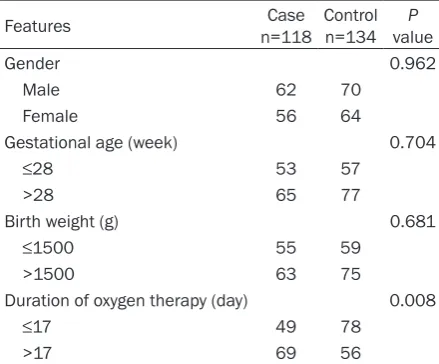
Preterm infants who had any cardiovascular diseases and eye diseases were excluded, and then 134 preterm infants were recruited as controls. Features of neonates such as gender, gestational age, birth weight, the duration of oxygen therapy were listed in Table 1. All par-ticipators were unrelated Chinese Han popula-tion. Written informed consent was signed by all families.
Genotyping method
Genomic DNA was extracted from 5 ml periph-eral blood samples of all participators using the TIANamp Blood DNA Kit (TIANGEN BIOTECH, China). Spectro-Designer software (SEQUENOM,
by crossover analysis. Odds ratios (ORs) and
95% confidence intervals (95% CIs) were used
to present the relative risk of ROP.
Results
Participant features
As shown in Table 1, only the duration of
oxy-gen therapy had significant difference between
case and control groups (P<0.05). Other fea-tures, such as gender, gestational age and birth weight had no obvious differences between the two groups (P>0.05).
Correlation of NOS3 SNPs (T-786C and G894T) and ROP susceptibility
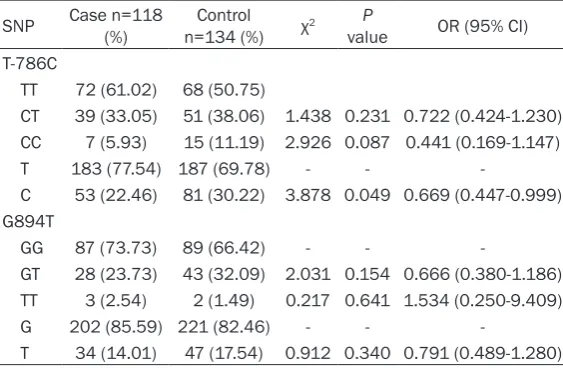
Genotype distributions of T-786C and G894T polymorphisms were all in accordance with HWE (P>0.05), indicating the subjects were had a good representativeness. All of the genotypes
of T-786C SNP had no significant association
with the susceptibility of ROP (Table 2, P>0.05).
-786C allele was significantly correlated with
ROP susceptibility (P=0.049, OR=0.669, 95% CI=0.447-0.999). Meanwhile, no obvious asso-ciation was found between genotypes and alleles of NOS3 G894T SNP with the suscepti-bility of ROP (Table 2).
Interaction between NOS3 gene polymor-phisms (T-786C and G894T) and oxygen thera-py duration in ROP
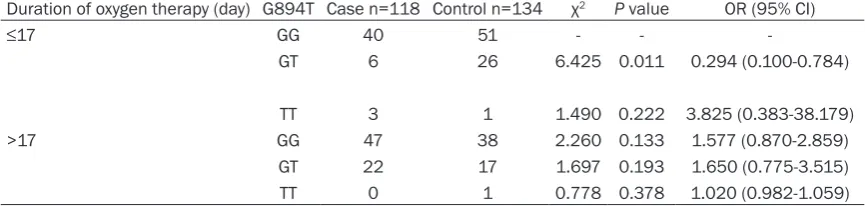
Interaction analysis results were shown in
[image:2.629.99.319.93.275.2]Tables 3 and 4. For the interaction of T-786C
Table 1. Features of participants
Features n=118Case Control n=134 valueP
Gender 0.962
Male 62 70
Female 56 64
Gestational age (week) 0.704
≤28 53 57
>28 65 77
Birth weight (g) 0.681
≤1500 55 59
>1500 63 75
Duration of oxygen therapy (day) 0.008
≤17 49 78
>17 69 56
USA) was used to design the polymerase chain reaction (PCR) primers and extension primers. Genotypes of NOS3 SNPs (T-786C and G894T) were done with MassArray sys-tem (SEQUENOM, USA).
Statistic analysis
polymorphism and the duration of oxygen ther-apy, when the duration of oxygen therapy was less than 17 days, the -786CC genotype might relate to the susceptibility of ROP (P=0.020, OR=0.115, 95% CI=0.014-0.960). When oxy-gen therapy duration was more than 17 days, all of the genotypes of NOS3 T-786C polymor-phism had no obvious correlation with ROP sus-ceptibility (P>0.05). Interaction was also exist-ed in oxygen therapy duration and NOS3 G894T polymorphism (Table 4). 894GT genotype maybe relate to the susceptibility of ROP when the oxygen therapy duration was less than 17 days (P=0.011, OR=0.294, 95% CI= 0.100-0.784).
Discussion
ROP is an eye disease affecting preterm babies who generally receive neonatal care. It is thought to be caused by aberrant growth of reti-nal blood vessels which may lead to scarring and retinal detachment [15, 16]. ROP may be resolved spontaneously, but it also leads to blindness in serious cases. Although the patho-genesis of ROP is unknown, it is believed that low birth weight, oxygen toxicity and hypoxia could contribute to the development of it [17-20]. However, not all the prematurely born babies undergo the occurrence of ROP. There exists individual difference, and genetic factors might decide the difference. NOS3, as a nitric oxide synthase in endothelial cell, is involved in the regulating of vessels. Previous studies indi-cated that NOS3 gene relate to the incidence of
but the differences were not significant. -786C
allele of NOS3 gene was significantly high in
cases, and might play a protection role for ROP. This result was agreed with previous study which focused on diabetic retinopathy [23], and another study found that -786C allele could increase the ROP risk [22]. However a previous research performed by Rusai et al. indicated that T-786C SNP had no association with ROP [24]. For NOS3 gene G894T polymorphism,
genotypes and alleles of it had no significant
association with the susceptibility of ROP, denominating G894T polymorphism was not related to ROP susceptibility. That was different from previous study which indicated 894T allele
is a significant risk factor for the occurrence of
ROP [22]. However Azmy et al. suggested GG genotype of G894T SNP could increase the risk of diabetic retinopathy [25].
Because features analysis indicated that oxy-gen therapy duration was associated with the risk of ROP, we carried out the interaction anal-ysis to explore whether the interactions were existed between the duration of oxygen therapy and the two NOS3 gene polymorphisms. As for T-786C SNP, if not considered the effects of oxygen therapy, -786CC genotype was not relat-ed to ROP risk. If take into the interaction, there
was a significant change. When oxygen therapy
duration was less than 17 days, -786CC geno-type was correlated with 0.115 fold decreased risk of ROP. When the duration of oxygen thera-py was more than 17 days -786CC genotype
has no significant association with the occur
-Table 2. Genotype and allele distributions of NOS3 gene polymor-phisms (T-786C and G894T) in ROP
SNP Case n=118 (%) n=134 (%)Control χ2 P
value OR (95% CI) T-786C
TT 72 (61.02) 68 (50.75)
CT 39 (33.05) 51 (38.06) 1.438 0.231 0.722 (0.424-1.230) CC 7 (5.93) 15 (11.19) 2.926 0.087 0.441 (0.169-1.147)
T 183 (77.54) 187 (69.78) - -
C 53 (22.46) 81 (30.22) 3.878 0.049 0.669 (0.447-0.999) G894T
GG 87 (73.73) 89 (66.42) - -
GT 28 (23.73) 43 (32.09) 2.031 0.154 0.666 (0.380-1.186) TT 3 (2.54) 2 (1.49) 0.217 0.641 1.534 (0.250-9.409)
G 202 (85.59) 221 (82.46) - -
T 34 (14.01) 47 (17.54) 0.912 0.340 0.791 (0.489-1.280)
retinopathy [21, 22]. T-786C and G894T is the two widely studied SNPs in NOS3 gene. T-786C polymorphism is in the promoter region of NOS3 gene, and G894T (Glu298Asp) SNP is a missense mutation which locates in exon 7 of the gene. Therefore we analyz- ed the association between NOS3 gene polymorphisms (T-786C and G894T) and the susceptibility of ROP in this study.
[image:3.629.100.382.105.289.2]rence of ROP. Meanwhile 894GT genotype becomes the protective factor for the develop-ment of ROP, when the duration of oxygen ther-apy was less than 17 days. Before interacted with the oxygen therapy 894GT genotype had no obvious association with the risk of ROP. All of the results suggested that there existed interactions between NOS3 SNPs and the dura-tion of oxygen therapy.
Our study is the first study focused on the inter -action between NOS3 gene polymorphisms and the duration of oxygen therapy in the devel-opment of ROP. The interaction could affect the susceptibility of ROP, and alter the action of NOS3 gene polymorphisms in ROP susceptibil-ity. Under certain conditions, NOS3 gene T-786C and G894T SNPs might play crucial role in the occurrence of ROP. We suggested that
ROP is a complex disease which influenced by
gene and environment factors. Although we obtained a meaningful result, the etiology of ROP was still unclear. In order to get a credible evidence to certify the pathogenesis of it, fur-ther study with a big sample size and more loci was necessary.
Disclosure of conflict of interest
None.
Address correspondence to: Dr. Xiaobing Li, De- partment of Neurology, The First Affiliated Hospital
of Nanchang University, 17 Yongwaizheng Street, Donghu District, Nanchang 330006, Jiangxi, China. E-mail: [email protected]
References
[1] Gergely K and Gerinec A. Retinopathy of pre-maturity--epidemics, incidence, prevalence, blindness. Bratisl Lek Listy 2010; 111: 514-517.
[2] Gilbert C, Fielder A, Gordillo L, Quinn G, Semiglia R, Visintin P and Zin A. Characteristics of infants with severe retinopathy of prematu-rity in countries with low, moderate, and high levels of development: implications for screen-ing programs. Pediatrics 2005; 115: e518-525.
[3] Limburg H, Gilbert C, Hon do N, Dung NC and Hoang TH. Prevalence and causes of blindness in children in Vietnam. Ophthalmology 2012; 119: 355-361.
[4] Flynn JT. The premature retina: a model for the in vivo study of molecular genetics? Eye (Lond) 1992; 6: 161-165.
[5] Terry TL. Fibroblastic Overgrowth of Persistent Tunica Vasculosa Lentis in Infants Born Prematurely: II. Report of Cases-Clinical Aspects. Trans Am Ophthalmol Soc 1942; 40: 262-284.
[6] Yau GS, Lee JW, Tam VT, Liu CC and Wong IY. Risk factors for retinopathy of prematurity in extremely preterm Chinese infants. Medicine (Baltimore) 2014; 93: e314.
[7] Chattopadhyay MP, Pradhan A, Singh R and Datta S. Incidence and risk factors for
retinop-Table 3. Interaction between NOS3 gene T-786C polymorphism and oxygen therapy in ROP Duration of oxygen therapy (day) T-786C Case n=118 Control n=134 χ2 P value OR (95% CI)
≤17 TT 31 32 - -
-CT 17 37 3.776 0.052 0.474 (0.222-1.012)
CC 1 9 5.388 0.020 0.115 (0.014-0.960)
>17 TT 41 36 0.266 0.634 1.176 (0.604-2.290)
CT 22 14 1.305 0.253 1.622 (0.076-3.729)
[image:4.629.99.530.94.185.2]CC 6 6 0.003 0.960 1.032 (0.300-3.548)
Table 4. Interaction between NOS3 G894T polymorphism and oxygen therapy in ROP
Duration of oxygen therapy (day) G894T Case n=118 Control n=134 χ2 P value OR (95% CI)
≤17 GG 40 51 - -
-GT 6 26 6.425 0.011 0.294 (0.100-0.784)
TT 3 1 1.490 0.222 3.825 (0.383-38.179)
>17 GG 47 38 2.260 0.133 1.577 (0.870-2.859)
GT 22 17 1.697 0.193 1.650 (0.775-3.515)
[image:4.629.98.531.224.327.2]athy of prematurity in neonates. Indian Pediatr 2015; 52: 157-158.
[8] Ture M, Yildiz M, Karkucak M, Gulten ET, Sigirli D, Ozmen AT and Yakut T. Investigation of TNF-alpha gene (G308A) and GSTP1 gene (Ilel05Val) polymorphisms in Turkish patients with retinopathy of prematurity. Turk J Med Sci 2015; 45: 164-169.
[9] Smith LE. Pathogenesis of retinopathy of pre-maturity. Semin Neonatol 2003; 8: 469-473. [10] Li JY, Lin ZL, Wei J, Yan YY and Lin J. [What is
the optimal oxygen saturation for extremely premature infants? A Meta analysis]. Zhongguo Dang Dai Er Ke Za Zhi 2015; 17: 128-133. [11] Ramirez-Patino R, Figuera LE, Puebla-Perez
AM, Delgado-Saucedo JI, Legazpi-Macias MM, Mariaud-Schmidt RP, Ramos-Silva A, Gutierrez-Hurtado IA, Gomez Flores-Ramos L, Zuniga-Gonzalez GM and Gallegos-Arreola MP. Intron 4 VNTR (4a/b) polymorphism of the endotheli-al nitric oxide synthase gene is associated with breast cancer in Mexican women. J Korean Med Sci 2013; 28: 1587-1594.
[12] Levinsson A, Olin AC, Bjorck L, Rosengren A and Nyberg F. Nitric oxide synthase (NOS) sin-gle nucleotide polymorphisms are associated with coronary heart disease and hypertension in the INTERGENE study. Nitric Oxide 2014; 39: 1-7.
[13] Yang B, Liu X, Li M, Yang Y, Na X and Wang Y. Genetic association of rs1800780 (A-->G) polymorphism of the eNOS gene with suscepti-bility to essential hypertension in a Chinese Han population. Biochem Genet 2014; 52: 71-78.
[14] Qian-Qian Y, Yong Y, Jing Z, Dong-Hong F, Tian-Hua X, Li Y, Lan L, Jia C and Zhe-Yao G. Association between a 27-bp variable number of tandem repeat polymorphism in intron 4 of the eNOS gene and risk for diabetic retinopa-thy Type 2 diabetes mellitus: a meta-analysis. Curr Eye Res 2014; 39: 1052-1058.
[15] Alon T, Hemo I, Itin A, Pe’er J, Stone J and Keshet E. Vascular endothelial growth factor acts as a survival factor for newly formed reti-nal vessels and has implications for retinopa-thy of prematurity. Nat Med 1995; 1: 1024-1028.
[16] Hartnett ME. Pathophysiology and mecha-nisms of severe retinopathy of prematurity. Ophthalmology 2015; 122: 200-210.
[17] Karna P, Muttineni J, Angell L and Karmaus W. Retinopathy of prematurity and risk factors: a prospective cohort study. BMC Pediatr 2005; 5: 18.
[18] Kim J, Jin JY and Kim SS. Postnatal weight gain in the first two weeks as a predicting factor of severe retinopathy of prematurity requiring treatment. Korean J Pediatr 2015; 58: 52-59. [19] Luo R, Liu J, Hu P, Cheng SS, Shi BZ, Zhu JH
and Liu L. [Results of 779 cases of neonatal fundus screening and risk factors for neonatal fundus diseases]. Zhongguo Dang Dai Er Ke Za Zhi 2014; 16: 1197-1201.
[20] Xu Z, Gong J, Maiti D, Vong L, Wu L, Schwarz JJ and Duh EJ. MEF2C ablation in endothelial cells reduces retinal vessel loss and suppress-es pathologic retinal neovascularization in oxy-gen-induced retinopathy. Am J Pathol 2012; 180: 2548-2560.
[21] Cheema BS, kohli HS, Sharma R, Bhansali A and Khullar M. Endothelial nitric oxide syn-thase gene polymorphism and type 2 diabetic retinopathy among Asian Indians. Acta Diabetol 2012; 49: 481-488.
[22] Yanamandra K, Napper D, Pramanik A, Bocchini JA Jr and Dhanireddy R. Endothelial nitric oxide synthase genotypes in the etiology of retinopathy of prematurity in premature in-fants. Ophthalmic Genet 2010; 31: 173-177. [23] Bazzaz JT, Amoli MM, Pravica V, Chan-
drasecaran R, Boulton AJ, Larijani B and Hutchinson IV. eNOS gene polymorphism as-sociation with retinopathy in type 1 diabetes. Ophthalmic Genet 2010; 31: 103-107.
[24] Rusai K, Vannay A, Szebeni B, Borgulya G, Fekete A, Vasarhelyi B, Tulassay T and Szabo AJ. Endothelial nitric oxide synthase gene T-786C and 27-bp repeat gene polymorphisms in retinopathy of prematurity. Mol Vis 2008; 14: 286-290.