Court experience of adults
with mental health conditions,
learning disabilities and limited
mental capacity
Report 5: Policy processes, services
and practices
Rosie McLeod, Cassie Philpin, Anna Sweeting,
Lucy Joyce and Roger Evans
BMRB and Liverpool John Moores University
Court experience of adults
with mental health conditions, learning
disabilities and limited mental capacity
Report 5: Policy processes, services and practices
Rosie McLeod, Cassie Philpin, Anna Sweeting,
Lucy Joyce and Roger Evans
BMRB and Liverpool John Moores University
Report 5 of 6
This information is also available on the Ministry of Justice website:
Disclaimer
The views expressed are those of the authors and are not necessarily shared by the Ministry
of Justice (nor do they represent Government policy).
© Crown Copyright 2010.
Extracts from this document may be reproduced for non-commercial purposes on condition
that the source is acknowledged.
First Published 2010
ISBN: 978-1-84099-396-7
Acknowledgements
We would like to thank all the court users, carers and practitioners who participated in this
research study, both for the time that they gave and for their openness in sharing their
experiences with us. We also thank the many support organisations and services who
voluntarily assisted us in recruiting participants to the study, and without whom the project
would not have been possible. We are grateful to all members of the steering group,
stakeholders and practitioners for their indispensable guidance and expertise. In particular,
we would like to thank the staff of the following courts for their participation in the study:
Newcastle-upon-Tyne Combined Court, Gateshead Magistrates’ Court, Stratford Magistrates’
Court, The Central Criminal Court and Lambeth County Court.
The authors
BMRB is the longest established research agency in Britain, having been founded in 1933.
Throughout that time the company has built up a reputation for methodological excellence
and innovation, and enjoys a reputation for producing strategic work of the highest quality
and integrity. BMRB regularly carries out important studies to inform policy-making for major
organisations in the public and private sectors.
Roger Evans is Director of the School of Law and Professor of Socio-Legal Studies at Liverpool John Moores University and a Non-Executive Director of a Mental Health NHS
Foundation Trust. The team also worked in collaboration with Neil Hickman, a practitioner working in community health. The team holds a combination of policy knowledge, research
expertise and practical experience of working with the specified vulnerable groups and of
researching within the court setting. In the past, the team has collaborated on projects such
as Victims’ Advocates and a research project into vulnerable and intimidated witnesses for
This is the fifth in a series of six reports on a research project exploring the court experience
of adults with mental health conditions, learning disabilities and limited mental capacity. The
research relates to victims and witnesses in criminal cases, and to participants in civil and
family cases.
Report 1 outlines the key findings from the research.
Opportunities for identification of court users with these vulnerabilities, and the extent
of subsequent support, varied across the courts. A number of relevant policies and
processes have been introduced in recent years. However, these tended not to be designed specifically for court users with mental health conditions, learning disabilities and limited mental capacity. Furthermore, policies related to particular stages of the court case or to
particular agencies, rather than the whole ‘journey’ of an individual victim, witness or case
participant through the justice system. The report therefore recommends a clear support
pathway for vulnerable court users, supported by improved systems of accountability and
the establishment of small multi-disciplinary teams. Better processes for early identification
of conditions, and guidelines to increase awareness of how disclosures can be made, are
also recommended. A single point of contact for vulnerable court users throughout a case
is proposed, along with increased dissemination of tailored information, improved access to
legal representation, additional and improved training for professionals, and improvements to
implementation of special measures.
Report 2 outlines the experiences of court users with these vulnerabilities from their first involvement with the justice system until their attendance at court.
Across the courts, conditions were more likely to be identified when a support worker
was present with the court user. In criminal cases, experiences varied greatly depending
upon police awareness of the court user’s support needs. In civil proceedings, a lack of
contact with the courts could impede identification, and court users depended on legal
representatives or existing support networks to identify needs and provide support.
Identification was most likely in family proceedings where assessments and close contact
with professionals were common. Court users were unlikely to disclose their condition
unprompted. Protocols for support in criminal courts meant that court users were more
content with the level of information and support offered than was the case in civil and family
proceedings, where no protocols or designation of responsibility for support existed.
Report 3 considers the process of attending court, including arriving at court, waiting to go
into the court room, being in the court room and giving evidence.
Generally, court users made their way to the court room alone and were daunted by the
process, the presence of a support worker, and the support of the Witness Service in criminal
courts. Court users who felt they needed support were willing to disclose their condition,
but were not always aware of whether disclosure was appropriate or who was responsible
for informing the court. In turn, staff often assumed that identification would already have
occurred and did not feel that they had the expertise to carry out this function. Where the
judiciary were aware of need, the adjustments which they made were helpful to court users
and increased their sense of inclusion in proceedings. In criminal cases, special measures
were helpful in supporting court users to give evidence. More specialist support was only
required by those who felt unable to manage their conditions.
Report 4 outlines the ‘after-court’ process, including receiving verdicts in court, leaving the
court and making the journey home, awaiting outcomes and receiving news at home, and
moving on from the experience.
Hearing a verdict in court and receiving news of the case outcome at home were times
of particular stress and low mood for court users. They needed clear explanations to
understand their case outcome, and emotional support to come to terms with it.
Co-ordination between agencies to ensure that the court user was adequately supported at
this point required careful management, but there are few protocols for support provision
following court appearances. Many of the court users who were interviewed for this research
did not feel any further support was necessary following case closure. However, where it was
required, communication and cross-referrals between service providers were important to
ensure the court user was not left unsupported.
Report 5 provides an overview of the policies, services and practices in place across the
court system to support the needs of adults with mental health conditions, learning disabilities
and limited mental capacity.
Two key policy processes within the criminal justice system are relevant. The first aims to
better enable vulnerable or intimidated witnesses to give best evidence in court, (including
the use of special measures). The second aims to improve the criminal justice system
more widely to better meet the needs of victims and witnesses. Special measures has had
a significant positive impact on court experience, and early evaluations of intermediary
schemes are promising. A range of protocols are used by the police and the CPS to facilitate
the identification and support of this group of court users. In the civil justice system, service
delivery in this area has been guided by two policy aims: to improve, simplify and speed
up the litigation system (assisted by the Civil Procedure Rules), and to strengthen the law
in relation to Anti-Social Behaviour Orders, including the extension of special measures to
anti-social behaviour cases. In the family courts, policy to harmonise the Family Procedure
Rules with the Civil Procedure Rules, and guidelines to support the use of McKenzie Friends
are the amended Mental Health Act (2007), the Mental Capacity Act (2005), the Disability
Discrimination Act (2005), and the Department of Health’s ‘No Secrets’ (2000) guidance on
protection of vulnerable adults.
Report 6 outlines the background to the research and presents the project’s research aims
and methodology.
Overall, this research aimed to examine how the court system supports the complex and
specific needs of adults with mental health conditions, learning disabilities and limited mental
capacity. It explored the direct experiences of victims and witnesses in criminal cases, and
case participants in civil and family courts. The project had two phases: a developmental
scoping study, and a programme of interviews with practitioners, court users and carers. The
methodology was entirely qualitative. Recruitment was conducted in house through contact
with a range of networks and support organisations. All study participants voluntarily
self-disclosed their conditions, and definitions of conditions followed participants’ own usage. A
Contents
1. Introduction 1
2. Understanding policy processes, services and practices 2
3. Criminal justice system 4
3.1 Policy processes 4
3.2 Services and practices 13
4. Civil justice system 15
4.1 Policy processes 15
4.2 Services and practices 17
5. Family justice system 19
5.1 Policy processes 19
5.2 Services and practices 20
6. Across all three systems 22
6.1 Mental Capacity Act 2005 22
6.2 Mental Health Act 2007 22
6.3 Disability Discrimination Act 2005 23
6.4 No secrets 23
6.5 Overall 24
7. Conclusion 26
List of figures and tables
Table 3.1 Table of policy outputs in relation to better enabling vulnerable
and intimidated witnesses to give best evidence in court 6 Table 3.2 Table of policy outputs in relation to improving the criminal justice system
to meet the needs of victims and witnesses more effectively 10 Table 4.1 Table of policy outputs in relation to improving, simplifying
and speeding up the civil justice system 16
Table 4.2 Table of policy outputs in relation to strengthening the law concerned
with Anti-Social Behaviour Orders 17
Table 5.1 Table of policy outputs in relation to harmonising the Family Procedure Rules along the lines of the Civil Procedure Rules 19 Table 5.2 Table of policy outputs in relation to the growth of litigants in person
and use of McKenzie Friends 20
Table 6.1 Overarching policy outputs 24
Figure 3.1 Map of support services and practices
in the criminal justice system (2009) 14
Figure 4.1 Map of support services and practices
in the civil justice system (2009) 18
Figure 5.1 Map of support services and practices
1. Introduction
People with mental health conditions and learning disabilities may experience greater
difficulties in accessing justice than other groups, and possibly also greater discrimination
and disadvantage (Mind, 2001). Current Government policy aims to meet the needs of
victims, witnesses and users of the justice systems more effectively and to improve access to
justice, particularly for vulnerable people.
The Court Experience of Vulnerable People Research Programme helps deliver this aim by
providing evidence to facilitate improvement in Ministry of Justice (MoJ) services. As part
of this programme, the MoJ commissioned BMRB and Professor Roger Evans of Liverpool
John Moores University to undertake research into the experiences of court users with
mental health conditions, learning disabilities and limited mental capacity.
Overall, the research aimed to determine how the courts system supports the complex and
specific needs of adults with mental health conditions, learning disabilities and limited mental
capacity. The study placed a strong emphasis on the direct experiences of court users in
criminal (excluding defendants and young witnesses), civil and family courts.
The research comprised two phases: a scoping study (Phase 1) and a main stage of research
(Phase 2). Phase 1 mapped the range of policies and structures in place within and outside
different court settings to support people with mental health conditions, learning disabilities
and mental capacity issues. It involved three stages: desk research; interviews with 27 key
stakeholders; and consultation with the 25 Area Directors for Her Majesty’s Courts Service
(HMCS). Phase 2 built on Phase 1 and developed a more localised and in-depth understanding
of the experiences of these vulnerable court users. It focused on London and the North
East and involved: court observations; 143 interviews with practitioners; 61 interviews with
court users with mental health conditions, learning disabilities or limited mental capacity; 23
interviews with carers; and journey mapping with the court users.
This report is the fifth in a series of six reports presenting the findings from the research. It provides
an overview of the policy processes, services and practices in place across the court system in
England and Wales to support the needs of adults with mental health conditions, learning disabilities
and limited mental capacity. The review focuses firstly on the criminal court and then looks at the
civil and family courts in turn. The overarching policy outputs for all three courts are then discussed.
The information in this report was obtained through the desk research conducted as part of
Phase 1. The findings in this report then formed part of the discussion in Phase 2 interviews
with policy makers, court staff, judiciary, magistrates, solicitors and practitioners from public
agencies and support organisations. Any changes or additions to policy processes, services
2
2. Understanding policy processes, services and
practices
Prior to outlining the policies, services and practices in place, it is important to clarify the
usage of these terms.
These terms all relate to the policy process. The policy process is defined widely and
flexibly in the literature. For example Yeatman (1998), referring to the public sector, defined
the policy process as:
‘All aspects of what is involved in providing policy direction for the work of the public sector. These include the ideas which inform policy conception, the talk and work which goes into providing the formulation of policy directions, and all the talk, work and collaboration which goes into translating these directions into practice.’
The relevant policy areas may be fragmented, and policies formulated in different areas are
not necessarily joined up. Policies developed in separate components of the system may not
always fit into any overarching policy framework.
The outputs of the policy process encompass a wide range of products, including
legislation, strategies, written policies, implementation plans, codes of practice, guidance,
services and practices.
The term services in this research refers to forms of organisation designed to deliver policy
objectives. The main services dealt with here are Her Majesty’s Courts Service, the Crown
Prosecution Service, the police, the Witness Service, the judiciary, legal representatives and
third sector organisations. In the process of implementation, policies are almost invariably
interpreted and translated to fit with different local needs and conditions, stakeholder
interests, organisational imperatives and other factors. Consequently there is often some gap
between formal policy and its implementation in practice.
The term practice here refers to what service providers do when delivering services. Policy
may be just one factor that could influence practice. Other factors may include professional
training, occupational cultures, organisational imperatives and so on.
It is important to highlight that while it may be possible to make an analytic distinction
between policy, services and practices, in reality they lie on a continuum and are all
components of the policy process. There is rarely a straightforward linear progression from
policy to implementation to practice.
The following is an empirical account of those policies, services and practices that the
even if this relevance is only indirect to scoping the court experience of vulnerable court
users. This report does not claim to provide a systematic policy review. Rather it is a map of
the often-fragmented policy processes that have emerged in relation to different subjects and
4
3. Criminal justice system
This chapter outlines policy processes, services and practices in place in the criminal justice
system which are relevant to the vulnerable court users considered in this project.
3.1 Policy processes
Two key policy processes within the criminal justice system are relevant to the experiences
of court users with mental health conditions, learning disabilities and limited mental capacity.
These are the Government’s commitments to:
● better enable vulnerable or intimidated witnesses to give best evidence in court; and
● improve the criminal justice system more widely to better meet the needs of victims and
witnesses.
Enabling vulnerable and intimidated witnesses to give best evidence in court
In 1998, the Government published the report, Speaking up for Justice (Criminal Justice
Performance, Justice, Victims and Witnesses Unit, 1998). This proposed an integrated
scheme to provide appropriate support and assistance for ‘vulnerable or intimidated’
witnesses. It set out 78 recommendations to improve their treatment within the criminal
justice system and to enable them to give best evidence in criminal proceedings. Proposals
for support and assistance for these witnesses covered the investigation stage, pre-trial
support, the trial and beyond. An implementation plan, Action for Justice (Home Office, 1999), was developed to take forward the recommendations in Speaking Up for Justice.
Some of the measures in the report required legislation, and therefore were included in the
Youth Justice and Criminal Evidence Act 1999 (British Government, 1999).
The definition of a ‘vulnerable witness’ encompasses children, and adults who have a mental disorder (as defined within the Mental Health Act), or a significant learning disability. It may
also include some people with physical disabilities. In practice, the majority of interviewees in
this research could be considered ‘vulnerable’ under this definition.
A set of procedures designed to help vulnerable and intimidated witnesses to give ‘best
evidence’ in the criminal courts were introduced under the Youth Justice and Criminal Evidence Act 1999 (YJCEA 1999). These have become collectively known as ‘special measures’. The YJCEA specifies that they may be authorised by the court ‘only if they are
likely to improve the quality of a witness’s evidence’.
The special measures available in criminal cases include:
● screening to ensure that the witness and defendant cannot see one another;
● clearing the public gallery while the witness gives their evidence;
● requesting the removal of wigs and gowns by judiciary members;
● video recording of an interview to be admitted as evidence to the court;
● video recorded cross-examination or re-examination;
● examination of a witness through an intermediary; and
● allowing a witness to use communication aids (e.g. a symbol book or alphabet board).
Most of the special measures outlined in the Youth Justice and Criminal Act 1999 were
implemented in the Crown Court in July 2002. Evaluations have shown positive impacts
for vulnerable and intimidated witnesses. These include a reduction of anxiety and stress
(Burton et al., 2006) and a significantly greater likelihood of expressing overall satisfaction with the criminal justice system than among witnesses not offered special measures (Hamlyn
et al., 2004). However, these evaluations identified some difficulties encountered by the
police in identifying vulnerable and intimidated witnesses, particularly those with learning
disabilities or mental disorders (Burton et al., 2006).
The special measure ‘examination of a witness through an intermediary’ was introduced
in six pathfinder areas in 2005 and nationally rolled out from April 2008 following
positive findings from the evaluation (Plotnikoff and Woolfson, 2007). Intermediaries can communicate on behalf of a victim or witness with communication difficulties, and explain or
clarify what other people have said so that he/she can understand it. The intermediary does
not act on behalf of the prosecution or defence; they are neutral and their responsibility is
to the court and to justice, ensuring that best evidence is obtained. Intermediaries complete
an accredited training course and a full assessment process, and comply with Codes of
Practice and Ethics, and regular reassessments. They are registered with the Intermediary
Registration Board.
Evaluations of the scheme found that witnesses and their carers expressed positive opinions
of their experience (Plotnikoff and Woolfson, 2007). Carers felt that intermediaries facilitated
communication and also helped witnesses to cope with the stress of giving evidence. A
number of benefits were highlighted, including the potential of intermediaries to assist in the
process of bringing offenders to justice and to improve access to justice, associated cost
savings, assistance in identifying witness needs and the use of appropriate interviewing
and questioning techniques. However, some skills gaps were identified among the available
intermediaries (Plotnikoff and Woolfson, 2007).
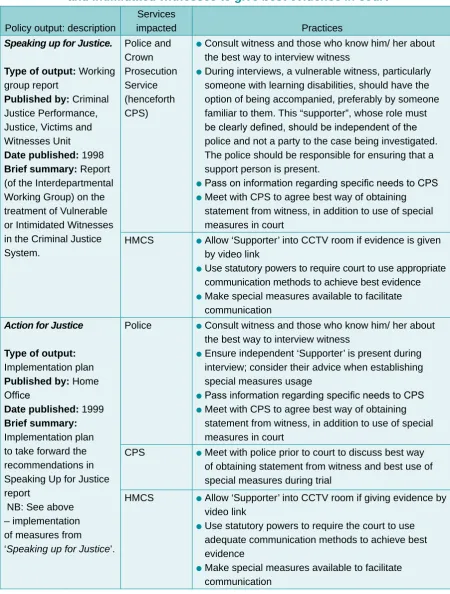
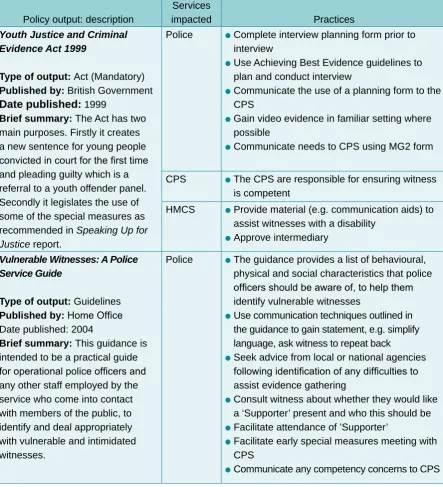
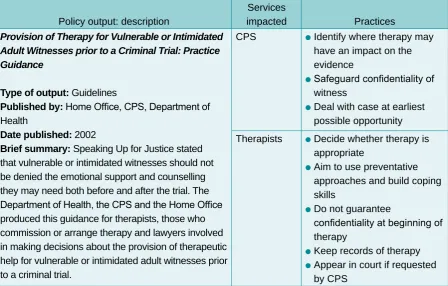
Table 3.1 outlines the different policy outputs discussed above that have helped to enable
vulnerable and intimidated witnesses to give best evidence in court. A brief description of
each is given, along with a list of the services involved in delivery, and the practices that are
6
Table 3.1 Table of policy outputs in relation to better enabling vulnerable
and intimidated witnesses to give best evidence in court
Policy output: description
Services
impacted Practices
Speaking up for Justice.
Type of output: Working group report
Published by: Criminal Justice Performance, Justice, Victims and Witnesses Unit
Date published: 1998
Brief summary: Report (of the Interdepartmental Working Group) on the treatment of Vulnerable or Intimidated Witnesses in the Criminal Justice System. Police and Crown Prosecution Service (henceforth CPS)
●Consult witness and those who know him/ her about
the best way to interview witness
●During interviews, a vulnerable witness, particularly
someone with learning disabilities, should have the option of being accompanied, preferably by someone familiar to them. This “supporter”, whose role must
be clearly defined, should be independent of the
police and not a party to the case being investigated. The police should be responsible for ensuring that a support person is present.
●Pass on information regarding specific needs to CPS ●Meet with CPS to agree best way of obtaining
statement from witness, in addition to use of special measures in court
HMCS ●Allow ‘Supporter’ into CCTV room if evidence is given
by video link
●Use statutory powers to require court to use appropriate
communication methods to achieve best evidence ●Make special measures available to facilitate
communication Action for Justice
Type of output:
Implementation plan
Published by: Home
Office
Date published: 1999
Brief summary:
Implementation plan to take forward the recommendations in Speaking Up for Justice report
NB: See above – implementation of measures from ‘Speaking up for Justice’.
Police ●Consult witness and those who know him/ her about
the best way to interview witness
●Ensure independent ‘Supporter’ is present during
interview; consider their advice when establishing special measures usage
●Pass information regarding specific needs to CPS ●Meet with CPS to agree best way of obtaining
statement from witness, in addition to use of special measures in court
CPS ●Meet with police prior to court to discuss best way
of obtaining statement from witness and best use of special measures during trial
HMCS ●Allow ‘Supporter’ into CCTV room if giving evidence by
video link
●Use statutory powers to require the court to use
adequate communication methods to achieve best evidence
●Make special measures available to facilitate
[image:15.595.71.522.101.696.2]Table 3.1 Table of policy outputs in relation to better enabling vulnerable
and intimidated witnesses to give best evidence in court
(continued)
Policy output: description
Services
impacted Practices
Youth Justice and Criminal Evidence Act 1999
Type of output: Act (Mandatory)
Published by: British Government
Date published: 1999
Brief summary: The Act has two main purposes. Firstly it creates a new sentence for young people
convicted in court for the first time
and pleading guilty which is a referral to a youth offender panel. Secondly it legislates the use of some of the special measures as recommended in Speaking Up for Justice report.
Police ●Complete interview planning form prior to interview
●Use Achieving Best Evidence guidelines to
plan and conduct interview
●Communicate the use of a planning form to the
CPS
●Gain video evidence in familiar setting where
possible
●Communicate needs to CPS using MG2 form
CPS ●The CPS are responsible for ensuring witness
is competent
HMCS ●Provide material (e.g. communication aids) to
assist witnesses with a disability ●Approve intermediary
Vulnerable Witnesses: A Police Service Guide
Type of output: Guidelines
Published by: Home Office
Date published: 2004
Brief summary: This guidance is intended to be a practical guide
for operational police officers and
any other staff employed by the service who come into contact with members of the public, to identify and deal appropriately with vulnerable and intimidated witnesses.
Police ●The guidance provides a list of behavioural, physical and social characteristics that police
officers should be aware of, to help them
identify vulnerable witnesses
●Use communication techniques outlined in
the guidance to gain statement, e.g. simplify language, ask witness to repeat back
●Seek advice from local or national agencies
following identification of any difficulties to
assist evidence gathering
●Consult witness about whether they would like
a ‘Supporter’ present and who this should be ●Facilitate attendance of ’Supporter’
●Facilitate early special measures meeting with
CPS
8
Table 3.1 Table of policy outputs in relation to better enabling vulnerable
and intimidated witnesses to give best evidence in court
(continued)
Policy output: description
Services
impacted Practices
Achieving Best Evidence in Criminal Proceedings: Guidance on vulnerable or intimidated witnesses including children
Type of output: Guidelines
Published by: Home
Office Communication
Directorate.
Date published: 2002
Brief summary: This document describes good practice in preparing for and conducting interviews with vulnerable and intimidated witnesses. The aim is to enable vulnerable and intimidated witnesses to give the best evidence possible.
Police ●Adhere to appropriate interview techniques
(e.g. pacing and phrasing of questions, building rapport)
●Use specific techniques for people with autism or learning disabilities
●Offer witness a series of short interviews rather
than one long one
●Where capacity is in question, obtain expert
assessment from psychiatrist / clinical psychologist
●Adapt behaviour in interviews according to
guidelines to facilitate optimum evidence gathering
Judiciary ●Approve special measures
●Rule out inappropriate questioning by defence or
other party Legal
representatives
●Draw attention of judge to inappropriate questions
from defence or other party
●Outline potential negative consequences of
adjournment to the well-being of the witness Early Special Measures
Meeting between the police and the Crown Prosecution Service and meetings between the Crown Prosecution Service and Vulnerable or Intimidated Witnesses: Practice Guidance
Type of output: Guidance
Published by: Home Office,
CPS, ACPO
Date published: 2001
Brief summary: This document provides the national blueprint for local protocols between the police and CPS relating to the special measures outlined in the Act.
Police ●Inform CPS at meeting about the reasons why
special measures might be appropriate ●Consider inviting expert witness to advise on
witness competence ●Consider inviting witness
●Record meeting on form provided in guidance
documentation
Therapists ●Attend early special measures meeting with police
●Contribute to discussion on grounds for special
measures
●Ask witness to confirm views about special measures
●Inform witness of binding nature of court direction
●Record meeting on form provided in guidance
Table 3.1 Table of policy outputs in relation to better enabling vulnerable
and intimidated witnesses to give best evidence in court
(continued)
Policy output: description
Services
impacted Practices
Provision of Therapy for Vulnerable or Intimidated Adult Witnesses prior to a Criminal Trial: Practice Guidance
Type of output: Guidelines
Published by: Home Office, CPS, Department of
Health
Date published: 2002
Brief summary: Speaking Up for Justice stated that vulnerable or intimidated witnesses should not be denied the emotional support and counselling they may need both before and after the trial. The
Department of Health, the CPS and the Home Office
produced this guidance for therapists, those who commission or arrange therapy and lawyers involved in making decisions about the provision of therapeutic help for vulnerable or intimidated adult witnesses prior to a criminal trial.
CPS ●Identify where therapy may
have an impact on the evidence
●Safeguard confidentiality of witness
●Deal with case at earliest
possible opportunity
Therapists ●Decide whether therapy is appropriate
●Aim to use preventative
approaches and build coping skills
●Do not guarantee
confidentiality at beginning of
therapy
●Keep records of therapy
●Appear in court if requested
by CPS
Improving the criminal justice system to meet the needs of victims and
witnesses more effectively
The general aims of placing the needs of victims and witnesses at the heart of the justice
system, and improving access to justice (see introduction) have led to the implementation
of a number of policy outputs in the justice sector. These are not specifically focused on
the needs of the court users with mental health conditions, learning disabilities or limited
mental capacity. However, they outline the more generic support available, and include some
specific requirements for vulnerable and intimidated witnesses (court users with mental
health conditions, learning disabilities and limited mental capacity are included).
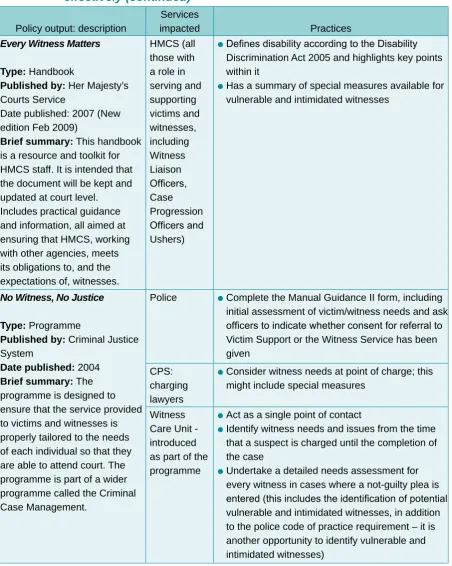
Table 3.2 outlines the relevant policy outputs. A brief description of each is given, along with
a list of the services involved in delivery, and the practices that are relevant to vulnerable
and intimidated witnesses. This includes court users with mental health conditions, learning
disabilities and limited mental capacity. There is some duplication between the practices
listed for each policy output. However, this detail has been included in order to provide a
[image:18.595.75.524.122.408.2]10
Table 3.2 Table of policy outputs in relation to improving the criminal
justice system to meet the needs of victims and witnesses more
effectively
Policy output: description
Services
impacted Practices
Criminal Procedure Rules
Type of output: Procedure rules
Published by: Ministry of Justice
Date published: 2005
Brief summary: The Criminal Procedure Rules set out an overriding objective that courts and everyone involved in a criminal case must pursue: to deal with the case justly. They give courts explicit powers to actively manage the preparation of criminal cases waiting to be heard, to eliminate unfair and avoidable delays, and to promote certainty about what is
happening for the benefit of everyone
involved (Ministry of Justice, 2005).
HMCS and ‘all other parties involved in criminal proceedings (e.g. CPS)
●Applications for special measures must be
made in writing in the form set out in the Rules ●A party wishing to oppose a special measures
application must notify the applicant and the court within 14 days; the court will then arrange a hearing
●After the special measures hearing the court
must, within three days, notify the parties in writing whether special measures have been granted
Criminal Case Management Framework
Type of output: Framework
Published by: Office for Criminal
Justice Reform
Date published: 2007
Brief summary: The Criminal Case Management Framework is a step-by-step guide for participants in the criminal justice process, setting out best practice in case management so that cases are prepared and conducted appropriately, in accordance with the Criminal Procedure Rules and brought to a
conclusion efficiently and with the
minimum of delay.
Police ●Applications for special measures must be
made in writing in the form set out in the Rules ●A party wishing to oppose a special measures
application must notify the applicant and the court within 14 days; the court will then arrange a hearing
●After the special measures hearing the court
must, within three days, notify the parties in writing whether special measures have been granted Witness Care
Unit (see below)
HMCS ●Where the court has been notified that a vulnerable or intimidated witness or victim is involved, ensure that the WCU is informed of:
− decisions of all case hearing dates
− out of court decisions
− adjournments and postponements
− outcome of the trial
●In cases where there are vulnerable or intimidated
witnesses or victims, this must be done no later than one working day after the date is set for. It must be done no later than three working days after the date is set in other cases.
●Ensure, as far as possible, that cases
involving a vulnerable witness are given priority when listing
Table 3.2 Table of policy outputs in relation to improving the criminal
justice system to meet the needs of victims and witnesses more
effectively (continued)
Policy output: description
Services
impacted Practices
The Code of Practice for Victims of Crime
Type of output: Code of practice
Published by: Office for
Criminal Justice Reform
Date published: 2006
Brief summary: This sets out the minimum standards of services to be provided by criminal justice agencies to victims of crime and includes statements on enhanced services for vulnerable witnesses.
Police ●Identify vulnerability (see report 3)
●If a victim is eligible for special measures, explain the
measures available to them and record on the Manual Guidance 2 form any views the victim expresses about applying for special measures
●Notify vulnerable victims of any developments in the
case (e.g. concerning arrests, bail conditions, case
progression etc.) within one day (rather than five days
which is the case for other victims)
CPS ●Identify vulnerability
●Notify a vulnerable and intimidated victim within one
working day (rather than five days for other victims) if the Crown Prosecutor decides there is insufficient
evidence to bring any proceedings
●Notify a vulnerable and intimidated victim within one
working day (rather than five days for other victims) if
the CPS takes a decision to alter substantially or drop any charge
●Have systems in place to assist prosecutors in
considering whether or not to make an application to the court for a special measures direction (see report 3)
HMCS ●Identify vulnerability
●In cases where there is a vulnerable victim, HMCS
must notify the police and Witness Care Unit (WCU) of the following within one working day (rather than three days, as for other victims)
− All hearing dates
− Decisions relating to first hearings/bail applications − Decisions relating to all subsequent hearings
− All adjournments and postponements of scheduled hearings to without a court hearing
●Ensure the availability of special measures as far as
12
Table 3.2 Table of policy outputs in relation to improving the criminal
justice system to meet the needs of victims and witnesses more
effectively (continued)
Policy output: description
Services
impacted Practices
Every Witness Matters
Type: Handbook
Published by: Her Majesty’s Courts Service
Date published: 2007 (New edition Feb 2009)
Brief summary: This handbook is a resource and toolkit for HMCS staff. It is intended that the document will be kept and updated at court level.
Includes practical guidance and information, all aimed at ensuring that HMCS, working with other agencies, meets its obligations to, and the expectations of, witnesses.
HMCS (all those with a role in serving and supporting victims and witnesses, including Witness Liaison Officers, Case Progression Officers and Ushers)
●Defines disability according to the Disability Discrimination Act 2005 and highlights key points within it
●Has a summary of special measures available for
vulnerable and intimidated witnesses
No Witness, No Justice
Type: Programme
Published by: Criminal Justice System
Date published: 2004
Brief summary: The programme is designed to ensure that the service provided to victims and witnesses is properly tailored to the needs of each individual so that they are able to attend court. The programme is part of a wider programme called the Criminal Case Management.
Police ●Complete the Manual Guidance II form, including
initial assessment of victim/witness needs and ask
officers to indicate whether consent for referral to
Victim Support or the Witness Service has been given
CPS: charging lawyers
●Consider witness needs at point of charge; this
might include special measures
Witness Care Unit - introduced as part of the programme
●Act as a single point of contact
●Identify witness needs and issues from the time
that a suspect is charged until the completion of the case
●Undertake a detailed needs assessment for
every witness in cases where a not-guilty plea is
entered (this includes the identification of potential
Table 3.2 Table of policy outputs in relation to improving the criminal
justice system to meet the needs of victims and witnesses more
effectively (continued)
Policy output: description
Services
impacted Practices
Witness Charter
Type: Set of standards
Published by:
Criminal Justice System
Date Published: 2008
Brief summary: A set of 34 standards which outline the level of service witnesses can expect to receive at every stage of the criminal justice process and the standards necessary to provide an
enhanced service for vulnerable witnesses.
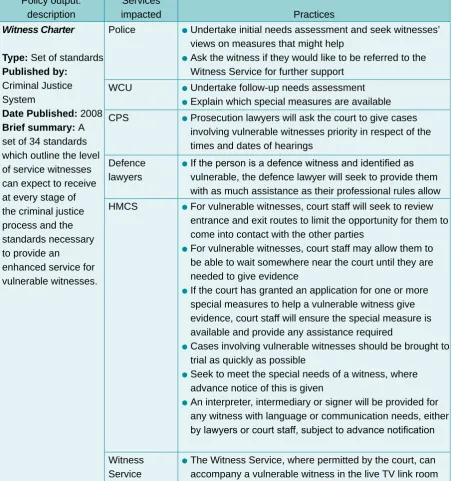
Police ●Undertake initial needs assessment and seek witnesses’
views on measures that might help
●Ask the witness if they would like to be referred to the
Witness Service for further support
WCU ●Undertake follow-up needs assessment
●Explain which special measures are available
CPS ●Prosecution lawyers will ask the court to give cases
involving vulnerable witnesses priority in respect of the times and dates of hearings
Defence lawyers
●If the person is a defence witness and identified as vulnerable, the defence lawyer will seek to provide them with as much assistance as their professional rules allow HMCS ●For vulnerable witnesses, court staff will seek to review
entrance and exit routes to limit the opportunity for them to come into contact with the other parties
●For vulnerable witnesses, court staff may allow them to
be able to wait somewhere near the court until they are needed to give evidence
●If the court has granted an application for one or more
special measures to help a vulnerable witness give evidence, court staff will ensure the special measure is available and provide any assistance required
●Cases involving vulnerable witnesses should be brought to
trial as quickly as possible
●Seek to meet the special needs of a witness, where
advance notice of this is given
●An interpreter, intermediary or signer will be provided for
any witness with language or communication needs, either
by lawyers or court staff, subject to advance notification
Witness Service
●The Witness Service, where permitted by the court, can
accompany a vulnerable witness in the live TV link room
3.2 Services and practices
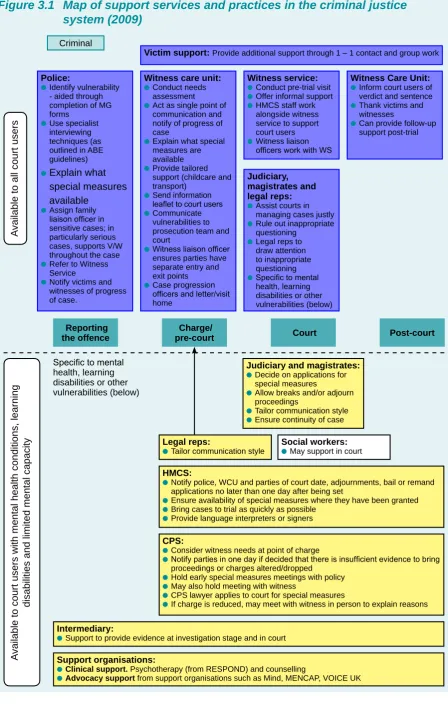
Figure 3.1 provides a process map of the services in place in the criminal justice system
and the practices they undertake according to the policy outputs described above and those
described in the stakeholder interviews. The map outlines the services and practices that
provide generic support (grey boxes above the court process arrows) and those that provide
specific support to court users with mental health conditions, learning disabilities and limited
14
Figure 3.1 Map of support services and practices in the criminal justice
system (2009)
Criminal
A
vailable to all court users
A
vailable to court users with mental health conditions, learning
disabilities and limited mental capacity
Reporting the offence
Charge/
pre-court Court Post-court Victim support:Provide additional support through 1 – 1 contact and group work
Police:
●Identify vulnerability - aided through completion of MG forms
●Use specialist interviewing techniques (as outlined in ABE guidelines)
●Explain what
special measures available
●Assign family
liaison officer in
sensitive cases; in particularly serious cases, supports V/W throughout the case
●Refer to Witness Service
●Notify victims and witnesses of progress of case.
Witness care unit:
●Conduct needs assessment
●Act as single point of communication and notify of progress of case
●Explain what special measures are available
●Provide tailored support (childcare and transport)
●Send information
leaflet to court users
●Communicate vulnerabilities to prosecution team and court
●Witness liaison officer
ensures parties have separate entry and exit points
●Case progression
officers and letter/visit
home
Witness service:
●Conduct pre-trial visit
●Offer informal support
●HMCS staff work alongside witness service to support court users
●Witness liaison
officers work with WS
Judiciary, magistrates and legal reps:
●Assist courts in managing cases justly
●Rule out inappropriate questioning
●Legal reps to draw attention to inappropriate questioning
●Specific to mental
health, learning disabilities or other vulnerabilities (below)
Witness Care Unit:
●Inform court users of verdict and sentence
●Thank victims and witnesses
●Can provide follow-up support post-trial
Judiciary and magistrates:
●Decide on applications for special measures
●Allow breaks and/or adjourn proceedings
●Tailor communication style
●Ensure continuity of case
HMCS:
●Notify police, WCU and parties of court date, adjournments, bail or remand applications no later than one day after being set
●Ensure availability of special measures where they have been granted
●Bring cases to trial as quickly as possible
●Provide language interpreters or signers
CPS:
●Consider witness needs at point of charge
●Notify parties in one day if decided that there is insufficient evidence to bring
proceedings or charges altered/dropped
●Hold early special measures meetings with policy
●May also hold meeting with witness
●CPS lawyer applies to court for special measures
●If charge is reduced, may meet with witness in person to explain reasons
Intermediary:
●Support to provide evidence at investigation stage and in court
Support organisations:
●Clinical support. Psychotherapy (from RESPOND) and counselling
●Advocacy support from support organisations such as Mind, MENCAP, VOICE UK
Legal reps:
●Tailor communication style
Social workers:
●May support in court
Specific to mental
4. Civil justice system
This chapter outlines the policy processes, services and practices in place to support adults with
mental health conditions, learning disabilities and limited mental capacity in the civil justice system.
4.1 Policy processes
Two key policy processes within the civil justice system are relevant to this research project.
These are the Government’s drives to:
● improve, simplify and speed up the litigation system; and
● strengthen the law in relation to Anti-Social Behaviour Orders.
This section discusses these policy processes, provides a brief background and describes
the various relevant policy outputs.
Improve, simplify and speed up the litigation system
In 1996, Lord Woolf’s report ‘Access to Justice’ (Woolf, 1996) recommended a range of reforms
(‘Woolf Reforms’) to the civil justice system. Their aim was to develop a civil justice system that was
just, fair in the treatment of litigants, easily understood and able to operate more quickly, efficiently
and economically. The recommendations were incorporated into the Civil Procedure Rules1998.
The Rules defined detailed procedures and protocols to be followed in civil cases, with the
over-riding objective of enabling the court to deal with cases ‘justly’. This included ensuring
that parties are on an equal footing and that cases are dealt with expeditiously and fairly.
The main consequence of the reforms is more ‘active’ management of cases by the courts.
Much of the procedural decision-making is taken away from the parties to a case and control
of proceedings is transferred to the court. The aims of this transfer are, amongst other things,
to ensure that cases do not reach court unnecessarily, to encourage alternative forms of
dispute resolution and to oblige parties to conduct litigation reasonably. The court can impose
strict timetables for litigation and encourage co-operation between parties.
The Rules did not include the special measures available to vulnerable witnesses in criminal
proceedings (described above). This is because civil (and also family) cases are regarded
as less adversarial. However, special requirements can be applied to civil and family case in
certain circumstances (see below).
However, the Rules defined a ‘protected party’ as someone who lacks capacity (within the
meaning of the Mental Capacity Act 2005) to conduct proceedings, and stipulated that a
protected party must have a ‘Litigation Friend’ to conduct proceedings on their behalf. A
16
himself or herself. As well as ‘protected parties’, clients who are under the age of 18 would
normally be required to have a Litigation Friend. This person has a duty to conduct the
proceedings fairly and competently on behalf of the child or person lacking capacity.
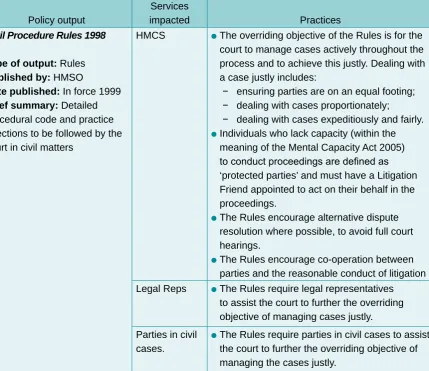
[image:25.595.90.520.211.582.2]Table 4.1 provides an overview of the content of the Civil Procedure Rules 1995.
Table 4.1 Table of policy outputs in relation to improving, simplifying and
speeding up the civil justice system
Policy output
Services
impacted Practices
Civil Procedure Rules 1998
Type of output: Rules
Published by: HMSO
Date published: In force 1999
Brief summary: Detailed procedural code and practice directions to be followed by the court in civil matters
HMCS ●The overriding objective of the Rules is for the
court to manage cases actively throughout the process and to achieve this justly. Dealing with a case justly includes:
− ensuring parties are on an equal footing;
− dealing with cases proportionately;
− dealing with cases expeditiously and fairly. ●Individuals who lack capacity (within the
meaning of the Mental Capacity Act 2005)
to conduct proceedings are defined as
‘protected parties’ and must have a Litigation Friend appointed to act on their behalf in the proceedings.
●The Rules encourage alternative dispute
resolution where possible, to avoid full court hearings.
●The Rules encourage co-operation between
parties and the reasonable conduct of litigation Legal Reps ●The Rules require legal representatives
to assist the court to further the overriding objective of managing cases justly.
Parties in civil cases.
●The Rules require parties in civil cases to assist
the court to further the overriding objective of managing the cases justly.
Strengthen the law in relation to Anti-Social Behaviour Orders
The Serious Organised Crime and Police Act 2005 (British Government, 2005) introduced an
amendment to the law which enables special measures (as described above) to apply in civil
Anti-Social Behaviour Order applications in Crown Court and magistrates’ courts. Vulnerable
and intimidated witnesses in civil anti-social behaviour cases can now benefit from the range
of supportive and protective measures that were previously only available in criminal cases.
This amendment was part of a range of new measures to strengthen the existing law in
A document entitled Supporting Victims and Witnesses in Anti-Social Behaviour Court Cases:
A Comprehensive Guide to Civil Courts (Home Office, Communities and Local Government
and the Ministry of Justice) was published in 2008 and provided further detailed guidance
and examples of best practice on supporting victims and witnesses through court cases
involving anti-social behaviour. Table 4.2 provides an overview of this guide as well as the
Serious Organised Crime and Police Act 2005.
Table 4.2 Table of policy outputs in relation to strengthening the law
concerned with Anti-Social Behaviour Orders
Policy output Services
impacted
Practices
Serious Organised Crime and Police Act 2005
Type: Statute
Published by: HMSO Date published: 2005
Brief summary: A range of statutory powers to combat crime and disorder
HMCS ●The Act extended the availability of
special measures for vulnerable or intimidated witnesses (previously only available in criminal cases) to include witnesses in civil anti-social behaviour cases. For example:
− screening the witness from the ac-cused;
− witness evidence provided by video link or in private;
− providing communication aids;
− removal of wigs and gowns by judges / legal representatives Supporting victims and witnesses in
Anti-Social Behaviour Court Cases: A Comprehensive Guide to Civil Courts
Type: Guidance
Published by: Home Office,
Communities and Local Government and the Ministry of Justice
Date published: May 2008
Brief summary: Guidance and best practice for the support of victims and witnesses through cases involving anti-social behaviour. Also includes guidance on restorative justice.
●Guidance for all parties concerned
including:
− definitions of witnesses and victims; − how to encourage witnesses and
victims to come forward;
− how to gather evidence effectively;
− an explanation of the court process;
− guidance on restorative justice. ●Additional detailed guidance for
experts in the field on evidence, special
measures and witness intimidation.
4.2 Services and practices
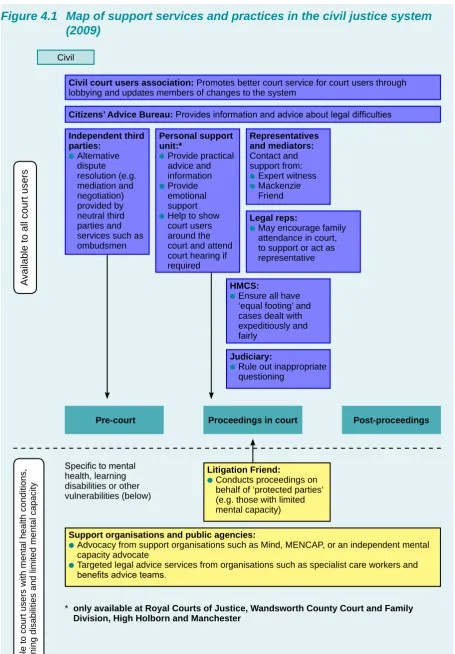
Figure 4.1 provides a process map of the services in place in the civil justice system and the
practices they undertake to support court users according to the policy outputs described
above and those described in the stakeholder interviews. The map outlines the services and
practices that provide generic support and those that provide specific support to court users
18
Figure 4.1 Map of support services and practices in the civil justice system
(2009)
Civil
A
vailable to all court users
A
vailable to court users with mental health conditions, learning disabilities and limited mental capacity
Pre-court Proceedings in court Post-proceedings Civil court users association: Promotes better court service for court users through lobbying and updates members of changes to the system
Citizens’ Advice Bureau: Provides information and advice about legal difficulties Independent third parties: ●Alternative dispute resolution (e.g. mediation and negotiation) provided by neutral third parties and services such as ombudsmen
Personal support unit:*
●Provide practical advice and information
●Provide emotional support
●Help to show court users around the court and attend court hearing if required
Representatives and mediators:
Contact and support from:
●Expert witness
●Mackenzie Friend
Legal reps:
●May encourage family attendance in court, to support or act as representative
HMCS:
●Ensure all have ‘equal footing’ and cases dealt with expeditiously and fairly
Judiciary:
●Rule out inappropriate questioning
Litigation Friend:
●Conducts proceedings on behalf of ‘protected parties’ (e.g. those with limited mental capacity)
Support organisations and public agencies:
●Advocacy from support organisations such as Mind, MENCAP, or an independent mental capacity advocate
●Targeted legal advice services from organisations such as specialist care workers and
benefits advice teams. Specific to mental
health, learning disabilities or other vulnerabilities (below)
5. Family justice system
This chapter outlines the policy processes, services and practices in place in the family
justice system to support adults with mental health conditions, learning disabilities and limited
mental capacity.
5.1 Policy processes
One key policy process within the family justice system is relevant to this research project:
● to harmonise the Family Procedure Rules along the lines of the Civil Procedure Rules
(discussed above)so that there is a single set of rules for all tiers of the family courts.
In addition, an increase has been recognised in the number of litigants in person, and the
advantages to the court of allowing a ‘McKenzie Friend’ to attend court with the litigant.
A litigant in person is an individual, company or organisation who is not represented by a
solicitor or barrister in court, but nevertheless has the right to address the court in person. A
McKenzie Friend is not a legal representative, but can assist a litigant in person in various
ways during the court process. These include the provision of moral support, non-legal
advice, and assistance with sourcing legal forms and editing documents.
Harmonising the Family Procedure Rules with the Civil Procedure Rules
The Family Proceedings Rules 1991 (British Government, 1991) came into force on 14 October
1991. The rules are currently in the process of reform and development in order to harmonise
along the lines of the Civil Procedure Rules. The first of the new rules (Family Procedure Rules
(Adoption)) were published in 2005 (British Government, 2005) and the intention is to create
new procedure rules for all areas of family law. The overriding objective of the new rules mirrors
the Civil Procedure Rules 1998 (British Government, 1998) discussed above, and includes
similar provisions regarding protected parties and the use of litigation friends.
Table 5.1 outlines the policy output that has occurred to harmonise the Family Procedure
Rules 2005 along the lines of the Civil Procedure Rules 1998 and its aims and objectives.
Table 5.1 Table of policy outputs in relation to harmonising the Family
Procedure Rules along the lines of the Civil Procedure Rules
Policy output
Services
impacted Practices
Family Procedure (Adoption) Rules 2005
Type of output: Statutory instrument
Published by: Her Majesty’s Stationery
Office
Date published: In force 2005
Brief summary: Detailed procedural code and practice directions to be followed by the
HMCS (family courts)
●Individuals who lack capacity within the
meaning of the Mental Capacity Act
2005 are defined as ‘protected parties’;
a Litigation Friend must be appointed to act on their behalf in the proceedings ●The rules have the same overriding
20
The increase in the number of litigants in person and use of McKenzie Friends
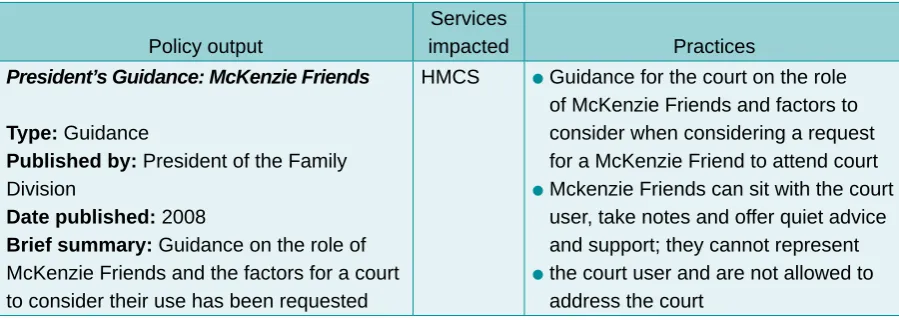
The first use of a McKenzie Friend was in the family court, and they are generally associated
with family proceedings. However, they have also been used in some civil and criminal cases.
The role has no legal basis or professional standing and, in practice, McKenzie Friends are
simply friends or assistants. They have no rights to address the court but can accompany,
quietly advise and assist the court user through the proceedings. Case law has established that
if the assistance of a McKenzie Friend is available to a court user, in the interests of fairness
there would generally be no objection to a McKenzie Friend being present and there is no
need to make a formal application for permission for their attendance. The court does have
the discretion to refuse, but this would only occur in extreme circumstances, where there were
concerns over security, or over the need to maintain order or do justice. With the increase in the
number of litigants in person in the family court, the President Guidelines: McKenzie Friends
(President of the Family Division, 2008) have recently been updated. This document provides
[image:29.595.72.522.361.521.2]guidelines for the use of McKenzie friends in the family courts.
Table 5.2 Table of policy outputs in relation to the growth of litigants in
person and use of McKenzie Friends
Policy output
Services
impacted Practices
President’s Guidance: McKenzie Friends
Type: Guidance
Published by: President of the Family Division
Date published: 2008
Brief summary: Guidance on the role of McKenzie Friends and the factors for a court to consider their use has been requested
HMCS ●Guidance for the court on the role
of McKenzie Friends and factors to consider when considering a request for a McKenzie Friend to attend court
●Mckenzie Friends can sit with the court
user, take notes and offer quiet advice and support; they cannot represent
●the court user and are not allowed to
address the court
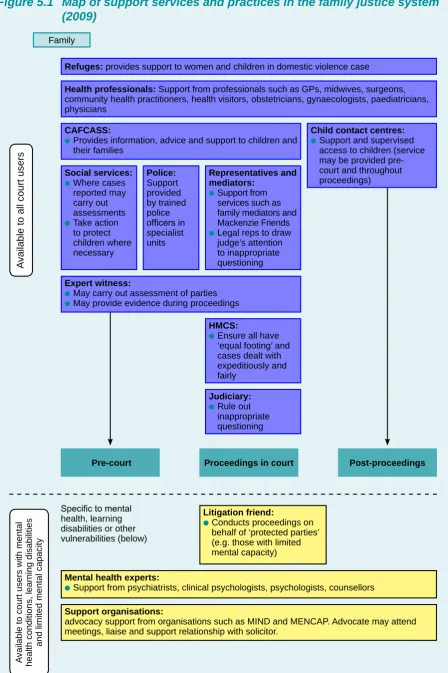
5.2 Services and practices
Figure 5.1 provides a process map of the services in place in the family justice system and
the practices they undertake according to the policy outputs described above and those
described in interviews. The map outlines the services and practices which provide generic
support, and those which offer specific support to court users with mental health conditions,
Figure 5.1 Map of support services and practices in the family justice system
(2009)
Family
A
vailable to all court users
A
vailable to court users with mental
health conditions, learning disabilities
and limited mental capacity
Pre-court Proceedings in court Post-proceedings Refuges: provides support to women and children in domestic violence case
Health professionals: Support from professionals such as GPs, midwives, surgeons, community health practitioners, health visitors, obstetricians, gynaecologists, paediatricians, physicians
CAFCASS:
●Provides information, advice and support to children and their families
Expert witness:
●May carry out assessment of parties
●May provide evidence during proceedings
Litigation friend:
●Conducts proceedings on behalf of ‘protected parties’ (e.g. those with limited mental capacity)
Mental health experts:
●Support from psychiatrists, clinical psychologists, psychologists, counsellors
Support organisations:
advocacy support from organisations such as MIND and MENCAP. Advocate may attend meetings, liaise and support relationship with solicitor.
Specific to mental
health, learning disabilities or other vulnerabilities (below)
Child contact centres:
●Support and supervised access to children (service may be provided pre-court and throughout proceedings)
Social services:
●Where cases reported may carry out assessments
●Take action to protect children where necessary Police: Support provided by trained police officers in specialist units Representatives and mediators:
●Support from services such as family mediators and Mackenzie Friends
●Legal reps to draw judge’s attention to inappropriate questioning
HMCS:
●Ensure all have ‘equal footing’ and cases dealt with expeditiously and fairly
Judiciary:
22
6. Across all three systems
A number of overarching policy outputs are relevant to the experience of court users with
the conditions considered, or where there are concerns over a person’s capacity to make a
decision, or their level of vulnerability. These policy outputs are discussed in this chapter.
6.1 Mental Capacity Act 2005
The Mental Capacity Act 2005 (Department of Constitutional Affairs, 2007) came fully into
force in April 2007 and provides the statutory framework for decision-making on behalf of
people lacking capacity. The relevant key principles of the Act are:
● capacity to make a decision is presumed unless a lack of capacity can be established
and all practicable steps have been taken to aid the person to make a decision; and
● any act or decision made on behalf of a person must be in their best interests and the
aim of the act or decision must be achieved in the least restrictive way.
The Act establishes a new Court of Protection to deal with all issues concerning individuals
who lack capacity. These include decisions over provision of medical treatment, the
appointment of deputies to act on behalf of a person lacking capacity, and resolution
of disputes over whether a person lacks capacity, or over a particular decision. The Act
also establishes a new official role of ‘Public Guardian’, invested with a range of general
monitoring and supervisory functions under the Act. These include the provision of advice
and support to the public and to persons carrying out functions under the Act. The Public
Guardian also acts as the ‘gateway’ to the Court of Protection by recommending alternative
methods of resolving disputes (for example, mediation) without the need for an application to
the court.
Where a serious decision is involved, a person lacking capacity has a right to an Independent
Mental Capacity Advocate. The role of the Advocate is to gather information, try to establish
the wishes and feelings of the person concerned, and explore alternative options. This role is
likely to extend to assisting a person involved in civil proceedings.
The Act does not expressly address the position for people lacking capacity in a court setting.
However, there are clear areas of overlap with the Civil Procedure Rules 1998 which have
been amended to take account of the Mental Capacity Act 2005.
6.2 Mental Health Act 2007
The Mental Health Act 2007 (Department of Health, 2007) provides the statutory framework
for the reception, care and treatment of people suffering from a mental disorder. The Act
covers the detention and treatment of ‘civil’ patients and also patients involved in criminal
concerning the position of a person with mental health conditions involved in other civil or
family proceedings. However, the Act contains a number of safeguards for detained patients,
one of which is access to a Mental Health Review Tribunal. This is a court with the power
to review detentions under the Act and to order the discharge of a patient where the legal
grounds for detention are no longer met.
6.3 Disability Discrimination Act 2005
The Disability Discrimination Act 2005 (British Government, 2005) provides protection for
disabled people by making an act of discrimination unlawful in employment, the provision
of goods, facilities or services, and the provision and management of premises. The Act
does not deal specifically with the rights of a disabled person involved in court proceedings.
However, as a government agency, HMCS are bound by the Act and must provide the same
service to a disabled person as they would to a non-disabled person and must not make it
impossible or unreasonably difficult for a disabled person to use the service.
6.4 No secrets
No secrets: Guidance on developing and implementing multi-agency policies and procedures
to protect vulnerable adults from abuse (Department of Health, 2000) was published in 2000
following recommendations in the report, Speaking up for Justice and the Government White
Paper, Modernising Social Services (Department of Health, 1998). The former highlighted
concerns about the identification and reporting of crime against vulnerable adults in care
settings, and proposed the development of a national policy to protect these individuals. It
was subsequently agreed that local multi-agency codes of practice should be put in place.
No secrets provided a structure for the development of these local inter-agency policies,
procedures and protocols. It was intended for use by agencies responsible for investigating
and taking action when a vulnerable adult, including those with mental health conditions
or learning disabilities, was believed to be abused. It proposes that these policies should
include guidance relating to support with criminal justice issues, including those at court.
In 2008 a consultation on the guidance was launched. Its findings were published in
Safeguarding Adults – Report on the Consultation on the Review of ‘No secrets: Guidance
on developing and implementing multi-agency policies and procedures to protect vulnerable
adults’ (Department of Health, 2009). As part of the consultation, the Association of Chief
Police Officers (ACPO) led a review across the Police Service in England and Wales. This
highlighted the need for