A R T I C L E
Dirk Gillespie ÆRobert S. Eisenberg
Physical descriptions of experimental selectivity measurements
in ion channels
Received: 20 December 2001 / Accepted: 2 May 2002 / Published online: 16 July 2002 EBSA 2002
Abstract Three experiments that quantify the amount of selectivity exhibited by a biological ion channel are ex-amined with Poisson-Nernst-Planck (PNP) theory. Conductance ratios and the conductance mole fraction experiments are examined by considering a simple model ion channel for which an approximate solution to the PNP equations with Donnan boundary conditions is derived. A more general result is derived for the Gold-man-Hodgkin-Katz permeability ratio. The results show that (1) the conductance ratio measures the ratio of the diffusion coefficients of the ions inside the channel, (2) the mole fraction experiment measures the difference of the excess chemical potentials of the ions inside the channel, and (3) the permeability ratiomeasures both diffusion coefficients and excess chemical potentials. The results are used to divide selectivity into two compo-nents: partitioning, an equilibrium measure of how well the ions enter the channel, and diffusion, a nonequilib-rium measure of how well the ions move through the channel.
Keywords Poisson-Nernst-PlanckÆ SelectivityÆ
Conductance ratioÆPermeability ratio
Abbreviations GHK: Goldman-Hodgkin-KatzÆMMF:
midpoint mole fraction ÆPNP: Poisson-Nernst-Planck
Introduction
Ion channels are hollow proteins that span biological membranes and act as conduits, allowing ions to move
through otherwise impermeable membranes (Hille
2001). Most electrical activity in living systems is pro-duced by this kind of charge movement. In many cir-cumstances it is vital that only one type of ion moves across the membrane (typically Na+, K+, Ca2+, o r Cl–), even when other ions have a larger concentration and concentration gradient. In neurons, for example, po-tassium channels ensure that sodium ions do not enter the cell as potassium ions exit; vice versa, sodium channels let sodium in while keeping potassium from leaking out. Following a positive displacement in elec-trical potential, these two channel types open and close with different lag times toproduce the transient electri-cal signal (the action potential) that propagates along the nerve fiber, carrying information from one end of the cell tothe other.
Ion selectivity is defined operationally in experiments by several different protocols. However, one often finds that the selectivity estimated by one protocol is not the same as that estimated by another. In this paper we examine three of these experimental protocols (described below) for a model channel and show that, in fact, these
protocols shouldnotgive the same results. Our model is
analyzed with the Poisson-Nernst-Planck (PNP) theory of ion transport (Nonner and Eisenberg 1998; Chen et al. 1997a, 1997b, 1999) and is consistent with the charge/ space competition model of selectivity introduced by Nonner et al. (2000, 2001). In this hypothetical channel, selectivity has contributions from various physical pa-rameters, including the charge, diffusion coefficient, and excess chemical potential of each ion species. We find that the experimental protocols weight these contribu-tions differently: (1) the conductance ratio measures the ratio of the diffusion coefficients of the ions inside the channel; (2) the mole fraction experiment mea-sures the difference of the excess chemical potentials of
DOI 10.1007/s00249-002-0239-x
D. Gillespie (&)
Department of Physiology and Biophysics, University of Miami School of Medicine, P.O. Box 016430, Miami, FL 33101-6430, USA E-mail: [email protected] Tel.: +1-305-2435536
Fax: +1-305-2435931 R.S. Eisenberg
the ions inside the channel; (3) the permeability ratio defined by the Goldman-Hodgkin-Katz equation mea-sures both diffusion coefficients and excess chemical potentials. This diversity of results can be used to esti-mate those physical parameters.
The selectivity experiments
The three selectivity experiments considered in this pa-per are described here using NaCl and KCl as example ion species.
Conductance ratios
Single channel current/voltage (I/V) relations are mea-sured by placing the channel in a lipid bilayer sur-rounded by two baths of known ionic composition and applying a voltage across the system. If this experiment is conducted with the same concentration of NaCl (for
example) in both baths, the conductance (dI/dV)
mea-sured at zero applied potential can be plotted as a function of bath concentration. Experiments often show that the conductance increases from zeroat zerocon-centration and saturates with some maximal conduc-tance as the concentration increases more and more
(Hille 2001). If gNa is this saturated conductance for
Na+ found in one experiment and if gK is the
corre-sponding saturated conductance for K+ found in
an-other experiment, then one simple measure of selectivity is the ratio of these saturated conductances:
gNa
gK
ð1Þ
Mole fraction experiment
In the classical conductance mole fraction experiment, the two baths are identical, containing a mixture of two salts, and the conductance at zero applied potential is measured as a function of the mole fraction of one salt. If ions were to conduct like ions in a dilute electrolyte solution, their contribution to the overall conductance would be additive; that is, the total conductance as a function of mole fraction would be linear between the two limiting conductances. For example, the total
con-ductance would be gNa when [KCl]=0 and the total
conductance would be gK when [NaCl]=0. In many
channels the total conductance is a nonlinear function of mole fraction; if the function has a minimum or maxi-mum, the channel is said to exhibit an anomalous mole fraction effect (AMFE).
The average of the limiting conductancesgNaandgK
can help define a measure of selectivity: the mole frac-tion of NaCl that produces the average of the limiting conductances shows the ion that is preferred by the channel. If this midpoint mole fraction (MMF) is below
1/2, then the channel prefers Na+ over K+ because a
smaller amount of Na+has the same effect as a larger
amount of K+.
Permeability ratios and the GHK equation
Introduced by Hodgkin and Katz more than 50 years ago (Hodgkin and Katz 1949), the permeability coeffi-cient relates the reversal potential to the concentrations of the ion species in the baths through the
Goldman-Hodgkin-Katz (GHK) equation (Goldman 1943;
Hodgkin and Katz 1949; Hille 2001). For the specific case of NaCl and KCl in the baths, the GHK equation is:
Vrev¼
kT zeln
PNacNaðRÞ þPKcKðRÞ þPClcClðLÞ
PNacNaðLÞ þPKcKðLÞ þPClcClðRÞ
ð2Þ
where Vrev is the reversal potential (the applied
poten-tial at which nonet current is measured), k is the
Boltzmann constant,Tis the absolute temperature,eis
the elementary charge, and z is the valence of the
cations and the absolute value of the valence of the anions. For ion speciesj, Pjis the permeability,cj(L) is the bulk bath concentration on the left (or inside orcis)
side of the membrane, and cj(R) is the bulk bath
con-centration on the right (or outside ortrans) side of the membrane. The potential is measured as the potential difference between the left side and right side. The anion current is negligible in many cation-selective channels and PCl is zero.
In the original derivations of the GHK equation, each permeability has three components (Hodgkin and Katz 1949; Hille 2001):
Pj¼
Djbj
d ð3Þ
whereDjis the diffusion coefficient of speciesjinside the channel,bjis the water/channel partition coefficient forj,
and dis the length of the channel. The partition
coeffi-cientbjrelatescj, the bath concentration ofj, toCj, the
concentration just inside the channel:
bj¼Cj
cj
ð4Þ
It is assumed that bj is the same on each side of the
channel and independent of the bath concentrations (Hodgkin and Katz 1949; Hille 2001).
Permeability ratios in the literature are nearly always measured under symmetric bi-ionic conditions (for ex-ample, 150 mM of KCl on the left side and 150 mM of
NaCl on the right) and calculated from Eq. (2) withPCl
set tozero. If K+ is on the left and Na+ on the right,
then:
PNa
PK
¼exp ze
kTVrev
ð5Þ
IfPNa
PK >1, then Na +
The GHK equation (2) is derived by a straightforward integration of a Nernst-Planck equation for each species [Eq. (9) below withlex
j set to zero] if several assumptions are made (Hodgkin and Katz 1949; Hille 2001):
1. Ions do not interact with each other as they cross the channel.
2. Ions do not interact with the channel protein as they cross the channel.
3. The electric field inside the channel is constant. Spe-cifically, the electric field is assumed tobe spatially uniform and does not change when properties of the channel protein are changed by mutation (for exam-ple, the charge on the protein), when the partition coefficient is changed, or when bath concentrations or transmembrane potential are changed.
4. For each ion species the partition coefficient bj
de-fined in Eq. (4) is the same on both sides of the channel and independent of the bath composition.
Each of these assumptions, however, is not physically plausible:
1. Ions are charged particles. On very general principles, they must strongly interact through Coulomb’s Law (an inverse square law) when traveling through a channel tens of angstroms in length.
2. Ignoring the interaction between the protein and the ions implies that the channel has little effect on per-meation. However, biological reasoning and muta-tion studies suggest that the role of the channel is to control ion movement. In general, the physical loca-tion of the protein ensures that its charges interact electrostatically with ions in the pore. Chemical in-teractions are also quite likely because many atoms of the channel wall collide with ions. Thus channels interact with ions and the equations describing permeation should include such interactions.
3. The electric field is created by the charges in the system and the locations of the charges in the system are changed by the electric field; these quantities are strongly and nonlinearly coupled (Henisch 1984; Selberherr 1984; Jacoboni and Lugli 1989). Both of these quantities are manipulated in most experiments, changing the properties of the channel, and so it seems unwise to make an assumption about the structure of the resulting electric field.
4. If the channel has differently charged groups on each end, then the partition coefficient cannot be the same on both sides [Chen et al. (1997a) give an example of such a channel]. In any case, the partition coefficient is never independent of the surrounding bath con-centrations (see below).
Despite these arguments, the permeabilities defined by the GHK equation are widely used to determine what ions a channel prefers to pass through its pore. Perme-abilities have proven to be durable, if heuristic, measures of selectivity. This paper tries to clarify their physical interpretation.
Materials and methods
The PNP equations
The PNP model we will use to analyze the experiments outlined above has fit data of several channels (Kurnikova et al. 1996, 1999; Chen et al. 1997a, 1997b, 1999; Nonner and Eisenberg 1998; Cardenas et al. 2000; Im et al. 2000) and can be derived as an approximate description of the Brownian motion of a charged particle (Schuss et al. 2001).
The PNP theory describes the flux of the ions with Nernst-Planck equations:
Jj¼
1
kTDjðxÞAðxÞcjðxÞ dlj
dxðxÞ ð6Þ
where A(x) is an area function equal to the area of the channel inside the channel [Gillespie (1999) gives a detailed explanation],
Jj is the (constant) particle flux, Dj(x) is the local diffusion coefficient,cj(x) is the local concentration, andlj(x) is the local electrochemical potential of speciesj. The electrochemical poten-tial consists of an ideal componentlid
jðxÞ and an excess compo-nentlex
j ðxÞ:
ljðxÞ ¼lidjðxÞ þl ex
j ðxÞ ð7Þ
with:
lid
jðxÞ ¼zje/ðxÞ þkTlncjðxÞ
ð8Þ
where /(x) is the local electrostatic potential. With these defini-tions, Eq. (6) can be rewritten:
Jj¼DjðxÞAðxÞ dcj
dxðxÞ þ zje kTcjðxÞ
d/
dxðxÞ
þ 1
kTcjðxÞ dlex
j dx ðxÞ
ð9Þ
The ideal chemical potentiallid
jðxÞis the free energy per mole of a dilute solution of point particles that interact only through the mean electric field. This ideal solution is the ionic analog of an ideal dilute gaseous plasma. The excess chemical potential is the difference in the chemical potentials of the real solution and the ideal solution. It includes, for example, entropic effects of the finite size of the ions, electrostatic effects of interacting charged hard spheres (Nonner et al. 2000), and effects of the solvent (Nonner et al. 2001). For each ion speciesj,lex
j ðxÞis a function of the concentrations ofallthe particles nearx; that is, it depends on all the variables of the system. However, a theory to computelex j in the presence of flux does not currently exist; here, we assume that eachlex
j is a given function of x.
To make the notation simpler, we will usually describe the excess chemical potentiallex
j by the activity coefficient:
cj¼exp
lex j kT
ð10Þ
The activity coefficientcjmeasures the ion-specific properties of a real solution which depend on the properties of all ions in the solution. In particular, the activity coefficient of Na+ depends significantly on the concentration of K+in concentrated salt so-lutions. In contrast to the activity coefficient, the concentrationcj measures the nonspecific properties of an ideal solution. The ac-tivity of a solution:
cjcj¼exp
lj
kT ð11Þ
d
dx ðxÞ d/
dxðxÞ
þðxÞ 1
AðxÞ
dA dxðxÞ
d/
dxðxÞ
¼eX
j
zjcjðxÞ þeqðxÞ ð12Þ
where(x) is the local dielectric coefficient andq(x) is the local fixed charge due tothe channel protein (q=0 in the baths).
To calculate the transport of ions, the PNP equations are solved simultaneously (self-consistently); that is, all the Nernst-Planck equations and the Poisson equation must be satisfied at the same time. This even-handed treatment of the electric field and concen-tration profiles is not present in the derivation of the GHK equa-tion [Eq. (2)], where assumpequa-tions about the electric field were made in order to simplify the equations so they could be integrated an-alytically. As shown in Appendix A and noted by early workers in the field (MacInnes 1939; Goldman 1943; Helfferich 1962), a simple substitution into the Poisson equation shows that a constant field is generally not consistent with the concentration profiles of the GHK equation. More quantitative analysis shows that the inconsistency has large effects on the predicted profiles of both concentrations and electrostatic potential, as well as the predicted currents (Chen et al. 1992).
Boundary conditions
Boundary conditions are needed that connect the concentration and potential at the edge of the channel to those far away in the baths, where they are measured and controlled by auxiliary sys-tems. These systems do not maintain the concentrations and po-tential at the edge of the channel.
When solving the PNP equations numerically, one must either include enough of the bath in the analysis so that the concentra-tions and electrostatic potential are approximately equal to their bulk values (Kurnikova et al. 1996, 1999; Nonner and Eisenberg 1998; Cardenas et al. 2000; Hollerbach et al. 2001), or one must derive an analytic approximation to their values just inside the channel. In earlier numerical solutions of the PNP equations (Chen et al. 1997a, 1997b, 1999) the boundary conditions were those used to describe the contact between semiconductors and wires (Henisch 1984; Selberherr 1984; Jacoboni and Lugli 1989).
These ‘‘built-in’’ boundary conditions give the Donnan potential of classical physiology (MacInnes 1939; Helfferich 1962). Because the channel has a high fixed charge density, a potential difference exists between the bulk bath and the end of the channel; this is the Donnan potential (Gillespie and Eisenberg 2001). If the channel is located in the interval (0,d), the approximation of the potential/(0) and concentrationcj(0) at the channel’s left edge are given by:
/ð0Þ ¼VþWL ð13Þ
cjð0Þ ¼c
bath j ðLÞ
cchan j
cjðLÞexp zje
kTWL
ð14Þ
where the classic Donnan potentialYLon the left side of the channel is given by solving:
0¼X
j zjc
bath j ðLÞ
cchan j
cjðLÞYzj
L þqL ð15Þ
for:
YL¼exp e
kTWL
ð16Þ
Herecbath
j ðLÞis the activity coefficient of speciesjin the left bath and
cchan
j its activity coefficient just inside the channel.qLis the fixed charge just inside the left side of the channel. At the right edge [with an equation similar to Eq. (15)]:
/ðdÞ ¼WR ð17Þ
cjðdÞ ¼c
bath j ðRÞ
cchan j
cjðRÞexp zje
kTWR
ð18Þ
whereVis the applied voltage and we assume the potential at the right electrode is 0.
Corrections to the Donnan boundary conditions that give more accurate approximations to the potentials and concentrations at the channel edges have recently been derived (Gillespie and Eisenberg 2001). That paper also shows that the classic Donnan boundary conditions [Eqs. (13, 14, 15, 16, 17, 18)] give the same current/voltage relations as the modified Donnan potentials (with the assumptions listed in the ‘‘Assumptions’’ section below). Thus, when deriving current/voltage relations, classic Donnan potentials can be used, but the modified Donnan potentials must be used if accurate values of the potentials and concentrations at the edges of the channel are required.
In this paper, our choice of boundary conditions is guided by this distinction. Specifically, the conductance and mole fraction experiments (see the ‘‘Conductance ratios’’ section, ‘‘Mole fraction experiment’’ section, and Appendix A) involve finding current/ voltage relations and therefore we will use the classic Donnan boundary conditions for those cases. The GHK permeability result (see ‘‘Permeability ratios’’ section) and the analysis in the Discus-sion, on the other hand, require accurate values of the potentials and concentrations, necessitating the use of modified Donnan boundary conditions.
Assumptions
In order to derive analytic results we make several assumptions. For the GHK permeability result we assume:
1. Inside the channel, the diffusion coefficientsDjand the activity coefficientscjare scaled by a multiplicative constant and they have the same functional form:
DjðxÞ ¼Dchanj DðxÞ ð19Þ
and:
cjðxÞ ¼cchanj cðxÞ ð20Þ
for allxinside the channel, whereDchanj andcchan
j are species-dependent constants andD(x) andc(x) are species-independent functions ofx. Furthermore,cchan
j can be different for each ex-perimental protocol; that is,cchan
j depends on the applied voltage and the bath concentrations:
cchanj ¼c chan
j ðV;c1ðLÞ;c2ðLÞ; :::;c1ðRÞ;c2ðRÞ; :::Þ ð21Þ
2. The areaAis constant inside the channel.
3. The dielectric coefficient is constant throughout the system. The details of a continuous(x) have only a small impact on the solution of the PNP equations (Gillespie 1999; Gillespie and Eisenberg 2001). The discontinuous case can be solved by using an auxiliary Poisson equation (Schuss et al. 2001).
4. The relative resistance of the channel is so great compared to the resistance of the bath that the current does not significantly change the concentrations or electrostatic potential across the baths. Gillespie (1999) shows that this assumption is satisfied if the bulk concentrations are sufficiently large (J50 mM) and if
the diffusion coefficients in the baths are much larger than those in the channel.
5. The anion current and concentration inside the channel are negligible.
When deriving the conductance and mole fraction results, we also use the following assumptions:
1. The channel is assumed tohave a spatially uniform fixed charge densityq<0 due to the permanent charges of the channel pro-tein. This is the simplest charge structure that can be imposed on the PNP system to produce a cation-selective channel (Chen et al. 1997b, 1999; Nonner and Eisenberg 1998). More complex charge structures are of considerable biological importance (Chen 1997a), but need tobe analyzed separately.
2. The diffusion coefficientsDjand the activity coefficientscj (ex-cess chemical potentials lex
j ) are piecewise constant, taking valuesDbath
j ðLÞ,cbathj ðLÞ,Dbathj ðRÞ,cbathj ðRÞin the left and right baths andDchan
j andcchanj inside the channel. Eq. (21) is assumed tohold.
3. The potential at the edges of the channel are given by the Donnan boundary conditions. Gillespie and Eisenberg (2001) discuss the consequences of this assumption.
4. The anions have valence –1.
Results
An approximate analytic solution to the PNP equations is derived in Appendix A, with Eq. (99) giving an equation for the flux of speciesj. Equations (13, 14, 15, 16, 17, 18) allow the results to be rewritten as:
Jj¼zc
A d
Dchanj
cchan
j
e kTV ln
YR
YL
c
bath
j ðRÞcjðRÞ cbathj ðLÞcjðLÞexp zkTceV
Yzc
R Y
zc
L exp
zce
kTV
ð22Þ
where zc is the valence of all cations, and the left and
right side Donnan potentials YL and YR, respectively,
define YLand YRby:
YL¼exp
e kTWL
ð23Þ
YR¼exp
e kTWR
ð24Þ
A further simplification can be made if the bath con-centrations are small compared to the fixed charge concentration |q|:
cbath
j ðLÞ cchan
j
cjðLÞ j jq ð25Þ
and:
cbath
j ðRÞ cchan
j
cjðRÞ j jq ð26Þ
In that case, in Appendix B we show that:
Yzc L
zc
q
j j
X
zj¼zc
cbathj ðLÞ
cchan
j
cjðLÞ ð27Þ
and similarly:
Yzc R
zc
q
j j
X
zj¼zc
cbath
j ðRÞ cchan
j
cjðRÞ ð28Þ
With this simplification, Eq. (22) becomes an explicit equation for the flux:
Jj ¼Adj jqDchanj kTe V ln
P
zj¼zckjðRÞcjðRÞ P
zj¼zckjðLÞcjðLÞ !
" #
kjðRÞcjðRÞkjðLÞcjðLÞexpðzcekTVÞ P
zj¼zckjðRÞcjðRÞ P
zj¼zckjðLÞcjðLÞ
exp zce kTV
ð Þ
ð29Þ
where:
kjðLÞ ¼ cbath
j ðLÞ
cchanj ð30Þ
¼exp 1
kT l
ex
j ðL bath
lexj ðchannelÞ
ð31Þ
and:
kjðRÞ ¼ cbath
j ðRÞ cchan
j
ð32Þ
¼exp 1
kT l
ex
j ðR bath
lexj ðchannelÞ
ð33Þ
Conductance ratios
Conductance ratio experiments are usually done with the same salt on both sides of the channel. In that case, Eq. (29) simplifies to:
I ¼zc
e2
kT A dj jqD
chan
j V ð34Þ
where, because the anion current is negligible, the total currentIis:
I ¼ezcJj ð35Þ
Thus in this experiment the uniform fixed charge channel (see ‘‘Assumptions’’ section) has a linear cur-rent/voltage relation with conductance:
gj¼ dI
dV ¼zc e2
kT A dj jqD
chan
j ð36Þ
(Obviously this result is not true in general; the con-ductance is independent of the bath concentrations only in special cases. For example, this approximation is useful if the bath concentrations are high enough to
make gj a ‘‘saturated’’ conductance. Furthermore,
(Chen et al. 1997b, 1999; Nonner and Eisenberg 1998),q
is 4–30 M and therefore the latter condition is generally not a constraint.)
Applying Eq. (36) totwoseparate experiments (one with cation species 1 on both sides of the channel and the other with cation species 2 on both sides) shows that the ratio of the conductances is an estimate of the ratio of the diffusion coefficients inside the channel:
g2
g1
¼D
chan 2
Dchan 1
ð37Þ
Mole fraction experiment
In a mole fraction experiment, if cation species 1 has mole fractionr, then:
c1ðLÞ ¼c1ðRÞ ¼rc ð38Þ
and:
c2ðLÞ ¼c2ðRÞ ¼ð1rÞc ð39Þ wherecis the total bath concentration. Because the ionic strength is maintained under the experimental condi-tions, it is plausible to assume that the activity coeffi-cients of the two cations are approximately constant for all mole fractions; that is, for all mole fractions r, the activity coefficient of species 1 (species 2) is equal to its
activity coefficient at mole fraction r=1 (r=0), when
species 1 (species 2) is the only cation. Calculations using the mean spherical approximation (Simonin 1996; Barthel et al. 1998; Durand-Vidal et al. 2000) support this approximation and therefore we use it.
Equation (29) then gives:
dJ1
dV ¼
e kT
A dD
chan 1 j jq
k1r k1rþk2ð1rÞ
ð40Þ
dJ2
dV ¼
e kT
A dD
chan 2 j jq
k2ð1rÞ k1rþk2ð1rÞ
ð41Þ
where:
kj¼ cbath
j
cchanj ð42Þ
Even if cbath
j is independent of the mole fraction, by
Eq. (21) eachkjis a function of the mole fractionr; that is:
kj¼kjðrÞ ð43Þ
Then the total conductance measured in the experiment is:
gðrÞ ¼zc
e2
kT A dj jq
Dchan
1 rk1ðrÞ þDchan2 ð1rÞk2ðrÞ
rk1ðrÞ þ ð1rÞk2ðrÞ
ð44Þ
Since the mole fraction is between 0 and 1, there are two limiting conductances, when the solutions contain only one type of cation. These are:
g1¼gðr¼1Þ ¼zc
e2
kT A dj jqD
chan
1 ð45Þ
when the solution contains only cation species 1, and:
g2¼gðr¼0Þ ¼zc
e2 kT
A dj jqD
chan
2 ð46Þ
when the solution contains only cation species 2. Equa-tion (44) then becomes:
gðrÞ ¼g1rk1ðrÞ þg2ð1rÞk2ðrÞ
rk1ðrÞ þ ð1rÞk2ðrÞ
ð47Þ
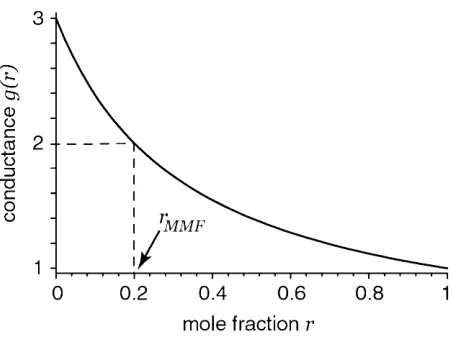
The midpoint mole fraction (MMF) (denotedrMMF)
defined by:
gðrMMFÞ ¼ 1
2ðg1þg2Þ ð48Þ
can be determined by solving the implicit equation:
rMMF¼
k2ðrMMFÞ k1ðrMMFÞ þk2ðrMMFÞ
ð49Þ
If bothkjare independent of the mole fraction (Nonner
and Eisenberg 1998; Chen et al. 1999), then Eq. (49) is explicit. In any case, Eq. (49) together with Eq. (42)
shows thatthe MMF is determined by the activity
coef-ficients of the ions inside the channel.
Figure 1 shows a mole fraction experiment
[Eq. (47)] computed assuming the kj are independent
of the mole fraction. In that case, our model channel does not exhibit an anomalous mole fraction effect; it does not have an extremum. However, the conduc-tance versus mole fraction curve is nonlinear when-ever:
k1¼ cbath
1 cchan
1
6¼k2¼ cbath
2 cchan
2
ð50Þ
or, equivalently:
lex1 ðbathÞ lex1 ðchannelÞ 6¼lex2 ðbathÞ lex2 ðchannelÞ ð51Þ
Permeability ratios
We now turn to the most commonly used selectivity experiment, the measurement of the reversal potential to estimate the permeability of the channel to ions. This situation can be studied without the analytic approxi-mation to the PNP equations derived in Appendix A. In particular, the analysis of this section doesnotrequire a channel with uniform fixed charge (see ‘‘Assumptions’’ section).
Jj
Z d
0
cjðsÞ
DjðsÞAðsÞ exp zje
kT/ðsÞ
ds
¼cjðdÞcjðdÞexp
zje
kT/ðdÞ
cjð0Þcjð0Þexp
zje
kT/ð0Þ
ð52Þ
As discussed in the ‘‘Boundary conditions’’ section, we use the results of Gillespie and Eisenberg (2001) to evaluate the right-hand side of Eq. (52). Specifically, Eq. (70) of that paper shows that:
cjð0Þcjð0Þexp
zje
kT/ð0Þ
cbathj ðLÞcjðLÞexp
zje
kTV
ð53Þ
cjðdÞcjðdÞexp
zje
kT/ðdÞ
cbathj ðRÞcjðRÞ ð54Þ
and soEq. (52) becomes:
Jj
Rd
0
cjðsÞ
DjðsÞAðsÞexp
zje
kT/ðsÞ
ds
¼ cbathj ðRÞcjðRÞcjbathðLÞcjðLÞexp zkTjeV
ð55Þ
Therefore, for a channel with the GHK assumptions listed previously, we have:
Jj cchanj
Dchan
j
Z d
0
cðsÞ
AðsÞDðsÞexp
zce
kT/ðsÞ
ds
¼cbathj ðRÞcjðRÞ cbathj ðLÞcjðLÞexp
zce
kTV
ð56Þ
for cation speciesj. If there are twocation species 1 and 2 and the anion current is negligible, then at the reversal potentialVrev:
J2¼ J1 ð57Þ
and:
1¼J2
J1
¼D
chan 2 =Dchan1 cchan
2 =cchan1 cbath
2 ðRÞc2ðRÞ cbath2 ðLÞc2ðLÞexp zkTceVrev
cbath
1 ðRÞc1ðRÞ cbath1 ðLÞc1ðLÞexp
zce
kTVrev
ð58Þ
Under the bi-ionic conditions of the permeability experiment, with only species 1 in the left bath (c2(L)=0) and only species 2 in the right (c1(R)=0), by Eq. (5) we have:
P2
P1
¼D
chan 2
Dchan1
k2 k1
ð59Þ
where, for bath concentrationc, we define:
kj¼ cbathj ðcÞ
cchan
j
ð60Þ
This derivation of the GHK equation is
mathemati-cally similar tothe one by Hille (2001), but includes
more physics.
Determining model parameters
The results of the previous sections can be used to esti-mate the physical and chemical properties of ions in channels, given certain assumptions. Specifically,
for each ion species j, the diffusion coefficient Dchanj
and the activity coefficientcchanj can be determined from experimental measurements (assuming our model of the channel). Bath values of these parameters are known (Robinson and Stokes 1965; Conway 1969; Zematis et al. 1986) or can be calculated from separate theories (Simonin 1996; Barthel et al. 1998; Durand-Vidal et al. 2000).
In order to find the ion parameters, one must know the dimensions and fixed charge profile of the channel. For many channels the dimensions such as the radius and length of the channel (or the selectivity filter) are approximately known from experiments. The tertiary structure of the channel shows which amino acid side chains face the conduction pathway, when the structure is known. Genetic manipulations gives this information in other cases. The identity of the amino acid residues
allows good estimates of the permanent charge q
(per-haps depending on protonation state). When we assume
uniformly spread fixed charge,qis given by the sum of
the charges of the amino acid residues divided by the
volume of the pore determined from the estimates ofA
andd.
[image:7.595.58.284.42.211.2]It is important to note that if the channel contains both positively and negatively charged amino acid resi-dues (voltage-gated sodium channels, for example), this approach should not be used; the spatial distribution of permanent charge in the channel has profound effects on Fig. 1. Graph of Eq. (47) withg1=1,g2=3, andk1/k2=4. While
the qualitative and quantitative properties of the chan-nel, including its current/voltage relations. This result is well known from the analogous analysis of semicon-ductors (Henisch 1984; Selberherr 1984; Jacoboni and Lugli 1989).
If the charge, length, and area of the channel (q, d,
and A) are known, diffusion and chemical parameters
can be determined from the conductance and mole fraction experiments. Equation (36) can be used to
estimate the diffusion coefficient of species j from its
saturated conductancegj:
Dchanj ¼kT
e2
d A
gj
zjj jq
ð61Þ
Determining the channel activity coefficients (that is, excess chemical potentials or free energies) first requires assuming that these activity coefficients inside the channel are the same for all experiments; that is, we must
assume that Eq. (21) is not true. In that case, the
mea-surement of the midpoint mole fractionrMMFallows an
estimate of the relative channel activity coefficients through Eq. (49):
cchan2 cchan
1
¼c
bath 2 cbath
1
1
rMMF
1
ð62Þ
By using Eq. (62), the absolute channel activity coeffi-cients of all the experimental ions can be determined if one knows the absolute activity coefficient of one ion. Nonner and Eisenberg (1998) do this by assuming the activity coefficient of protons is 1.
Discussion
Summary
We have examined three selectivity experiments (see above) in terms of the PNP electrodiffusion model. The
GHK permeability ratiowas examined for a fairly
general class of channels (see ‘‘Assumptions’’ section above). The conductance ratio and conductance mole fraction experiments were treated with a simple model channel with a constant fixed charge density in the channel. For that model, we derived an approximate analytical solution to the PNP equations with Donnan boundary conditions (see ‘‘Boundary conditions’’ sec-tion).
The PNP model we consider [Eqs. (9) and (12)] con-tains two ion parameters: the diffusion coefficient and the excess chemical potential. Both take into account the size of the ions, but measure different physical proper-ties; the diffusion coefficient measures the resistance a moving ion encounters, while the excess chemical po-tential measures the effects of the ions’ packing and the electrostatic effects of such packing (Nonner et al. 2000), as well as the solvation energy (Nonner et al. 2001).
In the case of the model channel, the conductance ratio and mole fraction experiments each directly
mea-sure one of these two properties. Specifically, ifgjis the
saturated conductance of cationj, then, for two cations, the ratio of these conductances is the ratio of the diffu-sion coefficients:
g2
g1
¼D
chan 2
Dchan 1
ð63Þ
Furthermore, in the mole fraction experiment the
mid-point mole fractionrMMF(where the total conductance
is half way between the limiting conductances) is deter-mined by the ratio of the activity coefficients of the ions inside the channel:
rMMF¼ 1 1þk1=k2
ð64Þ
where:
kj¼ cbathj cchan
j
ð65Þ
and the activity coefficient is linked to the excess chem-ical potential by Eq. (10). Lastly, the GHK permeability ratio is a combination of the diffusion and activity co-efficients inside the channel:
P2
P1
¼D
chan 2
Dchan 1
k2 k1
ð66Þ
Note that by Eq. (21) it is possible that the kj are
functions of the concentration and in that case Eq. (64) is an implicit equation and the permeability ratio in Eq. (66) is concentration dependent. Even when thecchanj
arenot functions of the mole fraction, the permeability
ratio given by Eq. (66) is concentration dependent be-cause the bath activity coefficients will vary with bath concentrations. For LiCl and KCl solutions this effect alone can give a permeability ratio at 2 M that is 60% larger than that at 100 mM (Robinson and Stokes 1965; Conway 1969; Zematis et al. 1986).
Although we invert these equations to give ion
parameters (see ‘‘Determining model parameters’’
section), it must be understood that the equations depend on many assumptions designed to make this model an-alytically simple – and the inversion requires even more assumptions. For example, the inversion requires the unrealistic assumption that the excess chemical poten-tials are the same under all experimental conditions.
include flux. In this paper we use our simplified channel totry tomake theoretical inroads intothe physics and chemistry of selectivity.
Thermodynamics of selectivity
A closer examination of the derivation of the conduc-tance ratioresult [Eq. (36)] shows that each individual cation species conductance is proportional to its own diffusion coefficient when it is the only cation species in both baths:
gj¼zj
e2
kT A dj jqD
chan
j ð67Þ
This is true with either symmetric or asymmetric bath concentrations.
It is interesting tonote that the conductance does not depend on the activity coefficient of the cation. The reason is that the inside of the channel is (nearly) charge neutral [see Eq. (96)] [Gillespie and Eisenberg (2001) give a de-tailed discussion]. Because the channel protein is nega-tively charged with charge densityq, it attracts sufficient cations to neutralize (that is, screen) its own charge. Since charge neutrality is the end result, the specifics of the cations’ packing and their dehydration energy (which are measured by the activity coefficient) are un-important. In this case, the only difference between ca-tions in two experiments is the resistance they experience as they move through the channel. That is measured by the diffusion coefficient alone.
When there are several types of cations to screen the fixed charge of the channel protein, then, for each ion species, the difference between its electrochemical po-tentials in the baths and inside the channel determines how well the ion partitions into the channel (Nonner et al. 2000, 2001). In general, the more negative the electrochemical potential of an ion is (either in the bath or in the channel), the more energy it takes to remove it and any difference in the electrochemical potential between two compartments is a driving force on the ion.
As discussed in ‘‘The PNP equations’’ section, the
local electrochemical potential of ion species j has two
components, ideal (id) and excess (ex) (Nonner et al. 2000):
ljð Þ ¼x lidj ð Þ þx lexj ð Þx ð68Þ
where:
lidjð Þ ¼x zje/ð Þ þx kTln cjð Þx
ð69Þ
Here /(x) is the electrostatic potential and cj(x) is the
concentration of species j at position x. With these
definitions the electrochemical potential difference
be-tween twopoints x1and x2can be split intotwoparts:
Dljðx1;x2Þ ¼Dlidj ðx1;x2Þ þDlexj ðx1;x2Þ ð70Þ
where:
Dlidj ðx1;x2Þ ¼ljexð Þ x1 lidj ð Þx2 ð71Þ
¼zje½/ð Þ x1 /ð Þx2 þkTln ccjjð Þð Þxx12
ð72Þ
and:
Dlexj ðx1;x2Þ ¼lidj ð Þ x1 lexj ð Þ ¼x2 kTln cjð Þx1 cjð Þx2 !
ð73Þ
Now suppose that we take x1tobe in the left bath
andx2=0 (the left edge of the channel) to give:
DljðL;0Þ ¼zje V½ /ð Þ0 þkTln
cjð ÞL
cjð Þ0
þkTln kjð ÞL
ð74Þ
By Eq. (70) of Gillespie and Eisenberg (2001), we have:
zje V½ /ð Þ0 þkTln
cjð ÞL
cjð Þ0
kTln c chan j ð Þ0
cbath j ð ÞL
!
¼ kTln kjð ÞL
ð75Þ
wherecchan
j ð Þ0 is the activity coefficient just inside the left side of the channel. Therefore:
DljðL;0Þ 0 ð76Þ
that is, the (left) bath and the channel are close to equilibrium. A similar results holds for the right bath if we takex1in the right bath andx2=d(the right edge of the channel):
DljðR;dÞ 0 ð77Þ
This near-equilibrium situation then allows us to determine the free energy of partitioning for each ion species from the left and right baths into the channel:
sjð Þ ¼L ln
cjð Þ0
cjð ÞL
zje
kT½V /ð Þ0 þln kjð ÞL
ð78Þ
sjð Þ ¼R ln
cjð Þd
cjð ÞR
zje
kT/ð Þ þd ln kjð ÞR
ð79Þ
Each sj is then in energy units of kT. If sj(L)>0, then
species j partitions into the channel from the left bath
and similarly for the right bath.
Therefore, one quantitative measure of selectivity of species 1 and 2 is:
K1;2¼exp
1
2fs1ð Þ þL s1ð Þ R ½s2ð Þ þL s2ð ÞR g
ð80Þ
exp e
kT z1z2
2 ½V /ð Þ 0 /ð Þd
k1ð ÞL k1ð ÞR
k2ð ÞL k2ð ÞR
1=2
In the case that z16¼z2, the terms V–/(0) and /(d) may be calculated from Eq. (68) of Gillespie and Eisenberg (2001) or can be approximated more coarsely as Donnan potentials (Nonner et al. 2000, 2001). If
L1,2>1, then one can infer that species 1 partitions more easily intothe channel compared tospecies 2.
In the specific case considered in this paper, we have
z1=z2and:
cchan
j ð Þ0 cchan
j ð Þd
¼1 ð82Þ
For the mole fraction (mf) experiment:
cbathj ð Þ ¼L cbathj ð Þ R cbathj ð83Þ
and therefore:
Kmf1;2 ¼k1
k2
ð84Þ
For the bi-ionic reversal potential experiment, on the other hand:
cbath2 ð Þ ¼L cbath1 ð Þ ¼R 1 ð85Þ
and so:
KGHK1;2 ¼ c
chan 2 cchan1
k1 k2
1=2
¼k1
k2 cbath
2 ð ÞR cbath1 ð ÞL
1=2
ð86Þ
The partitioning selectivity in the mole fraction ex-periment [Eq. (84)] is different from the partitioning se-lectivity in the reversal potential experiment [Eq. (86)] because the measurements are made under different conditions. Under bi-ionic conditions, species 1 can only partition in from the left bath and species 2 only from the right bath, while in the mole fraction experiment, both species partition from both baths. However, the term:
cbath 2 cbath
1
1=2
ð87Þ
is usually close to 1 if the two baths are at the same concentration; for the rather extreme case of 2 M KCl and 2 M LiCl, it less than 1.3 (Robinson and Stokes 1965; Conway 1969; Zematis et al. 1986). Therefore, the partitioning selectivities are approximately the same in the mole fraction and reversal potential experiments [with the value given by Eq. (84)] if the channel activity coefficients between the two experiments are not too different [Eq. (21)].
This difference in the partitioning selectivity L1,2 be-tween the two experiments is one example of the vari-ability of the partitioning selectivity; the partitioning selectivityL1,2isnota constant for the two species 1 and 2.L1,2not only contains the bath activity coefficients of both ions that vary with bath concentration, but it also contains the channel activity coefficients. The channel activity coefficients cchan
j have several components with
different physical and chemical origins. First, there are
terms that measure the excluded volume (entropic) in-teractions arising because two ions cannot occupy the same space. Intuitively one might think that the smaller ion would always be favored because it is seemingly easier to pack into an already crowded volume. How-ever, density functional theory studies of uncharged systems have shown that in various confined geometries
larger spheres can be selected solely on the basis of ex-cluded volume (Goulding et al. 2000, 2001). cchan
j also depends on electrostatic effects that can be different even for ions of the same valence (Nonner et al. 2000) and solvation effects that measure the difficulty of removing an ion from the bath (Nonner et al. 2001). Each of these components can change for each ion species, depending on the exact experimental conditions.
Although the partitioning selectivity L1,2 is not a
constant for the two cation species, we can use it to divide selectivity into equilibrium and nonequilibrium compo-nents. Specifically, because each side of the channel is in near equilibrium with the bath on that side of the channel [Eqs. (76) and (77)], the partitioning selectivity L1,2 as defined in Eq. (80) is an (approximately) equilibrium quantity. However, as the conductance ratio and per-meability results suggest, there is a nonequilibrium component to selectivity as well, namely the ratio of the diffusion coefficients of the cations inside the channel. We will call this the diffusion selectivity (it is possible, of course, that that the formula for the diffusion selectivity is more complex in channels for which our assumptions do not hold). Both of the equilibrium and nonequilibri-um components are necessary to determine the function of the channel; the partitioning selectivity measures the energetic differences that determine the contents of the channel, while the diffusion selectivity measures the rel-ative resistance encountered by the ions moving through the confined geometry of the channel.
An interesting consequence of separating selectivity into equilibrium (partitioning) and nonequilibrium (diffusion) components is the possibility that these two components can have opposite, perhaps balancing, ef-fects. For example, ion species 1 might partition more easily into the channel (compared to ion species 2), but might have a lower diffusion coefficient in the channel. In that case:
K1;2>1 ðpartitioning favors 1Þ ð88Þ
while:
Dchan 2
Dchan1 >1 ðdiffusion favors 2Þ ð89Þ
An example of such a case is the ryanodine receptor with Li+and K+as species 1 and 2, respectively (Chen et al. 1999).
g2
g1
¼D
chan 2
Dchan1 >1 ð90Þ
rMMF¼ 1 1þK1;2
<1
2 ð91Þ
The GHK permeability ratio, however, gives a com-posite and thus ambiguous measure of the diffusion and partitioning selectivities:
P2
P1
¼D
chan 2
Dchan1
k2 k1
Dchan 2
Dchan1
1
K1;2
ð92Þ
and it may be less than or greater than 1. This ambiguity shows that the GHK permeability ratio is not an ideal indicator of which ion is preferred by the channel. The GHK permeability ratio does, however, measure the relative size of the partitioning and diffusion selectivities.
Conclusion
The work in this paper is a first extrapolation of the selectivity theory introduced by Nonner et al. (2000, 2001). There the authors considered only an equilibrium situation, but calculated the excess chemical potentials from the concentrations of all the ions to show how both charge interactions and the space available to the ions affect selectivity. Here, we showed that even the simplest implementation of the charge/space competition idea in a flux model offers new ways to measure selectivity of a channel using classical experimental protocols. Consid-eration of the detailed properties of charge/space com-petition is likely to lead to other methods of measuring the physical properties of open ionic channels and more insight intothe physics and chemistry of selectivity.
Acknowledgements D.G. was supported by NIH grant T32NS07044. R.S.E. was supported by DARPA/SPO grant MDA972-00-1-0009. The authors wish to thank Wolfgang Nonner for his comments on the manuscript.
Appendix
Appendix A: Approximate solution to the PNP equations
Here we derive the approximate analytic solution to the PNP equations using all the assumptions mentioned previously (see above). We start by rewriting the PNP equations (12) and (9) for the inside of the channel with these assumptions:
d
2/
dx2 ¼ X
j
zjcjþq ð93Þ
Jj¼DjA dcj
dxþ zje
kTcj
d/ dx
ð94Þ
with the channel located on the interval (0,d).
For boundary conditions we will use the classic Donnan boundary conditions of Eqs. (13, 14, 15, 16, 17, 18). In general we do not require all of the specific details of these boundary conditions, but only the fact that due toEq. (15) the channel is charge neutral at the edges; that is:
0¼X
j
zjcjð Þ þ0 qð Þ ¼0
X
j
zjcjð Þ þd q dð Þ ð95Þ
In this analysis we could use any boundary conditions which satisfy this condition. However, for channels the Donnan boundary conditions are the only boundary conditions we are aware of that give charge neutrality at the edges.
We will show that when we use boundary conditions for the concentrations that include charge neutrality and
when the anion concentration is negligible, the
exact solution of the PNP equations follows by
requiring charge neutrality everywhere inside the
channel; that is:
0¼X
j
zjcjþq ð96Þ
or, equivalently by the Poisson equation (93):
d2/
dx2 ¼0 ð97Þ
throughout the channel. We show this by deriving a general condition that must be satisfied whenever con-dition (97) is assumed.
For the moment we do not assume thatqis constant,
but some function of x. By Eq. (97), / is linear and
necessarily:
/ð Þ ¼x ½/ð Þ d /ð Þ0 x
dþ/ð Þ0 ð98Þ
Integrating the Nernst-Planck equation (94) gives:
Jj¼ zj
A dDjw
cjðdÞ cjð0ÞexpðzjwÞ 1expðzjwÞ
ð99Þ
where:
w¼ e
kT½/ðdÞ /ð0Þ ð100Þ
Substituting Eq. (99) intothe Nernst-Planck equa-tion (94) gives:
zj w
d
cjðdÞ cjð0ÞexpðzjwÞ 1expðzjwÞ
¼dcj
dx þzjcj
w
d ð101Þ
whose solution is:
cjðxÞ
¼cjðdÞ cjð0ÞexpðzjwÞ
1expðzjwÞ
cjðdÞ cjð0Þ
1expðzjwÞ
exp zjw
x d
Equation (102) is a solution for the concentrations if it satisfies the Poisson equation (93). Therefore, substi-tuting Eq. (102) intoEq. (96) shows that:
0¼qðxÞ þX
j
zj
cjðdÞ cjð0ÞexpðzjwÞ 1expðzjwÞ
þ cjð0Þ cjðdÞ
1expðzjwÞ
exp zjw
x d
ð103Þ
Therefore any time one assumes that/is linear, the
measure of how good is this approximation is how close the right-hand side of Eq. (103) is to zero for allx(in an absolute sense if all concentrations are measured in molar). If the right-hand side is not small for some re-gion ofx, then there is a region of space charge. In that case, the original assumption of charge neutrality is vi-olated and, by the Poisson equation (93), the potential/
is nolonger linear. This, in turn, will invalidate the
predicted concentration profiles and current.
In the case that we consider whereqis constant inside the channel, the co-ions have negligible concentration inside the channel, and all the counter-ions are of the same valence, then Eq. (103) is zerobecause we assumed that the channel was charge neutral at the edges. Therefore, up to these approximations, Eqs. (98) and (102) are an exact solution to the PNP equations.
Appendix B: Low concentration approximation of Donnan potentials
If the cations all have valence zc and the anions have
valence –1, we will show that:
exp zce
kTWL
zc
q
j j
X
zj¼zc
cbath
j ð ÞL cchan
j
cjð ÞL ð104Þ
Tostart, by Eq. (15) the Donnan potential YLmust
satisfy:
0¼NYzcþ1qYzc z
cP ð105Þ
where:
P ¼X
zj¼zc
cbath
j ð ÞL cchan
j
cjð ÞL ð106Þ
N ¼ X
zj¼1
cbath
j ð ÞL
cchanj cjð ÞL ð107Þ
Y ¼exp e
kTwL
ð108Þ
(we show the work on the left side of the channel. Similar formulas are valid for the right side of the channel by substituting R for L). For cation channels,
q<0, and sowe have:
0¼aeYzcþ1þYzcz
ce ð109Þ
where we have dropped the L subscript:
a¼N
P ð110Þ
and:
e¼ P
q
j j1 ð111Þ
Rewriting Eq. (109) as:
Yzc ¼z
ceaeYzcþ1 ð112Þ
we find that the right-hand side is of order e and so
Yzc ¼OðeÞ(Kevorkian and Cole 1996). In that case:
aeYzcþ1¼O e2þ1=zc
ð113Þ
and therefore:
Yzc ¼z
ceþO e2þ1=zc
ð114Þ
which is equivalent toEq. (104).
References
Barthel JMG, Krienke H, Kunz W (1998) Physical chemistry of electrolyte solutions: modern aspects. Springer, Berlin Heidel-berg New York
Berry RS, Rice SA, Rice J (2000) Physical chemistry, 2nd edn. Oxford University Press, New York
Cardenas AE, Coalson RD, Kurnikova MG (2000) Three-dimen-sional Poisson-Nernst-Planck theory studies: influence of membrane electrostatics in gramicidin A channel conductance. Biophys J 79:80–93
Chen DP, Barcilon V, Eisenberg RS (1992) Constant field and constant gradients in open ionic channels. Biophys J 61:1372– 1393
Chen DP, Lear J, Eisenberg B (1997a) Permeation through an open channel: Poisson-Nernst-Planck theory of a synthetic ionic channel. Biophys J 72:97–116
Chen DP, Xu L, Tripathy A, Meissner G, Eisenberg B (1997b) Permeation through the calcium release channel of cardiac muscle. Biophys J 73:1337–1354
Chen DP, Xu L, Tripathy A, Meissner G, Eisenberg B (1999) Se-lectivity and permeation in calcium release channel of cardiac muscle: alkali metal ions. Biophys J 76:1346–1366
Conway BE (1969) Electrochemical data. Greenwood Press, Westport, Conn
Durand-Vidal S, Simonin J-P, Turq P (2000) Electrolytes at In-terfaces. Kluwer, Dordrecht, The Netherlands
Gillespie D (1999) A singular perturbation analysis of the Poisson-Nernst-Planck system: applications to ionic channels. PhD thesis, Rush University, Chicago
Gillespie D, Eisenberg RS (2001) Modified Donnan potentials for ion transport through biological ion channels. Phys Rev E 63:061902
Goldman DE (1943) Potential, impedance, and rectification in membranes. J Gen Physiol 27:37–60
Goulding D, Hansen J-P, Melchionna S (2000) Size selectivity of narrow pores. Phys Rev Lett 85:1132–1135
Henisch HK (1984) Semiconductor contacts: an approach to ideas and models. Oxford University Press, New York
Hille B (2001) Ionic channels of excitable membranes, 3rd edn. Sinauer, Sunderland, Mass
Hodgkin AL, Katz B (1949) The effect of sodium ions on the electrical activity of the giant axon of the squid. J Physiol (Lond) 108:37–77
Hollerbach U, Chen D-P, Eisenberg RS (2001) Two- and three-dimensional Poisson-Nernst-Planck simulations of current flow through gramicidin A. J Sci Comput 16:373–409
Im W, Seefeld S, Roux B (2000) A grand canonical Monte Carlo-Brownian dynamics algorithm for simulating ion channels. Biophys J 79:788–801
Jacoboni C, Lugli P (1989) The Monte Carlo method for semi-conductor device simulation. Springer, Berlin Heidelberg New York
Kevorkian J, Cole JD (1996) Multiple scale and singular pertur-bation methods. Springer, Berlin Heidelberg New York Kurnikova MG, Waldeck DH, Coalson RD (1996) A molecular
dynamics study of dielectric friction. J Chem Phys 105:628–638 Kurnikova MG, Coalson RD, Graf P, Nitzan A (1999) A lattice relaxation algorithm for three-dimensional Poisson-Nernst-Planck theory with applications to ion transport through the gramicidin A channel. Biophys J 76:642–656
MacInnes DA (1939) The principles of electrochemistry. Reinhold, New York
Nonner W, Eisenberg B (1998) Ion permeation and glutamate residues linked by Poisson-Nernst-Planck theory in L-type calcium channels. Biophys J 75:1287–1305
Nonner W, Catacuzzeno L, Eisenberg B (2000) Binding and se-lectivity in L-type calcium channels: a mean spherical approx-imation. Biophys J 79:1976–1992
Nonner W, Gillespie D, Henderson D, Eisenberg B (2001) Ion accumulation in a biological calcium channel: effects of solvent and confining pressure. J Phys Chem B 105:6427–6436 Robinson RA, Stokes RH (1965) Electrolyte solutions.
Butter-worths, London
Rosenfeld Y (1993) Free energy model for inhomogeneous fluid mixtures: Yukawa-charged hard spheres, general interactions, and plasmas. J Chem Phys 98:8126–8148
Rosenfeld Y, Schmidt M, Loewen H, Tarazona P (1997) Funda-mental-measure free-energy density functional for hard spheres: dimensional crossover and freezing. Phys Rev E 55:4245– 4263
Selberherr S (1984) Analysis and simulation of semiconductor de-vices. Springer, Berlin Heidelberg New York
Schuss Z, Nadler B, Eisenberg RS (2001) Derivation of Poisson and Nernst-Planck equations in a bath and channel from mo-lecular model. Phys Rev E 64:036116
Simonin J-P (1996) Real ionic solutions in the mean spherical ap-proximation. 1. Simple salts in the primitive model. J Phys Chem 100:7704–7709