Original Article
Prognostic value of immune cell infiltration, tertiary
lymphoid structures and PD-L1 expression
in Merkel cell carcinomas
Daniel S Behr1, Wiebke K Peitsch1, Christian Hametner2, Felix Lasitschka3, Roland Houben4, Kathrin
Schönhaar1, Julia Michel1, Claudia Dollt1, Matthias Goebeler4, Alexander Marx5, Sergij Goerdt1, Astrid
Schmieder1
1Department of Dermatology, Venereology and Allergology, 5Department of Pathology, University Medical Center and Medical Faculty Mannheim, University of Heidelberg, Mannheim, Germany; 2Department of Neurology, 3Institute of Pathology, University Hospital Heidelberg, Heidelberg, Germany; 4Department of Dermatology, Julius Maximilians University, Würzburg, Germany
Received September 10, 2014; Accepted October 31, 2014; Epub October 15, 2014; Published November 1, 2014
Abstract: Merkel cell carcinoma (MCC) is an aggressive, virus-associated, neuroendocrine tumor of the skin mainly
affecting immunocompromised patients. Higher intratumoral infiltration with CD3 and CD8 positive T-cells is associ -ated with a better prognosis, highlighting the relevance of the immune system for MCC development and progres-sion. In this study 21 primary MCCs were stained with immune cell markers including CD3, CD4, CD8, CD68, CD20, and S100. Furthermore, tumor-infiltrating neutrophils, tertiary lymphoid structures and PD-L1 expression were ana -lyzed and correlated with overall and recurrence free survival. All MCCs were Merkel Cell Polyomavirus positive.
Overall and recurrence-free survival did not correlate with intra- and peritumoral CD3 and CD8 T-cell infiltration. In addition, no significant association regarding prognosis was found for tumor-associated neutrophils, tumor-associat
-ed macrophages or PD-L1 positivity in MCCs. Interestingly, the presence of tertiary lymphoid structures (TLS) in the tumor microenvironment significantly correlated with recurrence-free survival (P=0.025). In addition, TLS were sig
-nificantly associated with a higher CD8/CD4 ratio in the tumor periphery (P=0.032), but not in the center of the tu-mor (P > 0.999). These results demonstrate for the first time that TLS, easily assessed in paraffin-embedded tissue
in the tumor periphery of MCCs, may be a valuable prognostic factor indicating prolonged recurrence free survival.
Keywords: Merkel cell carcinoma, immune cell infiltration, tertiary lymphoid structures, PD-L1
Introduction
Merkel cell carcinomas (MCCs) are rare and highly aggressive neuroendocrine neoplasms of the skin that mainly develop in elderly or immunocompromised patients [1]. The associ -ation between MCC development and immuno-suppression led to the groundbreaking idea that MCC might belong to oncovirus-induced cancers. In 2008, Feng et al. described for the first time Merkel Cell Polyomavirus (MCPyV) in 8 out of 10 MCCs [2]. Most MCPyV-positive MCCs express several MCPyV proteins, among them large T antigen and small T antigen which potentially stimulate tumor cell proliferation. This and other observations support a patho -genic role of MCPyV for MCC development
used, MCPyV is found in about 80-100% of MCCs [8]. It is still unclear whether in negative MCCs the detection method was not sensitive enough or whether such MCCs have another etiology or loose MCPyV oncogene expression during tumor progression [9].
-response. No association with M2 macrophage infiltration characterized by CD68/CD163 posi -tivity was found [11]. It has not been studied so far whether other innate immune cells such as myeloid-derived suppressor cells or tumor-as- sociated neutrophils (TANs) are implicated in MCC progression, but their tumor promoting properties have been shown for many other tumor entities [12, 13].
Additional histopathological features previously associated with a better prognosis of patients with different kinds of tumors are tertiary lym-phoid structures (TLS) present in the tumor environment [14-16]. Tertiary lymphoid struc -tures (TLS) are known to play an important role in autoimmunity, organ transplantation and infection. They constitute important ectopic an-tigen-presenting formations with structural si- milarities to lymph nodes. Infiltrating CD20-positive B cells cluster with T cells and dendritic cells and form germinal center-like patterns that lead to the development of specific humor -al and cell-mediated immune responses, there-by sustaining long-term immunity [17]. Recent studies have identified TLS in the tumor micro -environment as a site of dendritic cell (DC), B cell and T cell priming and maturation with a resultant stronger anti-tumor immune response and longer overall survival [18-20]. However, the presence of TLS and their significance for overall and recurrence-free survival has so far not been studied in MCC.
Evidence that the immune system significantly contributes to MCC development and
progres-receptor PD-1. In addition, PD-L1 expression has been described in MCCs, tumor-infiltrating and peritumoral leucocytes [23, 24]. These findings imply the possibility that blocking anti -bodies against PD-1 or PD-L1 could enhance an endogenous anti-tumor response leading to tumor regression.
In the present study we investigated the corre-lation of intratumoral and peritumoral CD3+ lymphocytes, CD8+ cytotoxic cells, CD4+ T-hel-per cells, CD68+ macrophages, and tumor-associated neutrophils with overall and recur-rence-free survival in 21 patients with primary MCC. In addition, we examined whether PD-L1 expression in MCC and the presence of tertiary lymphoid structures in the tumor microenviron-ment was associated with a better prognosis.
Materials and methods
Patients and tumor tissues
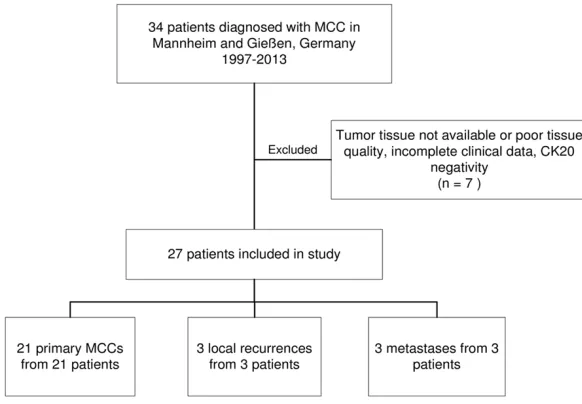
Our sample comprised 43 formalin-fixed paraf -fin-embedded Merkel cell carcinoma (MCC) specimens from 34 patients, which had been surgically removed or biopsied between 1997 and 2013 at the University Hospital Mannheim, University of Heidelberg, Germany (n=37 tu- mors from 31 patients) or at the Department of Dermatology of the University Hospital Giessen, Germany (n=6 tumors from 3 patients). Out of the 34 subjects 7 were excluded due to incom-plete clinical data, insufficient amounts of par -affin-embedded MCC tissue or inadequate tis -sue sample quality. The final study cohort con
-Figure 1. Flowchart of subjects included in the study.
[image:2.612.89.380.72.274.2]tained material of 21 primary carcinomas from 21 subjects as well as 3 local recurrences and 3 metastases from 6 subjects (Figure 1). All tumors were positive for the Merkel cell marker cytokeratin 20.
Clinical data including age, sex, immune status, localization and kind of MCC, stage at initial diagnosis and at the end of follow-up period, recurrence, recurrence-free and overall survival were extracted from the patients’ clinical re- cords. Immunosuppression was assumed in patients with inherited or acquired immunodefi -ciency syndromes, organ transplant, other dis-seminated malignancies, immunosuppressive medications or chemotherapy. Staging was per- formed according to the classification suggest -ed by the American Joint Cancer Committee (AJCC) in 2010 [25]. Due to the fact that the size of the primary MCC was only inconsistently reported, patients were categorized into local-ized disease (stages I and II), regional disease (stage III) and disseminated disease (stage IV). Local recurrences were classified as stage II, lymph node metastases and in-transit metas-tases as stage III. For patients presenting a pri-mary MCC at initial contact, recurrence-free survival was defined as the disease-free inter -val between curative treatment of the primary tumor and if applicable concomitant metasta-ses, and relapse of the MCC in months. If patients initially presented local recurrences or MCC metastases, recurrence-free survival was defined as the disease-free interval after cura -tive treatment of the recurrence or the metas-tases. If patients experienced several relapses in the course of their disease, time until the first relapse was taken into account. Patients who never reached a disease-free state were de- fined as having a recurrence-free survival of 0 months. All procedures were performed accord-ing to the principles of the Declaration of He- lsinki and approved by the local medical ethic committee.
Immunohistochemistry and light microscopy
One µm-sections of paraffin-embedded MCC tissues were dried at 37°C overnight and depa-raffinized using graded alcohol series accord -ing to standard protocols. Subsequent heat-in-duced antigen retrieval was carried out in either Heat-Induced Epitope Retrieval (HIER) citrate buffer (pH6) for 40 min at 95°C or Tris/EDTA buffer pH9 (Leica Biosystems, UK, Novocastra Epitope Retrieval Solutions) for 20 min at 95°C
using a water bath. All MCCs were stained with antibodies against the marker protein cytokera-tin 20 (Clone Ks 20.8, Dako M7019, Hamburg, Germany) at a working concentration of 0.25 µg/mL. The percentage of proliferating cells was determined by staining with Ki67 antibody (Ab15580, Abcam, Cambridge, UK) at a con -centration of 3 µg/mL. For evaluation of tumor stroma cells the following antibodies were used for staining: Stabilin-1 (custom-made rabbit anti-mouse/human stabilin-1 antibody (RS1), PSL GmbH, Heidelberg, Germany; working dilu-tion 1:1000), CD68 (Clone PG-M1, Dako M0-876; 0.1 µg/mL), CD163 (PHA-69786, Dianova, Hamburg, Germany; working dilution 1:100), CD3 (Clone SP7, RM-9107 Thermo Scientific, Ulm, Germany 1:150); CD4 (NCL-CD4-1F6, Novocastra, Wetzlar, Germany; 80 µg/mL); CD8 (Clone 8/144B, Dako M7103, 3 µg/mL), CD31 (Clone JC70A, Dako M0823, 1:100), PD-1 (Ab-52587, Abcam, Cambridge, UK; 20 µg/mL) and PD-L1 (anti human B7-H1 clone 5H1, 2 µg/mL, kindly provided by Dr Lieping Chen, Yale Cancer Center, New Haven, USA [26]), CD20 (Clone L26, Dako M0755, working dilution 1:1500), and S100 (Dako Z0311, 1:100). Antigen-bound primary antibodies were visualized by appropri-ate horseradish-peroxidase (HRP)-coupled sec-ondary antibodies, HRP-coupled polymers or Avidin-Biotin Complex (ABC) in combination with Streptavidin-HRP (PD-L1). AEC Substrate-Chromogen (Dako) was precipitated by HRP-activation, followed by hematoxylin counters- tain.
Images of all stained tumor slides were record-ed with a Nikon Eclipse Ni-E microscope (Nikon DS-U3 Digital Camera Control Unit) and soft-ware system (Nikon, Düsseldorf, Germany).The absolute number of positively stained intratu-moral cells was counted using ImageJ count in an area of 1 mm2.
Scoring
III: > 50%). CD8/CD4 ratio was assessed in the tumor center and periphery and was then dichotomized for statistical analysis (CD8/ CD4 ≤ 1 or > 1). TLS were identified by HE-morphological appearance and staining with CD4, CD8, CD20 and S100 antibodies (Figure 2B-E).
Membranous PD-L1 expression in MCCs was dichotomized into two categories (absent or low vs. strong). More than 50 PD-L1-positive intra-tumoral macrophages/mm2 were classified as
strong infiltration, ≤50 as a limited infiltration. The extent of PD-L1 expression in peritumoral lymphohistiocytic infiltrates was classified into the categories limited (≤ 10%) or strong (> 10%).
Evaluation and counting was performed by two independent investigators (D.S.B. and A.S.). In case of discordance a third investigator (W.K.P.) was consulted and specimens were discussed until unanimous agreement was achieved.
DNA isolation and Merkel cell polyomavirus detection
DNA was isolated from serial paraffin sections using a DNA Isolation Kit (Qiagen, Hilden, Germany). MCC samples were analyzed for the presence of MCPyV by using a TaqMan assay
specific for the MCPyV large T antigen and VP1 gene, as described previously [27, 28].
Statistical analysis
Statistical analysis was performed with the Statistical Package for Social Science (IBM Corp. Released 2012. IBM SPSS Statistics for Mac, Version 21.0. Armonk, NY: IBM Corp.). Ma-nn-Whitney-U tests or Student T-tests were applied for continuous distributions and Fi- sher’s Exact-Tests for categorical distributions. Spearman’s P was used for correlations with non-normal distribution. All statistical tests were two-sided, and a P-value ≤ 0.05 was con -sidered as significant.
Results
Impact of tumor infiltrating leukocytes on over -all and recurrence-free survival
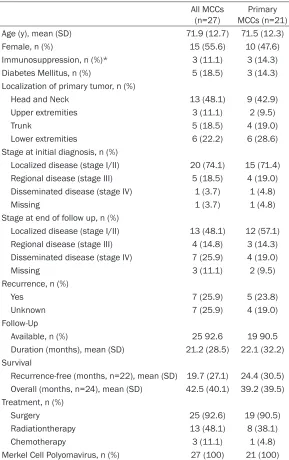
[image:4.612.91.525.72.295.2]In our patient cohort the mean age at first diag -nosis of MCC was 71.9 years and 11.1% of the patients were immunosuppressed (Table 1). The most frequent localization of the primary tumor was the head and neck region (48.1%). At initial diagnosis, 74.1% of the patients had localized disease (stage I or II according to the classification suggested by the AJCC 2010). At the end of the follow-up period 48.1% still had Figure 2. TLS as prognostic markers in MCCs. (A) Box blot showing the association between TLS and recurrence-free
survival (p=0.25, Mann-Whitney-U-Test); (B) Immunohistochemical staining of TLS with anti-CD4 antibody; (C-E) Im
local disease while 14.8% suffered from region -al disease and 25.9% from distant metastases. Local recurrence occurred in 25.9%. In the whole patient sample, the mean recurrence-free survival was 19.7 months and the mean overall survival 42.5 months. Patients with pri-mary MCCs had a mean recurrence-free vival of 24.4 months and a mean overall sur-vival of 39.2 months. All MCCs were MCPyV-positive (Table 1).
0.457, P=0.075) or overall survival (CD31: Spearman’s ρ=-0.123, P=0.627, Ki67: Spe- arman’s ρ=0.08, P=0.752).
Correlation of tumor-associated neutrophils, tertiary lymphoid structures and PD-L1 with survival
[image:5.612.91.380.83.543.2]Recent studies point to a negative correlation of tumor-associated neutrophil (TAN) infiltration with tumor prognosis [12] and to a favorable
Table 1. Characteristics of the study cohort
All MCCs
(n=27) MCCs (n=21)Primary Age (y), mean (SD) 71.9 (12.7) 71.5 (12.3)
Female, n (%) 15 (55.6) 10 (47.6)
Immunosuppression, n (%)* 3 (11.1) 3 (14.3)
Diabetes Mellitus, n (%) 5 (18.5) 3 (14.3)
Localization of primary tumor, n (%)
Head and Neck 13 (48.1) 9 (42.9)
Upper extremities 3 (11.1) 2 (9.5)
Trunk 5 (18.5) 4 (19.0)
Lower extremities 6 (22.2) 6 (28.6)
Stage at initial diagnosis, n (%)
Localized disease (stage I/II) 20 (74.1) 15 (71.4) Regional disease (stage III) 5 (18.5) 4 (19.0)
Disseminated disease (stage IV) 1 (3.7) 1 (4.8)
Missing 1 (3.7) 1 (4.8)
Stage at end of follow up, n (%)
Localized disease (stage I/II) 13 (48.1) 12 (57.1) Regional disease (stage III) 4 (14.8) 3 (14.3)
Disseminated disease (stage IV) 7 (25.9) 4 (19.0)
Missing 3 (11.1) 2 (9.5)
Recurrence, n (%)
Yes 7 (25.9) 5 (23.8)
Unknown 7 (25.9) 4 (19.0)
Follow-Up
Available, n (%) 25 92.6 19 90.5
Duration (months), mean (SD) 21.2 (28.5) 22.1 (32.2) Survival
Recurrence-free (months, n=22), mean (SD) 19.7 (27.1) 24.4 (30.5) Overall (months, n=24), mean (SD) 42.5 (40.1) 39.2 (39.5)
Treatment, n (%)
Surgery 25 (92.6) 19 (90.5)
Radiationtherapy 13 (48.1) 8 (38.1)
Chemotherapy 3 (11.1) 1 (4.8)
Merkel Cell Polyomavirus, n (%) 27 (100) 21 (100)
SD: standard deviation; *The three immunocompromised patients suffered from my-cosis fungoides or from non-Hodgkin lymphoma or received an immunosuppressive therapy for rheumatoid arthritis (leflunomid and prednisolone).
Since it has been suggested that a high intratumoral T-cell (CD3+) and cytotoxic T-cell (CD8+) count is associated with a favorable prognosis of MCC patients [10, 29], we assessed the composition of the inflammatory infiltrate in the 21 primary MCCs of our cohort and its correlation with recurrence-free and overall survival. Exemplary immuno-histochemical stainings are shown in Supplementary Fi- gure S1, and raw data of CD3, CD4, CD8, CD68, CD31 and ki67 cell counts in Supp-lementary Table S1. PD-1 pos-itive T-cells were scares and only found in the stroma of 4 out of 21 MCCs. Nearly all macrophages present in the MCCs stained positive for CD163. Interestingly, no Stabi- lin-1+ macrophages were de- tected in the MCCs, only the surrounding tissue macroph- ages expressed Stabilin-1. No- ne of the leukocyte antigens examined (CD3, CD4, CD8, CD8/CD4 ratio, CD68) were significantly associated with overall survival or recurrence-free survival when counted intratumorally (Table 2) or in the tumor periphery (data not shown). Furthermore, the in- tratumoral density of CD31+ vessel and the proliferation rate assessed by Ki67 sta- ining did not correlate with recurrence-free survival (CD- 31: Spearman’s ρ=-0.037, P=
prognosis when tertiary lymphoid structures (TLS) are found in the tumor periphery [17-19] or when MCCs are PD-L1 positive [24].
In our cohort of 21 patients with primary MCCs, neither a significant association of overall sur -vival with intratumoral (TAN+ vs. TAN-: median 6
months (IQR 5, 80.5) (n=4) vs. median 34.5 months (IQR 13.75, 58.25), n=14, P=0.524) or with peritumoral (TAN+ vs. TAN-: median 5 mo-
nths (IQR n.a.) (n=2) vs. median 3.5 months (IQR 9.5, 58.75) (n=16), P=0.16) TAN infiltra -tion, nor an association of recurrence-free sur-vival with intratumoral (TAN+ vs. TAN-: median 3
initial diagnosis did not correlate with the pres-ence of TLS (Table 3).
TLS have also been described in metastatic tumors including metastatic melanomas [30, 31]. We therefore analyzed if TLS were present also in local recurrences and in metastases. Indeed, all local recurrences and all metasta-ses contained TLS.
PD-L1 expression by MCCs has been shown to correlate with improved overall survival of patients with MCC [24]. We therefore analyzed whether PD-L1 expression in tumor cells,
intra-Table 2. Correlation of intratumoral immune markers with overall and recurrence-free survival
Overall survival Recurrence-free survival N Spearman’s ρ P-value N Spearman’s ρ P-value
CD3 17 0.156 0.55 15 -0.271 0.329
CD4 17 -0.296 0.248 15 -0.355 0.194
CD8 18 0.07 0.783 16 -0.194 0.472
CD4/CD8 17 -0.25 0.333 15 0.002 0.995
CD68 18 0.152 0.548 16 -0.323 0.222
CD31 18 -0.123 0.627 16 -0.037 0.892
[image:6.612.89.401.97.216.2]Ki67 18 0.08 0.752 16 0.457 0.075
Table 3. Associations between tertiary lymphoid structures (TLS) and clinicopathological or prognostic features
TLS+ TLS- P
n 8 13
Age (y), mean (SD) 66.9 (13.4) 74.3 (11.3) 0.209*
Sex
Female (n=10), n (%) 4 (50) 6 (46.2) > 0.999†
Male (n=11), n (%) 4 (50) 7 (53.8)
Stage initial diagnosis, n (%)
I/II 5 (62.5) 10 (76.9) > 0.999†
III/IV 2 (25.0) 3 (23.1)
Unknown 1 (12.5) 0 (0)
Local, n (%)
Yes 1 (12.5) 4 (30.8) 0.338†
No 6 (75) 6 (46.2)
Unknown 1 (12.5) 3 (23.1)
Recurrence-free survival (month, n=16)
Median (IQR 25, 75) 40 (15, 70.5) 3 (0.75, 22.75) 0.025*
Min-Max 3-105 0-57
Overall survival (month, n=18)
Median (IQR 25, 75) 29 (5; 59) 18 (5; 57) 0.651*
Min-Max 2-105 1-135
SD: standard deviation; *Mann-Whitney-U-Test; †Fisher’s Exact Test.
months (IQR n.a.) (n=3) vs. median 17.0 months (IQR 1, 45.5), n=13, P=
0.635) or peritumoral (TAN+ vs. TAN-: median 3
months (IQR n. a.) (n=2) vs. median 18 months (IQR 1, 52.5) (n=14), P=
0.522) TAN infiltration was found, although a tr- end towards a longer re- currence-free and overall survival was surely seen in TAN- MCCs.
Interestingly however, the presence of TLS in pri-may MCCs significantly correlated with recurre- nce-free survival (TLS+ vs.
TLS-: median 40 vs. 3
months, P=0.025; Table 3; Figure 2A). Patients with MCCs containing TLS also had a somewhat lo- nger overall survival th- an those with TLS- tumors
(median 29 vs. 18 mon-ths), but differences were not statistically significant (P=0.651; Table 3). In addition, TLS were signifi -cantly associated with a higher CD8/CD4 ratio in the tumor periphery (P=
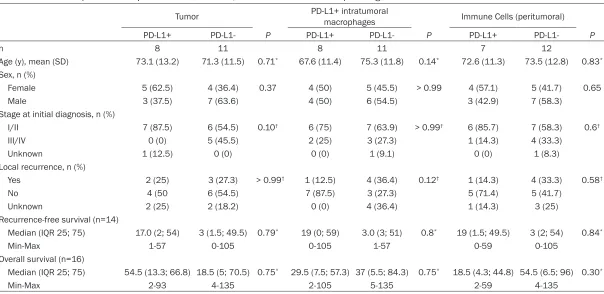
[image:6.612.88.412.264.527.2]tumoral macrophages and peritumoral immune cells was associated with specific clinicopatho -logical characteristics or survival of our cohort. Eight of 19 primary MCCs (2 not assessed, no more tissue available) were strongly positive for PD-L1 (for exemplary immunohistochemical stainings of PD-L1 positive and PD-L1 negative MCCs see Figure 3A, 3B). In addition, 8 of 19 MCCs showed a strong infiltration with PD-L1 positive macrophages and 7 of 19 MCCs had peritumoral PD-L1 positive immune cells (Table 4, for exemplary immunohistochemichal stain-ings of PD-L1 positive macrophages and PD-L1 positive immune cells see Figure 3C, 3D). Nei- ther sex nor age nor stage at initial diagnosis significantly correlated with PD-L1 expression in tumor cells and immune cells (Table 4). In addition, PD-L1 positivity in tumor cells or im- mune cells did not impact the frequency of local recurrence, recurrence-free or overall sur-vival in our cohort (Table 4).
Taken together, the presence of TLS was the only histopathological finding associated with prolonged recurrence-free survival in our pa- tient cohort.
Discussion
Our study shows for the first time that presence of TLS in the tumor periphery of MCCs signifi -cantly correlates with prolonged recurrence-free survival and that this is associated with a higher CD8/CD4 ratio in the tumor periphery.
[image:7.612.90.522.71.404.2]The immune system plays a central role for sys -temic tumor surveillance; accordingly, immuno-suppressed patients bear a considerably high-er risk of developing malignancies, including MCCs [1]. In addition, data from diverse studies support an association of a robust T-cell infiltra -tion in the tumor with a better prognosis in malignancies such as colorectal, breast and ovarian carcinoma [32-35]. In MCC presence of
Table 4. Relationship of PD-L1-expression in tumor cells, immune cells with clinicopathological features and survival rates
Tumor PD-L1+ intratumoral macrophages Immune Cells (peritumoral)
PD-L1+ PD-L1- P PD-L1+ PD-L1- P PD-L1+ PD-L1- P
n 8 11 8 11 7 12
Age (y), mean (SD) 73.1 (13.2) 71.3 (11.5) 0.71* 67.6 (11.4) 75.3 (11.8) 0.14* 72.6 (11.3) 73.5 (12.8) 0.83*
Sex, n (%)
Female 5 (62.5) 4 (36.4) 0.37 4 (50) 5 (45.5) > 0.99 4 (57.1) 5 (41.7) 0.65
Male 3 (37.5) 7 (63.6) 4 (50) 6 (54.5) 3 (42.9) 7 (58.3)
Stage at initial diagnosis, n (%)
I/II 7 (87.5) 6 (54.5) 0.10† 6 (75) 7 (63.9) > 0.99† 6 (85.7) 7 (58.3) 0.6†
III/IV 0 (0) 5 (45.5) 2 (25) 3 (27.3) 1 (14.3) 4 (33.3)
Unknown 1 (12.5) 0 (0) 0 (0) 1 (9.1) 0 (0) 1 (8.3)
Local recurrence, n (%)
Yes 2 (25) 3 (27.3) > 0.99† 1 (12.5) 4 (36.4) 0.12† 1 (14.3) 4 (33.3) 0.58†
No 4 (50 6 (54.5) 7 (87.5) 3 (27.3) 5 (71.4) 5 (41.7)
Unknown 2 (25) 2 (18.2) 0 (0) 4 (36.4) 1 (14.3) 3 (25)
Recurrence-free survival (n=14)
Median (IQR 25; 75) 17.0 (2; 54) 3 (1.5; 49.5) 0.79* 19 (0; 59) 3.0 (3; 51) 0.8* 19 (1.5; 49.5) 3 (2; 54) 0.84*
Min-Max 1-57 0-105 0-105 1-57 0-59 0-105
Overall survival (n=16)
Median (IQR 25; 75) 54.5 (13.3; 66.8) 18.5 (5; 70.5) 0.75* 29.5 (7.5; 57.3) 37 (5.5; 84.3) 0.75* 18.5 (4.3; 44.8) 54.5 (6.5; 96) 0.30*
Min-Max 2-93 4-135 2-105 5-135 2-59 4-135
a dense CD3+ and CD8+ T-cell infiltrate is a favorable prognostic sign [10, 11, 29]. The fact that we did not find any significant correlation of recurrence-free or overall survival with intra- and peritumoral CD8+ or CD3+ T-cells may be do to the small sample size of our cohort. Intratumoral T- and B-cells can specifically rec -ognize tumor antigens [36, 37], which has also been shown for CD8+ and CD4+ T-cells in MCCs [38]. However, little is known about the mecha -nisms controlling such a specific immune acti -vation. Generally it is believed that secondary lymphoid structures such as draining lymph nodes are the major sites of lymphocyte activa-tion. Recently, however, TLS have been identi -fied in direct tumor proximity. The presence of such structures has been associated with a better prognosis in diverse tumor entities such as colon, lung, breast and renal carcinomas as well as in melanomas [31, 39-42]. TLS are com -posed of T- and B-cell areas. In B-cell areas fol -licular dendritic cells and B-cells are found, while in T-cell areas high endothelial venules, mature dendritic cells as well as T-cells are localized in close proximity [31]. Such a cluster-ing of antigen-presentcluster-ing cells with cells of the adaptive immune system is thought to facilitate the development of a specific anti-tumor im-mune response by bringing the whole imim-mune cell repertoire in close proximity to tumor anti-gens. In our study TLS were analyzed for the first time in MCCs. More than one third of the MCC samples studied contained such struc-tures (8 of 21). Interestingly, the TLS status sig -nificantly correlated with the CD8/CD4 ratio in the tumor periphery. It has been reported that the presence of TLS mature dendritic cells is specifically associated with a Th1 and CD8+ cytotoxic T-cell response in non small cell lung carcinoma patients and that this finding corre -lates with improved long-term survival [43]. Based on our analysis we cannot conclude that the association of a higher CD8/CD4 ratio in the tumor periphery with the presence of TLS is a sign of a specific immune-mediated anti-tumor response. To confirm this hypothesis, it will be necessary to study the T-cell receptor repertoire and T-cell activation status. Inte-restingly, also all local recurrences and distant metastases studied in this work contained TLS. The presence of TLS in metastases has already been described for melanoma [31]. The authors suggested that TLS might be a sign of an active immune reaction against neoplastic cells. Ba- sed on their results they could not say whether
the presence of TLS helps or impairs tumor pro -gression as TLS can also be involved in the induction of peripheral immune tolerance [31, 44]. Clearly, the association between TLS and recurrence-free survival of MCC patients docu-mented here as well as the impact of TLS on metastasis formation and overall survival need to be verified in larger patient cohorts.
Patients with MCC have a high risk of lymph node and distant metastasis in the course of their disease [45]. Although their tumors are usually chemosensitive with overall response rates of 60-70% [46, 47], the median duration of response to currently used chemotherapy regimens is only about 8 months [45]. Therefore new therapeutic options are urgently needed. The promotion of an anti-tumor-directed im-mune response by blockade of inhibitory co-stimulatory receptors or ligands such as CTLA-4, PD-1 and PD-L1 has proven effective for patients with advanced melanoma and other cancers [21, 22, 48]. Tumor cells express PD-L1 especially in response to inflammatory stim -uli as a sign of immune resistance [49]. It has been suggested that surface expression of PD- L1 on tumor cells might be a useful biomarker to identify patients who benefit from therapeu -tic PD-1 and PD-L1 blockade [50]. Surface ex- pression of PD-L1 has been reported in about 50% of MCCs [24]. Interestingly, PD-L1 expres -sion in MCCs has been identified as a favorable prognostic marker [22]. It has been postulated that strong PD-L1 expression in tumor cells could point to a strong immune response ag- ainst MCCs mediated by IFN-gamma secreting CD8+ lymphocytes [24], which leads to up-reg -ulation of PD-L1 in tumor cells in an attempt to reestablish a permissive environment. In our study we were able to confirm the PD-L1 sur -face expression on 42% of the primary MCCs. However, we did not find any correlation with patients’ survival rates, possibly due to the small sample size. Clearly, the prognostic value of PD-L1 in MCC needs to be further assessed. However, based on our results and the findings by Lipson and colleagues we believe that in patients with advanced MCCs checkpoint blo- cking agents such as anti-PD-1 or anti-PD-L1 might be promising therapeutic options.
easy to assess in paraffin-embedded tissue. Validation of these findings in larger patient co-horts and tumor samples and exploration of these molecules as tools for routine diagnostic or targets for novel therapies will be of great interest.
Acknowledgements
We would like to thank Lieping Chen, Yale Cancer Center, New Haven, CT, USA, for kindly providing the PD-L1 antibody. This work was supported in part by grants of the Deutsche Forschungsgemeinschaft (DFG), SFB938, proj -ect H to SG and proj-ect Z2 to FL.
Disclosure of conflict of interest
None.
Address correspondence to: Dr. Astrid Schmieder,
Department of Dermatology, Venereology and
Aller-gology, University Medical Center and MedicalFaculty
Mannheim, University of Heidelberg, Theodor-Ku-tzer-Ufer 1-3, Mannheim 68135, Germany. Tel:
+49-621-383 2048; Fax: +49-+49-621-383 3815; E-mail:
References
[1] Schrama D and Becker JC. Merkel cell carcino-ma--pathogenesis, clinical aspects and
treat-ment. J Eur Acad Dermatol Venereol 2011; 25:
1121-1129.
[2] Feng H, Shuda M, Chang Y and Moore PS. Clonal integration of a polyomavirus in human
Merkel cell carcinoma. Science 2008; 319:
1096-1100.
[3] Becker JC, Kauczok CS, Ugurel S, Eib S, Brocker EB and Houben R. Merkel cell carcinoma: mo-lecular pathogenesis, clinical features and
therapy. J Dtsch Dermatol Ges 2008; 6:
709-719.
[4] Amber K, McLeod MP and Nouri K. The Merkel
cell polyomavirus and its involvement in Merkel cell carcinoma. Dermatol Surg 2013; 39:
232-238.
[5] Pipas JM. Common and unique features of T
antigens encoded by the polyomavirus group. J
Virol 1992; 66: 3979-3985.
[6] Houben R, Shuda M, Weinkam R, Schrama D, Feng H, Chang Y, Moore PS and Becker JC. Merkel cell polyomavirus-infected Merkel cell
carcinoma cells require expression of viral T antigens. J Virol 2010; 84: 7064-7072.
[7] Shuda M, Kwun HJ, Feng H, Chang Y and Moore PS. Human Merkel cell polyomavirus
small T antigen is an oncoprotein targeting
the 4E-BP1 translation regulator. J Clin Invest 2011; 121: 3623-3634.
[8] Rodig SJ, Cheng J, Wardzala J, DoRosario A, Scanlon JJ, Laga AC, Martinez-Fernandez A, Barletta JA, Bellizzi AM, Sadasivam S, Holloway
DT, Cooper DJ, Kupper TS, Wang LC and
De-Caprio JA. Improved detection suggests all Merkel cell carcinomas harbor Merkel poly-omavirus. J Clin Invest 2012; 122: 4645-4653.
[9] Touze A, Le Bidre E, Laude H, Fleury MJ, Cazal
R, Arnold F, Carlotti A, Maubec E, Aubin F, Avril
MF, Rozenberg F, Tognon M, Maruani A,
Gu-yetant S, Lorette G and Coursaget P. High lev-els of antibodies against merkel cell polyoma-virus identify a subset of patients with merkel cell carcinoma with better clinical outcome. J Clin Oncol 2011; 29: 1612-1619.
[10] Paulson KG, Iyer JG, Tegeder AR, Thibodeau R, Schelter J, Koba S, Schrama D, Simonson WT,
Lemos BD, Byrd DR, Koelle DM, Galloway DA, Leonard JH, Madeleine MM, Argenyi ZB, Disis
ML, Becker JC, Cleary MA and Nghiem P.
Tr-anscriptome-wide studies of merkel cell
carci-noma and validation of intratumoral CD8+
lymphocyte invasion as an independent pre-dictor of survival. J Clin Oncol 2011; 29: 1539-1546.
[11] Sihto H, Bohling T, Kavola H, Koljonen V, Salmi M, Jalkanen S and Joensuu H. Tumor infiltrat -ing immune cells and outcome of Merkel cell carcinoma: a population-based study. Clin Ca-
ncer Res 2012; 18: 2872-2881.
[12] Shen M, Hu P, Donskov F, Wang G, Liu Q and
Du J. Tumor-associated neutrophils as a new
prognostic factor in cancer: a systematic re-view and meta-analysis. PLoS One 2014; 9:
e98259.
[13] Sevko A and Umansky V. Myeloid-derived sup -pressor cells interact with tumors in terms of myelopoiesis, tumorigenesis and immunosup-pression: thick as thieves. J Cancer 2013; 4: 3-11.
[14] Pimenta EM and Barnes BJ. Role of Tertiary Lymphoid Structures (TLS) in Anti-Tumor Im-munity: Potential Tumor-Induced Cytokines/ Chemokines that Regulate TLS Formation in
Epithelial-Derived Cancers. Cancers (Basel) 2014; 6: 969-997.
[15] Dieu-Nosjean MC, Antoine M, Danel C, Heudes
D, Wislez M, Poulot V, Rabbe N, Laurans L, Tartour E, de Chaisemartin L, Lebecque S,
Fri-dman WH and Cadranel J. Long-term survival for patients with non-small-cell lung cancer with intratumoral lymphoid structures. J Clin
Oncol 2008; 26: 4410-4417.
[16] de Chaisemartin L, Goc J, Damotte D, Validire
Characterization of chemokines and adhesion
molecules associated with T cell presence in
tertiary lymphoid structures in human lung cancer. Cancer Res 2011; 71: 6391-6399. [17] Nelson BH. CD20+ B cells: the other
tumor-in-filtrating lymphocytes. J Immunol 2010; 185: 4977-4982.
[18] Silina K, Rulle U, Kalnina Z and Line A. Mani-
pulation of tumour-infiltrating B cells and ter -tiary lymphoid structures: a novel anti-cancer treatment avenue? Cancer Immunol Immu- nother 2014; 63: 643-62
[19] Germain C, Gnjatic S, Tamzalit F, Knockaert S,
Remark R, Goc J, Lepelley A, Becht E, Katsahian
S, Bizouard G, Validire P, Damotte D, Alifano M, Magdeleinat P, Cremer I, Teillaud JL, Fridman
WH, Sautes-Fridman C and Dieu-Nosjean MC. Presence of B cells in tertiary lymphoid struc-tures is associated with a protective immunity in patients with lung cancer. Am J Respir Crit
Care Med 2014; 189: 832-844.
[20] Goc J, Fridman WH, Sautes-Fridman C and Dieu-Nosjean MC. Characteristics of tertiary lymphoid structures in primary cancers. Onco-
immunology 2013; 2: e26836.
[21] Ott PA, Hodi FS and Robert C. CTLA-4 and
PD-1/PD-L1 blockade: new
immunotherapeu-tic modalities with durable clinical benefit in
melanoma patients. Clin Cancer Res 2013; 19: 5300-5309.
[22] Topalian SL, Hodi FS, Brahmer JR, Gettinger
SN, Smith DC, McDermott DF, Powderly JD, Carvajal RD, Sosman JA, Atkins MB, Leming PD, Spigel DR, Antonia SJ, Horn L, Drake CG, Pardoll DM, Chen L, Sharfman WH, Anders RA,
Taube JM, McMiller TL, Xu H, Korman AJ,
Jure-Kunkel M, Agrawal S, McDonald D, Kollia GD, Gupta A, Wigginton JM and Sznol M. Safety, activity, and immune correlates of anti-PD-1 antibody in cancer. N Engl J Med 2012; 366: 2443-2454.
[23] Afanasiev OK, Yelistratova L, Miller N, Nagase K, Paulson K, Iyer JG, Ibrani D, Koelle DM and
Nghiem P. Merkel polyomavirus-specific T cells fluctuate with merkel cell carcinoma burden
and express therapeutically targetable PD-1
and Tim-3 exhaustion markers. Clin Cancer
Res 2013; 19: 5351-5360.
[24] Lipson EJ, Vincent JG, Loyo M, Kagohara LT, Luber BS, Wang H, Xu H, Nayar SK, Wang TS, Sidransky D, Anders RA, Topalian SL and
Tau-be JM. PD-L1 expression in the Merkel cell car-cinoma microenvironment: association with
inflammation, Merkel cell polyomavirus and
overall survival. Cancer Immunol Res 2013; 1: 54-63.
[25] American Joint Committee on Cancer: AJCC cancer staging handbook. New York: Springer; 2010.
[26] Taube JM, Anders RA, Young GD, Xu H, Sharma R, McMiller TL, Chen S, Klein AP, Pardoll DM, Topalian SL and Chen L. Colocalization of in
-flammatory response with B7-h1 expression in
human melanocytic lesions supports an adap-tive resistance mechanism of immune escape.
Sci Transl Med 2012; 4: 127ra137.
[27] Helmbold P, Lahtz C, Enk A, Herrmann-Trost P,
Marsch W, Kutzner H and Dammann RH.
Frequent occurrence of RASSF1A promoter hy -permethylation and Merkel cell polyomavirus in Merkel cell carcinoma. Mol Carcinog 2009;
48: 903-909.
[28] Vlahova L, Doerflinger Y, Houben R, Becker JC,
Schrama D, Weiss C, Goebeler M, Helmbold P, Goerdt S and Peitsch WK. P-cadherin expres-sion in Merkel cell carcinomas is associated with prolonged recurrence-free survival. Br J Dermatol 2012; 166: 1043-1052.
[29] Johnson ME, Zhu F, Li T, Wu H, Galloway TJ, Farma JM, Perlis CS and Turaka A. Absolute
lymphocyte count: A potential prognostic factor for Merkel cell carcinoma. J Am Acad Dermatol
2014; 70: 1028-1035.
[30] Remark R, Alifano M, Cremer I, Lupo A,
Dieu-Nosjean MC, Riquet M, Crozet L, Ouakrim H, Goc J, Cazes A, Flejou JF, Gibault L, Verkarre V,
Regnard JF, Pages ON, Oudard S, Mlecnik B, Sautes-Fridman C, Fridman WH and Damotte D. Characteristics and clinical impacts of the immune environments in colorectal and renal
cell carcinoma lung metastases: influence of
tumor origin. Clin Cancer Res 2013; 19: 4079-4091.
[31] Cipponi A, Mercier M, Seremet T, Baurain JF, Theate I, van den Oord J, Stas M, Boon T,
Coulie PG and van Baren N. Neogenesis of lym-phoid structures and antibody responses oc-cur in human melanoma metastases. Cancer Res 2012; 72: 3997-4007.
[32] Sato E, Olson SH, Ahn J, Bundy B, Nishikawa H, Qian F, Jungbluth AA, Frosina D, Gnjatic S, Am-
brosone C, Kepner J, Odunsi T, Ritter G, Lele S, Chen YT, Ohtani H, Old LJ and Odunsi K. Intraepithelial CD8+ tumor-infiltrating lympho
-cytes and a high CD8+/regulatory T cell ratio
are associated with favorable prognosis in ovarian cancer. Proc Natl Acad Sci U S A 2005;
102: 18538-18543.
[33] Galon J, Costes A, Sanchez-Cabo F, Kirilovsky
A, Mlecnik B, Lagorce-Pages C, Tosolini M,
Ca-mus M, Berger A, Wind P, Zinzindohoue F,
Bruneval P, Cugnenc PH, Trajanoski Z, Fridman WH and Pages F. Type, density, and location of
immune cells within human colorectal tumors predict clinical outcome. Science 2006; 313: 1960-1964.
[34] Schumacher K, Haensch W, Roefzaad C and
-ed CD8(+) T cell infiltrations within esophageal
carcinomas. Cancer Res 2001; 61: 3932-3936.
[35] Mahmoud SM, Paish EC, Powe DG, Macmillan RD, Grainge MJ, Lee AH, Ellis IO and Green AR.
Tumor-infiltrating CD8+ lymphocytes predict
clinical outcome in breast cancer. J Clin Oncol 2011; 29: 1949-1955.
[36] Coronella-Wood JA and Hersh EM. Naturally oc-curring B-cell responses to breast cancer. Cancer Immunol Immunother 2003; 52:
715-738.
[37] Mizukami M, Hanagiri T, Baba T, Fukuyama T, Nagata Y, So T, Ichiki Y, Sugaya M, Yasuda M, Takenoyama M, Sugio K and Yasumoto K. Ide-ntification of tumor associated antigens recog
-nized by IgG from tumor-infiltrating B cells of
lung cancer: correlation between Ab titer of the patient’s sera and the clinical course. Cancer
Sci 2005; 96: 882-888.
[38] Iyer JG, Afanasiev OK, McClurkan C, Paulson K, Nagase K, Jing L, Marshak JO, Dong L, Carter J, Lai I, Farrar E, Byrd D, Galloway D, Yee C, Koelle DM and Nghiem P. Merkel cell
polyomavirus-specific CD8(+) and CD4(+) T-cell responses identified in Merkel cell carcinomas and blood. Clin Cancer Res 2011; 17: 6671-6680.
[39] Bergomas F, Grizzi F, Doni A, Pesce S, Laghi L,
Allavena P, Mantovani A and Marchesi F.
Ter-tiary intratumor lymphoid tissue in colo-rectal cancer. Cancers (Basel) 2011; 4: 1-10.
[40] Coppola D, Nebozhyn M, Khalil F, Dai H,
Yeatman T, Loboda A and Mule JJ. Unique ecto -pic lymph node-like structures present in hu-man primary colorectal carcinoma are
identi-fied by immune gene array profiling. Am J
Pathol 2011; 179: 37-45.
[41] Gottlin EB, Bentley RC, Campa MJ, Pisetsky
DS, Herndon JE 2nd and Patz EF Jr. The
As-sociation of Intratumoral Germinal Centers with early-stage non-small cell lung cancer. J
Thorac Oncol 2011; 6: 1687-1690.
[42] Gu-Trantien C, Loi S, Garaud S, Equeter C, Libin
M, de Wind A, Ravoet M, Le Buanec H, Sibille
C, Manfouo-Foutsop G, Veys I, Haibe-Kains B,
Singhal SK, Michiels S, Rothe F, Salgado R, Duvillier H, Ignatiadis M, Desmedt C, Bron D, Larsimont D, Piccart M, Sotiriou C and
Willard-Gallo K. CD4(+) follicular helper T cell infiltra -tion predicts breast cancer survival. J Clin In-
vest 2013; 123: 2873-2892.
[43] Goc J, Germain C, Vo-Bourgais TK, Lupo A,
Klein C, Knockaert S, de Chaisemartin L, Ou-
akrim H, Becht E, Alifano M, Validire P, Remark
R, Hammond SA, Cremer I, Damotte D, Fridman WH, Sautes-Fridman C and Dieu-Nosjean MC. Dendritic cells in tumor-associated tertiary
lymphoid structures signal a Th1 cytotoxic im -mune contexture and license the positive
prog-nostic value of infiltrating CD8+ T cells. Cancer
Res 2014; 74: 705-715.
[44] Brown K, Sacks SH and Wong W. Tertiary lym -phoid organs in renal allografts can be
associ-ated with donor-specific tolerance rather than rejection. Eur J Immunol 2011; 41: 89-96.
[45] Prieto Munoz I, Pardo Masferrer J, Olivera
Ve-gas J, Medina Montalvo MS, Jover Diaz R and Perez Casas AM. Merkel cell carcinoma from
2008 to 2012: reaching a new level of under
-standing. Cancer Treat Rev 2013; 39:
421-429.
[46] Bichakjian CK, Lowe L, Lao CD, Sandler HM,
Bradford CR, Johnson TM and Wong SL. Merkel
cell carcinoma: critical review with guidelines for multidisciplinary management. Cancer 2007; 110: 1-12.
[47] Becker J, Mauch C, Kortmann RD, Keilholz U, Bootz F, Garbe C, Hauschild A and Moll I. Short German guidelines: Merkel cell carcinoma. J
Dtsch Dermatol Ges 2008; 6 Suppl 1: S15-16. [48] Brahmer JR, Tykodi SS, Chow LQ, Hwu WJ,
To-palian SL, Hwu P, Drake CG, Camacho LH, Kauh J, Odunsi K, Pitot HC, Hamid O, Bhatia S,
Martins R, Eaton K, Chen S, Salay TM,
Ala-parthy S, Grosso JF, Korman AJ, Parker SM, Agrawal S, Goldberg SM, Pardoll DM, Gupta A and Wigginton JM. Safety and activity of anti-PD-L1 antibody in patients with advanced can-cer. N Engl J Med 2012; 366: 2455-2465. [49] Curiel TJ, Wei S, Dong H, Alvarez X, Cheng P,
Mottram P, Krzysiek R, Knutson KL, Daniel B, Zimmermann MC, David O, Burow M, Gordon A, Dhurandhar N, Myers L, Berggren R, Hem-
minki A, Alvarez RD, Emilie D, Curiel DT, Chen L
and Zou W. Blockade of B7-H1 improves my-eloid dendritic cell-mediated antitumor immu-nity. Nat Med 2003; 9: 562-567.
[50] Topalian SL, Drake CG and Pardoll DM.
Figure S1. Exemplary immunohistochemical stainings of MCCs for (A) CD3, (B) CD4, (C) CD8, (D) PD-1, (E) CD31,
(F) Ki67.
Table S1. Immune cell infiltration in MCCs
Mean (SD) Median (IQR 25, 75) Min-Max
CD3 [cells/mm2] 135 (393) 16 (6, 72) 0-1764
CD4 [cells/mm2] 135 (482) 18 (0, 53) 0-2175
CD8 [cells/mm2] 172 (302) 25 (6, 253) 0-1188
CD68 [cells/mm2] 182 (121) 137 (109, 232) 16-534
CD31 [cells/mm2] 47 (55) 29 (25, 45) 18-278
[image:13.612.89.522.389.483.2]