ISSN Online: 2473-1900 ISSN Print: 2473-1889
DOI: 10.4236/ojogas.2018.34020 Oct. 26, 2018 231 Open Journal of Yangtze Gas and Oil
The Performance Evaluation and Field
Application of Low Temperature Coalbed Gas
Clean Fracturing Fluid
Jianhan Xu
1,2, Jiao Ka
3, Shoucheng Wen
1,2*, Bin Liu
4, Jidan Tang
4 1University of Petroleum Engineering, Yangtze University, Wuhan, China2Collaborative Innovation Center for Unconventional Oil and Gas, Yangtze University, Wuhan, China 3China Oilfield Services Ltd. (COSL Drilling Shenzhen), Shenzhen, China
4Coalbed Methane Exploration and Development Division, North China Oilfied Company, Changzhi, China
Abstract
Clean fracturing fluid has many advantages, such as strong sand carrying ca-pacity, strong ability to high generation and low friction, etc. However, the temperature of coalbed gas in the shallow part is low (25˚C to 35˚C). And there are no liquid hydrocarbons or no large amount of free water in the re-servoir, which can make fracturing fluid break. The difficulty to break the clean fracturing fluid could result in serious reservoir damage during frac-turing. This paper introduces many breakers for cleaning fracturing fluid. And the performances of those breakers have been evaluated in the condition of low temperature. On the base of research, the breaker for clean fracturing fluid is recommended for coalbed gas in the shallow part. The breaker can break clean fracturing fluid completely in low temperature of 25˚C. At the same time, the degree of damage caused by fracturing fluid is evaluated. The damage rate of fracturing fluid is only 11%. The system of cleaning fracturing fluid has been applied in Qinshui Basin of Shanxi Province. The field experi-ment has achieved good results.
Keywords
Viscoelastic Surfactant (VES) Fracturing Fluids, Coalbed Methane, Gel Breaking Agent, Residue of Fracturing Fluid Breaking
1. Introduction
Fracturing is an important measure to improve the productivity of unconven-tional reservoirs such as coalbed methane and shale gas. Fracturing fluid per-formance is directly related to the transformation of oil and gas wells. At How to cite this paper: Xu, J.H., Ka, J.,
Wen, S.C., Liu, B. and Tang, J.D. (2018) The Performance Evaluation and Field Application of Low Temperature Coalbed Gas Clean Fracturing Fluid. Open Journal of Yangtze Gas and Oil, 3, 231-239.
https://doi.org/10.4236/ojogas.2018.34020
Received: September 6, 2017 Accepted: October 23, 2018 Published: October 26, 2018
Copyright © 2018 by authors and Scientific Research Publishing Inc. This work is licensed under the Creative Commons Attribution International License (CC BY 4.0).
DOI: 10.4236/ojogas.2018.34020 232 Open Journal of Yangtze Gas and Oil reservoir pores. They could cause serious formation damage [2]. Clean fractur-ing fluid is the kind of solution based on viscoelastic surfactant, which has strong shear resistance and good sand carrying capacity. The fracturing fluid contains no solid after gel breaking and has low friction. Therefore, the clean fracturing fluid has a wide application prospect in coalbed gas in the shallow part [3].
Viscoelastic surfactant molecule contains hydrophilic groups and hydrophob-ic groups, whhydrophob-ich show positive and negative charges. Before the surfactant con-centration reaches the critical micelle concon-centration, the molecules of surfactant are present in a single group or small groups. However, the surfactant molecules spontaneously form spherical micelles with low viscosity when the concentration reaches the critical micelle concentration because the hydrophobic group repels the aqueous phase and the hydrophilic group extends into the aqueous phase. The repulsive force between the cationic groups of the surfactant is reduced by electrostatic attraction of the counterion, electrostatic attraction of the discharge aiding agent and electrostatic attraction between the surfactants. As a result, the aggregation form of the viscoelastic surfactant is transformed from spherical glued gels to worm-like glued gels. The worm-like micelles are a three-dimensional network structure, which makes the gels with high viscoelastic. The properties help the clean fracturing fluid to get strong capacities of wide generation and carry proppants [4] [5]. The breaking mechanism of clean fracturing fluid is as follows: The polar material is absorbed on the worm-like micellar network structure, which leads to the reduce of the network structure relaxation time by 3 to 4 nn e other hand, some part chains of the polymer wraps around the surface of the micelle. And the other part chains of the polymer point to the aqueous phase. The surfactant micelles are separated. As a result, the formation of worm-like micelles is prevented, which makes the solution lose its viscoelasticity
[6]. The breaking should be carried out after the completion of the strata stage. And the fracturing fluid must be broken thoroughly as soon as possible to re-duce the damage to the reservoir. Figure 1 shows the cleaning of fracturing fluid into glue and breaking glue.
DOI: 10.4236/ojogas.2018.34020 233 Open Journal of Yangtze Gas and Oil
Figure 1. Gel and gel breaking.
low temperature [7]. So it is particularly important to screen the gel breaker, which would contribute to control the gel broken time and reduce the damage of fracturing fluid on the underlying layer [8] [9]. In this paper, the concept of re-cessive breaker is introduced in the system, so that the fracturing fluid is com-pletely broken when the CBM reservoir temperature is below 35˚C, which solves the problem that the clean fracturing fluid cannot be broken in the fracturing process because of lack of free water or liquid hydrocarbon, especially under the low temperature in coalbed gas in the shallow part. The fracturing fluid filtrate has less damage to the reservoir. This system can be used for the CBM reservoir in the shallow part fracturing.
2. Lab Testing and Discussions
2.1. Experiment and Discussion of VES Gel Breaker
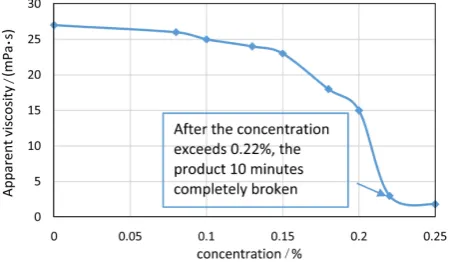
2.1.1. Rheological Property Test [image:3.595.262.488.591.722.2]A six-speed rotary viscometer is used for testing the viscosity in the laboratory: first of all, take 500 mL clean fracturing fluid products (0.4% VES + 0.15% SSN + 1.0% clay swelling inhibitor + 0.06% synergist + 0.08% residue inhibitor); se-condly, select different quantities of gel breakers, and add the gel breakers into the product A respectively; finally, record the viscosity values in the conditions of 100 r/min and 25˚C.
Figure 2 indicates that the self-made gel breaker cannot break clean fracturing
DOI: 10.4236/ojogas.2018.34020 234 Open Journal of Yangtze Gas and Oil breaker can break the fracturing fluid gel at a low temperature condition. How-ever, there is a large amount of oil released from the fracturing fluid, which would result in heavy formation damage. In order to solve the problem, the non-ionic surfactant and recessive gel breaker are compounded.
[image:4.595.247.500.296.434.2]Figure 3. Experimental data of self-made breaker.
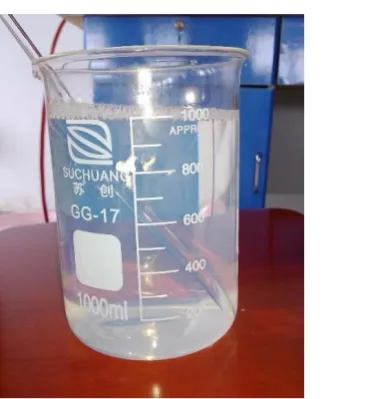
[image:4.595.233.520.561.727.2]Figure 4 indicates that the sand carrying capacity is lost 1.5 to 3 hours after the addition of 0.035% - 0.040% of the self-made gel breaker and 0.335% - 0.450% of non-ionic surfactants. And after 6 to 8 hours, the fracturing fluid is broken completely. Figure 5 shows that no oil phases are released on the surface of the broken solution.
DOI: 10.4236/ojogas.2018.34020 235 Open Journal of Yangtze Gas and Oil
Figure 5. Picture after breaking.
2.1.2. Capillary Viscosimeter
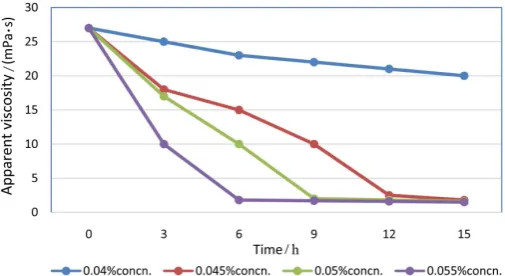
Because the six-speed rotary viscometer is not sensitive to low viscosity fluid, the coriolisviscosity meter is utilized to measure the viscosity of the obtained gel broken solution [10]. After a six-speed rotary viscometer test is completed, 10mL of the solution is taken with a pipette, and put into the coriolisviscosity meter. And the coriolisviscosity meter is put into a temperature-controlled water bath at a set temperature of 25˚C. Compared with the water-based retention time, the relative viscosity was obtained by using an equation to calculate the re-tention time for a whole night.
In Figure 6, the relative viscosity of the self-made clean fracturing fluid is showed after being heated for 15 hours at a constant temperature of 25˚C after the addition of the optimum concentration of the combination breakers. Figure 6 shows the formulations of all breakers used in the test. The viscosity of clean fracturing fluid is between 1.2 mPa∙s to1.4 mPa∙s after breaking. Data indicates that there exists an optimal ratio between the recessive breaker and nonionic surfactant. The breaker cannot break the fracturing fluid completely beyond the optimization ratio.
[image:5.595.234.512.575.714.2]DOI: 10.4236/ojogas.2018.34020 236 Open Journal of Yangtze Gas and Oil hours, and then put into a core holder. The original permeability is measured with simulating formation water. The simulating formation water is injected in-to the core forward until the quantity of flow and pressure are stable for more than 60 minutes [11]. According to Darcy formula, the original permeability value is obtained by the experiment. Then the clean fracturing fluid is injected into the core reversely for 36 minutes at 25˚C degree. And the displacement fracturing pressure is stable at 3.5 MPa. The filtrate loss of fracturing fluid is measured under simulated formation pressure and shear rate during fracturing. So, the loss rate of the fracturing fluid is obtained. After the fracturing fluid is injected, the valves on both ends of the holder are closed in order to keep the fracturing fluid stating in the core for 2 hours. Finally, the core is displaced by the formation water reversely. The permeability value is calculated by the expe-riment. Compared with the original permeability, the damage rate of the per-meability is obtained [12].
[image:6.595.210.539.566.625.2]The study aims to understand the compatibility between the gel broken tion and the coal rocks, but also the compatibility between the gel breaking solu-tion and the coalbed fluid. Therefore, the influence of other factors on the per-meability determination should be minimized in the experiment. It is shown that the damage of the gel broken solution to the rock core is relatively smaller in
Table 1. It indicates that there is good compatibility between the gel broken so-lution, core and formation water.
Table 1. Measurement data of fracturing fluid filtrate damage on coal core.
Core
number Core type permeability/10Initial −3 µm2 fracturing fluid/(mL∙minInjection rate of −1) Filtration time/min Damage rate/%
S4-520 Fill san 30.258 0.10 120 11.5
S1-519 Fill san 13.266 0.10 120 15.5
3. Field Application
DOI: 10.4236/ojogas.2018.34020 237 Open Journal of Yangtze Gas and Oil can be improved greatly. For fracturing design, the total amount of fracturing fluid is 390 m3, including 60 m3 ahead liquid, 300 m3 sand carrying liquid and 30
m3 displacement liquid. Fifteen cubic meters of 40/70 mesh quartz sand, twenty
[image:7.595.217.531.289.458.2]cubic meters of 20/40 mesh quartz sand and ten cubic meters of 16/20 mesh quartz sand are selected as propping agent. When fracturing, the actual amount of fracturing fluid is only 381 cubic meters.
Figure 7 shows that the formation breakdown pressure reaches up to 34.38
MPa. And the closed pressure is 22.53 MPa. During fracturing, the construction pressure is stable between 15.06 MPa and 34.38 MPa when the displacement ve-locity is between 3.0 m3/min to 6.0 m3/min. The ratio of the average sand
carry-ing by fracturcarry-ing fluid is 17%. After fracturcarry-ing fluid breakcarry-ing, the viscosity of the flow back liquid is only 1.09 mPa∙s. These data show that the construction meets the designed requirements.
[image:7.595.254.495.565.726.2]Figure 7. On-site construction curves.
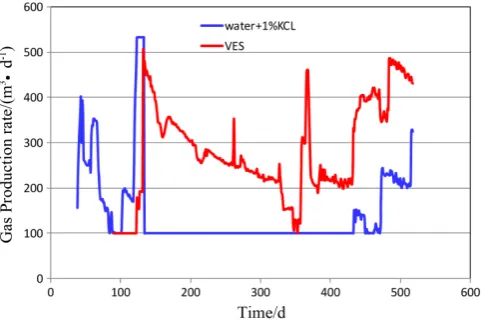
Figure 8 shows the comparison of flied fracturing effects of the self-made
clean fracturing fluid and active water fracturing fluid. The production of the well, which is stimulated by the self-made clean fracturing fluid, is twice as much as that of the well stimulated by active water fracturing fluid.
DOI: 10.4236/ojogas.2018.34020 238 Open Journal of Yangtze Gas and Oil the formation water. The results of field application in Qinshui Basin of Shanxi Province show that the production of the well, which is stimulated by the self-made clean fracturing fluid, is twice as much as that of the well, which is stimulated by the active water fracturing fluid. Therefore, the clean fracturing fluid has a wide application prospect in the coalbed gas in the shallow part.
Conflicts of Interest
The authors declare no conflicts of interest regarding the publication of this pa-per.
References
[1] Bao, S.G., Liu, Y.T., Liu, P., et al. (2016) Research Present Situation and Develop-ment of Coal-Bed Gas Fracturing Fluid. Coal Science and Technology, 44, 11-17. [2] Sun, M.Y. and Huang, C. (1997) Overseas Investigation Report on Coalbed
Me-thane Technology. China’s Coal, No. 3, 44-46.
[3] Tao, T., Lin, X., Fang, X.X., et al. (2011) Study on the Fracturing Damage Mechan-ism and Low Damage Fracturing Fluid for CBM Well. Journal of Chongqing Uni-versity of Science and Technology (Natural Sciences Edition), 13, 21-23.
[4] Liu, X.Q., Yi, M.X., Zhao, J.Y., et al. (2001) Viscoelastic Surfactant Based Fracturing Fluids. Oilflied Chemistry, 18, 273-277.
[5] Wen, S.C., Zhou, M., Wang, W.Y., et al. (2014) Development of Coalbed Methane in Low Temperature Clean Fracturing Fluid and Its Performance Evaluation. Drill-ing Fluid and Completion Fluid, 31, 79-81.
[6] Zhou, F.J., Lian, Y.F., Yang, X.Y., et al. (2005) Development and Application of High Density Viscoelastic Surfactant Fracturing Fluids. Oil Field Chemistry, 22, 136-139.
[7] Rimmer, B. Fracture Geometry Optimization: Designs Utilizing New Polymer-Free Fracturing Fluid and Log-Derived Stress Profile/Rock Properties. SPE 58761. [8] Chen, H., Wang, B.H., Zhang, Q.S., et al. (2009) Study and Analysis on Viscoelastic
Surfactant Fracturing Fluids. Chemical Industry and Engineering, 26, 361-365. [9] Zhang, C.J., He, X.G., Guan, X.H., et al. (2009) Low Temperature Clean Fracturing
Fluid and Application Prospect in China. Drilling and Production Technology, 32, 93-96.
DOI: 10.4236/ojogas.2018.34020 239 Open Journal of Yangtze Gas and Oil
Fracturing Fluid. Oilfield Chemistry, 32, 141-145.